REVIEW 3 major objections 5 minor 42 references
Toward Near-Globally Optimal Nonlinear Model Predictive Control via Diffusion Models
T0 review · 3 major / 5 minor · reviewed 2026-08-11 · deepseek-v4-flash
Pith's one-line read A diffusion model trained on local optima yields a near-globally optimal NMPC policy with high probability.
desk verdict A plausible diffusion-based NMPC pipeline whose near-global guarantee rests on an unverified positive-probability assumption about the data-generating process. read the letter →
The pith
A machine-rendered reading of the paper's core claim, the machinery that carries it, and where it could break.
The reading
What carries the argument
The mechanism that carries the argument is a conditional diffusion model $p_\theta(\cdot|x_t)$, trained with classifier-free guidance to approximate the multi-modal distribution $\rho(\cdot|x_t)$ of optimal control sequences that a local NMPC solver produces from random initial guesses. The online phase, Algorithm 2, is a random-shooting loop: sample $M$ sequences from $p_\theta$, evaluate the OCP cost $J(x_t,\cdot)$ for each, and return the sequence with the lowest cost. The load-bearing identity is the error bound $\delta=(1-p_B+\tilde{\delta})^M$ from Theorem 3, which converts the positive event that a single sample lands in the $\varepsilon$-ball around the global optimum into an exponentially reliable selection guarantee as $M$ increases.
What would settle it
Take any benchmark OCP with a known global optimum $u^*$, sample $N$ random initial guesses from the full support of $\phi$, run the local solver on each, and count the fraction $p_B$ of runs that land within $\varepsilon$ of $u^*$. If $p_B=0$ for a state in the reachable set while the diffusion model is trained on that state, then Theorem 2's premise is violated and Algorithm 2 cannot be near-globally optimal; conversely, if $p_B>0$, the bound $\delta=(1-p_B+\tilde{\delta})^M$ gives a concrete, testable prediction for the reliability as a function of $M$ and the estimated model error $\tilde{\delta}$.
Extended reading notes
Core claim
On the paper's own terms, the claim is that the distribution of locally optimal NMPC solutions -- obtained by applying a local optimizer to uniformly random initial guesses -- is learnable by a diffusion model, and that sampling from that learned distribution in a sample-score-rank loop is probabilistically near-globally optimal. Theorem 3 states this precisely: if the diffusion model approximates the true solution distribution $\rho(\cdot|x_t)$ to within an error $\tilde{\delta}$ on every $\varepsilon$-ball, and if $\tilde{\delta}$ is smaller than $p_B$, the probability mass that $\rho$ puts on the $\varepsilon$-ball around the global optimum $u^*_{[0:H]}(x_t)$, then drawing $M$ independent candidate sequences and keeping the cheapest one satisfies $\mathbb{P}(\|u-u^*_{[0:H]}(x_t)\|_2\leq\varepsilon)\geq 1-\delta$ with $\delta=(1-p_B+\tilde{\delta})^M$. Because $\delta$ decays exponentially in $M$, arbitrarily high reliability is achieved by drawing more samples, which is cheap on parallel hardware. The paper also proves (Theorem 2) that, under a positive-probability condition on reaching the global basin from random initial guesses, the offline dataset asymptotically contains dense global optima, so the approach avoids the covariance-shift problem that plagues direct behavior cloning.
Load-bearing premise
That for every state the system can reach, a randomly initialized local solver has some chance of finding the absolute best control sequence, not just a locally good one.
Editorial extensions
If this is right
- Real-time NMPC on systems with fast dynamics could reach global-optimizer-level performance without any online global optimization, since the diffusion model's forward pass is GPU-parallelizable and the reliability is tuned purely by the sample count $M$.
- The learned distribution can serve as a high-quality warm start for local solvers, combining the probabilistic guarantee with exact constraint satisfaction in an online refinement stage.
- For systems with discrete switching between locally optimal behaviours (e.g., left and right swing-up of a cart-pole), the multimodal learned distribution naturally represents both strategies, so the controller can switch between them as the state evolves.
- Because $\delta$ decays exponentially in $M$, the computational budget for a desired reliability level is directly predictable from the model quality $\tilde{\delta}$ and the probability mass $p_B$ around the global optimum.
- The framework reduces global NMPC to a supervised learning problem: any improvement in diffusion model accuracy lowers the required sample count $M$ for a fixed $\delta$.
Reading between the lines
- The guarantee is only as strong as Theorem 2's implicit assumption that the local solver reaches the global basin with positive probability; if the global optimum's basin of attraction has zero measure in the space of initial guesses, the dataset will never contain it and the near-global claim collapses regardless of $M$.
- The paper defers the proofs of Theorems 2 and 3 to an extended version, so the formal guarantee must be verified in that document; the present manuscript states the results without their derivations.
- A testable extension is to compute the empirical miss rate of Algorithm 2 on a benchmark with a known global optimum and compare it to the bound $(1-p_B+\tilde{\delta})^M$; a systematic violation would indicate that $\tilde{\delta}$ underestimates the model error.
- The method is essentially replacing multistart global optimization with a learned proposal distribution; it could be combined with importance sampling or sequential Monte Carlo to obtain unbiased estimates of the global optimum rather than only a bound.
Editorial analysis
A structured set of objections, weighed in public.
Referee Report
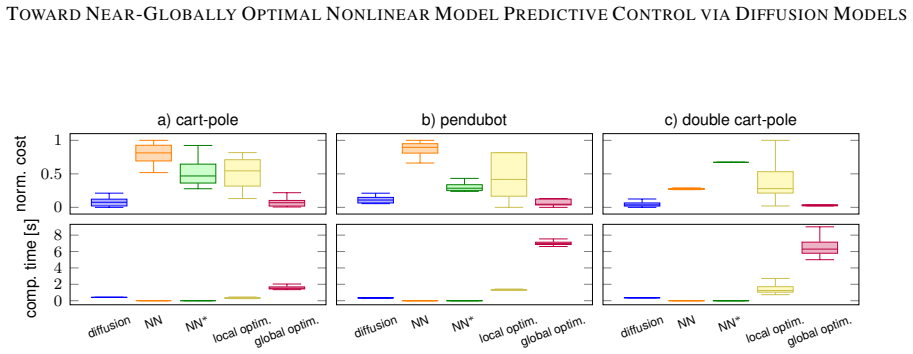
Summary. The paper proposes a diffusion-model-based approximation of globally optimal nonlinear model predictive control (NMPC). Offline, Algorithm 1 generates a dataset by applying a local optimizer to random initial guesses, producing a multimodal distribution rho(·|x_t) of locally optimal control sequences, and trains a conditional diffusion model p_theta to approximate rho. Online, Algorithm 2 draws M control sequences from the diffusion model, evaluates their costs, and selects the lowest-cost sequence. The central theoretical result, Theorem 3, states that if the diffusion approximation error satisfies (10) with tilde_delta < p_B, where p_B is the rho-mass of an epsilon-ball around the global optimum, then Algorithm 2 is probabilistically near-globally optimal with delta = (1 - p_B + tilde_delta)^M. The numerical evaluation on cart-pole, pendubot, and double cart-pole reports lower costs than direct neural-network approximations and computation times comparable to or lower than local NMPC, while matching the cost of a global-optimization baseline.
Significance. If the stated assumptions could be verified, the result would be significant for NMPC practice: it would show that a diffusion model trained on locally optimal solutions can replace expensive online global optimization by parallelizable sampling, preserving a probabilistic near-global optimality guarantee. The paper's strengths include a clean probabilistic formulation of near-global optimality, a practical offline data-generation scheme, a clear comparison against local and global NMPC and neural-network baselines, and ablation-style experiments varying M, H, and K. The main weakness is that the two load-bearing hypotheses of Theorem 3—positive probability p_B of hitting the global optimum under the local-solver-induced distribution, and a certified approximation error tilde_delta < p_B—are not verified either theoretically or empirically. Section 5 explicitly defers formal theoretical optimality guarantees to future work, which is consistent with the conditional nature of the current result. The manuscript therefore presents a promising empirical method and a conditional guarantee, but the near-global optimality claim is not yet established for the tested or general problems.
major comments (3)
- [Section 3.1, Theorem 2] The assumption P(u*_{[0:H]}(x)) > 0 for all x is load-bearing but not justified by the argument given. The local optimizer S is a deterministic operator for each fixed state x; under an initial-guess distribution phi, the probability of reaching the global optimum is the phi-measure of the basin of attraction of u*_{[0:H]}(x) under S. A uniform phi with positive support on U^H only ensures that initial guesses are drawn densely; it does not ensure that this basin has positive volume. For OCPs in which a global optimum lies on the boundary of U^H, is a degenerate stationary point, or exists only at a bifurcation value of the state, the basin can have measure zero, giving P(u*_{[0:H]}(x)) = 0. In that case the dataset generated by Algorithm 1 contains no samples near the global optimum for those states, the condition p_B > 0 in Theorem 3 fails, and no number M of online samples can compensate. The paper should either prove a sufficient condition for positive basin volume for the considered problem class, restrict the claim to states where this has been verified, or provide empirical estimates of p_B for all states visited in the simulations.
- [Section 3.2, Eq. (10) and Theorem 3] Equation (10) is asserted to be achievable 'given a sufficiently large data set D' and a sufficiently flexible model, but the paper provides no sample-complexity bound, no training guarantee, and no verification that the trained diffusion model satisfies tilde_delta < p_B for every x in X and every epsilon-ball around the global optimum. Since p_B can be extremely small in the high-dimensional control-sequence space U^H, the condition tilde_delta < p_B is nontrivial and likely difficult to certify in practice. The theorem's conclusion delta = (1 - p_B + tilde_delta)^M depends critically on this strict inequality; without a way to estimate p_B or bound tilde_delta, the near-global optimality guarantee cannot be instantiated for any of the numerical examples. The paper should state how p_B and tilde_delta would be estimated or bounded for the considered systems, or explicitly restrict the theorem to cases where such bounds are available.
- [Section 5] The conclusion states that 'future work will focus on deriving formal theoretical optimality guarantees for our proposed approach.' This admission is in tension with Theorem 3, which is presented as a probabilistic near-global optimality guarantee. The tension is resolved if Theorem 3 is understood as a conditional guarantee whose assumptions are not verified, but the manuscript should say this explicitly and should specify which parts of the optimality claim are currently formal and which remain heuristic. As written, a reader could reasonably conclude that the near-global optimality of Algorithm 2 has been established for the tested systems when in fact only a conditional statement with unverified hypotheses is provided.
minor comments (5)
- [Algorithm 1, line 9] There is a mismatch between the algorithm and the text: Algorithm 1 propagates the system using x^d_t, i.e., x_{t+1} <- f(x^d_t, \hat{u}_0(x^d_t)), while the surrounding text says 'Apply \hat{u}_0(x_t) to system (1): x_{t+1} <- f(x_t, \hat{u}_0(x_t)).' Please clarify which state is used for the roll-out, as this affects the state distribution in the dataset.
- [Section 2, Eq. (3)] The stochastic policy is defined as pi : R^{n_u} x R^{n_x} -> R_{>=0}, but in (3) it is used as a distribution over control sequences u in U^H conditioned on x_t. The domain should be U^H x X or the notation should be adjusted to match the conditional density interpretation.
- [Theorem 3] The expression delta = (1 - p_B + tilde_delta)^M is only guaranteed to be a probability in [0,1] when the condition tilde_delta < p_B holds. This is stated, but the proof sketch could make clearer that this inequality is used both to ensure the base of the exponent is less than 1 and to ensure the Markov bound is meaningful.
- [Section 4.1] The text refers to 'CASADOS (Verschueren et al., 2021)' but the cited software is ACADOS. This looks like a typo and should be corrected.
- [Figures 2 and 3] The cost and computation-time comparisons are shown without error bars or confidence intervals. Since the method is probabilistic and the baselines involve random initializations, reporting variability across seeds or initial states would strengthen the empirical claims.
Circularity Check
No significant circularity: the main theorem is a conditional probability bound with an explicit assumption (p_B), and the numerical evaluation gives independent empirical support.
full rationale
The claimed derivation is conditional rather than circular. Section 3.1 defines the data distribution rho by pushing a uniform initial-guess distribution phi through the local optimizer S, and Algorithm 1 samples (x, u-hat) pairs from it. Theorem 2 states that, under P(u*[0:H](x))>0 and positive state-perturbation variance, global optima eventually appear in the dataset; this is a coverage assertion about the sampling scheme, not an output that is later renamed as a prediction. Theorem 3 then takes the diffusion-model approximation error (10) and the rho-mass p_B as hypotheses and derives the random-shooting bound delta=(1-p_B+tilde_delta)^M; p_B is not fitted from the dataset and the bound is a direct union-bound arithmetic fact. The online phase (Algorithm 2) scores samples by the original cost J, so the selection step is evaluated on fresh costs and is not forced by a trained parameter. The paper's only self-citation is a pointer to the extended version for proofs, which is not a load-bearing appeal to a uniqueness theorem or an ansatz. The concern that p_B > 0 may fail for some nonconvex OCPs is a correctness/assumption risk about the data-generating process, not circularity; the paper explicitly states the assumption and the theorem is conditional on it. Therefore no circular step can be exhibited.
Assumptions & free parameters
free parameters (5)
- Diffusion model parameters theta =
not reported, thousands of weights
- Number of online samples M =
20 in Section 4.2, varied in Fig. 3
- Initial guess distribution phi =
uniform over [-u_{t-1}, u_{t-1}] per Section 4.1
- Perturbation variance schedule sigma(t) =
not specified precisely
- Diffusion hyperparameters (K, beta_k, p) =
p = 0.25, K sensitivity explored in Fig. 3; beta schedule not specified
assumptions (5)
- ad hoc to paper P(u*[0:H](x)) > 0 for all x under the distribution induced by phi and the local solver S.
- standard math The diffusion model can approximate rho(·|x_t) arbitrarily well given enough data and model capacity, as in Eq. (10).
- ad hoc to paper The model error satisfies ~delta < p_B for every state and every epsilon-ball around the global optimum.
- domain assumption Stage and terminal costs and dynamics are differentiable, and X and U are compact; no state constraints.
- standard math State perturbations with Gaussian noise make the training-state distribution asymptotically dense in X.
Cite this review
Pith. "Pith review of Toward Near-Globally Optimal Nonlinear Model Predictive Control via Diffusion Models." pith.science (2026). https://pith.science/paper/G56SE3LS
@misc{pith2026241208278,
  author       = {Pith},
  title        = {Pith review of: Toward Near-Globally Optimal Nonlinear Model Predictive Control via Diffusion Models},
  year         = {2026},
  howpublished = {\url{https://pith.science/paper/G56SE3LS}},
  note         = {Machine review of arXiv:2412.08278}
}
read the original abstract
Achieving global optimality in nonlinear model predictive control (NMPC) is challenging due to the non-convex nature of the underlying optimization problem. Since commonly employed local optimization techniques depend on carefully chosen initial guesses, this non-convexity often leads to suboptimal performance resulting from local optima. To overcome this limitation, we propose a novel diffusion model-based approach for near-globally optimal NMPC consisting of an offline and an online phase. The offline phase employs a local optimizer to sample from the distribution of optimal NMPC control sequences along generated system trajectories through random initial guesses. Subsequently, the generated diverse dataset is used to train a diffusion model to reflect the multi-modal distribution of optima. In the online phase, the trained model is leveraged to efficiently perform a variant of random shooting optimization to obtain near-globally optimal control sequences without relying on any initial guesses or online NMPC solving. The effectiveness of our approach is illustrated in a numerical simulation indicating high performance benefits compared to direct neural network approximations of NMPC and significantly lower computation times than online solving NMPC using global optimizers.
Figures


Reference graph
Works this paper leans on
-
[1]
Anurag Ajay, Yilun Du, Abhi Gupta, Joshua B. Tenenbaum, Tommi S. Jaakkola, and Pulkit Agrawal. Is conditional generative modeling all you need for decision making? In Proceedings of the International Conference on Learning Representations, 2023
work page 2023
-
[2]
Casadi: a software framework for nonlinear optimization and optimal control
Joel AE Andersson, Joris Gillis, Greg Horn, James B Rawlings, and Moritz Diehl. Casadi: a software framework for nonlinear optimization and optimal control. Mathematical Programming Computation, 11: 0 1--36, 2019
work page 2019
-
[3]
The explicit linear quadratic regulator for constrained systems
Alberto Bemporad, Manfred Morari, Vivek Dua, and Efstratios N Pistikopoulos. The explicit linear quadratic regulator for constrained systems. Automatica, 38 0 (1): 0 3--20, 2002
work page 2002
-
[4]
Angelo D. Bonzanini, Joel A. Paulson, Georgios Makrygiorgos, and Ali Mesbah. Fast approximate learning-based multistage nonlinear model predictive control using gaussian processes and deep neural networks. Computers & Chemical Engineering, 145: 0 107174, 2021
work page 2021
-
[5]
Motion planning diffusion: Learning and planning of robot motions with diffusion models
Joao Carvalho, An T Le, Mark Baierl, Dorothea Koert, and Jan Peters. Motion planning diffusion: Learning and planning of robot motions with diffusion models. In IEEE/RSJ International Conference on Intelligent Robots and Systems (IROS), pages 1916--1923, 2023
work page 1916
-
[6]
Transformer-based model predictive control: Trajectory optimization via sequence modeling
Davide Celestini, Daniele Gammelli, Tommaso Guffanti, Simone D'Amico, Elisa Capello, and Marco Pavone. Transformer-based model predictive control: Trajectory optimization via sequence modeling. IEEE Robotics and Automation Letters, 9 0 (11): 0 9820--9827, 2024
work page 2024
-
[7]
Diffusion policy: Visuomotor policy learning via action diffusion
Cheng Chi, Zhenjia Xu, Siyuan Feng, Eric Cousineau, Yilun Du, Benjamin Burchfiel, Russ Tedrake, and Shuran Song. Diffusion policy: Visuomotor policy learning via action diffusion. The International Journal of Robotics Research, page 02783649241273668, 2023
2023
-
[8]
Recent theoretical advances in non-convex optimization
Marina Danilova, Pavel Dvurechensky, Alexander Gasnikov, Eduard Gorbunov, Sergey Guminov, Dmitry Kamzolov, and Innokentiy Shibaev. Recent theoretical advances in non-convex optimization. In High-Dimensional Optimization and Probability: With a View Towards Data Science, pages 79--163. Springer, 2022
work page 2022
Show all 42 references
-
[9]
Model predictive control and its application in agriculture: A review
Ying Ding, Liang Wang, Yongwei Li, and Daoliang Li. Model predictive control and its application in agriculture: A review. Computers and Electronics in Agriculture, 151: 0 104--117, 2018
2018
-
[10]
Optimal control of a laboratory binary distillation column via regionless explicit mpc
J \'a n Drgo n a, Martin Klau c o, Filip Jane c ek, and Michal Kvasnica. Optimal control of a laboratory binary distillation column via regionless explicit mpc. Computers & Chemical Engineering, 96: 0 139--148, 2017
2017
-
[11]
One step diffusion via shortcut models
Kevin Frans, Danijar Hafner, Sergey Levine, and Pieter Abbeel. One step diffusion via shortcut models. arXiv preprint arXiv:2410.12557, 2024
2024 arXiv
-
[12]
An implicit and explicit dual model predictive control formulation for a steel recycling process
Andrea Ghezzi, Florian Messerer, Jacopo Balocco, Vincenzo Manzoni, and Moritz Diehl. An implicit and explicit dual model predictive control formulation for a steel recycling process. European Journal of Control, 74: 0 100841, 2023
2023
-
[13]
Lane-merging using policy-based reinforcement learning and post-optimization
Patrick Hart, Leonard Rychly, and Alois Knoll. Lane-merging using policy-based reinforcement learning and post-optimization. In 2019 IEEE Intelligent Transportation Systems Conference (ITSC), pages 3176--3181. IEEE, 2019
2019
-
[14]
Keep it upright: Model predictive control for nonprehensile object transportation with obstacle avoidance on a mobile manipulator
Adam Heins and Angela P Schoellig. Keep it upright: Model predictive control for nonprehensile object transportation with obstacle avoidance on a mobile manipulator. IEEE Robotics and Automation Letters, 2023
2023
-
[15]
Learning an approximate model predictive controller with guarantees
Michael Hertneck, Johannes Köhler, Sebastian Trimpe, and Frank Allgöwer. Learning an approximate model predictive controller with guarantees. IEEE Control Systems Letters, 2 0 (3): 0 543--548, 2018
2018
-
[16]
Classifier-free diffusion guidance
Jonathan Ho and Tim Salimans. Classifier-free diffusion guidance. arXiv preprint arXiv:2207.12598, 2022
2022 arXiv
-
[17]
Denoising diffusion probabilistic models
Jonathan Ho, Ajay Jain, and Pieter Abbeel. Denoising diffusion probabilistic models. In Advances in Neural Information Processing Systems, volume 33, pages 6840--6851, 2020
2020
-
[18]
Diffusion-based generation, optimization, and planning in 3d scenes
Siyuan Huang, Zan Wang, Puhao Li, Baoxiong Jia, Tengyu Liu, Yixin Zhu, Wei Liang, and Song-Chun Zhu. Diffusion-based generation, optimization, and planning in 3d scenes. In Proceedings of the IEEE/CVF Conference on Computer Vision and Pattern Recognition, pages 16750--16761, 2023
2023
-
[19]
Planning with diffusion for flexible behavior synthesis
Michael Janner, Yilun Du, Joshua B Tenenbaum, and Sergey Levine. Planning with diffusion for flexible behavior synthesis. International Conference on Machine Learning, 2022
2022
-
[20]
Efficient representation and approximation of model predictive control laws via deep learning
Benjamin Karg and Sergio Lucia. Efficient representation and approximation of model predictive control laws via deep learning. IEEE Transactions on Cybernetics, 50 0 (9): 0 3866--3878, 2020
2020
-
[21]
Efficient and guaranteed-safe non-convex trajectory optimization with constrained diffusion model
Anjian Li, Zihan Ding, Adji Bousso Dieng, and Ryne Beeson. Efficient and guaranteed-safe non-convex trajectory optimization with constrained diffusion model. arXiv preprint arXiv:2403.05571, 2024
2024 arXiv
-
[22]
Nonlinear mpc for collision avoidance and control of uavs with dynamic obstacles
Björn Lindqvist, Sina Sharif Mansouri, Ali-akbar Agha-mohammadi, and George Nikolakopoulos. Nonlinear mpc for collision avoidance and control of uavs with dynamic obstacles. IEEE Robotics and Automation Letters, 5 0 (4): 0 6001--6008, 2020
2020
-
[23]
Safe and fast tracking on a robot manipulator: Robust mpc and neural network control
Julian Nubert, Johannes Köhler, Vincent Berenz, Frank Allgöwer, and Sebastian Trimpe. Safe and fast tracking on a robot manipulator: Robust mpc and neural network control. IEEE Robotics and Automation Letters, 5 0 (2): 0 3050--3057, 2020
2020
-
[24]
Jones, Dimitrios Gyalistras, Markus Gwerder, Vanessa Stauch, Beat Lehmann, and Manfred Morari
Frauke Oldewurtel, Alessandra Parisio, Colin N. Jones, Dimitrios Gyalistras, Markus Gwerder, Vanessa Stauch, Beat Lehmann, and Manfred Morari. Use of model predictive control and weather forecasts for energy efficient building climate control. Energy and Buildings, 45: 0 15--27, 2012
2012
-
[25]
Sample-efficient cross-entropy method for real-time planning
Cristina Pinneri, Shambhuraj Sawant, Sebastian Blaes, Jan Achterhold, Joerg Stueckler, Michal Rolinek, and Georg Martius. Sample-efficient cross-entropy method for real-time planning. In Conference on Robot Learning, pages 1049--1065. PMLR, 2021
2021
-
[26]
An overview of industrial model predictive control technology
S Joe Qin and Thomas A Badgwell. An overview of industrial model predictive control technology. In AIche symposium series, volume 93, pages 232--256, 1997
1997
-
[27]
Toward the fundamental limits of imitation learning
Nived Rajaraman, Lin Yang, Jiantao Jiao, and Kannan Ramchandran. Toward the fundamental limits of imitation learning. Advances in Neural Information Processing Systems, 33: 0 2914--2924, 2020
2020
-
[28]
Application of interior-point methods to model predictive control
Christopher V Rao, Stephen J Wright, and James B Rawlings. Application of interior-point methods to model predictive control. Journal of optimization theory and applications, 99: 0 723--757, 1998
1998
-
[29]
Model predictive control: theory, computation, and design, volume 2
James Blake Rawlings, David Q Mayne, Moritz Diehl, et al. Model predictive control: theory, computation, and design, volume 2. Nob Hill Publishing Madison, WI, 2017
2017
-
[30]
Ac4mpc: Actor-critic reinforcement learning for nonlinear model predictive control
Rudolf Reiter, Andrea Ghezzi, Katrin Baumg \ A \=I rtner, Jasper Hoffmann, Robert D McAllister, and Moritz Diehl. Ac4mpc: Actor-critic reinforcement learning for nonlinear model predictive control. arXiv preprint arXiv:2406.03995, 2024
2024 arXiv
-
[31]
A reduction of imitation learning and structured prediction to no-regret online learning
Stephane Ross, Geoffrey Gordon, and Drew Bagnell. A reduction of imitation learning and structured prediction to no-regret online learning. In Proceedings of the Fourteenth International Conference on Artificial Intelligence and Statistics, volume 15, pages 627--635. PMLR, 11-...
2011
-
[32]
Deep unsupervised learning using nonequilibrium thermodynamics
Jascha Sohl-Dickstein, Eric Weiss, Niru Maheswaranathan, and Surya Ganguli. Deep unsupervised learning using nonequilibrium thermodynamics. In Proceedings of the 32nd International Conference on Machine Learning, volume 37, pages 2256--2265. PMLR, 07--09 Jul 2015
2015
-
[33]
Denoising diffusion implicit models
Jiaming Song, Chenlin Meng, and Stefano Ermon. Denoising diffusion implicit models. arXiv preprint arXiv:2010.02502, 2020
2010 arXiv
-
[34]
Efficient deep learning of robust policies from mpc using imitation and tube-guided data augmentation
Andrea Tagliabue and Jonathan P How. Efficient deep learning of robust policies from mpc using imitation and tube-guided data augmentation. IEEE Transactions on Robotics, 2024
2024
-
[35]
Deep generative models in robotics: A survey on learning from multimodal demonstrations
Julen Urain, Ajay Mandlekar, Yilun Du, Mahi Shafiullah, Danfei Xu, Katerina Fragkiadaki, Georgia Chalvatzaki, and Jan Peters. Deep generative models in robotics: A survey on learning from multimodal demonstrations. arXiv preprint arXiv:2408.04380, 2024
2024 arXiv
-
[36]
Fatrop: A fast constrained optimal control problem solver for robot trajectory optimization and control
Lander Vanroye, Ajay Sathya, Joris De Schutter, and Wilm Decr \'e . Fatrop: A fast constrained optimal control problem solver for robot trajectory optimization and control. In 2023 IEEE/RSJ International Conference on Intelligent Robots and Systems (IROS), pages 10036--10043. ...
2023
-
[37]
acados -- a modular open-source framework for fast embedded optimal control
Robin Verschueren, Gianluca Frison, Dimitris Kouzoupis, Jonathan Frey, Niels van Duijkeren, Andrea Zanelli, Branimir Novoselnik, Thivaharan Albin, Rien Quirynen, and Moritz Diehl. acados -- a modular open-source framework for fast embedded optimal control. Mathematical Program...
2021
-
[38]
Exploring model-based planning with policy networks
Tingwu Wang and Jimmy Ba. Exploring model-based planning with policy networks. International Conference on Learning Representations, 2020
2020
-
[39]
Wächter and L
A. Wächter and L. Biegler. On the implementation of an interior-point filter line-search algorithm for large-scale nonlinear programming. Math. Program, 106: 0 25--27, 2006
2006
-
[40]
Fast nonlinear model predictive control on fpga using particle swarm optimization
Fang Xu, Hong Chen, Xun Gong, and Qin Mei. Fast nonlinear model predictive control on fpga using particle swarm optimization. IEEE Transactions on Industrial Electronics, 63 0 (1): 0 310--321, 2016
2016
-
[41]
Warm-start strategies in interior-point methods for linear programming
E Alper Yildirim and Stephen J Wright. Warm-start strategies in interior-point methods for linear programming. SIAM Journal on Optimization, 12 0 (3): 0 782--810, 2002
2002
-
[42]
Diffusion model predictive control
Guangyao Zhou, Sivaramakrishnan Swaminathan, Rajkumar Vasudeva Raju, J Swaroop Guntupalli, Wolfgang Lehrach, Joseph Ortiz, Antoine Dedieu, Miguel L \'a zaro-Gredilla, and Kevin Murphy. Diffusion model predictive control. arXiv preprint arXiv:2410.05364, 2024
Reviewed August 11, 2026 · model on record in the stance chip above.
Discussion (0). Continue with ORCID to comment.