Latent thermal instability
Pith reviewed 2026-06-26 01:51 UTC · model grok-4.3
The pith
Heat-flux-driven instabilities let local thermal instability form and stabilize outside galaxy cluster cores.
A machine-rendered reading of the paper's core claim, the machinery that carries it, and where it could break.
Core claim
In weakly collisional or collisionless plasmas, thermal conduction is anomalously suppressed by heat-flux-driven plasma instabilities triggered in the presence of a local magnetic field. This suppression allows local thermal instability to form condensates in a parameter regime that overlaps with conditions outside cluster cores and to reach a steady state similar to the hydrodynamic limit. One-dimensional hydrodynamic simulations of condensates test these analytical ideas and show the unstable regime extends to over 50 percent of the cluster volume.
What carries the argument
Heat-flux-driven plasma instabilities that suppress thermal conduction in weakly collisional plasmas
If this is right
- Condensates form in a new parameter regime overlapping conditions outside the core.
- Condensates reach a steady state as in the hydrodynamic limit.
- The regime of instability-driven fluctuations extends to over 50 percent of the cluster volume depending on temperature.
- Observed resistance to mixing and thermal conduction in the collisional medium is accounted for.
Where Pith is reading between the lines
- The mechanism could alter models of how subhalos or accreting baryons stir the ICM by allowing longer-lived fluctuations.
- Similar suppression effects might appear in other weakly collisional astrophysical plasmas beyond clusters.
- Incorporating magnetic field geometry into simulations would quantify the exact volume fraction affected.
Load-bearing premise
Heat-flux-driven plasma instabilities triggered by a local magnetic field suppress thermal conduction sufficiently in the weakly collisional regime outside the core.
What would settle it
If observations or simulations demonstrate that temperature fluctuations outside cluster cores mix or conduct heat at classical rates without anomalous suppression, the proposed extension of the unstable regime would not hold.
Figures

read the original abstract
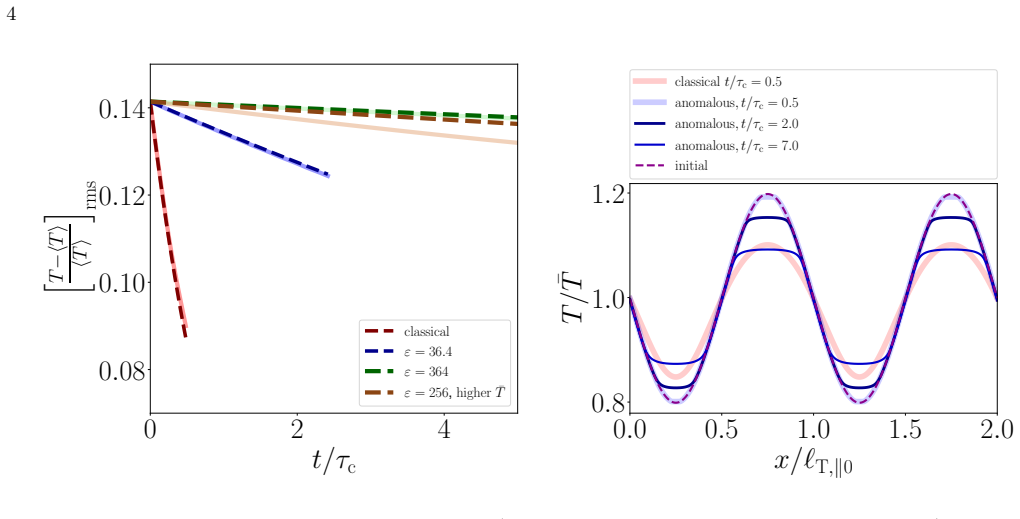
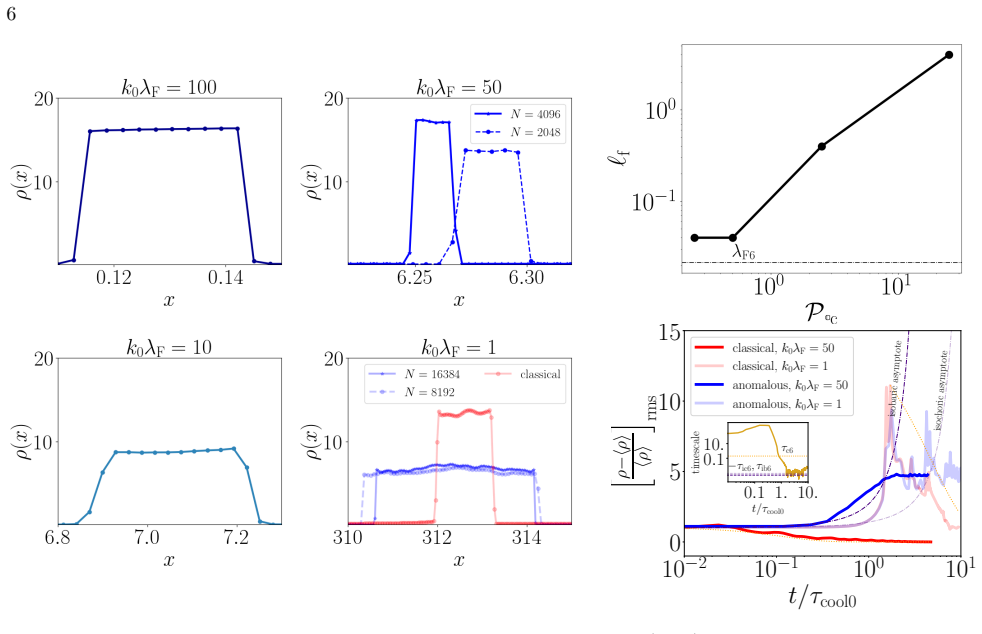
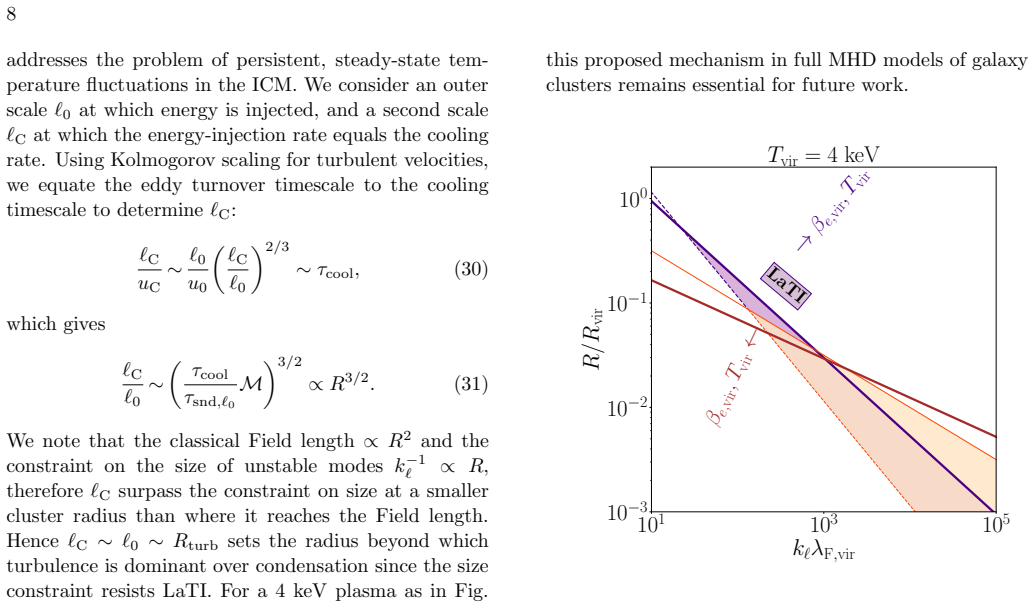
Multiscale temperature fluctuations are abundant in the intracluster medium (ICM) outside of galaxy cluster cores ($\sim 100~{\rm kpc}$). Their origin is often attributed to turbulent stirring by subhalos or accreting baryons crossing the virial radius. However, their apparent resistance to mixing and thermal conduction in a collisional medium has not been explained. We propose a new mechanism by which steady-state temperature fluctuations can form and persist outside the cluster core. Local thermal instability, or Field instability, is used to explain filamentary condensates in cluster cores but is usually dismissed outside them because thermal conduction should suppress instability. In weakly collisional or collisionless plasmas, however, thermal conduction can be anomalously suppressed by heat-flux-driven plasma instabilities triggered in presence of a local magnetic field, leading to two effects: (i) condensates form in a new parameter regime that overlaps with conditions outside the core, and (ii) condensates reach a steady state as in the hydrodynamic limit. This extends the regime of instability-driven fluctuations to over $\gtrsim50\%$ (depending on hot plasma temperature) of the cluster. We use one-dimensional hydrodynamic simulations of condensates to test our analytical ideas.
Editorial analysis
A structured set of objections, weighed in public.
Referee Report
Summary. The manuscript proposes that local thermal instability (Field instability) can form and reach a steady state outside galaxy cluster cores in weakly collisional or collisionless plasmas. Heat-flux-driven plasma instabilities are argued to suppress thermal conduction sufficiently to enable this in a new parameter regime, extending the unstable regime to ≳50% of the cluster volume depending on temperature. Analytical arguments are presented, and 1D hydrodynamic simulations of condensates are used to test the resulting evolution under the assumed suppression.
Significance. If the conduction suppression assumption holds under ICM conditions, the result would provide a mechanism for the observed multiscale temperature fluctuations outside cluster cores without external turbulent stirring and would indicate that a substantial fraction of cluster volume is susceptible to such instabilities. The analytical approach combined with targeted 1D simulations is a positive element of the work.
major comments (2)
- [Abstract / simulation description] The 1D hydrodynamic simulations impose conduction suppression by heat-flux-driven instabilities as an input rather than deriving it. The abstract states that the simulations test condensate evolution after suppression is assumed; they do not evolve the kinetic instabilities or magnetic-field geometry needed to obtain a self-consistent reduction factor from ICM parameters (T, n, B). This assumption is load-bearing for the central claim of an extended unstable regime.
- [Analytical argument] The quantitative claim that the unstable regime extends to ≳50% of the cluster volume (depending on hot plasma temperature) is presented without an explicit mapping from plasma parameters to the conductivity reduction factor or to the resulting unstable volume fraction. No parameter scans, growth-rate calculations, or saturation amplitudes are shown to support the overlap with observed fluctuation locations.
minor comments (1)
- The abstract refers to 'weakly collisional or collisionless' conditions but does not define the collisionality threshold (e.g., in terms of ion mean free path relative to temperature gradient scale) used to delineate the regime.
Simulated Author's Rebuttal
We thank the referee for the constructive feedback, which helps clarify the scope and limitations of our study. We address each major comment below, agreeing where the manuscript requires clarification and proposing targeted revisions. The work is intentionally focused on the hydrodynamic consequences of assumed conduction suppression rather than a first-principles kinetic derivation.
read point-by-point responses
-
Referee: [Abstract / simulation description] The 1D hydrodynamic simulations impose conduction suppression by heat-flux-driven instabilities as an input rather than deriving it. The abstract states that the simulations test condensate evolution after suppression is assumed; they do not evolve the kinetic instabilities or magnetic-field geometry needed to obtain a self-consistent reduction factor from ICM parameters (T, n, B). This assumption is load-bearing for the central claim of an extended unstable regime.
Authors: We agree that the 1D simulations treat the suppression factor as an imposed input, consistent with the abstract's description that they test condensate evolution under this assumption. The manuscript's focus is on demonstrating that, once suppression occurs, the hydrodynamic evolution permits steady-state fluctuations in a new parameter regime. A self-consistent treatment of the kinetic instabilities and magnetic geometry would require multidimensional kinetic simulations, which lies outside the paper's scope. We will revise the abstract, introduction, and discussion sections to more explicitly state this modeling choice and reference existing literature on the saturation of heat-flux-driven instabilities. revision: yes
-
Referee: [Analytical argument] The quantitative claim that the unstable regime extends to ≳50% of the cluster volume (depending on hot plasma temperature) is presented without an explicit mapping from plasma parameters to the conductivity reduction factor or to the resulting unstable volume fraction. No parameter scans, growth-rate calculations, or saturation amplitudes are shown to support the overlap with observed fluctuation locations.
Authors: The ≳50% volume estimate is an order-of-magnitude calculation based on standard ICM temperature and density profiles combined with a literature-motivated reduction factor for conduction. We acknowledge that the manuscript does not include explicit parameter scans or growth-rate calculations for the kinetic instabilities. We will add a dedicated subsection (or appendix) that spells out the analytical mapping from assumed suppression level to unstable radius, together with a brief discussion of how the reduction factor is drawn from prior kinetic studies. This will make the volume-fraction claim more transparent without requiring new simulations. revision: yes
- Deriving a self-consistent conductivity reduction factor, including explicit growth-rate calculations and saturation amplitudes, from first-principles kinetic simulations across the full range of ICM parameters (T, n, B).
Circularity Check
Conduction suppression by heat-flux instabilities is an external input assumption, not a derived output
full rationale
The paper states that in weakly collisional plasmas thermal conduction is anomalously suppressed by heat-flux-driven instabilities, which then allows Field instability to operate and reach steady state outside cluster cores. One-dimensional hydrodynamic simulations are used only to test condensate evolution after this suppression is imposed. No equations, fitted parameters, or self-referential definitions appear in the provided text that reduce the claimed extension to ≳50% of cluster volume to a quantity defined by the model itself. The suppression factor is treated as coming from prior plasma physics results rather than being constructed within this work, so the derivation chain remains self-contained against external benchmarks.
Axiom & Free-Parameter Ledger
axioms (1)
- domain assumption Thermal conduction is anomalously suppressed by heat-flux-driven instabilities in weakly collisional plasmas with local magnetic field.
Reference graph
Works this paper leans on
-
[1]
2006, ApJ, 650, 102, doi: 10.1086/506508
Ascasibar, Y., & Markevitch, M. 2006, ApJ, 650, 102, doi: 10.1086/506508
-
[2]
2022, A&A, 666, A71, doi: 10.1051/0004-6361/202243873
Olivares, V. 2022, A&A, 666, A71, doi: 10.1051/0004-6361/202243873
-
[3]
Journal of Plasma Physics , keywords =
Bott, A. F., Cowley, S., & Schekochihin, A. 2024, Journal of Plasma Physics, 90, 975900207, doi: 10.1017/S0022377824000308
-
[4]
Braginskii, S. I. 1965, Reviews of Plasma Physics, 1, 205
1965
-
[5]
G., & Henry, J
Briel, U. G., & Henry, J. P. 1995, A&A, 302, L9
1995
-
[6]
Choudhury, P. P. 2023, Frontiers in Astronomy and Space
2023
-
[7]
Sciences, Volume 10 - 2023, doi: 10.3389/fspas.2023.1155865
-
[8]
Modeling transport in weakly collisional plasmas using thermodynamic forcing
Choudhury, P. P., & Bott, A. F. A. 2025, arXiv e-prints, arXiv:2504.14000, doi: 10.48550/arXiv.2504.14000
work page internal anchor Pith review Pith/arXiv arXiv doi:10.48550/arxiv.2504.14000 2025
-
[9]
A case for the large-scale global eigenmodes in unmagnetized and weakly magnetized cluster core
Choudhury, P. P., & Reynolds, C. S. 2025, MNRAS, 537, 3194, doi: 10.1093/mnras/staf184
-
[10]
Choudhury, P. P., & Sharma, P. 2016, MNRAS, 457, 2554, doi: 10.1093/mnras/stw152
-
[11]
Choudhury, P. P., Sharma, P., & Quataert, E. 2019, MNRAS, 488, 3195, doi: 10.1093/mnras/stz1857
-
[12]
Churazov, E., Vikhlinin, A., Zhuravleva, I., et al. 2012, MNRAS, 421, 1123, doi: 10.1111/j.1365-2966.2011.20372.x
-
[13]
2019, A&A, 624, A96, doi: 10.1051/0004-6361/201834699
Claes, N., & Keppens, R. 2019, A&A, 624, A96, doi: 10.1051/0004-6361/201834699
-
[14]
Cowie, L. L., Fabian, A. C., & Nulsen, P. E. J. 1980, MNRAS, 191, 399, doi: 10.1093/mnras/191.2.399
-
[15]
L., & Mckee, C
Cowie, L. L., & Mckee, C. F. 1977,, Tech. rep
1977
-
[16]
Das, H. K., Choudhury, P. P., & Sharma, P. 2021, Monthly Notices of the Royal Astronomical Society, 502, 4935, doi: 10.1093/mnras/stab382
-
[17]
P., & Bott, A
Davies, R., Choudhury, P. P., & Bott, A. F. A. 2026,
2026
-
[18]
Fabian, A. C. 1994, ARA&A, 32, 277, doi: 10.1146/annurev.aa.32.090194.001425
-
[19]
Field, G. B. 1965, ApJ, 142, 531, doi: 10.1086/148317
-
[20]
Ji, S., Oh, S. P., & McCourt, M. 2018, MNRAS, 476, 852, doi: 10.1093/mnras/sty293
-
[21]
Kaul, I., Tan, B., Oh, S. P., & Mandelker, N. 2025, MNRAS, 539, 3669, doi: 10.1093/mnras/staf706
-
[22]
2016, MNRAS, 463, 655, doi: 10.1093/mnras/stw2027
Khatri, R., & Gaspari, M. 2016, MNRAS, 463, 655, doi: 10.1093/mnras/stw2027
-
[23]
2018, Journal of Plasma Physics, 84, 905840305, doi: 10.1017/S0022377818000399
Spitkovsky, A. 2018, Journal of Plasma Physics, 84, 905840305, doi: 10.1017/S0022377818000399
-
[24]
Detection of Filamentary X-Ray Structure in the Core of the Shapley Supercluster
Kull, A., & B¨ ohringer, H. 1999, A&A, 341, 23, doi: 10.48550/arXiv.astro-ph/9812319
work page internal anchor Pith review Pith/arXiv arXiv doi:10.48550/arxiv.astro-ph/9812319 1999
-
[25]
1992, Astrophysical Journal, Part 1 (ISSN 0004-637X), vol
Levinson, A., & Eichler, D. 1992, Astrophysical Journal, Part 1 (ISSN 0004-637X), vol. 387, March 1, 1992, p. 212-218. Research supported by NASA and USIBSF., 387, 212
1992
-
[26]
2025, Journal of Plasma Physics, 91, E45, doi: 10.1017/S0022377825000078
Lopez, N., Bott, A., & Schekochihin, A. 2025, Journal of Plasma Physics, 91, E45, doi: 10.1017/S0022377825000078
-
[27]
2003, ApJL, 586, L19, doi: 10.1086/374656
Markevitch, M., Mazzotta, P., Vikhlinin, A., et al. 2003, ApJL, 586, L19, doi: 10.1086/374656
-
[28]
McCourt, M., Sharma, P., Quataert, E., & Parrish, I. J. 2012, MNRAS, 419, 3319, doi: 10.1111/j.1365-2966.2011.19972.x
-
[29]
Meinecke, J., Tzeferacos, P., Ross, J. S., et al. 2022, Science Advances, 8, eabj6799, doi: 10.1126/sciadv.abj6799
-
[30]
2007, The Astrophysical Journal Supplement Series, 170, 228, doi: 10.1086/513316
Mignone, A., Bodo, G., Massaglia, S., et al. 2007, ApJS, 170, 228, doi: 10.1086/513316
-
[31]
Mirakhor, M. S., & Walker, S. A. 2020, MNRAS, 497, 3204, doi: 10.1093/mnras/staa2203
-
[32]
2019, Monthly Notices of the Royal Astronomical Society, 484, 4881, doi: 10.1093/mnras/stz328
Mohapatra, R., & Sharma, P. 2019, Monthly Notices of the Royal Astronomical Society, 484, 4881, doi: 10.1093/mnras/stz328
-
[33]
Narayan, R., & Medvedev, M. V. 2001, ApJL, 562, L129, doi: 10.1086/338325
-
[34]
Nipoti, C., & Binney, J. 2004, MNRAS, 349, 1509, doi: 10.1111/j.1365-2966.2004.07628.x
-
[35]
Parker, E. N. 1953, ApJ, 117, 431, doi: 10.1086/145707
-
[36]
Parrish, I. J., Quataert, E., & Sharma, P. 2009, ApJ, 703, 96, doi: 10.1088/0004-637X/703/1/96
-
[37]
Perrone, L. M., Berlok, T., & Pfrommer, C. 2024, A&A, 690, A292, doi: 10.1051/0004-6361/202449555
-
[38]
title A unifying view of the spectral energy distributions of blazars
Pistinner, S. L., & Eichler, D. 1998, Monthly Notices of the Royal Astronomical Society, 301, 49, doi: 10.1046/j.1365-8711.1998.01770.x
-
[39]
2018, Physical Review Letters, 120, 35101, doi: 10.1103/PhysRevLett.120.035101
Swisdak, M. 2018, Physical Review Letters, 120, 35101, doi: 10.1103/PhysRevLett.120.035101
-
[40]
Briel, U. G. 2004, A&A, 426, 387, doi: 10.1051/0004-6361:20041039
-
[41]
Sharma, P., McCourt, M., Quataert, E., & Parrish, I. J. 2012, MNRAS, 420, 3174, doi: 10.1111/j.1365-2966.2011.20246.x
-
[42]
Sharma, P., Parrish, I. J., & Quataert, E. 2010, Astrophysical Journal, 720, 652, doi: 10.1088/0004-637X/720/1/652
-
[43]
B., Donahue, M., Jord´ an, A., Ferrarese, L., & Cˆ ot´ e, P
Sparks, W. B., Donahue, M., Jord´ an, A., Ferrarese, L., & Cˆ ot´ e, P. 2004, ApJ, 607, 294, doi: 10.1086/383189
-
[44]
1962, Physics of Fully Ionized Gases 10
Spitzer, L. 1962, Physics of Fully Ionized Gases 10
1962
-
[45]
A., Ariyathilaka, P., Creaser, L., et al
Vincent, T. A., Ariyathilaka, P., Creaser, L., et al. 2026, High Power Laser Science and Engineering, 1, doi: 10.1017/hpl.2026.10152
-
[46]
Voit, G. M., Wibking, B. D., & Yaldiz, D. 2026, arXiv e-prints, arXiv:2602.15121, doi: 10.48550/arXiv.2602.15121
-
[47]
2019, Space Science Reviews, 215, 7
Walker, S., Simionescu, A., Nagai, D., et al. 2019, Space Science Reviews, 215, 7
2019
-
[48]
2019, The Astrophysical Journal, 875, 158, doi: 10.3847/1538-4357/ab10e1
Waters, T., & Proga, D. 2019, The Astrophysical Journal, 875, 158, doi: 10.3847/1538-4357/ab10e1
-
[49]
Wibking, B. D., Voit, G. M., & O’Shea, B. W. 2025, MNRAS, 544, 2577, doi: 10.1093/mnras/staf1801
-
[50]
Yerger, E. L., Kunz, M. W., Bott, A. F. A., & Spitkovsky, A. 2024, http://arxiv.org/abs/2405.06481
arXiv 2024
-
[51]
Zakamska, N. L., & Narayan, R. 2003, ApJ, 582, 162, doi: 10.1086/344641
discussion (0)
Sign in with ORCID, Apple, or X to comment. Anyone can read and Pith papers without signing in.