MDGMIX: Boundary-Aware Subgraph Mixing for Multi-Domain Graph Pre-Training
Pith reviewed 2026-06-29 22:16 UTC · model grok-4.3
The pith
MDGMIX mixes boundary subgraphs and applies hierarchical losses to separate shared from domain-specific patterns in multi-domain graph pre-training.
A machine-rendered reading of the paper's core claim, the machinery that carries it, and where it could break.
Core claim
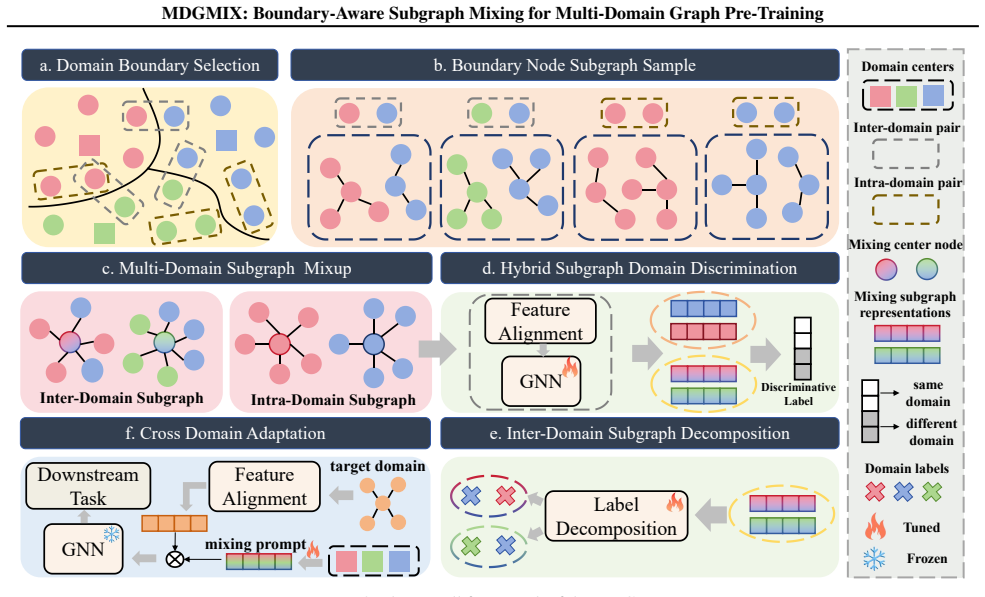
The paper claims that boundary-aware subgraph mixing combined with coarse-grained domain discrimination and fine-grained domain decomposition losses successfully decouples shared patterns from domain-specific patterns, yielding models that outperform joint-training baselines on few-shot classification tasks while using less time and memory during pre-training and adaptation.
What carries the argument
Boundary-aware subgraph mixing that constructs challenging mixed-domain subgraphs from boundary nodes, paired with hierarchical discrimination losses that recover domain labels at coarse and fine scales.
If this is right
- Pre-training no longer requires loading and processing every source domain graph at once.
- Shared patterns across domains become explicitly separated from domain-unique patterns through the two-level losses.
- Adaptation to a new domain requires only a small prompt-weighting module rather than full model updates.
- Few-shot classification accuracy improves over strong joint-training baselines across the tested domains.
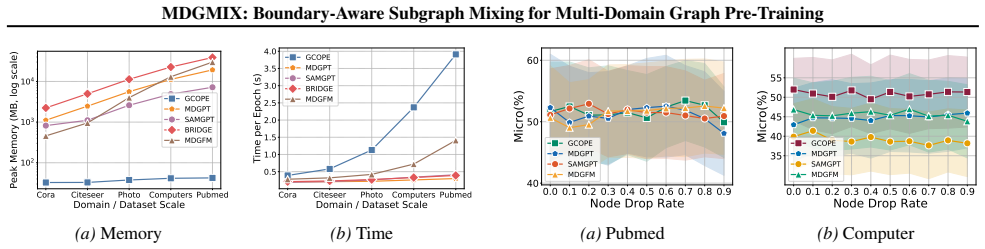
- Both training time and peak memory drop while maintaining or increasing downstream performance.
Where Pith is reading between the lines
- The same boundary-selection idea could be tested as a data-augmentation technique inside a single domain to increase robustness.
- If boundary nodes reliably mark domain transitions, the method might surface structural signatures that define domain boundaries in graphs.
- Prompt weighting at adaptation time could be extended to handle multiple target domains simultaneously without retraining.
- The redundancy finding suggests that dataset pruning strategies based on boundary density might generalize beyond the current graph setting.
Load-bearing premise
Multi-domain graph pre-training contains significant data redundancy that can be exploited by selecting boundary nodes to create mixed subgraphs whose domain origins remain recoverable by the proposed losses.
What would settle it
An experiment in which the hierarchical losses fail to recover domain labels from the boundary-mixed subgraphs above chance level, or in which full joint training without mixing matches or exceeds MDGMIX on the few-shot tasks.
Figures
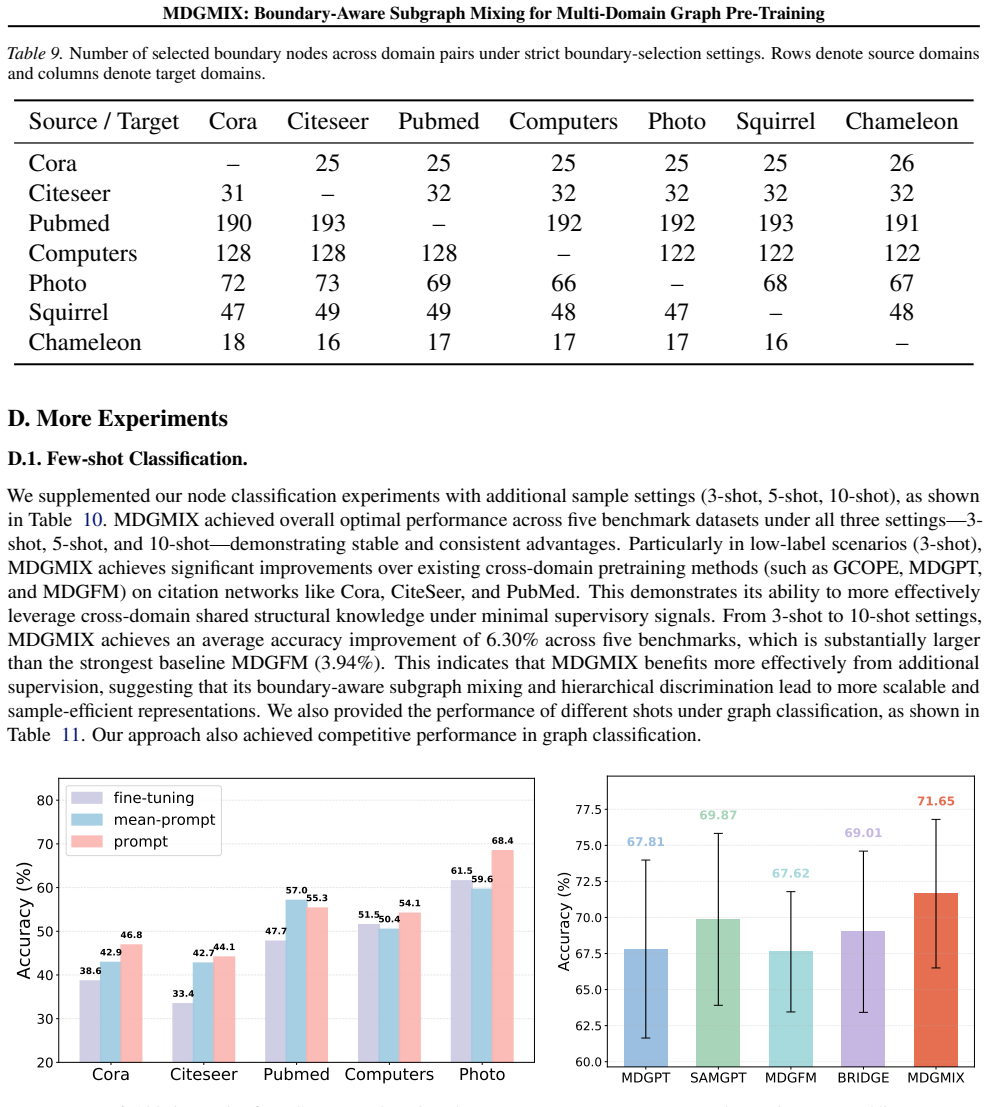
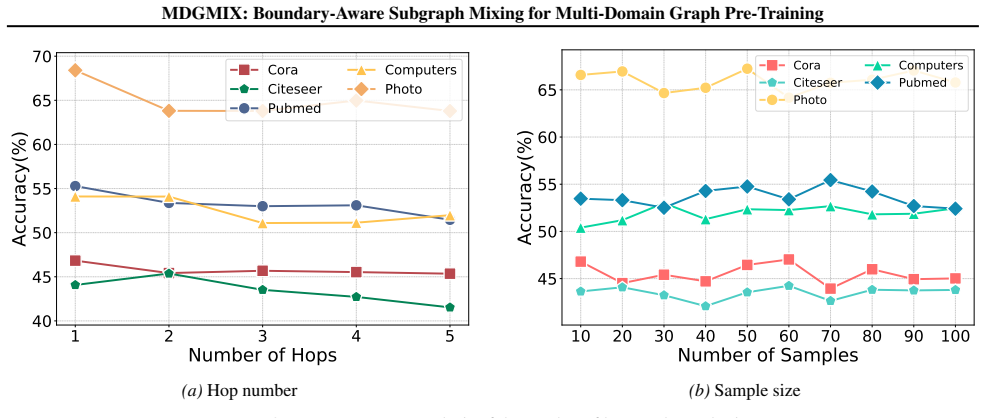
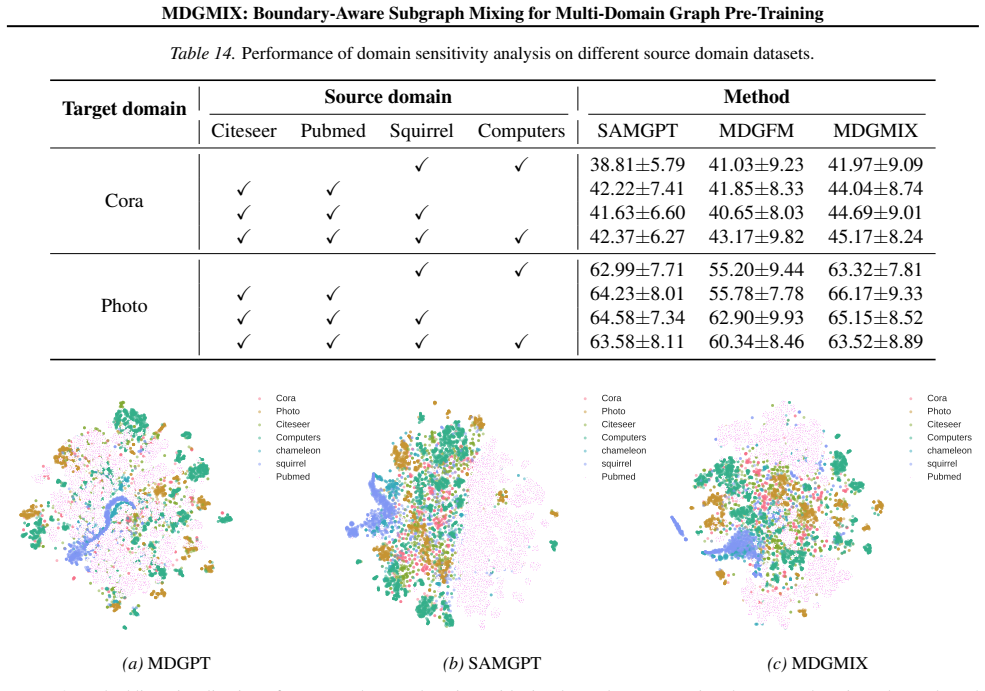
read the original abstract
Multi-domain graph pre-training is a crucial step in constructing foundational graph models with cross-domain generalization capabilities. However, existing methods predominantly rely on jointly training all source domain graphs, resulting in high computational costs. Furthermore, it remains unclear whether all source domain graph data contribute equally to effective transfer. This paper empirically reveals significant data redundancy in multi-domain graph pre-training. Based on this finding, we propose the Multi-domain Graph Pre-training Framework, MDGMIX, which combines boundary-aware subgraph mixing with hierarchical discrimination. By selecting boundary nodes to construct challenging mixed-domain subgraphs, MDGMIX employs coarse-grained domain discrimination and fine-grained domain decomposition losses to decouple shared patterns from domain-specific patterns. During adaptation, MDGMIX employs a lightweight prompt weighting mechanism to transfer source domain knowledge. Extensive experiments demonstrate that MDGMIX consistently outperforms strong baselines in few-shot classification tasks while exhibiting superior time and memory efficiency. The code is available at: https://github.com/zhengziyu77/MDGMIX.
Editorial analysis
A structured set of objections, weighed in public.
Referee Report
Summary. The paper claims that multi-domain graph pre-training contains significant data redundancy, and introduces MDGMIX, a framework that selects boundary nodes to construct mixed-domain subgraphs, applies coarse-grained domain discrimination and fine-grained domain decomposition losses to decouple shared versus domain-specific patterns, and uses a lightweight prompt weighting mechanism at adaptation time. It reports consistent outperformance over strong baselines on few-shot classification tasks together with improved time and memory efficiency, with code released.
Significance. If the empirical redundancy finding and the effectiveness of boundary-aware mixing hold, the work could materially lower the cost of building cross-domain graph foundation models by avoiding full joint training over all source domains. The public code release is a concrete strength that supports direct verification of the implementation.
major comments (3)
- [Abstract] Abstract: the central empirical claim of 'significant data redundancy' is asserted without any quantitative measurement protocol, performance-drop numbers when subsets are removed, or statistical tests; this is load-bearing for the motivation of the entire MDGMIX pipeline.
- [Abstract] Abstract and Experiments section: outperformance is reported without error bars, number of runs, or ablation on the boundary-node selection rule; the absence of these details prevents verification of the claim that boundary-aware mixing reliably decouples patterns via the proposed losses.
- [Method] Method section: the precise definitions of the coarse-grained domain discrimination loss and the fine-grained domain decomposition loss are not supplied with equations or pseudocode, so it is impossible to assess whether they actually achieve the claimed decoupling of shared and domain-specific patterns.
minor comments (1)
- [Abstract] The GitHub link is provided, which is helpful for reproducibility.
Simulated Author's Rebuttal
We thank the referee for the constructive feedback. We address each major comment below and will incorporate revisions to strengthen the empirical grounding and methodological clarity of the manuscript.
read point-by-point responses
-
Referee: [Abstract] Abstract: the central empirical claim of 'significant data redundancy' is asserted without any quantitative measurement protocol, performance-drop numbers when subsets are removed, or statistical tests; this is load-bearing for the motivation of the entire MDGMIX pipeline.
Authors: The experiments section contains the quantitative redundancy analysis, including performance drops when subsets are removed. However, the abstract presents the claim concisely without referencing the protocol or key statistics. We will revise the abstract to briefly note the measurement protocol (subset removal with performance tracking) and direct readers to the relevant experimental results for the full details and any statistical tests performed. revision: yes
-
Referee: [Abstract] Abstract and Experiments section: outperformance is reported without error bars, number of runs, or ablation on the boundary-node selection rule; the absence of these details prevents verification of the claim that boundary-aware mixing reliably decouples patterns via the proposed losses.
Authors: We agree that error bars, run counts, and an ablation on boundary-node selection are necessary for verifying reliability and the role of the mixing strategy. In the revised version, we will report results with error bars over multiple independent runs and add an ablation study isolating the boundary-node selection rule to demonstrate its contribution to pattern decoupling. revision: yes
-
Referee: [Method] Method section: the precise definitions of the coarse-grained domain discrimination loss and the fine-grained domain decomposition loss are not supplied with equations or pseudocode, so it is impossible to assess whether they actually achieve the claimed decoupling of shared and domain-specific patterns.
Authors: The method section provides a high-level description of the losses. To enable direct assessment of the decoupling mechanism, we will add the explicit mathematical formulations (equations) for both the coarse-grained domain discrimination loss and the fine-grained domain decomposition loss in the revised method section. revision: yes
Circularity Check
No significant circularity
full rationale
The paper presents an empirical observation of data redundancy in multi-domain graph pre-training, followed by a proposed framework (MDGMIX) using boundary-aware subgraph mixing and hierarchical losses, validated through experiments. No equations, derivations, or first-principles predictions are described that reduce to fitted inputs or self-citations by construction. The central claims rest on experimental results rather than any self-referential mathematical chain, making the work self-contained against external benchmarks.
Axiom & Free-Parameter Ledger
Reference graph
Works this paper leans on
-
[1]
This assumption relaxes label-space consistency and enables generalization to target domains with unseen or shifted label spaces
Lipschitz continuity:|ℓ(z 1, y)−ℓ(z 2, y)| ≤L ℓ∥z1 −z 2∥2,∀z 1, z2 ∈ Z, y∈ Y Assumption C.3(Structural Semantic Consistency).There exists a structural semantic space S and a mapping ψ:Z → S such that the push-forward distributions satisfy: W1(P S t , R∗S)≤ϵ struct where P S denotes the distribution induced by ψ, and ϵstruct ≥0 quantifies the structural di...
2024
discussion (0)
Sign in with ORCID, Apple, or X to comment. Anyone can read and Pith papers without signing in.