REVIEW 2 major objections 2 minor 47 references
Predicted-Flow Control Barrier Functions for Real-Time Safe Optimal Control
T0 review · 2 major / 2 minor · reviewed 2026-06-28 · grok-4.3
Pith's one-line read Predicted-flow control barrier functions certify safety over the full prediction horizon by solving one always-feasible convex program that also minimizes an integral cost.
desk verdict P-CBFs extend CBFs to predicted flows with a terminal backup set and planning-time shift so one QP stays feasible and safe, but the guarantees rest on existence claims that need checking. read the letter →
The pith
A machine-rendered reading of the paper's core claim, the machinery that carries it, and where it could break.
The reading
What carries the argument
The predicted-flow control barrier function (P-CBF), a functional of the predicted state trajectory under a parametrized control plan, together with a terminal backup-set condition and an adjustable planning-time shift that together produce a single feasible convex program.
What would settle it
A closed-loop simulation or experiment in which, for some reachable initial state inside the safe set, every possible planning-time shift either makes the quadratic program infeasible or allows the state to leave the safe set before the horizon ends.
Extended reading notes
Core claim
A predicted-flow control barrier function is a functional of the state trajectory that a parametrized control plan produces over a finite horizon. When the functional is required to stay non-negative along the entire predicted flow and the terminal state is forced into a backup safe set, the resulting constraint set is rendered forward invariant by a single convex program. The program jointly optimizes the control-plan parameters and the planning-time shift; when the admissible controls form a convex polytope the program is a quadratic program that is always feasible.
Load-bearing premise
A terminal candidate P-CBF always exists that forces the predicted flow to end inside a backup safe set, and a planning-time shift can always be chosen so the single convex program stays feasible while preserving forward invariance.
Editorial extensions
If this is right
- The closed-loop trajectory satisfies the safety constraint at every instant over the entire prediction horizon, not only at the current time.
- When control constraints are a convex polytope the joint safety-and-optimization problem reduces to a quadratic program solvable in real time.
- The quadratic program is guaranteed feasible at every sampling instant and the safe set is rendered forward invariant.
- Finite-horizon integral-cost minimization and safety certification are performed inside the same convex program rather than in cascaded layers.
- The method applies directly to nonholonomic systems such as ground robots navigating obstacle fields.
Reading between the lines
- The same terminal-backup and shift construction might allow safety filters to be inserted into existing model-predictive controllers without destroying recursive feasibility.
- Because the program remains convex even for nonlinear dynamics, the approach could be combined with successive linearization or other convexification techniques already used in real-time MPC.
- If the backup safe set can be chosen as a simple invariant region, the method may reduce the need for hand-crafted barrier functions in high-dimensional state spaces.
Editorial analysis
A structured set of objections, weighed in public.
Referee Report
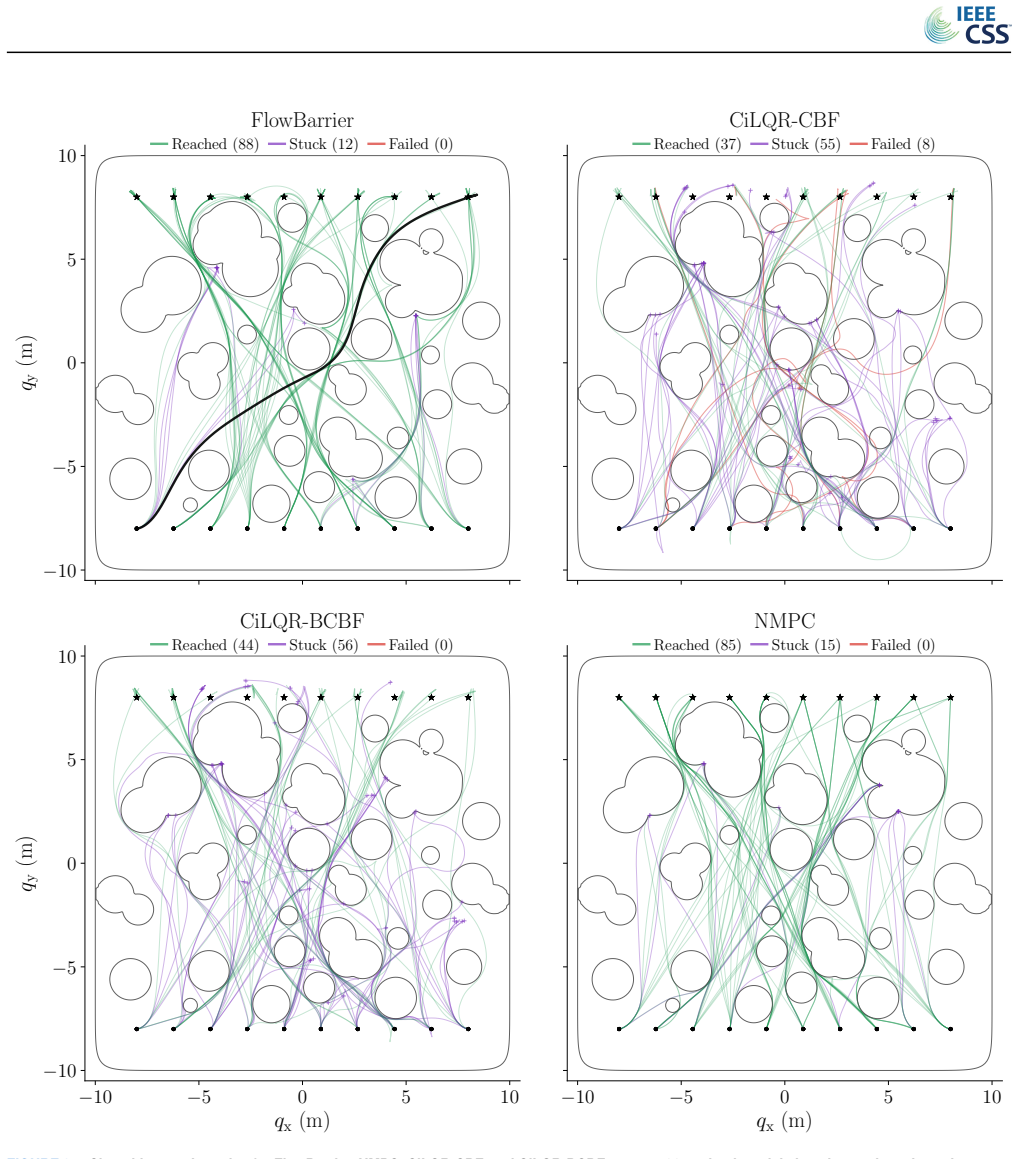
Summary. The manuscript introduces Predicted-Flow Control Barrier Functions (P-CBFs) that extend standard CBFs to functionals over predicted flows under parametrized control plans over a finite horizon. It augments this with a terminal candidate P-CBF (requiring the predicted flow to terminate inside a backup safe set) and a planning-time shift to ensure that a single convex program—reducing to a QP when control constraints form a convex polytope—is always feasible and renders the safe set forward invariant. The resulting FlowBarrier controller is claimed to unify finite-horizon integral-cost optimization with safety certification and is demonstrated on a nonholonomic ground robot in dense environments, outperforming NMPC and two CBF safety filters across 100 trials with the highest goal-reaching rate, zero safety violations, and lowest computation time.
Significance. If the feasibility and forward-invariance guarantees can be placed on a rigorous footing with explicit conditions, the work would offer a practical route to real-time safe optimal control that supplies certificates over an entire prediction horizon rather than pointwise, addressing a recognized limitation of classical CBFs while retaining convexity.
major comments (2)
- [Abstract] Abstract: the central claim that 'the QP implementation is guaranteed to be feasible and renders the associated safe set forward invariant' is load-bearing, yet the text supplies no derivation, proof sketch, or explicit conditions on the dynamics, the backup safe set, or the planning-time shift selection rule that would ensure a terminal candidate P-CBF exists and the shift can always be chosen to maintain feasibility for arbitrary reachable states (cf. the weakest assumption identified in the reader report).
- [Abstract] Abstract and the P-CBF definition section: the asserted forward invariance over the full prediction horizon is stated to follow from the terminal candidate P-CBF plus the planning-time shift, but no reduction is shown demonstrating that the invariance property is preserved under the joint optimization of control, plan parameters, and shift; without this step the unification claim with integral-cost optimization rests on an unverified step.
minor comments (2)
- [Abstract] The acronym 'P-CBF' and the term 'FlowBarrier' are introduced without an immediate parenthetical definition or pointer to the defining equation.
- [Abstract] The experimental claim of 'zero safety violations' in 100 trials would benefit from a brief statement of the state-space coverage or failure-mode sampling strategy used to generate the trials.
Simulated Author's Rebuttal
We thank the referee for the careful and constructive review. The comments correctly identify that the feasibility and forward-invariance claims require more explicit supporting material to be fully rigorous. We address each point below and will revise the manuscript to incorporate the requested derivations, conditions, and reductions.
read point-by-point responses
-
Referee: [Abstract] Abstract: the central claim that 'the QP implementation is guaranteed to be feasible and renders the associated safe set forward invariant' is load-bearing, yet the text supplies no derivation, proof sketch, or explicit conditions on the dynamics, the backup safe set, or the planning-time shift selection rule that would ensure a terminal candidate P-CBF exists and the shift can always be chosen to maintain feasibility for arbitrary reachable states (cf. the weakest assumption identified in the reader report).
Authors: We agree that the abstract states the guarantee without an accompanying proof sketch or explicit conditions, which is a limitation given the space constraints of an abstract. The body of the manuscript introduces the terminal candidate P-CBF and planning-time shift with the intent of ensuring feasibility, but does not supply a self-contained derivation or the weakest assumptions on the dynamics and backup set. In the revision we will add a dedicated remark or short subsection that states the explicit conditions (including on the backup safe set and shift selection) and provides a concise proof outline establishing existence of a feasible shift for reachable states. revision: yes
-
Referee: [Abstract] Abstract and the P-CBF definition section: the asserted forward invariance over the full prediction horizon is stated to follow from the terminal candidate P-CBF plus the planning-time shift, but no reduction is shown demonstrating that the invariance property is preserved under the joint optimization of control, plan parameters, and shift; without this step the unification claim with integral-cost optimization rests on an unverified step.
Authors: The manuscript asserts that invariance follows by construction from the terminal condition and shift, and that the single convex program unifies safety with integral-cost optimization. However, an explicit reduction showing preservation of the invariance property under the joint optimization of control, plan parameters, and shift is not provided. We will add this step (as a lemma or proposition) in the revised version to make the argument complete and to support the unification claim. revision: yes
Circularity Check
No significant circularity; derivation introduces new constructs without reducing to fitted inputs or self-citations
full rationale
The paper defines P-CBFs as a functional generalization of standard CBFs over a predicted flow, then introduces a terminal candidate P-CBF (requiring termination in a backup safe set) and a planning-time shift as additional degrees of freedom. These are presented as novel elements whose existence and selection rules are asserted to guarantee QP feasibility and forward invariance. No equations or claims reduce a 'prediction' or invariance result to a previously fitted parameter by construction, nor does any load-bearing step rely on a self-citation chain whose validity is internal to the authors' prior work. The central QP guarantee is therefore a direct consequence of the stated definitions and assumptions rather than a renaming or tautological fit. This is the normal case of a method paper whose safety certificate is self-contained within its own constructions.
Assumptions & free parameters
free parameters (2)
- prediction horizon length
- planning-time shift
assumptions (2)
- domain assumption System dynamics are known and permit explicit computation or approximation of the predicted flow under any parametrized control plan.
- domain assumption A backup safe set exists that can be reached at the terminal time of the prediction horizon.
invented entities (2)
-
Predicted-Flow Control Barrier Function (P-CBF)
-
Terminal candidate P-CBF
Cite this review
Pith. "Pith review of Predicted-Flow Control Barrier Functions for Real-Time Safe Optimal Control." pith.science (2026). https://pith.science/paper/G67E22G6
@misc{pith2026260600297,
  author       = {Pith},
  title        = {Pith review of: Predicted-Flow Control Barrier Functions for Real-Time Safe Optimal Control},
  year         = {2026},
  howpublished = {\url{https://pith.science/paper/G67E22G6}},
  note         = {Machine review of arXiv:2606.00297}
}
read the original abstract
Control barrier functions (CBFs) provide real-time safety guarantees through pointwise conditions on the state. However, synthesizing a valid CBF is difficult and the resulting controllers are myopic. To address myopia, this article introduces predicted-flow control barrier functions (P-CBFs), which generalize the CBF from a function of the current state to a functional of a predicted flow under a parametrized control plan over a finite prediction horizon. For safety, a P-CBF can certify that the predicted flow is in a safe set over the entire prediction horizon. However, candidate P-CBFs suffer from the same challenge as candidate CBFs, namely, control constraints make it difficult to guarantee that the P-CBF is valid. This article resolves this challenge by introducing a terminal candidate P-CBF requiring that the predicted flow end in a backup safe set at the terminal time, and a planning-time shift that modulates the prediction horizon, providing an additional degree of freedom to ensure feasibility. The real-time control and the evolution of the control-plan parameter and planning-time shift are determined jointly by a single convex optimization that is guaranteed to be feasible and renders the associated safe set forward invariant. The resulting safe optimal flow control provides a safety certificate over the entire prediction horizon and unifies finite-horizon integral-cost optimization with safety certification. This optimization reduces to a quadratic program (QP) if the control constraints are a convex polytope. The QP implementation, termed FlowBarrier, is validated on a nonholonomic ground robot navigating a dense environment. FlowBarrier is compared to nonlinear model predictive control and two CBF-based safety filter methods across 100 trials, where FlowBarrier achieves the highest goal-reaching rate, zero safety violations, and the lowest computation time.
Figures


Figures from the paper (2 more)


Reference graph
Works this paper leans on
-
[1]
Past, present, and future of aerial robotic manipulators,
A. Ollero, M. Tognon, A. Su ´arez, D. Lee, and A. Franchi, “Past, present, and future of aerial robotic manipulators,”IEEE Transactions on Robotics, vol. 38, no. 1, pp. 626–645, 2022
2022
-
[2]
Coordinating hundreds of cooperative, autonomous vehicles in warehouses,
P. R. Wurman, R. D’Andrea, and M. Mountz, “Coordinating hundreds of cooperative, autonomous vehicles in warehouses,”AI Magazine, vol. 29, no. 1, pp. 9–19, 2008
2008
-
[3]
A survey of motion planning and control techniques for self-driving urban vehicles,
B. Paden, M. ˇC´ap, S. Z. Yong, D. Yershov, and E. Frazzoli, “A survey of motion planning and control techniques for self-driving urban vehicles,” IEEE Transactions on Intelligent Vehicles, vol. 1, no. 1, pp. 33–55, 2016
2016
-
[4]
Set invariance in control,
F. Blanchini, “Set invariance in control,”Automatica, vol. 35, no. 11, pp. 1747–1767, 1999. 18 VOLUME 00 2026
1999
-
[5]
Hamilton-Jacobi reachability: Some recent theoretical advances and applications in unmanned airspace management,
S. Bansal, M. Chen, S. Herbert, and C. J. Tomlin, “Hamilton-Jacobi reachability: Some recent theoretical advances and applications in unmanned airspace management,”Annual Review of Control, Robotics, and Autonomous Systems, vol. 1, pp. 333–253, 2017
2017
-
[6]
Hamilton–Jacobi reachability: A brief overview and recent advances,
M. Chen and C. J. Tomlin, “Hamilton–Jacobi reachability: A brief overview and recent advances,”IEEE Conference on Decision and Control (CDC), pp. 2242–2253, 2018
2018
-
[7]
Scalable learning of safety guarantees for autonomous systems using Hamilton–Jacobi reachability,
S. L. Herbert, S. Bansal, and C. J. Tomlin, “Scalable learning of safety guarantees for autonomous systems using Hamilton–Jacobi reachability,” arXiv preprint arXiv:2101.05916, 2021
-
[8]
Con- strained model predictive control: Stability and optimality,
D. Q. Mayne, J. B. Rawlings, C. V . Rao, and P. O. Scokaert, “Con- strained model predictive control: Stability and optimality,”Automatica, vol. 36, no. 6, pp. 789–814, 2000
2000
Show all 47 references
-
[9]
J. B. Rawlings, D. Q. Mayne, and M. Diehl,Model Predictive Control: Theory, Computation, and Design. Nob Hill Publishing, 2017
2017
-
[10]
Learning- based model predictive control for safe exploration,
T. Koller, F. Berkenkamp, M. Turchetta, and A. Krause, “Learning- based model predictive control for safe exploration,” inIEEE Confer- ence on Decision and Control (CDC), pp. 6059–6066, 2018
2018
-
[11]
Constructive safety using control barrier functions,
P. Wieland and F. Allg ¨ower, “Constructive safety using control barrier functions,”IFAC Proc., vol. 40, no. 12, pp. 462–467, 2007
2007
-
[12]
Control barrier function based quadratic programs for safety critical systems,
A. D. Ames, X. Xu, J. W. Grizzle, and P. Tabuada, “Control barrier function based quadratic programs for safety critical systems,”IEEE Trans. Autom. Contr., pp. 3861–3876, 2016
2016
-
[13]
Time-varying soft-maximum control barrier functions for safety in an a priori unknown environment,
A. Safari and J. B. Hoagg, “Time-varying soft-maximum control barrier functions for safety in an a priori unknown environment,” in2024 American Control Conference (ACC), pp. 3698–3703, IEEE, 2024
2024
-
[14]
Time-varying soft-maximum barrier functions for safety in unmapped and dynamic environments,
A. Safari and J. B. Hoagg, “Time-varying soft-maximum barrier functions for safety in unmapped and dynamic environments,”IEEE Transactions on Control Systems Technology, pp. 1–16, 2025
2025
-
[15]
Safe navigation in unmapped environments for robotic systems with input constraints,
A. Safari and J. B. Hoagg, “Safe navigation in unmapped environments for robotic systems with input constraints,” in2025 IEEE 64th Conference on Decision and Control (CDC), pp. 6957–6962, IEEE, 2025
2025
-
[16]
A closed-form control for safety under input constraints using a composition of control barrier functions,
P. Rabiee and J. B. Hoagg, “A closed-form control for safety under input constraints using a composition of control barrier functions,” arXiv preprint arXiv:2406.16874, 2024
2024
-
[17]
Composition of control barrier functions with differing relative degrees for safety under input constraints,
P. Rabiee and J. B. Hoagg, “Composition of control barrier functions with differing relative degrees for safety under input constraints,” in 2024 American Control Conference (ACC), pp. 3692–3697, 2024
2024
-
[18]
Robust control barrier–value functions for safety-critical control,
J. J. Choi, D. Lee, K. Sreenath, C. J. Tomlin, and S. L. Herbert, “Robust control barrier–value functions for safety-critical control,”IEEE Conference on Decision and Control (CDC), pp. 6814–6821, 2021
2021
-
[19]
Permissive barrier certificates for safe stabilization using sum-of-squares,
L. Wang, D. Han, and M. Egerstedt, “Permissive barrier certificates for safe stabilization using sum-of-squares,” in2018 Amer. Contr. Conf. (ACC), pp. 585–590, 2018
2018
-
[20]
A scalable safety critical control framework for nonlinear systems,
T. Gurriet, M. Mote, A. Singletary, P. Nilsson, E. Feron, and A. D. Ames, “A scalable safety critical control framework for nonlinear systems,”IEEE Access, pp. 187249–187275, 2020
2020
-
[21]
Soft-minimum barrier functions for safety- critical control subject to actuation constraints,
P. Rabiee and J. B. Hoagg, “Soft-minimum barrier functions for safety- critical control subject to actuation constraints,” inProc. Amer. Contr. Conf., pp. 2646–2651, 2023
2023
-
[22]
The gatekeeper: Online safety verification and control for nonlinear systems in dynamic environments,
D. R. Agrawal and D. Panagou, “The gatekeeper: Online safety verification and control for nonlinear systems in dynamic environments,” IEEE Transactions on Robotics, 2025. To appear
2025
-
[23]
Safe drone flight with time-varying backup controllers,
A. Singletary, A. Swann, I. D. J. Rodriguez, and A. D. Ames, “Safe drone flight with time-varying backup controllers,” in2022 IEEE/RSJ International Conference on Intelligent Robots and Systems (IROS), pp. 4577–4584, IEEE, 2022
2022
-
[24]
Soft-minimum and soft-maximum barrier functions for safety with actuation constraints,
P. Rabiee and J. B. Hoagg, “Soft-minimum and soft-maximum barrier functions for safety with actuation constraints,”Automatica, vol. 171, p. 111921, 2025
2025
-
[25]
Multi-layered safety for legged robots via control barrier functions and model predictive control,
R. Grandia, A. J. Taylor, A. D. Ames, and M. Hutter, “Multi-layered safety for legged robots via control barrier functions and model predictive control,”IEEE International Conference on Robotics and Automation (ICRA), pp. 8352–8358, 2021
2021
-
[26]
Receding horizon cbf- based multi-layer controllers for safe trajectory generation,
L. Sforni, G. Notarstefano, and A. D. Ames, “Receding horizon cbf- based multi-layer controllers for safe trajectory generation,” in2024 american control conference (ACC), pp. 4765–4770, IEEE, 2024
2024
-
[27]
Predictive control barrier functions for online safety critical control,
J. Breeden and D. Panagou, “Predictive control barrier functions for online safety critical control,” inIEEE Conference on Decision and Control (CDC), pp. 5765–5772, 2022
2022
-
[28]
Forward invariance in trajectory spaces for safety-critical control,
M. Vahs, S. Biedenbach, A. D. Ames, and M. N. Zeilinger, “Forward invariance in trajectory spaces for safety-critical control,” inLearning for Dynamics and Control (L4DC), 2024
2024
-
[29]
Safety-critical model predictive control with discrete-time control barrier function,
J. Zeng, B. Zhang, and K. Sreenath, “Safety-critical model predictive control with discrete-time control barrier function,” inAmerican Control Conference (ACC), pp. 3882–3889, 2021
2021
-
[30]
Learning- enabled iterative convex optimization for safety-critical model predictive control,
S. Liu, Z. Huang, J. Zeng, K. Sreenath, and C. A. Belta, “Learning- enabled iterative convex optimization for safety-critical model predictive control,”IEEE Open Journal of Control Systems, 2025
2025
-
[31]
Guaranteed-safe mppi through composite control barrier functions for efficient sampling in multi-constrained robotic systems,
P. Rabiee and J. B. Hoagg, “Guaranteed-safe mppi through composite control barrier functions for efficient sampling in multi-constrained robotic systems,” in2025 IEEE 64th Conference on Decision and Control (CDC), pp. 5515–5520, IEEE, 2025
2025
-
[32]
Receding-horizon nonlinear optimal control with safety constraints using constrained approximate dynamic programming,
R. Gutierrez and J. B. Hoagg, “Receding-horizon nonlinear optimal control with safety constraints using constrained approximate dynamic programming,”arXiv preprint arXiv:2604.01956, 2026
2026
-
[33]
Predictive synthesis of control barrier functions and its application to time-varying constraints,
A. Wiltz and D. V . Dimarogonas, “Predictive synthesis of control barrier functions and its application to time-varying constraints,”arXiv preprint arXiv:2504.15830, 2025
2025
-
[34]
H. K. Khalil,Nonlinear Systems. Upper Saddle River, NJ: Prentice Hall, 3rd ed., 2002
2002
-
[35]
Neural ordinary differential equations,
R. T. Chen, Y . Rubanova, J. Bettencourt, and D. K. Duvenaud, “Neural ordinary differential equations,”Advances in Neural Information Processing Systems, vol. 31, 2018
2018
-
[36]
Semi-infinite programming,
M. L ´opez and G. Still, “Semi-infinite programming,”European Journal of Operational Research, vol. 180, no. 2, pp. 491–518, 2007
2007
-
[37]
Constrained differential dynamic programming: A primal-dual augmented lagrangian approach,
W. Jallet, A. Bambade, N. Mansard, and J. Carpentier, “Constrained differential dynamic programming: A primal-dual augmented lagrangian approach,” in2022 IEEE International Conference on Robotics and Automation (ICRA), pp. 9126–9132, IEEE, 2022
2022
-
[38]
High-order control barrier functions,
W. Xiao and C. Belta, “High-order control barrier functions,”IEEE Trans. Autom. Contr., vol. 67, no. 7, pp. 3655–3662, 2021
2021
-
[39]
do-mpc: Towards fair nonlinear and robust model predictive control,
F. Fiedler, B. Karg, L. L ¨uken, D. Brandner, M. Heinlein, F. Brabender, and S. Lucia, “do-mpc: Towards fair nonlinear and robust model predictive control,”Control Engineering Practice, vol. 140, p. 105676, 2023
2023
-
[40]
On the implementation of an interior- point filter line-search algorithm for large-scale nonlinear programming,
A. W ¨achter and L. T. Biegler, “On the implementation of an interior- point filter line-search algorithm for large-scale nonlinear programming,” Mathematical Programming, vol. 106, no. 1, pp. 25–57, 2006
2006
-
[41]
trajax: differentiable optimal control on accelerators,
R. Frostig, V . Sindhwani, S. Singh, and S. Tu, “trajax: differentiable optimal control on accelerators,”URL http://github.com/google/trajax, 2021
2021
-
[42]
Kidger,On Neural Differential Equations
P. Kidger,On Neural Differential Equations. PhD thesis, University of Oxford, 2021
2021
-
[43]
JAXopt: Hardware accelerated, batchable and differentiable optimizers in JAX,
M. Blondel, Q. Berthet, M. Cuturi, R. Frostig, S. Hoyer, F. Llinares- L´opez, F. Pedregosa, and J.-P. Vert, “JAXopt: Hardware accelerated, batchable and differentiable optimizers in JAX,” 2022. [Online]. Available: https://github.com/google/jaxopt
2022
-
[44]
OSQP: An operator splitting solver for quadratic programs,
B. Stellato, G. Banjac, P. Goulart, A. Bemporad, and S. Boyd, “OSQP: An operator splitting solver for quadratic programs,”Mathematical Programming Computation, vol. 12, no. 4, pp. 637–672, 2020
2020
-
[45]
J. M. Danskin,The theory of max-min and its application to weapons allocation problems, vol. 5. Springer Science & Business Media, 2012
2012
-
[46]
Borrelli, A
F. Borrelli, A. Bemporad, and M. Morari,Predictive control for linear and hybrid systems. Cambridge University Press, 2017
2017
-
[47]
Differential properties of the marginal function in mathematical programming,
J. Gauvin and F. Dubeau, “Differential properties of the marginal function in mathematical programming,” inOptimality and Stability in Mathematical Programming, pp. 101–119, Springer, 2009. VOLUME 00 2026 19
2009
Reviewed June 28, 2026 · model on record in the stance chip above.
Discussion (0). Continue with ORCID to comment.