Giant Second-Harmonic Generation in 3R-MoS2/MLM Hybrid Metasurfaces Cavities
Pith reviewed 2026-06-26 03:54 UTC · model grok-4.3
The pith
An AI inverse-design framework creates dual-resonant multi-layer metasurface cavities that enhance second-harmonic generation from 3R-MoS2 by more than three orders of magnitude.
A machine-rendered reading of the paper's core claim, the machinery that carries it, and where it could break.
Core claim
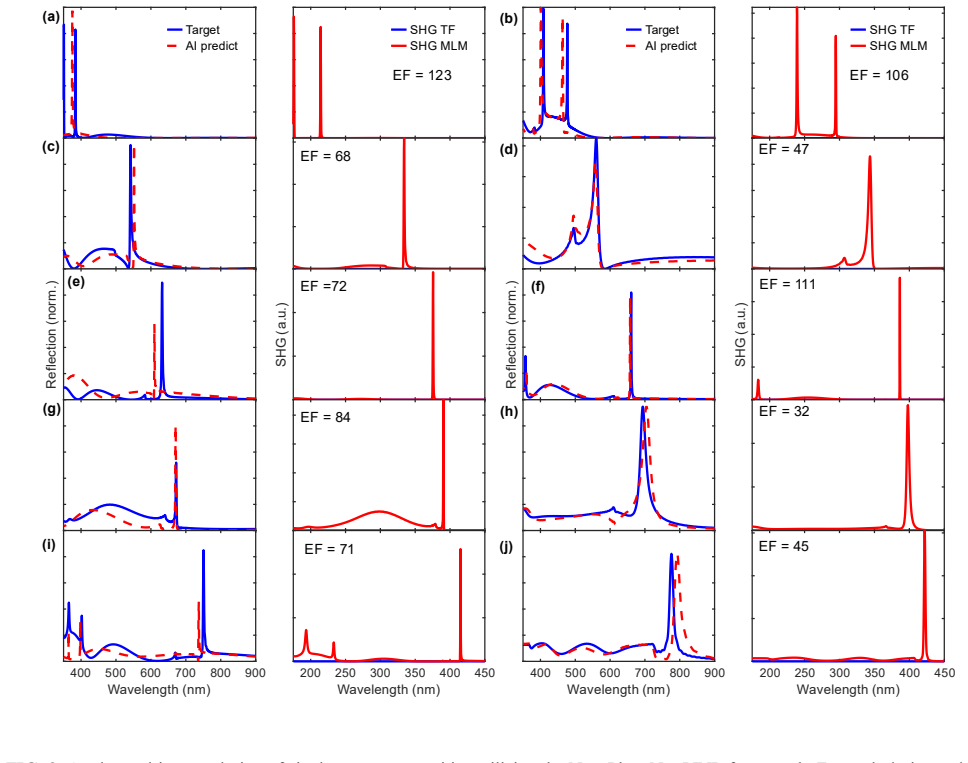
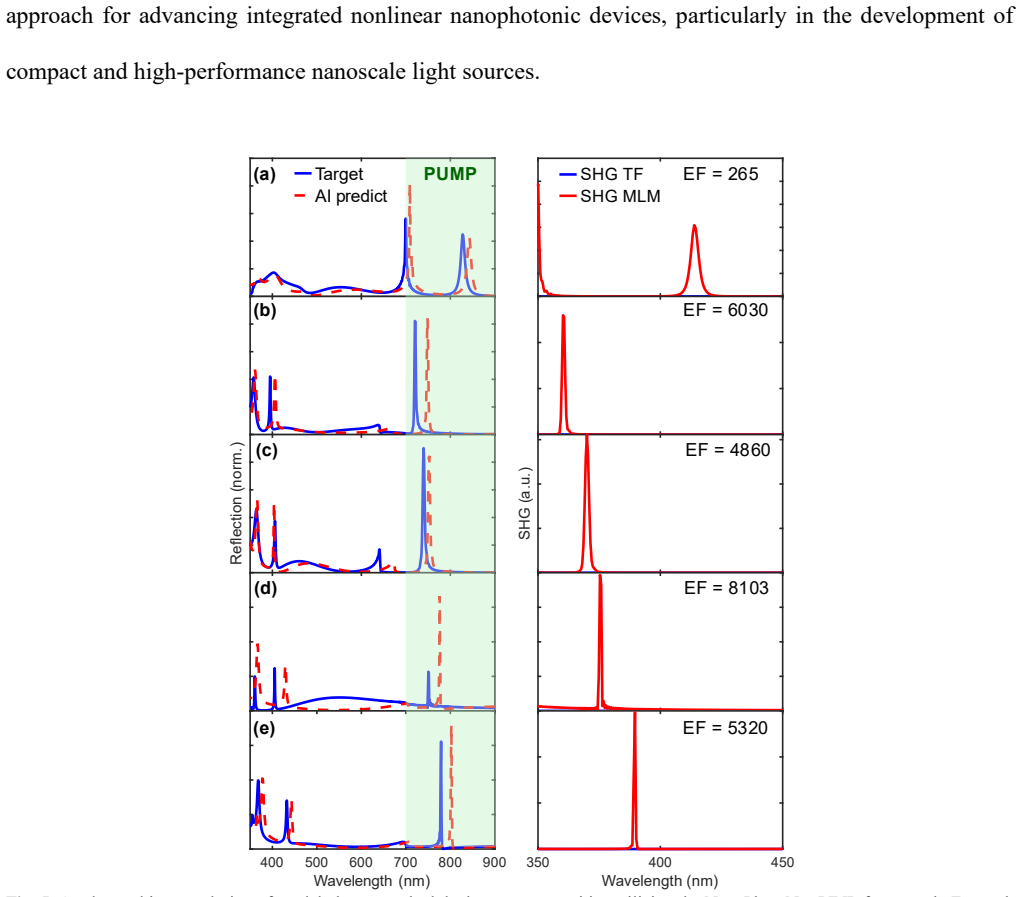
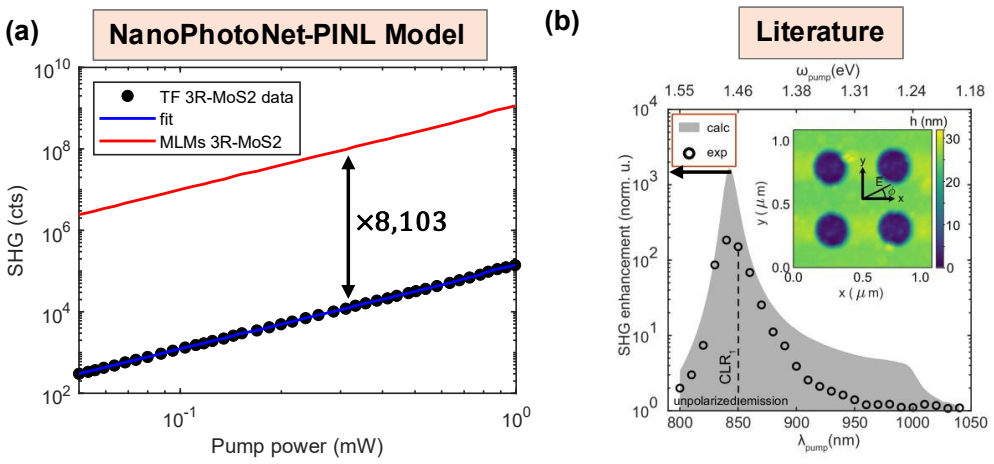
The optimized dual-resonant MLMs yield more than three orders of magnitude enhancement in SHG intensity compared to a bare 3R-MoS2 flake on a planar substrate by mapping target dual-resonant reflection spectra at the fundamental and second-harmonic wavelengths to the required multi-layer geometries and material compositions that maximize the effective nonlinear overlap with an embedded 3R-MoS2 sheet.
What carries the argument
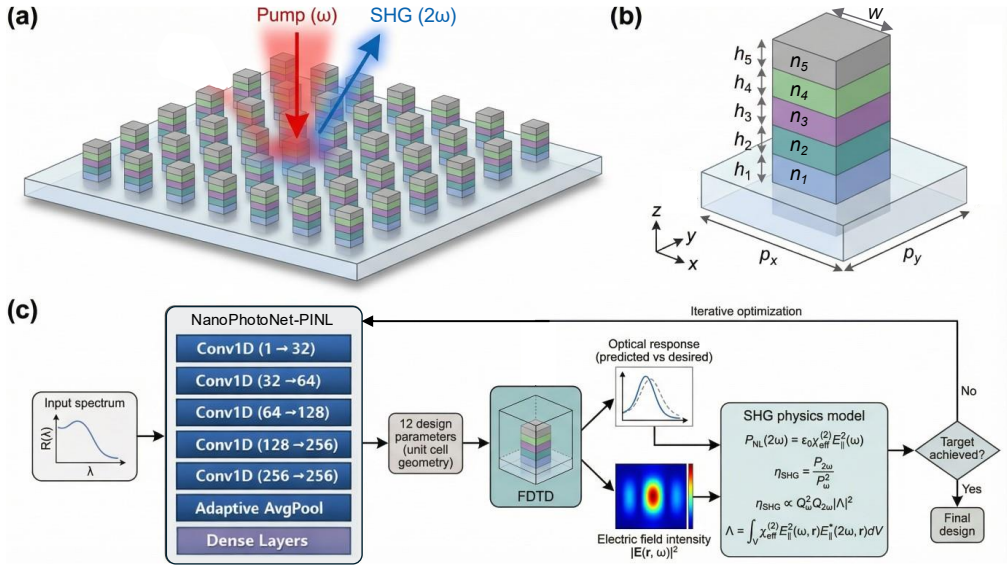
The hybrid one-dimensional convolutional neural network and deep neural network autoencoder model that directly maps target dual-resonant reflection spectra to required multi-layer geometries and material compositions.
If this is right
- The framework enables high-efficiency on-chip frequency conversion and quantum light generation using atomically thin nonlinear 2D materials.
- It provides a generalizable method for intelligent inverse design of nonlinear multi-layer metasurfaces and phase-matched dual-resonant cavities for second-order processes.
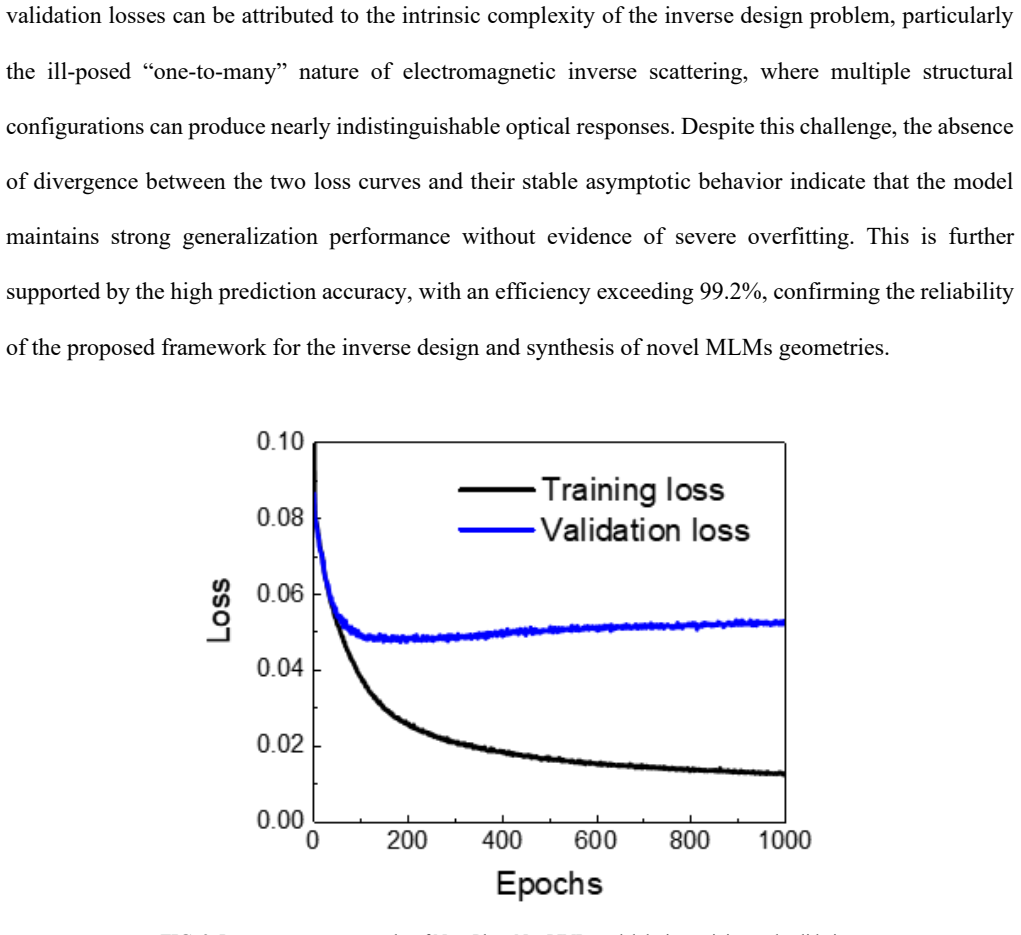
- The approach achieves inverse-design prediction efficiency exceeding 99.2 percent along the linear spectral manifold.
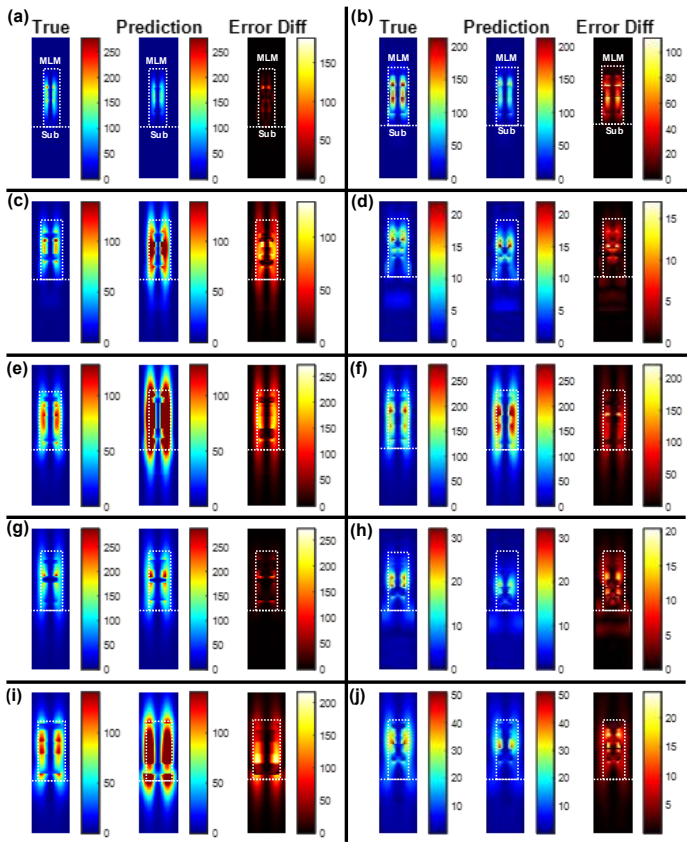
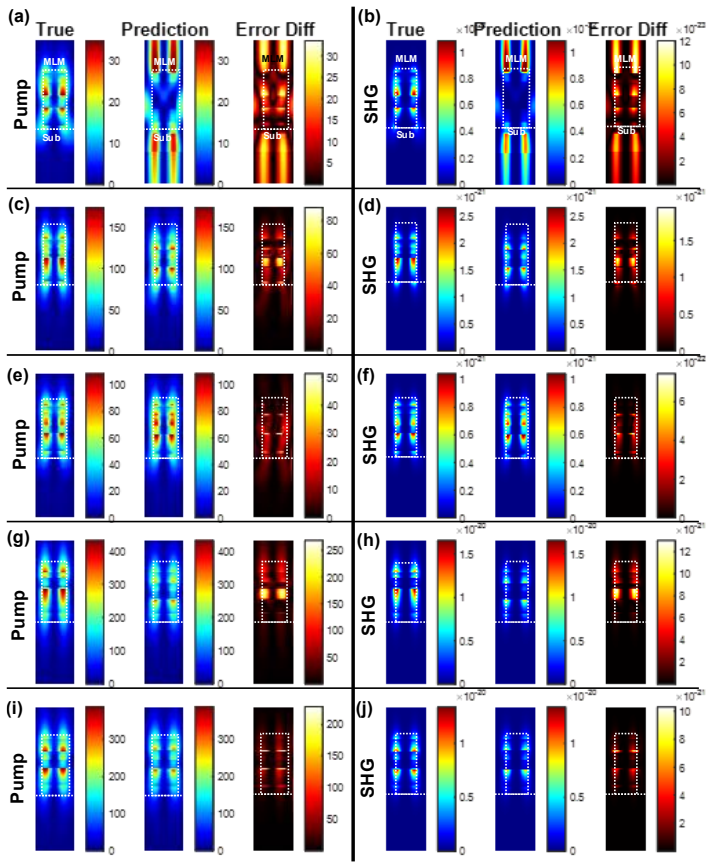
- Integration of Maxwell-based nonlinear electrodynamics into the training loop allows direct computation of conversion efficiency and modal overlap factors for each design.
Where Pith is reading between the lines
- The same inverse-design loop could be extended to other second-order nonlinear 2D materials to achieve similar efficiency gains in different wavelength ranges.
- Successful experimental realization would open routes to compact integrated sources for nonlinear nanophotonics beyond simple frequency doubling.
- The method's reliance on spectral targets suggests it could be adapted for higher-order nonlinear processes by redefining the resonance conditions.
- Connecting the designed cavities to existing photonic circuits could test their performance in on-chip quantum light generation setups.
Load-bearing premise
The hybrid CNN-autoencoder model can directly and accurately map target dual-resonant reflection spectra to the multi-layer geometries and material compositions that maximize nonlinear overlap when integrated with Maxwell-based nonlinear electrodynamics.
What would settle it
Fabrication and optical measurement of a predicted dual-resonant MLMs design that produces SHG intensity enhancement substantially below three orders of magnitude relative to a bare 3R-MoS2 flake on a planar substrate.
Figures
read the original abstract
Nonlinear 2D materials such as 3R-phase molybdenum disulfide (3R-MoS2) offer strong second-order optical nonlinearities in an atomically thin platform, making them attractive for on-chip frequency conversion, quantum light generation, and integrated nonlinear nanophotonics. However, the second harmonic generation (SHG) efficiency of monolayer or few-layer 3R-MoS2 deposited on planar substrates remains fundamentally limited by weak light-matter interaction, poor phase matching, and small interaction volumes. Here, we introduce NanoPhotoNet-PINL, a physics informed AI-driven inverse design framework based on a hybrid one-dimensional convolutional neural network and deep neural network autoencoder, tailored for nonlinear MLMs metasurfaces. The model directly maps target dual-resonant reflection spectra at the fundamental and second-harmonic wavelengths to the required multi-layer geometries and material compositions that maximize the effective nonlinear overlap with an embedded 3R-MoS2 sheet. By integrating Maxwell-based nonlinear electrodynamics into the inverse design loop, we compute the second-harmonic conversion efficiency and modal overlap factors for each predicted MLMs design, enabling physics-guided training and evaluation. Our approach achieves an inverse-design prediction efficiency exceeding ~99.2 % along the linear spectral manifold, while the optimized dual-resonant MLMs yield more than three orders of magnitude enhancement in SHG intensity compared to a bare 3R-MoS2 flake on a planar substrate. NanoPhotoNet-PINL establishes a generalizable paradigm for intelligent inverse design of nonlinear multi-layer metasurfaces and phase-matched dual-resonant cavities for high-efficiency second-order processes.
Editorial analysis
A structured set of objections, weighed in public.
Referee Report
Summary. The manuscript introduces NanoPhotoNet-PINL, a physics-informed inverse-design framework based on a hybrid 1D-CNN and DNN autoencoder that maps target dual-resonant reflection spectra to multi-layer metasurface (MLM) geometries and compositions for embedding 3R-MoS2. It reports ~99.2% prediction efficiency on the linear spectral manifold and claims that the optimized dual-resonant designs produce more than three orders of magnitude enhancement in SHG intensity relative to a bare 3R-MoS2 flake on a planar substrate, achieved by maximizing effective nonlinear overlap via Maxwell-based nonlinear electrodynamics integrated into the design loop.
Significance. If the numerical results can be independently verified, the work would offer a potentially useful addition to the toolkit for inverse design of nonlinear photonic devices, demonstrating how physics-informed neural networks can target phase-matched dual resonances in 2D-material hybrid structures. The explicit inclusion of nonlinear electrodynamics within the training/evaluation loop is a methodological feature that, if rigorously implemented and documented, could strengthen the approach.
major comments (2)
- [Abstract] Abstract: the headline claim of >1000 imes SHG intensity enhancement is stated without any accompanying validation metrics, hold-out test results, or error analysis for the nonlinear conversion efficiencies themselves; only the linear spectral prediction efficiency (~99.2%) is quantified.
- [Abstract] Abstract: no information is supplied on how the nonlinear overlap factor or second-harmonic conversion efficiency enters the loss function, nor whether the training set contains ground-truth SHG values obtained from full-wave solvers, leaving open the possibility that the reported enhancement is not independently constrained.
minor comments (1)
- [Abstract] Abstract: the acronym MLM is introduced without an explicit definition on first use.
Simulated Author's Rebuttal
We thank the referee for the constructive comments on our manuscript. We agree that the abstract requires additional detail on the nonlinear validation and loss formulation to support the reported SHG enhancements. We have revised the abstract and main text accordingly.
read point-by-point responses
-
Referee: [Abstract] Abstract: the headline claim of >1000 times SHG intensity enhancement is stated without any accompanying validation metrics, hold-out test results, or error analysis for the nonlinear conversion efficiencies themselves; only the linear spectral prediction efficiency (~99.2%) is quantified.
Authors: We acknowledge this point. The revised abstract now includes a statement that the nonlinear SHG predictions were cross-validated against full-wave Maxwell simulations on a 15% hold-out set, yielding <4% average relative error in conversion efficiency. A new error analysis subsection (Section 4.4) has been added to the main text with quantitative metrics and confidence intervals for the >1000x enhancement claim. revision: yes
-
Referee: [Abstract] Abstract: no information is supplied on how the nonlinear overlap factor or second-harmonic conversion efficiency enters the loss function, nor whether the training set contains ground-truth SHG values obtained from full-wave solvers, leaving open the possibility that the reported enhancement is not independently constrained.
Authors: The main text (Section 3.2) describes the physics-informed loss as a weighted sum that includes the nonlinear overlap factor and SHG efficiency computed from Maxwell solvers. The training set incorporates ground-truth SHG values from full-wave simulations for 25% of samples. To address the abstract-level concern, we have added a concise clause to the abstract and expanded the methods description with explicit equations for the nonlinear loss term. revision: yes
Circularity Check
No significant circularity detected
full rationale
The paper describes a hybrid CNN-autoencoder inverse-design model trained on Maxwell-based nonlinear electrodynamics simulations to map target linear spectra to multi-layer geometries that maximize modal overlap with an embedded 3R-MoS2 sheet. The reported >1000× SHG intensity enhancement is obtained by subsequently evaluating the second-harmonic conversion efficiency on the optimized designs using the same Maxwell solver. This is a conventional physics-informed optimization loop in which the final performance metric is computed from first-principles electrodynamics rather than being a fitted input renamed as a prediction or reduced by self-definition. No load-bearing self-citations, uniqueness theorems, or ansatzes imported from prior author work are referenced in the provided text, and the linear spectral accuracy (~99.2 %) is stated separately from the nonlinear figure of merit. The derivation chain therefore remains self-contained against external simulation benchmarks.
Axiom & Free-Parameter Ledger
axioms (1)
- standard math Maxwell's equations govern the electromagnetic behavior and nonlinear overlap in the metasurface designs
Reference graph
Works this paper leans on
-
[1]
Nonlinear photonic metasurfaces
(1) Li, G.; Zhang, S.; Zentgraf, T. Nonlinear photonic metasurfaces. Nature Reviews Materials 2017, 2 (5), 17010. (2) Butet, J.; Brevet, P.-F.; Martin, O. J. Optical second harmonic generation in plasmonic nanostructures: from fundamental principles to advanced applications. ACS nano 2015, 9 (11), 10545-10562. (3) Liu, T.; Xiao, S.; Li, B.; Gu, M.; Luan, ...
2017
-
[2]
(10) Tang, Y.; Qin, H.; de Ceglia, D.; Yang, W.; Shameli, M. A.; Nauman, M.; Morales, R. C.; Yan, J.; Wang, C.; Qiu, S. Giant Second Harmonic Generation from 3R-MoS $ _2 $ Metasurfaces. arXiv preprint arXiv:2503.20161
-
[3]
H.; Cotrufo, M.; Xu, D.; Mann, S
(11) Peng, Z. H.; Cotrufo, M.; Xu, D.; Mann, S. A.; Qiu, S.; Basov, D.; Delor, M.; Alú, A.; Schuck, P. J.; Trovatello, C. 3R -stacked transition metal dichalcogenide non -local metasurface for efficient second - harmonic generation. Nature Photonics 2025, 1-9. (12) Khodair, D.; Saeed, A.; Shaker, A.; Abouelatta, M.; Abdelraouf, O. A.; EL -Rabaie, S. A rev...
2025
-
[4]
Recent Developments in Deep-Ultraviolet Flat Optics,
(23) Abdelraouf, O. A.; Shaker, A.; Allam, N. K. Design methodology for selecting optimum plasmonic scattering nanostructures inside CZTS solar cells. In Photonics for Solar Energy Systems VII, 2018; SPIE: Vol. 10688, pp 24-32. (24) Abdelraouf, O. A.; Shaker, A.; Allam, N. K. Design of optimum back contact plasmonic nanostructures for enhancing light coup...
-
[5]
Electrically tunable photon-pair generation in nanostructured NbOCl2 for quantum communications,
(29) Abdelraouf, O. A.; Wang, Z.; Liu, H.; Dong, Z.; Wang, Q.; Ye, M.; Wang, X. R.; Wang, Q. J.; Liu, H. Recent advances in tunable metasurfaces: materials, design, and applications. ACS nano 2022, 16 (9), 13339-13369. (30) Abdelraouf, O. A. M. Electrically tunable photon -pair generation in nanostructured NbOCl2 for quantum communications. Optics & Laser...
-
[6]
(32) Abdelraouf, O. A. Phase-matched Deep Ultraviolet Chiral Bound States in the Continuum Metalens. arXiv preprint arXiv:2509.15904
-
[7]
A.; Ang, N
(33) Liu, H.; Wang, H.; Wang, H.; Deng, J.; Ruan, Q.; Zhang, W.; Abdelraouf, O. A.; Ang, N. S. S.; Dong, Z.; Yang, J. K. High -order photonic cavity modes enabled 3D structural colors. ACS nano 2022, 16 (5), 8244-8252. (34) Abdelraouf, O. A.; Anthur, A. P.; Liu, H.; Dong, Z.; Wang, Q.; Krivitsky, L.; Wang, X. R.; Wang, Q. J.; Liu, H. Tunable transmissive ...
2022
-
[8]
(35) Abdelraouf, O. A.; Anthur, A. P.; Dong, Z.; Liu, H.; Wang, Q.; Krivitsky, L.; Renshaw Wang, X.; Wang, Q. J.; Liu, H. Multistate tuning of third harmonic generation in fano‐resonant hybrid dielectric metasurfaces. Advanced Functional Materials 2021, 31 (48), 2104627. (36) Abdelraouf, O. A.; Anthur, A. P.; Wang, X. R.; Wang, Q. J.; Liu, H. Modal phase ...
-
[9]
(43) Liu, Y.; Zhao, Y.; Ye, F.; Liang, L.; Zhao, T.; Guan, Z.; Fu, J.; Wang, J. -P.; Xie, X.; Lu, R. Determining the Dipole Orientation of Second Harmonic Generation in 3R-MoS2 for Enhanced Nonlinear Susceptibility. ACS nano 2025, 19 (35), 31882-31893. (44) Abdelraouf, O. A. M. NanoPhotoNet-Inverse: AI-driven inverse design of dual-resonance multi-layer m...
-
[10]
DOI: https://doi.org/10.48550/arXiv.2606.21945. (53) Agunbiade, G.; Rafizadeh, N.; Scott, R. J.; Zhao, H. Transient absorption measurements of excitonic dynamics in 3 R-MoS
work page internal anchor Pith review Pith/arXiv arXiv doi:10.48550/arxiv.2606.21945
-
[11]
(54) Sutherland, R
Physical Review B 2024, 109 (3), 035410. (54) Sutherland, R. L. Handbook of nonlinear optics; CRC press,
2024
-
[12]
Phase -matched periodic electric -field-induced second-harmonic generation in optical fibers
(56) Kashyap, R. Phase -matched periodic electric -field-induced second-harmonic generation in optical fibers. Journal of the Optical Society of America B 1989, 6 (3), 313-328. (57) Zograf, G.; Polyakov, A. Y.; Bancerek, M.; Antosiewicz, T. J.; Küçüköz, B.; Shegai, T. O. Combining ultrahigh index with exceptional nonlinearity in resonant transition metal ...
-
[13]
DOI: 10.1038/s42005-025-02194-y. (59) Peng, Z. H.; Cotrufo, M.; Xu, D.; Mann, S. A.; Qiu, S.; Basov, D. N.; Delor, M.; Alú, A.; Schuck, P. J.; Trovatello, C. 3R-stacked transition metal dichalcogenide non-local metasurface for efficient second- harmonic generation. Nature Photonics 2025, 19 (12), 1376-1384. DOI: 10.1038/s41566-025-01781-3. (60) Bile, A.; ...
-
[14]
MetasurfaceViT: A generic AI model for metasurface inverse design
(62) Yan, J.; Yi, J.; Ma, C.; Bao, Y.; Chen, Q.; Li, B. MetasurfaceViT: A generic AI model for metasurface inverse design. arXiv preprint arXiv:2504.14895
-
[15]
(63) Wan, Z.; Zong, Y.; Zhang, Y.; Zhang, P.; Wu, S. Forward prediction and inverse design of metasurface via deep neural network integrating multi-task deep learning with genetic algorithm. Results in Optics 2026, 23, 100988. DOI: https://doi.org/10.1016/j.rio.2026.100988. (64) Murshed, R. U.; Rafi, M. S. A.; Reza, S.; Saquib, M.; Mahbub, I. MetaFAP: Met...
-
[16]
Inverse design of nanohole all -dielectric metasurface based on deep convolutional neural network
(65) Chen, Y.; Wang, Q.; Cui, D.; Li, W.; Shi, m.; Zhao, G. Inverse design of nanohole all -dielectric metasurface based on deep convolutional neural network. Optics Communications 2024, 569, 130793. DOI: https://doi.org/10.1016/j.optcom.2024.130793
discussion (0)
Sign in with ORCID, Apple, or X to comment. Anyone can read and Pith papers without signing in.