Optical pulse-induced quantum geometric waves in graphene
Pith reviewed 2026-06-27 08:06 UTC · model grok-4.3
The pith
A short optical pulse makes the quantum metric of graphene dynamic and wave-like near Dirac points.
A machine-rendered reading of the paper's core claim, the machinery that carries it, and where it could break.
Core claim
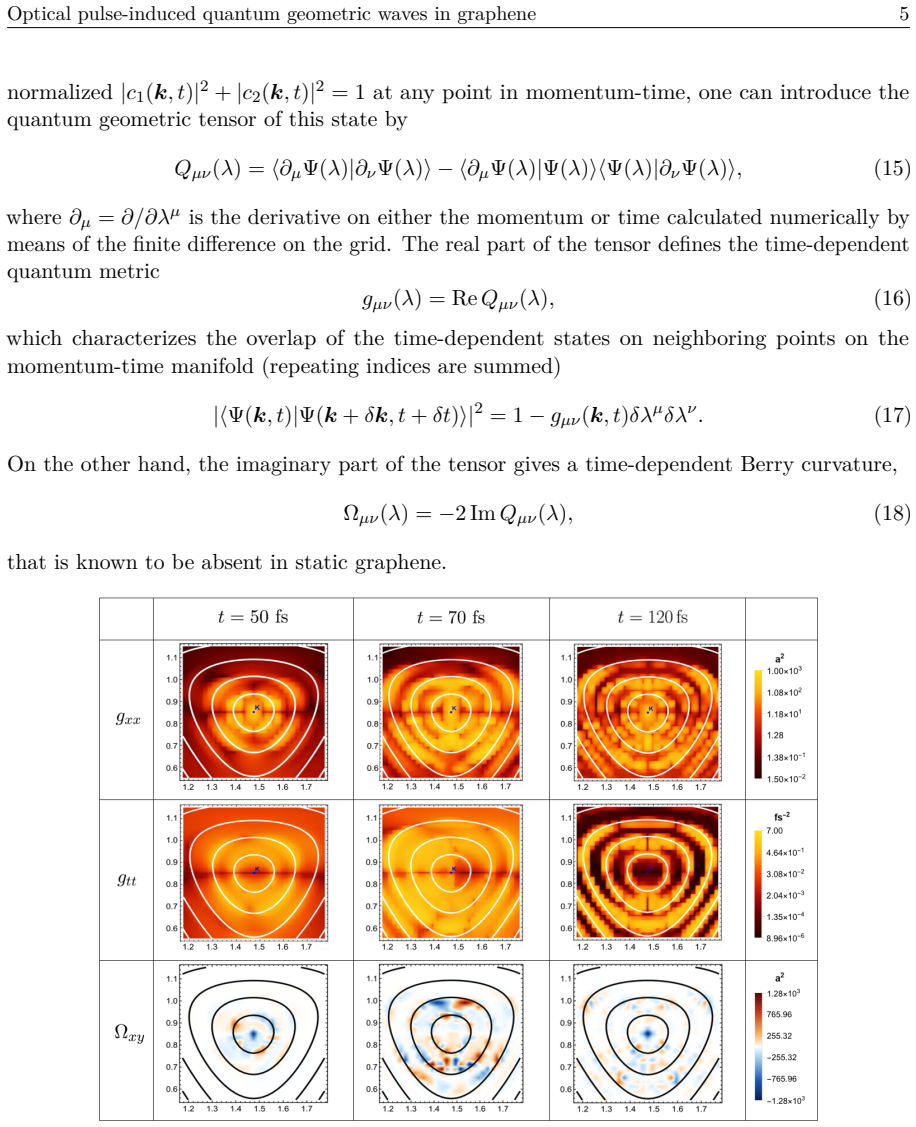
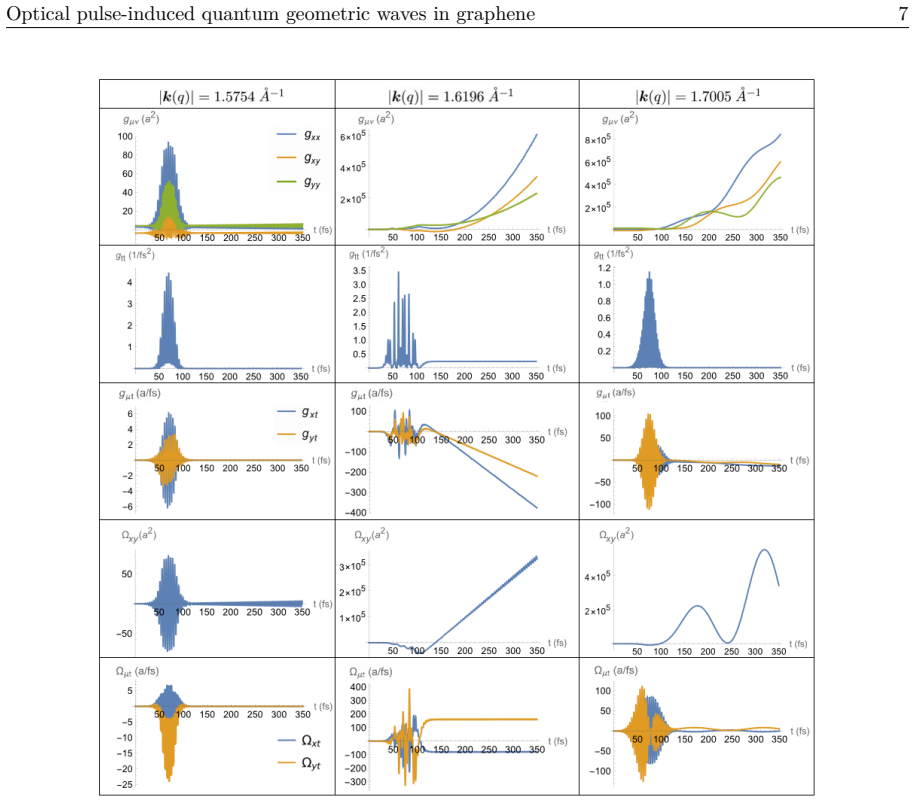
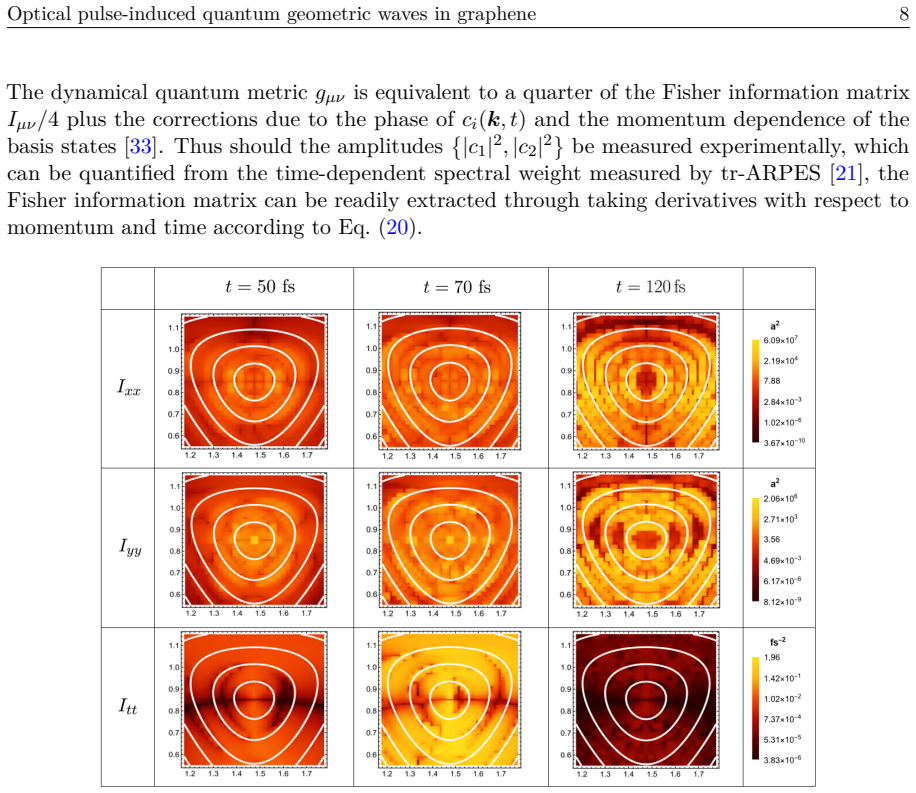
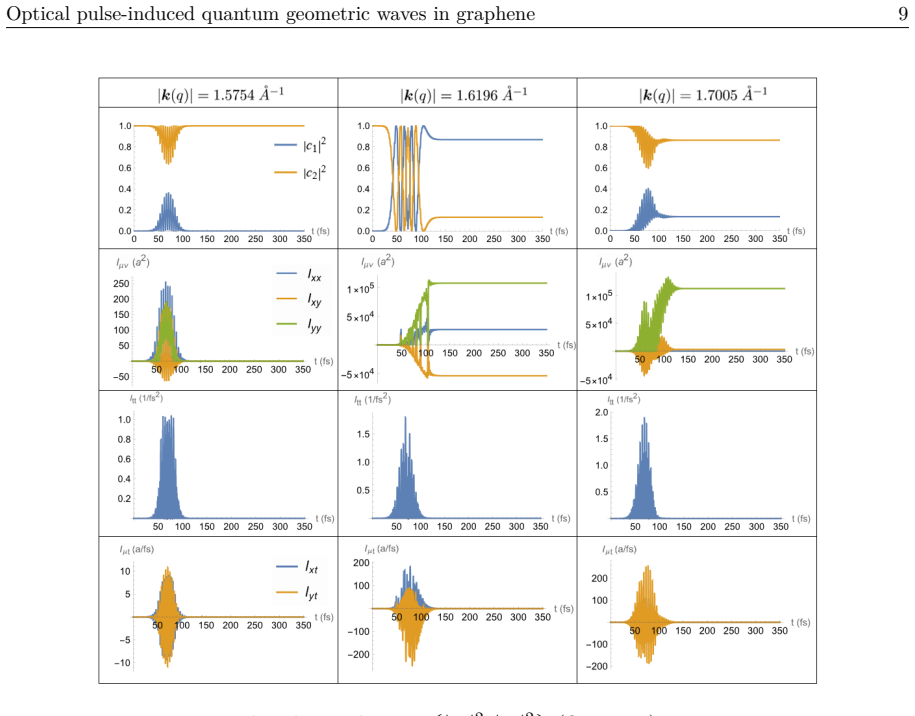
Under a short optical pulse, the quantum metric of Bloch states in the momentum-time (kx, ky, t) space of graphene becomes dynamic and exhibits a wave-like behavior near Dirac points. This quantum metric wave reflects the Floquet-band structure caused by the pulse. The momentum and temporal components of the metric have very distinct time dependence that persists even after the pulse has passed. In addition, the pulse also generates a Berry curvature wave that is otherwise absent in static graphene. The time-dependent electron densities in conduction and valence bands also give rise to a Fisher information wave that constitutes part of the quantum metric wave.
What carries the argument
The time-dependent quantum metric in (kx, ky, t) space obtained by solving the time-dependent Schrödinger equation for pulse-driven Bloch states.
If this is right
- The momentum and temporal components of the metric evolve with distinct time dependence that survives after the pulse.
- The pulse creates a Berry curvature wave absent from static graphene.
- Time-dependent band densities produce a Fisher information wave as part of the quantum metric wave.
- These waves directly encode the Floquet band structure induced by the pulse.
Where Pith is reading between the lines
- Similar pulse-driven waves may appear in other Dirac materials if the same non-interacting approximation holds.
- The persistence of the metric components after the pulse suggests a route to imprinting transient geometric phases for ultrafast control.
- Pump-probe detection of the Fisher information wave offers a direct experimental handle on non-equilibrium quantum geometry without requiring full tomography.
Load-bearing premise
The calculation assumes correlations and out-of-equilibrium effects can be ignored when solving the time-dependent Schrödinger equation.
What would settle it
Pump-probe measurement of the time-dependent electron density or Berry curvature near the Dirac points under a short optical pulse that matches or deviates from the wave patterns predicted by the time-dependent Schrödinger equation solution.
Figures

read the original abstract
We show that, under a short optical pulse, the quantum metric of Bloch states in the momentum-time (kx, ky , t) of graphene becomes dynamic and exhibits a wave-like behavior near Dirac points. This quantum metric wave reflects the Floquet-band structure caused by the pulse, as revealed by solving the time-dependent Schr\"odinger equation assuming that correlations and out-of-equilibrium effects can be ignored. The momentum and temporal components of the metric have very distinct time dependence that persists even after the pulse has passed. In addition, the pulse also generates a Berry curvature wave that is otherwise absent in static graphene. The time-dependent electron densities in conduction and valence bands also give arise to a Fisher information wave that constitutes part of the quantum metric wave, and is readily measurable by pump-probe experiments.
Editorial analysis
A structured set of objections, weighed in public.
Referee Report
Summary. The manuscript claims that a short optical pulse renders the quantum metric of Bloch states dynamic in the (kx, ky, t) space of graphene, producing wave-like behavior near the Dirac points that reflects the Floquet-band structure. This is obtained by direct solution of the time-dependent Schrödinger equation under the explicit assumption that correlations and out-of-equilibrium effects can be ignored. The pulse additionally generates a Berry curvature wave (absent in equilibrium graphene) and a Fisher information wave arising from the time-dependent conduction- and valence-band densities, the latter asserted to be measurable via pump-probe spectroscopy. Momentum and temporal metric components exhibit distinct post-pulse time dependence.
Significance. If the single-particle TDSE approximation remains valid, the work would establish a concrete route by which optical driving can induce propagating quantum-geometric waves in a Dirac material, thereby connecting Floquet engineering to time-resolved measurements of the quantum metric and Berry curvature. The derivation contains no free parameters and proceeds from an explicit TDSE solution rather than phenomenological fitting, which strengthens its internal consistency.
major comments (2)
- [Abstract / TDSE derivation] Abstract and the TDSE solution section: the reported wave-like propagation of the quantum metric and the induced Berry curvature wave are obtained under the assumption that correlations and out-of-equilibrium effects can be ignored. In graphene, electron-electron and electron-phonon scattering times are often comparable to or shorter than typical optical-pulse durations; without a quantitative estimate of the regime where the non-interacting evolution remains accurate, it is unclear whether the claimed wave-like features survive in a realistic many-body setting.
- [Post-pulse dynamics paragraph] Results on post-pulse dynamics: the manuscript states that the momentum and temporal components of the metric retain distinct time dependence even after the pulse has passed. Because the central claim of a persistent quantum metric wave rests on this persistence, an explicit check against the neglected scattering channels (or a statement of the relevant timescales) is required to establish that the wave-like behavior is not an artifact of the non-interacting approximation.
minor comments (2)
- [Abstract] Abstract: 'give arise to' should read 'give rise to'.
- [Introduction / Methods] Notation for the quantum geometric tensor in (kx, ky, t) should be introduced with a brief reminder of its relation to the standard quantum metric g_{\mu\nu} and Berry curvature \Omega, to aid readers unfamiliar with the time-dependent extension.
Simulated Author's Rebuttal
We thank the referee for the careful reading and constructive comments. Our work is a single-particle TDSE study under the stated assumption of negligible correlations. We address the two major comments below and will make partial revisions to clarify timescales.
read point-by-point responses
-
Referee: [Abstract / TDSE derivation] Abstract and the TDSE solution section: the reported wave-like propagation of the quantum metric and the induced Berry curvature wave are obtained under the assumption that correlations and out-of-equilibrium effects can be ignored. In graphene, electron-electron and electron-phonon scattering times are often comparable to or shorter than typical optical-pulse durations; without a quantitative estimate of the regime where the non-interacting evolution remains accurate, it is unclear whether the claimed wave-like features survive in a realistic many-body setting.
Authors: The manuscript explicitly frames the calculation as a non-interacting TDSE solution (see abstract and derivation section). We will add a discussion of relevant timescales, noting that optical pulses are typically femtoseconds while electron-phonon scattering in graphene is often picoseconds (depending on doping and temperature), suggesting a window where coherent evolution dominates. A full many-body validation lies outside the present scope; the reported waves constitute the coherent baseline. This is a partial revision. revision: partial
-
Referee: [Post-pulse dynamics paragraph] Results on post-pulse dynamics: the manuscript states that the momentum and temporal components of the metric retain distinct time dependence even after the pulse has passed. Because the central claim of a persistent quantum metric wave rests on this persistence, an explicit check against the neglected scattering channels (or a statement of the relevant timescales) is required to establish that the wave-like behavior is not an artifact of the non-interacting approximation.
Authors: The distinct post-pulse time dependence of metric components follows directly from the phase evolution of the time-dependent Bloch states after the drive is off. We will insert a clarifying statement on timescales, indicating that the persistence is expected to hold for durations shorter than scattering times within the non-interacting model. An explicit scattering calculation would require an entirely different formalism and is not feasible here, but the result is not presented as an artifact. revision: partial
- A quantitative estimate of the regime of validity for the non-interacting approximation, which would require many-body calculations beyond the manuscript's scope.
Circularity Check
No significant circularity; derivation is direct TDSE solution
full rationale
The paper's central claim follows from numerically or analytically solving the time-dependent Schrödinger equation for single-particle Bloch states in graphene under a short optical pulse, then computing the quantum geometric tensor (including metric and Berry curvature components) in (kx, ky, t) space from the evolved states. This procedure is presented as a first-principles computation under the explicit assumption that correlations and out-of-equilibrium effects can be ignored; no parameters are fitted to data and then relabeled as predictions, no quantities are defined in terms of each other, and no load-bearing self-citations or imported uniqueness theorems are invoked in the abstract or described method. The resulting wave-like behavior in the metric and induced Berry curvature are direct consequences of the Floquet-like structure generated by the pulse, making the derivation self-contained against external benchmarks.
Axiom & Free-Parameter Ledger
axioms (1)
- domain assumption correlations and out-of-equilibrium effects can be ignored
Reference graph
Works this paper leans on
-
[1]
J. P. Provost and G. Vallee. Riemannian structure on manifolds of quantum states.Comm. Math. Phys., 76(3):289–301, 1980
1980
-
[2]
M. V. Berry. Quantal phase factors accompanying adiabatic changes.Proc. R. Soc. A, 392(1802):45–57, 1984
1984
-
[3]
Berry phase effects on electronic properties.Rev
Di Xiao, Ming-Che Chang, and Qian Niu. Berry phase effects on electronic properties.Rev. Mod. Phys., 82:1959–2007, July 2010
1959
-
[4]
Extracting the quantum metric tensor through periodic driving.Phys
Tomoki Ozawa and Nathan Goldman. Extracting the quantum metric tensor through periodic driving.Phys. Rev. B, 97:201117, May 2018
2018
-
[5]
Riemannian geometry of resonant optical responses.Nat
Junyeong Ahn, Guang-Yu Guo, Naoto Nagaosa, and Ashvin Vishwanath. Riemannian geometry of resonant optical responses.Nat. Phys., 18(3):290–295, Mar 2022
2022
-
[6]
The quantum geometric origin of capacitance in insulators.Nature Communications, 15(1):4621, May 2024
Ilia Komissarov, Tobias Holder, and Raquel Queiroz. The quantum geometric origin of capacitance in insulators.Nature Communications, 15(1):4621, May 2024
2024
-
[7]
Dielectric and optical markers originating from quantum geometry.Phys
Wei Chen. Dielectric and optical markers originating from quantum geometry.Phys. Rev. B, 111:085202, Feb 2025
2025
-
[8]
De Grandi, V
C. De Grandi, V. Gritsev, and A. Polkovnikov. Quench dynamics near a quantum critical point.Phys. Rev. B, 81:012303, Jan 2010
2010
-
[9]
De Grandi, V
C. De Grandi, V. Gritsev, and A. Polkovnikov. Quench dynamics near a quantum critical point: Application to the sine-gordon model.Phys. Rev. B, 81:224301, Jun 2010
2010
-
[10]
Shengshi Pang and Andrew N. Jordan. Optimal adaptive control for quantum metrology with time-dependent hamiltonians.Nature Communications, 8(1):14695, Mar 2017
2017
-
[11]
Jafari and Alireza Akbari
R. Jafari and Alireza Akbari. Dynamics of quantum coherence and quantum fisher informa- tion after a sudden quench.Phys. Rev. A, 101:062105, Jun 2020
2020
-
[12]
Universal critical dynamics of quantum geometry, 2024
Shuohang Wu, Zhengxin Guo, Zijian Xiong, Yuan Yao, and Zi Cai. Universal critical dynamics of quantum geometry, 2024. arXiv:2401.17885
arXiv 2024
-
[13]
Bogar Díaz, Diego Gonzalez, Marcos J. Hernández, and J. David Vergara. Time-dependent quantum geometric tensor and some applications, 2025. arXiv:2502.01788
arXiv 2025
-
[14]
Dawlaty, Shriram Shivaraman, Mvs Chandrashekhar, Farhan Rana, and Michael G
Jahan M. Dawlaty, Shriram Shivaraman, Mvs Chandrashekhar, Farhan Rana, and Michael G. Spencer. Measurement of ultrafast carrier dynamics in epitaxial graphene.Appl. Phys. Lett., 92(4):042116, 01 2008
2008
-
[15]
Strait, Paul A
Haining Wang, Jared H. Strait, Paul A. George, Shriram Shivaraman, Virgil B. Shields, Mvs Chandrashekhar, Jeonghyun Hwang, Farhan Rana, Michael G. Spencer, Carlos S. Ruiz-Vargas, and Jiwoong Park. Ultrafast relaxation dynamics of hot optical phonons in graphene.Appl. Phys. Lett., 96(8):081917, 02 2010
2010
-
[16]
Breusing, S
M. Breusing, S. Kuehn, T. Winzer, E. Malić, F. Milde, N. Severin, J. P. Rabe, C. Ropers, A. Knorr, and T. Elsaesser. Ultrafast nonequilibrium carrier dynamics in a single graphene layer.Phys. Rev. B, 83:153410, Apr 2011
2011
-
[17]
Strait, Haining Wang, Shriram Shivaraman, Virgil Shields, Michael Spencer, and Farhan Rana
Jared H. Strait, Haining Wang, Shriram Shivaraman, Virgil Shields, Michael Spencer, and Farhan Rana. Very slow cooling dynamics of photoexcited carriers in graphene observed by optical-pump terahertz-probe spectroscopy.Nano Lett., 11(11):4902–4906, Nov 2011. Optical pulse-induced quantum geometric waves in graphene 14
2011
-
[18]
Winnerl, M
S. Winnerl, M. Orlita, P. Plochocka, P. Kossacki, M. Potemski, T. Winzer, E. Malic, A. Knorr, M. Sprinkle, C. Berger, W. A. de Heer, H. Schneider, and M. Helm. Carrier relaxation in epitaxial graphene photoexcited near the dirac point.Phys. Rev. Lett., 107:237401, Nov 2011
2011
-
[19]
K. J. Tielrooij, J. C. W. Song, S. A. Jensen, A. Centeno, A. Pesquera, A. Zurutuza Elorza, M. Bonn, L. S. Levitov, and F. H. L. Koppens. Photoexcitation cascade and multiple hot-carrier generation in graphene.Nat. Phys., 9(4):248–252, Apr 2013
2013
-
[20]
Jens Christian Johannsen, Søren Ulstrup, Federico Cilento, Alberto Crepaldi, Michele Zacchigna, Cephise Cacho, I. C. Edmond Turcu, Emma Springate, Felix Fromm, Christian Raidel, Thomas Seyller, Fulvio Parmigiani, Marco Grioni, and Philip Hofmann. Direct view of hot carrier dynamics in graphene.Phys. Rev. Lett., 111:027403, Jul 2013
2013
-
[21]
Petersen, Matteo Mitrano, Cephise Cacho, I
Isabella Gierz, Jesse C. Petersen, Matteo Mitrano, Cephise Cacho, I. C. Edmond Turcu, Emma Springate, Alexander Stöhr, Axel Köhler, Ulrich Starke, and Andrea Cavalleri. Snap- shots of non-equilibrium dirac carrier distributions in graphene.Nat. Mater., 12(12):1119– 1124, Dec 2013
2013
-
[22]
Brida, A
D. Brida, A. Tomadin, C. Manzoni, Y. J. Kim, A. Lombardo, S. Milana, R. R. Nair, K. S. Novoselov, A. C. Ferrari, G. Cerullo, and M. Polini. Ultrafast collinear scattering and carrier multiplication in graphene.Nat. Commun., 4(1):1987, Jun 2013
1987
-
[23]
Time-resolved spectroscopy on epitaxial graphene in the infrared spectral range: relaxation dynamics and saturation behavior.J
S Winnerl, F Göttfert, M Mittendorff, H Schneider, M Helm, T Winzer, E Malic, A Knorr, M Orlita, M Potemski, M Sprinkle, C Berger, and W A de Heer. Time-resolved spectroscopy on epitaxial graphene in the infrared spectral range: relaxation dynamics and saturation behavior.J. Phys. Condens. Matter, 25(5):054202, jan 2013
2013
-
[24]
Plötzing, T
T. Plötzing, T. Winzer, E. Malic, D. Neumaier, A. Knorr, and H. Kurz. Experimental verification of carrier multiplication in graphene.Nano Lett., 14(9):5371–5375, Sep 2014
2014
-
[25]
McLeod, Aleksandr S
Martin Wagner, Zhe Fei, Alexander S. McLeod, Aleksandr S. Rodin, Wenzhong Bao, Eric G. Iwinski, Zeng Zhao, Michael Goldflam, Mengkun Liu, Gerardo Dominguez, Mark Thiemens, Michael M. Fogler, Antonio H. Castro Neto, Chun Ning Lau, Sergiu Amarie, Fritz Keilmann, and D. N. Basov. Ultrafast and nanoscale plasmonic phenomena in exfoliated graphene revealed by ...
2014
-
[26]
Gierz, F
I. Gierz, F. Calegari, S. Aeschlimann, M. Chávez Cervantes, C. Cacho, R. T. Chapman, E.Springate, S.Link, U.Starke, C.R.Ast, andA.Cavalleri. Trackingprimarythermalization events in graphene with photoemission at extreme time scales.Phys. Rev. Lett., 115:086803, Aug 2015
2015
-
[27]
M. A. Sentef, M. Claassen, A. F. Kemper, B. Moritz, T. Oka, J. K. Freericks, and T. P. Devereaux. Theory of floquet band formation and local pseudospin textures in pump-probe photoemission of graphene.Nature Communications, 6(1):7047, May 2015
2015
-
[28]
Michael Schüler and Michael A. Sentef. Theory of subcycle time-resolved photoemission: Application to terahertz photodressing in graphene.J. Electron Spectrosc. Relat. Phenom., 253:147121, 2021
2021
-
[29]
Manmana, Michael A
Marco Merboldt, Michael Schüler, David Schmitt, Jan Philipp Bange, Wiebke Bennecke, Karun Gadge, Klaus Pierz, Hans Werner Schumacher, Davood Momeni, Daniel Steil, Salvatore R. Manmana, Michael A. Sentef, Marcel Reutzel, and Stefan Mathias. Observation of floquet states in graphene.Nat. Phys., 21(7):1093–1099, Jul 2025. Optical pulse-induced quantum geomet...
2025
-
[30]
Driven quantum tunneling.Physics Reports, 304(5):229– 354, 1998
Milena Grifoni and Peter Hänggi. Driven quantum tunneling.Physics Reports, 304(5):229– 354, 1998
1998
-
[31]
Amari.Information Geometry and Its Applications
S. Amari.Information Geometry and Its Applications. Springer, February 2016
2016
-
[32]
R. A. Fisher. Theory of statistical estimation.Math. Proc. Camb. Philos. Soc., 22(5):700–725, 1925
1925
-
[33]
Man’ko, Giuseppe Marmo, E.C.G
Paolo Facchi, Ravi Kulkarni, V.I. Man’ko, Giuseppe Marmo, E.C.G. Sudarshan, and Franco Ventriglia. Classical and quantum fisher information in the geometrical formulation of quantum mechanics.Physics Letters A, 374(48):4801–4803, 2010
2010
-
[34]
A. H. Castro Neto, F. Guinea, N. M. R. Peres, K. S. Novoselov, and A. K. Geim. The electronic properties of graphene.Rev. Mod. Phys., 81:109–162, Jan 2009
2009
-
[35]
Model spin-orbit coupling hamiltonians for graphene systems.Phys
Denis Kochan, Susanne Irmer, and Jaroslav Fabian. Model spin-orbit coupling hamiltonians for graphene systems.Phys. Rev. B, 95:165415, Apr 2017
2017
-
[36]
Measurement of topological order based on metric- curvature correspondence.Phys
Gero von Gersdorff and Wei Chen. Measurement of topological order based on metric- curvature correspondence.Phys. Rev. B, 104:195133, Nov 2021
2021
-
[37]
Measurement of the berry curvature of solids using high-harmonic spectroscopy.Nat
Tran Trung Luu and Hans Jakob Wörner. Measurement of the berry curvature of solids using high-harmonic spectroscopy.Nat. Commun., 9(1):916, Mar 2018
2018
-
[38]
Measurement of interaction-dressed berry curvature and quantum metric in solids by optical absorption.SciPost Phys
Wei Chen and Gero von Gersdorff. Measurement of interaction-dressed berry curvature and quantum metric in solids by optical absorption.SciPost Phys. Core, 5:040, 2022
2022
-
[39]
Neves, Linda Ye, Junseo Jung, Denny Puntel, Federico Mazzola, Shiang Fang, Chris Jozwiak, Aaron Bostwick, Eli Rotenberg, Jun Fuji, Ivana Vobornik, Jae-Hoon Park, Joseph G
Mingu Kang, Sunje Kim, Yuting Qian, Paul M. Neves, Linda Ye, Junseo Jung, Denny Puntel, Federico Mazzola, Shiang Fang, Chris Jozwiak, Aaron Bostwick, Eli Rotenberg, Jun Fuji, Ivana Vobornik, Jae-Hoon Park, Joseph G. Checkelsky, Bohm-Jung Yang, and Riccardo Comin. Measurements of the quantum geometric tensor in solids.Nat. Phys., 21(1):110–117, Jan 2025
2025
discussion (0)
Sign in with ORCID, Apple, or X to comment. Anyone can read and Pith papers without signing in.