Dirac-Phase CP-Violation in the Low-Scale Type-I Seesaw with Three Right-Handed Neutrinos
Pith reviewed 2026-06-28 21:43 UTC · model grok-4.3
The pith
CP violation solely from the Dirac phase enables low-scale leptogenesis with testable heavy neutrinos.
A machine-rendered reading of the paper's core claim, the machinery that carries it, and where it could break.
Core claim
A CP-conserving non-real 3x3 orthogonal matrix parametrized by two real angles and one imaginary parameter can be constructed so that the only CP-violating phases in the Yukawa couplings are those of the PMNS matrix; under this hypothesis, Dirac-phase CP violation alone suffices to generate the observed baryon asymmetry through low-scale leptogenesis for quasi-degenerate heavy neutrinos whose mixings are testable at colliders.
What carries the argument
The CP-conserving non-real structure of the 3x3 orthogonal matrix in the Casas-Ibarra parametrization, which isolates all CP violation to the Dirac phase δ.
If this is right
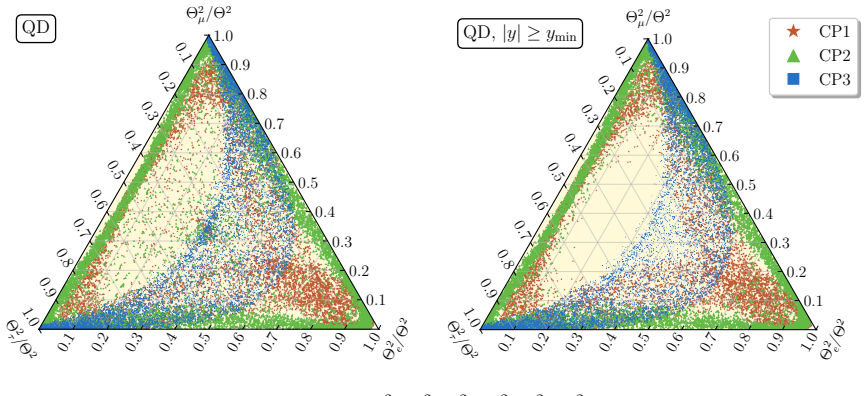
- Only restricted subregions of the ternary space of squared couplings Θ_e² : Θ_μ² : Θ_τ² remain compatible with Dirac-phase CP violation and collider testability.
- The effective Majorana mass parameter for neutrinoless double-beta decay acquires specific forms fixed by the same orthogonal-matrix structure.
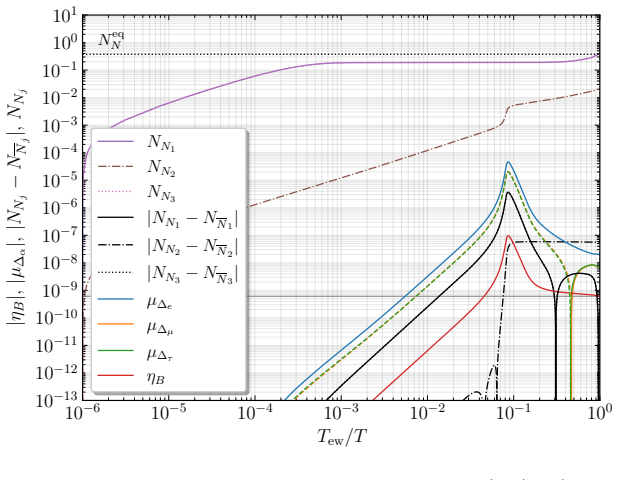
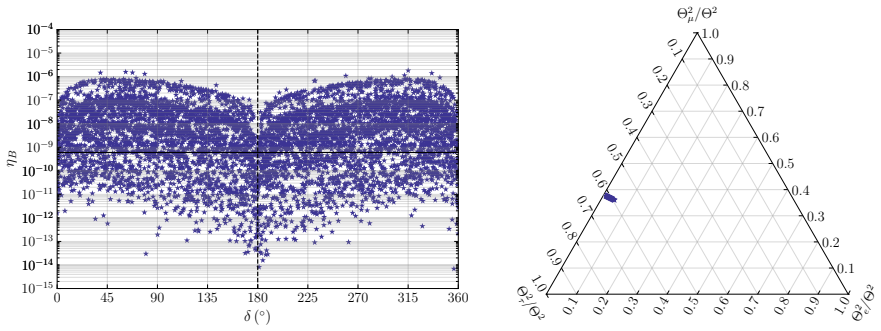
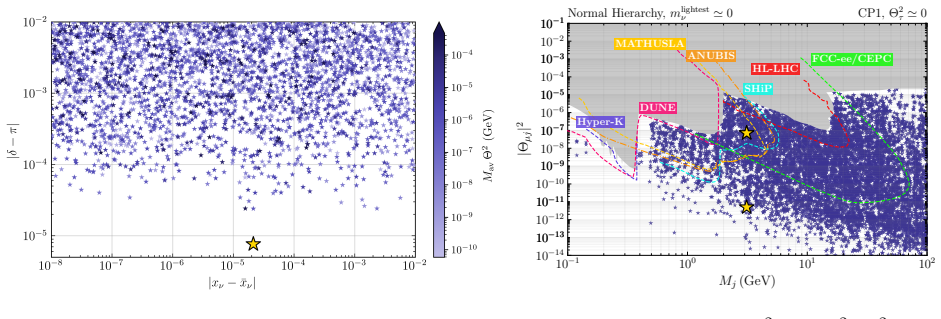
- The baryon asymmetry vanishes exactly when δ equals 0, π or 2π, but is recovered for deviations as small as O(10^{-5}).
- Low-scale leptogenesis remains viable throughout the entire testable region under this CP-violation hypothesis.
Where Pith is reading between the lines
- If future collider data exclude the allowed coupling-ratio subregions while still finding heavy neutrinos, the hypothesis that CP violation arises only from δ would be ruled out independently of leptogenesis calculations.
- The smallness of the required δ deviation suggests that ultraviolet models with nearly exact CP symmetry could still account for the baryon asymmetry provided the orthogonal-matrix structure is realized.
Load-bearing premise
A specific CP-conserving non-real form of the orthogonal matrix can always be chosen so that the only source of CP violation in the Yukawa couplings is the Dirac phase of the PMNS matrix.
What would settle it
Observation of a non-zero baryon asymmetry together with collider evidence for quasi-degenerate heavy neutrinos whose flavor coupling ratios lie outside the allowed subregions would falsify the scenario.
Figures





read the original abstract
We study the low-scale type-I seesaw with three right-handed neutrinos (i.e. heavy Majorana neutrinos) when the CP-violation arises solely from the low-energy Dirac phase $\delta$ of the Pontecorvo-Maki-Nakagawa-Sakata (PMNS) neutrino mixing matrix and the heavy neutrinos have testable mixings. We derive a CP-conserving and non-real structure of the $3\times 3$ orthogonal matrix entering the Casas-Ibarra parametrisation in terms of two real angles and one single imaginary parameter, ensuring that the only CP-violating phases in the neutrino Yukawa couplings are those of the PMNS matrix. We then focus on the case of CP-violation from $\delta$ alone and discuss the phenomenological implications of this hypothesis. We concentrate on quasi-degenerate heavy Majorana neutrinos with masses within $\sim (0.1-100)\,\text{GeV}$, as relevant for low-scale leptogenesis. Only certain subregions of the full ternary space defined by the ratios $\Theta^2_e:\Theta^2_\mu:\Theta^2_\tau$ -- where $\Theta^2_\alpha$ denotes the squared coupling of the heavy neutrinos to leptons of flavour $\alpha = e,\,\mu,\,\tau$ -- are compatible with Dirac-phase CP-violation while being testable at collider experiments. Our assumption also implies specific forms of the effective Majorana mass parameter that can be tested at neutrinoless double-beta decay searches. Finally, low-scale leptogenesis under this restrictive scenario can still reproduce the observed baryon asymmetry of the Universe (BAU) in the entire testable region of the parameter space. The BAU vanishes in the exact limit of CP-conserving values of the Dirac phase $\delta = 0,\,\pi,\,2\pi$, but the observed BAU can be reproduced within the testable region even if $\delta$ deviates from these values by a factor as small as $\mathcal{O}(10^{-5})$, with important implications for ultraviolet completions with approximate CP-symmetry.
Editorial analysis
A structured set of objections, weighed in public.
Referee Report
Summary. The manuscript derives a CP-conserving non-real 3×3 orthogonal matrix R in the Casas-Ibarra parametrization for the type-I seesaw with three right-handed neutrinos, using two real angles and one imaginary parameter, such that the only CP-violating phases in the Yukawa matrix Y_ν arise from the PMNS Dirac phase δ. It then examines the low-scale regime with quasi-degenerate heavy neutrinos (0.1–100 GeV) and testable mixings, identifying compatible subregions of the Θ_e²:Θ_μ²:Θ_τ² space, specific forms for the effective Majorana mass in 0νββ decay, and showing that resonant leptogenesis can reproduce the observed BAU for |δ| deviations as small as O(10^{-5}) while vanishing exactly at δ = 0, π, 2π.
Significance. If the derivation of the R structure holds without hidden cancellations or tuning, the result is significant for demonstrating that Dirac-phase-only CP violation suffices for viable low-scale leptogenesis in a restrictive but collider-testable parameter space, with direct implications for approximate-CP UV completions. The explicit link between small δ and BAU generation across the full testable mixing subregions, combined with 0νββ predictions, offers falsifiable tests not commonly explored in three-RHN models.
major comments (2)
- [Abstract (derivation step)] Abstract (derivation step): The central construction of a CP-conserving yet non-real R that forces all CP phases in Y_ν = (i/v) U_PMNS diag(√m_ν) R diag(√M_N) to originate solely from δ must be shown explicitly to produce an unflavoured or flavoured CP asymmetry ε_α strictly proportional to sin δ, without the imaginary parameter in R inducing additional imaginary-part cancellations that would suppress ε below the level needed for Y_B ≈ 6×10^{-10} in the quasi-degenerate window.
- [Leptogenesis results (implied quantitative section)] Leptogenesis results (implied quantitative section): The statement that the observed BAU is reproduced in the entire testable region for |δ| ≳ O(10^{-5}) depends on the specific choice of the two real angles and imaginary parameter of R together with the mass splitting; it is unclear whether this holds generically or only after restricting to subregions of the Θ² ternary space, raising the possibility that the result is not parameter-free within the stated hypothesis.
minor comments (2)
- The exact explicit form of the derived R matrix (its elements in terms of the two angles and imaginary parameter) should be displayed in a dedicated equation early in the text rather than described only in the abstract, to allow direct verification of the CP properties.
- Clarify whether the compatible subregions of the Θ_e²:Θ_μ²:Θ_τ² space are determined solely by the Dirac-phase condition or also by additional constraints from the seesaw mass matrix diagonalization.
Simulated Author's Rebuttal
We thank the referee for the careful reading of our manuscript and the constructive comments. We address each major comment point by point below, providing explicit references to the derivations and results already present in the paper. We believe the existing analysis suffices to resolve the concerns without requiring changes to the core claims.
read point-by-point responses
-
Referee: [Abstract (derivation step)] Abstract (derivation step): The central construction of a CP-conserving yet non-real R that forces all CP phases in Y_ν = (i/v) U_PMNS diag(√m_ν) R diag(√M_N) to originate solely from δ must be shown explicitly to produce an unflavoured or flavoured CP asymmetry ε_α strictly proportional to sin δ, without the imaginary parameter in R inducing additional imaginary-part cancellations that would suppress ε below the level needed for Y_B ≈ 6×10^{-10} in the quasi-degenerate window.
Authors: Section 2 of the manuscript explicitly constructs the CP-conserving non-real R matrix using two real angles and one imaginary parameter, chosen so that all imaginary contributions from R cancel in the phase structure of Y_ν, leaving only the PMNS Dirac phase δ as the source of CP violation. In Section 4, the flavoured CP asymmetries ε_α are derived analytically and shown to be strictly proportional to sin δ. The imaginary parameter in R affects only the overall magnitude of the Yukawa couplings (and thus the mixing angles Θ_α²) but does not introduce additional phases or cancellations that suppress ε_α; this is verified both analytically and through the numerical scans in the quasi-degenerate regime (0.1–100 GeV), where Y_B reaches the observed value without suppression below 6×10^{-10}. revision: no
-
Referee: [Leptogenesis results (implied quantitative section)] Leptogenesis results (implied quantitative section): The statement that the observed BAU is reproduced in the entire testable region for |δ| ≳ O(10^{-5}) depends on the specific choice of the two real angles and imaginary parameter of R together with the mass splitting; it is unclear whether this holds generically or only after restricting to subregions of the Θ² ternary space, raising the possibility that the result is not parameter-free within the stated hypothesis.
Authors: The hypothesis of Dirac-phase-only CP violation inherently restricts the allowed parameter space to specific subregions of the Θ_e²:Θ_μ²:Θ_τ² ternary plot, as derived in Section 3 from the structure of R. Within these subregions, Section 5 presents numerical results for resonant leptogenesis across the full range of compatible mixings and mass splittings (with the imaginary parameter and real angles fixed by the CP-conserving condition). The observed BAU is reproduced for |δ| deviations as small as O(10^{-5}) throughout the testable region, vanishing exactly at δ = 0, π, 2π. The result is generic under the stated hypothesis rather than dependent on further ad hoc tuning. revision: no
Circularity Check
No circularity: derivation of R is an explicit construction; BAU result is a numerical check within the constructed scenario
full rationale
The paper explicitly derives a parametrized form of the orthogonal matrix R (two real angles + one imaginary parameter) chosen so that the only CP phases in Y_ν arise from U_PMNS. This is a direct construction realizing the stated hypothesis rather than a self-definitional loop or a fitted parameter relabeled as a prediction. The subsequent statement that low-scale leptogenesis reproduces the observed BAU throughout the testable region is a consequence obtained after restricting to the subregions compatible with that R; it does not reduce the result to the input by construction. No self-citation load-bearing step, uniqueness theorem imported from the same authors, or ansatz smuggled via citation is present in the provided text. The analysis is therefore self-contained against external benchmarks (Casas-Ibarra parametrization, standard leptogenesis equations) and receives score 0.
Axiom & Free-Parameter Ledger
free parameters (3)
- two real angles of the orthogonal matrix
- one imaginary parameter of the orthogonal matrix
- heavy-neutrino mass scale and quasi-degeneracy splitting
axioms (2)
- domain assumption Validity of the type-I seesaw mechanism with exactly three right-handed neutrinos at low scale
- standard math Casas-Ibarra parametrization of the neutrino Yukawa matrix in terms of the PMNS matrix and an orthogonal matrix
Reference graph
Works this paper leans on
-
[1]
Minkowski,µ→eγat a Rate of One Out of10 9 Muon Decays?,Physics Letters B 67(1977) 421
P. Minkowski,µ→eγat a Rate of One Out of10 9 Muon Decays?,Physics Letters B 67(1977) 421
1977
-
[2]
Yanagida,Horizontal Symmetry and Masses Of Neutrinos,Conference Proceedings C7902131(1979) 95
T. Yanagida,Horizontal Symmetry and Masses Of Neutrinos,Conference Proceedings C7902131(1979) 95
1979
-
[3]
M. Gell-Mann, P. Ramond and R. Slansky,Complex Spinors and Unified Theories, Conference ProceedingsC790927(1979) 315 [1306.4669]
Pith/arXiv arXiv 1979
-
[4]
Glashow,The Future of Elementary Particle Physics,NATO Advanced Study Institutes Series61(1980) 687
S. Glashow,The Future of Elementary Particle Physics,NATO Advanced Study Institutes Series61(1980) 687
1980
-
[5]
R. N. Mohapatra and G. Senjanovic,Neutrino Mass and Spontaneous Parity Violation, Physical Review Letters44(1980) 912
1980
-
[6]
Wyler and L
D. Wyler and L. Wolfenstein,Massless neutrinos in left-right symmetric models,
-
[7]
R. N. Mohapatra,Mechanism for Understanding Small Neutrino Mass in Superstring Theories,Physical Review Letters56(1986) 561
1986
-
[8]
M. Malinsky, J. C. Rom˜ ao and J. W. F. Valle,Novel supersymmetric SO(10) seesaw mechanism,Physical Review Letters95(2005) 161801 [hep-ph/0506296]
Pith/arXiv arXiv 2005
-
[9]
C. N. Leung and S. T. Petcov,A Comment on the Coexistence of Dirac and Majorana Massive Neutrinos,Physics Letters B125(1983) 461
1983
-
[10]
Shaposhnikov,A possible symmetry of theνMSM,Nuclear Physics B763(2007) 49 [hep-ph/0605047]
M. Shaposhnikov,A possible symmetry of theνMSM,Nuclear Physics B763(2007) 49 [hep-ph/0605047]
Pith/arXiv arXiv 2007
-
[11]
J. Kersten and A. Y. Smirnov,Right-handed neutrinos at CERN LHC and the mechanism of neutrino mass generation,Physical Review D76(2007) 073005 [0705.3221]
Pith/arXiv arXiv 2007
-
[12]
M. B. Gavela, T. Hambye, D. Hernandez and P. Hernandez,Minimal flavour seesaw models,Journal of High Energy Physics09(2009) 038 [0906.1461]
Pith/arXiv arXiv 2009
-
[13]
A. Ibarra, E. Molinaro and S. T. Petcov,TeV scale see-saw mechanisms of neutrino mass generation, the Majorana nature of the heavy singlet neutrinos and(ββ) 0ν-decay, Journal of High Energy Physics09(2010) 108 [1007.2378]
Pith/arXiv arXiv 2010
-
[14]
S. Antusch and O. Fischer,Testing sterile neutrino extensions of the Standard Model at future lepton colliders,Journal of High Energy Physics05(2015) 053 [1502.05915]. 58
Pith/arXiv arXiv 2015
-
[15]
A. Granelli, D. Meloni, M. Parriciatu, J. T. Penedo and S. T. Petcov, Modular-symmetry-protected seesaw,Journal of High Energy Physics12(2025) 35 [2505.21405]
arXiv 2025
-
[16]
A. Pilaftsis,Radiatively induced neutrino masses and large Higgs-neutrino couplings in the Standard Model with Majorana fields,Zeitschrift f¨ ur Physik C Particles and Fields 55(1992) 275–282 [hep-ph/9901206]
Pith/arXiv arXiv 1992
-
[17]
W. Grimus and L. Lavoura,One-loop corrections to the seesaw mechanism in the multi-Higgs-doublet Standard Model,Physics Letters B546(2002) 86–95 [hep-ph/0207229]
Pith/arXiv arXiv 2002
-
[18]
D. Aristizabal Sierra and C. E. Yaguna,On the importance of the 1-loop finite corrections to seesaw neutrino masses,Journal of High Energy Physics2011(2011) [1106.3587]
Pith/arXiv arXiv 2011
-
[19]
J. Lopez-Pavon, S. Pascoli and C.-f. Wong,Can heavy neutrinos dominate neutrinoless double beta decay?,Physical Review D87(2013) [1209.5342]
Pith/arXiv arXiv 2013
-
[20]
A. M. Abdullahi et al.,The present and future status of heavy neutral leptons,Journal of Physics G50(2023) 020501 [2203.08039]
arXiv 2023
-
[21]
C. Antel et al.,Feebly-interacting particles: FIPs 2022 Workshop Report,The European Physical Journal C83(2023) 1122 [2305.01715]
arXiv 2022
-
[22]
V. A. Kuzmin, V. A. Rubakov and M. E. Shaposhnikov,On the Anomalous Electroweak Baryon Number Nonconservation in the Early Universe,Physics Letters B155(1985) 36
1985
-
[23]
Fukugita and T
M. Fukugita and T. Yanagida,Baryogenesis Without Grand Unification,Physics Letters B174(1986) 45
1986
-
[24]
Aghanim et al.,Planck 2018 results,Astronomy&Astrophysics641(2020) A6 [1807.06209]
N. Aghanim et al.,Planck 2018 results,Astronomy&Astrophysics641(2020) A6 [1807.06209]
Pith/arXiv arXiv 2018
-
[25]
R. J. Cooke, M. Pettini and C. C. Steidel,One Percent Determination of the Primordial Deuterium Abundance,The Astrophysical Journal855(2018) 102 [1710.11129]
Pith/arXiv arXiv 2018
-
[26]
A. D. Sakharov,Violation of CP Invariance, C Asymmetry, and Baryon Asymmetry of the Universe,Soviet Physics Uspekhi5(1991) 32
1991
-
[27]
M. D’Onofrio, K. Rummukainen and A. Tranberg,Sphaleron Rate in the Minimal Standard Model,Physical Review Letters113(2014) 141602 [1404.3565]
Pith/arXiv arXiv 2014
-
[28]
A. Pilaftsis,CP violation and baryogenesis due to heavy Majorana neutrinos,Physical Review D56(1997) 5431 [hep-ph/9707235]
Pith/arXiv arXiv 1997
-
[29]
A. Pilaftsis and T. E. J. Underwood,Resonant leptogenesis,Nuclear Physics B692 (2004) 303 [hep-ph/0309342]
Pith/arXiv arXiv 2004
-
[30]
E. K. Akhmedov, V. A. Rubakov and A. Y. Smirnov,Baryogenesis via neutrino oscillations,Physical Review Letters81(1998) 1359 [hep-ph/9803255]. 59
Pith/arXiv arXiv 1998
-
[31]
T. Asaka and M. Shaposhnikov,TheνMSM, dark matter and baryon asymmetry of the universe,Physics Letters B620(2005) 17 [hep-ph/0505013]
Pith/arXiv arXiv 2005
-
[32]
J. Racker, M. Pena and N. Rius,Leptogenesis with small violation of B-L,Journal of Cosmology and Astroparticle Physics07(2012) 030 [1205.1948]
Pith/arXiv arXiv 2012
-
[33]
D. Bodeker and W. Buchmuller,Baryogenesis from the weak scale to the grand unification scale,Reviews of Modern Physics93(2021) 035004 [2009.07294]
arXiv 2021
-
[34]
T. Hambye and D. Teresi,Higgs doublet decay as the origin of the baryon asymmetry, Physical Review Letters117(2016) 091801 [1606.00017]
Pith/arXiv arXiv 2016
-
[35]
T. Hambye and D. Teresi,Baryogenesis from L-violating Higgs-doublet decay in the density-matrix formalism,Physical Review D96(2017) 015031 [1705.00016]
Pith/arXiv arXiv 2017
-
[36]
A. Granelli, K. Moffat and S. T. Petcov,Flavoured resonant leptogenesis at sub-TeV scales,Nuclear Physics B973(2021) 115597 [2009.03166]
arXiv 2021
-
[37]
J. Klari´ c, M. Shaposhnikov and I. Timiryasov,Uniting Low-Scale Leptogenesis Mechanisms,Physical Review Letters127(2021) 111802 [2008.13771]
arXiv 2021
-
[38]
J. Klari´ c, M. Shaposhnikov and I. Timiryasov,Reconciling resonant leptogenesis and baryogenesis via neutrino oscillations,Physical Review D104(2021) 055010 [2103.16545]
arXiv 2021
- [39]
-
[40]
J. A. Casas and A. Ibarra,Oscillating neutrinos andµ→e, γ,Nuclear Physics B618 (2001) 171 [hep-ph/0103065]. [41]T2Kcollaboration,Measurements of neutrino oscillation parameters from the T2K experiment using3.6×10 21 protons on target,The European Physical Journal C83 (2023) 782 [2303.03222]. [42]NOvAcollaboration,Precision Measurement of Neutrino Oscillat...
Pith/arXiv arXiv 2001
-
[41]
S. M. Bilenky, J. Hosek and S. T. Petcov,On Oscillations of Neutrinos with Dirac and Majorana Masses,Physics Letters B94(1980) 495
1980
-
[42]
S. Pascoli, S. T. Petcov and A. Riotto,Connecting low energy leptonic CP-violation to leptogenesis,Physical Review D75(2007) 083511 [hep-ph/0609125]. 60
Pith/arXiv arXiv 2007
-
[43]
S. Pascoli, S. T. Petcov and A. Riotto,Leptogenesis and Low Energy CP Violation in Neutrino Physics,Nuclear Physics B774(2007) 1 [hep-ph/0611338]
Pith/arXiv arXiv 2007
-
[44]
S. Blanchet and P. Di Bari,Flavor effects on leptogenesis predictions,Journal of Cosmology and Astroparticle Physics03(2007) 018 [hep-ph/0607330]
Pith/arXiv arXiv 2007
-
[45]
G. C. Branco, A. J. Buras, S. Jager, S. Uhlig and A. Weiler,Another look at minimal lepton flavour violation,l i →l jγ, leptogenesis, and the ratioM ν/ΛLF V ,Journal of High Energy Physics09(2007) 004 [hep-ph/0609067]
Pith/arXiv arXiv 2007
-
[46]
G. C. Branco, R. Gonzalez Felipe and F. R. Joaquim,A New bridge between leptonic CP violation and leptogenesis,Physics Letters B645(2007) 432 [hep-ph/0609297]
Pith/arXiv arXiv 2007
-
[47]
S. Uhlig,Minimal Lepton Flavour Violation and Leptogenesis with exclusively low-energy CP Violation,Journal of High Energy Physics11(2007) 066 [hep-ph/0612262]
Pith/arXiv arXiv 2007
-
[48]
A. Anisimov, S. Blanchet and P. Di Bari,Viability of Dirac phase leptogenesis,Journal of Cosmology and Astroparticle Physics04(2008) 033 [0707.3024]
Pith/arXiv arXiv 2008
-
[49]
E. Molinaro and S. T. Petcov,The Interplay Between the ’Low’ and ’High’ Energy CP-Violation in Leptogenesis,The European Physical Journal C61(2009) 93 [0803.4120]
Pith/arXiv arXiv 2009
-
[50]
E. Molinaro and S. T. Petcov,A Case of Subdominant/Suppressed ’High Energy’ Contribution to the Baryon Asymmetry of the Universe in Flavoured Leptogenesis, Physics Letters B671(2009) 60 [0808.3534]
Pith/arXiv arXiv 2009
-
[51]
M. J. Dolan, T. P. Dutka and R. R. Volkas,Dirac-Phase Thermal Leptogenesis in the extended Type-I Seesaw Model,Journal of Cosmology and Astroparticle Physics06 (2018) 012 [1802.08373]
Pith/arXiv arXiv 2018
-
[52]
K. Moffat, S. Pascoli, S. T. Petcov and J. Turner,Leptogenesis from Low EnergyCP Violation,Journal of High Energy Physics03(2019) 034 [1809.08251]
Pith/arXiv arXiv 2019
-
[53]
Z.-z. Xing and D. Zhang,A direct link between unflavored leptogenesis and low-energy CP violation via the one-loop quantum corrections,Journal of High Energy Physics04 (2020) 179 [2003.00480]
arXiv 2020
-
[54]
Z.-z. Xing and D. Zhang,Bridging resonant leptogenesis and low-energy CP violation with an RGE-modified seesaw relation,Physics Letters B804(2020) 135397 [2003.06312]
arXiv 2020
-
[55]
A. Granelli, K. Moffat and S. T. Petcov,Aspects of high scale leptogenesis with low-energy leptonic CP violation,Journal of High Energy Physics11(2021) 149 [2107.02079]
arXiv 2021
-
[56]
A. Granelli, S. Pascoli and S. T. Petcov,Low-Scale Leptogenesis with Low-Energy Dirac CP-Violation,Physical Review D108(2023) L101302 [2307.07476]. 61
arXiv 2023
-
[57]
A. Granelli, K. Hamaguchi, M. E. Ramirez-Quezada, K. Shimada, J. Wada and T. Yokoyama,Insights on the scale of leptogenesis from neutrino masses and neutrinoless double-beta decay,The European Physical Journal C85(2025) 778 [2502.10093]
arXiv 2025
-
[58]
A. Meroni, E. Molinaro and S. T. Petcov,Revisiting Leptogenesis in a SUSY SU(5) x T’ Model of Flavour,Physics Letters B710(2012) 435 [1203.4435]
Pith/arXiv arXiv 2012
-
[59]
R. N. Mohapatra and C. C. Nishi,Implications ofµ-τflavored CP symmetry of leptons, Journal of High Energy Physics08(2015) 092 [1506.06788]
Pith/arXiv arXiv 2015
-
[60]
R. Samanta, R. Sinha and A. Ghosal,Importance of generalizedµτsymmetry and its CP extension on neutrino mixing and leptogenesis,Journal of High Energy Physics10 (2019) 057 [1805.10031]
arXiv 2019
-
[61]
C. C. Nishi, B. L. S´ anchez-Vega and G. Souza Silva,µτreflection symmetry with a high scale texture-zero,Journal of High Energy Physics09(2018) 042 [1806.07412]
Pith/arXiv arXiv 2018
-
[62]
P. Chen, G.-J. Ding and S. F. King,Leptogenesis and residual CP symmetry,Journal of High Energy Physics03(2016) 206 [1602.03873]
Pith/arXiv arXiv 2016
-
[63]
C. Hagedorn and E. Molinaro,Flavor and CP symmetries for leptogenesis and 0νββ decay,Nuclear Physics B919(2017) 404 [1602.04206]
Pith/arXiv arXiv 2017
-
[64]
C.-C. Li and G.-J. Ding,Implications of residual CP symmetry for leptogenesis in a model with two right-handed neutrinos,Physical Review D96(2017) 075005 [1701.08508]. [69]SHiPcollaboration,Sensitivity of the SHiP experiment to Heavy Neutral Leptons, Journal of High Energy Physics04(2019) 077 [1811.00930]
Pith/arXiv arXiv 2017
-
[65]
A. Blondel et al.,Searches for long-lived particles at the future FCC-ee,Frontiers in Phys.10(2022) 967881 [2203.05502]. [71]CEPC Study Groupcollaboration,CEPC Conceptual Design Report: Volume 2 - Physics & Detector,1811.10545
arXiv 2022
-
[66]
S. Antusch, E. Cazzato, M. Drewes, O. Fischer, B. Garbrecht, D. Gueter et al.,Probing Leptogenesis at Future Colliders,Journal of High Energy Physics09(2018) 124 [1710.03744]
Pith/arXiv arXiv 2018
-
[67]
S. Sandner, P. Hernandez, J. Lopez-Pavon and N. Rius,Predicting the baryon asymmetry with degenerate right-handed neutrinos,Journal of High Energy Physics11 (2023) 153 [2305.14427]
arXiv 2023
-
[68]
Autonne,Sur les matrices hypohermitiennes et sur les matrices unitaire,Annales de l’Universit´ e de Lyon, Nouvelle S´ erie I38(1915) 1
L. Autonne,Sur les matrices hypohermitiennes et sur les matrices unitaire,Annales de l’Universit´ e de Lyon, Nouvelle S´ erie I38(1915) 1
1915
-
[69]
Takagi,On an Algebraic Problem Related to an Analytic Theorem of Carath´ eodory and Fej´ er and Its Application to an Integral Equation,Japan Journal of Mathematics1 (1925) 83
T. Takagi,On an Algebraic Problem Related to an Analytic Theorem of Carath´ eodory and Fej´ er and Its Application to an Integral Equation,Japan Journal of Mathematics1 (1925) 83. 62
1925
-
[70]
H. E. Haber,A tale of three diagonalizations,International Journal of Modern Physics A36(2021) 2130003 [2009.03990]
arXiv 2021
- [71]
- [72]
-
[73]
E. Fernandez-Martinez, J. Hernandez-Garcia, J. Lopez-Pavon and M. Lucente,Loop level constraints on Seesaw neutrino mixing,Journal of High Energy Physics10(2015) 130 [1508.03051]
Pith/arXiv arXiv 2015
-
[74]
M. Blennow, P. Coloma, E. Fernandez-Martinez, J. Hernandez-Garcia and J. Lopez-Pavon,Non-Unitarity, sterile neutrinos, and Non-Standard neutrino Interactions,Journal of High Energy Physics04(2017) 153 [1609.08637]
Pith/arXiv arXiv 2017
-
[75]
M. Blennow, E. Fern´ andez-Mart´ ınez, J. Hern´ andez-Garc´ ıa, J. L´ opez-Pav´ on, X. Marcano and D. Naredo-Tuero,Bounds on lepton non-unitarity and heavy neutrino mixing, Journal of High Energy Physics08(2023) 030 [2306.01040]
arXiv 2023
-
[76]
Nakamura and S.T
K. Nakamura and S.T. Petcov, in M. Tanabashi et al. (Particle Data Group collaboration),Review of Particle Physics,Physical Review D98(2018) 030001
2018
-
[77]
I. Esteban, M. C. Gonzalez-Garcia, M. Maltoni, I. Martinez-Soler, J. P. Pinheiro and T. Schwetz,NuFit-6.0: updated global analysis of three-flavor neutrino oscillations, Journal of High Energy Physics12(2024) 216 [2410.05380]. [85]JUNOcollaboration,First measurement of reactor neutrino oscillations at JUNO, 2511.14593
Pith/arXiv arXiv 2024
-
[78]
P. Langacker, S. T. Petcov, G. Steigman and S. Toshev,Implications of the Mikheev-Smirnov-Wolfenstein (MSW) Mechanism of Amplification of Neutrino Oscillations in Matter,Nuclear Physics B282(1987) 589. [87]KATRINcollaboration,Direct neutrino-mass measurement based on 259 days of KATRIN data,Science388(2025) 180 [2406.13516]. [88]KamLAND-Zencollaboration,S...
arXiv 1987
-
[79]
J. T. Penedo and S. T. Petcov,The 10 −3 eV frontier in neutrinoless double beta decay, Physics Letters B786(2018) 410 [1806.03203]
Pith/arXiv arXiv 2018
-
[80]
J. T. Penedo and S. T. Petcov,The meV frontier of neutrinoless double beta decay in the JUNO era,2603.06787. 63 [91]DESIcollaboration,DESI 2024 VI: cosmological constraints from the measurements of baryon acoustic oscillations,Journal of Cosmology and Astroparticle Physics02(2025) 021 [2404.03002]. [92]DESIcollaboration,DESI DR2 results. II. Measurements ...
arXiv 2024
discussion (0)
Sign in with ORCID, Apple, or X to comment. Anyone can read and Pith papers without signing in.