OMGTex: One-stage Multi-style Facial Texture Reconstruction without Geometry Guidance
Pith reviewed 2026-06-29 22:32 UTC · model grok-4.3
The pith
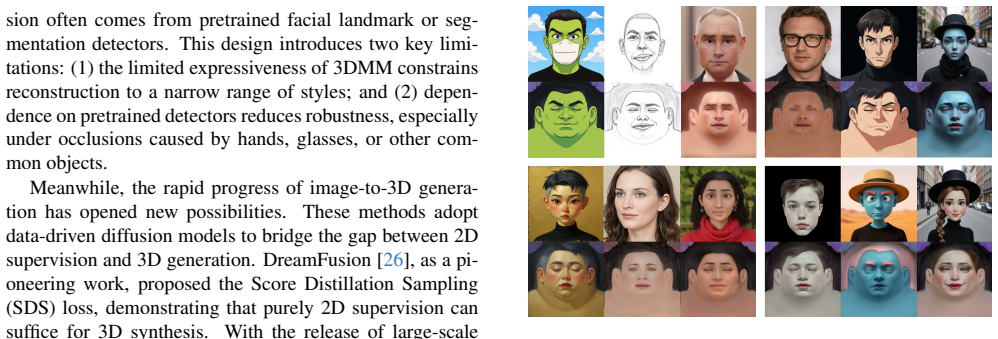
OMGTex reconstructs editable facial UV textures from 2D images without any 3D geometry input.
A machine-rendered reading of the paper's core claim, the machinery that carries it, and where it could break.
Core claim
OMGTex is an end-to-end diffusion framework that directly maps a 2D face image to an editable UV texture by combining gradient-guided refinement to enforce structural consistency with a training paradigm that amplifies semantic disentanglement, achieving robust results across realistic and stylized domains without geometry priors.
What carries the argument
The geometry-free pipeline that feeds a 2D image into a diffusion model and applies gradient-guided refinement at inference to align UV output while using semantic distribution training for region-aware editing.
If this is right
- Texture reconstruction becomes feasible for images where 3D face fitting is inaccurate or impossible.
- Semantic editing of specific facial regions such as eyes or skin becomes direct without re-estimating geometry.
- Style-consistent results extend to artistic and non-photorealistic domains where prior methods degrade.
- A single model handles both realistic and multi-style inputs without separate geometry pipelines.
Where Pith is reading between the lines
- The same refinement idea could be tested on non-face objects to create a general texture-from-image method.
- Temporal consistency might be added by applying the pipeline across video frames with shared refinement constraints.
- The CANVAS dataset could support follow-up work on unpaired style transfer between texture domains.
Load-bearing premise
A diffusion model can be trained so that its UV texture outputs have structural errors that a gradient-guided refinement step can always correct without geometry information.
What would settle it
A test set of occluded or heavily stylized faces where the refined OMGTex textures still show persistent feature misalignment or loss of identity that geometry-based methods avoid.
Figures





read the original abstract
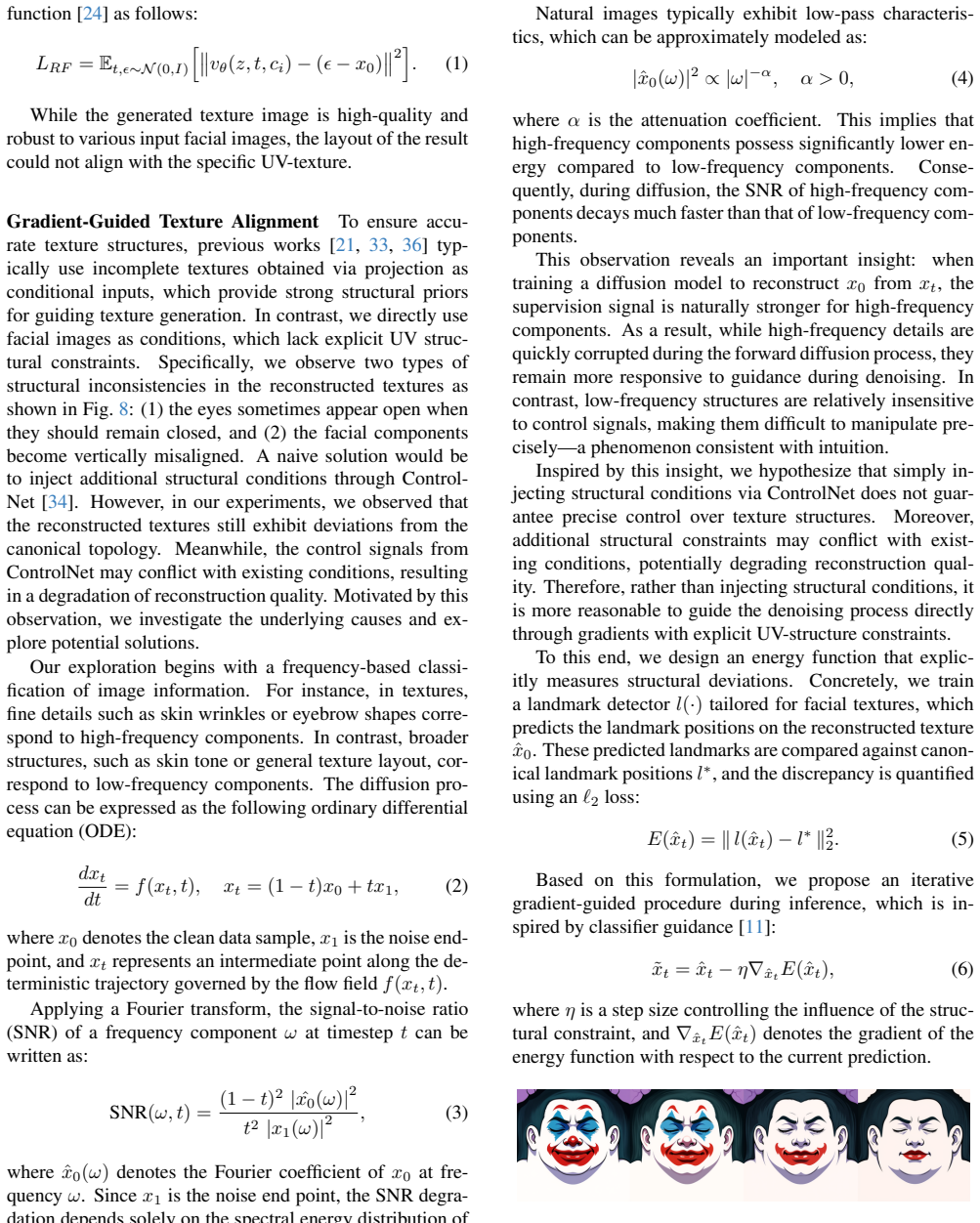
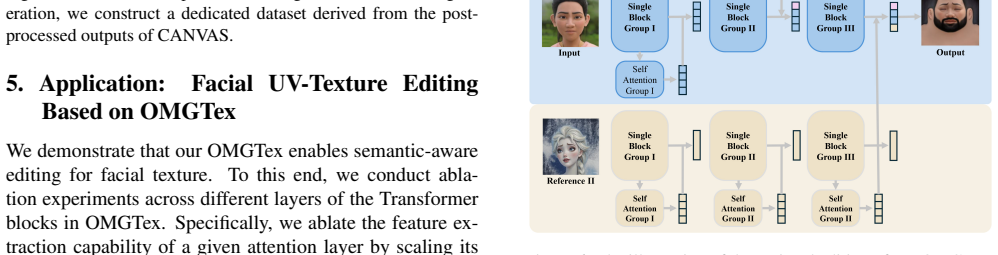
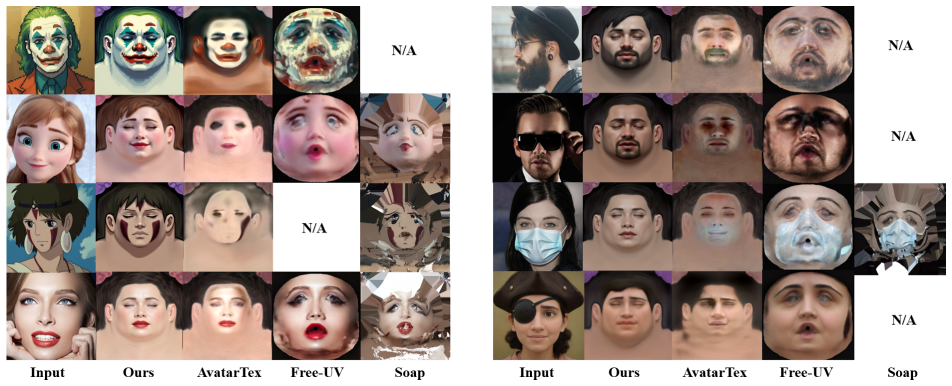
We propose OMGTex, an end-to-end diffusion-based framework for reconstructing high-quality and editable facial UV textures from multi-style facial images. Existing texture reconstruction methods face two major limitations: (1) Fragility due to reliance on 3D geometry priors, which are difficult to estimate accurately, especially under facial occlusions or in stylized domains; and (2) A lack of semantic disentanglement, inhibiting region-specific texture editing and style transfer. Our work addresses both challenges simultaneously. Our core innovation is a geometry-free pipeline that directly maps a 2D face image to its corresponding editable UV texture. We introduce two key techniques: First, to address the challenge of UV misalignment common in diffusion generation, we introduce a gradient-guided refinement strategy at inference time, which explicitly corrects structural consistency. Second, we leverage the inherent semantic distribution capability of diffusion models and design a novel training paradigm to enhance this tendency, enabling semantic-aware editing of facial texture. Furthermore, to address the data scarcity in multi-style texture reconstruction, we construct CANVAS, the first comprehensive paired texture reconstruction dataset covering realistic and diverse stylized domains. To the best of our knowledge, OMGTex is the first geometry-free inference framework that achieves robust, style-consistent, and editable facial texture reconstruction across diverse domains. Our method achieves state-of-the-art performance on multiple facial texture benchmarks.
Editorial analysis
A structured set of objections, weighed in public.
Referee Report
Summary. The paper proposes OMGTex, an end-to-end diffusion-based framework for one-stage reconstruction of high-quality, editable facial UV textures directly from multi-style 2D images without any 3D geometry guidance or priors. Key components include a gradient-guided refinement step at inference to enforce structural/UV consistency and a training paradigm that leverages diffusion models' semantic distribution to enable disentangled, region-specific editing. The authors also introduce the CANVAS dataset of paired multi-style textures and claim state-of-the-art results on facial texture benchmarks.
Significance. If the empirical claims hold, the work would be significant for removing a major source of fragility (inaccurate 3D geometry estimation under occlusion or stylization) in facial texture pipelines. The CANVAS dataset is a concrete, reusable contribution that directly supports the multi-style claim and will benefit future research. The geometry-free design and inference-time refinement are potentially impactful for downstream applications in editing and style transfer.
major comments (2)
- [Abstract] Abstract: the central claim that gradient-guided refinement at inference produces reliable UV structural consistency without any geometry prior is load-bearing for the 'robust' and 'geometry-free' assertions, yet the description provides no quantitative metrics, ablation results, or failure-case analysis showing correction of misalignment under occlusion or stylization.
- [Abstract] Abstract: the novel training paradigm is asserted to enhance semantic disentanglement for region-specific editing, but no implementation details, loss formulations, or controlled experiments (e.g., editing one semantic region while holding others fixed) are visible to verify that the disentanglement is genuine rather than an artifact of the diffusion prior.
minor comments (1)
- [Abstract] The abstract refers to 'multiple facial texture benchmarks' without naming them or reporting specific numbers; explicit listing and table of results would improve verifiability.
Simulated Author's Rebuttal
We thank the referee for the constructive feedback on the abstract. We agree that the abstract should more explicitly reference the supporting experimental evidence and will revise it accordingly. We address each major comment below.
read point-by-point responses
-
Referee: [Abstract] Abstract: the central claim that gradient-guided refinement at inference produces reliable UV structural consistency without any geometry prior is load-bearing for the 'robust' and 'geometry-free' assertions, yet the description provides no quantitative metrics, ablation results, or failure-case analysis showing correction of misalignment under occlusion or stylization.
Authors: The abstract is a concise summary. Quantitative metrics (e.g., UV consistency error reductions), ablation studies isolating the gradient-guided refinement, and failure-case visualizations under occlusion and stylization are reported in Section 4.3 and the supplementary material. We will revise the abstract to include a short reference to these key quantitative results supporting the geometry-free claim. revision: yes
-
Referee: [Abstract] Abstract: the novel training paradigm is asserted to enhance semantic disentanglement for region-specific editing, but no implementation details, loss formulations, or controlled experiments (e.g., editing one semantic region while holding others fixed) are visible to verify that the disentanglement is genuine rather than an artifact of the diffusion prior.
Authors: Implementation details, loss formulations for the semantic training paradigm, and controlled region-specific editing experiments (with metrics showing independent control of semantic regions) appear in Section 3.2 and Section 4.4. We will update the abstract to briefly note these experimental validations of disentanglement. revision: yes
Circularity Check
No significant circularity detected
full rationale
The paper presents an empirical method (diffusion-based pipeline with gradient-guided refinement and a training paradigm for semantic disentanglement) plus a new dataset (CANVAS), with performance claims evaluated on benchmarks. No equations, fitted parameters, or derivation chain are described that reduce a claimed prediction or result back to the inputs by construction. The central claims rest on architectural choices and experimental outcomes rather than self-referential definitions or load-bearing self-citations that would force the outcome. This is a standard non-circular empirical contribution in computer vision.
Axiom & Free-Parameter Ledger
Reference graph
Works this paper leans on
-
[1]
Optimal step nonrigid icp algorithms for surface registration
Brian Amberg, Sami Romdhani, and Thomas Vetter. Optimal step nonrigid icp algorithms for surface registration. In2007 IEEE conference on computer vision and pattern recogni- tion, pages 1–8. IEEE, 2007. 4
2007
-
[2]
Ffhq-uv: Normalized facial uv-texture dataset for 3d face reconstruction
Haoran Bai, Di Kang, Haoxian Zhang, Jinshan Pan, and Lin- chao Bao. Ffhq-uv: Normalized facial uv-texture dataset for 3d face reconstruction. InProceedings of the IEEE/CVF con- ference on computer vision and pattern recognition, pages 362–371, 2023. 3, 4
2023
-
[3]
A morphable model for the synthesis of 3d faces
V olker Blanz and Thomas Vetter. A morphable model for the synthesis of 3d faces. InSeminal Graphics Papers: Pushing the Boundaries, Volume 2, pages 157–164. 2023. 2, 4
2023
-
[4]
Abo: Dataset and benchmarks for real-world 3d object un- derstanding
Jasmine Collins, Shubham Goel, Kenan Deng, Achlesh- war Luthra, Leon Xu, Erhan Gundogdu, Xi Zhang, Tomas F Yago Vicente, Thomas Dideriksen, Himanshu Arora, et al. Abo: Dataset and benchmarks for real-world 3d object un- derstanding. InProceedings of the IEEE/CVF conference on computer vision and pattern recognition, pages 21126– 21136, 2022. 3
2022
-
[5]
Objaverse-XL: A Universe of 10M+ 3D Objects
Matt Deitke, Ruoshi Liu, Matthew Wallingford, Huong Ngo, Oscar Michel, Aditya Kusupati, Alan Fan, Chris- tian Laforte, Vikram V oleti, Samir Yitzhak Gadre, Eli VanderBilt, Aniruddha Kembhavi, Carl V ondrick, Georgia Gkioxari, Kiana Ehsani, Ludwig Schmidt, and Ali Farhadi. Objaverse-xl: A universe of 10m+ 3d objects.arXiv preprint arXiv:2307.05663, 2023. 3
work page internal anchor Pith review Pith/arXiv arXiv 2023
-
[6]
Accurate 3d face reconstruction with weakly-supervised learning: From single image to image set
Yu Deng, Jiaolong Yang, Sicheng Xu, Dong Chen, Yunde Jia, and Xin Tong. Accurate 3d face reconstruction with weakly-supervised learning: From single image to image set. InIEEE Computer Vision and Pattern Recognition Work- shops, 2019. 2
2019
-
[7]
Learning an animatable detailed 3d face model from in-the- wild images.ACM Transactions on Graphics (ToG), 40(4): 1–13, 2021
Yao Feng, Haiwen Feng, Michael J Black, and Timo Bolkart. Learning an animatable detailed 3d face model from in-the- wild images.ACM Transactions on Graphics (ToG), 40(4): 1–13, 2021. 2
2021
-
[8]
3d-future: 3d fur- niture shape with texture.International Journal of Computer Vision, 129(12):3313–3337, 2021
Huan Fu, Rongfei Jia, Lin Gao, Mingming Gong, Binqiang Zhao, Steve Maybank, and Dacheng Tao. 3d-future: 3d fur- niture shape with texture.International Journal of Computer Vision, 129(12):3313–3337, 2021. 3
2021
-
[9]
Os- tec: One-shot texture completion
Baris Gecer, Jiankang Deng, and Stefanos Zafeiriou. Os- tec: One-shot texture completion. InProceedings of the IEEE/CVF conference on computer vision and pattern recognition, pages 7628–7638, 2021. 3
2021
-
[10]
Generative adversarial networks.Commu- nications of the ACM, 63(11):139–144, 2020
Ian Goodfellow, Jean Pouget-Abadie, Mehdi Mirza, Bing Xu, David Warde-Farley, Sherjil Ozair, Aaron Courville, and Yoshua Bengio. Generative adversarial networks.Commu- nications of the ACM, 63(11):139–144, 2020. 3
2020
-
[11]
Denoising dif- fusion probabilistic models.Advances in neural information processing systems, 33:6840–6851, 2020
Jonathan Ho, Ajay Jain, and Pieter Abbeel. Denoising dif- fusion probabilistic models.Advances in neural information processing systems, 33:6840–6851, 2020. 3, 5
2020
-
[12]
LoRA: Low-rank adaptation of large language models
Edward J Hu, Yelong Shen, Phillip Wallis, Zeyuan Allen- Zhu, Yuanzhi Li, Shean Wang, Lu Wang, and Weizhu Chen. LoRA: Low-rank adaptation of large language models. InIn- ternational Conference on Learning Representations, 2022. 4
2022
-
[13]
Toonify3d: Stylegan-based 3d stylized face generator
Wonjong Jang, Yucheol Jung, Hyomin Kim, Gwangjin Ju, Chaewon Son, Jooeun Son, and Seungyong Lee. Toonify3d: Stylegan-based 3d stylized face generator. InACM SIG- GRAPH 2024 Conference Papers, pages 1–11, 2024. 2
2024
-
[14]
Deep deformable 3d carica- tures with learned shape control
Yucheol Jung, Wonjong Jang, Soongjin Kim, Jiaolong Yang, Xin Tong, and Seungyong Lee. Deep deformable 3d carica- tures with learned shape control. InACM SIGGRAPH 2022 Conference Proceedings, pages 1–9, 2022. 2
2022
-
[15]
A style-based generator architecture for generative adversarial networks
Tero Karras, Samuli Laine, and Timo Aila. A style-based generator architecture for generative adversarial networks. InProceedings of the IEEE/CVF conference on computer vi- sion and pattern recognition, pages 4401–4410, 2019. 3, 7
2019
-
[16]
Analyzing and improving the image quality of StyleGAN
Tero Karras, Samuli Laine, Miika Aittala, Janne Hellsten, Jaakko Lehtinen, and Timo Aila. Analyzing and improving the image quality of StyleGAN. InProc. CVPR, 2020. 4
2020
-
[17]
Flux.https://github.com/ black-forest-labs/flux, 2024
Black Forest Labs. Flux.https://github.com/ black-forest-labs/flux, 2024. 3, 4, 6
2024
-
[18]
Flux.1 kontext: Flow matching for in-context image generation and editing in latent space,
Black Forest Labs, Stephen Batifol, Andreas Blattmann, Frederic Boesel, Saksham Consul, Cyril Diagne, Tim Dock- horn, Jack English, Zion English, Patrick Esser, Sumith Ku- lal, Kyle Lacey, Yam Levi, Cheng Li, Dominik Lorenz, Jonas M¨uller, Dustin Podell, Robin Rombach, Harry Saini, Axel Sauer, and Luke Smith. Flux.1 kontext: Flow matching for in-context i...
-
[19]
Hunyuan3D 2.5: Towards High-Fidelity 3D Assets Generation with Ultimate Details
Zeqiang Lai, Yunfei Zhao, Haolin Liu, Zibo Zhao, Qingxi- ang Lin, Huiwen Shi, Xianghui Yang, Mingxin Yang, Shuhui Yang, Yifei Feng, et al. Hunyuan3d 2.5: Towards high- fidelity 3d assets generation with ultimate details.arXiv preprint arXiv:2506.16504, 2025. 3
work page internal anchor Pith review Pith/arXiv arXiv 2025
-
[20]
Facerefiner: High-fidelity facial texture refinement with differentiable rendering-based style transfer.IEEE Transactions on Multimedia, 26:7225–7236, 2024
Chengyang Li, Baoping Cheng, Yao Cheng, Haocheng Zhang, Renshuai Liu, Yinglin Zheng, Jing Liao, and Xuan Cheng. Facerefiner: High-fidelity facial texture refinement with differentiable rendering-based style transfer.IEEE Transactions on Multimedia, 26:7225–7236, 2024. 3
2024
-
[21]
Uv-idm: identity-conditioned latent diffu- sion model for face uv-texture generation
Hong Li, Yutang Feng, Song Xue, Xuhui Liu, Bohan Zeng, Shanglin Li, Boyu Liu, Jianzhuang Liu, Shumin Han, and Baochang Zhang. Uv-idm: identity-conditioned latent diffu- sion model for face uv-texture generation. InProceedings of the IEEE/CVF Conference on Computer Vision and Pattern Recognition, pages 10585–10595, 2024. 3, 4, 5
2024
-
[22]
Gligen: Open-set grounded text-to-image generation.CVPR,
Yuheng Li, Haotian Liu, Qingyang Wu, Fangzhou Mu, Jian- wei Yang, Jianfeng Gao, Chunyuan Li, and Yong Jae Lee. Gligen: Open-set grounded text-to-image generation.CVPR,
-
[23]
Soap: Style- omniscient animatable portraits
Tingting Liao, Yujian Zheng, Adilbek Karmanov, Liwen Hu, Leyang Jin, Yuliang Xiu, and Hao Li. Soap: Style- omniscient animatable portraits. 2025. 3, 4, 6
2025
-
[24]
Flow Matching for Generative Modeling
Yaron Lipman, Ricky TQ Chen, Heli Ben-Hamu, Maximil- ian Nickel, and Matt Le. Flow matching for generative mod- eling.arXiv preprint arXiv:2210.02747, 2022. 5
work page internal anchor Pith review Pith/arXiv arXiv 2022
-
[25]
Chong Mou, Xintao Wang, Liangbin Xie, Yanze Wu, Jian Zhang, Zhongang Qi, Ying Shan, and Xiaohu Qie. T2i- adapter: Learning adapters to dig out more controllable ability for text-to-image diffusion models.arXiv preprint arXiv:2302.08453, 2023. 3
work page internal anchor Pith review Pith/arXiv arXiv 2023
-
[26]
DreamFusion: Text-to-3D using 2D Diffusion
Ben Poole, Ajay Jain, Jonathan T Barron, and Ben Milden- hall. Dreamfusion: Text-to-3d using 2d diffusion.arXiv preprint arXiv:2209.14988, 2022. 3
work page internal anchor Pith review Pith/arXiv arXiv 2022
-
[27]
3dcaricshop: A dataset and a baseline method for single-view 3d caricature face reconstruction
Yuda Qiu, Xiaojie Xu, Lingteng Qiu, Yan Pan, Yushuang Wu, Weikai Chen, and Xiaoguang Han. 3dcaricshop: A dataset and a baseline method for single-view 3d caricature face reconstruction. InProceedings of the IEEE/CVF Con- ference on Computer Vision and Pattern Recognition, pages 10236–10245, 2021. 2
2021
-
[28]
Avatartex: High-fidelity facial texture reconstruction from single-image stylized avatars,
Yuda Qiu, Zitong Xiao, Yiwei Zuo, Zisheng Ye, Weikai Chen, and Xiaoguang Han. Avatartex: High-fidelity facial texture reconstruction from single-image stylized avatars,
-
[29]
3dcom- pat++: An improved large-scale 3d vision dataset for compo- sitional recognition.IEEE Transactions on Pattern Analysis and Machine Intelligence, 2025
Habib Slim, Xiang Li, Yuchen Li, Mahmoud Ahmed, Mo- hamed Ayman, Ujjwal Upadhyay, Ahmed Abdelreheem, Arpit Prajapati, Suhail Pothigara, Peter Wonka, et al. 3dcom- pat++: An improved large-scale 3d vision dataset for compo- sitional recognition.IEEE Transactions on Pattern Analysis and Machine Intelligence, 2025. 3
2025
-
[30]
3d face reconstruction with the geometric guidance of facial part segmentation
Zidu Wang, Xiangyu Zhu, Tianshuo Zhang, Baiqin Wang, and Zhen Lei. 3d face reconstruction with the geometric guidance of facial part segmentation. InProceedings of the IEEE/CVF Conference on Computer Vision and Pattern Recognition, pages 1672–1682, 2024. 2
2024
-
[31]
Unique3d: High-quality and efficient 3d mesh generation from a single image
Kailu Wu, Fangfu Liu, Zhihan Cai, Runjie Yan, Hanyang Wang, Yating Hu, Yueqi Duan, and Kaisheng Ma. Unique3d: High-quality and efficient 3d mesh generation from a single image. InThe Thirty-eighth Annual Conference on Neural Information Processing Systems, 2024. 4
2024
-
[32]
Lpff: A portrait dataset for face generators across large poses
Yiqian Wu, Jing Zhang, Hongbo Fu, and Xiaogang Jin. Lpff: A portrait dataset for face generators across large poses. In Proceedings of the IEEE/CVF International Conference on Computer Vision (ICCV), pages 20327–20337, 2023. 7
2023
-
[33]
Freeuv: Ground-truth-free realistic facial uv texture recovery via cross-assembly inference strategy
Xingchao Yang, Takafumi Taketomi, Yuki Endo, and Yoshi- hiro Kanamori. Freeuv: Ground-truth-free realistic facial uv texture recovery via cross-assembly inference strategy. In Proceedings of the Computer Vision and Pattern Recognition Conference, pages 326–337, 2025. 3, 4, 5, 6
2025
-
[34]
Adding conditional control to text-to-image diffusion models, 2023
Lvmin Zhang, Anyi Rao, and Maneesh Agrawala. Adding conditional control to text-to-image diffusion models, 2023. 3, 5, 8
2023
-
[35]
Easycontrol: Adding efficient and flexible control for diffusion transformer
Yuxuan Zhang, Yirui Yuan, Yiren Song, Haofan Wang, and Jiaming Liu. Easycontrol: Adding efficient and flexible control for diffusion transformer. InProceedings of the IEEE/CVF International Conference on Computer Vision, pages 19513–19524, 2025. 4
2025
-
[36]
Ultravatar: A realistic animatable 3d avatar diffusion model with authenticity guided textures
Mingyuan Zhou, Rakib Hyder, Ziwei Xuan, and Guojun Qi. Ultravatar: A realistic animatable 3d avatar diffusion model with authenticity guided textures. InProceedings of the IEEE/CVF Conference on Computer Vision and Pattern Recognition, pages 1238–1248, 2024. 3, 4, 5
2024
discussion (0)
Sign in with ORCID, Apple, or X to comment. Anyone can read and Pith papers without signing in.