REVIEW 4 major objections 4 minor 43 references
Critical behaviors of the entanglement and participation entropy near the many-body localization transition in a disordered quantum spin chain
T0 review · 4 major / 4 minor · reviewed 2026-08-14 · deepseek-v4-flash
Pith's one-line read The many-body localization transition is continuous, and at the critical point the entanglement entropy is strictly thermal, matching the same critical behavior in the participation entropy.
desk verdict A plausible scaling scheme with a genuine participation-entropy cross-check, but the 'strictly thermal at criticality' conclusion rests on an r→0 extrapolation that is really L_A→0, so the headline is not established. read the letter →
The pith
A machine-rendered reading of the paper's core claim, the machinery that carries it, and where it could break.
The reading
What carries the argument
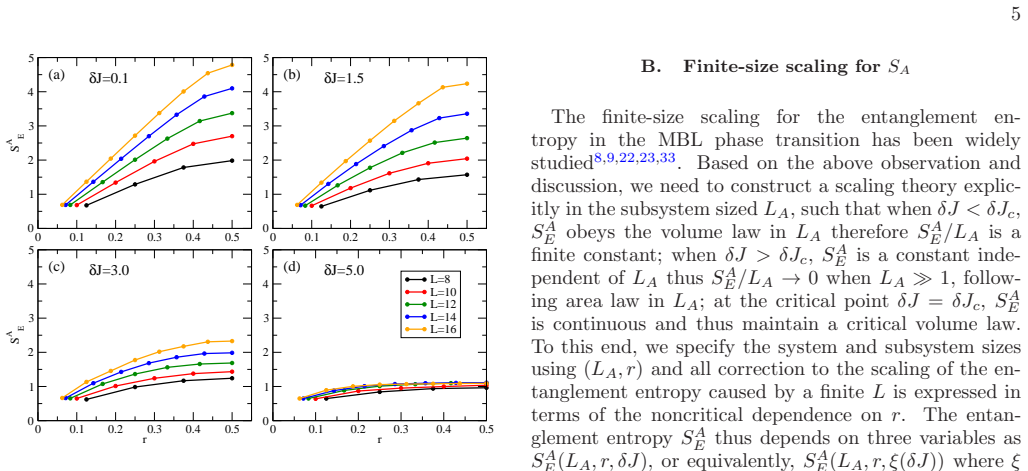
The central object is the finite-size scaling ansatz for the entanglement entropy, $S_A^E(L_A, r, \delta J) = L_A f(L_A |\delta J - \delta J_c|^\nu, r)$, where $r = L_A/L$ is the partition ratio. The ansatz states that the only relevant scaling variable is $L_A/\xi$ with $\xi$ the divergent correlation length, that the total size $L$ enters only through $r$ as a correction, and that the critical amplitude $f_c(r) = f(0,r)$ extrapolated to $r \to 0$ gives the thermal value $\ln 2$. The extraction proceeds by data-collapsing $S_A^E/L_A$ versus $r$ to determine $\delta J_c$ and $f_c(r)$, then scaling $y = S_A^E/(f_c(r)L_A)$ versus $x = L_A|\delta J - \delta J_c|^\nu$ to determine $\nu$.
What would settle it
Measure the von Neumann entanglement entropy for subsystems up to $L_A = 10$ in systems of size $L = 20$ to $24$ at the estimated critical disorder $\delta J \approx 3.2$, keeping $r \le 0.1$ (using, for example, tensor-network or DMRG methods that go beyond exact diagonalization). If $S_A^E/L_A$ extrapolated to $L \to \infty$ and $r \to 0$ does not approach $\ln 2$ within error bars, or if a two-parameter scaling with an additional relevant field gives a significantly better collapse, the thermal-critical-point and single-length-scale claims would be refuted.
Extended reading notes
Core claim
In the thermodynamic limit $L \gg L_A \gg 1$, the paper claims the entanglement entropy per subsystem size at the critical disorder obeys $S_A^E/L_A \to \ln 2$, the fully thermal value, with the extrapolated intercept $\alpha = 0.72 \pm 0.03$ consistent with $\ln 2 \approx 0.693$. The correlation length diverges as $\xi \sim |\delta J - \delta J_c|^{-\nu}$ with $\nu = 0.94 \pm 0.07$; this violates the Harris bound but agrees with a theoretical prediction of $\nu = 1$. The participation entropy in the $z$-spin (domain-wall occupation) basis yields the same critical point $\delta J_c' = 3.16 \pm 0.04$ and exponent $\nu' = 0.89 \pm 0.03$, leading the authors to conclude that the transition is continuous and describable as localization in many-body configuration space.
Load-bearing premise
The scaling ansatz $S_A^E(L_A, r, \delta J) = L_A f(L_A |\delta J - \delta J_c|^\nu, r)$ must hold: the subsystem entropy can depend on the total size only through the ratio $r$, and on disorder only through the single combination $L_A |\delta J - \delta J_c|^\nu$.
Editorial extensions
If this is right
- The MBL transition is a continuous eigenstate phase transition described by a single divergent length scale set by $L_A/\xi$.
- At the critical point a finite subsystem is thermal: $S_A^E/L_A \to \ln 2$, so the critical eigenstates carry maximal entropy per site.
- The exponent $\nu \approx 0.94$ supports the view that the Harris criterion does not apply to this transition, consistent with a predicted $\nu = 1$.
- The matching scaling of the participation entropy suggests the MBL transition is equivalent to Anderson localization in the many-body configuration space.
- The subthermal entanglement seen in prior half-chain studies is reinterpreted as a finite-size effect of large $r$, not a thermodynamic property.
Reading between the lines
- If the scaling theory is correct, the same $L_A/\xi$ analysis with partition-ratio corrections could sharpen critical-exponent estimates in other disordered models where exact diagonalization is limited to small sizes.
- A testable extension: in a global quench starting from a product state at the critical disorder, the entanglement entropy of a small interval should saturate at $\ln 2$ per spin, reproducing the thermal value predicted here.
- The basis-dependence argument implies that participation-entropy scaling will only match the entanglement-entropy result when the chosen basis aligns with the quasiparticle occupation basis of the model's ordered ground state.
- The study is performed at high energy density ($\epsilon = 59/60$); whether the strictly thermal critical amplitude persists at lower energy densities remains an open question.
Signed reviews
Editorial analysis
A structured set of objections, weighed in public.
Referee Report
Summary. The paper studies the many-body localization (MBL) transition in a disordered transverse-field Ising chain using exact diagonalization with twisted boundary conditions. The authors introduce a scaling form for the subsystem entanglement entropy, S_A^E(L_A,r,δJ) = L_A f(L_A|δJ−δJ_c|^ν, r), where r=L_A/L, and determine the critical disorder and correlation-length exponent from finite-size scaling collapses. They further extract the r→0 limit of the critical entanglement amplitude from a polynomial fit and compare it with ln2, concluding that the critical eigenstates are thermal and that the transition is continuous. They then perform a similar scaling analysis for the participation entropy in a spin/domain-wall basis and report consistent critical point and exponent, suggesting that MBL can be viewed as a localization transition in configuration space.
Significance. If the main claims hold, the paper would provide numerical support for a continuous MBL transition with thermal critical eigenstates, consistent with Grover's argument, and would supply a correlation-length exponent ν≈0.94 that challenges the Harris bound while agreeing with Monthus's prediction. The use of twisted boundary conditions to reduce finite-size fluctuations and the independent consistency between entanglement and participation entropy are genuine strengths. However, the central thermal-volume-law conclusion rests on a small-r extrapolation that may not access the intended thermodynamic limit, and the scaling analysis lacks a quantitative collapse criterion; these issues must be addressed before the claims can be considered established.
major comments (4)
- [Sec. III.B, Eq. (8), Fig. 6(c)] The conclusion that the entanglement entropy is strictly thermal at the critical point rests on the fitted intercept α=0.72±0.03 in the polynomial fc(r)=α+βr+γr². The smallest-r data points in this fit correspond to L_A=1 and L_A=2 at L=16, i.e., r=1/16 and 1/8. The extrapolation to r→0 is therefore an extrapolation toward L_A→0 at fixed L, not toward the thermodynamic limit 1≪L_A≪L. Since γ=0.84±0.62 is poorly constrained, and since a plausible finite-size correction of the form 1/L_A is not included in Eq. (8), the intercept is not robustly determined. The authors should demonstrate that the result survives excluding L_A=1,2 or adding an explicit 1/L_A term; otherwise the 'strictly thermal' claim is not established.
- [Sec. III.B, Eqs. (6)-(7), Fig. 7] The critical point δJc=3.19±0.03 and exponent ν=0.94±0.07 are extracted from 'best data collapse' without any quantitative collapse metric or goodness-of-fit criterion. Because the same dataset is used first to fix fc(r) and then to collapse the scaled variable y=S_A^E/(L_A fc(r)), the procedure is susceptible to circularity. A quantitative collapse measure (e.g., minimization of the scatter of the collapsed curves, or a chi-square statistic) and a validation on independent synthetic data would make the error bars meaningful and the exponent determination reproducible.
- [Sec. III.B, Eq. (6)] The scaling ansatz assumes that S_A^E depends on L only through r and on disorder only through the single combination L_A|δJ−δJc|^ν. However, Fig. 4 shows a clear L dependence of S_A^E near the critical region at fixed L_A. The paper interprets this as an r correction, but since r is changed by varying both L and L_A, the data do not directly test whether an independent L dependence remains. The authors should provide a test of the ansatz, for example by checking whether data with the same r but different (L,L_A) collapse, or by including an explicit correction term and showing it is negligible. Without such a test, the extracted critical point and exponent could be biased by a missing scaling field.
- [Sec. IV, Fig. 8] The participation entropy scaling gives δJc'=3.16±0.04 and ν'=0.89±0.03, which agree with the entanglement results. This is a valuable cross-check, but it does not by itself resolve the concerns about the entanglement scaling, because the participation entropy analysis uses the same finite-size systems and the same type of visually assessed data collapse. The authors should state explicitly whether a quantitative collapse criterion was used here as well and how the reported errors were obtained.
minor comments (4)
- [General] There are several typographical errors, including 'bondary conditions' in the Section II.B heading, 'wether' in the Introduction, 'entanglement e ntropy' in the title, and 'participation entropy' misspelled in places. A careful proofreading pass is needed.
- [Fig. 6 caption] The caption states that 26 data points are obtained for L=10,12,14,16 and L_A=1,...,L/2, which gives 5+6+7+8=26 points; however, the text in Section III.B refers to 'all data points in Fig. 5' when determining fc(r). Clarify whether the L=8 data are included in the fit and why the caption omits L=8.
- [Sec. III.B, discussion after Eq. (8)] The statement that 'fc(r)<ln2 for nonzero r' in Fig. 6(c) is made without showing error bars or statistical significance on the individual points. Since the fitted γ has a large uncertainty, this qualitative claim should be supported by confidence intervals.
- [Sec. IV] The choice of the spin-z basis for the participation entropy is justified by the domain-wall picture, but the statement that 'any two choices of basis connected by transformations that commute with the Hamiltonian will give the same behavior' is too strong; it holds only for exact symmetries of the Hamiltonian, not for arbitrary local basis rotations. Clarify the intended scope of this remark.
Circularity Check
No significant circularity: the thermal-volume-law check compares a free fitted intercept to the external constant ln2, and the same-author citation is not load-bearing.
full rationale
The paper's central scaling ansatz, Eq. (6), is stated as an assumption based on continuity, and the critical amplitude f_c(r) is then obtained by data collapse and fitted to Eq. (8), f_c(r)=α+βr+γr^2. The value α=0.72±0.03 is a free parameter; ln2≈0.693 is not imposed in the fit. Therefore the agreement with the thermal entropy is a genuine consistency check rather than a prediction forced by construction. The later scaling of y=S_A^E/(L_A f_c(r)) uses the previously fitted f_c(r), which is a standard data-collapse procedure: the success of the collapse is not guaranteed and can fail, so this is not circular reuse. The participation entropy analysis of Sec. IV is an independent observable and agrees with the entanglement result, providing additional non-circular support. The only self-citation (Ref. 37) appears in a list of references in Sec. IV and is not used to justify the central scaling or to forbid alternative interpretations; it is not load-bearing. The paper explicitly labels the continuity assumption and Grover's relation as assumptions, and does not present the thermal value as a parameter-free prediction. The paper also openly flags the Harris-bound issue as unresolved. Concerns about the small-L_A extrapolation to r→0 are validity/finite-size issues, not circularity of the derivation.
Assumptions & free parameters
free parameters (5)
- deltaJc (entanglement scaling critical disorder) =
3.19 +/- 0.03 (3.2 +/- 0.1 from collapse)
- nu (entanglement correlation length exponent) =
0.94 +/- 0.07
- deltaJc' (participation entropy critical disorder) =
3.16 +/- 0.04
- nu' (participation entropy exponent) =
0.89 +/- 0.03
- alpha, beta, gamma (polynomial coefficients of f_c(r)) =
alpha=0.72 +/- 0.03, beta=-1.31 +/- 0.22, gamma=0.84 +/- 0.62
assumptions (5)
- domain assumption The MBL-ETH transition is continuous.
- ad hoc to paper S_A^E depends on L only through r and on disorder only through L_A/xi (scaling ansatz).
- ad hoc to paper For r away from 0.5, the remaining r-dependence in the scaling function g_r(x) is negligible.
- domain assumption At energy density epsilon=59/60 (near mid-spectrum) the thermal entropy per site is ln2.
- domain assumption The sigma^z spin configuration basis is the physically appropriate basis for the many-body IPR because the ground state is ferromagnetic along z.
Cite this review
Pith. "Pith review of Critical behaviors of the entanglement and participation entropy near the many-body localization transition in a disordered quantum spin chain." pith.science (2026). https://pith.science/paper/GBTB7NS6
@misc{pith2026190804039,
  author       = {Pith},
  title        = {Pith review of: Critical behaviors of the entanglement and participation entropy near the many-body localization transition in a disordered quantum spin chain},
  year         = {2026},
  howpublished = {\url{https://pith.science/paper/GBTB7NS6}},
  note         = {Machine review of arXiv:1908.04039}
}
abstract
The transition between many-body localized states and the delocalized thermal states is an eigen-state phase transition at finite energy density outside the scope of conventional quantum statistical mechanics. In this work we investigate the properties of the transition by studying the behavior of the entanglement entropy of a subsystem of size $L_A$ in a system of size $L > L_A$ near the critical regime of the many-body localization transition. The many-body eigenstates are obtained by exact diagonalization of a disordered quantum spin chain under twisted boundary conditions to reduce the finite-size effect. We present a scaling theory based on the assumption that the transition is continuous and use the subsystem size $L_A /\xi$ as the scaling variable, where $\xi$ is the correlation length. We show that this scaling theory provides an effective description of the critical behavior and that the entanglement entropy follows the thermal volume law at the transition point. We extract the critical exponent governing the divergence of $\xi$ upon approaching the transition point. We also study the participation entropy in the spin-basis of the domain wall excitations and show that the transition point and the critical exponent agree with those obtained from finite size scaling of the entanglement entropy. Our findings suggest that the many-body localization transition in this model is continuous and describable as a localization transition in the many-body configuration space.
Figures


Figures from the paper (3 more)


Reference graph
Works this paper leans on
-
[1]
author author P. W. \ Anderson ,\ 10.1103/PhysRev.109.1492 journal journal Phys. Rev. \ volume 109 ,\ pages 1492 ( year 1958 ) NoStop
-
[2]
author author D. Basko , author I. Aleiner , \ and\ author B. Altshuler ,\ https://doi.org/10.1016/j.aop.2005.11.014 journal journal Annals of Physics \ volume 321 ,\ pages 1126 ( year 2006 ) NoStop
-
[3]
author author A. Pal \ and\ author D. A. \ Huse ,\ 10.1103/PhysRevB.82.174411 journal journal Phys. Rev. B \ volume 82 ,\ pages 174411 ( year 2010 ) NoStop
-
[4]
author author D. A. \ Huse , author R. Nandkishore , author V. Oganesyan , author A. Pal , \ and\ author S. L. \ Sondhi ,\ 10.1103/PhysRevB.88.014206 journal journal Phys. Rev. B \ volume 88 ,\ pages 014206 ( year 2013 ) NoStop
-
[5]
author author R. Nandkishore , author S. Gopalakrishnan , \ and\ author D. A. \ Huse ,\ 10.1103/PhysRevB.90.064203 journal journal Phys. Rev. B \ volume 90 ,\ pages 064203 ( year 2014 ) NoStop
-
[6]
author author R. Nandkishore \ and\ author D. A. \ Huse ,\ 10.1146/annurev-conmatphys-031214-014726 journal journal Annual Review of Condensed Matter Physics \ volume 6 ,\ pages 15 ( year 2015 ) ,\ http://arxiv.org/abs/https://doi.org/10.1146/annurev-conmatphys-031214-014726 https://doi.org/10.1146/annurev-conmatphys-031214-014726 NoStop
-
[7]
author author V. Oganesyan \ and\ author D. A. \ Huse ,\ 10.1103/PhysRevB.75.155111 journal journal Phys. Rev. B \ volume 75 ,\ pages 155111 ( year 2007 ) NoStop
-
[8]
author author D. J. \ Luitz , author N. Laflorencie , \ and\ author F. Alet ,\ 10.1103/PhysRevB.91.081103 journal journal Phys. Rev. B \ volume 91 ,\ pages 081103 ( year 2015 ) NoStop
Show all 43 references
-
[9]
author author J. A. \ Kj\"all , author J. H. \ Bardarson , \ and\ author F. Pollmann ,\ 10.1103/PhysRevLett.113.107204 journal journal Phys. Rev. Lett. \ volume 113 ,\ pages 107204 ( year 2014 ) NoStop
2014 doi
-
[10]
Bauer \ and\ author C
author author B. Bauer \ and\ author C. Nayak ,\ http://stacks.iop.org/1742-5468/2013/i=09/a=P09005 journal journal Journal of Statistical Mechanics: Theory and Experiment \ volume 2013 ,\ pages P09005 ( year 2013 ) NoStop
2013
-
[11]
Z Z nidari c c , author T
author author M. Z Z nidari c c , author T. c. v. \ Prosen , \ and\ author P. Prelov s s ek ,\ 10.1103/PhysRevB.77.064426 journal journal Phys. Rev. B \ volume 77 ,\ pages 064426 ( year 2008 ) NoStop
2008 doi
-
[12]
Vosk \ and\ author E
author author R. Vosk \ and\ author E. Altman ,\ 10.1103/PhysRevLett.110.067204 journal journal Phys. Rev. Lett. \ volume 110 ,\ pages 067204 ( year 2013 ) NoStop
2013 doi
-
[13]
Altman \ and\ author R
author author E. Altman \ and\ author R. Vosk ,\ 10.1146/annurev-conmatphys-031214-014701 journal journal Annual Review of Condensed Matter Physics \ volume 6 ,\ pages 383 ( year 2015 ) ,\ http://arxiv.org/abs/https://doi.org/10.1146/annurev-conmatphys-031214-014701 https://do...
2015 doi
-
[14]
author author J. H. \ Bardarson , author F. Pollmann , \ and\ author J. E. \ Moore ,\ 10.1103/PhysRevLett.109.017202 journal journal Phys. Rev. Lett. \ volume 109 ,\ pages 017202 ( year 2012 ) NoStop
2012 doi
-
[15]
Serbyn , author Z
author author M. Serbyn , author Z. Papi c \' c , \ and\ author D. A. \ Abanin ,\ 10.1103/PhysRevLett.110.260601 journal journal Phys. Rev. Lett. \ volume 110 ,\ pages 260601 ( year 2013 a ) NoStop
2013 doi
-
[16]
Serbyn , author Z
author author M. Serbyn , author Z. Papi c \' c , \ and\ author D. A. \ Abanin ,\ 10.1103/PhysRevLett.111.127201 journal journal Phys. Rev. Lett. \ volume 111 ,\ pages 127201 ( year 2013 b ) NoStop
2013 doi
-
[17]
Schreiber , author S
author author M. Schreiber , author S. S. \ Hodgman , author P. Bordia , author H. P. \ L \"u schen , author M. H. \ Fischer , author R. Vosk , author E. Altman , author U. Schneider , \ and\ author I. Bloch ,\ 10.1126/science.aaa7432 journal journal Science \ volume 349 ,\ pa...
-
[18]
Jurcevic , author H
author author P. Jurcevic , author H. Shen , author P. Hauke , author C. Maier , author T. Brydges , author C. Hempel , author B. P. \ Lanyon , author M. Heyl , author R. Blatt , \ and\ author C. F. \ Roos ,\ 10.1103/PhysRevLett.119.080501 journal journal Phys. Rev. Lett. \ vo...
-
[19]
Smith , author A
author author J. Smith , author A. Lee , author P. Richerme , author B. Neyenhuis , author P. W. \ Hess , author P. Hauke , author M. Heyl , author D. A. \ Huse , \ and\ author C. Monroe ,\ https://doi.org/10.1038/nphys3783 journal journal Nature Physics \ volume 12 ,\ pages 9...
-
[20]
author author H. P. \ L\"uschen , author P. Bordia , author S. S. \ Hodgman , author M. Schreiber , author S. Sarkar , author A. J. \ Daley , author M. H. \ Fischer , author E. Altman , author I. Bloch , \ and\ author U. Schneider ,\ 10.1103/PhysRevX.7.011034 journal journal P...
-
[21]
Bordia , author H
author author P. Bordia , author H. P. \ L\"uschen , author S. S. \ Hodgman , author M. Schreiber , author I. Bloch , \ and\ author U. Schneider ,\ 10.1103/PhysRevLett.116.140401 journal journal Phys. Rev. Lett. \ volume 116 ,\ pages 140401 ( year 2016 ) NoStop
-
[22]
Grover ,\ @noop journal journal arXiv e-prints \ ,\ eid arXiv:1405.1471 ( year 2014 ) ,\ http://arxiv.org/abs/1405.1471 arXiv:1405.1471 [cond-mat.dis-nn] NoStop
author author T. Grover ,\ @noop journal journal arXiv e-prints \ ,\ eid arXiv:1405.1471 ( year 2014 ) ,\ http://arxiv.org/abs/1405.1471 arXiv:1405.1471 [cond-mat.dis-nn] NoStop
2014 arXiv
-
[23]
Khemani , author S
author author V. Khemani , author S. P. \ Lim , author D. N. \ Sheng , \ and\ author D. A. \ Huse ,\ 10.1103/PhysRevX.7.021013 journal journal Phys. Rev. X \ volume 7 ,\ pages 021013 ( year 2017 ) NoStop
2017 doi
-
[24]
Chandran , author C
author author A. Chandran , author C. R. \ Laumann , \ and\ author V. Oganesyan ,\ @noop journal journal arXiv e-prints \ ,\ eid arXiv:1509.04285 ( year 2015 ) ,\ http://arxiv.org/abs/1509.04285 arXiv:1509.04285 [cond-mat.dis-nn] NoStop
2015 arXiv
-
[25]
Vosk , author D
author author R. Vosk , author D. A. \ Huse , \ and\ author E. Altman ,\ 10.1103/PhysRevX.5.031032 journal journal Phys. Rev. X \ volume 5 ,\ pages 031032 ( year 2015 ) NoStop
2015 doi
-
[26]
author author A. C. \ Potter , author R. Vasseur , \ and\ author S. A. \ Parameswaran ,\ 10.1103/PhysRevX.5.031033 journal journal Phys. Rev. X \ volume 5 ,\ pages 031033 ( year 2015 ) NoStop
2015 doi
-
[27]
Zhang , author B
author author L. Zhang , author B. Zhao , author T. Devakul , \ and\ author D. A. \ Huse ,\ 10.1103/PhysRevB.93.224201 journal journal Phys. Rev. B \ volume 93 ,\ pages 224201 ( year 2016 ) NoStop
2016 doi
-
[28]
Monthus ,\ 10.3390/e18040122 journal journal Entropy \ volume 18 ( year 2016 ),\ 10.3390/e18040122 NoStop
author author C. Monthus ,\ 10.3390/e18040122 journal journal Entropy \ volume 18 ( year 2016 ),\ 10.3390/e18040122 NoStop
2016 doi
-
[29]
Bera , author H
author author S. Bera , author H. Schomerus , author F. Heidrich-Meisner , \ and\ author J. H. \ Bardarson ,\ 10.1103/PhysRevLett.115.046603 journal journal Phys. Rev. Lett. \ volume 115 ,\ pages 046603 ( year 2015 ) NoStop
2015 doi
-
[30]
Beugeling , author A
author author W. Beugeling , author A. Andreanov , \ and\ author M. Haque ,\ http://stacks.iop.org/1742-5468/2015/i=2/a=P02002 journal journal Journal of Statistical Mechanics: Theory and Experiment \ volume 2015 ,\ pages P02002 ( year 2015 ) NoStop
2015
-
[31]
author author A. A. \ Aligia , author C. D. \ Batista , \ and\ author F. H. L. \ E ler ,\ 10.1103/PhysRevB.62.3259 title Numerical method for detecting incommensurate correlations in the heisenberg zigzag ladder , \ ( year 2000 ) NoStop
-
[32]
Thesberg \ and\ author E
author author M. Thesberg \ and\ author E. S. \ S rensen ,\ 10.1103/PhysRevB.90.115117 journal journal Phys. Rev. B \ volume 90 ,\ pages 115117 ( year 2014 ) NoStop
2014 doi
-
[33]
author author P. T. \ Dumitrescu , author R. Vasseur , \ and\ author A. C. \ Potter ,\ 10.1103/PhysRevLett.119.110604 journal journal Phys. Rev. Lett. \ volume 119 ,\ pages 110604 ( year 2017 ) NoStop
2017 doi
-
[34]
Devakul \ and\ author R
author author T. Devakul \ and\ author R. R. P. \ Singh ,\ 10.1103/PhysRevLett.115.187201 journal journal Phys. Rev. Lett. \ volume 115 ,\ pages 187201 ( year 2015 ) NoStop
2015 doi
-
[35]
author author S. P. \ Lim \ and\ author D. N. \ Sheng ,\ 10.1103/PhysRevB.94.045111 journal journal Phys. Rev. B \ volume 94 ,\ pages 045111 ( year 2016 ) NoStop
2016 doi
-
[36]
author author T. E. \ J. \ and\ author S. L. \ F. ,\ @noop journal journal Annalen der Physik \ volume 529 ,\ pages 1600284 ( year 2017 ) NoStop
2017
-
[37]
Zhang , author L
author author W. Zhang , author L. Wang , \ and\ author Z. Wang ,\ 10.1103/PhysRevB.99.054208 journal journal Phys. Rev. B \ volume 99 ,\ pages 054208 ( year 2019 ) NoStop
2019 doi
-
[38]
Roushan , author C
author author P. Roushan , author C. Neill , author J. Tangpanitanon , author V. M. \ Bastidas , author A. Megrant , author R. Barends , author Y. Chen , author Z. Chen , author B. Chiaro , author A. Dunsworth , author A. Fowler , author B. Foxen , author M. Giustina , author ...
-
[39]
author author R. J. \ Bell ,\ 10.1088/0034-4885/35/3/306 journal journal Reports on Progress in Physics \ volume 35 ,\ pages 1315 ( year 1972 ) NoStop
1972 doi
-
[40]
Wegner ,\ https://doi.org/10.1007/BF01325284 journal journal Zeitschrift f \"u r Physik B Condensed Matter \ volume 36 ,\ pages 209 ( year 1980 ) NoStop
author author F. Wegner ,\ https://doi.org/10.1007/BF01325284 journal journal Zeitschrift f \"u r Physik B Condensed Matter \ volume 36 ,\ pages 209 ( year 1980 ) NoStop
1980 doi
-
[41]
author author D. J. \ Luitz , author F. Alet , \ and\ author N. Laflorencie ,\ 10.1103/PhysRevLett.112.057203 journal journal Phys. Rev. Lett. \ volume 112 ,\ pages 057203 ( year 2014 ) NoStop
2014 doi
-
[42]
Chen , author B
author author X. Chen , author B. Hsu , author T. L. \ Hughes , \ and\ author E. Fradkin ,\ 10.1103/PhysRevB.86.134201 journal journal Phys. Rev. B \ volume 86 ,\ pages 134201 ( year 2012 ) NoStop
2012 doi
-
[43]
Biroli , author G
author author G. Biroli , author G. Semerjian , \ and\ author M. Tarzia ,\ 10.1143/PTPS.184.187 journal journal Progress of Theoretical Physics Supplement \ volume 184 ,\ pages 187 ( year 2010 ) NoStop
2010 doi
Reviewed August 14, 2026 · model on record in the stance chip above.
Discussion (0). Continue with ORCID to comment.