Cooling, conduction, compact objects: Gravothermal evolution of dissipative self-interacting dark matter halos
Pith reviewed 2026-06-26 19:35 UTC · model grok-4.3
The pith
Strong central cooling in dissipative SIDM halos inverts heat conduction and keeps it directed inward throughout evolution.
A machine-rendered reading of the paper's core claim, the machinery that carries it, and where it could break.
Core claim
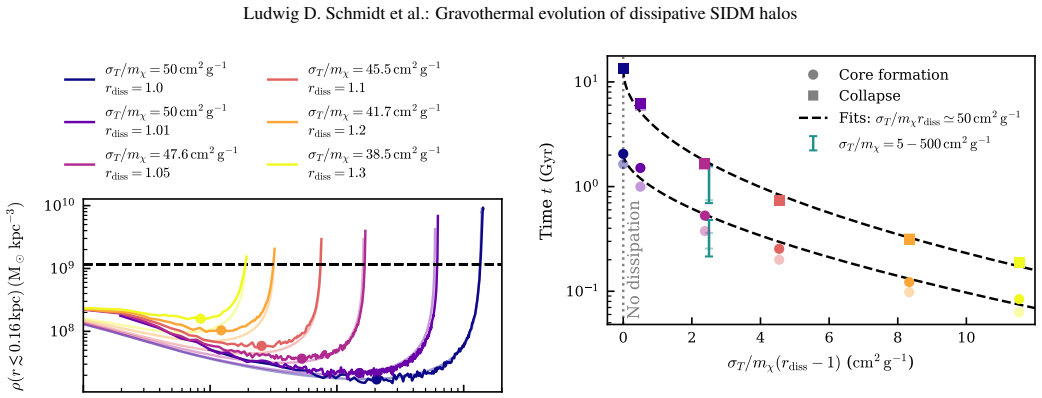
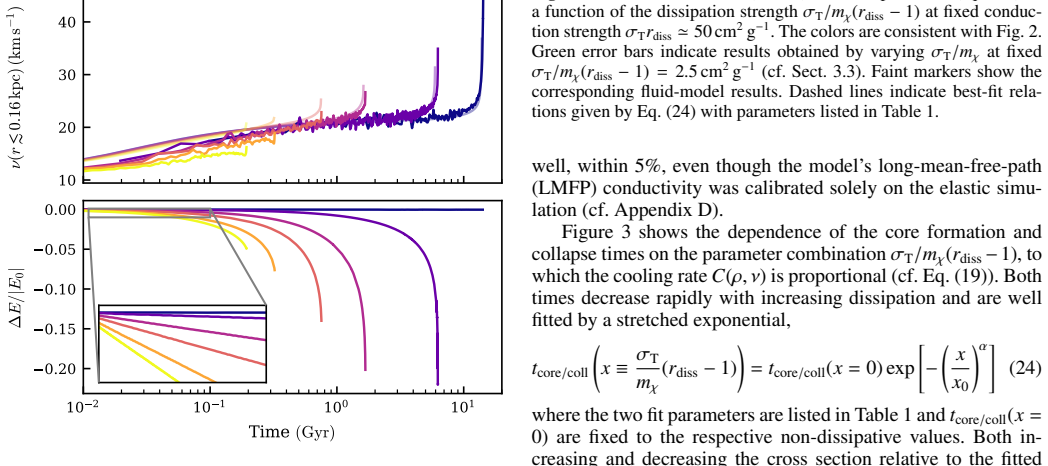
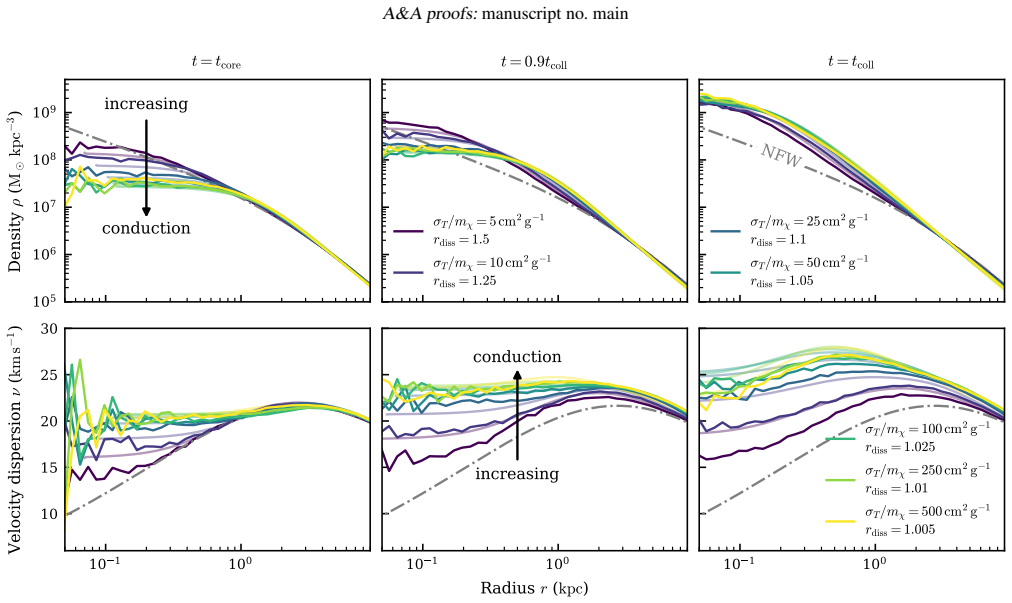
Dissipation qualitatively changes gravothermal evolution beyond accelerating collapse. Sufficiently strong central cooling inverts the usual role of heat conduction by suppressing isothermal core formation, so conduction remains directed inward throughout. Outer halo regions beyond the scale radius cool efficiently rather than being heated, producing a larger region of mass infall and a less pronounced indentation in the final density profile. These effects depend strongly on the cooling rate but are insensitive to the angular dependence of the cross section. Weakly dissipative self-interactions explain the JVAS B1938+666 perturber with significantly shorter evolution times or smaller cross
What carries the argument
The first extension of the N-body formalism for frequent small-angle self-interactions (fSIDM) to include effective dissipation, compared against a dissipative gravothermal fluid model.
If this is right
- Outer halo regions cool efficiently, increasing the scale of mass infall.
- Density profiles show a less pronounced indentation between the core and outer halo.
- Conduction stays inward for the entire evolution when cooling is strong enough.
- Observed compact objects can be matched with smaller self-interaction cross sections or shorter times.
Where Pith is reading between the lines
- Dissipative models may relax upper bounds on elastic cross sections while still fitting halo data.
- The same cooling mechanism could affect the structure of other compact dark-matter objects beyond the reported lens.
- Varying the cooling rate in future runs could map the transition between standard and inverted conduction regimes.
Load-bearing premise
The extended N-body formalism with dissipation, together with the fluid model comparison, accurately captures radiative processes without major artifacts that would alter the reported qualitative changes in halo evolution.
What would settle it
A density profile from simulation or observation that still develops a clear isothermal core despite strong central cooling rates would falsify the claimed inversion of conduction direction.
Figures





read the original abstract
Many proposed self-interacting dark matter (SIDM) models give rise to radiative processes that can dissipate energy. Understanding their impact on astrophysical objects through simulations and comparing the results with observations may thus constrain SIDM models. In this work, we systematically investigate how dissipation alters the gravothermal evolution of isolated SIDM halos by independently varying dissipation and heat conduction and identify potential observational signatures. To this end, we present the first extension of the $N$-body formalism for frequent small-angle self-interactions (fSIDM) to include effective dissipation. We compare all results for isolated halos with a dissipative gravothermal fluid model to assess its validity and limitations. We find that dissipation qualitatively changes the gravothermal evolution of SIDM halos beyond simply accelerating collapse. Sufficiently strong central cooling can invert the usual role of heat conduction: the formation of an isothermal core is suppressed such that conduction remains directed inward throughout the evolution. Outer halo regions beyond the scale radius can cool efficiently rather than being heated by conduction, resulting in a larger region of mass infall and a less pronounced indentation between the core and the outer halo in the final density profile. These effects depend strongly on the cooling rate but are comparatively insensitive to the angular dependence of the self-interaction cross section. We further show that weakly dissipative self-interactions can explain the properties of the recently observed strong lens perturber in JVAS~B1938+666 with significantly shorter evolution times or, equivalently, smaller cross sections compared to the elastic case. Our results open a new route to connecting halo structure and recently reported compact objects to dark-sector microphysics.
Editorial analysis
A structured set of objections, weighed in public.
Referee Report
Summary. The manuscript extends the N-body formalism for frequent small-angle self-interacting dark matter (fSIDM) to include effective dissipation, compares results for isolated halos against a dissipative gravothermal fluid model, and reports that sufficiently strong central cooling inverts the usual role of heat conduction: isothermal core formation is suppressed, conduction remains inward-directed, outer regions cool efficiently, and the final density profile shows a larger mass-infall region with reduced core-outer indentation. These effects depend strongly on cooling rate but weakly on angular dependence of the cross section. The work further claims that weakly dissipative self-interactions can reproduce the observed properties of the strong-lens perturber in JVAS B1938+666 with shorter evolution times or smaller cross sections than the elastic case.
Significance. If the reported inversion and its mapping to the JVAS B1938+666 perturber hold, the results supply a concrete route from dark-sector radiative processes to observable halo structure and compact objects, extending beyond elastic SIDM. The dual-method comparison (N-body extension plus fluid model) and the identification of qualitative changes that are not merely accelerated collapse constitute clear strengths.
major comments (2)
- [results section (N-body vs. fluid comparison)] The central claim that conduction remains directed inward throughout the evolution (abstract and strongest claim) is load-bearing for the inversion result; the manuscript must show explicit time series of the conductive heat flux or temperature gradient (e.g., in the results section comparing N-body and fluid runs) to demonstrate that the inversion is sustained rather than transient.
- [discussion of observational application] The quantitative statement that weakly dissipative interactions explain the JVAS B1938+666 perturber with 'significantly shorter evolution times or equivalently smaller cross sections' requires tabulated values of the adopted cooling rate, cross section, and resulting collapse timescale for both dissipative and elastic cases so that the magnitude of the reduction can be assessed directly.
minor comments (3)
- [methods] Notation for the effective dissipation term in the extended fSIDM N-body scheme should be defined explicitly (e.g., the relation between the dissipation parameter and the radiative cooling function) to allow direct comparison with the fluid-model equations.
- [figures] Figure captions for the density-profile evolution plots should state the number of independent realizations and the resolution used, to clarify the robustness of the reported qualitative changes in core indentation.
- [abstract] The abstract states that effects are 'comparatively insensitive to the angular dependence'; a brief sentence in the results summarizing the tested angular regimes (e.g., isotropic vs. forward-peaked) would make this statement self-contained.
Simulated Author's Rebuttal
We thank the referee for the positive assessment and constructive comments. We address the two major comments below and will revise the manuscript accordingly.
read point-by-point responses
-
Referee: [results section (N-body vs. fluid comparison)] The central claim that conduction remains directed inward throughout the evolution (abstract and strongest claim) is load-bearing for the inversion result; the manuscript must show explicit time series of the conductive heat flux or temperature gradient (e.g., in the results section comparing N-body and fluid runs) to demonstrate that the inversion is sustained rather than transient.
Authors: We agree that explicit time series are needed to confirm the inversion is sustained. We will add plots of the conductive heat flux and temperature gradient versus time (and radius) in the results section for representative N-body and fluid runs, demonstrating that inward conduction persists for strong cooling cases rather than being transient. revision: yes
-
Referee: [discussion of observational application] The quantitative statement that weakly dissipative interactions explain the JVAS B1938+666 perturber with 'significantly shorter evolution times or equivalently smaller cross sections' requires tabulated values of the adopted cooling rate, cross section, and resulting collapse timescale for both dissipative and elastic cases so that the magnitude of the reduction can be assessed directly.
Authors: We will add a table in the observational discussion section listing the cooling rates, velocity-dependent cross sections, and resulting collapse timescales for both the dissipative and elastic cases applied to the JVAS B1938+666 perturber, allowing direct comparison of the reduction factors. revision: yes
Circularity Check
No significant circularity
full rationale
The paper extends N-body methods for dissipative fSIDM and compares results to an independent gravothermal fluid model. Central claims (conduction inversion under strong cooling, shorter evolution times for JVAS B1938+666) are outputs of these direct simulations and model comparisons rather than quantities defined by the paper's own fitted parameters or self-citation chains. No load-bearing step reduces by construction to its inputs; the derivation remains self-contained against external benchmarks.
Axiom & Free-Parameter Ledger
Reference graph
Works this paper leans on
-
[1]
doi:10.48550/arXiv.2603.19362 , archivePrefix =
Survival of the most compact: the life and death of satellite halos in self-interacting dark matter. doi:10.48550/arXiv.2603.19362 , archivePrefix =. 2603.19362 , primaryClass =
-
[2]
, title =. 2026 , month = may, number =. arXiv , doi =:2504.13004 , keywords =
Pith/arXiv arXiv 2026
-
[3]
, title =. 2026 , month = apr, number =. arXiv , doi =:2510.11006 , keywords =
arXiv 2026
-
[4]
2026 , month = mar, pages =
Nature Astronomy , title =. 2026 , month = mar, pages =
2026
-
[5]
, title =. 2026 , month = mar, number =. arXiv , doi =:2509.12317 , keywords =
arXiv 2026
-
[6]
arXiv , doi =:2603.10107 , keywords =
2026 , month = mar, adsnote =. arXiv , doi =:2603.10107 , keywords =
arXiv 2026
-
[7]
, title =. 2025 , month = nov, pages =. arXiv , doi =:2506.06269 , keywords =
arXiv 2025
-
[8]
Nature Astronomy , title =. 2025 , month = nov, pages =. arXiv , doi =:2510.07382 , keywords =
arXiv 2025
-
[9]
Reviews of Modern Physics , title =. 2025 , month = oct, number =. arXiv , doi =:2207.10638 , keywords =
arXiv 2025
-
[10]
, title =. 2025 , month = aug, pages =. arXiv , doi =:2504.12393 , keywords =
arXiv 2025
-
[11]
, title =. 2025 , month = apr, number =. arXiv , doi =:2408.15317 , keywords =
arXiv 2025
-
[12]
, title =. 2025 , month = feb, pages =. arXiv , doi =:2410.07175 , keywords =
arXiv 2025
-
[13]
, title =. 2024 , month = dec, number =. arXiv , doi =:2402.01604 , keywords =
arXiv 2024
-
[14]
, title =. 2024 , month = may, number =. arXiv , doi =:2206.05327 , keywords =
arXiv 2024
-
[15]
, title =. 2024 , month = may, number =. arXiv , doi =:2312.09296 , keywords =
arXiv 2024
-
[16]
, title =. 2024 , month = apr, number =. arXiv , doi =:2310.07750 , keywords =
arXiv 2024
-
[17]
, title =. 2023 , month = sep, number =. arXiv , doi =:2304.09878 , keywords =
arXiv 2023
-
[18]
, title =. 2023 , month = aug, number =. arXiv , doi =:2204.06568 , keywords =
arXiv 2023
-
[19]
, title =. 2022 , month = nov, number =. arXiv , doi =:2209.00064 , keywords =
arXiv 2022
-
[20]
, title =. 2022 , month = sep, number =. arXiv , doi =:2205.03392 , keywords =
arXiv 2022
-
[21]
, title =. 2022 , month = feb, number =. arXiv , doi =:2012.06611 , keywords =
arXiv 2022
-
[22]
, title =. 2021 , month = sep, number =. arXiv , doi =:2102.09580 , keywords =
arXiv 2021
-
[23]
, title =. 2021 , month = jul, number =. arXiv , doi =:2012.10277 , keywords =
arXiv 2021
-
[24]
, title =. 2021 , month = jul, number =. arXiv , doi =:2103.13407 , keywords =
arXiv 2021
-
[25]
, title =. 2021 , month = jan, number =. arXiv , doi =:2006.12515 , keywords =
arXiv 2021
-
[26]
, title =. 2020 , month = sep, pages =. arXiv , doi =:1807.06209 , keywords =
Pith/arXiv arXiv 2020
-
[27]
, title =. 2020 , month = jun, number =. arXiv , doi =:1912.06757 , keywords =
arXiv 2020
-
[28]
, title =. 2020 , month = mar, number =. arXiv , doi =:1901.00499 , keywords =
arXiv 2020
-
[29]
, title =. 2019 , month = sep, number =. arXiv , doi =:1809.01144 , keywords =
arXiv 2019
-
[30]
, title =. 2019 , month = jul, number =. arXiv , doi =:1812.05088 , keywords =
Pith/arXiv arXiv 2019
-
[31]
, title =. 2019 , month = feb, number =. arXiv , doi =:1809.07326 , keywords =
Pith/arXiv arXiv 2019
-
[32]
, title =. 2018 , month = dec, number =. arXiv , doi =:1712.04512 , keywords =
Pith/arXiv arXiv 2018
-
[33]
, title =. 2018 , month = nov, number =. arXiv , doi =:1805.04512 , keywords =
Pith/arXiv arXiv 2018
-
[34]
, title =. 2018 , month = feb, pages =. arXiv , doi =:1705.02358 , keywords =
Pith/arXiv arXiv 2018
-
[35]
, title =. 2017 , month = aug, number =. arXiv , doi =:1707.04256 , keywords =
arXiv 2017
-
[36]
, title =. 2017 , month = jun, number =. arXiv , doi =:1612.03906 , keywords =
Pith/arXiv arXiv 2017
-
[37]
International Journal of Modern Physics A , title =. 2016 , month = aug, number =. arXiv , doi =:1604.04627 , keywords =
Pith/arXiv arXiv 2016
-
[38]
Advances in Parallel Computing , title =. 2016 , month = may, pages =. arXiv , doi =:1810.09898 , keywords =
Pith/arXiv arXiv 2016
-
[39]
Saas-Fee Advanced Course , title =. 2016 , month = jan, pages =. arXiv , doi =:1412.5187 , keywords =
Pith/arXiv arXiv 2016
-
[40]
, title =. 2015 , month = oct, number =. arXiv , doi =:1412.1477 , keywords =
Pith/arXiv arXiv 2015
-
[41]
, title =. 2015 , month = sep, number =. arXiv , doi =:1412.1839 , keywords =
Pith/arXiv arXiv 2015
-
[42]
, title =. 2014 , month = sep, number =. arXiv , doi =:1407.4121 , keywords =
Pith/arXiv arXiv 2014
-
[43]
, title =. 2014 , month = jul, number =. arXiv , doi =:1402.7073 , keywords =
Pith/arXiv arXiv 2014
-
[44]
, title =. 2014 , month = jan, number =. arXiv , doi =:1308.3419 , keywords =
Pith/arXiv arXiv 2014
-
[45]
, title =. 2014 , month = jan, number =. arXiv , doi =:1311.2937 , keywords =
Pith/arXiv arXiv 2014
-
[46]
Physics of the Dark Universe , title =. 2013 , month = sep, number =. arXiv , doi =:1306.1305 , keywords =
Pith/arXiv arXiv 2013
-
[47]
Physics of the Dark Universe , title =. 2013 , month = sep, number =. arXiv , doi =:1303.1521 , keywords =
Pith/arXiv arXiv 2013
-
[48]
, title =. 2013 , month = aug, number =. arXiv , doi =:1301.3137 , keywords =
Pith/arXiv arXiv 2013
-
[49]
, title =. 2013 , month = jun, number =. arXiv , doi =:1302.3898 , keywords =
Pith/arXiv arXiv 2013
-
[50]
, title =. 2012 , month = sep, number =. arXiv , doi =:1205.2729 , keywords =
Pith/arXiv arXiv 2012
-
[51]
, title =. 2011 , month = aug, number =. arXiv , doi =:1101.3097 , keywords =
Pith/arXiv arXiv 2011
-
[52]
, title =. 2010 , month = may, number =. arXiv , doi =:0909.0753 , keywords =
Pith/arXiv arXiv 2010
-
[53]
, title =. 2008 , month = jun, number =. arXiv , doi =:0704.0261 , keywords =
Pith/arXiv arXiv 2008
-
[54]
, title =. 2005 , month = dec, number =. arXiv , doi =:astro-ph/0505010 , keywords =
Pith/arXiv arXiv 2005
-
[55]
International Journal of Modern Physics D , title =. 2004 , month = jan, number =. arXiv , doi =:astro-ph/0407623 , keywords =
Pith/arXiv arXiv 2004
-
[56]
, title =. 2003 , month = jan, number =. arXiv , doi =:astro-ph/0201544 , keywords =
Pith/arXiv arXiv 2003
-
[57]
, title =. 2002 , month = dec, number =. arXiv , doi =:astro-ph/0205322 , keywords =
Pith/arXiv arXiv 2002
-
[58]
, title =. 2002 , month = apr, number =. arXiv , doi =:astro-ph/0110561 , keywords =
Pith/arXiv arXiv 2002
-
[59]
, title =. 2001 , month = nov, number =. arXiv , doi =:astro-ph/0010436 , keywords =
Pith/arXiv arXiv 2001
-
[60]
, title =. 2001 , month = feb, number =. arXiv , doi =:astro-ph/0006218 , keywords =
Pith/arXiv arXiv 2001
-
[61]
, title =. 2000 , month = nov, number =. arXiv , doi =:astro-ph/0003483 , keywords =
Pith/arXiv arXiv 2000
-
[62]
, title =. 2000 , month = may, number =. arXiv , doi =:astro-ph/0002409 , keywords =
Pith/arXiv arXiv 2000
-
[63]
, title =. 2000 , month = apr, number =. arXiv , doi =:astro-ph/9909386 , keywords =
Pith/arXiv arXiv 2000
-
[64]
, title =. 1997 , month = dec, number =. arXiv , doi =:astro-ph/9611107 , keywords =
Pith/arXiv arXiv 1997
-
[65]
1978, Physical processes in the interstellar medium (New York: Wiley), doi: 10.1002/9783527617722
1978 , adsnote =. doi:10.1002/9783527617722 , publisher =
-
[66]
1968 , month = jan, pages =
, title =. 1968 , month = jan, pages =
1968
-
[67]
Simulations of galaxy cluster mergers with velocity-dependent, rare, and frequent self-interactions. , keywords =. doi:10.1093/mnras/stae664 , archivePrefix =. 2310.07769 , primaryClass =
-
[68]
On the consequences of the gravothermal catastrophe. , keywords =. doi:10.1093/mnras/191.3.483 , adsurl =
-
[69]
, keywords =
Anisotropy in stellar dynamics. , keywords =
-
[70]
SIDM and CDM interpretations of the million-solar-mass lensing perturber JVAS B1938+666- V
-
[71]
R.et al.Array programming with NumPy.Nature585, 357–362 (2020)
Charles R. Harris and K. Jarrod Millman and St. Array programming with. 2020 , month = sep, journal =. doi:10.1038/s41586-020-2649-2 , publisher =
-
[72]
Hunter, J. D. , Title =. Computing in Science & Engineering , Volume =
discussion (0)
Sign in with ORCID, Apple, or X to comment. Anyone can read and Pith papers without signing in.