Itinerant Nature of Spin-Density-Wave Order in Ruddlesden-Popper Nickelates
Pith reviewed 2026-05-20 03:30 UTC · model grok-4.3
The pith
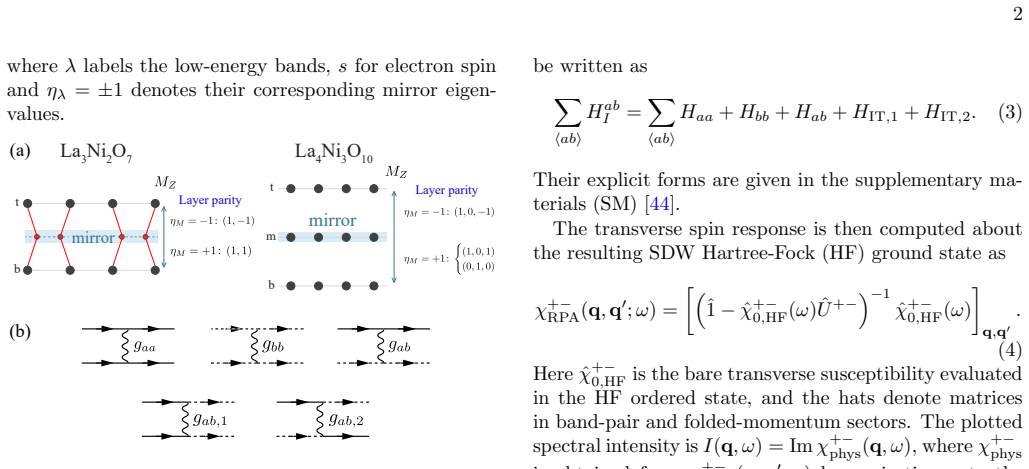
Magnetism in multilayer nickelates arises from itinerant electrons through mirror-selective spin-density-wave order.
A machine-rendered reading of the paper's core claim, the machinery that carries it, and where it could break.
Core claim
Magnetism in multilayer nickelates is itinerant in origin and arises from a mirror-selective interband SDW instability. The multilayer mirror structure organizes low-energy states into mirror-even and mirror-odd sectors, with dominant nesting between mirror-opposite bands selecting the SDW. Its collective modes account for the spin-wave-like spectra measured in La3Ni2O7 and La4Ni3O10, while in the trilayer case the SDW further induces a mirror-even charge density wave.
What carries the argument
mirror-selective interband SDW order, in which the multilayer mirror structure of the NiO2 blocks divides electronic states into even and odd sectors whose interband nesting drives the instability
If this is right
- The SDW collective modes reproduce the spin-wave-like magnetic excitations observed in both bilayer and trilayer compounds.
- In La4Ni3O10 the primary SDW induces a secondary mirror-even charge density wave, producing intertwined spin and charge order.
- Mirror-selective interband SDW order provides a single organizing principle for magnetic correlations across these multilayer nickelates.
Where Pith is reading between the lines
- The same mirror-parity nesting mechanism could organize order in other layered oxides that share similar block stacking symmetries.
- Experiments that break mirror symmetry through strain or external fields could test whether the SDW wavevector or transition temperature shifts as predicted.
- Band calculations that track mirror eigenvalues may identify candidate wavevectors for SDW order in related Ruddlesden-Popper phases.
Load-bearing premise
The multilayer mirror structure of the NiO2 blocks organizes low-energy electronic states into mirror-even and mirror-odd sectors with dominant interband nesting between opposite-parity bands.
What would settle it
A direct observation that the measured spin excitations cannot be reproduced by collective modes of an itinerant SDW, or evidence that local-moment susceptibility dominates instead, would falsify the claim.
Figures


read the original abstract
The nature of magnetism in layered Ruddlesden-Popper nickelates remains a central open question, particularly in light of recent observations of spin-wave-like magnetic excitations in metallic multilayer compounds. Here, we develop a unified itinerant description of spin-density-wave (SDW) order and magnetic excitations in La$_3$Ni$_2$O$_7$ and La$_4$Ni$_3$O$_{10}$. The essential ingredient is the multilayer mirror structure of the NiO$_2$ blocks, which organizes the low-energy electronic states into mirror-even and mirror-odd sectors. We show that dominant interband nesting between mirror-opposite bands drives a mirror-selective itinerant SDW instability, whose collective modes naturally reproduce the experimentally observed spin-wave-like spectra. In La$_4$Ni$_3$O$_{10}$, the SDW further induces a secondary mirror-even charge density wave, yielding intertwined spin and charge textures. Our results demonstrate that magnetism in multilayer nickelates is fundamentally itinerant rather than local-moment in origin, and establish mirror-selective interband SDW order as a unifying organizing principle for magnetic correlations in these systems.
Editorial analysis
A structured set of objections, weighed in public.
Referee Report
Summary. The manuscript develops a unified itinerant description of spin-density-wave (SDW) order and magnetic excitations in the Ruddlesden-Popper nickelates La₃Ni₂O₇ and La₄Ni₃O₁₀. The essential ingredient is the multilayer mirror structure of the NiO₂ blocks, which organizes low-energy states into mirror-even and mirror-odd sectors. Dominant interband nesting between mirror-opposite bands is argued to drive a mirror-selective itinerant SDW instability whose collective modes reproduce observed spin-wave-like spectra; in La₄Ni₃O₁₀ the SDW further induces a secondary mirror-even charge density wave, producing intertwined orders. The work concludes that magnetism in multilayer nickelates is fundamentally itinerant rather than local-moment in origin and positions mirror-selective interband SDW as a unifying principle.
Significance. If the central claims hold, the paper would offer a coherent itinerant framework for magnetism in these nickelates, moving beyond local-moment interpretations and linking magnetic excitations to mirror symmetry. It could unify observations of SDW wavevectors, spin-wave spectra, and charge orders across the Ruddlesden-Popper series, with potential relevance to related layered systems.
major comments (2)
- [Abstract and essential ingredient section] Abstract and section on the essential ingredient: the claim that interband nesting between mirror-opposite bands is the dominant instability is load-bearing for the mirror-selective SDW picture, yet the manuscript provides no explicit Lindhard function or RPA susceptibility matrix computation comparing the interband channel peak at the observed q_SDW against intraband and same-mirror contributions.
- [Collective modes section] Section on collective modes and magnetic excitations: the statement that the SDW collective modes naturally reproduce the experimentally observed spin-wave-like spectra is asserted without equations, derivations of the mode dispersion, or direct comparisons to data (e.g., no figures or tables showing calculated vs. measured spectra).
minor comments (2)
- [Figures] Expand figure captions to explicitly label mirror-even and mirror-odd bands and indicate which nesting vectors are plotted.
- [Methods] Add a brief methods paragraph summarizing the tight-binding model parameters and the approximation level (e.g., RPA or beyond) used for the susceptibility.
Simulated Author's Rebuttal
We thank the referee for the careful reading and constructive comments on our manuscript. The points raised identify areas where additional explicit calculations and derivations would strengthen the presentation of our itinerant SDW framework. We respond to each major comment below and will incorporate revisions in the next version of the manuscript.
read point-by-point responses
-
Referee: [Abstract and essential ingredient section] Abstract and section on the essential ingredient: the claim that interband nesting between mirror-opposite bands is the dominant instability is load-bearing for the mirror-selective SDW picture, yet the manuscript provides no explicit Lindhard function or RPA susceptibility matrix computation comparing the interband channel peak at the observed q_SDW against intraband and same-mirror contributions.
Authors: We agree that an explicit comparison via the Lindhard function and RPA susceptibility matrix would make the dominance of the interband nesting channel more quantitative and transparent. In the revised manuscript we will add these calculations, demonstrating the peak position and strength in the mirror-opposite interband channel at the observed q_SDW relative to intraband and same-mirror contributions. revision: yes
-
Referee: [Collective modes section] Section on collective modes and magnetic excitations: the statement that the SDW collective modes naturally reproduce the experimentally observed spin-wave-like spectra is asserted without equations, derivations of the mode dispersion, or direct comparisons to data (e.g., no figures or tables showing calculated vs. measured spectra).
Authors: We acknowledge that the collective-modes discussion would be strengthened by explicit derivations and data comparison. In the revised manuscript we will include the equations governing the SDW collective-mode dispersion and add a figure that directly overlays the calculated spin-wave spectrum with the experimental data for both La₃Ni₂O₇ and La₄Ni₃O₁₀. revision: yes
Circularity Check
Derivation chain remains self-contained with no circular reductions
full rationale
The paper constructs its itinerant SDW description directly from the multilayer mirror symmetry of the NiO2 blocks, a structural property that partitions bands into mirror-even and mirror-odd sectors. This symmetry-based partitioning then informs the analysis of interband nesting as the driver of the instability. No quoted equations or steps reduce the claimed SDW wavevector, mode spectrum, or itinerant character to a fitted parameter renamed as a prediction, nor does the central claim rest on a self-citation chain or uniqueness theorem imported from the authors' prior work. The derivation is therefore independent of the final conclusion and does not exhibit any of the enumerated circularity patterns.
Axiom & Free-Parameter Ledger
Reference graph
Works this paper leans on
-
[1]
H. Sun, M. Huo, X. Hu, J. Li, Z. Liu, Y. Han, L. Tang, Z. Mao, P. Yang, B. Wang, J. Cheng, D.-X. Yao, G.-M. Zhang, and M. Wang, Nature621, 493 (2023)
work page 2023
- [2]
-
[3]
N. Wang, G. Wang, X. Shen, J. Hou, J. Luo, X. Ma, H. Yang, L. Shi, J. Dou, J. Feng, J. Yang, Y. Shi, Z. Ren, H. Ma, P. Yang, Z. Liu, Y. Liu, H. Zhang, X. Dong, Y. Wang, K. Jiang, J. Hu, S. Nagasaki, K. Kitagawa, S. Calder, J. Yan, J. Sun, B. Wang, R. Zhou, Y. Uwatoko, and J. Cheng, Nature634, 579 (2024)
work page 2024
-
[4]
F. Li, Z. Xing, D. Peng, J. Dou, N. Guo, L. Ma, Y. Zhang, L. Wang, J. Luo, J. Yang, J. Zhang, T. Chang, Y.-S. Chen, W. Cai, J. Cheng, Y. Wang, Y. Liu, T. Luo, N. Hi- rao, T. Matsuoka, H. Kadobayashi, Z. Zeng, Q. Zheng, R. Zhou, Q. Zeng, X. Tao, and J. Zhang, Nature649, 871 (2026)
work page 2026
-
[5]
Y. Zhu, D. Peng, E. Zhang, B. Pan, X. Chen, L. Chen, H. Ren, F. Liu, Y. Hao, N. Li, Z. Xing, F. Lan, J. Han, J. Wang, D. Jia, H. Wo, Y. Gu, Y. Gu, L. Ji, W. Wang, H. Gou, Y. Shen, T. Ying, X. Chen, W. Yang, H. Cao, C. Zheng, Q. Zeng, J.-g. Guo, and J. Zhao, Nature631, 531 (2024)
work page 2024
-
[6]
H. Sakakibara, M. Ochi, H. Nagata, Y. Ueki, H. Saku- rai, R. Matsumoto, K. Terashima, K. Hirose, H. Ohta, M. Kato, Y. Takano, and K. Kuroki, Phys. Rev. B109, 144511 (2024)
work page 2024
-
[7]
M. Zhang, C. Pei, D. Peng, X. Du, W. Hu, Y. Cao, Q. Wang, J. Wu, Y. Li, H. Liu, C. Wen, J. Song, Y. Zhao, C. Li, W. Cao, S. Zhu, Q. Zhang, N. Yu, P. Cheng, L. Zhang, Z. Li, J. Zhao, Y. Chen, C. Jin, H. Guo, C. Wu, F. Yang, Q. Zeng, S. Yan, L. Yang, and Y. Qi, Physical Review X15, 021005 (2025)
work page 2025
- [8]
- [9]
-
[10]
Y. Wang, K. Jiang, J. Ying, T. Wu, J. Cheng, J. Hu, and X. Chen, National Science Review12, nwaf373 (2025)
work page 2025
-
[11]
M. Wang, H.-H. Wen, T. Wu, D.-X. Yao, and T. Xiang, Chinese Physics Letters41, 077402 (2024)
work page 2024
-
[12]
E. K. Ko, Y. Yu, Y. Liu, L. Bhatt, J. Li, V. Thampy, C.-T. Kuo, B. Y. Wang, Y. Lee, K. Lee, J.-S. Lee, B. H. Goodge, D. A. Muller, and H. Y. Hwang, Nature638, 935 (2025)
work page 2025
-
[13]
Y. Liu, E. K. Ko, Y. Tarn, L. Bhatt, J. Li, V. Thampy, B. H. Goodge, D. A. Muller, S. Raghu, Y. Yu, and H. Y. Hwang, Nature Materials24, 1221 (2025)
work page 2025
-
[14]
G. Zhou, W. Lv, H. Wang, Z. Nie, Y. Chen, Y. Li, H. Huang, W.-Q. Chen, Y.-J. Sun, Q.-K. Xue, and Z. Chen, Nature640, 641 (2025)
work page 2025
-
[15]
M. Shi, D. Peng, K. Fan, Z. Xing, S. Yang, Y. Wang, H. Li, R. Wu, M. Du, B. Ge, Z. Zeng, Q. Zeng, J. Ying, T. Wu, and X. Chen, Nature Physics21, 1780 (2025)
work page 2025
-
[16]
Z. Liu, H. Sun, M. Huo, X. Ma, Y. Ji, E. Yi, L. Li, H. Liu, J. Yu, Z. Zhang, Z. Chen, F. Liang, H. Dong, H. Guo, D. Zhong, B. Shen, S. Li, and M. Wang, Science China Physics, Mechanics & Astronomy66, 217411 (2022)
work page 2022
-
[17]
D. Zhao, Y. Zhou, M. Huo, Y. Wang, L. Nie, Y. Yang, J. Ying, M. Wang, T. Wu, and X. Chen, Science Bulletin 70, 1239 (2025)
work page 2025
-
[18]
K. Chen, X. Liu, J. Jiao, M. Zou, C. Jiang, X. Li, Y. Luo, Q. Wu, N. Zhang, Y. Guo, and L. Shu, Phys. Rev. Lett. 132, 256503 (2024)
work page 2024
-
[19]
X. Chen, J. Choi, Z. Jiang, J. Mei, K. Jiang, J. Li, S. Agrestini, M. Garcia-Fernandez, H. Sun, X. Huang, D. Shen, M. Wang, J. Hu, Y. Lu, K.-J. Zhou, and D. Feng, Nature Communications15, 9597 (2024)
work page 2024
-
[20]
R. Khasanov, T. J. Hicken, D. J. Gawryluk, V. Saz- gari, I. Plokhikh, L. P. Sorel, M. Bartkowiak, S. B¨ otzel, F. Lechermann, I. M. Eremin, H. Luetkens, and Z. Guguchia, Nature Physics21, 430 (2025)
work page 2025
-
[21]
Y. Wang, D. Zhao, E. Zhang, L. Chen, Y. Zhou, M. Shi, Y. Zhu, J. Ying, J. Zhao, and T. Wu, Nature Communi- cations 10.1038/s41467-026-73082-4 (2026)
-
[22]
M. Yashima, N. Seto, Y. Oshita, M. Kakoi, H. Sakurai, Y. Takano, and H. Mukuda, Journal of the Physical So- ciety of Japan94, 054704 (2025)
work page 2025
-
[23]
X. Ren, R. Sutarto, X. Wu, J. Zhang, H. Huang, T. Xi- ang, J. Hu, R. Comin, X. Zhou, and Z. Zhu, Communi- cations Physics8, 52 (2025)
work page 2025
-
[24]
J. Luo, J. Feng, G. Wang, N. Wang, J. Dou, A. Fang, 6 J. Yang, J. Cheng, G. Zheng, and R. Zhou, Chinese Physics Letters42, 067402 (2025)
work page 2025
-
[25]
L. Chen, E. Zhang, Y. Hao, Y. Zhu, B. Cui, D. L. Abernathy, T. J. Williams, Y. Ikeda, H. Zhang, F. Liu, W. Wang, Q. Wang, and J. Zhao, Nature of mag- netism in bilayer nickelate la3ni2o7 single crystals (2026), arXiv:2605.03448 [cond-mat.str-el]
work page internal anchor Pith review Pith/arXiv arXiv 2026
-
[26]
X. Chen, Z. Li, M. Xie, D. Hu, Y.-F. Chiu, S. Agres- tini, W. Zhang, Y. Lu, M. Wang, M. Garcia-Fernandez, D. Feng, and K.-J. Zhou, Dissecting superconductivity in the ruddlesden-popper nickelates: The role of elec- tron correlation and interlayer magnetic exchange (2026), arXiv:2604.01902 [cond-mat.supr-con]
-
[27]
Y. Chan, Y. Li, Y. Yan, X. Hong, T. Wang, M. dos Reis Cantarino, Y. Zhu, E. Zhang, L. Chen, J. Okamoto, H.-Y. Huang, D.-J. Huang, N. B. Brookes, J. Chang, Y. Shen, J. Zhao, and Q. Wang, Collective spin excitations in trilayer nickelate la 4ni3o10 (2026), arXiv:2604.04643 [cond-mat.supr-con]
work page internal anchor Pith review Pith/arXiv arXiv 2026
-
[28]
M. Li, J. Gong, Y. Zhu, Z. Chen, J. Zhang, E. Zhang, Y. Li, R. Yin, S. Wang, J. Zhao, D.-L. Feng, Z. Du, and Y.-J. Yan, Phys. Rev. B112, 045132 (2025)
work page 2025
- [29]
-
[30]
X. Jia, Y. Shen, H. LaBollita, X. Chen, J. Zhang, Y. Li, H. Zhao, M. G. Kanatzidis, M. Krogstad, H. Zheng, A. H. Said, A. Alatas, S. Rosenkranz, D. Phelan, M. P. M. Dean, M. R. Norman, J. F. Mitchell, A. S. Botana, and Y. Cao, Phys. Rev. X16, 011013 (2026)
work page 2026
-
[31]
Y. Wang, K. Jiang, Z. Wang, F.-C. Zhang, and J. Hu, Phys. Rev. B110, 205122 (2024)
work page 2024
-
[32]
H. LaBollita, V. Pardo, M. R. Norman, and A. S. Botana, Phys. Rev. Mater.8, L111801 (2024)
work page 2024
-
[33]
X.-S. Ni, Y. Ji, L. He, T. Xie, D.-X. Yao, M. Wang, and K. Cao, npj Quantum Materials10, 17 (2025)
work page 2025
-
[34]
J. Yang, H. Sun, X. Hu, Y. Xie, T. Miao, H. Luo, H. Chen, B. Liang, W. Zhu, G. Qu, C.-Q. Chen, M. Huo, Y. Huang, S. Zhang, F. Zhang, F. Yang, Z. Wang, Q. Peng, H. Mao, G. Liu, Z. Xu, T. Qian, D.-X. Yao, M. Wang, L. Zhao, and X. J. Zhou, Nature Communica- tions15, 4373 (2024)
work page 2024
-
[35]
H. Li, X. Zhou, T. Nummy, J. Zhang, V. Pardo, W. E. Pickett, J. F. Mitchell, and D. S. Dessau, Nature Com- munications8, 704 (2017)
work page 2017
-
[36]
X. Du, Y. L. Wang, Y. D. Li, Y. T. Cao, M. X. Zhang, C. Y. Pei, J. M. Yang, W. X. Zhao, K. Y. Zhai, Z. K. Liu, Z. W. Li, J. K. Zhao, Z. T. Liu, D. W. Shen, Z. Li, Y. He, Y. L. Chen, Y. P. Qi, H. J. Guo, and L. X. Yang, Phys. Rev. Lett.135, 146506 (2025)
work page 2025
-
[37]
J. Yang, J. Zhan, T. Miao, M. Huo, Q. Xu, Y. Li, Y. Xie, B. Liang, N. Cai, H. Chen, W. Zhu, M. Xu, S. Zhang, F. Zhang, F. Yang, Z. Wang, Q. Peng, H. Mao, X. Li, Z. Zhu, G. Liu, Z. Xu, J. Hu, X. Wu, M. Wang, L. Zhao, and X. J. Zhou, Electronic origin of density wave orders in a trilayer nickelate (2026), arXiv:2601.22608 [cond- mat.supr-con]
-
[38]
Z. Jiang, E. Zhang, Y. Wang, Z. Liu, J. Liu, R. Zhang, X. Zhang, W. Jing, Y. Huang, Q. Jiang, M. Ye, K. Jiang, J. Zhao, D. Shen, and D. Feng, arXiv e-prints , arXiv:2602.02127 (2026), arXiv:2602.02127 [cond-mat.supr-con]
-
[39]
P. M. R. Brydon and C. Timm, Phys. Rev. B80, 174401 (2009)
work page 2009
- [40]
- [41]
- [42]
-
[43]
M. R. Norman, Phys. Rev. B112, 075149 (2025)
work page 2025
-
[44]
See Supplemental Material for: (i) tight-binding mod- els, bandwidth rescalings, and mirror-basis/folded- momentum conventions; (ii) the residual-interaction model and Hartree–Fock/RPA formulation; (iii) or- bital/layer projections of the ordered spin and charge textures, including the induced 2Qcharge modulation; and (iv) a local-spin comparison for larg...
discussion (0)
Sign in with ORCID, Apple, or X to comment. Anyone can read and Pith papers without signing in.