Monolithic axial InGaAs quantum dot emitters in GaAs-based nanowires via Sb-mediated facet engineering
Pith reviewed 2026-05-21 07:49 UTC · model grok-4.3
The pith
Dilute antimony incorporation suppresses rotational twins in GaAs nanowires to enable abrupt axial InGaAs quantum dot emitters.
A machine-rendered reading of the paper's core claim, the machinery that carries it, and where it could break.
Core claim
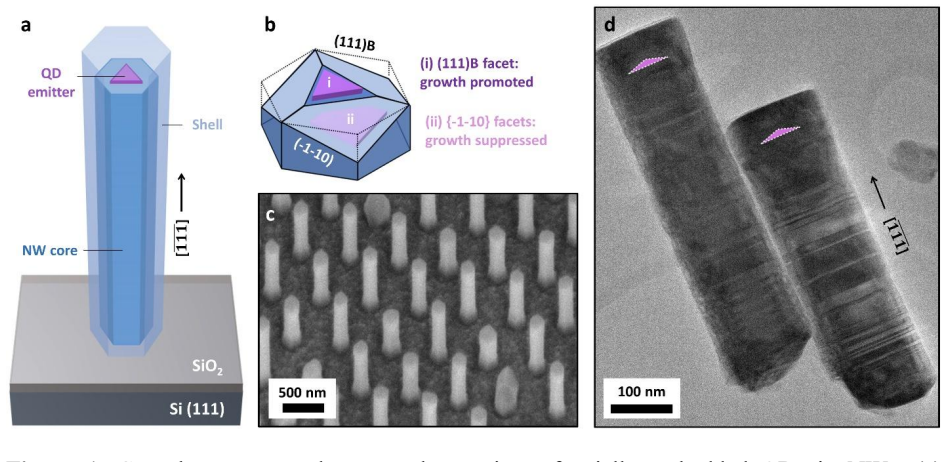
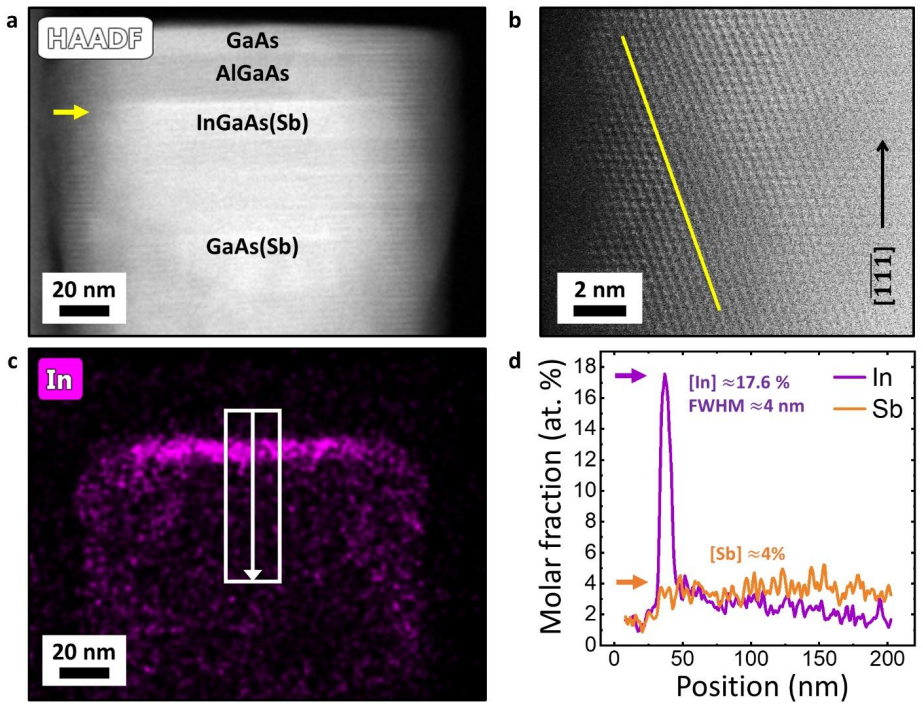
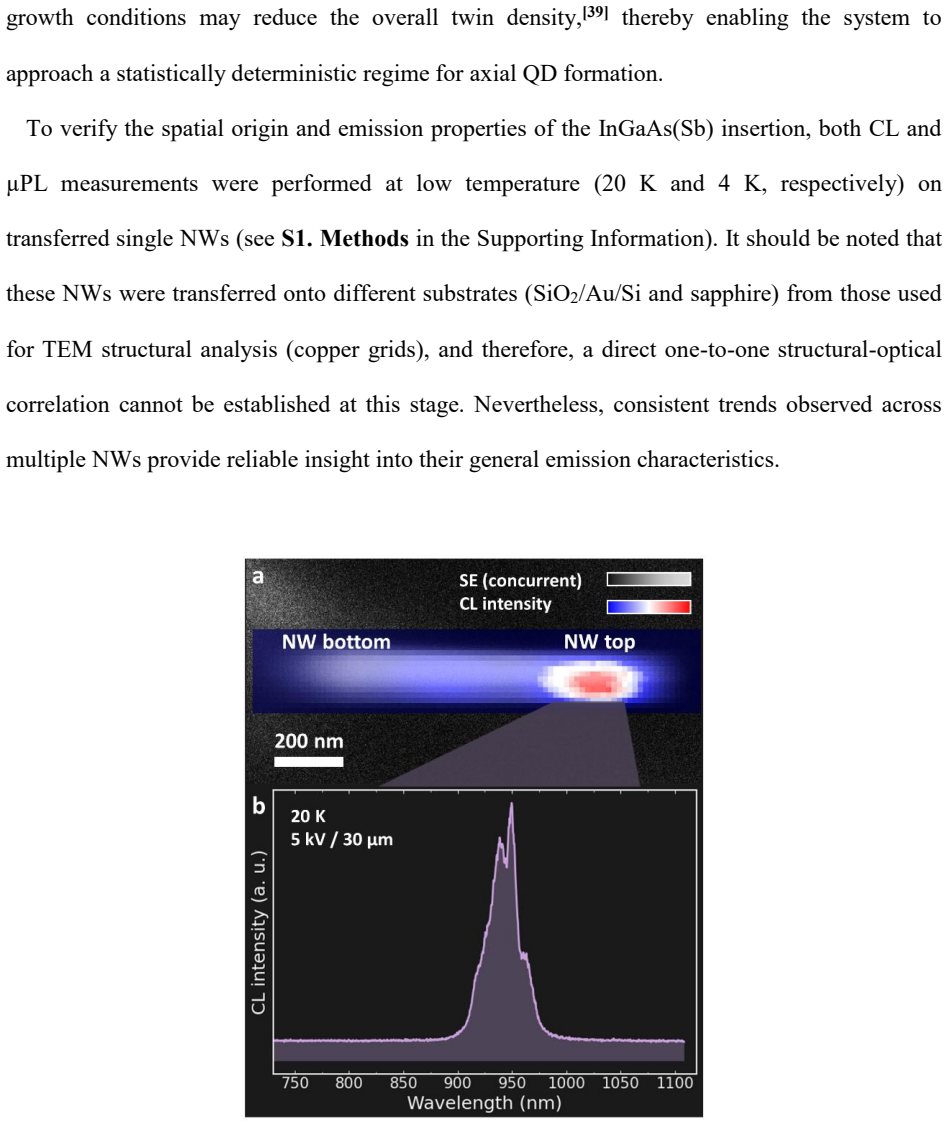
By tailoring facet evolution via dilute Sb incorporation, which efficiently suppresses twins and promotes confined axial insertion at the growth-front facet, the approach significantly enhances the probability of obtaining abrupt, few-nanometer-thin quantum dots at the nanowire tip. Single-nanowire optical spectroscopy reveals intense, spatially localized emission from the active region with lifetimes as short as (0.51 ± 0.02) ns, and second-order photon-correlation measurements consistently exhibit pronounced antibunching with g^(2)(0)<0.4, confirming single-photon emission.
What carries the argument
Sb-mediated facet engineering that suppresses rotational twins and promotes confined axial InGaAs insertion at the nanowire growth front.
If this is right
- Single-nanowire spectroscopy shows intense spatially localized emission from the active region.
- Emission lifetimes reach as short as 0.51 ns.
- Photon correlations yield g^(2)(0) < 0.4, confirming single-photon emission.
- Twin density correlates strongly with the success of axial heterostructure formation.
- Defect control is identified as essential for monolithically integrated nanowire single-photon sources.
Where Pith is reading between the lines
- The same dilute Sb strategy could be tested in other III-V nanowire heterostructures to improve interface abruptness.
- Avoiding post-growth transfer steps may become easier when placing these emitters on silicon photonic circuits.
- Lower twin densities could benefit nanowire optoelectronic devices beyond single-photon sources.
- Quantifying the minimum Sb concentration needed for twin suppression under different growth conditions would be a direct next measurement.
Load-bearing premise
Dilute Sb incorporation is the main cause of twin suppression and abrupt axial InGaAs insertion rather than other unstated growth parameters or substrate effects.
What would settle it
Growing the same nanowires without any antimony and still obtaining abrupt axial InGaAs quantum dots with comparable single-photon emission would disprove the claimed dominant role of Sb.
Figures
read the original abstract
GaAs-based nanowires hosting active quantum heterostructures provide a promising route toward monolithic integration of single-photon sources on silicon, a key requirement for scalable quantum photonics. However, ultrathin axial quantum-emitter formation is often hindered by facet-dependent growth dynamics and rotational twins, which induce lateral overgrowth and compromise interface abruptness. Here, we develop InGaAs-based quantum emitters by tailoring facet evolution via dilute Sb incorporation, which efficiently suppresses twins and promotes confined axial insertion at the growth-front facet. This approach significantly enhances the probability of obtaining abrupt, few-nanometer-thin quantum dots at the nanowire tip. Single-nanowire optical spectroscopy reveals intense, spatially localized emission from the active region with lifetimes as short as (0.51 $\pm$ 0.02) ns, and second-order photon-correlation measurements consistently exhibit pronounced antibunching with $g^{(2)}(0)<0.4$, confirming single-photon emission. These results establish a strong correlation between twin density and axial heterostructure formation, identifying defect control as a key factor in realizing monolithically integrated nanowire single-photon sources.
Editorial analysis
A structured set of objections, weighed in public.
Referee Report
Summary. The paper reports a growth strategy for GaAs-based nanowires incorporating axial InGaAs quantum dots, using dilute Sb incorporation during MBE to engineer facets, suppress rotational twins, and enable abrupt axial heterostructure insertion at the growth front. Single-nanowire optical measurements show spatially localized emission with lifetimes as short as (0.51 ± 0.02) ns and consistent antibunching with g^(2)(0) < 0.4, taken as confirmation of single-photon emission. The central result is a correlation between reduced twin density and successful formation of few-nanometer-thin axial QDs.
Significance. If the reported correlation holds, the work provides a practical route toward monolithic single-photon sources on silicon via nanowire heterostructures, addressing a key integration challenge in quantum photonics. The concrete optical metrics (sub-nanosecond lifetime and g^(2)(0) < 0.4) constitute direct evidence of functional single-photon behavior in these axial emitters, strengthening the case for defect-engineered nanowire platforms.
major comments (1)
- [Abstract and facet evolution discussion] Abstract and paragraph on facet evolution and twin density correlation: the claim that dilute Sb incorporation is the dominant factor suppressing twins and enabling abrupt axial InGaAs insertion rests on observed correlations but lacks explicit controls that independently vary other growth parameters (e.g., temperature, V/III ratio, or substrate preparation). Without such controls, it remains difficult to rule out confounding effects and to establish Sb dose as the primary causal variable.
minor comments (2)
- [Abstract] The abstract cites specific values for lifetime and g^(2)(0), yet the manuscript does not report the number of nanowires measured, statistical distributions, or raw correlation data; inclusion of these would allow readers to assess the robustness of the single-photon confirmation.
- [Growth and characterization sections] Figure captions and growth-section text should explicitly state the Sb flux range used and the corresponding twin-density quantification method (e.g., TEM statistics) to make the facet-engineering mechanism reproducible.
Simulated Author's Rebuttal
We thank the referee for their constructive feedback and for recognizing the significance of our results on axial InGaAs quantum dots in GaAs nanowires. We address the major comment below and have prepared revisions to clarify the experimental design.
read point-by-point responses
-
Referee: [Abstract and facet evolution discussion] Abstract and paragraph on facet evolution and twin density correlation: the claim that dilute Sb incorporation is the dominant factor suppressing twins and enabling abrupt axial InGaAs insertion rests on observed correlations but lacks explicit controls that independently vary other growth parameters (e.g., temperature, V/III ratio, or substrate preparation). Without such controls, it remains difficult to rule out confounding effects and to establish Sb dose as the primary causal variable.
Authors: We thank the referee for this observation. In the reported growth series, substrate temperature, V/III ratio, and substrate preparation were held fixed while only the Sb flux was systematically varied; these fixed parameters are specified in the Methods section. The resulting correlation between Sb dose, twin suppression, and axial QD formation under constant conditions supports our interpretation that dilute Sb incorporation is the dominant factor. We acknowledge that a broader set of independent controls on each parameter would further strengthen the causal claim. In the revised manuscript we will expand the facet-evolution discussion to explicitly restate the fixed parameters, the rationale for the chosen experimental design, and the limitations of the current correlation-based evidence. revision: yes
Circularity Check
No significant circularity
full rationale
The manuscript is a purely experimental report on nanowire growth via MBE, facet evolution under Sb flux, and single-nanowire optical characterization. No equations, derivations, fitted parameters, or predictive models appear in the abstract or described sections. Claims rest on direct TEM imaging of twin density, PL spectra, lifetime measurements, and g^(2)(0) antibunching data. These are independent observables, not reductions of one another by construction. No self-citation load-bearing steps or ansatz smuggling are indicated in the provided text.
Axiom & Free-Parameter Ledger
axioms (1)
- domain assumption Rotational twins in GaAs nanowires induce lateral overgrowth that compromises axial heterostructure abruptness.
Lean theorems connected to this paper
-
IndisputableMonolith/Foundation/AlexanderDuality.leanalexander_duality_circle_linking unclear?
unclearRelation between the paper passage and the cited Recognition theorem.
dilute Sb incorporation... suppresses twins and promotes confined axial insertion at the growth-front facet... strong correlation between twin density and axial heterostructure formation
-
IndisputableMonolith/Cost/FunctionalEquation.leanwashburn_uniqueness_aczel unclear?
unclearRelation between the paper passage and the cited Recognition theorem.
lifetimes as short as (0.51 ± 0.02) ns... g(2)(0)<0.4, confirming single-photon emission
What do these tags mean?
- matches
- The paper's claim is directly supported by a theorem in the formal canon.
- supports
- The theorem supports part of the paper's argument, but the paper may add assumptions or extra steps.
- extends
- The paper goes beyond the formal theorem; the theorem is a base layer rather than the whole result.
- uses
- The paper appears to rely on the theorem as machinery.
- contradicts
- The paper's claim conflicts with a theorem or certificate in the canon.
- unclear
- Pith found a possible connection, but the passage is too broad, indirect, or ambiguous to say the theorem truly supports the claim.
discussion (0)
Sign in with ORCID, Apple, or X to comment. Anyone can read and Pith papers without signing in.