Deep Distillation Gradient Preconditioning for Inverse Problems
Pith reviewed 2026-05-21 23:09 UTC · model grok-4.3
The pith
A nonlinear preconditioner learned by distilling gradients from a well-conditioned teacher matrix improves convergence when plugged into FISTA for ill-conditioned imaging tasks.
A machine-rendered reading of the paper's core claim, the machinery that carries it, and where it could break.
Core claim
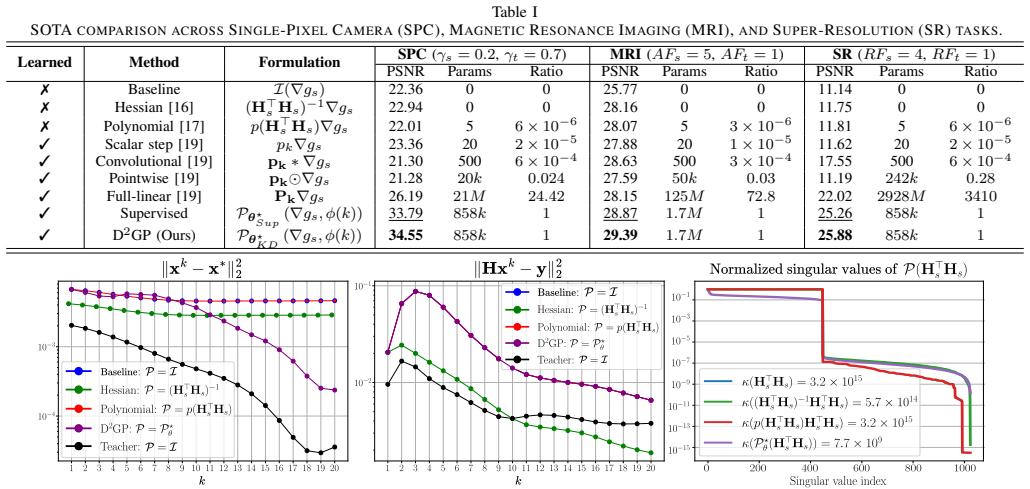
A nonlinear preconditioning neural network trained by gradient matching between a teacher algorithm (using a synthetic better-conditioned sensing matrix) and a student algorithm (using the real ill-conditioned matrix) can be plugged into FISTA to improve both convergence speed and reconstruction quality across single-pixel, MR, and super-resolution imaging tasks.
What carries the argument
Nonlinear preconditioning neural network trained via gradient matching distillation from teacher to student algorithm.
If this is right
- The preconditioner yields faster empirical convergence in iterative solvers for inverse problems.
- Reconstruction quality improves in single-pixel, magnetic resonance, and super-resolution imaging when the preconditioner is used with FISTA.
- The method works as a plug-and-play module inside existing optimization algorithms.
- It avoids the null-space solutions that arise when linear preconditioners are trained only on data-fidelity terms.
Where Pith is reading between the lines
- The distillation idea could be applied to other first-order solvers besides FISTA.
- Similar teacher-student gradient matching might help in settings where the sensing operator changes dynamically.
- The approach suggests a route to reducing manual design of matrix-dependent preconditioners.
Load-bearing premise
Gradient steps distilled from a synthetic better-conditioned matrix will produce preconditioner updates that remain effective on the real ill-conditioned matrix without driving solutions into its null space.
What would settle it
Running the preconditioned FISTA on a test problem where the final reconstruction produces forward projections that deviate substantially from the measured data or where the iteration diverges would falsify the claim.
Figures


read the original abstract
Imaging inverse problems are commonly addressed by minimizing measurement consistency and signal prior terms. While huge attention has been paid to developing high-performance priors, even the most advanced signal prior may lose its effectiveness when paired with an ill-conditioned sensing matrix that hinders convergence and degrades reconstruction quality. In optimization theory, preconditioners allow improving the algorithm's convergence by transforming the gradient update. Traditional linear preconditioning techniques enhance convergence, but their performance remains limited due to their dependence on the structure of the sensing matrix. Learning-based linear preconditioners have been proposed, but they are optimized only for data-fidelity optimization, which may lead to solutions in the null-space of the sensing matrix. This paper employs knowledge distillation to design a nonlinear preconditioning operator. In our method, a teacher algorithm using a better-conditioned (synthetic) sensing matrix guides the student algorithm with an ill-conditioned sensing matrix through gradient matching via a preconditioning neural network. We validate our nonlinear preconditioner for plug-and-play FISTA in single-pixel, magnetic resonance, and super-resolution imaging tasks, showing consistent performance improvements and better empirical convergence.
Editorial analysis
A structured set of objections, weighed in public.
Referee Report
Summary. The manuscript proposes a nonlinear preconditioning operator for gradient-based solvers in imaging inverse problems, learned via knowledge distillation. A teacher algorithm operating on a synthetic better-conditioned sensing matrix supervises a student preconditioning network through gradient matching; the resulting network is then inserted into plug-and-play FISTA applied to the original ill-conditioned operator. The approach is claimed to yield improved empirical convergence and reconstruction quality on single-pixel, MR, and super-resolution tasks.
Significance. If the central claim is substantiated with quantitative evidence, the work would offer a practical route to nonlinear preconditioning that sidesteps the null-space problems associated with purely data-fidelity linear preconditioners. The distillation-from-synthetic-teacher strategy is a distinctive contribution that could be adopted in other learned-optimization pipelines for inverse problems.
major comments (2)
- [Abstract] Abstract: the statement that the method shows 'consistent performance improvements and better empirical convergence' is unsupported by any quantitative metrics, tables, ablation studies, or details on how the synthetic teacher matrix is constructed. These omissions prevent assessment of the magnitude and reliability of the claimed gains across the three tasks.
- [Method] Method description (gradient-matching stage): no explicit constraint (range projection onto A^*, orthogonality penalty, or null-space regularizer) is described that would guarantee the preconditioned direction lies in the row space of the true sensing operator. Because the teacher matrix is synthetic and structurally different from the real A, gradient matching alone supplies no safeguard against null-space drift that the subsequent proximal step may not cancel.
minor comments (2)
- [Abstract] The abstract would be clearer if it briefly indicated the architecture of the preconditioning network and the precise form of the gradient-matching loss.
- [Introduction] Related-work discussion of linear preconditioners and knowledge-distillation techniques in optimization should be expanded with specific citations to establish novelty.
Simulated Author's Rebuttal
We thank the referee for the thoughtful and constructive report. We address each major comment below, indicating the revisions we plan to incorporate.
read point-by-point responses
-
Referee: [Abstract] Abstract: the statement that the method shows 'consistent performance improvements and better empirical convergence' is unsupported by any quantitative metrics, tables, ablation studies, or details on how the synthetic teacher matrix is constructed. These omissions prevent assessment of the magnitude and reliability of the claimed gains across the three tasks.
Authors: We agree that the abstract, being concise by nature, does not convey the quantitative evidence present in the full manuscript. Sections 4 and 5 contain tables of PSNR/SSIM values, convergence plots, and ablation studies across the single-pixel, MR, and super-resolution tasks, along with a description of the synthetic teacher matrix construction. In the revision we will augment the abstract with a brief quantitative summary of the observed gains and move additional details on the teacher matrix into the main method section to improve accessibility. revision: yes
-
Referee: [Method] Method description (gradient-matching stage): no explicit constraint (range projection onto A^*, orthogonality penalty, or null-space regularizer) is described that would guarantee the preconditioned direction lies in the row space of the true sensing operator. Because the teacher matrix is synthetic and structurally different from the real A, gradient matching alone supplies no safeguard against null-space drift that the subsequent proximal step may not cancel.
Authors: This observation correctly identifies a point that is not explicitly addressed in the current method description. Although the proximal step in plug-and-play FISTA provides some implicit enforcement of measurement consistency, we will revise the manuscript to include a dedicated discussion of row-space properties and to augment the distillation loss with an optional orthogonality penalty that penalizes components outside the row space of the true operator A. This addition will be presented as a straightforward safeguard that can be toggled during training. revision: yes
Circularity Check
No significant circularity; derivation relies on external teacher and empirical validation
full rationale
The paper introduces a nonlinear preconditioner trained by distilling gradient steps from a teacher solver that operates on a synthetic better-conditioned matrix, then plugs the learned operator into FISTA on the real ill-conditioned operator. This training procedure uses an external gradient-matching loss and is validated empirically on single-pixel, MR, and super-resolution tasks. No step reduces by construction to a fitted parameter renamed as prediction, no self-definitional loop appears in the equations, and no load-bearing uniqueness theorem or ansatz is imported solely via self-citation. The central claim therefore remains an independent empirical result rather than a tautological restatement of its inputs.
Axiom & Free-Parameter Ledger
Lean theorems connected to this paper
-
IndisputableMonolith/Cost/FunctionalEquation.leanwashburn_uniqueness_aczel unclear?
unclearRelation between the paper passage and the cited Recognition theorem.
teacher algorithm using a better-conditioned (synthetic) sensing matrix guides the student algorithm with an ill-conditioned sensing matrix through gradient matching via a preconditioning neural network
-
IndisputableMonolith/Foundation/AlphaCoordinateFixation.leanJ_uniquely_calibrated_via_higher_derivative unclear?
unclearRelation between the paper passage and the cited Recognition theorem.
LKD = λG LG + λI LI + λS LS with LG = ||1 − Sc(Pθ(∇gs), ∇gt)||²
What do these tags mean?
- matches
- The paper's claim is directly supported by a theorem in the formal canon.
- supports
- The theorem supports part of the paper's argument, but the paper may add assumptions or extra steps.
- extends
- The paper goes beyond the formal theorem; the theorem is a base layer rather than the whole result.
- uses
- The paper appears to rely on the theorem as machinery.
- contradicts
- The paper's claim conflicts with a theorem or certificate in the canon.
- unclear
- Pith found a possible connection, but the passage is too broad, indirect, or ambiguous to say the theorem truly supports the claim.
Reference graph
Works this paper leans on
-
[1]
Image super-resolution via sparse representation,
Jianchao Yang et al., “Image super-resolution via sparse representation,” IEEE transactions on image processing , vol. 19, no. 11, pp. 2861–2873, 2010
work page 2010
-
[2]
Coil sensitivity encoding for fast mri,
Klaas P Pruessmann et al., “Coil sensitivity encoding for fast mri,” in Proceedings of the ISMRM 6th Annual Meeting, Sydney , 1998, vol. 1998
work page 1998
-
[3]
Single-pixel imaging via compressive sampling,
Marco F Duarte et al., “Single-pixel imaging via compressive sampling,” IEEE signal processing magazine , vol. 25, no. 2, pp. 83–91, 2008
work page 2008
-
[4]
Improving compressive imaging recovery via measurement augmentation,
Romario Gualdr ´on-Hurtado, Roman Jacome, Leon Suarez, Emmanuel Martinez, and Henry Arguello, “Improving compressive imaging recovery via measurement augmentation,” in ICASSP 2025-2025 IEEE International Conference on Acoustics, Speech and Signal Processing (ICASSP). IEEE, 2025, pp. 1–5
work page 2025
-
[5]
Matrix conditioning and nonlinear optimization,
David F Shanno and Kang Hoh Phua, “Matrix conditioning and nonlinear optimization,” Mathematical Programming, vol. 14, pp. 149–160, 1978
work page 1978
-
[6]
Least squares optimization with l1-norm regularization,
Mark Schmidt, “Least squares optimization with l1-norm regularization,” CS542B Project Report , vol. 504, no. 2005, pp. 195–221, 2005
work page 2005
-
[7]
Tikhonov regularization and total least squares,
Gene H Golub, Per Christian Hansen, and Dianne P O’Leary, “Tikhonov regularization and total least squares,” SIAM journal on matrix analysis and applications, vol. 21, no. 1, pp. 185–194, 1999
work page 1999
-
[8]
Edge-preserving and scale-dependent properties of total variation regularization,
David Strong and Tony Chan, “Edge-preserving and scale-dependent properties of total variation regularization,” Inverse problems, vol. 19, no. 6, pp. S165, 2003
work page 2003
-
[9]
A fast iterative shrinkage-thresholding algorithm for linear inverse problems,
Amir Beck and Marc Teboulle, “A fast iterative shrinkage-thresholding algorithm for linear inverse problems,” SIAM journal on imaging sciences, vol. 2, no. 1, pp. 183–202, 2009
work page 2009
-
[10]
Stephen Boyd, Neal Parikh, and Eric Chu, Distributed optimization and statistical learning via the alternating direction method of multipliers , Now Publishers Inc, 2011
work page 2011
-
[11]
Plug-and-play priors for model based reconstruction,
Singanallur V . Venkatakrishnan, Charles A. Bouman, and Brendt Wohlberg, “Plug-and-play priors for model based reconstruction,” in 2013 IEEE Global Conference on Signal and Information Processing , 2013, pp. 945–948
work page 2013
-
[12]
The little engine that could: Regularization by denoising (red),
Yaniv Romano, Michael Elad, and Peyman Milanfar, “The little engine that could: Regularization by denoising (red),” SIAM Journal on Imaging Sciences, vol. 10, no. 4, pp. 1804–1844, 2017
work page 2017
-
[13]
Deep learned non-linear propagation model regularizer for compressive spectral imaging,
Romario Gualdr ´on-Hurtado, Henry Arguello, and Jorge Bacca, “Deep learned non-linear propagation model regularizer for compressive spectral imaging,” IEEE Transactions on Computational Imaging , 2024
work page 2024
-
[14]
Efficient preconditioners for optimality systems arising in connection with inverse problems,
Bjørn Fredrik Nielsen and Kent-Andre Mardal, “Efficient preconditioners for optimality systems arising in connection with inverse problems,”SIAM Journal on Control and Optimization , vol. 48, no. 8, pp. 5143–5177, 2010
work page 2010
-
[15]
Ioannis Dassios, Kimon Fountoulakis, and Jacek Gondzio, “A precondi- tioner for a primal-dual newton conjugate gradient method for compressed sensing problems,” SIAM Journal on Scientific Computing , vol. 37, no. 6, pp. A2783–A2812, 2015
work page 2015
-
[16]
Conjugate-gradient preconditioning methods for shift-variant pet image reconstruction,
Jeffrey A Fessler and Scott D Booth, “Conjugate-gradient preconditioning methods for shift-variant pet image reconstruction,” IEEE transactions on image processing , vol. 8, no. 5, pp. 688–699, 1999
work page 1999
-
[17]
Polynomial preconditioners for regularized linear inverse problems,
Siddharth S Iyer et al., “Polynomial preconditioners for regularized linear inverse problems,” SIAM Journal on Imaging Sciences , vol. 17, no. 1, pp. 116–146, 2024
work page 2024
-
[18]
On the origins of linear and non-linear preconditioning,
Martin J Gander, “On the origins of linear and non-linear preconditioning,” in Domain decomposition methods in science and engineering XXIII . Springer, 2017, pp. 153–161
work page 2017
-
[19]
Learning preconditioners for inverse problems,
Matthias J Ehrhardt, Patrick Fahy, and Mohammad Golbabaee, “Learning preconditioners for inverse problems,” arXiv e-prints, pp. arXiv–2406, 2024
work page 2024
-
[20]
Distilling the knowledge in a neural network,
Geoffrey Hinton, Oriol Vinyals, and Jeff Dean, “Distilling the knowledge in a neural network,” 2015
work page 2015
-
[21]
Distilling knowledge for designing computational imaging systems,
Leon Suarez-Rodriguez, Roman Jacome, and Henry Arguello, “Distilling knowledge for designing computational imaging systems,” arXiv preprint arXiv:2501.17898, 2025
-
[22]
Hadamard single-pixel imaging versus fourier single-pixel imaging,
Zibang Zhang, Xueying Wang, Guoan Zheng, and Jingang Zhong, “Hadamard single-pixel imaging versus fourier single-pixel imaging,” Optics Express, vol. 25, no. 16, pp. 19619–19639, 2017
work page 2017
-
[23]
An overview of bilevel optimization,
Benoˆıt Colson, Patrice Marcotte, and Gilles Savard, “An overview of bilevel optimization,” Annals of operations research , vol. 153, no. 1, pp. 235–256, 2007
work page 2007
-
[24]
Adam: A method for stochastic optimization,
Diederik P. Kingma and Jimmy Ba, “Adam: A method for stochastic optimization,” in 3rd International Conference on Learning Represen- tations, ICLR 2015, San Diego, CA, USA, May 7-9, 2015, Conference Track Proceedings, Yoshua Bengio and Yann LeCun, Eds., 2015
work page 2015
-
[25]
Decoupled Weight Decay Regularization
I Loshchilov, “Decoupled weight decay regularization,” arXiv preprint arXiv:1711.05101, 2017
work page internal anchor Pith review Pith/arXiv arXiv 2017
-
[26]
DeepInverse: A deep learning framework for inverse problems in imaging,
Julian Tachella et al., “DeepInverse: A deep learning framework for inverse problems in imaging,” June 2023
work page 2023
-
[27]
The mnist database of handwritten digit images for machine learning research [best of the web],
Li Deng, “The mnist database of handwritten digit images for machine learning research [best of the web],” IEEE signal processing magazine , vol. 29, no. 6, pp. 141–142, 2012
work page 2012
-
[28]
Florian Knoll et al., “FastMRI: A publicly available raw k-space and DICOM dataset of knee images for accelerated MR image reconstruction using machine learning,” Radiol. Artif. Intell. , vol. 2, no. 1, pp. e190007, Jan. 2020
work page 2020
-
[29]
Deep learning face attributes in the wild,
Ziwei Liu et al., “Deep learning face attributes in the wild,” in Proceedings of International Conference on Computer Vision (ICCV) , 2015
work page 2015
-
[30]
The perceptron: a probabilistic model for information storage and organization in the brain.,
Frank Rosenblatt, “The perceptron: a probabilistic model for information storage and organization in the brain.,” Psychological review, vol. 65, no. 6, pp. 386, 1958
work page 1958
-
[31]
Gradient-based learning applied to document recognition,
Yann LeCun, L ´eon Bottou, Yoshua Bengio, and Patrick Haffner, “Gradient-based learning applied to document recognition,” Proceedings of the IEEE , vol. 86, no. 11, pp. 2278–2324, 1998
work page 1998
-
[32]
Cbam: Convolutional block attention module,
Sanghyun Woo et al., “Cbam: Convolutional block attention module,” in Proceedings of the European conference on computer vision (ECCV) , 2018, pp. 3–19
work page 2018
-
[33]
U-net: Con- volutional networks for biomedical image segmentation,
Olaf Ronneberger, Philipp Fischer, and Thomas Brox, “U-net: Con- volutional networks for biomedical image segmentation,” in Medical Image Computing and Computer-Assisted Intervention–MICCAI 2015: 18th International Conference, Munich, Germany, October 5-9, 2015, Proceedings, Part III 18 . Springer, 2015, pp. 234–241
work page 2015
-
[34]
A multiscale and multidepth convolutional neural network for remote sensing imagery pan-sharpening,
Qiangqiang Yuan et al., “A multiscale and multidepth convolutional neural network for remote sensing imagery pan-sharpening,” IEEE Journal of Selected Topics in Applied Earth Observations and Remote Sensing, vol. 11, no. 3, pp. 978–989, 2018
work page 2018
-
[35]
Inversion by direct iteration: An alternative to denoising diffusion for image restoration,
Mauricio Delbracio and Peyman Milanfar, “Inversion by direct iteration: An alternative to denoising diffusion for image restoration,”arXiv preprint arXiv:2303.11435, 2023
-
[36]
An Image is Worth 16x16 Words: Transformers for Image Recognition at Scale
Alexey Dosovitskiy et al., “An image is worth 16x16 words: Transformers for image recognition at scale,” arXiv preprint arXiv:2010.11929 , 2020
work page internal anchor Pith review Pith/arXiv arXiv 2010
-
[37]
Zhuang Liu et al., “A convnet for the 2020s,” in Proceedings of the IEEE/CVF conference on computer vision and pattern recognition , 2022, pp. 11976–11986
work page 2022
-
[38]
Schedul- ing techniques for liver segmentation: Reducelronplateau vs onecyclelr,
Ayman Al-Kababji, Faycal Bensaali, and Sarada Prasad Dakua, “Schedul- ing techniques for liver segmentation: Reducelronplateau vs onecyclelr,” in International conference on intelligent systems and pattern recognition . Springer, 2022, pp. 204–212
work page 2022
-
[39]
On the expressive power of deep neural networks,
Maithra Raghu et al., “On the expressive power of deep neural networks,” in international conference on machine learning. PMLR, 2017, pp. 2847– 2854
work page 2017
-
[40]
John E Dennis Jr and Robert B Schnabel, Numerical methods for unconstrained optimization and nonlinear equations , SIAM, 1996
work page 1996
discussion (0)
Sign in with ORCID, Apple, or X to comment. Anyone can read and Pith papers without signing in.