Polarisation and Faraday rotation measure imaging at metre wavelengths with sub-arcsecond resolution: a foundational calibration strategy
Pith reviewed 2026-06-26 22:22 UTC · model grok-4.3
The pith
A calibration strategy using in-field unpolarised calibrators enables sub-arcsecond polarimetric imaging with the full LOFAR array.
A machine-rendered reading of the paper's core claim, the machinery that carries it, and where it could break.
Core claim
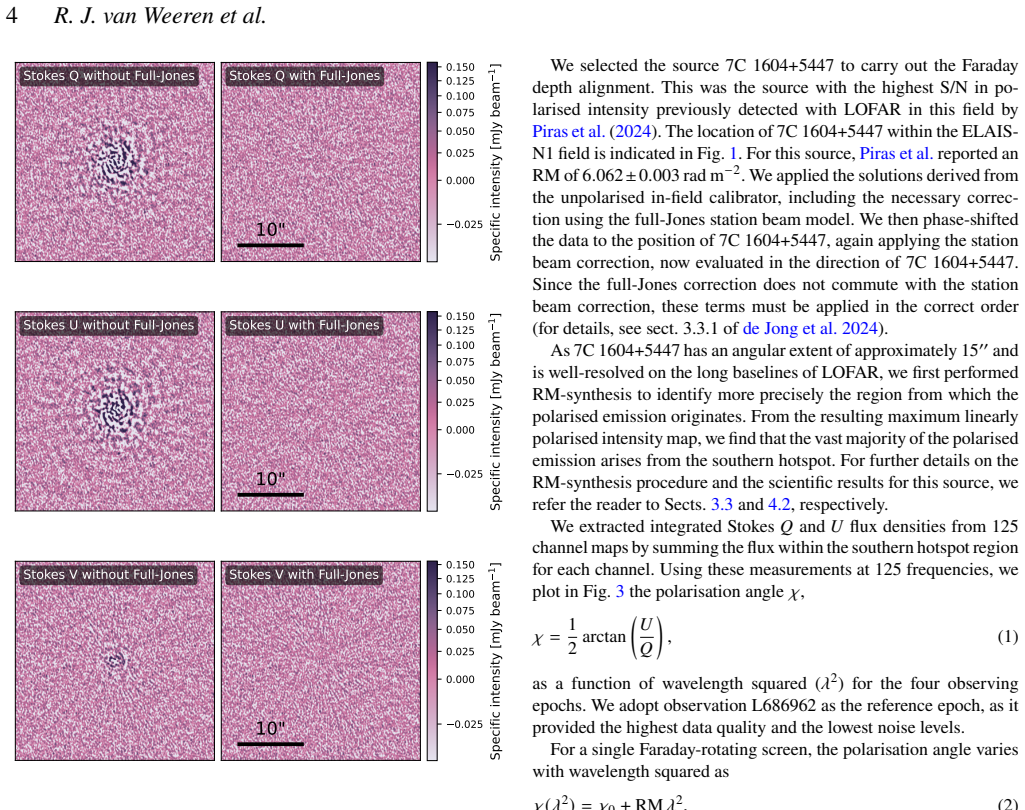
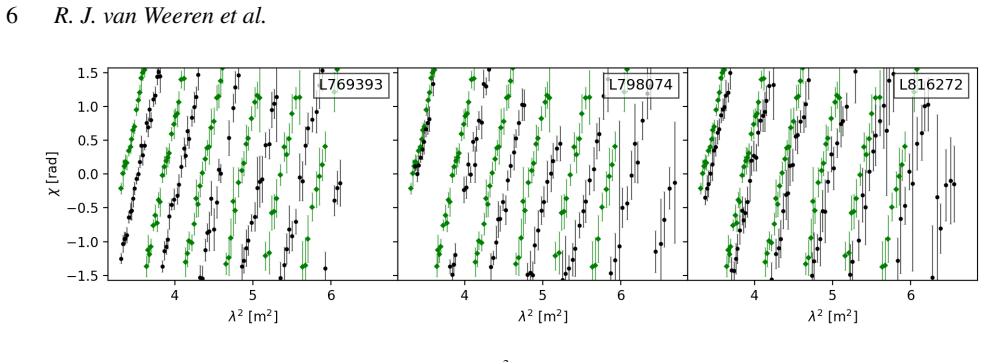
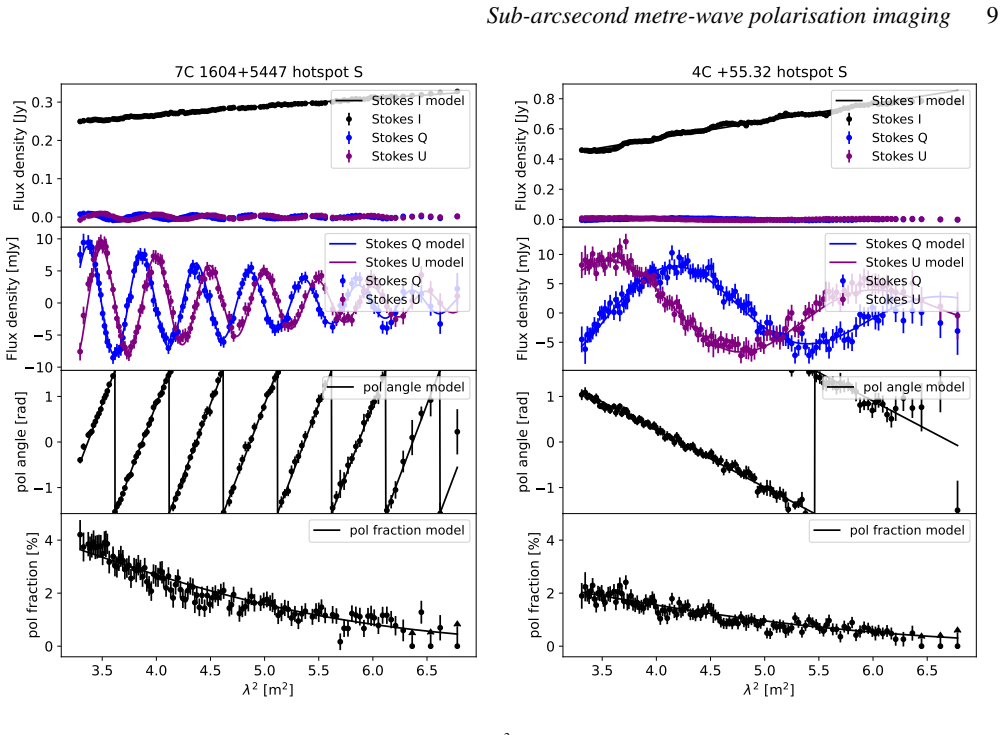
Full-Jones corrections applied to international stations via an in-field unpolarised calibrator, together with visibility-based multi-epoch alignment in Faraday depth when a sufficiently bright polarised source is present, enable polarimetric imaging at 0.3 arcsec resolution. This was validated by combining 32 hours of LOFAR data on ELAIS-N1, detecting and resolving polarised emission regions with sub-arcsecond precision and measuring circular polarisation from an M-dwarf binary.
What carries the argument
Full-Jones calibration from an in-field unpolarised calibrator plus visibility-based Faraday-depth alignment of multi-epoch data.
If this is right
- Combined multi-epoch data reach greater depth for imaging and deconvolution of polarised structures.
- Polarised sources can be resolved into multiple components with sub-arcsecond localisation.
- New polarised sources become detectable that were missed at lower resolution.
- Circular polarisation and proper motion can be measured for compact objects such as M-dwarf binaries.
Where Pith is reading between the lines
- The same corrections could be tested on other long-baseline low-frequency arrays to extend high-resolution polarimetry beyond LOFAR.
- Fields without a bright polarised source might still benefit from single-epoch full-Jones corrections alone.
- The method may improve studies of Faraday rotation in extended sources by reducing beam depolarisation at metre wavelengths.
Load-bearing premise
An in-field unpolarised calibrator must be available and bright enough to derive full-Jones corrections, and a sufficiently bright polarised source must be present for epoch alignment.
What would settle it
Apply the same strategy to a field lacking both an in-field unpolarised calibrator and a bright polarised source, then check whether sub-arcsecond polarimetric images can still be formed and aligned across epochs.
Figures





read the original abstract
Low-frequency radio polarimetric observations provide a powerful probe of magnetic fields in astrophysical sources and the intervening medium, as well as magnetospheric emission from compact objects such as pulsars, magnetically active stars, brown dwarfs, and planetary aurorae. With baselines of up to 2000 km, LOFAR offers a unique opportunity to study the low-frequency polarised Universe at sub-arcsecond resolution. However, polarimetric studies with LOFAR have so far been limited to angular resolutions of about 6 arcsec, resulting in stronger beam depolarisation. Here we present a calibration strategy that enables full-resolution polarimetric imaging with the LOFAR pan-European array. Our method applies full-Jones corrections to the international stations using an in-field unpolarised calibrator. In addition, when a sufficiently bright polarised source is present in the field, multi-epoch observations can be aligned in Faraday depth using a visibility-based correction that accounts for polarisation angle and rotation measure offsets. This approach enables deeper combined imaging and deconvolution. We apply this strategy to the LOFAR ELAIS-N1 field, combining four 8 h observations for a total integration time of 32 h. At 0.3 arcsec resolution, we detect two previously known polarised sources identified in lower-resolution studies, resolve additional polarised components, and localise emission regions with sub-arcsecond precision. We also identify a new polarised source and detect circularly polarised emission from the binary M-dwarf system CR Draconis, measuring its proper motion across epochs. These results demonstrate that sub-arcsecond polarimetry at metre wavelengths is now feasible with LOFAR, opening new science opportunities in the LOFAR2.0 era.
Editorial analysis
A structured set of objections, weighed in public.
Referee Report
Summary. The paper presents a calibration strategy for full-resolution polarimetric imaging with the LOFAR pan-European array at metre wavelengths. It applies full-Jones corrections to international stations using an in-field unpolarised calibrator and, when a bright polarised source is present, uses a visibility-based correction to align multi-epoch observations in Faraday depth. The method is demonstrated on four 8-hour observations of the ELAIS-N1 field (total 32 h), achieving 0.3 arcsec resolution to detect and resolve previously known polarised sources, identify a new one, and measure circular polarisation and proper motion from CR Draconis.
Significance. If the calibration approach proves robust, it would enable sub-arcsecond polarimetry at low frequencies, reducing beam depolarisation and opening new science cases for LOFAR2.0. The demonstration on real data from ELAIS-N1 provides concrete evidence that the strategy can succeed when suitable calibrators are available, including detection of resolved components and circular polarisation.
major comments (2)
- [Calibration Strategy / Abstract] The central claim that the strategy enables sub-arcsecond polarimetry rests on the availability of an in-field unpolarised calibrator for full-Jones corrections on international stations (abstract and calibration strategy section). The ELAIS-N1 demonstration succeeds under these conditions, but the manuscript provides no quantitative assessment of how frequently such calibrators exist across typical fields or the effect of even modest residual polarisation in the calibrator on leakage and direction-dependent errors.
- [Multi-epoch Alignment / Results] The multi-epoch Faraday-depth alignment claim is conditional on the presence of a sufficiently bright polarised source (abstract). While the paper shows this works for ELAIS-N1, there is no discussion of how often this second condition holds or how residual RM/angle offsets propagate into the combined imaging when the assumption is only approximately met.
minor comments (2)
- [Abstract / Methods] The abstract and results section would benefit from explicit statements on the assumed polarisation fraction threshold for the 'unpolarised' calibrator and any leakage tolerance used in the full-Jones solutions.
- [Results] Figure captions and text should clarify whether the reported detections include any post-selection criteria or if all sources above a fixed S/N threshold were examined.
Simulated Author's Rebuttal
We thank the referee for their constructive comments and positive assessment of the work's significance. We respond point-by-point to the major comments below.
read point-by-point responses
-
Referee: [Calibration Strategy / Abstract] The central claim that the strategy enables sub-arcsecond polarimetry rests on the availability of an in-field unpolarised calibrator for full-Jones corrections on international stations (abstract and calibration strategy section). The ELAIS-N1 demonstration succeeds under these conditions, but the manuscript provides no quantitative assessment of how frequently such calibrators exist across typical fields or the effect of even modest residual polarisation in the calibrator on leakage and direction-dependent errors.
Authors: We agree the method requires an in-field unpolarised calibrator and present it as a demonstration under those conditions, as explicitly stated. The paper does not claim universality across all fields. A quantitative sky-wide assessment of calibrator frequency or the precise impact of small residual polarisation would require a dedicated multi-field survey or extensive simulations, which lies outside the scope of this foundational calibration paper. We will add a clarifying sentence in the discussion section emphasising the required conditions and assumptions. revision: partial
-
Referee: [Multi-epoch Alignment / Results] The multi-epoch Faraday-depth alignment claim is conditional on the presence of a sufficiently bright polarised source (abstract). While the paper shows this works for ELAIS-N1, there is no discussion of how often this second condition holds or how residual RM/angle offsets propagate into the combined imaging when the assumption is only approximately met.
Authors: The alignment technique is presented as applicable when a sufficiently bright polarised source is available, which holds for the demonstrated ELAIS-N1 data. We show successful application but do not claim it applies universally. Quantifying occurrence rates or performing a full propagation analysis of small residual offsets would require additional statistical studies or error simulations not part of the current manuscript. We will insert a brief note on the assumptions and limitations in the revised text. revision: partial
- Quantitative assessment of how frequently suitable in-field unpolarised calibrators exist across typical fields.
- Quantitative assessment of the effect of even modest residual polarisation in the calibrator on leakage and direction-dependent errors.
- Discussion of how often the bright polarised source condition holds or how residual RM/angle offsets propagate into combined imaging.
Circularity Check
No significant circularity; method is a practical calibration strategy tested on data
full rationale
The paper presents a calibration strategy for sub-arcsecond polarimetric imaging with LOFAR, relying on full-Jones corrections from an in-field unpolarised calibrator and optional visibility-based Faraday depth alignment when a bright polarised source is available. It demonstrates the approach on four epochs of ELAIS-N1 observations, detecting known and new sources. No load-bearing derivations, predictions, or uniqueness theorems are claimed that reduce to inputs by construction. No self-citation chains or ansatzes smuggled via prior work are used to justify core results. The strategy's applicability depends on source availability (an external assumption), but the paper does not rename known results or fit parameters then relabel them as predictions. The derivation chain is self-contained as an empirical method description.
Axiom & Free-Parameter Ledger
axioms (2)
- domain assumption An in-field unpolarised calibrator is available and suitable for full-Jones corrections on international stations.
- domain assumption A sufficiently bright polarised source is present in the field for multi-epoch alignment in Faraday depth.
Reference graph
Works this paper leans on
-
[1]
Deep sub-arcsecond wide-field imaging of the Lockman Hole field at 144 MHz. Nature Astronomy , keywords =. doi:10.1038/s41550-021-01573-z , archivePrefix =. 2202.01608 , primaryClass =
-
[2]
Nature Communications , year = 2020, month = oct, volume =
The misuse of colour in science communication. Nature Communications , year = 2020, month = oct, volume =. doi:10.1038/s41467-020-19160-7 , adsurl =
-
[3]
doi:10.5281/zenodo.8409685 , version =
Scientific colour maps. doi:10.5281/zenodo.8409685 , version =
-
[4]
RM-Tools: Software for Analyzing Polarized Radio Spectra. arXiv e-prints , keywords =. doi:10.48550/arXiv.2601.20092 , archivePrefix =. 2601.20092 , primaryClass =
-
[5]
Scalable and robust wide-field facet calibration with LOFAR's longest baselines. , keywords =. doi:10.1093/mnras/staf1373 , archivePrefix =. 2508.12115 , primaryClass =
-
[6]
doi:10.5281/zenodo.18761240 , url =
de Jong, Jurjen , title =. doi:10.5281/zenodo.18761240 , url =
-
[7]
General Purpose Image Encoder DINOv2 for Medical Image Registration. arXiv e-prints , keywords =. doi:10.48550/arXiv.2402.15687 , archivePrefix =. 2402.15687 , primaryClass =
-
[8]
Unlocking ultra-deep wide-field imaging with sidereal visibility averaging. , keywords =. doi:10.1051/0004-6361/202452492 , archivePrefix =. 2501.07374 , primaryClass =
-
[9]
Features are fate: a theory of transfer learning in high-dimensional regression. arXiv e-prints , keywords =. doi:10.48550/arXiv.2410.08194 , archivePrefix =. 2410.08194 , primaryClass =
-
[10]
Machine Learning: Science and Technology , keywords =
Probing transfer learning with a model of synthetic correlated datasets. Machine Learning: Science and Technology , keywords =. doi:10.1088/2632-2153/ac4f3f , archivePrefix =. 2106.05418 , primaryClass =
-
[11]
DINOv2 Rocks Geological Image Analysis: Classification, Segmentation, and Interpretability. arXiv e-prints , keywords =. doi:10.48550/arXiv.2407.18100 , archivePrefix =. 2407.18100 , primaryClass =
-
[12]
Assessing the Performance of the DINOv2 Self-supervised Learning Vision Transformer Model for the Segmentation of the Left Atrium from MRI Images. arXiv e-prints , keywords =. doi:10.48550/arXiv.2411.09598 , archivePrefix =. 2411.09598 , primaryClass =
-
[13]
LoTSS jellyfish galaxies. III. The first identification of jellyfish galaxies in the Perseus cluster. , keywords =. doi:10.1051/0004-6361/202142294 , archivePrefix =. 2112.08728 , primaryClass =
-
[14]
Discovery of a Radio Halo (and Relic) in a M _ 500 <2 10 ^ 14 M _ Cluster. , keywords =. doi:10.3847/2041-8213/ac0636 , archivePrefix =. 2105.14025 , primaryClass =
-
[15]
Statistical Analysis of Spherical Data
-
[16]
Towards the Generalization of Contrastive Self-Supervised Learning. arXiv e-prints , keywords =. doi:10.48550/arXiv.2111.00743 , archivePrefix =. 2111.00743 , primaryClass =
-
[17]
DINOv2: Learning Robust Visual Features without Supervision
DINOv2: Learning Robust Visual Features without Supervision. arXiv e-prints , keywords =. doi:10.48550/arXiv.2304.07193 , archivePrefix =. 2304.07193 , primaryClass =
work page internal anchor Pith review Pith/arXiv arXiv doi:10.48550/arxiv.2304.07193
-
[18]
Vision Transformers Need Registers
Vision Transformers Need Registers. arXiv e-prints , keywords =. doi:10.48550/arXiv.2309.16588 , archivePrefix =. 2309.16588 , primaryClass =
work page internal anchor Pith review Pith/arXiv arXiv doi:10.48550/arxiv.2309.16588
-
[19]
International Journal of Computer Vision (IJCV) , volume=
Imagenet large scale visual recognition challenge , author=. International Journal of Computer Vision (IJCV) , volume=. 2015 , publisher=
2015
-
[20]
, year = 1986, month = oct, volume =
Learning representations by back-propagating errors. , year = 1986, month = oct, volume =. doi:10.1038/323533a0 , adsurl =
-
[21]
Proceedings of the 27th International Conference on Machine Learning (ICML-10) , pages=
Rectified linear units improve restricted Boltzmann machines , author=. Proceedings of the 27th International Conference on Machine Learning (ICML-10) , pages=
-
[22]
LOFAR high-band antenna observations of the Perseus cluster. arXiv e-prints , keywords =. doi:10.48550/arXiv.2410.02863 , archivePrefix =. 2410.02863 , primaryClass =
-
[23]
Optimising the Processing and Storage of Visibilities using lossy compression. arXiv e-prints , keywords =. doi:10.48550/arXiv.2410.15683 , archivePrefix =. 2410.15683 , primaryClass =
-
[24]
Journal of Space Weather and Space Climate , keywords =
Towards the possibility to combine LOFAR and GNSS measurements to sense ionospheric irregularities. Journal of Space Weather and Space Climate , keywords =. doi:10.1051/swsc/2023021 , adsurl =
-
[25]
Rethinking the Inception Architecture for Computer Vision
Rethinking the Inception Architecture for Computer Vision. arXiv e-prints , keywords =. doi:10.48550/arXiv.1512.00567 , archivePrefix =. 1512.00567 , primaryClass =
work page internal anchor Pith review Pith/arXiv arXiv doi:10.48550/arxiv.1512.00567
-
[26]
Google Landmarks Dataset v2 -- A Large-Scale Benchmark for Instance-Level Recognition and Retrieval. arXiv e-prints , keywords =. doi:10.48550/arXiv.2004.01804 , archivePrefix =. 2004.01804 , primaryClass =
-
[27]
An Image is Worth 16x16 Words: Transformers for Image Recognition at Scale
An Image is Worth 16x16 Words: Transformers for Image Recognition at Scale. arXiv e-prints , keywords =. doi:10.48550/arXiv.2010.11929 , archivePrefix =. 2010.11929 , primaryClass =
work page internal anchor Pith review Pith/arXiv arXiv doi:10.48550/arxiv.2010.11929 2010
-
[28]
2022 , eprint=
FAIR standards for astronomical data , author=. 2022 , eprint=
2022
-
[29]
Scientific data3(1), 1–9 (2016) https://doi.org/10.1038/sdata.2016.18
The FAIR Guiding Principles for scientific data management and stewardship , author=. Scientific data , volume=. 2016 , publisher=. doi:10.1038/sdata.2016.18 , url=
-
[30]
An ALMA Survey of Sub-millimeter Galaxies in the Extended Chandra Deep Field South: Sub-millimeter Properties of Color-selected Galaxies. , keywords =. doi:10.1088/0004-637X/780/2/115 , archivePrefix =. 1311.2604 , primaryClass =
work page internal anchor Pith review Pith/arXiv arXiv doi:10.1088/0004-637x/780/2/115
-
[31]
Faraday synthesis in direction-dependent imaging. , keywords =. doi:10.1051/0004-6361/202554903 , archivePrefix =. 2504.00141 , primaryClass =
-
[32]
Building Capacity for FAIR and Open Science: Insights from the World Café sessions at the OSCARS 1st AGM , author =. 2025 , month =. doi:10.5281/zenodo.17854379 , url =
-
[33]
Information Handling in Astronomy - Historical Vistas , year = 2003, editor =
AIPS, the VLA, and the VLBA. Information Handling in Astronomy - Historical Vistas , year = 2003, editor =. doi:10.1007/0-306-48080-8_7 , adsurl =
-
[34]
Sub-arcsecond imaging with the International LOFAR Telescope. II. Completion of the LOFAR Long-Baseline Calibrator Survey. , keywords =. doi:10.1051/0004-6361/202140756 , archivePrefix =. 2108.07284 , primaryClass =
-
[35]
LOFAR HBA observations of the Euclid Deep Field North (EDFN). , keywords =. doi:10.1051/0004-6361/202348333 , archivePrefix =. 2312.06247 , primaryClass =
-
[36]
Unveiling Sizes of Compact AGN Hosts with ALMA. , keywords =. doi:10.3847/1538-4357/ab595b , archivePrefix =. 1911.07858 , primaryClass =
-
[37]
Star Formation Rates in Lyman Break Galaxies: Radio Stacking of LBGs in the COSMOS Field and the Sub- Jy Radio Source Population. , keywords =. doi:10.1086/592319 , archivePrefix =. 0808.2391 , primaryClass =
work page internal anchor Pith review Pith/arXiv arXiv doi:10.1086/592319
-
[38]
LOFAR 150-MHz observations of the Bo\"otes field: Catalogue and Source Counts
LOFAR 150-MHz observations of the Bo \"o tes field: catalogue and source counts. , keywords =. doi:10.1093/mnras/stw1056 , archivePrefix =. 1605.01531 , primaryClass =
work page internal anchor Pith review Pith/arXiv arXiv doi:10.1093/mnras/stw1056
-
[39]
The LOFAR Two-metre Sky Survey. II. First data release. , keywords =. doi:10.1051/0004-6361/201833559 , archivePrefix =. 1811.07926 , primaryClass =
work page internal anchor Pith review Pith/arXiv arXiv doi:10.1051/0004-6361/201833559
-
[40]
The Very Large Array Low-frequency Sky Survey Redux (VLSSr)
The Very Large Array Low-frequency Sky Survey Redux (VLSSr). , keywords =. doi:10.1093/mnras/stu256 , archivePrefix =. 1404.0694 , primaryClass =
work page internal anchor Pith review Pith/arXiv arXiv doi:10.1093/mnras/stu256
-
[41]
Extremely deep 150 MHz source counts from the LoTSS Deep Fields. , keywords =. doi:10.1051/0004-6361/202039998 , archivePrefix =. 2011.08829 , primaryClass =
-
[42]
The LOFAR Two-metre Sky Survey. III. First data release: Optical/infrared identifications and value-added catalogue. , keywords =. doi:10.1051/0004-6361/201833564 , archivePrefix =. 1811.07927 , primaryClass =
work page internal anchor Pith review Pith/arXiv arXiv doi:10.1051/0004-6361/201833564
-
[43]
LOFAR Facet Calibration. , keywords =. doi:10.3847/0067-0049/223/1/2 , archivePrefix =. 1601.05422 , primaryClass =
work page internal anchor Pith review Pith/arXiv arXiv doi:10.3847/0067-0049/223/1/2
-
[44]
Plasma interactions of exoplanets with their parent star and associated radio emissions , journal =
Plasma interactions of exoplanets with their parent star and associated radio emissions. , year = 2007, month = apr, volume =. doi:10.1016/j.pss.2006.05.045 , adsurl =
-
[45]
Modeling the radio signature of the orbital parameters, rotation, and magnetic field of exoplanets. , keywords =. doi:10.1051/0004-6361/201116510 , adsurl =
-
[46]
Sub-arcsecond imaging with the International LOFAR Telescope. I. Foundational calibration strategy and pipeline. , keywords =. doi:10.1051/0004-6361/202140649 , archivePrefix =. 2108.07283 , primaryClass =
-
[47]
The LOFAR Two-meter Sky Survey: Deep Fields Data Release 1. II. The ELAIS-N1 LOFAR deep field. , keywords =. doi:10.1051/0004-6361/202038828 , archivePrefix =. 2011.08211 , primaryClass =
-
[48]
Cosmic evolution of FRI and FRII sources out to z=2.5. arXiv e-prints , keywords =. doi:10.48550/arXiv.2311.13427 , archivePrefix =. 2311.13427 , primaryClass =
-
[49]
The LOFAR Two-meter Sky Survey: Deep Fields Data Release 1. I. Direction-dependent calibration and imaging. , keywords =. doi:10.1051/0004-6361/202038804 , archivePrefix =. 2011.08328 , primaryClass =
-
[50]
The LOFAR Two-meter Sky Survey: Deep Fields Data Release 1. IV. Photometric redshifts and stellar masses. , keywords =. doi:10.1051/0004-6361/202038809 , archivePrefix =. 2011.08204 , primaryClass =
-
[51]
Cosmic evolution of low-excitation radio galaxies in the LOFAR two-metre sky survey deep fields. , keywords =. doi:10.1093/mnras/stac1128 , archivePrefix =. 2204.07588 , primaryClass =
-
[52]
Accretion mode versus radio morphology in the LOFAR Deep Fields. , keywords =. doi:10.1093/mnras/stac140 , archivePrefix =. 2201.04433 , primaryClass =
-
[53]
The LOFAR Two-meter Sky Survey: Deep Fields Data Release 1. III. Host-galaxy identifications and value added catalogues. , keywords =. doi:10.1051/0004-6361/202038813 , archivePrefix =. 2011.08201 , primaryClass =
-
[54]
The LOFAR Two-metre Sky Survey. I. Survey description and preliminary data release. , keywords =. doi:10.1051/0004-6361/201629313 , archivePrefix =. 1611.02700 , primaryClass =
work page internal anchor Pith review Pith/arXiv arXiv doi:10.1051/0004-6361/201629313
-
[55]
The Eleventh and Twelfth Data Releases of the Sloan Digital Sky Survey: Final Data from SDSS-III
The Eleventh and Twelfth Data Releases of the Sloan Digital Sky Survey: Final Data from SDSS-III. , keywords =. doi:10.1088/0067-0049/219/1/12 , archivePrefix =. 1501.00963 , primaryClass =
work page internal anchor Pith review Pith/arXiv arXiv doi:10.1088/0067-0049/219/1/12
-
[56]
The Westerbork SINGS Survey II. Polarization, Faraday Rotation, and Magnetic Fields
The Westerbork SINGS survey. II Polarization, Faraday rotation, and magnetic fields. , keywords =. doi:10.1051/0004-6361/200912240 , archivePrefix =. 0905.3995 , primaryClass =
work page internal anchor Pith review Pith/arXiv arXiv doi:10.1051/0004-6361/200912240
-
[57]
The LOFAR Two-metre Sky Survey: Deep Fields Data Release 2: I. The ELAIS-N1 field. , keywords =. doi:10.1051/0004-6361/202452930 , archivePrefix =. 2501.04093 , primaryClass =
-
[58]
QLoRA: Efficient Finetuning of Quantized LLMs
QLoRA: Efficient Finetuning of Quantized LLMs. arXiv e-prints , keywords =. doi:10.48550/arXiv.2305.14314 , archivePrefix =. 2305.14314 , primaryClass =
work page internal anchor Pith review Pith/arXiv arXiv doi:10.48550/arxiv.2305.14314
-
[59]
The LOFAR Two-metre Sky Survey. V. Second data release. , keywords =. doi:10.1051/0004-6361/202142484 , archivePrefix =. 2202.11733 , primaryClass =
-
[60]
Faceting for direction-dependent spectral deconvolution
Faceting for direction-dependent spectral deconvolution. , keywords =. doi:10.1051/0004-6361/201731474 , archivePrefix =. 1712.02078 , primaryClass =
work page internal anchor Pith review Pith/arXiv arXiv doi:10.1051/0004-6361/201731474
-
[61]
High accuracy wide-field imaging method in radio interferometry. , keywords =. doi:10.1093/mnras/stab3548 , archivePrefix =. 2101.11172 , primaryClass =
-
[62]
American Astronomical Society Meeting Abstracts , year = 1995, series =
High Fidelity Interferometric Imaging: Robust Weighting and NNLS Deconvolution. American Astronomical Society Meeting Abstracts , year = 1995, series =
1995
-
[63]
Efficient wide-field radio interferometry response. , keywords =. doi:10.1051/0004-6361/202039723 , archivePrefix =. 2010.10122 , primaryClass =
-
[64]
IEEE Journal of Selected Topics in Signal Processing , year = 2008, month = nov, volume =
Multiscale CLEAN Deconvolution of Radio Synthesis Images. IEEE Journal of Selected Topics in Signal Processing , year = 2008, month = nov, volume =. doi:10.1109/JSTSP.2008.2006388 , adsurl =
-
[65]
An optimized algorithm for multi-scale wideband deconvolution of radio astronomical images
An optimized algorithm for multiscale wideband deconvolution of radio astronomical images. , keywords =. doi:10.1093/mnras/stx1547 , archivePrefix =. 1706.06786 , primaryClass =
work page internal anchor Pith review Pith/arXiv arXiv doi:10.1093/mnras/stx1547
-
[66]
Cotton , title =
W. Cotton , title =. 2009 , month =
2009
-
[67]
A high-resolution study of the recurrent activity
Nuclear regions as seen with LOFAR international baselines. A high-resolution study of the recurrent activity. , keywords =. doi:10.1051/0004-6361/202245821 , archivePrefix =. 2311.12114 , primaryClass =
-
[68]
Solution intervals considered harmful: on the optimality of radio interferometric gain solutions. , keywords =. doi:10.1093/mnras/stab928 , adsurl =
-
[69]
Baseline Dependent Averaging in Radio Interferometry
Baseline-dependent averaging in radio interferometry. , keywords =. doi:10.1093/mnras/sty360 , archivePrefix =. 1802.09321 , primaryClass =
work page internal anchor Pith review Pith/arXiv arXiv doi:10.1093/mnras/sty360
-
[70]
Synthesis Imaging , year = 1986, editor =
Special problems in imaging. Synthesis Imaging , year = 1986, editor =
1986
-
[71]
Compression of interferometric radio-astronomical data
Compression of interferometric radio-astronomical data. , keywords =. doi:10.1051/0004-6361/201629565 , archivePrefix =. 1609.02019 , primaryClass =
work page internal anchor Pith review Pith/arXiv arXiv doi:10.1051/0004-6361/201629565
-
[72]
Synthesis Imaging in Radio Astronomy II , year = 1999, editor =
Bandwidth and Time-Average Smearing. Synthesis Imaging in Radio Astronomy II , year = 1999, editor =
1999
-
[73]
Applying Wirtinger derivatives to the radio interferometry calibration problem
Applying Wirtinger derivatives to the radio interferometry calibration problem. arXiv e-prints , keywords =. doi:10.48550/arXiv.1410.8706 , archivePrefix =. 1410.8706 , primaryClass =
work page internal anchor Pith review Pith/arXiv arXiv doi:10.48550/arxiv.1410.8706
-
[74]
Understanding radio polarimetry. I. Mathematical foundations. , keywords =
-
[75]
Extraction and self-calibration of individual LOFAR targets
LOFAR observations of galaxy clusters in HETDEX. Extraction and self-calibration of individual LOFAR targets. , keywords =. doi:10.1051/0004-6361/202039826 , archivePrefix =. 2011.02387 , primaryClass =
-
[76]
The SPECFIND V2.0 catalogue of radio cross-identifications and spectra. SPECFIND meets the Virtual Observatory. , keywords =. doi:10.1051/0004-6361/200913460 , archivePrefix =. 0912.4174 , primaryClass =
work page internal anchor Pith review Pith/arXiv arXiv doi:10.1051/0004-6361/200913460
-
[77]
Fast and Reproducible LOFAR Workflows with AGLOW
Fast and Reproducible LOFAR Workflows with AGLOW. arXiv e-prints , keywords =. doi:10.48550/arXiv.1808.10735 , archivePrefix =. 1808.10735 , primaryClass =
work page internal anchor Pith review Pith/arXiv arXiv doi:10.48550/arxiv.1808.10735
-
[78]
Variational Dropout and the Local Reparameterization Trick , url =
Kingma, Durk P and Salimans, Tim and Welling, Max , booktitle =. Variational Dropout and the Local Reparameterization Trick , url =
-
[79]
Aggregated Residual Transformations for Deep Neural Networks
Aggregated Residual Transformations for Deep Neural Networks. arXiv e-prints , keywords =. doi:10.48550/arXiv.1611.05431 , archivePrefix =. 1611.05431 , primaryClass =
work page internal anchor Pith review Pith/arXiv arXiv doi:10.48550/arxiv.1611.05431
-
[80]
Deep Residual Learning for Image Recognition
Deep Residual Learning for Image Recognition. 2016 IEEE Conference on Computer Vision and Pattern Recognition (CVPR , year = 2016, month = jun, eid =. doi:10.1109/CVPR.2016.90 , archivePrefix =. 1512.03385 , primaryClass =
work page internal anchor Pith review Pith/arXiv arXiv doi:10.1109/cvpr.2016.90 2016
discussion (0)
Sign in with ORCID, Apple, or X to comment. Anyone can read and Pith papers without signing in.