Quantum Time Lower Bounds by Permutation Invariance
Pith reviewed 2026-06-28 05:56 UTC · model grok-4.3
The pith
Permutation invariance reduces quantum sample complexity lower bounds to matching time complexity lower bounds.
A machine-rendered reading of the paper's core claim, the machinery that carries it, and where it could break.
Core claim
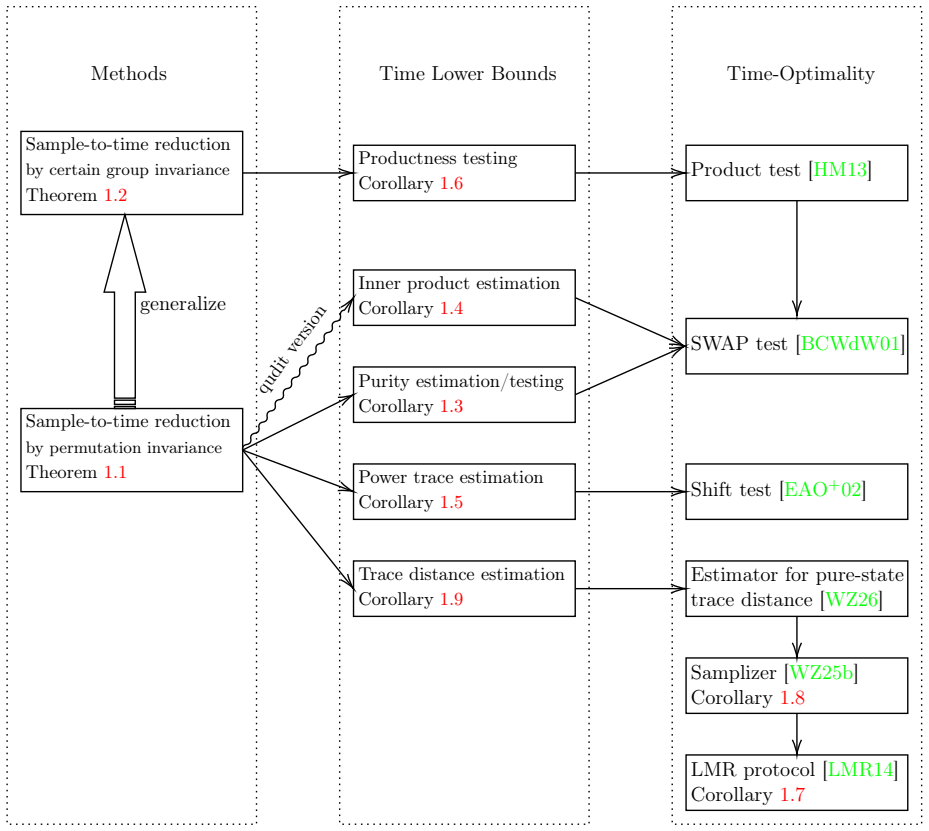
For testing permutation-invariant properties of quantum states, lower bounds on quantum sample complexity imply matching lower bounds on quantum time complexity (circuit size) via a direct reduction that incurs no significant overhead. Applying the reduction shows that the SWAP test is time-optimal for estimating purity and inner products, the Shift test is time-optimal for high-order functionals tr(ρ^k), the productness tester is time-optimal, the LMR protocol is time-optimal for reflection about a pure state, the samplizer is time-optimal for pure states, and the estimator for pure-state trace distance and fidelity is time-optimal.
What carries the argument
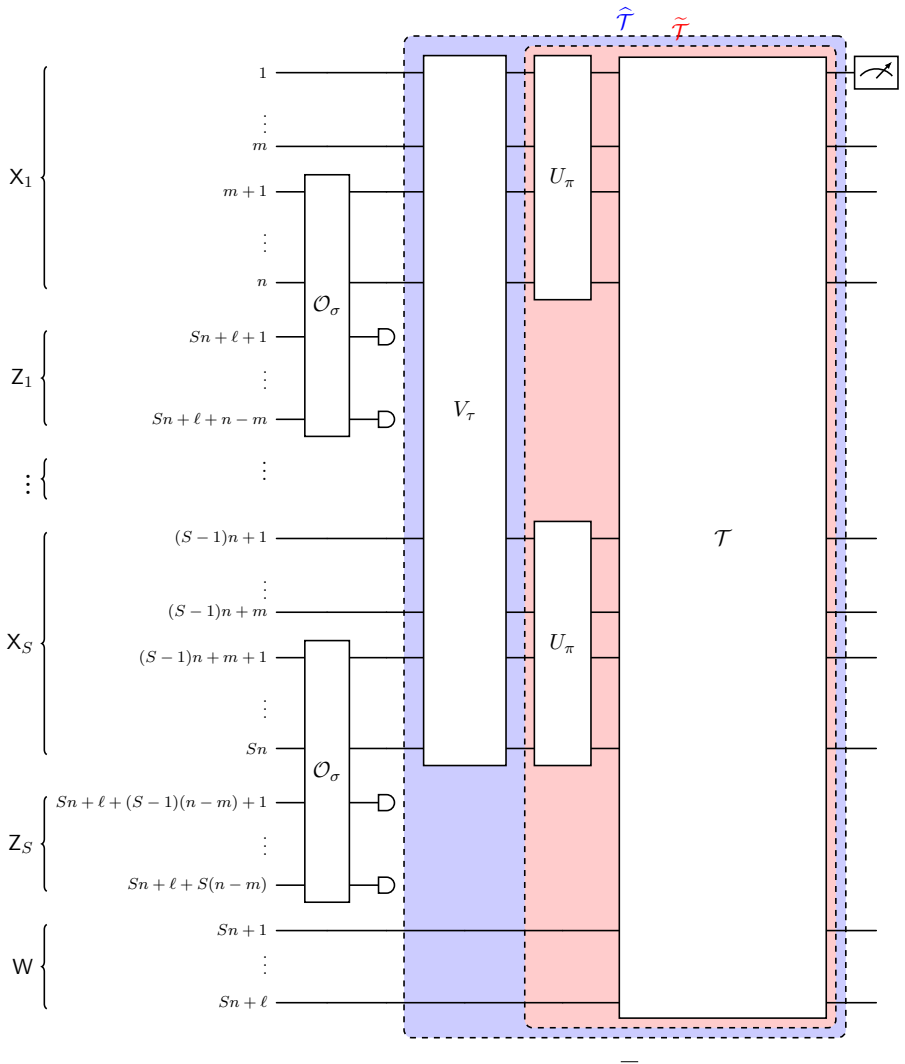
The reduction from quantum sample complexity lower bounds to quantum time complexity lower bounds for permutation-invariant properties.
If this is right
- The SWAP test is time-optimal for estimating tr(ρ²) and tr(ρσ).
- The Shift test is time-optimal for estimating tr(ρ^k).
- The productness tester for multipartite pure states is time-optimal.
- The LMR protocol is time-optimal for implementing the reflection operator about a pure state.
- The samplizer and pure-state trace-distance estimator are time-optimal.
Where Pith is reading between the lines
- The same reduction technique could be applied to derive time lower bounds for other quantum state properties that are invariant under permutations.
- The result indicates that the dominant cost in these tasks is the number of independent samples required rather than additional computation per sample.
- Analogous reductions might exist for properties invariant under other symmetry groups.
Load-bearing premise
A time-efficient quantum circuit for a permutation-invariant testing task can be converted into a sample-efficient procedure without substantial extra cost.
What would settle it
A quantum circuit that solves one of the listed tasks, such as estimating purity via the SWAP test, using fewer gates than the known sample complexity lower bound.
Figures
read the original abstract
Tight bounds on quantum sample complexity and quantum query complexity have been known for various computational problems in the literature, whereas tight bounds on quantum time complexity (i.e., the size of quantum circuits) remain unresolved. In this paper, we provide a framework to establish lower bounds on the quantum time complexity for testing permutation-invariant properties of quantum states, via a reduction from quantum sample complexity. As an application, we obtain a series of matching lower bounds when given sample access to the input quantum states, including: 1. The SWAP test due to Buhrman, Cleve, Watrous, and de Wolf (Phys. Rev. Lett. 2001) is time-optimal to estimate the purity $\operatorname{tr}(\rho^2)$ and the inner product $\operatorname{tr}(\rho\sigma)$. 2. The Shift test due to Ekert, Alves, Oi, Horodecki, Horodecki, and Kwek (Phys. Rev. Lett. 2002) is time-optimal to estimate the high-order functionals $\operatorname{tr}(\rho^k)$. 3. The productness tester for multipartite pure states due to Harrow and Montanaro (J. ACM 2013) is time-optimal. 4. The LMR protocol due to Lloyd, Mohseni, and Rebentrost (Nat. Phys. 2014) is time-optimal to implement the reflection operator about a pure state. 5. The samplizer due to Wang and Zhang (IEEE Trans. Inf. Theory 2025) is time-optimal for pure states. 6. The estimator for pure-state trace distance and fidelity due to Wang and Zhang (ICALP 2026) is time-optimal. To the best of our knowledge, this is the first method that allows us to systematically establish tight lower bounds on quantum time complexity.
Editorial analysis
A structured set of objections, weighed in public.
Referee Report
Summary. The manuscript introduces a framework that reduces known quantum sample-complexity lower bounds for permutation-invariant properties of quantum states to quantum circuit-size (time-complexity) lower bounds. It applies the framework to obtain matching lower bounds establishing time-optimality of the SWAP test for purity and inner-product estimation, the Shift test for tr(ρ^k), the Harrow-Montanaro productness tester, the LMR reflection protocol, the Wang-Zhang samplizer, and the Wang-Zhang trace-distance/fidelity estimator.
Significance. If the reduction is shown to be overhead-free, the result would be significant: it supplies the first systematic method for proving tight quantum time lower bounds and supplies matching optimality statements for six well-known protocols whose upper bounds were previously known only in the sample or query model.
major comments (2)
- [§3] §3 (Framework), reduction theorem: the claim that symmetrization over the symmetric group maps an Ω(f(n)) sample lower bound to an Ω(f(n)) time lower bound with no polynomial or super-constant overhead is load-bearing for all matching claims; the argument must explicitly bound the cost of averaging or embedding, because a linear-in-k or poly(d) factor would make the derived time lower bound strictly weaker than the cited constant-size or polylog upper bounds.
- [Abstract] Abstract, items 1–6, and §4–§9 (applications): each optimality statement (“time-optimal”) rests on the reduction being tight; if the symmetrization step introduces even a logarithmic overhead, the “matching” language is no longer supported and the statements must be weakened to “nearly matching up to log factors.”
minor comments (2)
- The 2025 citation for the samplizer and the 2026 citation for the trace-distance estimator should be replaced by arXiv numbers or updated publication details if they have appeared.
- Notation for the symmetric-group averaging operator is introduced without an explicit equation number; adding an equation label would improve readability when the reduction is invoked in later sections.
Simulated Author's Rebuttal
We thank the referee for the detailed and constructive report. The concerns about potential overhead in the symmetrization step are important for validating the tightness of the derived time lower bounds. We address both major comments below and will revise the manuscript to include an explicit overhead analysis in §3. This clarification supports rather than weakens the matching claims.
read point-by-point responses
-
Referee: [§3] §3 (Framework), reduction theorem: the claim that symmetrization over the symmetric group maps an Ω(f(n)) sample lower bound to an Ω(f(n)) time lower bound with no polynomial or super-constant overhead is load-bearing for all matching claims; the argument must explicitly bound the cost of averaging or embedding, because a linear-in-k or poly(d) factor would make the derived time lower bound strictly weaker than the cited constant-size or polylog upper bounds.
Authors: We agree that an explicit bound on the symmetrization cost is required to rigorously support the no-overhead claim. In the framework of §3, the reduction proceeds by embedding the sample lower bound into a permutation-invariant circuit and then averaging over S_n via a fixed-size quantum circuit that implements the group action without repetition or dependence on k or d. The averaging is realized by a constant-depth circuit whose size is independent of the input parameters (using the fact that the property is fully symmetric). We will add a dedicated lemma in the revised §3 that formally bounds the total circuit-size overhead by a universal constant C (independent of n, k, d). This preserves the Ω(f(n)) time lower bound exactly as stated. revision: yes
-
Referee: [Abstract] Abstract, items 1–6, and §4–§9 (applications): each optimality statement (“time-optimal”) rests on the reduction being tight; if the symmetrization step introduces even a logarithmic overhead, the “matching” language is no longer supported and the statements must be weakened to “nearly matching up to log factors.”
Authors: Because the revised §3 will establish that the symmetrization overhead is a fixed constant (not logarithmic or polynomial), the time lower bounds remain asymptotically tight against the known constant-size or polylog upper bounds. Consequently the six optimality statements in the abstract and applications sections require no weakening. The language “time-optimal” continues to be justified once the explicit bound is supplied. revision: no
Circularity Check
No significant circularity; reduction framework is independent of target bounds
full rationale
The paper introduces a reduction from known quantum sample-complexity lower bounds to quantum time-complexity lower bounds for permutation-invariant properties. The listed matching results rely on external sample lower bounds (from 2001–2014 literature for most cases) paired with explicit upper-bound protocols; the two Wang–Zhang citations (2025/2026) supply sample bounds that are treated as independent inputs rather than derived inside this manuscript. No equations in the abstract or described framework equate a time lower bound to a fitted parameter or to a self-citation by construction. The derivation chain therefore remains non-circular.
Axiom & Free-Parameter Ledger
axioms (2)
- domain assumption Quantum circuits are the model for time complexity
- ad hoc to paper Permutation-invariant properties admit a reduction from sample to time complexity
Reference graph
Works this paper leans on
-
[1]
Helstrom, Carl W. , title =. Information and Control , volume =. doi:10.1016/S0019-9958(67)90302-6 , year =
-
[2]
Holevo, Alexander S. , title =. Journal of Multivariate Analysis , volume =. doi:10.1016/0047-259X(73)90028-6 , year =
-
[3]
and van de Graaf, Jeroen , title =
Fuchs, Christopher A. and van de Graaf, Jeroen , title =. IEEE Transactions on Information Theory , volume =. doi:10.1109/18.761271 , year =
-
[4]
IEEE Transactions on Information Theory , volume =
Chen, Kean and Wang, Qisheng and Zhang, Zhicheng , title =. IEEE Transactions on Information Theory , volume =. doi:10.1109/TIT.2026.3697790 , eprint =
-
[5]
Proceedings of the 2022 Annual ACM-SIAM Symposium on Discrete Algorithms , pages =
Testing matrix product states , author =. Proceedings of the 2022 Annual ACM-SIAM Symposium on Discrete Algorithms , pages =. doi:10.1137/1.9781611977073.68 , year =
-
[6]
Buhrman, Harry and Cleve, Richard and Watrous, John and de Wolf, Ronald , title =. Physical Review Letters , volume =. doi:10.1103/PhysRevLett.87.167902 , year =
-
[7]
and Alves, Carolina Moura and Oi, Daniel K
Ekert, Artur K. and Alves, Carolina Moura and Oi, Daniel K. L. and Horodecki, Micha. Direct estimations of linear and nonlinear functionals of a quantum state , journal =. doi:10.1103/PhysRevLett.88.217901 , year =
-
[8]
and Montanaro, Ashley , title =
Harrow, Aram W. and Montanaro, Ashley , title =. Journal of the ACM , volume =. doi:10.1145/2432622.2432625 , year =
-
[9]
Quantum principal component analysis.Nature Physics, 10(9):631–633, 2014.doi:10.1038/nphys3029
Lloyd, Seth and Mohseni, Masoud and Rebentrost, Patrick , journal =. Quantum principal component analysis , volume =. doi:10.1038/nphys3029 , year =
-
[10]
Kimmel, Shelby and Lin, Cedric Yen-Yu and Low, Guang Hao and Ozols, Maris and Yoder, Theodore J. , title =. npj Quantum Information , volume =. doi:10.1038/s41534-017-0013-7 , year =
-
[11]
IEEE Transactions on Information Theory , volume =
Wang, Qisheng and Zhang, Zhicheng , title =. IEEE Transactions on Information Theory , volume =. doi:10.1109/TIT.2025.3576137 , year =
-
[12]
Theory of Computing Library , series =
Montanaro, Ashley and de Wolf, Ronald , title =. Theory of Computing Library , series =. 2016 , publisher =. doi:10.4086/toc.gs.2016.007 , pages =
-
[13]
SIAM Journal on Computing , volume =
Bernstein, Ethan and Vazirani, Umesh , title =. SIAM Journal on Computing , volume =. doi:10.1137/S0097539796300921 , year =
-
[14]
SIAM Journal on Computing , volume =
Ambainis, Andris , title =. SIAM Journal on Computing , volume =. doi:10.1137/S0097539705447311 , year =
- [15]
-
[16]
Belovs, Aleksandrs and Jeffery, Stacey and Yolcu, Duyal , title =. Quantum , volume =. doi:10.22331/q-2024-08-23-1444 , year =
-
[17]
and Jeffery, Stacey and Kothari, Robin and Magniez, Frédéric , title =
Belovs, Aleksandrs and Childs, Andrew M. and Jeffery, Stacey and Kothari, Robin and Magniez, Frédéric , title =. Proceedings of the 40th International Colloquium on Automata, Languages, and Programming , pages =. doi:10.1007/978-3-642-39206-1_10 , year =
-
[18]
Proceedings of the 55th Annual ACM Symposium on Theory of Computing , pages =
Jeffery, Stacey and Zur, Sebastian , title =. Proceedings of the 55th Annual ACM Symposium on Theory of Computing , pages =. doi:10.1145/3564246.3585158 , year =
-
[19]
Cornelissen, Arjan and Jeffery, Stacey and Ozols, Maris and Piedrafita, Alvaro , title =. Proceedings of the 45th International Symposium on Mathematical Foundations of Computer Science , pages =. doi:10.4230/LIPIcs.MFCS.2020.26 , year =
-
[20]
Allcock, Jonathan and Bao, Jinge and Belovs, Aleksandrs and Lee, Troy and Santha, Miklos , title =. 2311.16401 , year =
-
[21]
Bacon, Dave and Chuang, Isaac L. and Harrow, Aram W. , title =. Physical Review Letters , volume =. doi:10.1103/PhysRevLett.97.170502 , year =
-
[22]
and Harrow, Aram W
Bacon, Dave and Chuang, Isaac L. and Harrow, Aram W. , title =. Proceedings of the 18th Annual ACM-SIAM Symposium on Discrete Algorithms , pages =. doi:, url =
-
[23]
Childs, Andrew M. and Harrow, Aram W. and Wocjan, Pawe. Weak. Proceedings of the 24th Annual Symposium on Theoretical Aspects of Computer Science , pages =. doi:10.1007/978-3-540-70918-3_51 , year =
- [24]
-
[25]
Grinko, Dmitry and Burchardt, Adam and Ozols, Maris , title =. 2310.02252 , year =
- [26]
-
[27]
and Ji, Zhengfeng and Wu, Xiaodi and Yu, Nengkun , title =
Haah, Jeongwan and Harrow, Aram W. and Ji, Zhengfeng and Wu, Xiaodi and Yu, Nengkun , title =. IEEE Transactions on Information Theory , volume =. doi:10.1109/TIT.2017.2719044 , year =
-
[28]
Proceedings of the 48th Annual ACM Symposium on Theory of Computing , pages =
O'Donnell, Ryan and Wright, John , title =. Proceedings of the 48th Annual ACM Symposium on Theory of Computing , pages =. doi:10.1145/2897518.2897544 , year =
-
[29]
Efficient quantum to- mography II
O'Donnell, Ryan and Wright, John , title =. Proceedings of the 49th Annual ACM Symposium on Theory of Computing , pages =. doi:10.1145/3055399.3055454 , year =
-
[30]
Quantum state certification , booktitle =
B. Quantum state certification , booktitle =. doi:10.1145/3313276.3316344 , year =
-
[31]
Communications in Mathematical Physics , volume =
O'Donnell, Ryan and Wright, John , title =. Communications in Mathematical Physics , volume =. doi:10.1007/s00220-021-04180-1 , year =
-
[32]
IEEE Transactions on Information Theory , volume =
Wang, Qisheng and Zhang, Zhicheng , title =. IEEE Transactions on Information Theory , volume =. doi:10.1109/TIT.2023.3321121 , year =
-
[33]
Acharya, Jayadev and Issa, Ibrahim and Shende, Nirmal V. and Wagner, Aaron B. , title =. IEEE Journal on Selected Areas in Information Theory , volume =. doi:10.1109/JSAIT.2020.3015235 , year =
-
[34]
Bavarian, Mohammad and Mehraban, Saeed and Wright, John , title =
-
[35]
Quantum lower bounds by polynomials
Beals, Robert and Buhrman, Harry and Cleve, Richard and Mosca, Michele and de Wolf, Ronald , title =. Journal of the ACM , volume =. doi:10.1145/502090.502097 , year =
-
[36]
Journal of Computer and System Sciences , volume =
Ambainis, Andris , title =. Journal of Computer and System Sciences , volume =. doi:10.1006/jcss.2002.1826 , year =
-
[37]
A fast quantum mechanical algorithm for database search
Grover, Lov K. , title =. Proceedings of the 28th Annual ACM Symposium on Theory of Computing , pages =. doi:10.1145/237814.237866 , year =
-
[38]
and Bernstein, Ethan and Brassard, Gilles and Vazirani, Umesh , title =
Bennett, Charles H. and Bernstein, Ethan and Brassard, Gilles and Vazirani, Umesh , title =. SIAM Journal on Computing , volume =. doi:10.1137/S0097539796300933 , year =
-
[39]
Tight bounds on quantum searching , journal =
Boyer, Michel and Brassard, Gilles and H. Tight bounds on quantum searching , journal =. doi:10.1002/(SICI)1521-3978(199806)46:4/5<493::AID-PROP493>3.0.CO;2-P , year =
-
[40]
Zalka, Christof , title =. Physical Review A , volume =. doi:10.1103/PhysRevA.60.2746 , year =
-
[41]
Grover, Lov K. , title =. Physical Review A , volume =. doi:10.1103/PhysRevA.66.052314 , year =
-
[42]
Quantum Information and Computation , volume =
Arunachalam, Srinivasan and de Wolf, Ronald , title =. Quantum Information and Computation , volume =. doi:10.26421/QIC17.3-4-4 , year =
-
[43]
IEEE Transactions on Information Theory , volume=
Unitarity estimation for quantum channels , author=. IEEE Transactions on Information Theory , volume=. doi:10.1109/TIT.2023.3263645 , year=
-
[44]
Gong, Weiyuan and Haferkamp, Jonas and Ye, Qi and Zhang, Zhihan , title =. 2410.12712 , howpublished =
-
[45]
Proceedings of the 54th Annual ACM SIGACT Symposium on Theory of Computing , pages =
Anshu, Anurag and Landau, Zeph and Liu, Yunchao , title =. Proceedings of the 54th Annual ACM SIGACT Symposium on Theory of Computing , pages =. doi:10.1145/3519935.3519974 , year =
-
[46]
IEEE Transactions on Information Theory , volume =
Chen, Kean and Wang, Qisheng and Yu, Zhan and Zhang, Zhicheng , title =. IEEE Transactions on Information Theory , volume =. doi:10.1109/TIT.2026.3699531 , year =
-
[47]
Physical Review Letters , volume =
Mintert, Florian and Kuś, Marek and Buchleitner, Andreas , title =. Physical Review Letters , volume =. doi:10.1103/PhysRevLett.95.260502 , year =
-
[48]
Proceedings of the 53rd International Colloquium on Automata, Languages, and Programming , pages =
Wang, Qisheng and Zhang, Zhicheng , title =. Proceedings of the 53rd International Colloquium on Automata, Languages, and Programming , pages =. doi:, eprint =
-
[49]
IEEE Transactions on Information Theory , volume=
Optimal trace distance and fidelity estimations for pure quantum states , author=. IEEE Transactions on Information Theory , volume=. 2024 , doi=
2024
-
[50]
2018 , doi =
Watrous, John , title =. 2018 , doi =
2018
-
[51]
Proceedings of the 35th Computational Complexity Conference , pages =
Aaronson, Scott and Chia, Nai-Hui and Lin, Han-Hsuan and Wang, Chunhao and Zhang, Ruizhe , title =. Proceedings of the 35th Computational Complexity Conference , pages =. doi:10.4230/LIPIcs.CCC.2020.16 , year =
-
[52]
Proceedings of the 38th International Symposium on Theoretical Aspects of Computer Science , pages =
Buhrman, Harry and Patro, Subhasree and Speelman, Florian , title =. Proceedings of the 38th International Symposium on Theoretical Aspects of Computer Science , pages =. doi:10.4230/LIPIcs.STACS.2021.19 , year =
-
[53]
Symmetries in Physics: Philosophical Reflections , volume =
French, Steven and Rickles, Dean , title =. Symmetries in Physics: Philosophical Reflections , volume =. doi:10.1017/CBO9780511535369.013 , publisher =
-
[54]
Tóth, G. and Wieczorek, W. and Gross, D. and Krischek, R. and Schwemmer, C. and Weinfurter, H. , title =. Physical Review Letters , volume =. doi:10.1103/PhysRevLett.105.250403 , year =
-
[55]
Linear Algebra and its Applications , volume =
Pollatsek, Harriet and Ruskai, Mary Beth , title =. Linear Algebra and its Applications , volume =. doi:10.1016/j.laa.2004.06.014 , year =
-
[56]
Ouyang, Yingkai , title =. Physical Review A , volume =. doi:10.1103/PhysRevA.90.062317 , year =
-
[57]
Theory of Computing , volume =
Aaronson, Scott and Ambainis, Andris , title =. Theory of Computing , volume =. doi:10.4086/toc.2014.v010a006 , year =
-
[58]
Proceedings of the 10th Innovations in Theoretical Computer Science Conference , pages =
Chailloux, André , title =. Proceedings of the 10th Innovations in Theoretical Computer Science Conference , pages =. doi:10.4230/LIPIcs.ITCS.2019.19 , year =
-
[59]
and Gilyén, András and Kretschmer, William and Podder, Supartha and Wang, Daochen , title =
Ben-David, Shalev and Childs, Andrew M. and Gilyén, András and Kretschmer, William and Podder, Supartha and Wang, Daochen , title =. SIAM Journal on Computing , volume =. doi:10.1137/23M1573975 , year =
-
[60]
IEEE Transactions on Information Theory , volume =
Guan, Ziyi and Huang, Yunqi and Yao, Penghui and Ye, Zekun , title =. IEEE Transactions on Information Theory , volume =. doi:10.1109/TIT.2025.3534920 , year =
-
[61]
IEEE Transactions on Information Theory , volume=
On estimating the trace of quantum state powers , author=. IEEE Transactions on Information Theory , volume=. 2026 , doi=
2026
-
[62]
IEEE Transactions on Information Theory , volume =
New quantum algorithms for computing quantum entropies and distances , author =. IEEE Transactions on Information Theory , volume =. 2024 , doi =
2024
-
[63]
Subramanian, Sathyawageeswar and Hsieh, Min-Hsiu , title =. Physical Review A , volume =. doi:10.1103/PhysRevA.104.022428 , year =
-
[64]
IEEE Transactions on Information Theory , volume =
Wang, Xinzhao and Zhang, Shengyu and Li, Tongyang , title =. IEEE Transactions on Information Theory , volume =. doi:10.1109/TIT.2024.3382037 , year =
-
[65]
Proceedings of the 38th Annual Conference on Learning Theory , pages =
Chen, Kean and Wang, Qisheng , title =. Proceedings of the 38th Annual Conference on Learning Theory , pages =. doi:, url =
-
[66]
Chen, Kean and Liu, Yupan and Wang, Qisheng , title =. 2505.09563v2 , year =
-
[67]
SIAM Journal on Computing , volume =
Wang, Qisheng and Zhang, Zhicheng , title =. SIAM Journal on Computing , volume =. doi:10.1137/24M1638616 , year =
-
[68]
Foundations of Physics , volume =
Brassard, Gilles , title =. Foundations of Physics , volume =. doi:10.1023/A:1026009100467 , year =
-
[69]
Proceedings of the 31st Annual European Symposium on Algorithms , pages =
Tight bounds for quantum phase estimation and related problems , author =. Proceedings of the 31st Annual European Symposium on Algorithms , pages =. doi:10.4230/LIPIcs.ESA.2023.81 , year =
-
[70]
Nielsen, Michael A. and Chuang, Isaac L. , title =. doi:10.1017/CBO9780511976667 , year =
discussion (0)
Sign in with ORCID, Apple, or X to comment. Anyone can read and Pith papers without signing in.