Partial Observation of Linear Systems with the Mori-Zwanzig Formalism
Pith reviewed 2026-06-26 06:41 UTC · model grok-4.3
The pith
For linear time-invariant systems the Mori-Zwanzig formalism gives closed-form Markovian, memory, and noise terms that recover variation-of-constants reduced dynamics.
A machine-rendered reading of the paper's core claim, the machinery that carries it, and where it could break.
Core claim
By expressing the dynamics in terms of observables, the Koopman generator, and projections onto resolved and unresolved components, we derive closed-form representations of the Markovian, noise, and memory contributions that arise in the Mori-Zwanzig identity. For the linear setting, the resulting formulas recover the reduced dynamics obtained from the variation-of-constants formula while retaining the operator-based structure of the Mori-Zwanzig approach.
What carries the argument
The Mori-Zwanzig identity applied using the Koopman generator and projections onto resolved and unresolved components to obtain explicit expressions for the memory, noise, and Markovian terms.
If this is right
- The formalism produces interpretable reduced-order models for partially observed linear systems.
- Unresolved variables affect the observed dynamics through explicit history-dependent memory terms.
- The derivation identifies the components needed to extend the approach to nonlinear systems and general projections including spectral filtering.
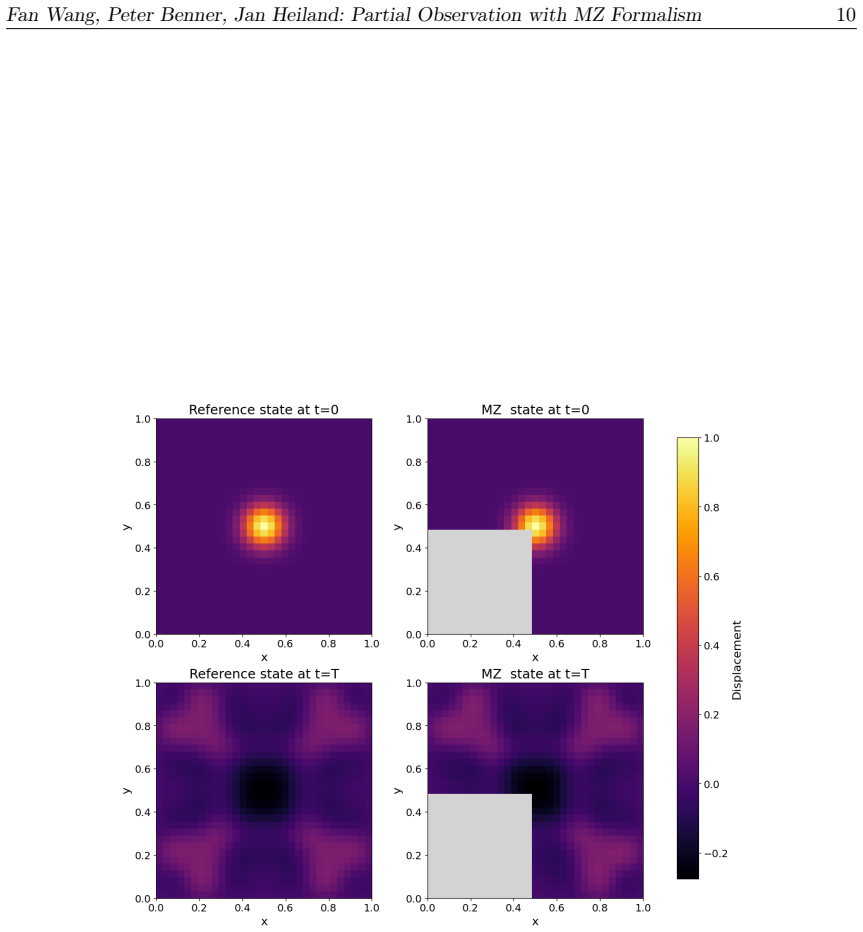
- Examples with the harmonic oscillator and wave equations demonstrate the construction and its use for interpretable models.
Where Pith is reading between the lines
- Data-driven approximations of the memory effects could be developed using this explicit structure as a guide.
- The projection method may extend to problems in control or estimation with partial state information.
- Numerical verification on additional linear systems would confirm if the closed forms hold beyond the presented examples.
- The operator structure might allow combination with other model reduction techniques for linear systems.
Load-bearing premise
The system is linear time-invariant, allowing the Koopman generator and projections to produce closed-form expressions for the memory, noise, and Markovian terms.
What would settle it
Computing the memory term from the Mori-Zwanzig derivation and comparing it to the unresolved part from the variation-of-constants formula on a linear system such as the harmonic oscillator; mismatch would falsify the recovery claim.
Figures

read the original abstract
The Mori-Zwanzig formalism provides a systematic framework for deriving reduced-order model of dynamical systems when only part of the state is observed, but its practical use is often limited by the complexity of the resulting computations. This paper develops an explicit formulation of the Mori-Zwanzig equation for linear time-invariant systems under partially observed observables. By expressing the dynamics in terms of observables, the Koopman generator, and projections onto resolved and unresolved components, we derive closed-form representations of the Markovian, noise, and memory contributions that arise in the Mori-Zwanzig identity. For the linear setting, the resulting formulas recover the reduced dynamics obtained from the variation-of-constants formula while retaining the operator-based structure of the Mori-Zwanzig approach. This makes the derivation a transparent reference case for reduced-order modelling with memory and clarifies how unresolved variables influence the observed dynamics through history-dependent terms. The analysis also identifies the ingredients needed for extensions to nonlinear systems and more general projections, including spectral filtering and data-driven approximations of memory effects. Analytical and numerical examples involving the harmonic oscillator and wave equations illustrate the construction and demonstrate how the formalism can be used to obtain interpretable reduced-order models for partially observed systems.
Editorial analysis
A structured set of objections, weighed in public.
Referee Report
Summary. The paper develops an explicit formulation of the Mori-Zwanzig (MZ) equation for linear time-invariant systems under partial observations. Using observables, the Koopman generator, and orthogonal projections onto resolved and unresolved components, it derives closed-form expressions for the Markovian, noise, and memory terms. These recover the reduced dynamics from the variation-of-constants formula while preserving the operator structure of MZ, with examples on the harmonic oscillator and wave equations to illustrate interpretable reduced-order models.
Significance. If the derivations hold, the work supplies a transparent reference case for MZ applied to linear systems, clarifying how unresolved variables enter through history-dependent terms. It identifies key ingredients for extensions to nonlinear systems, spectral filtering, and data-driven memory approximations, which may support reduced-order modeling in dynamical systems.
Simulated Author's Rebuttal
We thank the referee for the positive review and the recommendation to accept the manuscript. The referee summary correctly identifies the main contributions regarding the explicit Mori-Zwanzig formulation for partially observed linear systems.
Circularity Check
No significant circularity; derivation is self-contained
full rationale
The paper derives explicit closed-form Markovian, noise, and memory terms for linear time-invariant systems by expressing dynamics via the Koopman generator and orthogonal projections, then shows these recover the known reduced dynamics from the variation-of-constants formula. This equivalence is a direct consequence of linearity (explicit semigroup and linear evolution of the orthogonal complement) rather than a fitted parameter or self-referential definition. No self-citations are invoked as load-bearing premises, no ansatz is smuggled, and no uniqueness theorem from prior author work is used to force the result. The construction is presented as a transparent reference case that retains the Mori-Zwanzig operator structure while matching the classical formula, making the central claim independent of its own outputs.
Axiom & Free-Parameter Ledger
axioms (2)
- domain assumption The dynamical system is linear and time-invariant
- domain assumption The Koopman generator and projections onto resolved/unresolved components are applicable and well-defined
Reference graph
Works this paper leans on
-
[1]
ANU Press, Canberra, Australia, 2 edition, August 2007
Denis J Evans and Gary Morriss.Statistical Mechanics of Nonequilibrium Liquids. ANU Press, Canberra, Australia, 2 edition, August 2007
2007
-
[2]
A Gouasmi, EJ Parish, and K Duraisamy. A priori estimation of memory effects in reduced- order models of nonlinear systems using the Mori–Zwanzig formalism.Proceedings of the Royal Society A: Mathematical, Physical and Engineering Sciences, 473(2205):20170385, 2017
2017
-
[3]
echo state
Herbert Jaeger. The "echo state" approach to analysing and training recurrent neural net- works. GMD Report 148, German National Research Center for Information Technology, Sankt Augustin, Germany, 2001
2001
-
[4]
Regression-based projection for learning Mori–Zwanzig operators.SIAM Journal on Applied Dynamical Systems, 22(4):2791– 2818, 2023
Yen Ting Lin, Yifeng Tian, Danny Perez, and Daniel Livescu. Regression-based projection for learning Mori–Zwanzig operators.SIAM Journal on Applied Dynamical Systems, 22(4):2791– 2818, 2023
2023
-
[5]
Data-driven learning for the Mori–Zwanzig formalism: A generalization of the Koopman learning framework.SIAM Journal on Applied Dynamical Systems, 20(4):2558–2601, 2021
Yen Ting Lin, Yuan Tian, Daniel Livescu, and Marian Anghel. Data-driven learning for the Mori–Zwanzig formalism: A generalization of the Koopman learning framework.SIAM Journal on Applied Dynamical Systems, 20(4):2558–2601, 2021
2021
-
[6]
A dynamic subgrid scale model for large eddy simula- tions based on the Mori–Zwanzig formalism.Journal of Computational Physics, 349:154–175, 2017
Eric J Parish and Karthik Duraisamy. A dynamic subgrid scale model for large eddy simula- tions based on the Mori–Zwanzig formalism.Journal of Computational Physics, 349:154–175, 2017
2017
-
[7]
Parish and Karthik Duraisamy
Eric J. Parish and Karthik Duraisamy. Non-markovian closure models for large eddy simula- tions using the Mori–Zwanzig formalism.Physical Review Fluids, 2(1):014604, 2017
2017
-
[8]
Eric J Parish and Karthik Duraisamy. A unified framework for multiscale modeling us- ing the Mori–Zwanzig formalism and the variational multiscale method.arXiv preprint arXiv:1712.09669, 2017
work page internal anchor Pith review Pith/arXiv arXiv 2017
-
[9]
Detecting strange attractors in turbulence
Floris Takens. Detecting strange attractors in turbulence. In David Rand and Lai-Sang Young, editors,Dynamical Systems and Turbulence, Warwick 1980, volume 898, pages 366–
1980
-
[10]
Series Title: Lecture Notes in Mathematics
Springer Berlin Heidelberg, Berlin, Heidelberg, 1981. Series Title: Lecture Notes in Mathematics. Preprint (Max Planck Institute for Dynamics of Complex Technical Systems, Magdeburg). 2026-06-23 Fan Wang, Peter Benner, Jan Heiland: Partial Observation with MZ Formalism12
1981
-
[11]
Projection operators in statistical mechanics: a pedagogical approach.European Journal of Physics, 41(4):045101, 2020
Michael te Vrugt and Raphael Wittkowski. Projection operators in statistical mechanics: a pedagogical approach.European Journal of Physics, 41(4):045101, 2020
2020
-
[12]
Michael Woodward, Yifeng Tian, Yen Ting Lin, Christoph Hader, Hermann Fasel, and Daniel Livescu. Mori–Zwanzig modal decomposition: Transient flows and laminar-turbulent bound- ary layer transition.arXiv preprint arXiv:2403.09524, 2024. Preprint (Max Planck Institute for Dynamics of Complex Technical Systems, Magdeburg). 2026-06-23
discussion (0)
Sign in with ORCID, Apple, or X to comment. Anyone can read and Pith papers without signing in.