REVIEW 4 major objections 5 minor 2 cited by
This paper presents the first computation of the finite-volume '1-quark connected' contributions to the Omega^- baryon two-point function that arise with C-periodic boundary conditions, using a stochastic estimator.
Reviewed by Pith at T0; open to challenge. T0 means a machine referee read the full paper against a public rubric. the ladder, T0–T4 →
T0 review · deepseek-v4-flash
2026-08-02 20:07 UTC pith:GMO7ULXJ
load-bearing objection First numerical estimate of the C-periodic 1-q connected contribution to the Omega- correlator; the contraction algebra holds up but the signal is noise-dominated and the estimator lacks an independent check. Credible progress report, not yet a physics result. the 4 major comments →
Baryon masses with C-periodic boundary conditions
The pith
A machine-rendered reading of the paper's core claim, the machinery that carries it, and where it could break.
Core claim
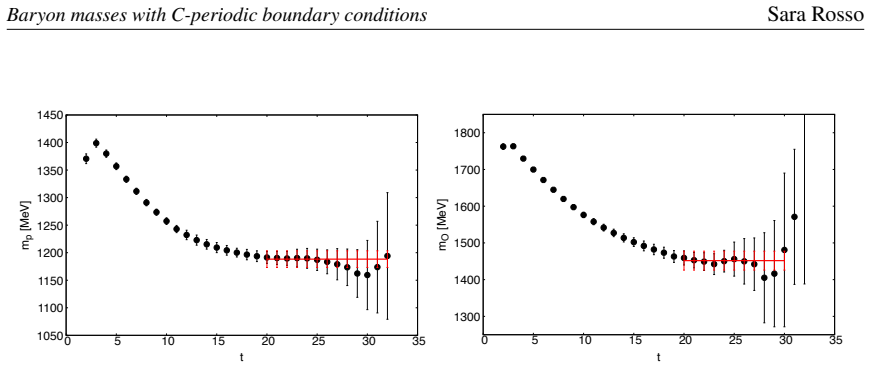
The paper reports the first numerical evaluation of the 1-quark connected contributions to the Omega^- two-point function, a finite-volume artifact of C-periodic boundary conditions that arises from modified quark-quark and antiquark-antiquark propagators. A stochastic estimator for the all-to-all propagator (Eq. 13) is introduced and tested via gauge and translational invariance plus tree-level checks. On a 400 MeV pion mass ensemble, the 1-q correlator is noise-dominated, with errors surpassing the 3-q signal at t=19 without smearing and t=24 with smearing. Preliminary proton and Omega masses from 50-60 point sources are 1170(10) and 1470(20) MeV on the large ensemble, and 1190(15) and 145
What carries the argument
The central machinery is a pair of modified propagator identities (Eq. 3) that C-periodic boundary conditions impose: in addition to the standard quark-antiquark propagator, one obtains quark-quark and antiquark-antiquark propagators that connect a point to its mirror image shifted by one lattice extent, e.g. D^{-1}(x, y+L hat 1) C. These generate the 1-q connected contractions in the baryon two-point function. The computational challenge is the all-to-all propagator from a point to a shifted point; the paper handles it with a stochastic estimator built from independent random numbers per colour-Dirac component per site (Eq. 12), yielding Eq. (13). The estimator's correctness is checked via
Load-bearing premise
The load-bearing assumption is that the stochastic estimator for the all-to-all propagator correctly captures the 1-q connected contributions, which are currently noise-dominated and have not yet been shown to be statistically different from zero; if the estimator or the C-periodic contraction is subtly wrong, the claimed first computation collapses.
What would settle it
On the same ensemble, replace the stochastic estimator with an exact all-to-all propagator (for example by deflation or on a small lattice) and compare the 1-q connected two-point function; a disagreement beyond statistical error would refute the method. Alternatively, measure the term on two volumes and test whether it decays as exp(-mL); absence of the expected decay would contradict the stated infinite-volume limit.
If this is right
- The 1-q connected finite-volume corrections can now be included in QCD+QED baryon-mass analyses, removing a previously unquantified systematic effect of C-periodic boundary conditions.
- The use of 50-60 point sources instead of 4-8 visibly reduces statistical noise and yields longer plateaux, making the extracted proton and Omega masses more reliable inputs for scale setting.
- The stochastic-estimator approach for the all-to-all propagator generalises to other baryons and to QCD+QED ensembles, so the Omega^- result is a proof of principle for a wider set of observables.
- The documented noise behaviour (error dominance from t=19 to t=24 when smearing is applied) gives a practical guide for choosing smearing levels in future measurements of partially connected terms.
- Increasing the source count to 100-150 and combining smearing levels in a GEVP analysis should further improve the 3-q connected masses.
Where Pith is reading between the lines
- If these 1-q terms are not subtracted, finite-volume baryon masses from C-periodic simulations will carry a bias that scales roughly as exp(-m L); the magnitude reported here suggests this bias is small but not negligible compared with the current statistical errors, so its inclusion may shift central values once the estimator variance is reduced.
- A direct check of the stochastic estimator against an exact all-to-all computation on a small lattice, where direct inversion is feasible, would provide an independent benchmark that the paper does not currently include.
- The variance of the estimator does not appear to vanish with volume as quickly as the signal, implying that a hierarchical-probing or deflation-based estimator may be needed to make the 1-q contribution statistically resolvable at larger volumes.
- The same formalism applies to the proton and to the full octet/decuplet, so the Omega^- measurement is likely the first of a systematic set of finite-volume corrections for all baryons in the C-periodic setup.
Editorial analysis
A structured set of objections, weighed in public.
Referee Report
Summary. The paper reports preliminary lattice QCD baryon-mass measurements (proton and Omega^-) on two N_f=3+1 ensembles with C-periodic boundary conditions generated by the RC* collaboration. The 3-q connected two-point functions are computed with 50-60 point sources, giving masses 1170(10) MeV and 1470(20) MeV (B400a00b324) and 1190(15) MeV and 1450(25) MeV (A400a00b324). The new element is a stochastic estimator for the '1-q connected' contribution to the Omega^- two-point function, which arises because C-periodic boundary conditions introduce quark-quark and antiquark-antiquark propagators. The authors claim the first numerical evaluation of these contributions, which are expected to vanish exponentially in the infinite volume limit; the presented 1-q correlators are noise-dominated and not shown to be statistically non-zero.
Significance. If the contraction algebra and the stochastic estimator in Eq. (13) are correct, the paper provides a useful technical ingredient for future QCD+QED baryon-mass calculations with C* boundary conditions. The 3-q mass results improve on earlier 4-8 source calculations by using 50-60 sources and longer plateaus. The authors are transparent about the noise problem and state that the 1-q variance is not yet controlled. However, the central claim—the 'first numerical evaluation' of the 1-q connected contribution—currently rests on internal consistency checks that are not sufficient to rule out a biased estimator, and the measured 1-q signal is statistically indistinguishable from zero.
major comments (4)
- [§3.2, Eq. (13)] The code is validated only by gauge/translational invariance and a tree-level check. These tests are necessary but not sufficient for the central claim: a sign or index-ordering error in the C-matrix contraction (Eq. 3b) or in the handling of stochastic sources on the mirror lattice can cancel in the tree-level amplitude while biasing the full correlator. Since the 1-q signal is noise-dominated (errors exceed the central value from t=19 without smearing and t=24 with smearing; Figs. 4-5), such a bias is invisible. The authors should benchmark the estimator against an exact all-to-all propagator on a small volume or one configuration, and/or compare two independent noise/dilution schemes. Without this, 'first numerical evaluation' is not established.
- [§3.2 and Conclusions] The text says the 1-q contributions were 'computed for the first time', but the plotted 1-q correlators are everywhere consistent with zero: the error bars are much larger than the central values in the plateau region and no effective mass or fit is shown for the 1-q term alone. The conclusion should state explicitly that the contribution is not yet resolved and that the paper provides an upper bound or exploratory estimate, not a measurement. This qualification belongs in the abstract, which currently implies a successful computation.
- [§2, Eqs. (8)-(11)] The contraction algebra leading to Eq. (11) is not shown. In particular, the index flow from the epsilon tensors to the propagator D^{-1}(x,x+L1)^{BA}_{b\alpha} C_{\alpha a} and the sign from Eq. (3b) should be written out explicitly. As written, a reader cannot verify that the correct C-matrix ordering and the correct placement of the L1 shift are used. Given that the central claim is the first evaluation of this term, the derivation should be self-contained.
- [§3.2] The exponential suppression of the 1-q term in the infinite-volume limit is attributed to [4], which addresses charged hadrons in QED+QCD with C* boundary conditions. For the present QCD-only C-periodic ensembles, the mechanism should be argued explicitly or the citation should be shown to cover this case. Moreover, no estimate is given of the expected signal-to-noise ratio; the statement in Conclusions that a variance-reducing estimator is still being developed further underlines that the current numerical evaluation has no demonstrated significance.
minor comments (5)
- [Fig. 4] The label 'CO' in the left panel should be 'C_Ω'; the zoom panels have axis tick labels concatenated without spaces and would benefit from clearer axis labels.
- [Eq. (12)] Specify the distribution of the stochastic noise (e.g., Z2 or Gaussian) and whether the 12 random numbers per site are real or complex components. The identity holds for any normalized distribution, but reproducibility requires this detail.
- [§3.1] Clarify that the 50-60 point sources are used for the mass results, while the 3-q comparison in Figs. 4-5 uses only 10 point sources. The text states both numbers without explicitly distinguishing the two analyses.
- [References] Reference [14] is cited as 'PoS Science466'; include an arXiv identifier or DOI for reproducibility.
- [Abstract/Conclusions] The abstract says 'we are computing for the first time' while the conclusions say 'we also computed for the first time'; align the tense and qualification with the actual status of the 1-q contribution.
Circularity Check
No significant circularity: reported masses and 1-q connected estimator are not fit to the quantities they claim.
full rationale
The central numerical outputs are measurements: the 3-q masses come from plateau fits (Figs. 2-3, Table 2) and the 1-q connected contribution is a direct stochastic estimator (Eq. 13) derived algebraically from the C-periodic propagator identities (Eq. 3) and the standard noise-source identity (Eq. 12). No parameter is fitted to the final masses or to the 1-q correlator: scale setting uses the external CLS value sqrt(8 t0)=0.415 fm and c_sw=2.18859 from [6]. The self-citations ([1,2] code, [5] ensembles, [14] previous work) provide tools and context, not the numerical claim, and [4] is used only for the formal expectation that the 1-q terms vanish exponentially; that formal QED_C result is an external, parameter-free input to the physical interpretation, not an output of the present fit. The paper's own statements that the 1-q estimator is noise-dominated and that a variance-reducing definition is still under investigation are statistical limitations, not circular reductions. The validation by gauge/translational invariance and tree-level tests is an internal consistency check; insufficient validation would be a correctness risk, but it does not make the derivation equivalent to its inputs by construction.
Axiom & Free-Parameter Ledger
free parameters (2)
- Gaussian smearing parameters kappa, N =
not stated; chosen from best parameters of [5]
- Plateau fit intervals =
not quoted numerically
axioms (5)
- domain assumption C* modified propagator identities (Eq. 3): quark-quark and antiquark-antiquark propagators get contributions shifted by one lattice spacing
- domain assumption 1-q connected contributions vanish exponentially in the infinite-volume limit
- standard math Stochastic estimator identity (Eq. 12) gives an unbiased estimate of the all-to-all propagator
- domain assumption CLS value sqrt(8t0)=0.415 fm and c_sw=2.18859 from [6], [7]
- domain assumption openQxD code with orbifold construction correctly implements C* boundary conditions
read the original abstract
Isospin-breaking corrections pose a significant challenge to lattice simulations, both because of the splitting between the up and down quark masses and, in particular, the need to include QED effects. The RC* collaboration has developed the openQxD code, based on openQCD, which enables fully dynamical QCD+QED simulations through the implementation of C-periodic boundary conditions. We use this code to measure baryon masses, with a special focus on the {\Omega^-} baryon mass, whose precise determination is especially important since it has been used to set the scale of lattice simulations. Due to the use of C-periodic boundary conditions, the two-point function of the {\Omega^-} baryon gets additional partially connected contributions, which vanish in the infinite-volume limit and which we are computing for the first time. We will present preliminary results for baryon masses obtained on QCD ensembles with C-periodic boundary conditions, at an unphysical pion mass of approximately 400 MeV.
Figures




Forward citations
Cited by 2 Pith papers
-
Normalizing flows for all-orders QED corrections in lattice field theory
Normalizing flows enable all-order QED corrections in lattice scalar QED in 2-4 dimensions with reduced variance and transferability from small to large lattices.
-
Comparing RM123 and non-perturbative QCD+QED approaches to the HVP with C-periodic boundary conditions
Full dynamical QCD+QED simulations yield smaller uncertainties than the RM123 method for the intermediate-window HVP contribution at fixed lattice spacing, volume, and statistics.
Reference graph
Works this paper leans on
-
[1]
RC* collaboration,openQ*Dcode 9 Baryon masses with C-periodic boundary conditionsSara Rosso
-
[2]
I.Campos,P.Fritzsch,M.Hansen,M.Marinković,A.Patella,A.Ramos,N.Tantalo,openQ*D code: aversatiletoolforQCD+QEDsimulations,Eur.Phys.JC80(2020)195[1908.11673]
Pith/arXiv arXiv 2020
-
[3]
Lüscher and others,Simulation program for lattice QCD (openQCD code), (2016)
M. Lüscher and others,Simulation program for lattice QCD (openQCD code), (2016)
2016
-
[4]
B. Lucini, A. Patella, A. Ramos, N. Tantalo,Charged hadrons in local finite-volume QED+QCD with C* boundary conditions, JHEP02(2016) 076 [1509.01636]
Pith/arXiv arXiv 2016
-
[5]
L. Bushnaq, I. Campos, M. Catillo, A. Cotellucci, M. Dale, P. Fritzsch, J. Lücke, M. Marinković, A. Patella, N. Tantalo,First results on QCD+QED with C* boundary condi- tions, JHEP03(2023) 012 [2209.13183]
Pith/arXiv arXiv 2023
-
[6]
P. Fritzsch, R. Sommer, F. Stollenwerk, U. Wolff,Symanzik improvement with dynamical charm: a 3+1 scheme for Wilson quarks, JHEP06(2018) 025 [1805.01661]
Pith/arXiv arXiv 2018
-
[7]
R. Höllwieser, F. Knechtli, T. Korzec,Scale setting for𝑁𝑓 =3+1QCD, Eur. Phys. J. C80 (2020) 4 [2002.02866]
Pith/arXiv arXiv 2020
-
[8]
S. Borsanyi, S. Durr, Z. Fodor, C. Hoelbling, S. D. Katz, S. Krieg, L. Lellouch, T. Lippert, A. Portelli, K. K. Szabo, and B. C. Toth,Ab initio calculation of the neutron-proton mass difference, Science347(2015) 1452 [1406.4088]
Pith/arXiv arXiv 2015
-
[9]
T.Blum,P.A.Boyle,N.H.Christ,J.Frison,N.Garron,R.J.Hudspith,T.Izubuchi,T.Janowski, C. Jung, A. Jüttner, C. Kelly, R.D. Kenway, C. Lehner, M. Marinkovic, R.D. Mawhinney, G. McGlynn, D.J. Murphy, S. Ohta, A. Portelli, C.T. Sachrajda, and A. Soni,Domain wall QCD with physical quark masses, Phys. Rev. D93(2016) 074505 [1411.7017]
Pith/arXiv arXiv 2016
-
[10]
N. Miller, L. Carpenter, E. Berkowitz, C. Cheng Chang, B. Hörz, D. Howarth, H. Monge- Camacho,E.Rinaldi,D.A.Brantley,C.Körber,C.Bouchard,M.A.Clark,A.SinghGambhir, C. J. Monahan, A. Nicholson, P. Vranas and A. Walker-Loud,Scale setting the Möbius domain wall fermion on gradient-flowed HISQ action using the omega baryon mass and the gradient-flow scales𝑡0 a...
Pith/arXiv arXiv 2021
-
[11]
Lüscher,Properties and uses of the Wilson flow in lattice QCD.JHEP08(2010) 071 [1006.4518]
M. Lüscher,Properties and uses of the Wilson flow in lattice QCD.JHEP08(2010) 071 [1006.4518]
Pith/arXiv arXiv 2010
-
[12]
DeGrand and R
T. DeGrand and R. Loft,Wave-function tests for lattice QCD spectroscopy.Comput. Phys. Commun.65.1(1991), pp. 84–91
1991
-
[13]
Orginos and D
K. Orginos and D. Richards,Improved methods for the study of hadronic physics from lattice QCD.J. Phys. G: Nucl. Part. Phys.42.3(2015) p. 034011
2015
-
[14]
S. Rosso, A. Altherr, I. Campos, A. Cotellucci, R. Gruber, T. Harris, J. Komijani, J. Lücke, M. Krstic Marinkovic, L. Parato, A. Patella and P. Tavella,Partially connected contributions to baryon masses in QCD+QEDPoS Science466[2502.03961] 10
discussion (0)
Sign in with ORCID, Apple, or X to comment. Anyone can read and Pith papers without signing in.