Normalizing flows for all-orders QED corrections in lattice field theory
Pith reviewed 2026-05-22 01:46 UTC · model grok-4.3
The pith
Normalizing flows transform lattice field configurations to include all-order QED corrections without extra Monte Carlo sampling.
A machine-rendered reading of the paper's core claim, the machinery that carries it, and where it could break.
Core claim
The central claim is that normalizing-flow transformations of field configurations can be used to determine all-order QED corrections directly, without additional Monte Carlo sampling or the diagram-by-diagram Wick contractions required at fixed order, as verified by applications to scalar QED in two to four spacetime dimensions that yield reduced variance and allow training on small volumes followed by evaluation on large volumes.
What carries the argument
Normalizing-flow transformations of field configurations, which reweight or remap ensembles to embed all-orders QED effects into the sampled distributions.
If this is right
- All-order QED corrections become accessible without computing separate perturbative orders or their associated diagram sums.
- Variance reduction occurs for both analytically constructed and machine-learned flows across two, three, and four dimensions.
- Training on small lattice geometries remains effective when the same flow is applied to much larger geometries.
- A direct route opens to fermionic theories, including eventual use in lattice QCD.
Where Pith is reading between the lines
- The same trained flow could be reused across multiple observables or coupling values, lowering the overall cost of electromagnetic corrections.
- Extension to dynamical fermions would require flows that also handle Grassmann-valued fields while preserving the reduced-variance property.
- If the volume extrapolation works as claimed, the method could enable all-order QED corrections on lattices fine enough for direct comparison with experimental precision data.
Load-bearing premise
Normalizing flows trained on field configurations can accurately reproduce all-order QED corrections and can be evaluated on lattice volumes much larger than those used during training.
What would settle it
A head-to-head comparison on the same scalar-QED observables showing that the variance of the flow-based estimator is not substantially lower than that of standard Monte Carlo sampling would falsify the claim.
Figures


read the original abstract
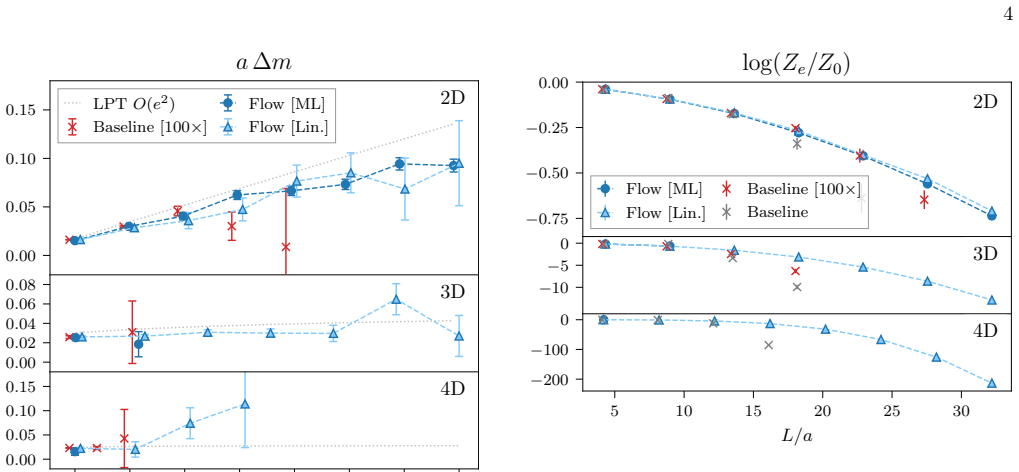
This work develops a framework to apply normalizing-flow transformations of field configurations for all-orders Quantum Electrodynamics (QED) corrections in lattice field theory. This opens a new possibility to determine all-order corrections without the need for additional Monte Carlo sampling, generally bypassing the complexity in Wick-contraction diagrams needed at fixed order. The new method is applied to lattice scalar QED in two, three, and four spacetime dimensions, using both analytical and machine-learned flows, with both approaches yielding estimates with significantly reduced variance with respect to standard methods. It is further shown that flows can be trained using small lattice geometries and subsequently evaluated on much larger lattice geometries while maintaining good efficiency. A generalization to theories with fermions is envisaged, suggesting a path to applications in challenging field theories including lattice Quantum Chromodynamics.
Editorial analysis
A structured set of objections, weighed in public.
Referee Report
Summary. The manuscript develops a framework for incorporating all-orders QED corrections into lattice field theory simulations via normalizing-flow transformations of field configurations. It applies the method to scalar QED in two, three, and four spacetime dimensions using both analytical and machine-learned flows, reports significantly reduced variance relative to standard Monte Carlo sampling, and demonstrates that flows trained on small lattices can be evaluated on substantially larger lattices while retaining good efficiency. The approach is positioned as bypassing additional Monte Carlo sampling and the combinatorial complexity of fixed-order Wick contractions, with an envisaged generalization to fermionic theories such as lattice QCD.
Significance. If the central claims hold, the work would offer a potentially important new tool for non-perturbative all-order QED corrections on the lattice, reducing the need for separate sampling runs and diagram-by-diagram calculations. The reported ability to train on small volumes and deploy on large ones, if rigorously validated, would be especially useful for realistic lattice sizes where direct all-order methods are computationally prohibitive.
major comments (2)
- [Abstract and Numerical Results] The abstract and results sections claim successful application with reduced variance in scalar QED, yet the provided text contains no visible derivations of the flow map, error bars on the reported estimates, or quantitative comparisons (e.g., variance ratios or effective sample sizes) against standard methods. This gap prevents assessment of whether the variance reduction is statistically significant and unbiased.
- [Large-volume transfer discussion] The central promise that flows trained on small geometries can be evaluated on much larger lattices while delivering unbiased all-order QED corrections relies on the learned transformation correctly encoding volume-dependent non-local photon-mediated interactions. The manuscript should supply explicit tests (e.g., comparison of finite-volume photon propagator effects or zero-mode handling between training and target volumes) to address the risk that long-range correlations are not preserved under volume extrapolation.
minor comments (1)
- [Methods] Notation for the normalizing-flow parameters and the precise definition of the all-order correction operator should be clarified to avoid ambiguity when generalizing beyond scalar QED.
Simulated Author's Rebuttal
We thank the referee for their careful reading and constructive comments on our manuscript. We address each major comment point by point below, outlining the revisions we will make to strengthen the presentation and validation of our results.
read point-by-point responses
-
Referee: [Abstract and Numerical Results] The abstract and results sections claim successful application with reduced variance in scalar QED, yet the provided text contains no visible derivations of the flow map, error bars on the reported estimates, or quantitative comparisons (e.g., variance ratios or effective sample sizes) against standard methods. This gap prevents assessment of whether the variance reduction is statistically significant and unbiased.
Authors: We thank the referee for this observation. While the manuscript describes the normalizing-flow framework and reports reduced variance relative to standard sampling, we agree that the initial submission would benefit from more explicit quantitative support. In the revised version we will add a dedicated subsection deriving the analytical flow map for scalar QED, include statistical error bars on all reported observables, and insert a table providing variance ratios together with effective sample sizes compared with conventional Monte Carlo. These additions will make the statistical significance and unbiased character of the results directly verifiable. revision: yes
-
Referee: [Large-volume transfer discussion] The central promise that flows trained on small geometries can be evaluated on much larger lattices while delivering unbiased all-order QED corrections relies on the learned transformation correctly encoding volume-dependent non-local photon-mediated interactions. The manuscript should supply explicit tests (e.g., comparison of finite-volume photon propagator effects or zero-mode handling between training and target volumes) to address the risk that long-range correlations are not preserved under volume extrapolation.
Authors: We agree that explicit validation of long-range correlation preservation is essential for the transferability claim. The current results demonstrate maintained efficiency on larger volumes, yet we acknowledge the need for targeted checks on volume-dependent effects. We will add new figures and accompanying text that directly compare the finite-volume photon propagator and zero-mode handling between the small training lattices and the larger target lattices. These tests will confirm that the learned transformations correctly encode the non-local interactions, thereby supporting the unbiased application of all-order corrections under volume extrapolation. revision: yes
Circularity Check
No circularity in the normalizing-flow framework for all-orders QED corrections
full rationale
The paper introduces a framework that trains normalizing flows on field configurations to incorporate all-order QED corrections without additional Monte Carlo sampling or fixed-order Wick contractions. Training occurs on small lattices with subsequent evaluation on larger volumes, but this transfer is presented as an empirical demonstration supported by explicit variance-reduction benchmarks rather than a definitional equivalence or fitted-parameter renaming. No load-bearing steps reduce the claimed predictions to the training inputs by construction, nor do any rely on self-citation chains for uniqueness theorems or ansatzes. The derivation remains independent and self-contained against external numerical checks.
Axiom & Free-Parameter Ledger
free parameters (1)
- normalizing flow parameters
axioms (1)
- domain assumption Standard lattice discretization of scalar QED is a faithful representation of the continuum theory for the purposes of this correction method
Lean theorems connected to this paper
-
IndisputableMonolith/Foundation/RealityFromDistinction.leanreality_from_one_distinction unclear?
unclearRelation between the paper passage and the cited Recognition theorem.
We propose to construct lattice normalizing flows to deterministically transform field configurations from an originally uncoupled theory (e=0) to the fully interacting theory, including QED dynamics at all orders.
What do these tags mean?
- matches
- The paper's claim is directly supported by a theorem in the formal canon.
- supports
- The theorem supports part of the paper's argument, but the paper may add assumptions or extra steps.
- extends
- The paper goes beyond the formal theorem; the theorem is a base layer rather than the whole result.
- uses
- The paper appears to rely on the theorem as machinery.
- contradicts
- The paper's claim conflicts with a theorem or certificate in the canon.
- unclear
- Pith found a possible connection, but the passage is too broad, indirect, or ambiguous to say the theorem truly supports the claim.
Reference graph
Works this paper leans on
-
[1]
Y. Aokiet al.(Flavour Lattice Averaging Group (FLAG)), FLAG review 2024, Phys. Rev. D113, 014508 (2026), arXiv:2411.04268 [hep-lat]
work page internal anchor Pith review Pith/arXiv arXiv 2024
-
[2]
Ab initio calculation of the neutron-proton mass difference
S. Borsanyiet al.(BMW), Ab initio calculation of the neutron-proton mass difference, Science347, 1452 (2015), arXiv:1406.4088 [hep-lat]
work page internal anchor Pith review Pith/arXiv arXiv 2015
-
[3]
G. M. de Divitiis, R. Frezzotti, V. Lubicz, G. Mar- tinelli, R. Petronzio, G. C. Rossi, F. Sanfilippo, S. Sim- ula, and N. Tantalo (RM123), Leading isospin breaking effects on the lattice, Phys. Rev. D87, 114505 (2013), arXiv:1303.4896 [hep-lat]
work page internal anchor Pith review Pith/arXiv arXiv 2013
- [4]
-
[5]
R. Frezzotti, G. Gagliardi, V. Lubicz, G. Martinelli, F. Sanfilippo, and S. Simula, Lattice calculation of the pion mass differenceM π+-Mπ0 at order O(α em), Phys. Rev. D106, 014502 (2022), arXiv:2202.11970 [hep-lat]
-
[6]
L. Bushnaq, I. Campos, M. Catillo, A. Cotellucci, M. Dale, P. Fritzsch, J. L¨ ucke, M. Krsti´ c Marinkovi´ c, A. Patella, and N. Tantalo (RCstar), First results on QCD+QED with C ∗ boundary conditions, JHEP03, 012, arXiv:2209.13183 [hep-lat]
-
[7]
A. Altherr, I. Campos, R. Gruber, T. Harris, F. Margari, M. Krsti´ c Marinkovi´ c, L. Parato, A. Patella, S. Rosso, and P. Tavella, Baryon masses with C-periodic boundary conditions, arXiv (2026), arXiv:2602.23910 [hep-lat]
-
[8]
QED Corrections to Hadronic Processes in Lattice QCD
N. Carrasco, V. Lubicz, G. Martinelli, C. T. Sachrajda, N. Tantalo, C. Tarantino, and M. Testa, QED Correc- tions to Hadronic Processes in Lattice QCD, Phys. Rev. D91, 074506 (2015), arXiv:1502.00257 [hep-lat]
work page internal anchor Pith review Pith/arXiv arXiv 2015
-
[9]
First lattice calculation of the QED corrections to leptonic decay rates
D. Giusti, V. Lubicz, G. Martinelli, C. T. Sachrajda, F. Sanfilippo, S. Simula, N. Tantalo, and C. Tarantino, First lattice calculation of the QED corrections to lep- tonic decay rates, Phys. Rev. Lett.120, 072001 (2018), arXiv:1711.06537 [hep-lat]
work page internal anchor Pith review Pith/arXiv arXiv 2018
-
[10]
M. Di Carlo, D. Giusti, V. Lubicz, G. Martinelli, C. T. Sachrajda, F. Sanfilippo, S. Simula, and N. Tantalo, Light-meson leptonic decay rates in lattice QCD+QED, Phys. Rev. D100, 034514 (2019), arXiv:1904.08731 [hep- lat]
-
[11]
P. Boyleet al., Isospin-breaking corrections to light- meson leptonic decays from lattice simulations at physi- cal quark masses, JHEP02, 242, arXiv:2211.12865 [hep- lat]
- [12]
-
[13]
D. Giusti, V. Lubicz, G. Martinelli, F. Sanfilippo, and S. Simula, Strange and charm HVP contributions to the muon (g−2) including QED corrections with twisted- mass fermions, JHEP10, 157, arXiv:1707.03019 [hep- lat]
work page internal anchor Pith review Pith/arXiv arXiv
-
[14]
T. Blum, P. A. Boyle, V. G¨ ulpers, T. Izubuchi, L. Jin, C. Jung, A. J¨ uttner, C. Lehner, A. Portelli, and J. T. Tsang (RBC, UKQCD), Calculation of the hadronic vac- uum polarization contribution to the muon anomalous magnetic moment, Phys. Rev. Lett.121, 022003 (2018), arXiv:1801.07224 [hep-lat]
work page internal anchor Pith review Pith/arXiv arXiv 2018
-
[15]
D. Giusti, V. Lubicz, C. Tarantino, G. Martinelli, F. San- filippo, S. Simula, and N. Tantalo, Leading isospin- breaking corrections to pion, kaon and charmed-meson masses with Twisted-Mass fermions, Phys. Rev. D95, 114504 (2017), arXiv:1704.06561 [hep-lat]
work page internal anchor Pith review Pith/arXiv arXiv 2017
-
[16]
Electromagnetic and strong isospin-breaking corrections to the muon $g - 2$ from Lattice QCD+QED
D. Giusti, V. Lubicz, G. Martinelli, F. Sanfilippo, and S. Simula, Electromagnetic and strong isospin-breaking corrections to the muong−2 from Lattice QCD+QED, Phys. Rev. D99, 114502 (2019), arXiv:1901.10462 [hep- lat]
work page internal anchor Pith review Pith/arXiv arXiv 2019
-
[17]
T. Aoyamaet al., The anomalous magnetic moment of the muon in the Standard Model, Phys. Rept.887, 1 (2020), arXiv:2006.04822 [hep-ph]
-
[18]
Borsanyiet al., Nature593, 51 (2021), arXiv:2002.12347 [hep-lat]
S. Borsanyiet al., Leading hadronic contribution to the muon magnetic moment from lattice QCD, Nature593, 6 51 (2021), arXiv:2002.12347 [hep-lat]
-
[19]
V. Biloshytskyi, E.-H. Chao, A. G´ erardin, J. R. Green, F. Hagelstein, H. B. Meyer, J. Parrino, and V. Pasca- lutsa, Forward light-by-light scattering and electromag- netic correction to hadronic vacuum polarization, JHEP 03, 194, arXiv:2209.02149 [hep-lat]
- [20]
-
[21]
Hybrid calculation of hadronic vacuum polarization in muon g-2 to 0.48\%
A. Boccalettiet al., Hybrid calculation of hadronic vac- uum polarization in muon g−2 to 0.48%, Nature653, 373 (2026), arXiv:2407.10913 [hep-lat]
work page internal anchor Pith review Pith/arXiv arXiv 2026
-
[22]
D. Djukanovic, G. von Hippel, S. Kuberski, H. B. Meyer, N. Miller, K. Ottnad, J. Parrino, A. Risch, and H. Wit- tig, The hadronic vacuum polarization contribution to the muon g−2 at long distances, JHEP04, 098, arXiv:2411.07969 [hep-lat]
-
[23]
J. Parrino, V. Biloshytskyi, E.-H. Chao, H. B. Meyer, and V. Pascalutsa, Computing the UV-finite electromag- netic corrections to the hadronic vacuum polarization in the muon (g−2) from lattice QCD, JHEP07, 201, arXiv:2501.03192 [hep-lat]
-
[24]
A. Altherret al.(RC⋆), Comparing QCD+QED via full simulation versus the RM123 method: U-spin window contribution toa HVP µ , JHEP10, 158, arXiv:2506.19770 [hep-lat]
-
[25]
The anomalous magnetic moment of the muon in the Standard Model: an update
R. Alibertiet al., The anomalous magnetic moment of the muon in the Standard Model: an update, Phys. Rept. 1143, 1 (2025), arXiv:2505.21476 [hep-ph]
work page internal anchor Pith review Pith/arXiv arXiv 2025
-
[26]
M. Bruno, V. G¨ ulpers, N. Hermansson-Truedsson, C. Lehner, J. Parrino, and J. T. Tsang, Isospin break- ing corrections to the hadronic vacuum polarization with stochastic coordinate sampling, in42th Inter- national Symposium on Lattice Field Theory(2026) arXiv:2602.24132 [hep-lat]
-
[27]
Radiative corrections to the nucleon isovector $g_V$ and $g_A$
O. Tomalak and Y.-B. Yang, Radiative corrections to the nucleon isovectorg V andg A, Universe12, 109 (2026), arXiv:2603.08596 [hep-ph]
work page internal anchor Pith review Pith/arXiv arXiv 2026
-
[28]
V. Cirigliano, W. Dekens, E. Mereghetti, and O. Toma- lak, Effective field theory for radiative corrections to charged-current processes. II. Axial-vector coupling, Phys. Rev. D111, 053005 (2025), arXiv:2410.21404 [nucl-th]
-
[29]
M. Gorchtein and C.-Y. Seng, The Standard Model The- ory of Neutron Beta Decay, Universe9, 422 (2023), arXiv:2307.01145 [hep-ph]
-
[30]
E. G. Tabak and E. Vanden-Eijnden, Density estimation by dual ascent of the log-likelihood, Commun. Math. Sci. 8, 217 (2010)
work page 2010
-
[31]
E. G. Tabak and C. V. Turner, A family of nonparametric density estimation algorithms, Communications on Pure and Applied Mathematics66, 145 (2013)
work page 2013
-
[32]
Variational Inference with Normalizing Flows
D. Rezende and S. Mohamed, Variational inference with normalizing flows, inInternational conference on machine learning(PMLR, 2015) pp. 1530–1538, arXiv:1505.05770 [stat.ML]
work page internal anchor Pith review Pith/arXiv arXiv 2015
- [33]
-
[34]
R. Abbott, A. Botev, D. Boyda, D. C. Hackett, G. Kan- war, S. Racani` ere, D. J. Rezende, F. Romero-L´ opez, P. E. Shanahan, and J. M. Urban, Applications of flow mod- els to the generation of correlated lattice QCD ensembles, Phys. Rev. D109, 094514 (2024), arXiv:2401.10874 [hep- lat]
- [35]
-
[36]
Charged hadrons in local finite-volume QED+QCD with C* boundary conditions
B. Lucini, A. Patella, A. Ramos, and N. Tantalo, Charged hadrons in local finite-volume QED+QCD with C ∗ boundary conditions, JHEP02, 076, arXiv:1509.01636 [hep-th]
work page internal anchor Pith review Pith/arXiv arXiv
-
[37]
D. Albandea, S. Kuberski, and F. P. Panadero, A first study of strong isospin breaking effects in lattice QCD using truncated polynomials, in42th International Sym- posium on Lattice Field Theory(2026) arXiv:2603.24420 [hep-lat]
-
[38]
M. G. Endres, A. Shindler, B. C. Tiburzi, and A. Walker- Loud, Massive photons: an infrared regularization scheme for lattice QCD+QED, Phys. Rev. Lett.117, 072002 (2016), arXiv:1507.08916 [hep-lat]
work page internal anchor Pith review Pith/arXiv arXiv 2016
-
[39]
P. Boyle, V. G¨ ulpers, J. Harrison, A. J¨ uttner, C. Lehner, A. Portelli, and C. T. Sachrajda, Isospin breaking cor- rections to meson masses and the hadronic vacuum polarization: a comparative study, JHEP09, 153, arXiv:1706.05293 [hep-lat]
work page internal anchor Pith review Pith/arXiv arXiv
-
[40]
A. Altherret al., Comparing RM123 and non- perturbative QCD+QED approaches to the HVP with C- periodic boundary conditions, in42th International Sym- posium on Lattice Field Theory(2026) arXiv:2605.01085 [hep-lat]
work page internal anchor Pith review Pith/arXiv arXiv 2026
-
[41]
Theoretical aspects of quantum electrodynamics in a finite volume with periodic boundary conditions
Z. Davoudi, J. Harrison, A. J¨ uttner, A. Portelli, and M. J. Savage, Theoretical aspects of quantum electrodynam- ics in a finite volume with periodic boundary conditions, Phys. Rev. D99, 034510 (2019), arXiv:1810.05923 [hep- lat]
work page internal anchor Pith review Pith/arXiv arXiv 2019
-
[42]
J. Bijnens, J. Harrison, N. Hermansson-Truedsson, T. Janowski, A. J¨ uttner, and A. Portelli, Electromag- netic finite-size effects to the hadronic vacuum polariza- tion, Phys. Rev. D100, 014508 (2019), arXiv:1903.10591 [hep-lat]
-
[43]
A. S. Kronfeld and U. J. Wiese, SU(N) gauge theo- ries with C periodic boundary conditions. 1. Topological structure, Nucl. Phys. B357, 521 (1991)
work page 1991
-
[44]
U. J. Wiese, C periodic and G periodic QCD at finite temperature, Nucl. Phys. B375, 45 (1992)
work page 1992
- [45]
-
[46]
Polley, Boundaries forSU(3) C ×U(1) el lattice gauge theory with a chemical potential, Z
L. Polley, Boundaries forSU(3) C ×U(1) el lattice gauge theory with a chemical potential, Z. Phys. C59, 105 (1993)
work page 1993
-
[47]
Electromagnetic Structure of Light Baryons in Lattice QCD
A. Duncan, E. Eichten, and H. Thacker, Electromagnetic structure of light baryons in lattice QCD, Phys. Lett. B 409, 387 (1997), arXiv:hep-lat/9607032
work page internal anchor Pith review Pith/arXiv arXiv 1997
-
[48]
Electromagnetic Splittings and Light Quark Masses in Lattice QCD
A. Duncan, E. Eichten, and H. Thacker, Electromagnetic splittings and light quark masses in lattice QCD, Phys. Rev. Lett.76, 3894 (1996), arXiv:hep-lat/9602005
work page internal anchor Pith review Pith/arXiv arXiv 1996
-
[49]
QED in finite volume and finite size scaling effect on electromagnetic properties of hadrons
M. Hayakawa and S. Uno, QED in finite volume and finite size scaling effect on electromagnetic proper- ties of hadrons, Prog. Theor. Phys.120, 413 (2008), arXiv:0804.2044 [hep-ph]. 7
work page internal anchor Pith review Pith/arXiv arXiv 2008
-
[50]
Position-space approach to hadronic light-by-light scattering in the muon $g-2$ on the lattice
N. Asmussen, J. Green, H. B. Meyer, and A. Nyffeler, Position-space approach to hadronic light-by-light scat- tering in the muong−2 on the lattice, PoSLA T- TICE2016, 164 (2016), arXiv:1609.08454 [hep-lat]
work page internal anchor Pith review Pith/arXiv arXiv 2016
-
[51]
X. Feng and L. Jin, QED self energies from lattice QCD without power-law finite-volume errors, Phys. Rev. D 100, 094509 (2019), arXiv:1812.09817 [hep-lat]
-
[52]
M. Di Carlo, M. T. Hansen, N. Hermansson-Truedsson, and A. Portelli, QEDr: a finite-volume QED action with redistributed spatial zero-momentum modes, JHEP10, 026, arXiv:2501.07936 [hep-lat]
-
[53]
K. Cranmer, G. Kanwar, S. Racani` ere, D. J. Rezende, and P. E. Shanahan, Advances in machine-learning-based sampling motivated by lattice quantum chromodynam- ics, Nature Rev. Phys.5, 526 (2023), arXiv:2309.01156 [hep-lat]
-
[54]
G. Kanwar, Flow-based sampling for lattice field theories, in40th International Symposium on Lattice Field Theory (2024) arXiv:2401.01297 [hep-lat]
-
[55]
Machine learning for four-dimensional SU(3) lattice gauge theories
U. Wenger, Machine learning for four-dimensional SU(3) lattice gauge theories, in42th International Symposium on Lattice Field Theory(2026) arXiv:2604.12416 [hep- lat]
work page internal anchor Pith review Pith/arXiv arXiv 2026
- [56]
-
[57]
U-Net: Convolutional Networks for Biomedical Image Segmentation
O. Ronneberger, P. Fischer, and T. Brox, U-net: Con- volutional networks for biomedical image segmentation, inInternational Conference on Medical image computing and computer-assisted intervention(Springer, 2015) pp. 234–241, arXiv:1505.04597 [cs.CV]
work page internal anchor Pith review Pith/arXiv arXiv 2015
-
[58]
S. Kullback and R. A. Leibler, On Information and Suf- ficiency, The Annals of Mathematical Statistics22, 79 (1951)
work page 1951
- [59]
- [60]
- [61]
-
[62]
R. Abbottet al., Gauge-equivariant flow models for sam- pling in lattice field theories with pseudofermions, Phys. Rev. D106, 074506 (2022), arXiv:2207.08945 [hep-lat]
-
[63]
S. McIntosh-Smith, S. R. Alam, and C. Woods, Isambard-AI: a leadership class supercomputer op- timised specifically for artificial intelligence (2024), arXiv:2410.11199 [cs.DC]
-
[64]
J. Skilling, The eigenvalues of mega-dimensional matri- ces, inMaximum Entropy and Bayesian Methods: Cam- bridge, England, 1988(Springer, 1989) pp. 455–466
work page 1988
-
[65]
M. F. Hutchinson, A stochastic estimator of the trace of the influence matrix for laplacian smoothing splines, Communications in Statistics-Simulation and Computa- tion18, 1059 (1989). 1 Supplemental Material Lattice perturbation theory Here we numerically determine the electromagnetic mass shift and corresponding two-point functionδ e2 Ce(t) in lattice p...
work page 1989
-
[66]
We choose the rest frame of the scalar wherep= (p 0,0). The QED L regularization here is manifest from the absence of the zero-modek=0in the spatial sum. The momenta are quantized according tok 0 = (2πn0)/Tandk i = (2πni)/L, where the integersn 0 andn i are bounded by− ˆT /2≤n 0 < ˆT /2 and −ˆL/2≤n i < ˆL/2. This can be numerically evaluated by either per...
discussion (0)
Sign in with ORCID, Apple, or X to comment. Anyone can read and Pith papers without signing in.