REVIEW 4 major objections 5 minor 1 cited by
GenTrack2: An Improved Hybrid Approach for Multi-Object Tracking
T0 review · 4 major / 5 minor · reviewed 2026-08-15 · deepseek-v4-flash
Pith's one-line read GenTrack2 claims near-perfect identity retention in crowded MOT by fusing particle filtering with deterministic association.
desk verdict A plausible hybrid MOT method with released code, but its superiority claim rests on a single sequence with author-modified ground truth and no repeated-run statistics. read the letter →
The pith
A machine-rendered reading of the paper's core claim, the machinery that carries it, and where it could break.
The reading
What carries the argument
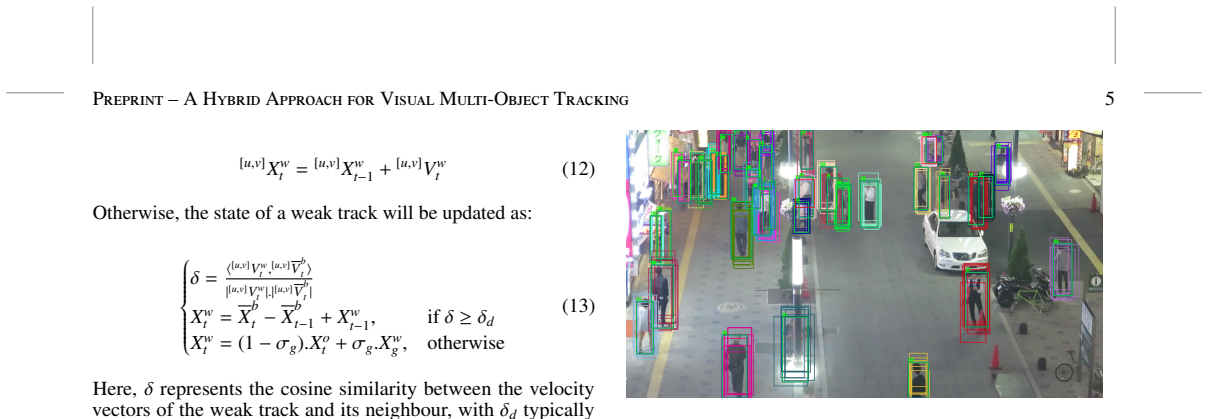
The load-bearing machinery is the division of labor between stochastic and deterministic components. A particle filter generates candidate states for each target from a random motion model; PSO then optimizes those particles using a weighted fitness of history fitness, exploration fitness, and social fitness, where social fitness repels particles from neighboring targets' states and velocities. The optimized particles feed a Hungarian-algorithm data association whose cost matrix combines particle-detection IoU and distance, detection confidence, and track penalties. Weak tracks that lose detections are updated using trustworthy neighbors' velocities, a repulsive obstacle-avoidance update, or their own velocity, with track penalties and ages controlling track death. A velocity regression over past states supplies trend-seed velocities for particle generation and state updates.
What would settle it
Run the same tracker on the full MOT17 training set or on a second crowded sequence such as MOT17-02 using the official ground-truth annotations, without any re-annotation, and compare ID switches and HOTA against the same baselines; if the three-ID-switch result does not survive, the claimed general superiority is not supported.
Extended reading notes
Core claim
The central claim is that identity switches in visual multi-object tracking can be largely eliminated by pairing a stochastic particle filter, guided by particle swarm optimization, with a deterministic association step that handles track birth and death. The particle filter models nonlinear dynamics and non-Gaussian noise; PSO pushes particles toward the modes of the target state distribution using a fitness that mixes appearance similarity, motion consistency, and repulsion from neighboring targets. The deterministic association builds a cost matrix from spatial overlap between particles and detections, detection confidence, and a track penalty, so weak tracks are not immediately discarded. The paper further introduces a scheme for updating weak tracks during occlusion, using neighbor velocities and an obstacle-avoidance term, plus a velocity regression over past states that seeds future particle sampling. The reported result is that this hybrid maintains stable identities on a crowded 1050-frame sequence, with only three ID switches.
Load-bearing premise
The comparison rests on the assumption that a single sequence, MOT17-04 with the authors' own modified ground truth annotating all humans rather than the original pedestrians-only labels, is a representative and unbiased basis for judging superiority over seven trackers.
Editorial extensions
If this is right
- The tracker can maintain stable identities during prolonged occlusions and crowded interactions, which are the main failure modes of Kalman-filter-based trackers.
- Because it uses only 8 particles per target and no GPU, the method can run in real time on modest CPUs, making it suitable for embedded robotics and live camera streams.
- The cost matrix unifies motion, appearance, confidence, and track-penalty signals, removing the need for separate high- and low-confidence association stages.
- The velocity regression over past states supports tracking with weak or noisy detectors, where simple linear motion models drift.
- The source-code reference implementations of the method and compared trackers allow direct re-implementation and fair re-evaluation.
Reading between the lines
- The social-fitness and neighbor-update mechanisms are effectively a repulsion model; extending them to learn target-specific interaction preferences, such as who occludes whom, could further reduce ID switches in dense crowds.
- The evaluation on a single sequence, even with the authors' own ground truth, does not establish general superiority; testing on more MOT17 sequences or on other benchmarks like MOT20 or DanceTrack would show whether the mechanism transfers.
- Because appearance is only captured through HoG similarity, targets that differ mainly in color or texture might be confused; a learned appearance embedding would be a natural extension.
- The method's reliance on a detector for births and deaths means its performance remains capped by detection quality; the contribution is in association, not detection.
Signed reviews
Editorial analysis
A structured set of objections, weighed in public.
Referee Report
Summary. The paper proposes GenTrack2, a hybrid multi-object tracking method that combines a stochastic particle filter with particle swarm optimization (PSO)-guided particle refinement and a deterministic Hungarian-based data association step. The tracker maintains target identities through a cost matrix that fuses particle-to-detection spatial consistency, detection confidence, and track penalties, and it handles occluded or unmatched targets via a weak-track update rule that uses neighbor information and a velocity regression over past states. The method is evaluated on the MOT17-04 sequence, where the authors modified the ground truth to annotate all humans (rather than only pedestrians), and the reported metrics (ATA 66.9, IDF1 93.9, HOTA 70.0, MOTA 85.7, IDSW 3) are compared against seven existing trackers. The authors claim superior performance and provide source code on GitHub.
Significance. If the reported results held under a standard and statistically sound evaluation protocol, the paper would make a meaningful contribution: it demonstrates that a lightweight particle-based tracker with only 8 particles per target and no GPU can achieve very strong identity consistency, which would be relevant for real-time and embedded MOT applications. The proposed design choices—PSO-guided sampling, neighbor-aware social fitness, track penalties in the matching cost, and velocity regression—are interesting and potentially transferable. However, the current significance is undermined by the evaluation design: the superiority claim rests on a single sequence with author-modified ground truth, without repeated-run statistics, ablations, or sensitivity analysis for the many hand-set parameters. The provided source code is a strength, as it enables re-evaluation and reproducibility, but the evidence presented in the manuscript is not yet sufficient to support the central claim of general superiority.
major comments (4)
- [Section 3, Table 1] The central claim that the proposed method outperforms state-of-the-art trackers is supported only by results on the MOT17-04 sequence, and the paper explicitly states that the ground truth was adjusted to annotate all humans and released under its original name. This deviates from the standard MOT17 benchmark protocol, and it is not reported whether the seven comparison trackers were evaluated on the same adjusted ground truth or on the original one. If the comparisons used different ground-truth annotations, the reported metric differences are not meaningful. The authors must either evaluate all methods on the identical, appropriately named ground truth or justify why the modified annotations are fair and unbiased. Without this, the superiority claim in Section 3 is unsupported.
- [Section 3, Table 1] The tracker is stochastic (particle filter with PSO, 8 particles per target), yet Table 1 reports a single run per tracker with no error bars, no multiple random seeds, and no tests of statistical significance. In particular, the IDSW difference between the proposed method (3) and DeepSORT (11) is small in absolute terms and could plausibly arise from stochastic variation or from evaluating on a single video. The authors should report mean and standard deviation over multiple runs and, ideally, results on additional MOT17 sequences (or a standard MOT benchmark subset) to establish that the observed advantage is not an artifact of one video or one random initialization.
- [Equations (4)-(7), (11), (13), (16)] The method depends on a large number of free parameters—σ_h, σ_p, σ_i, λ_s, λ_m, ξ_p, ξ_V, λ_p, λ_d, λ_h, δ_d, τ_V, ε_s, ε_0, H, F, ∂_max, ρ_re, Δ_e, and others—yet the manuscript provides no values, no default settings, and no sensitivity analysis. The sentence in Section 3 that the method is "largely insensitive to parameter settings" is an assertion without supporting experiments. Since these parameters were presumably chosen while developing the method on the same MOT17-04 sequence, the evaluation risks being tuned to that scene. The authors need to report parameter values and provide an ablation or sensitivity study, ideally on multiple sequences, to demonstrate that the method does not overfit to the specific video.
- [Equations (3), (16), and Section 2.2.3] Several notational and definitional issues make the method difficult to reproduce. In Eq. (3), λ_X and λ_V are used but the earlier text also refers to ε_X, ε_V without clear distinction. In Eq. (16), the definition of dV_i,t is ambiguous: the indices for the median/upper-lower cases are confusing (Q+1/2 vs. Q/2), the set dΓ is defined with a condition "0≤i≤j<H" that is inconsistent with the notation used for dΓ↑, and the parameter τ is not defined in the equation. In Eq. (11)-(13), ζ, σ_g, and the trust factor are described only verbally. These are not merely stylistic issues; they affect whether the algorithm can be implemented unambiguously from the paper alone. The authors should rewrite these definitions cleanly and specify all ranges and defaults.
minor comments (5)
- [Global] There are numerous typos and grammatical errors, e.g., 'neighours' and 'untrusworthy' in Section 2.2.3, 'Kuln' for 'Kuhn' in reference [27], and 'withdrawn from' in Section 2.2.1. The paper would benefit from a careful proofreading pass.
- [Section 2.2.3] The example in Figure 4 mentions target ID 14 with occlusion between frames 231–249, but the text first says 'from frame 215 to 275'; please clarify the exact frame ranges and make the caption consistent with the text.
- [Section 2.1, Eq. (1)] The notation in Eq. (1) is unclear: the symbol P appears both as a probability density and as a summation variable, and the expression 'X S' in the overline above the equation is not defined. Please standardize the notation for particle indices and the prediction step.
- [Section 3] The paper states that the source code includes the modified ground truth 'retaining its original name.' This is potentially confusing because a reader may mistake the adjusted annotations for the official MOT17 ground truth. It would be clearer to rename the file with a suffix such as '_all_humans' and explicitly state in the README that it differs from the original.
- [Section 3] The reported runtime discussion is informal ('enabling real-time application'); please provide actual per-frame processing time or FPS, including hardware details, to substantiate the practicality claim.
Circularity Check
No circularity found: the tracker is an empirical algorithmic contribution, and the reported evaluation concerns are validity issues rather than derivation-equivalence or self-citation circularity.
full rationale
The paper does not present a derivation in which a predicted quantity is equivalent by construction to an input. The method is an algorithmic tracker with stochastic particle sampling, PSO guidance, deterministic association, and update rules; none of the equations define a reported metric in terms of itself. No fitted parameter is renamed as a prediction: the hyperparameters are hand-set, and the paper claims insensitivity to settings without presenting a fitting procedure. There is no load-bearing self-citation: the references are to standard external trackers and benchmarks, and no uniqueness theorem or prior work by the same authors is invoked to force the design. The ansatz choices, such as the random motion model and PSO, are stated directly in the methodology rather than imported as external justification. The use of a single MOT17-04 sequence with author-adjusted ground truth is a legitimate evaluation-validity and generalization concern, but it is not circularity under the definitions used here, because the reported ATA, IDF1, HOTA, MOTA, and IDSW values are not equal to the method's inputs by construction. Therefore the appropriate finding is no significant circularity.
Assumptions & free parameters
free parameters (10)
- S (particle count) =
8
- sigma_h, sigma_p, sigma_i (PSO fitness weights) =
not reported
- lambda_s, lambda_m (fitness weights) =
not reported
- lambda_p, lambda_d, lambda_h (cost matrix weights) =
not reported
- xi_p, xi_V (social fitness weights) =
not reported
- delta_d (velocity direction threshold) =
0.8-0.95
- tau_V (velocity magnitude threshold) =
not reported
- epsilon_s (repulsive force coefficient) =
not reported
- H and F (history length and window) =
not reported
- max age delta_max, recovery threshold rho_re, entrance penalty delta_e =
not reported
assumptions (6)
- domain assumption Target motion is a random walk with bounded perturbations (Eq. 3)
- domain assumption Detection confidence and box geometry are sufficient observation information
- domain assumption Social interactions are modeled as repulsion between nearby targets
- standard math The Hungarian algorithm obtains the optimal track-detection assignment
- ad hoc to paper The adjusted ground truth correctly annotates all humans in MOT17-04
- domain assumption PSO converges toward the modes of the particle distribution
Cite this review
Pith. "Pith review of GenTrack2: An Improved Hybrid Approach for Multi-Object Tracking." pith.science (2026). https://pith.science/paper/GOC2UERI
@misc{pith2026251024410,
  author       = {Pith},
  title        = {Pith review of: GenTrack2: An Improved Hybrid Approach for Multi-Object Tracking},
  year         = {2026},
  howpublished = {\url{https://pith.science/paper/GOC2UERI}},
  note         = {Machine review of arXiv:2510.24410}
}
read the original abstract
This paper proposes a visual multi-object tracking method that jointly employs stochastic and deterministic mechanisms to ensure identifier consistency for unknown and time-varying target numbers under nonlinear dynamics. A stochastic particle filter addresses nonlinear dynamics and non-Gaussian noise, with support from particle swarm optimization (PSO) to guide particles toward state distribution modes and mitigate divergence through proposed fitness measures incorporating motion consistency, appearance similarity, and social-interaction cues with neighboring targets. Deterministic association further enforces identifier consistency via a proposed cost matrix incorporating spatial consistency between particles and current detections, detection confidences, and track penalties. Subsequently, a novel scheme is proposed for the smooth updating of target states while preserving their identities, particularly for weak tracks during interactions with other targets and prolonged occlusions. Moreover, velocity regression over past states provides trend-seed velocities, enhancing particle sampling and state updates. The proposed tracker is designed to operate flexibly for both pre-recorded videos and camera live streams, where future frames are unavailable. Experimental results confirm superior performance compared to state-of-the-art trackers. The source-code reference implementations of both the proposed method and compared-trackers are provided on GitHub: https://github.com/SDU-VelKoTek/GenTrack2
Figures


Figures from the paper (1 more)

Forward citations
Cited by 1 Pith paper
-
GenTrack3: Hybrid Stochastic-Deterministic Online Multi-Object Tracking with Cluster-Aware Association
GenTrack3 presents a cluster-aware association method that partitions the track-detection cost matrix into smaller local matrices and reports competitive MOT scores on two pedestrian-tracking sequences.
Reference graph
Works this paper leans on
-
[1]
Simple online and realtime tracking,
A. Bewley et al., “Simple online and realtime tracking," in 2016 IEEE International Conference on Image Processing (ICIP), Phoenix, AZ, USA, September 2016, pp. 3464- 3468
work page 2016
-
[2]
Simple online and realtime tracking with a deep association metric,
N. Wojke, A. Bewley, and D. Paulus, “Simple online and realtime tracking with a deep association metric," in 2017 IEEE International Conference on Image Processing (ICIP), Beijing, China, September 2017, pp. 3645-3649
work page 2017
-
[3]
ByteTrack: Multi-object tracking by as- sociating every detection box,
Y . Zhang et al., “ByteTrack: Multi-object tracking by as- sociating every detection box," In: Avidan, S., Brostow, G., Cisse, M., Farinella, G.M., Hassner, T. (eds) Com- puter Vision – ECCV 2022. ECCV 2022. Lecture Notes in Computer Science, vol 13682. Springer, Cham, 2022
work page 2022
-
[4]
BoT- SORT: Robust associations multi-pedestrian tracking,
N. Aharon, R. Orfaig, and B.-Z. Bobrovsky, “BoT- SORT: Robust associations multi-pedestrian tracking," arXiv:2206.14651v2, 2022
arXiv 2022
-
[5]
Observation-Centric SORT: Rethinking SORT for robust multi-object tracking,
J. Cao et al., “Observation-Centric SORT: Rethinking SORT for robust multi-object tracking," in 2023 IEEE/CVF Conference on Computer Vision and Pattern Recognition (CVPR), Vancouver, BC, Canada, June 2023, pp. 9686- 9696
work page 2023
-
[6]
SMILEtrack: Similarity learning for occlusion-aware multiple object tracking,
Y .-H. Wang et al., “SMILEtrack: Similarity learning for occlusion-aware multiple object tracking," in Proceedings of the Thirty-Eighth AAAI Conference on Artificial Intel- ligence, vol. 38, no. 6, pp. 5740-5748, 2024
work page 2024
-
[7]
H. Jung et al., “ConfTrack: Kalman filter-based multi- person tracking by utilizing confidence score of detection box," in 2024 IEEE/CVF Winter Conference on Applica- tions of Computer Vision (WACV), Waikoloa, HI, USA, January 2024, pp. 6583-6592
work page 2024
-
[8]
Distributed Markov Chain Monte Carlo kernel based particle filtering for object tracking,
D. Wang, Q. Zhang, and J. Morris, “Distributed Markov Chain Monte Carlo kernel based particle filtering for object tracking," Multimedia Tools and Applications, vol. 56, pp. 303-314, 2012
work page 2012
Show all 30 references
-
[9]
Particle filter with occlusion handling for visual tracking,
S. D. Lin, J.-J. Lin, and C.-Y . Chuang, “Particle filter with occlusion handling for visual tracking," IET Image Processing, vol. 9, no. 11, pp. 959-968, 2015. Preprint– A HybridApproach forVisualMulti-ObjectTracking7 Figure 4: Examples of target interactions during multi-obj...
2015
-
[10]
Object-tracking based on par- ticle filter using particle swarm optimization with density estimation,
G. Xia and S. A. Ludwig, “Object-tracking based on par- ticle filter using particle swarm optimization with density estimation," in 2016 IEEE Congress on Evolutionary Com- putation (CEC), Vancouver, BC, Canada, July 2016, pp. 4151-4158
2016
-
[11]
Multi-task correlation particle filter for robust object tracking,
T. Zhang, C. Xu, and M.-H. Yang, “Multi-task correlation particle filter for robust object tracking," in 2017 IEEE Con- ference on Computer Vision and Pattern Analysis (CVPR), Honolulu, HI, USA, July 2018, pp. 4819-4827
2017
-
[12]
Chaotic particle filter for visual object tracking,
M. Firouznia et al., “Chaotic particle filter for visual object tracking," Journal of Visual Communication and Image Representation, vol. 53, pp. 1-12, 2018
2018
-
[13]
Robust object tracking with crow search optimized multi-cue particle filter,
G. S. Walia et al., “Robust object tracking with crow search optimized multi-cue particle filter," Pattern Analysis and Applications, vol. 23, pp. 1439-1455, 2020
2020
-
[14]
Particle filter-based video object tracking using feature fusion in template partitions,
J. Panda and P. K. Nanda, “Particle filter-based video object tracking using feature fusion in template partitions," The Visual Computer, vol. 39, pp. 2757-2779, 2023
2023
-
[15]
A scale adaptive gen- erative target tracking method based on modified particle filter,
X. Yuqi, W. Yongjun, and Y . Fan, “A scale adaptive gen- erative target tracking method based on modified particle filter," Multimedia Tools and Applications, vol. 82, pp. 31329-31349, 2023
2023
-
[16]
Minimax Monte Carlo object tracking,
J. Lim, J.-Y . Park, and H.-M. Park, “Minimax Monte Carlo object tracking," The Visual Computer, vol. 39, pp. 1853- 1868, 2023
2023
-
[17]
Fast multiple object tracking via a hierarchical particle filter,
C. Yang, R. Duraiswami, and L. Davis, “Fast multiple object tracking via a hierarchical particle filter," in Pro- ceedings of Tenth IEEE International Conference on Com- puter Vision (ICCV), Beijing, China, October 2005, pp. 212-219
2005
-
[18]
Single and multiple object tracking using log-Euclidean Riemannian subspace and block-division appearance model,
W. Hu et al., “Single and multiple object tracking using log-Euclidean Riemannian subspace and block-division appearance model," IEEE Transactions on Pattern Analysis and Machine Intelligence, vol. 34, no. 12, pp. 2420-2440, 2012
2012
-
[19]
Variational particle filter for multi-object tracking,
Y . Jin and F. Mokhtarian, “Variational particle filter for multi-object tracking," in 2007 IEEE 11th International Conference on Computer Vision (ICCV), Rio de Janeiro, Brazil, October 2007, pp. 1-8
2007
-
[20]
Discriminatively trained particle filters for complex multi-object tracking,
R. Hess and A. Fern, “Discriminatively trained particle filters for complex multi-object tracking," in 2009 IEEE Conference on Computer Vision and Pattern Recognition (CVPR), Miami, FL, USA, June 2009, pp. 240-247
2009
-
[21]
BraMBLe: A Bayesian multiple-blob tracker,
M. Isard and J. MacCormick, “BraMBLe: A Bayesian multiple-blob tracker," in Proceedings Eighth IEEE Inter- national Conference on Computer Vision (ICCV 2001), Vancouver, BC, Canada, July 2001, pp. 34-41
2001
-
[22]
MCMC-based particle filter for tracking a variable number of interacting targets,
Z. Khan, T. Balch, and F. Dellaert, “MCMC-based particle filter for tracking a variable number of interacting targets," IEEE Transactions on Pattern Analysis and Machine Intel- ligence, vol. 27, no. 11, pp. 1805-1819, 2005
2005
-
[23]
Robust tracking-by-detection using a detector confidence particle filter,
M. D. Breitenstein et al., “Robust tracking-by-detection using a detector confidence particle filter," in 2009 IEEE 12th International Conference on Computer Vision (ICCV), Kyoto, Japan, September-October 2009, pp. 1515-1522
2009
-
[24]
Detection driven adaptive multi-cue inte- gration for multiple human tracking,
M. Yang et al., “Detection driven adaptive multi-cue inte- gration for multiple human tracking," in 2009 IEEE 12th Preprint– A HybridApproach forVisualMulti-ObjectTracking8 International Conference on Computer Vision (ICCV), Ky- oto, Japan, September-October 2009, pp. 1554-1561
2009
-
[25]
A boosted particle filter: multitarget detection and tracking,
K. Okuma et al., “A boosted particle filter: multitarget detection and tracking," in Proceedings of European Con- ference on Computer Vision (ECCV), Florence, Italy, May 2024, pp. 28-39
2024
-
[26]
Particle swarm optimiza- tion,
J. Kennedy and R. Eberhart, “Particle swarm optimiza- tion," in Proceedings of IEEE International Conference on Neural Networks, Perth, Australia, November 1995, pp. 1942-1948
1995
-
[27]
The Hungarian method for the assignment problem,
H. W. Kuln, “The Hungarian method for the assignment problem," Naval Research Logistics Quarterly, vol. 2, no. 1-2, pp. 83-97, 1955
1955
-
[28]
MOTChallenge: A benchmark for single-camera multiple target tracking,
P. Dendorfer et al., “MOTChallenge: A benchmark for single-camera multiple target tracking," International Jour- nal of Computer Vision, vol. 129, pp. 845-881, 2021
2021
-
[29]
Performance evaluation of object de- tection and tracking in video,
V . Manohar et al., “Performance evaluation of object de- tection and tracking in video," in: Narayanan, P.J., Nayar, S.K., Shum, HY . (eds) Computer Vision – ACCV 2006. ACCV 2006. Lecture Notes in Computer Science, vol. 3852, pp. 151-161. Springer, Berlin, Heidelberg
2006
-
[30]
HOTA: A higher order metric for evaluat- ing multi-object tracking,
J. Luiten et al., “HOTA: A higher order metric for evaluat- ing multi-object tracking," International Journal of Com- puter Vision, vol. 129, pp. 548-578, 2021
2021
Reviewed August 15, 2026 · model on record in the stance chip above.
Discussion (0). Continue with ORCID to comment.