AGI Maze as a Benchmark Framework for World-Modeling Agents
Pith reviewed 2026-07-02 12:52 UTC · model grok-4.3
The pith
Large language models do not build persistent internal representations of maze environments at inference time.
A machine-rendered reading of the paper's core claim, the machinery that carries it, and where it could break.
Core claim
Vanilla LLMs fail to represent mazes internally at LLM inference time. Although allowing the agent to use its message history as working memory can improve performance, it is still insufficient for an LLM agent to reliably solve even small mazes within a step budget that is more than enough for humans.
What carries the argument
AGI Maze benchmark framework, a set of grid-based maze tasks with clean API and multiple difficulty regimes that require constructing and using world state representations.
If this is right
- Agents relying only on standard LLM inference will fail to maintain state across observations in partially observable environments.
- Message history alone does not supply enough structure for LLMs to solve even small mazes reliably.
- Benchmarks that enforce hidden state tracking can separate surface pattern completion from actual world modeling.
- New agent designs will be required to add explicit mechanisms for building and updating manipulable world representations.
Where Pith is reading between the lines
- The same grid-maze setup could be used to compare LLMs against agents that maintain explicit maps or graphs.
- If the failure is due to missing state tracking, hybrid systems that pair LLMs with separate memory modules might succeed where pure LLMs do not.
- Extending the framework to include stochastic transitions or larger grids would test whether the observed limitations scale with task complexity.
Load-bearing premise
That failure or success on these grid mazes specifically measures the presence or absence of persistent, manipulable world-state representations rather than other factors such as search strategy or prompt formatting.
What would settle it
A demonstration that an unmodified LLM can reliably solve the provided small mazes at inference time without relying on message history as external memory would falsify the central claim.
Figures

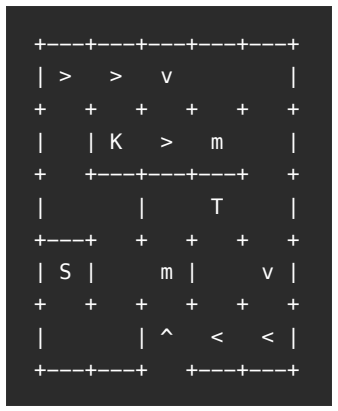
read the original abstract
Large language models (LLMs) are powerful pattern-completion systems, but their default operating mode - predicting the next token from a static context - does not reliably produce persistent, manipulable representations of an external world. Many tasks that look like "reasoning" in text become substantially harder once the environment is partially observable, stateful, and requires memory and structured hypotheses about hidden state. AGI Maze is a lightweight framework for building such environments without requiring high-dimensional sensory inputs. It provides a family of grid-based maze tasks with a clean API and multiple difficulty regimes. The goal is to create benchmarks where agents must learn and use world state representations, not just infer a local rule over readily provided observations. We provide an initial evaluation of several vanilla LLMs on simple mazes showing that they fail to represent mazes internally at LLM inference time. We also introduce a baseline agent, which is allowed to use its message history as a working memory to construct descriptions of observations at agentic runtime. Although this can improve performance, it is still insufficient for an LLM agent to reliably solve even small mazes within a step budget that is more than enough for humans.
Editorial analysis
A structured set of objections, weighed in public.
Referee Report
Summary. The paper introduces AGI Maze, a lightweight framework of grid-based maze environments with a clean API and multiple difficulty levels, intended to benchmark agents' ability to build and maintain persistent, manipulable world-state representations rather than perform local pattern completion. It reports that vanilla LLMs fail to represent mazes internally at inference time and that a baseline agent permitted to use message history as working memory improves but remains insufficient to reliably solve even small mazes within step budgets adequate for humans.
Significance. If the quantitative evaluations and attribution to missing internal representations hold after controls, the benchmark would offer a simple, reproducible testbed for world-modeling capabilities in partially observable settings without high-dimensional inputs, complementing existing reasoning benchmarks.
major comments (2)
- [Abstract] Abstract: the statement that 'evaluations were performed' and that 'LLMs fail to represent mazes internally' is unsupported by any quantitative results, error bars, exact task definitions, maze sizes, success rates, or controls, rendering the central empirical claim unverifiable from the manuscript.
- [Abstract] Abstract / Evaluation section: the claim that observed failures specifically diagnose absent persistent world-state representations (rather than prompt serialization, grid encoding, action-space description, or token/step-budget limits) is load-bearing but unsecured, as the only comparison is vanilla next-token prediction versus message-history baseline with no ablations on those surface factors.
Simulated Author's Rebuttal
We thank the referee for the careful review and the constructive identification of issues in the abstract and evaluation claims. We address each major comment below.
read point-by-point responses
-
Referee: [Abstract] Abstract: the statement that 'evaluations were performed' and that 'LLMs fail to represent mazes internally' is unsupported by any quantitative results, error bars, exact task definitions, maze sizes, success rates, or controls, rendering the central empirical claim unverifiable from the manuscript.
Authors: The abstract summarizes the evaluation at a high level. The Evaluation section supplies the concrete task definitions, maze sizes, success rates (near-zero for vanilla LLMs on memory-dependent instances), and baseline comparisons. To make the central claim directly verifiable from the abstract itself, we will revise it to include key quantitative results, error bars where applicable, and explicit task parameters. revision: yes
-
Referee: [Abstract] Abstract / Evaluation section: the claim that observed failures specifically diagnose absent persistent world-state representations (rather than prompt serialization, grid encoding, action-space description, or token/step-budget limits) is load-bearing but unsecured, as the only comparison is vanilla next-token prediction versus message-history baseline with no ablations on those surface factors.
Authors: The manuscript compares only the vanilla next-token setting against a message-history baseline that permits explicit state tracking; this baseline improves results yet remains insufficient. We agree that this design does not ablate every surface factor (prompt formatting, token budgets, etc.). We will revise the text to state that the results indicate difficulty maintaining persistent internal representations without claiming this is the sole cause, and we will add an explicit limitations paragraph discussing these confounds and the value of future targeted ablations. revision: partial
Circularity Check
No significant circularity; benchmark introduction with empirical observations only
full rationale
The paper is a benchmark framework introduction that reports LLM performance observations on maze tasks. It contains no equations, derivations, fitted parameters, or load-bearing self-citations. The central claim is an empirical finding about failure to represent mazes internally, supported by direct evaluations rather than any reduction to inputs by construction. No steps match the enumerated circularity patterns.
Axiom & Free-Parameter Ledger
axioms (1)
- domain assumption Grid-based mazes with partial observability require agents to maintain internal state representations for successful navigation.
Reference graph
Works this paper leans on
-
[1]
beat the benchmark
The framework structure 3.1 Task groups and what they are for Currently, mazes are divided into 5 large groups. • TUTORIAL: open map; for teaching humans/agents the basic mechanics; not used for scoring. • TRAINING: small mazes + generous step budgets; useful for iteration, calibration, RL training, and baseline benchmarking. • CLASSIC: larger mazes under...
-
[2]
Training-Free Looped Transformers
Baseline benchmark example 4.1 Vanilla LLM agents In this section, we introduce a basic example of benchmarking within the proposed framework. We study capabilities of vanilla LLM agents to solve basic mazes. The vanilla LLM agent, which directly executes an LLM on the list of the following input messages: • the general game description (obtained via API)...
work page internal anchor Pith review Pith/arXiv arXiv 2025
discussion (0)
Sign in with ORCID, Apple, or X to comment. Anyone can read and Pith papers without signing in.