REVIEW 6 minor 14 cited by
Discovery and Preliminary Characterization of a Third Interstellar Object: 3I/ATLAS
T0 review · 0 major / 6 minor · reviewed 2026-08-06 · deepseek-v4-flash
Pith's one-line read 3I/ATLAS is the third known interstellar object, on an unbound orbit arriving at 58 km/s with a faint coma and a red, primitive surface.
desk verdict 3I/ATLAS is a genuine interstellar discovery; the orbit is ~300 sigma hyperbolic, and the paper's only real weaknesses are minor caveats that don't threaten the central result. read the letter →
The pith
A machine-rendered reading of the paper's core claim, the machinery that carries it, and where it could break.
The reading
What carries the argument
The load-bearing object is the barycentric orbit solution, computed from astrometry spanning 2025 May 22 to July 6. Eccentricity relative to the solar system barycenter removes the planetary perturbation bias that a heliocentric eccentricity can carry, and e_b > 1 with e_b = 6.144 ± 0.016 is the unambiguous unbound-orbit discriminator. The astrometric solution is anchored by high-precision observations extrapolated to zero aperture to remove inner-coma asymmetry and calibrated against a global reference star catalog. A secondary machinery is the ATLAS detectability-volume model, which converts the single discovery into a local interstellar-object density estimate by computing the volume swept out per year as a function of absolute magnitude.
What would settle it
Re-fit the full astrometric arc with a nongravitational acceleration model, including radial and transverse terms; if the resulting barycentric eccentricity drops to within one sigma of 1, the interstellar classification would not be secure. The same re-fit would also test whether the reported incoming asymptote of right ascension about 295 degrees and declination about -19 degrees changes materially.
Extended reading notes
Core claim
The paper claims that C/2025 N1 (ATLAS), discovered on 2025 July 1, is on a barycentric hyperbolic orbit with eccentricity e_b = 6.144 ± 0.016 and incoming speed v∞ = 57.942 ± 0.049 km/s, making it the third known interstellar object after 1I/‘Oumuamua and 2I/Borisov. The object is weakly cometary: stacked images from large ground-based telescopes show a compact coma extending at least 4 arcseconds, and photometry over a roughly four-day span shows little brightness variation, with amplitudes below about 0.2 magnitudes. Its visible/near-infrared reflectance spectrum is featureless and moderately red, with a slope of 17.1 ± 0.2 %/100 nm, comparable to 2I/Borisov, D-type asteroids, and the redder end of 1I/‘Oumuamua measurements; pre-discovery colors suggest the nucleus may be closer to solar in color while the redder signal comes from ejected dust.
Load-bearing premise
The orbit is treated as purely gravitational even though the object is demonstrably active, so unmodeled outgassing forces could bias the reported incoming speed and direction, although the large eccentricity would likely still imply an interstellar origin.
Editorial extensions
If this is right
- 3I/ATLAS is the second active interstellar comet after 2I/Borisov, showing that interstellar objects can arrive both active and inactive.
- Its spectral slope places it with moderately red primitive bodies, supporting the view that interstellar objects share surface properties with the most primitive solar system small bodies.
- The ATLAS detectability model implies a local interstellar-object density of roughly 3×10^-4 au^-3 and a detection rate near 0.2 per year for objects as bright as 3I/ATLAS.
- The object is observable from Earth through early September 2025 and again from late November 2025, while its perihelion passage is well placed for Mars-orbiting spacecraft at a close approach of 0.19 au.
- The small light-curve amplitude over four days contrasts sharply with 1I/‘Oumuamua’s 3.5-magnitude swings, though coma dilution may hide rotational modulation.
Reading between the lines
- Because a coma can dilute rotational modulation, the small light-curve amplitude does not yet constrain the nucleus shape or spin; a coma-free nucleus measurement later in the apparition could.
- If the red measured color is dominated by ejected dust, the pre-discovery g'−r' colors near 0.42–0.44, which are close to solar, may be the better guide to the nucleus surface composition.
- A third sample with a high incoming velocity of about 58 km/s strengthens the view that interstellar objects arrive from multiple kinematic populations; a larger sample from upcoming wide-field surveys could determine whether such high speeds are common or rare.
- The apparent discovery of two relatively bright objects near H ~ 13 and no faint ones over a decade suggests either a size distribution shallower than the 1I/‘Oumuamua-based estimate or strong discovery bias against smaller interstellar objects; the paper's own density estimate is explicitly sensitive to phase-function and coma assumptions.
Editorial analysis
A structured set of objections, weighed in public.
Referee Report
Summary. The paper reports the discovery and initial characterization of 3I/ATLAS (C/2025 N1), identified as the third known interstellar object. From an 18-day astrometric arc extended by precovery detections to 2025 May 22, and from follow-up astrometry obtained with ATLAS, LCO, TBT, and VLT, the authors derive a strongly hyperbolic heliocentric orbit (e = 6.13, q = 1.36 au, i = 175 deg), with a barycentric eccentricity e_b = 6.144 ± 0.016 and an incoming velocity v_inf = 57.942 ± 0.049 km/s. Deep CFHT and VLT imaging resolves a compact coma; time-series photometry over about four days shows no large-amplitude variability; griz colors and a SNIFS spectrum give a red spectral slope of 17.1 ± 0.2 %/100 nm. The paper closes with an order-of-magnitude estimate of the local interstellar-object density and notes that Mars-orbiting spacecraft may be able to observe the object near perihelion.
Significance. If the result holds, this is the third interstellar object and the second active one, providing a valuable new data point for population statistics and for understanding the physical diversity of interstellar small bodies. The central classification rests on direct astrometry from multiple observatories, including Gaia-DR3-calibrated VLT astrometry with a zero-aperture correction, and is not a circular or model-dependent claim. The paper also makes its data and Python scripts available, which is a clear strength. The activity detection and red spectral slope are plausible but carry acknowledged caveats from coma-contaminated photometry and uncorrected light-curve geometry; these caveats do not affect the interstellar classification. The Section 4 density estimate is explicitly model-dependent and should be treated as preliminary.
minor comments (6)
- [Section 2.2 and Table 1] The orbit solution is presented without discussing nongravitational acceleration, even though Section 3.1 demonstrates that the object is active. Because the object has a coma, the quoted v_inf and incoming asymptote direction are formally fitted under a purely gravitational model; the authors should add a sentence quantifying the expected effect of nongravitational acceleration (or state that an acceleration fit was attempted) to reassure readers that e_b = 6.144 remains robust. This is a caveat on secondary characterization quantities, not on the interstellar classification itself.
- [Section 4, second paragraph] The sentence 'In this case since HV of 3I/ATLAS was measured when active this limiting search volume corresponds to the absolute brightness of the inert nucleus' appears to state the opposite of what is intended. If HV is measured during activity, the brightness includes coma light, so the detection volume corresponds to the combined nucleus-plus-coma brightness; the nucleus-only volume would be smaller. Please rephrase or clarify the intended logic.
- [Section 3.2 and Figure 6] The compiled light curve combines data from multiple telescopes, filters, apertures, and photometric methods and is not corrected for changing heliocentric/geocentric distance or solar phase angle. The claim of 'little brightness variation ≲ 0.2 mag' should be explicitly presented as an upper limit on the coma-contaminated brightness variation, since the uncorrected geometric and methodological offsets are of comparable magnitude.
- [Section 3.4 and Figure 7] The spectroscopic slope of 17.1 ± 0.2 %/100 nm and the color-derived slope of approximately 18 %/100 nm are quoted with very different precisions; as written, the two values appear formally inconsistent. Please report an uncertainty for the color-derived slope or explain why the difference is within systematic errors.
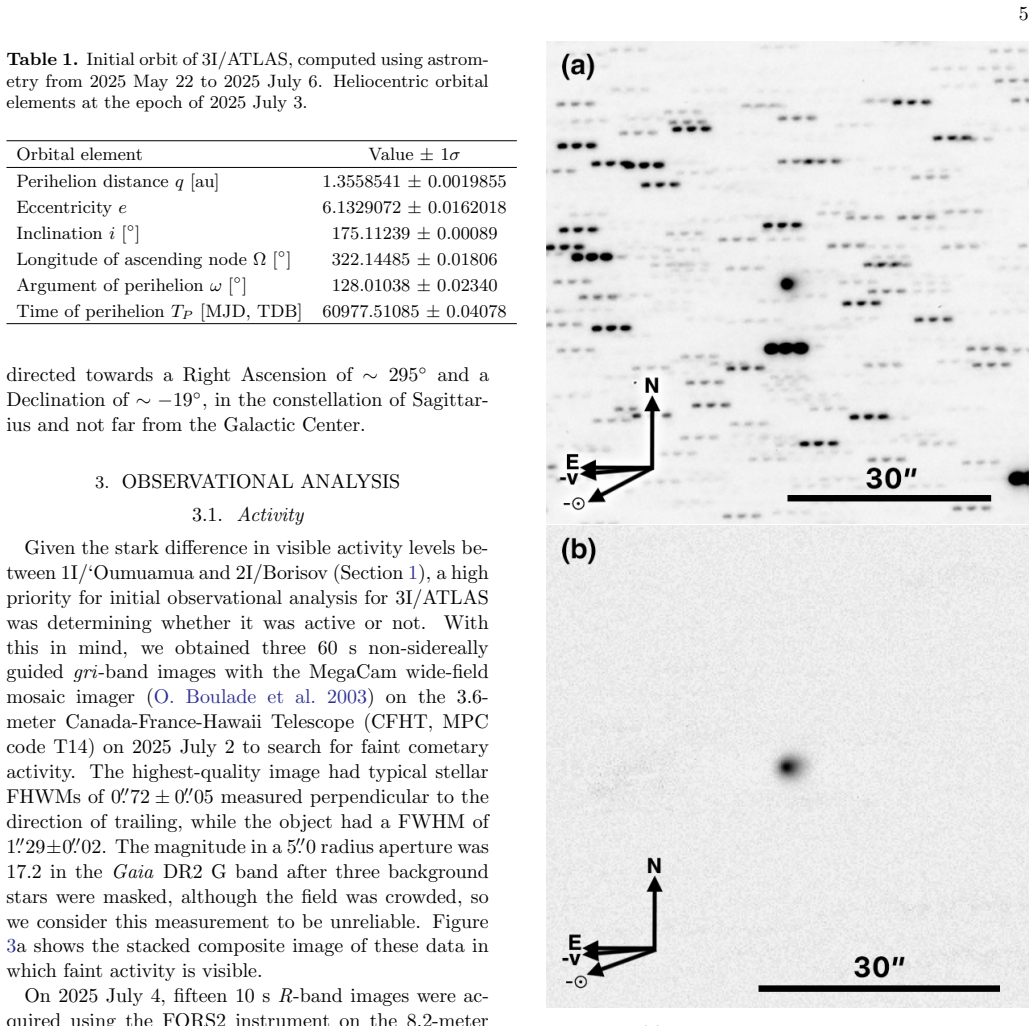
- [Figure 4 caption] The caption refers to 'the VLT image (Figure 3a)', but the VLT composite is Figure 3b; Figure 3a is the CFHT stack. Please correct the cross-reference.
- [Title] The title in the manuscript header reads '3I/A TLAS' with an erroneous space; please fix this typographical error.
Circularity Check
No significant circularity: the interstellar classification and physical characterization derive directly from astrometry, imaging, and spectroscopy, not from the paper's own assumptions.
full rationale
The discovery claim rests on a direct astrometric orbit determination: Section 2.2 reports barycentric eccentricity e_b = 6.144 ± 0.016 and incoming velocity v_inf = 57.942 ± 0.049 km/s from astrometry spanning 2025 May 22 to July 6, with Gaia DR3 as the reference catalog. These are measured orbital elements, not outputs of a model that assumes interstellar origin. The activity detection is likewise direct: CFHT and VLT images resolve a coma, and the photometric profile shows an excess over stellar Point Spread Functions (Section 3.1). Colors and spectral slope come from independent photometry and spectroscopy calibrated to standard catalogs. The population density estimate in Section 4 is an explicit extrapolation using an ATLAS detection-volume model, and the paper itself flags the sensitivity to the assumed phase function and activity state; it does not retroactively define the object's interstellar nature. Self-citations appear in the introduction and discussion (e.g., Micheli et al. 2018; Seligman et al. 2023, 2024; Taylor & Seligman 2025), but none is load-bearing for the central classification; they provide context on nongravitational acceleration and prior interstellar objects. The lack of a fitted nongravitational acceleration is a plausible modeling caveat for secondary quantities, but it is not circularity: the reported excess kinetic energy is enormous and would not be erased by realistic outgassing, and the paper explicitly encourages future nongravitational fits. The derivation chain is therefore self-contained and observationally grounded, with no step that reduces to its own input by construction.
Assumptions & free parameters
free parameters (4)
- ATLAS detection model limiting magnitude m_lim =
~19
- Phase function parameter G =
0.15
- Detection and crossing speed =
50 km/s
- Geometric albedo p_V =
0.05
assumptions (3)
- domain assumption Orbital fit assumes purely gravitational motion with no nongravitational acceleration terms.
- domain assumption ATLAS detectability model assumes a G=0.15 phase function, a weather and moon averaged limiting magnitude of m_lim ~19, and a crossing speed of 50 km/s.
- domain assumption Photometric absolute magnitudes are computed assuming a standard asteroidal phase function with G=0.15 and solar colors.
Cite this review
Pith. "Pith review of Discovery and Preliminary Characterization of a Third Interstellar Object: 3I/ATLAS." pith.science (2026). https://pith.science/paper/GRLZONJQ
@misc{pith2026250702757,
  author       = {Pith},
  title        = {Pith review of: Discovery and Preliminary Characterization of a Third Interstellar Object: 3I/ATLAS},
  year         = {2026},
  howpublished = {\url{https://pith.science/paper/GRLZONJQ}},
  note         = {Machine review of arXiv:2507.02757}
}
abstract
We report initial observations aimed at the characterization of a third interstellar object. This object, 3I/ATLAS or C/2025 N1 (ATLAS), was discovered on 2025 July 1 UT and has an orbital eccentricity of $e\sim6.1$, perihelion of $q\sim 1.36$ au, inclination of $\sim175^\circ$, and hyperbolic velocity of $V_\infty\sim 58$ km s$^{-1}$. We report deep stacked images obtained using the Canada-France-Hawaii Telescope and the Very Large Telescope that resolve a compact coma. Using images obtained from several smaller ground-based telescopes, we find minimal light curve variation for the object over a $\sim4$ day time span. The visible/near-infrared spectral slope of the object is 17.1$\pm$0.2 %/100 nm, comparable to other interstellar objects and primitive solar system small bodies (comets and D-type asteroids). 3I/ATLAS will be observable through early September 2025, then unobservable by Earth-based observatories near perihelion due to low solar elongation. It will be observable again from the ground in late November 2025. Although this limitation unfortunately prohibits detailed Earth-based observations at perihelion when the activity of 3I/ATLAS is likely to peak, spacecraft at Mars could be used to make valuable observations at this time.
Figures


Figures from the paper (5 more)


Forward citations
Cited by 14 Pith papers
-
Extreme Negative Polarisation of New Interstellar Comet 3I/ATLAS
First polarimetric observations of interstellar comet 3I/ATLAS show an unprecedentedly deep and narrow negative polarization branch, with a minimum near -2.7% at about 7 degrees and inversion at 17 degrees.
-
Very Large Telescope observations of interstellar comet 3I/ATLAS III: High-resolution monitoring of CN and forbidden oxygen emission across the perihelion passage with ESPRESSO
3I/ATLAS becomes progressively water-dominated near perihelion, with CN production falling as r_h^-4.62 on the inbound leg and a green-to-red oxygen ratio comparable to 2I/Borisov.
-
Precovery Observations of 3I/ATLAS from TESS Suggests Possible Distant Activity
Archival TESS images show 3I/ATLAS was brighter than distance effects alone can explain, implying possible cometary activity at ~6 au from the Sun.
-
Detecting dark objects in the Solar System with Gravitational Wave observatories
DECIGO could detect compact dark matter objects with masses 10^7 to 10^11 g flying through the solar system via their gravitational perturbation of the detector test masses.
-
Assessing interstellar comet 3I/ATLAS with the 10.4 m Gran Telescopio Canarias and the Two-meter Twin Telescope
3I/ATLAS, the third interstellar object, has a red TNO-like spectrum, an active dust coma, a rotation period of 16.79 hours, and a kinematic trace toward the Galactic thin disk.
-
Near-Discovery Observations of Interstellar Comet 3I/ATLAS with the NASA Infrared Telescope Facility
New observations of interstellar comet 3I/ATLAS produce the first near-infrared spectrum, showing a red slope that turns neutral at longer wavelengths, no water ice absorption, and a model-dependent upper limit of <7%...
-
From a Different Star: 3I/ATLAS in the context of the \={O}tautahi-Oxford interstellar object population model
3I/ATLAS's incoming speed and direction fit the Otautahi-Oxford model, which predicts it is an old (likely over 7.6 Gyr), water-rich object with no kinematic link to 1I/Oumuamua or 2I/Borisov.
-
Palomar and Apache Point Spectrophotometry of Interstellar Comet 3I/ATLAS
3I/ATLAS, the third interstellar object, has a red spectral slope of about 19%/100 nm from 420 to 700 nm and a neutral 6%/100 nm slope from 700 to 1000 nm, with no obvious C2 or CO+ emission.
-
The Kinematic Age of 3I/ATLAS and its Implications for Early Planet Formation
3I/ATLAS is likely an old, active comet about 2 km across, and its high speed implies it formed roughly 3 to 11 billion years ago around a low-metallicity star.
-
X-SHOOTER Spectrum of Comet 3I/ATLAS: Insights into a Distant Interstellar Visitor
3I/ATLAS, the third known interstellar visitor, shows a red reflectance spectrum and no detectable OH or CN emission at 4.4 AU, with derived upper limits.
-
Snapshot of a new interstellar comet: 3I/ATLAS has a red and featureless spectrum
The interstellar comet 3I/ATLAS has a red, featureless optical spectrum with no detected gas emission, indicating a dusty coma during early observations.
-
NSF-DOE Vera C. Rubin Observatory Observations of Interstellar Comet 3I/ATLAS (C/2025 N1)
Rubin Observatory delivers the earliest large-telescope astrometry and grizy photometry of interstellar comet 3I/ATLAS, including colors and a dust-to-nucleus cross-section ratio lower limit.
-
Comment on "Discovery and Preliminary Characterization of a Third Interstellar Object: 3I/ATLAS" [arXiv:2507.02757]
The brightness-based size of interstellar object 3I/ATLAS conflicts with the estimated interstellar mass budget, so the object must have a small core or be a member of a very rare population.
-
From Extraterrestrial Microbes to Alien Intelligence: Rebalancing Astronomical Research Priorities
An advocacy essay claiming the exclusion of extraterrestrial intelligence research from federal astronomy funding reflects institutional bias and proposes rebalancing priorities toward technosignatures and interstella...
Reference graph
Works this paper leans on
-
[1]
, " * write output.state after.block = add.period write newline
ENTRY address archivePrefix author booktitle chapter doi edition editor eprint howpublished institution journal key month number organization pages publisher school series title misctitle type volume year version url label extra.label sort.label short.list INTEGERS output.state before.all mid.sentence after.sentence after.block FUNCTION init.state.consts ...
-
[2]
write newline
" write newline "" before.all 'output.state := FUNCTION format.url url empty "" new.block "" url * "" * if FUNCTION format.eprint eprint empty "" archivePrefix empty "" archivePrefix "arXiv" = new.block " " eprint * " " * new.block " " eprint * " " * if if if FUNCTION format.doi doi empty "" " " doi * " " * if FUNCTION format.pid doi empty eprint empty ur...
-
[3]
oh = 0eBPQ P j BX J) ŏ*Q Ў ( 5?Oe [GX f8=7o zQ O2GRA Ў ( 5 66Ў ( 5?OB4o aS TC^! mYEJ ر
thebibliography [1] 20pt to REFERENCES 6pt =0pt \@twocolumntrue 12pt -12pt 10pt plus 3pt =0pt =0pt =1pt plus 1pt =0pt =0pt -12pt =13pt plus 1pt =20pt =13pt plus 1pt \@M =10000 =-1.0em =0pt =0pt 0pt =0pt =1.0em @enumiv\@empty 10000 10000 `\.\@m \@noitemerr \@latex@warning Empty `thebibliography' environment \@ifnextchar \@reference \@latexerr Missing key o...
2017
-
[4]
R., Serra-Ricart , M., Licandro , J., et al
Alarcon , M. R., Serra-Ricart , M., Licandro , J., et al. 2025, title Deep g'-band Imaging of Interstellar Comet 3I/ATLAS from the Two-meter Twin Telescope (TTT) , , The Astronomer's Telegram, No. 17264 https://www.astronomerstelegram.org/?read=17264
2025
-
[5]
Almeida-Fernandes , F., & Rocha-Pinto , H. J. 2018, title A kinematical age for the interstellar object 1I/`Oumuamua , , 480, 4903, 10.1093/mnras/sty2202
-
[6]
Aravind , K., Ganesh , S., Venkataramani , K., et al. 2021, title Activity of the first interstellar comet 2I/Borisov around perihelion: results from Indian observatories , , 502, 3491, 10.1093/mnras/stab084
-
[7]
Bagnulo , S., Cellino , A., Kolokolova , L., et al. 2021, title Unusual polarimetric properties for interstellar comet 2I/Borisov , Nature Communications, 12, 1797, 10.1038/s41467-021-22000-x
-
[8]
T., Opitom , C., Fitzsimmons , A., et al
Bannister , M. T., Opitom , C., Fitzsimmons , A., et al. 2020, title Interstellar comet 2I/Borisov as seen by MUSE: C _2 , NH _2 and red CN detections , arXiv e-prints, arXiv:2001.11605. 2001.11605
arXiv 2020
Show all 97 references
-
[9]
C., Kulkarni , S
Bellm , E. C., Kulkarni , S. R., Graham , M. J., et al. 2019, title The Zwicky Transient Facility: System Overview, Performance, and First Results , , 131, 018002, 10.1088/1538-3873/aaecbe
2019 doi
-
[10]
Belton , M. J. S., Hainaut , O. R., Meech , K. J., et al. 2018, title The Excited Spin State of 1I/2017 U1 Oumuamua , ApJL, 856, L21, 10.3847/2041-8213/aab370
2018 doi
-
[11]
J., et al
Belyakov , M., Fremling , C., Graham , M. J., et al. 2025, title Palomar and Apache Point Spectrophotometry of Interstellar Comet 3I/ATLAS , arXiv e-prints, arXiv:2507.11720. 2507.11720
2025 arXiv
-
[12]
B., & Seligman , D
Bergner , J. B., & Seligman , D. Z. 2023, title Acceleration of 1I/`Oumuamua from radiolytically produced H _ 2 in H _ 2 O ice , , 615, 610, 10.1038/s41586-022-05687-w
2023 doi
-
[13]
Binzel , R. P. 1992, title The optical spectrum of 5145 Pholus , , 99, 238, 10.1016/0019-1035(92)90185-A
1992 doi
-
[14]
2024, in Comets III, ed
Biver , N., Dello Russo , N., Opitom , C., & Rubin , M. 2024, in Comets III, ed. K. J. Meech , M. R. Combi , D. Bockel \'e e-Morvan , S. N. Raymodn , & M. E. Zolensky ( University of Arizona Press ), 459--498
2024
-
[15]
W., Feldman , P
Bodewits , D., Noonan , J. W., Feldman , P. D., et al. 2020, title The carbon monoxide-rich interstellar comet 2I/Borisov , Nature Astronomy, 4, 867, 10.1038/s41550-020-1095-2
2020 doi
-
[16]
T., Sato , H., et al
Borisov , G., Durig , D. T., Sato , H., et al. 2019, title Comet C/2019 Q4 (Borisov) , Central Bureau Electronic Telegrams, 4666, 1
2019
-
[17]
2003, in , Vol
Boulade , O., Charlot , X., Abbon , P., et al. 2003, in , Vol. 4841, Instrument Design and Performance for Optical/Infrared Ground-based Telescopes, 72--81, 10.1117/12.459890
2003 doi
-
[18]
1989, in Asteroids II, 524--556
Bowell , E., Hapke , B., Domingue , D., et al. 1989, in Asteroids II, 524--556
1989
-
[19]
A., Milam , S
Cordiner , M. A., Milam , S. N., Biver , N., et al. 2020, title Unusually high CO abundance of the first active interstellar comet , Nature Astronomy, 4, 861, 10.1038/s41550-020-1087-2
2020 doi
-
[20]
2020, title Dust Environment Model of the Interstellar Comet 2I/Borisov , , 893, L12, 10.3847/2041-8213/ab8455
Cremonese , G., Fulle , M., Cambianica , P., et al. 2020, title Dust Environment Model of the Interstellar Comet 2I/Borisov , , 893, L12, 10.3847/2041-8213/ab8455
2020 doi
-
[21]
R., et al
de la Fuente Marcos , R., Licandro , J., Alarcon , M. R., et al. 2025, title Assessing interstellar comet 3I/ATLAS with the 10.4 m Gran Telescopio Canarias and the Two-meter Twin Telescope , arXiv e-prints, arXiv:2507.12922. 2507.12922
2025 arXiv
-
[22]
2020, title Visible and near-infrared observations of interstellar comet 2I/Borisov with the 10.4-m GTC and the 3.6-m TNG telescopes , , 495, 2053, 10.1093/mnras/staa1190
de Le \'o n , J., Licandro , J., de la Fuente Marcos , C., et al. 2020, title Visible and near-infrared observations of interstellar comet 2I/Borisov with the 10.4-m GTC and the 3.6-m TNG telescopes , , 495, 2053, 10.1093/mnras/staa1190
2020 doi
-
[23]
E., Binzel , R
DeMeo , F. E., Binzel , R. P., Slivan , S. M., & Bus , S. J. 2009, title An extension of the Bus asteroid taxonomy into the near-infrared , , 202, 160, 10.1016/j.icarus.2009.02.005
2009 doi
-
[24]
2025, title 3I/ATLAS = C/2025 N1 (ATLAS) , MPEC
Denneau , L., Siverd , R., Tonry , J., et al. 2025, title 3I/ATLAS = C/2025 N1 (ATLAS) , MPEC
2025
-
[25]
J., & Jackson, A
Desch, S. J., & Jackson, A. P. 2021, title 1I/‘Oumuamua as an N2 ice fragment of an exo-pluto surface II: Generation of N2 ice fragments and the origin of ‘Oumuamua, Journal of Geophysical Research: Planets, e2020JE006807
2021
-
[26]
J., & Jackson , A
Desch , S. J., & Jackson , A. P. 2022, title Some Pertinent Issues for Interstellar Panspermia Raised after the Discovery of 1I/`Oumuamua , Astrobiology, 22, 1400, 10.1089/ast.2021.0199
2022
-
[27]
A., & Tonry , J
Do , A., Tucker , M. A., & Tonry , J. 2018, title Interstellar Interlopers: Number Density and Origin of Oumuamua-like Objects , , 855, L10, 10.3847/2041-8213/aaae67
2018 doi
-
[28]
Z., Granvik , M., et al
Farnocchia , D., Seligman , D. Z., Granvik , M., et al. 2023, title (523599) 2003 RM: The Asteroid that Wanted to be a Comet , , 4, 29, 10.3847/PSJ/acb25b
2023 doi
-
[29]
Feng , F., & Jones , H. R. A. 2018, title Oumuamua as a Messenger from the Local Association , , 852, L27, 10.3847/2041-8213/aaa404
2018 doi
-
[30]
2024, in Comets III, ed
Fitzsimmons , A., Meech , K., Matr \`a , L., & Pfalzner , S. 2024, in Comets III, ed. K. J. Meech , M. R. Combi , D. Bockel \'e e-Morvan , S. N. Raymodn , & M. E. Zolensky , 731--766
2024
-
[31]
2018, title Spectroscopy and thermal modelling of the first interstellar object 1I/2017 U1 `Oumuamua , Nature Astronomy, 2, 133, 10.1038/s41550-017-0361-4
Fitzsimmons , A., Snodgrass , C., Rozitis , B., et al. 2018, title Spectroscopy and thermal modelling of the first interstellar object 1I/2017 U1 `Oumuamua , Nature Astronomy, 2, 133, 10.1038/s41550-017-0361-4
2018 doi
-
[32]
J., et al
Fitzsimmons , A., Hainaut , O., Meech , K. J., et al. 2019, title Detection of CN Gas in Interstellar Object 2I/Borisov , , 885, L9, 10.3847/2041-8213/ab49fc
2019 doi
-
[33]
G., Luu , J., & Toussaint , R
Flekk y , E. G., Luu , J., & Toussaint , R. 2019, title The Interstellar Object Oumuamua as a Fractal Dust Aggregate , , 885, L41, 10.3847/2041-8213/ab4f78
2019 doi
-
[34]
A., Magnier , E
Flewelling , H. A., Magnier , E. A., Chambers , K. C., et al. 2020, title The Pan-STARRS1 Database and Data Products , , 251, 7, 10.3847/1538-4365/abb82d
2020 doi
-
[35]
C., Pravec , P., Fitzsimmons , A., et al
Fraser , W. C., Pravec , P., Fitzsimmons , A., et al. 2018, title The tumbling rotational state of 1I/`Oumuamua , Nature Astronomy, 2, 383, 10.1038/s41550-018-0398-z
2018 doi
-
[36]
Gaia Collaboration , Vallenari , A., Brown , A. G. A., et al. 2023, title Gaia Data Release 3. Summary of the content and survey properties , , 674, A1, 10.1051/0004-6361/202243940
2023 doi
-
[37]
2017, title Origin of Interstellar Object A/2017 U1 in a Nearby Young Stellar Association? , RNAAS, 1, 13, 10.3847/2515-5172/aa9851
Gaidos , E., Williams , J., & Kraus , A. 2017, title Origin of Interstellar Object A/2017 U1 in a Nearby Young Stellar Association? , RNAAS, 1, 13, 10.3847/2515-5172/aa9851
2017 doi
-
[38]
J., Kulkarni , S
Graham , M. J., Kulkarni , S. R., Bellm , E. C., et al. 2019, title The Zwicky Transient Facility: Science Objectives , , 131, 078001, 10.1088/1538-3873/ab006c
2019 doi
-
[39]
2020, title Initial characterization of interstellar comet 2I/Borisov , Nature Astronomy, 4, 53, 10.1038/s41550-019-0931-8
Guzik , P., Drahus , M., Rusek , K., et al. 2020, title Initial characterization of interstellar comet 2I/Borisov , Nature Astronomy, 4, 53, 10.1038/s41550-019-0931-8
2020 doi
-
[40]
2020, title The Dynamics of Interstellar Asteroids and Comets within the Galaxy: An Assessment of Local Candidate Source Regions for 1I/’Oumuamua and 2I/Borisov, , 159, 147
Hallatt, T., & Wiegert, P. 2020, title The Dynamics of Interstellar Asteroids and Comets within the Galaxy: An Assessment of Local Candidate Source Regions for 1I/’Oumuamua and 2I/Borisov, , 159, 147
2020
-
[41]
2025, title Is the Interstellar Object 3I/ATLAS Alien Technology? , arXiv e-prints, arXiv:2507.12213
Hibberd , A., Crowl , A., & Loeb , A. 2025, title Is the Interstellar Object 3I/ATLAS Alien Technology? , arXiv e-prints, arXiv:2507.12213. 2507.12213
2025
-
[42]
2006, title The colours of the Sun , , 367, 449, 10.1111/j.1365-2966.2005.09832.x
Holmberg , J., Flynn , C., & Portinari , L. 2006, title The colours of the Sun , , 367, 449, 10.1111/j.1365-2966.2005.09832.x
2006
-
[43]
J., Dorsey, R
Hopkins, M. J., Dorsey, R. C., Forbes, J. C., et al. 2025, title From a Different Star: 3I/ATLAS in the context of the \= O tautahi-Oxford interstellar object population model, 2507.05318
2025 arXiv
-
[44]
Hsieh , C.-H., Laughlin , G., & Arce , H. G. 2021, title Evidence Suggesting That 'Oumuamua Is the 30 Myr Old Product of a Molecular Cloud , , 917, 20, 10.3847/1538-4357/ac0729
2021 doi
-
[45]
Hui , M.-T., Ye , Q.-Z., F \"o hring , D., Hung , D., & Tholen , D. J. 2020, title Physical Characterization of Interstellar Comet 2I/2019 Q4 (Borisov) , , 160, 92, 10.3847/1538-3881/ab9df8
2020 doi
-
[46]
P., & Desch, S
Jackson, A. P., & Desch, S. J. 2021, title 1I/‘Oumuamua as an N2 ice fragment of an exo-Pluto surface: I. Size and Compositional Constraints, Journal of Geophysical Research: Planets, e2020JE006706
2021
-
[47]
2011, title TRAPPIST: TRAnsiting planets and PlanetesImals small telescope, The Messenger, 145
Jehin, E., Gillon, M., Queloz, D., et al. 2011, title TRAPPIST: TRAnsiting planets and PlanetesImals small telescope, The Messenger, 145
2011
-
[48]
2019, title Initial Characterization of Interstellar Comet 2I/2019 Q4 (Borisov) , , 886, L29, 10.3847/2041-8213/ab530b
Jewitt , D., & Luu , J. 2019, title Initial Characterization of Interstellar Comet 2I/2019 Q4 (Borisov) , , 886, L29, 10.3847/2041-8213/ab530b
2019 doi
-
[49]
2025, title Interstellar Interloper C/2025 N1 is Active , , The Astronomer's Telegram, No
Jewitt , D., & Luu , J. 2025, title Interstellar Interloper C/2025 N1 is Active , , The Astronomer's Telegram, No. 17263 https://www.astronomerstelegram.org/?read=17263
2025
-
[50]
2017, title Interstellar Interloper 1I/2017 U1: Observations from the NOT and WIYN Telescopes , ApJL, 850, L36, 10.3847/2041-8213/aa9b2f
Jewitt , D., Luu , J., Rajagopal , J., et al. 2017, title Interstellar Interloper 1I/2017 U1: Observations from the NOT and WIYN Telescopes , ApJL, 850, L36, 10.3847/2041-8213/aa9b2f
2017 doi
-
[51]
Jewitt , D., & Seligman , D. Z. 2023, title The Interstellar Interlopers , , 61, 197, 10.1146/annurev-astro-071221-054221
2023 doi
-
[52]
L., Chesley , S
Jones , R. L., Chesley , S. R., Connolly , A. J., et al. 2009, title Solar System Science with LSST , Earth Moon and Planets, 105, 101, 10.1007/s11038-009-9305-z
2009 doi
-
[53]
K., & Ammon , K
Jordi , K., Grebel , E. K., & Ammon , K. 2006, title Empirical color transformations between SDSS photometry and other photometric systems , , 460, 339, 10.1051/0004-6361:20066082
2006 doi
-
[54]
W., Harris , W
Kareta , T., Noonan , J. W., Harris , W. M., & Springmann , A. 2023, title Ice, Ice, Maybe? Investigating 46P/Wirtanen's Inner Coma for Icy Grains , , 4, 85, 10.3847/PSJ/accc28
2023 doi
-
[55]
W., et al
Kareta , T., Andrews , J., Noonan , J. W., et al. 2020, title Carbon Chain Depletion of 2I/Borisov , , 889, L38, 10.3847/2041-8213/ab6a08
2020 doi
-
[56]
2025, title Near-Discovery Observations of Interstellar Comet 3I/ATLAS with the NASA Infrared Telescope Facility , arXiv e-prints, arXiv:2507.12234
Kareta , T., Champagne , C., McClure , L., et al. 2025, title Near-Discovery Observations of Interstellar Comet 3I/ATLAS with the NASA Infrared Telescope Facility , arXiv e-prints, arXiv:2507.12234. 2507.12234
2025 arXiv
-
[57]
2020, title Coma Anisotropy and the Rotation Pole of Interstellar Comet 2I/Borisov , , 895, L34, 10.3847/2041-8213/ab9228
Kim , Y., Jewitt , D., Mutchler , M., et al. 2020, title Coma Anisotropy and the Rotation Pole of Interstellar Comet 2I/Borisov , , 895, L34, 10.3847/2041-8213/ab9228
2020 doi
-
[58]
M., Protopapa , S., Kelley , M
Knight , M. M., Protopapa , S., Kelley , M. S. P., et al. 2017, title On the Rotation Period and Shape of the Hyperbolic Asteroid 1I/ Oumuamua (2017 U1) from Its Lightcurve , ApJL, 851, L31, 10.3847/2041-8213/aa9d81
2017 doi
-
[59]
Kolokolova , L., Kelley , M. S. P., Kimura , H., & Hoang , T. 2024, in Comets III, ed. K. J. Meech , M. R. Combi , D. Bockel \'e e-Morvan , S. N. Raymodn , & M. E. Zolensky ( University of Arizona Press ), 621--652
2024
-
[60]
2004, in Society of Photo-Optical Instrumentation Engineers (SPIE) Conference Series, Vol
Lantz , B., Aldering , G., Antilogus , P., et al. 2004, in Society of Photo-Optical Instrumentation Engineers (SPIE) Conference Series, Vol. 5249, Optical Design and Engineering, ed. L. Mazuray , P. J. Rogers , & R. Wartmann , 146--155, 10.1117/12.512493
2004 doi
-
[61]
G., Cabot , S
Levine , W. G., Cabot , S. H. C., Seligman , D., & Laughlin , G. 2021, title Constraints on the Occurrence of 'Oumuamua-Like Objects , , 922, 39, 10.3847/1538-4357/ac1fe6
2021 doi
-
[62]
G., & Laughlin , G
Levine , W. G., & Laughlin , G. 2021, title Assessing the Formation of Solid Hydrogen Objects in Starless Molecular Cloud Cores , , 912, 3, 10.3847/1538-4357/abec85
2021 doi
-
[63]
W., Lee , C.-H., Gerdes , D
Lin , H. W., Lee , C.-H., Gerdes , D. W., et al. 2020, title Detection of Diatomic Carbon in 2I/Borisov , , 889, L30, 10.3847/2041-8213/ab6bd9
2020 doi
-
[64]
Lister , T., Kelley , M. S. P., Holt , C. E., et al. 2022, title The LCO Outbursting Objects Key Project: Overview and Year 1 Status , , 3, 173, 10.3847/PSJ/ac7a31
2022 doi
-
[65]
Discovery and Preliminary Characterization of a Third Interstellar Object: 3I/ATLAS
Loeb, A. 2025, title Comment on "Discovery and Preliminary Characterization of a Third Interstellar Object: 3I/ATLAS" [arXiv:2507.02757], 2507.05881
2025 arXiv
-
[66]
X., Flekk y , E
Luu , J. X., Flekk y , E. G., & Toussaint , R. 2020, title 'Oumuamua as a Cometary Fractal Aggregate: The ``Dust Bunny'' Model , , 900, L22, 10.3847/2041-8213/abafa7
2020 doi
-
[67]
2017, title Kinematics of the Interstellar Vagabond 1I/Oumuamua (A/2017 U1) , Research Notes of the American Astronomical Society, 1, 21, 10.3847/2515-5172/aa9bdc
Mamajek , E. 2017, title Kinematics of the Interstellar Vagabond 1I/Oumuamua (A/2017 U1) , Research Notes of the American Astronomical Society, 1, 21, 10.3847/2515-5172/aa9bdc
2017 doi
-
[68]
2019, title Modelling the light curve of `Oumuamua: evidence for torque and disc-like shape , MNRAS, 489, 3003, 10.1093/mnras/stz2380
Mashchenko , S. 2019, title Modelling the light curve of `Oumuamua: evidence for torque and disc-like shape , MNRAS, 489, 3003, 10.1093/mnras/stz2380
2019 doi
-
[69]
J., Cochran , A
McKay , A. J., Cochran , A. L., Dello Russo , N., & DiSanti , M. A. 2020, title Detection of a Water Tracer in Interstellar Comet 2I/Borisov , , 889, L10, 10.3847/2041-8213/ab64ed
2020 doi
-
[70]
J., Weryk , R., Micheli , M., et al
Meech , K. J., Weryk , R., Micheli , M., et al. 2017, title A brief visit from a red and extremely elongated interstellar asteroid , Nature, 552, 378, 10.1038/nature25020
2017 doi
-
[71]
J., et al
Micheli , M., Farnocchia , D., Meech , K. J., et al. 2018, title Non-gravitational acceleration in the trajectory of 1I/2017 U1 ('Oumuamua) , , 559, 223, 10.1038/s41586-018-0254-4
2018 doi
-
[72]
2017, title PHOTOMETRYPIPELINE: An automated pipeline for calibrated photometry, Astronomy and Computing, 18, 47
Mommert, M. 2017, title PHOTOMETRYPIPELINE: An automated pipeline for calibrated photometry, Astronomy and Computing, 18, 47
2017
-
[73]
2019, title Could 1I/’Oumuamua be an Icy Fractal Aggregate? , 872, L32
Moro-Mart \' n, A. 2019, title Could 1I/’Oumuamua be an Icy Fractal Aggregate? , 872, L32
2019
- [74]
-
[75]
2019, title 2I/Borisov: A C _ 2 -depleted interstellar comet , , 631, L8, 10.1051/0004-6361/201936959
Opitom , C., Fitzsimmons , A., Jehin , E., et al. 2019, title 2I/Borisov: A C _ 2 -depleted interstellar comet , , 631, L8, 10.1051/0004-6361/201936959
2019 doi
-
[76]
2025, title Initial VLT/MUSE spectroscopy of the interstellar object 3I/ATLAS, 2507.05226
Opitom, C., Snodgrass, C., Jehin, E., et al. 2025, title Initial VLT/MUSE spectroscopy of the interstellar object 3I/ATLAS, 2507.05226
2025 arXiv
-
[77]
Protopapa , S., Kelley , M. S. P., Yang , B., et al. 2018, title Icy Grains from the Nucleus of Comet C/2013 US _ 10 (Catalina) , , 862, L16, 10.3847/2041-8213/aad33b
2018 doi
-
[78]
2019, title Outgassing As Trigger of 1I/`Oumuamua's Nongravitational Acceleration: Could This Hypothesis Work at All? , arXiv e-prints, arXiv:1905.00935
Sekanina , Z. 2019, title Outgassing As Trigger of 1I/`Oumuamua's Nongravitational Acceleration: Could This Hypothesis Work at All? , arXiv e-prints, arXiv:1905.00935. 1905.00935
2019 arXiv
-
[79]
2020, title Evidence that 1I/2017 U1 ('Oumuamua) was Composed of Molecular Hydrogen Ice , , 896, L8, 10.3847/2041-8213/ab963f
Seligman , D., & Laughlin , G. 2020, title Evidence that 1I/2017 U1 ('Oumuamua) was Composed of Molecular Hydrogen Ice , , 896, L8, 10.3847/2041-8213/ab963f
2020 doi
-
[80]
Z., & Moro-Mart \' n , A
Seligman , D. Z., & Moro-Mart \' n , A. 2023, title Interstellar objects , Contemporary Physics, 63, 200, 10.1080/00107514.2023.2203976
2023
-
[81]
Z., Farnocchia , D., Micheli , M., et al
Seligman , D. Z., Farnocchia , D., Micheli , M., et al. 2023, title Dark Comets? Unexpectedly Large Nongravitational Accelerations on a Sample of Small Asteroids , , 4, 35, 10.3847/PSJ/acb697
2023 doi
-
[82]
Z., Farnocchia , D., Micheli , M., et al
Seligman , D. Z., Farnocchia , D., Micheli , M., et al. 2024, title Two distinct populations of dark comets delineated by orbits and sizes , Proceedings of the National Academy of Science, 121, e2406424121, 10.1073/pnas.2406424121
2024 doi
-
[83]
W., Smartt , S
Smith , K. W., Smartt , S. J., Young , D. R., et al. 2020, title Design and Operation of the ATLAS Transient Science Server , , 132, 085002, 10.1088/1538-3873/ab936e
2020 doi
-
[84]
G., & Seligman , D
Taylor , A. G., & Seligman , D. Z. 2025, title The Kinematic Age of 3I/ATLAS and its Implications for Early Planet Formation , arXiv e-prints, arXiv:2507.08111. 2507.08111
2025 arXiv
-
[85]
G., Seligman , D
Taylor , A. G., Seligman , D. Z., Hainaut , O. R., & Meech , K. J. 2023, title Fitting the Light Curve of 1I/'Oumuamua with a Nonprincipal Axis Rotational Model and Outgassing Torques , , 4, 186, 10.3847/PSJ/acf617
2023 doi
-
[86]
G., Steckloff , J
Taylor , A. G., Steckloff , J. K., Seligman , D. Z., et al. 2024, title The dynamical origins of the dark comets and a proposed evolutionary track , , 420, 116207, 10.1016/j.icarus.2024.116207
2024
-
[87]
L., Denneau , L., Heinze , A
Tonry , J. L., Denneau , L., Heinze , A. N., et al. 2018 a , title ATLAS: A High-cadence All-sky Survey System , , 130, 064505, 10.1088/1538-3873/aabadf
2018 doi
-
[88]
L., Denneau , L., Flewelling , H., et al
Tonry , J. L., Denneau , L., Flewelling , H., et al. 2018 b , title The ATLAS All-Sky Stellar Reference Catalog , , 867, 105, 10.3847/1538-4357/aae386
2018 doi
-
[89]
E., Mommert, M., Hora, J
Trilling, D. E., Mommert, M., Hora, J. L., et al. 2018, title Spitzer observations of interstellar object 1I/‘Oumuamua, , 156, 261
2018
-
[90]
A., Shappee , B
Tucker , M. A., Shappee , B. J., Huber , M. E., et al. 2022, title The Spectroscopic Classification of Astronomical Transients (SCAT) Survey: Overview, Pipeline Description, Initial Results, and Future Plans , , 134, 124502, 10.1088/1538-3873/aca719
2022 doi
-
[91]
V., Sato , H., Sarneczky , K., et al
Williams , G. V., Sato , H., Sarneczky , K., et al. 2017, title Minor Planets 2017 SN\_33 and 2017 U1 , Central Bureau Electronic Telegrams, 4450, 1
2017
-
[92]
Xing , Z., Bodewits , D., Noonan , J., & Bannister , M. T. 2020, title Water Production Rates and Activity of Interstellar Comet 2I/Borisov , , 893, L48, 10.3847/2041-8213/ab86be
2020 doi
-
[93]
Z., et al
Yaginuma , A., Frincke , T., Seligman , D. Z., et al. 2025, title The Feasibility of a Spacecraft Flyby with the Third Interstellar Object 3I/ATLAS from Earth or Mars , arXiv e-prints, arXiv:2507.15755. 2507.15755
2025
-
[94]
J., Connelley , M., & Keane , J
Yang , B., Meech , K. J., Connelley , M., & Keane , J. V. 2025, title Spectroscopic Characterization of Interstellar Object 3I/ATLAS: Water Ice in the Coma , arXiv e-prints, arXiv:2507.14916. 2507.14916
2025
-
[95]
A., et al
Yang, B., Li, A., Cordiner, M. A., et al. 2021, title Compact pebbles and the evolution of volatiles in the interstellar comet 2I/Borisov, Nature Astronomy, 10.1038/s41550-021-01336-w
2021 doi
-
[97]
Ye , Q., Kelley , M. S. P., Bolin , B. T., et al. 2020 b , title Pre-discovery Activity of New Interstellar Comet 2I/Borisov beyond 5 au , , 159, 77, 10.3847/1538-3881/ab659b
2020 doi
-
[98]
Ye , Q.-Z., Zhang , Q., Kelley , M. S. P., & Brown , P. G. 2017, title 1I/2017 U1 (`Oumuamua) is Hot: Imaging, Spectroscopy, and Search of Meteor Activity , , 851, L5, 10.3847/2041-8213/aa9a34
2017 doi
Reviewed August 6, 2026 · model on record in the stance chip above.
Discussion (0). Sign in to comment.