SurReal: Fr\'echet Mean and Distance Transform for Complex-Valued Deep Learning
Pith reviewed 2026-05-25 17:29 UTC · model grok-4.3
The pith
A neural net for complex data uses weighted Fréchet means on a Riemannian manifold to create equivariant convolutions and invariant fully connected layers.
A machine-rendered reading of the paper's core claim, the machinery that carries it, and where it could break.
Core claim
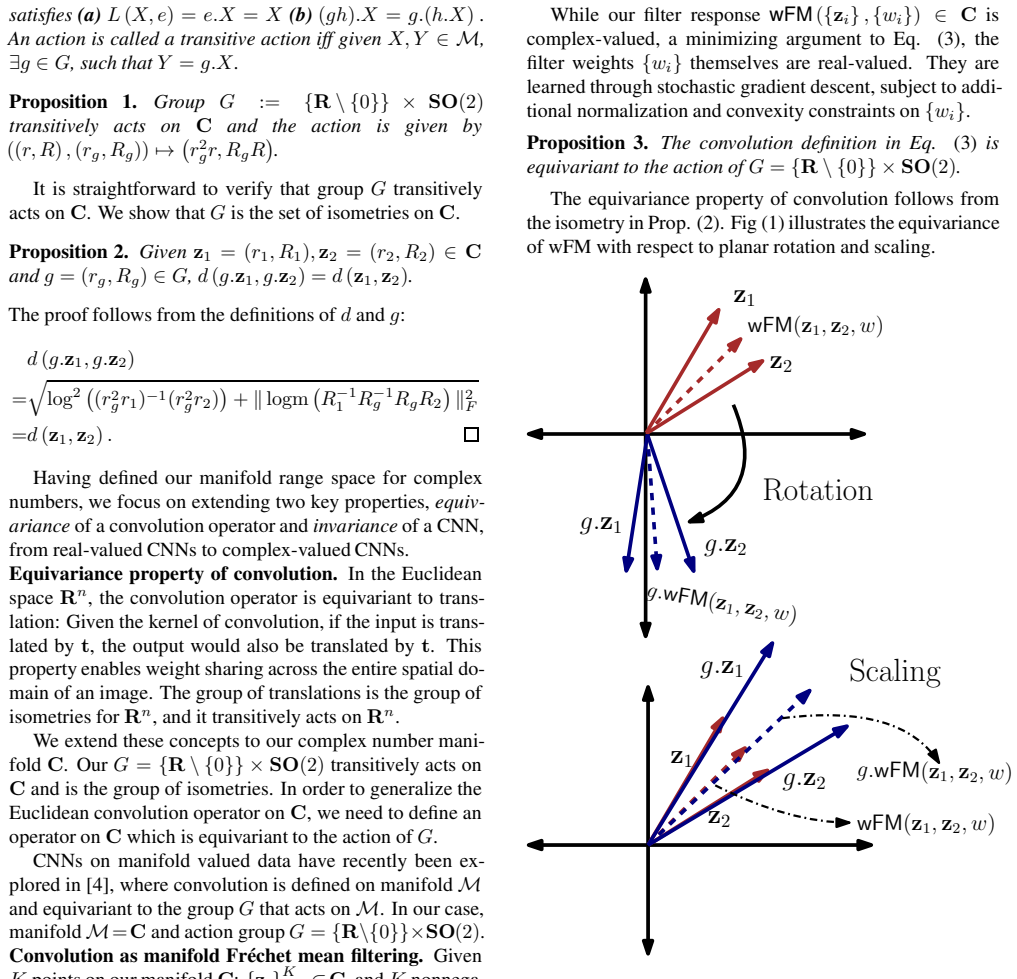
We develop a novel deep learning architecture for naturally complex-valued data, which is often subject to complex scaling ambiguity. We treat each sample as a field in the space of complex numbers. With the polar form of a complex-valued number, the general group that acts in this space is the product of planar rotation and non-zero scaling. This perspective allows us to develop not only a novel convolution operator using weighted Fréchet mean (wFM) on a Riemannian manifold, but also a novel fully connected layer operator using the distance to the wFM, with natural equivariant properties to non-zero scaling and planar rotation for the former and invariance properties for the latter.
What carries the argument
weighted Fréchet mean (wFM) on a Riemannian manifold for the convolution operator (equivariant to rotation and scaling) and distance to the wFM for the fully connected layer (invariant to those actions)
If this is right
- On MSTAR SAR images the model reaches 98% accuracy with under 45,000 parameters, improving from the baseline 94% at 8% of its size.
- On RadioML RF signals the model matches baseline accuracy at 10% of baseline model size.
- Convolution layers are equivariant to non-zero scaling and planar rotation.
- Fully connected layers are invariant to non-zero scaling and planar rotation.
Where Pith is reading between the lines
- The same manifold construction could be tested on other complex-valued domains such as MRI phase data to check for similar efficiency gains.
- An ablation that removes the Riemannian metric while keeping the polar representation would isolate whether the manifold geometry itself drives the reported gains.
- The approach suggests that explicitly encoding the multiplicative group structure of complex numbers can reduce the parameter count needed for rotation- and scale-robust signal classification.
Load-bearing premise
The polar-form group action of planar rotation and non-zero scaling supplies the symmetries needed to build equivariant and invariant layers that improve classification on the tested datasets.
What would settle it
Retraining both the proposed model and the real-valued baseline on the MSTAR dataset and observing no accuracy gain or parameter reduction would falsify the performance claim.
Figures


read the original abstract
We develop a novel deep learning architecture for naturally complex-valued data, which is often subject to complex scaling ambiguity. We treat each sample as a field in the space of complex numbers. With the polar form of a complex-valued number, the general group that acts in this space is the product of planar rotation and non-zero scaling. This perspective allows us to develop not only a novel convolution operator using weighted Fr\'echet mean (wFM) on a Riemannian manifold, but also a novel fully connected layer operator using the distance to the wFM, with natural equivariant properties to non-zero scaling and planar rotation for the former and invariance properties for the latter. Compared to the baseline approach of learning real-valued neural network models on the two-channel real-valued representation of complex-valued data, our method achieves surreal performance on two publicly available complex-valued datasets: MSTAR on SAR images and RadioML on radio frequency signals. On MSTAR, at 8% of the baseline model size and with fewer than 45,000 parameters, our model improves the target classification accuracy from 94% to 98% on this highly imbalanced dataset. On RadioML, our model achieves comparable RF modulation classification accuracy at 10% of the baseline model size.
Editorial analysis
A structured set of objections, weighed in public.
Referee Report
Summary. The paper proposes SurReal, a complex-valued neural network architecture that models data in the complex plane under the group action of planar rotations and non-zero scalings derived from the polar form. It introduces a weighted Fréchet mean (wFM) convolution operator claimed to be equivariant to this group action and a distance-to-wFM fully connected layer claimed to be invariant, both defined on a Riemannian manifold. The central empirical claim is that these operators yield improved or comparable classification accuracy on the MSTAR SAR dataset (94% to 98% at 8% model size, <45k parameters) and RadioML RF modulation dataset (comparable accuracy at 10% model size) relative to real-valued two-channel baselines.
Significance. If the performance gains can be rigorously attributed to the proposed equivariant/invariant operators rather than other factors, the work would offer a geometrically principled approach to handling scaling and phase ambiguities in complex data, with potential for parameter-efficient models in SAR imaging and communications. The Riemannian construction via Fréchet means is a distinctive technical element that could influence future complex-valued architectures if the symmetry assumptions align with the data.
major comments (2)
- [Abstract] Abstract and experimental sections: the reported accuracy gains (94%→98% on imbalanced MSTAR at <45k parameters; comparable RadioML accuracy at 10% baseline size) are presented without accompanying ablation studies, baseline architecture details, training protocols, or statistical significance tests that would isolate whether the wFM convolution and distance-to-wFM FC layers (and specifically their equivariance/invariance under the chosen C* group action) are responsible for the improvements versus the two-channel real baseline.
- [Experiments] The manuscript does not provide analysis or experiments testing whether the planar rotation × non-zero scaling group action matches the dominant ambiguities in MSTAR or RadioML data (as opposed to global phase, translation, or amplitude normalization), which is required to attribute the performance delta to the Riemannian construction rather than generic complex-valued processing.
Simulated Author's Rebuttal
We thank the referee for the constructive feedback. We address each major comment below and will revise the manuscript to strengthen the experimental validation and discussion of the group action.
read point-by-point responses
-
Referee: [Abstract] Abstract and experimental sections: the reported accuracy gains (94%→98% on imbalanced MSTAR at <45k parameters; comparable RadioML accuracy at 10% baseline size) are presented without accompanying ablation studies, baseline architecture details, training protocols, or statistical significance tests that would isolate whether the wFM convolution and distance-to-wFM FC layers (and specifically their equivariance/invariance under the chosen C* group action) are responsible for the improvements versus the two-channel real baseline.
Authors: We agree that the manuscript would benefit from more detailed experimental support to isolate the contribution of the proposed operators. In the revision we will add ablation studies that replace the wFM convolution and distance-to-wFM layers with standard complex-valued counterparts while keeping all other factors fixed, provide complete specifications of the baseline architectures and training protocols, and report statistical significance of the accuracy differences. These additions will allow readers to better attribute performance to the equivariant and invariant properties. revision: yes
-
Referee: [Experiments] The manuscript does not provide analysis or experiments testing whether the planar rotation × non-zero scaling group action matches the dominant ambiguities in MSTAR or RadioML data (as opposed to global phase, translation, or amplitude normalization), which is required to attribute the performance delta to the Riemannian construction rather than generic complex-valued processing.
Authors: The group action follows directly from the polar decomposition of complex numbers, which encodes the scaling and rotation ambiguities that arise in SAR imaging and RF signal acquisition. We will expand the manuscript with a dedicated discussion subsection that justifies this choice using the physical characteristics of each dataset. While we do not currently include side-by-side experiments with alternative group actions, the consistent gains across two distinct domains support the relevance of the chosen symmetries. revision: partial
Circularity Check
No circularity in derivation chain
full rationale
The paper selects the polar-form group action (planar rotation × non-zero scaling) as the symmetry for complex-valued data and constructs wFM convolution (equivariant) and distance-to-wFM FC (invariant) layers by design from that choice. Reported gains (94%→98% on MSTAR at <45k params; comparable RadioML accuracy at 10% size) are presented as empirical outcomes on external datasets, not as quantities derived or forced by the layer equations themselves. No self-citations, fitted parameters renamed as predictions, self-definitional reductions, or ansatz smuggling appear in the abstract or described chain. The architecture is self-contained against the chosen symmetry; performance claims rest on dataset evaluation rather than reducing to inputs by construction.
Axiom & Free-Parameter Ledger
axioms (1)
- domain assumption Complex numbers in polar form admit a Riemannian manifold structure whose isometries include planar rotation and non-zero scaling.
Lean theorems connected to this paper
-
IndisputableMonolith/Cost/FunctionalEquation.leanwashburn_uniqueness_aczel unclear?
unclearRelation between the paper passage and the cited Recognition theorem.
convolution operator using weighted Fréchet mean (wFM) on a Riemannian manifold... distance to the wFM, with natural equivariant properties to non-zero scaling and planar rotation
-
IndisputableMonolith/Foundation/RealityFromDistinction.leanreality_from_one_distinction unclear?
unclearRelation between the paper passage and the cited Recognition theorem.
identify C with the polar form... R+×SO(2)... d(z1,z2)=√[log²(r1^{-1}r2)+||logm(R1^{-1}R2)||²]
What do these tags mean?
- matches
- The paper's claim is directly supported by a theorem in the formal canon.
- supports
- The theorem supports part of the paper's argument, but the paper may add assumptions or extra steps.
- extends
- The paper goes beyond the formal theorem; the theorem is a base layer rather than the whole result.
- uses
- The paper appears to rely on the theorem as machinery.
- contradicts
- The paper's claim conflicts with a theorem or certificate in the canon.
- unclear
- Pith found a possible connection, but the passage is too broad, indirect, or ambiguous to say the theorem truly supports the claim.
Reference graph
Works this paper leans on
-
[1]
An introduction to differen- tiable manifolds and Riemannian geometry , volume
William M Boothby. An introduction to differen- tiable manifolds and Riemannian geometry , volume
-
[2]
Academic press, 1986
work page 1986
-
[3]
Adaptive learning for complex-valued data
Kerstin Bunte, Frank-Michael Schleif, and Michael Biehl. Adaptive learning for complex-valued data. In ESANN. Citeseer, 2012
work page 2012
-
[4]
A CNN for homogneous Riemannian manifolds with applications to Neuroimaging
Rudrasis Chakraborty, Monami Banerjee, and Baba C V emuri. H-cnns: Convolutional neural networks for riemannian homogeneous spaces. arXiv preprint arXiv:1805.05487, 2018
work page internal anchor Pith review Pith/arXiv arXiv 2018
-
[5]
ManifoldNet: A Deep Network Framework for Manifold-valued Data
Rudrasis Chakraborty, Jose Bouza, Jonathan Manton, and Baba C V emuri. Manifoldnet: A deep network framework for manifold-valued data. arXiv preprint arXiv:1809.06211, 2018
work page internal anchor Pith review Pith/arXiv arXiv 2018
-
[6]
Group equivariant con- volutional networks
Taco Cohen and Max Welling. Group equivariant con- volutional networks. In International conference on machine learning, pages 2990–2999, 2016
work page 2016
-
[7]
Taco S Cohen, Mario Geiger, Jonas Köhler, and Max Welling. Spherical CNNs. arXiv preprint arXiv:1801.10130, 2018
work page internal anchor Pith review Pith/arXiv arXiv 2018
-
[8]
Sander Dieleman, Kyle W . Willett, and Joni Dambre. Rotation-invariant convolutional neural networks for galaxy morphology prediction. Monthly Notices of the Royal Astronomical Society, 2015
work page 2015
-
[9]
David Steven Dummit and Richard M Foote. Abstract algebra, volume 3. Wiley Hoboken, 2004
work page 2004
-
[10]
Carlos Esteves, Christine Allen-Blanchette, Xiaowei Zhou, and Kostas Daniilidis. Polar Transformer Net- works. arXiv preprint arXiv:1709.01889 , 2017
work page internal anchor Pith review Pith/arXiv arXiv 2017
-
[11]
William T. Freeman and Edward H Adelson. The de- sign and use of steerable filters. IEEE Transactions on Pattern Analysis & Machine Intelligence, (9):891–906, 1991
work page 1991
-
[12]
Differential geometry and symmet- ric spaces, volume 12
Sigurdur Helgason. Differential geometry and symmet- ric spaces, volume 12. Academic press, 1962
work page 1962
-
[13]
Mstar extended operating conditions: A tutorial
Eric R Keydel, Shung Wu Lee, and John T Moore. Mstar extended operating conditions: A tutorial. In Algorithms for Synthetic Aperture Radar Imagery III , volume 2757, pages 228–243. International Society for Optics and Photonics, 1996
work page 1996
-
[14]
Adam: A Method for Stochastic Optimization
Diederik P Kingma and Jimmy Ba. Adam: A method for stochastic optimization. arXiv preprint arXiv:1412.6980, 2014
work page internal anchor Pith review Pith/arXiv arXiv 2014
-
[15]
Risi Kondor and Shubhendu Trivedi. On the general- ization of equivariance and convolution in neural net- works to the action of compact groups. arXiv preprint arXiv:1802.03690, 2018
work page internal anchor Pith review Pith/arXiv arXiv 2018
-
[16]
ImageNet Classification with Deep Convolutional Neural Networks
Alex Krizhevsky, Ilya Sutskever, and Geoffrey E Hin- ton. ImageNet Classification with Deep Convolutional Neural Networks. Advances In Neural Information Processing Systems, 2012
work page 2012
-
[17]
Affinity cnn: Learning pixel-centric pairwise relations for figure/ground embedding
Michael Maire, Takuya Narihira, and Stella X Y u. Affinity cnn: Learning pixel-centric pairwise relations for figure/ground embedding. In Proceedings of the IEEE Conference on Computer Vision and Pattern Recognition, pages 174–182, 2016
work page 2016
-
[18]
Understanding Deep Convolu- tional Networks
Stéphane Mallat. Understanding Deep Convolu- tional Networks. Philosophical Transactions A , 374:20150203, 2016
work page 2016
-
[19]
Les éléments aléatoires de nature quelconque dans un espace distancié
Maurice Fréchet. Les éléments aléatoires de nature quelconque dans un espace distancié. Annales de l’I. H. P .,, 10(4):215–310, 1948
work page 1948
-
[20]
Convolutional Radio Modulation Recognition Networks
Timothy J O’Shea, Johnathan Corgan, and T. Charles Clancy. Convolutional radio modulation recognition networks. arXiv preprint arXiv:1602.04105 , 2016
work page internal anchor Pith review Pith/arXiv arXiv 2016
-
[21]
Radio machine learning dataset generation with gnu radio
Timothy J O’Shea and Nathan West. Radio machine learning dataset generation with gnu radio. Proceed- ings of the 6th GNU Radio Conference , 2016
work page 2016
-
[22]
Chiheb Trabelsi, Olexa Bilaniuk, Ying Zhang, Dmitriy Serdyuk, Sandeep Subramanian, João Felipe Santos, Soroush Mehri, Negar Rostamzadeh, Y oshua Bengio, and Christopher J Pal. Deep complex networks. arXiv preprint arXiv:1705.09792, 2017
work page internal anchor Pith review Pith/arXiv arXiv 2017
-
[23]
Joint embedding and classification for sar target recognition
Jiayun Wang, Patrick Virtue, and Stella X Y u. Joint embedding and classification for sar target recognition. arXiv preprint arXiv:1712.01511 , 2017
-
[24]
Harmonic net- works: Deep translation and rotation equivariance
Daniel E Worrall, Stephan J Garbin, Daniyar Tur- mukhambetov, and Gabriel J Brostow. Harmonic net- works: Deep translation and rotation equivariance. In Proc. IEEE Conf. on Computer Vision and Pattern Recognition (CVPR), volume 2, 2017
work page 2017
-
[25]
Angular embedding: A robust quadratic criterion
Stella Y u. Angular embedding: A robust quadratic criterion. IEEE transactions on pattern analysis and machine intelligence, 34(1):158–173, 2012
work page 2012
discussion (0)
Sign in with ORCID, Apple, or X to comment. Anyone can read and Pith papers without signing in.