Gamma-ray emission in radio galaxies under the VLBI scope -- I. Parsec-scale kinematics and high-energy properties of γ-ray detected TANAMI radio galaxies
Pith reviewed 2026-05-25 19:50 UTC · model grok-4.3
The pith
Gamma-ray luminosity in radio galaxies shows no dependence on Doppler boosting indicators from parsec-scale jets
A machine-rendered reading of the paper's core claim, the machinery that carries it, and where it could break.
Core claim
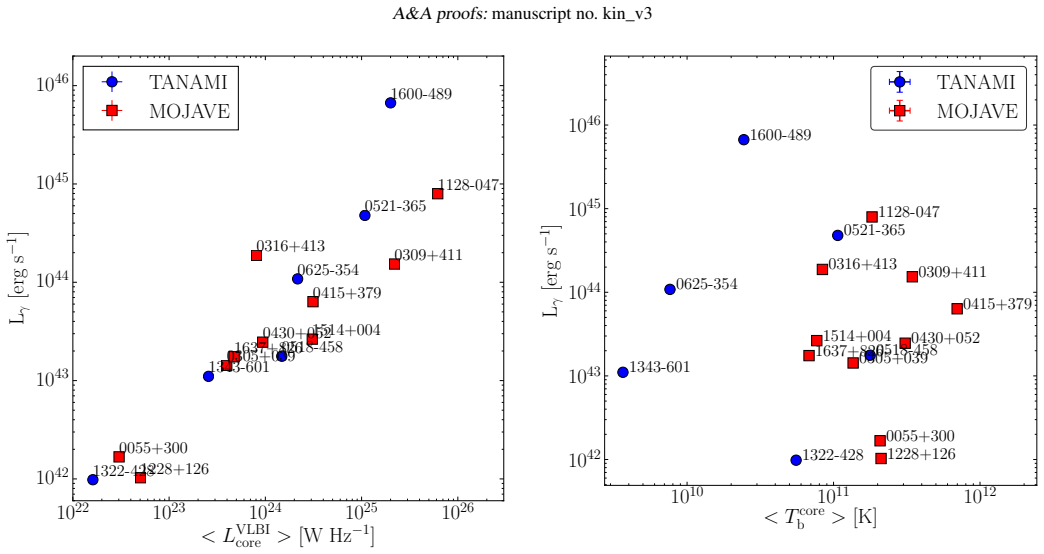
The authors find that the VLBI core flux density correlates with the gamma-ray flux. In contrast, the gamma-ray luminosity does not depend on core brightness temperature or core dominance. They therefore conclude that gamma-ray emission in radio galaxies is not driven by orientation-dependent effects.
What carries the argument
Multi-epoch VLBI imaging at 8.4 GHz to measure core flux density, brightness temperature, and core dominance, tested for correlation against Fermi-LAT gamma-ray flux and luminosity
If this is right
- The first gamma-ray detection of Pictor A may coincide with a new VLBI component passing through the radio core.
- PKS 0521-36 exhibits subluminal parsec-scale motions together with gamma-ray variability on timescales as short as six hours.
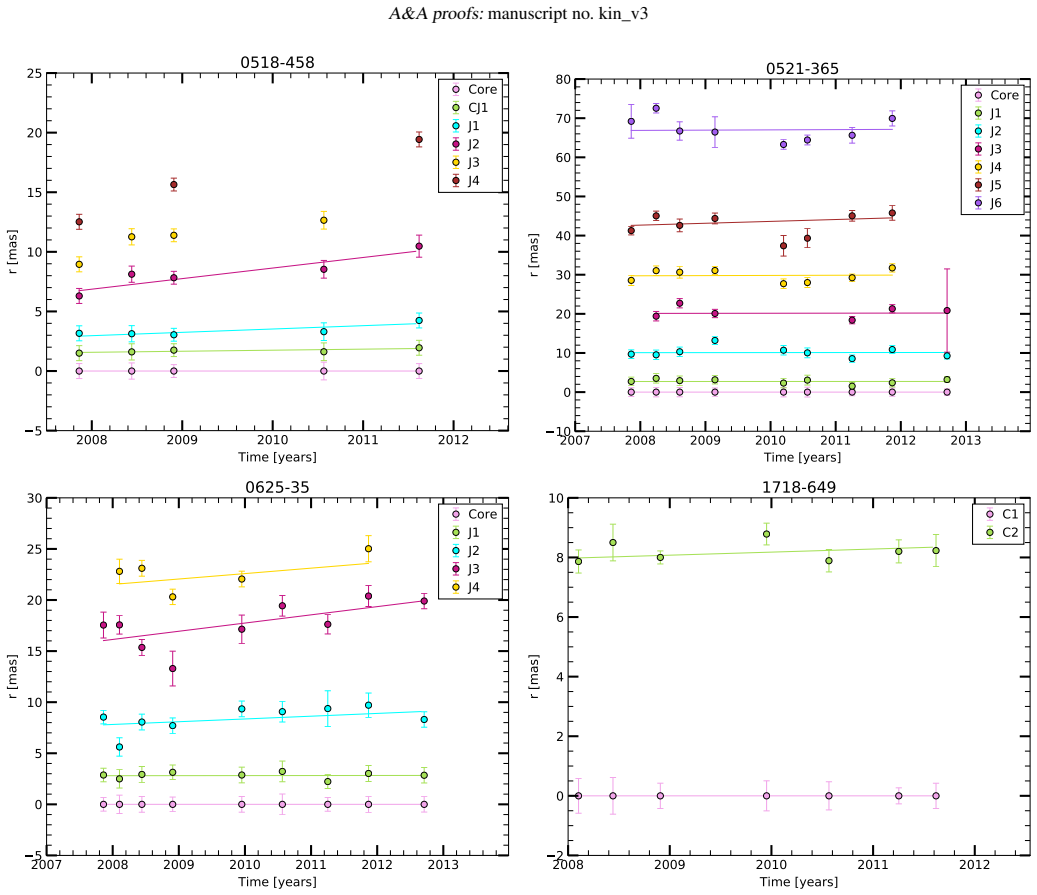
- PKS 0625-35 shows confirmed superluminal motion reaching beta_app approximately 3.
- A firm lower limit can be placed on the age of the compact symmetric object PKS 1718-649.
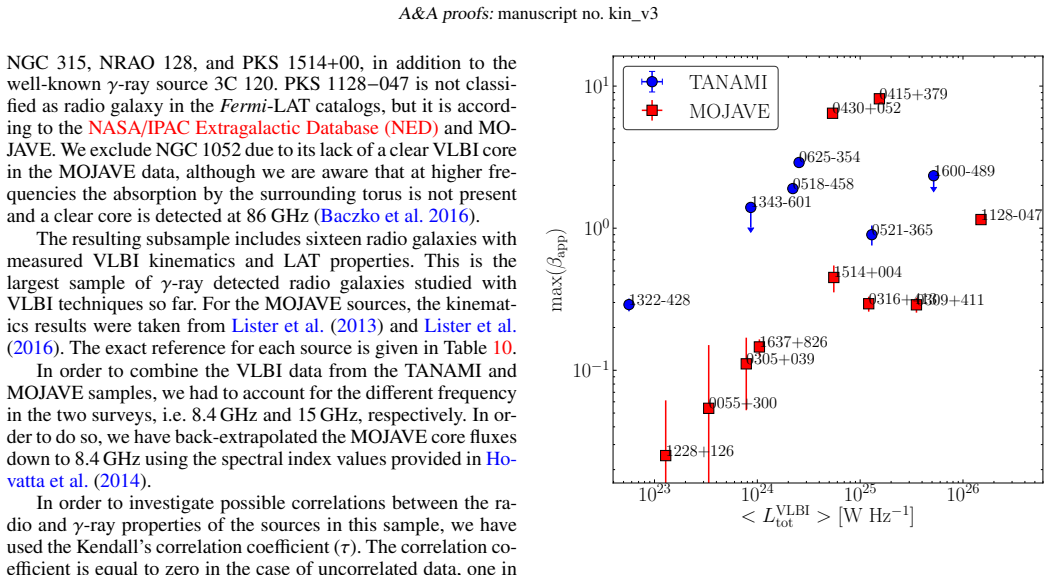
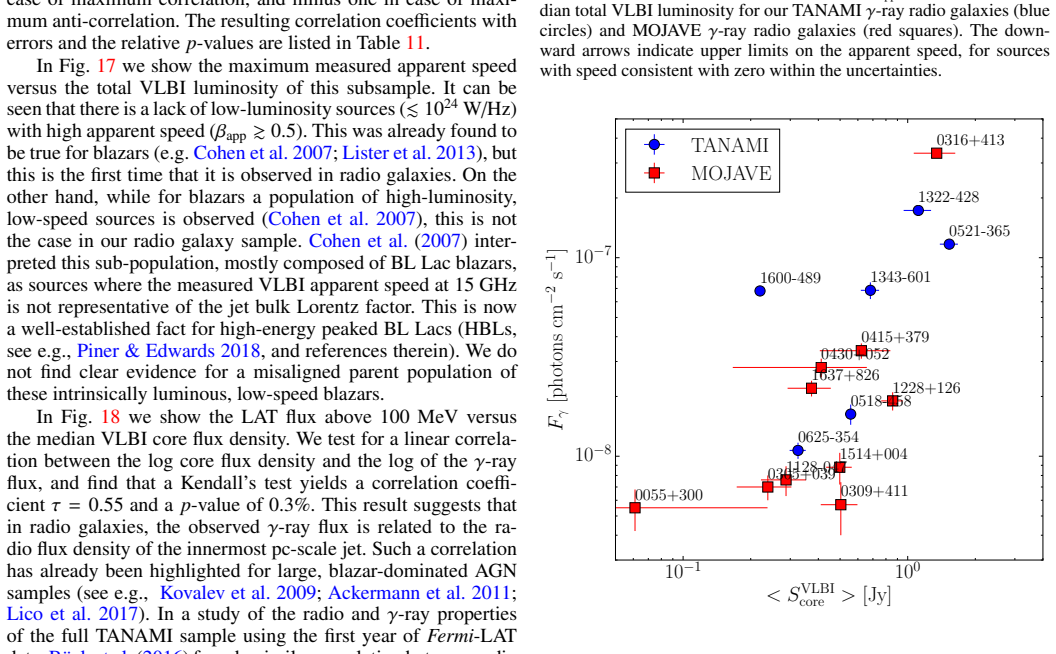
- The core-flux to gamma-ray-flux correlation holds across the combined TANAMI and MOJAVE sample.
Where Pith is reading between the lines
- Gamma-ray production regions in radio galaxies may lie outside the zone where the radio core's Doppler factor dominates.
- Intrinsic jet power rather than viewing angle could set the gamma-ray output in misaligned sources.
- Longer-term monitoring of component ejections versus gamma-ray flares could distinguish radio-galaxy behavior from blazar patterns.
- Repeating the test at higher radio frequencies closer to the black hole would directly check the proxy assumption.
Load-bearing premise
Core brightness temperature and core dominance measured at 8.4 GHz on parsec scales serve as reliable proxies for the Doppler factor that would affect gamma-ray emission produced closer to the black hole.
What would settle it
A statistically significant positive correlation between gamma-ray luminosity and either core brightness temperature or core dominance in a larger sample of radio galaxies would falsify the central claim.
Figures






read the original abstract
In the framework of the TANAMI multi-wavelength and VLBI monitoring, we study the evolution of the parsec-scale radio emission in radio galaxies in the southern hemisphere and their relationship to the $\gamma$-ray properties. In this first paper, we focus on Fermi-LAT-detected sources. We perform a kinematic analysis for five $\gamma$-ray detected radio galaxies using multi-epoch 8.4 GHz VLBI images, deriving limits on intrinsic jet parameters. We analyzed Fermi-LAT data in order to study possible connections between the $\gamma$-ray properties and the pc-scale jets of Fermi-LAT-detected radio galaxies, both in terms of variability and average properties. We discuss the individual source results and draw preliminary conclusions on sample properties including published VLBI results from the MOJAVE survey, with a total of fifteen sources. We find that the first $\gamma$-ray detection of Pictor A might be associated with the passage of a new VLBI component through the radio core. For the peculiar AGN PKS 0521-36, we detect subluminal parsec-scale jet motions, and we confirm the presence of fast $\gamma$-ray variability in the source down to timescales of 6 hours. We robustly confirm the presence of significant superluminal motion, up to $\beta_{app}\sim$3, in the jet of the TeV radio galaxy PKS 0625-35. Finally, we place a lower limit on the age of the Compact Symmetric Object (CSO) PKS 1718-649. We draw some preliminary conclusions on the relationship between pc-scale jets and $\gamma$-ray emission in radio galaxies. We find that the VLBI core flux density correlates with the $\gamma$-ray flux, as seen in blazars. On the other hand, the $\gamma$-ray luminosity does not show any dependence on the core brightness temperature and core dominance, two indicators of Doppler boosting, suggesting that $\gamma$-ray emission in radio galaxies is not driven by orientation-dependent effects.
Editorial analysis
A structured set of objections, weighed in public.
Referee Report
Summary. The paper reports multi-epoch 8.4 GHz VLBI kinematic analysis for five Fermi-LAT detected TANAMI radio galaxies, combined with Fermi-LAT light-curve and spectral analysis, and extends the sample to 15 sources by including published MOJAVE results. It finds a correlation between VLBI core flux density and gamma-ray flux but no correlation between gamma-ray luminosity and either core brightness temperature or core dominance (taken as Doppler-boosting proxies), leading to the conclusion that gamma-ray emission in radio galaxies is not driven by orientation-dependent effects.
Significance. If the central interpretation holds, the result would indicate that gamma-ray production in misaligned radio galaxies differs from the Doppler-boosted blazar paradigm, with implications for jet emission models and the location of the high-energy zone. The work benefits from direct VLBI component tracking, Fermi variability analysis down to 6-hour timescales in one source, and the combined 15-source sample that allows preliminary statistical statements.
major comments (1)
- [Abstract and concluding discussion] Abstract and final paragraph: the claim that the lack of correlation between gamma-ray luminosity and the two radio indicators implies gamma-ray emission is not orientation-driven rests on the untested assumption that 8.4 GHz parsec-scale core brightness temperature and core dominance faithfully trace the Doppler factor applicable to gamma-ray production (modeled as occurring on sub-parsec scales). No multi-frequency VLBI, jet-acceleration modeling, or comparison to sub-pc indicators is presented to support commensurability of the proxies across scales.
Simulated Author's Rebuttal
We thank the referee for the constructive review. We address the single major comment below, agreeing where the manuscript requires qualification and indicating the planned revisions.
read point-by-point responses
-
Referee: [Abstract and concluding discussion] Abstract and final paragraph: the claim that the lack of correlation between gamma-ray luminosity and the two radio indicators implies gamma-ray emission is not orientation-driven rests on the untested assumption that 8.4 GHz parsec-scale core brightness temperature and core dominance faithfully trace the Doppler factor applicable to gamma-ray production (modeled as occurring on sub-parsec scales). No multi-frequency VLBI, jet-acceleration modeling, or comparison to sub-pc indicators is presented to support commensurability of the proxies across scales.
Authors: We agree that the interpretation in the abstract and final paragraph assumes the 8.4 GHz parsec-scale core brightness temperature and core dominance serve as faithful proxies for the Doppler factor at the gamma-ray emission site. The manuscript contains no multi-frequency VLBI data, jet-acceleration modeling, or sub-parsec comparisons to test this assumption directly. In the revised version we will qualify the relevant statements to present the lack of correlation as suggestive rather than conclusive, explicitly note the scale mismatch as a limitation, and add a short paragraph in the discussion section outlining the need for future multi-scale observations to strengthen the proxy validation. revision: yes
Circularity Check
No circularity: empirical correlations derived directly from VLBI and Fermi measurements
full rationale
The paper's central results consist of direct observational correlations computed from independently measured quantities: VLBI core flux densities, brightness temperatures, and core dominance parameters extracted from 8.4 GHz multi-epoch images, together with Fermi-LAT gamma-ray fluxes and luminosities. No equations, fitted parameters, or self-citations reduce the reported absence of dependence on Doppler indicators to the inputs by construction. Kinematic limits are obtained via standard proper-motion analysis of component positions across epochs; the sample is augmented with published MOJAVE results treated as external data. The interpretation that gamma-ray emission is not orientation-driven follows from the observed lack of correlation and does not loop back to any definitional or fitted step within the paper.
Axiom & Free-Parameter Ledger
axioms (2)
- standard math Standard flat Lambda-CDM cosmology for converting angular to linear scales and apparent to intrinsic speeds
- domain assumption Core brightness temperature and core dominance at 8.4 GHz are monotonic proxies for Doppler factor
Forward citations
Cited by 1 Pith paper
-
FR0 radio galaxy jets -- I. linking jet dynamics and high-energy emission in LEDA 55267 and LEDA 58287
3D RHD simulations of FR0 jets in LEDA 55267 and LEDA 58287 show recollimation shocks driving compactness via turbulence and deceleration, with SED modeling predicting lepto-hadronic emission at TeV energies as a test...
Reference graph
Works this paper leans on
-
[1]
, " * write output.state after.block = add.period write newline
ENTRY address archiveprefix author booktitle chapter edition editor howpublished institution eprint journal key month note number organization pages publisher school series title type volume year label extra.label sort.label short.list INTEGERS output.state before.all mid.sentence after.sentence after.block FUNCTION init.state.consts #0 'before.all := #1 ...
-
[2]
" write newline "" before.all 'output.state := FUNCTION n.dashify 't := "" t empty not t #1 #1 substring "-" = t #1 #2 substring "--" = not "--" * t #2 global.max substring 't := t #1 #1 substring "-" = "-" * t #2 global.max substring 't := while if t #1 #1 substring * t #2 global.max substring 't := if while FUNCTION word.in bbl.in " " * FUNCTION format....
-
[3]
Abdalla , H., Abramowski , A., Aharonian , F., et al. 2018, , 476, 4187
work page 2018
-
[4]
A., Ackermann , M., Ajello , M., et al
Abdo , A. A., Ackermann , M., Ajello , M., et al. 2010 a , , 188, 405
work page 2010
-
[5]
A., Ackermann , M., Ajello , M., et al
Abdo , A. A., Ackermann , M., Ajello , M., et al. 2010 b , Science, 328, 725
work page 2010
-
[6]
A., Ackermann , M., Ajello , M., et al
Abdo , A. A., Ackermann , M., Ajello , M., et al. 2010 c , , 720, 912
work page 2010
- [7]
- [8]
- [9]
- [10]
-
[11]
Ajello , M., Atwood , W. B., Baldini , L., et al. 2017, , 232, 18
work page 2017
-
[12]
Akritas , M. G. & Siebert , J. 1996, , 278, 919
work page 1996
- [13]
- [14]
-
[15]
2017, Astroparticle Physics, 92, 42
Angioni , R., Grandi , P., Torresi , E., Vignali , C., & Kn \"o dlseder , J. 2017, Astroparticle Physics, 92, 42
work page 2017
-
[16]
Astropy Collaboration , Price-Whelan , A. M., Sip o cz , B. M., et al. 2018, , 156, 123
work page 2018
-
[17]
Astropy Collaboration , Robitaille , T. P., Tollerud , E. J., et al. 2013, , 558, A33
work page 2013
- [18]
- [19]
-
[20]
B \"o ck , M., Kadler , M., M \"u ller , C., et al. 2016, , 590, A40
work page 2016
-
[21]
Brown , A. M. & Adams , J. 2012, , 421, 2303
work page 2012
-
[22]
Casadio , C., G \'o mez , J. L., Grandi , P., et al. 2015, , 808, 162
work page 2015
- [23]
-
[24]
D'Ammando , F., Orienti , M., Tavecchio , F., et al. 2015, , 450, 3975
work page 2015
-
[25]
Fey , A. L., Ojha , R., Reynolds , J. E., et al. 2004, , 128, 2593
work page 2004
-
[26]
M., Ros , E., Perucho , M., et al
Fromm , C. M., Ros , E., Perucho , M., et al. 2013, , 557, A105
work page 2013
- [27]
-
[28]
Giroletti , M., Giovannini , G., Taylor , G. B., & Falomo , R. 2004, , 613, 752
work page 2004
-
[29]
Giroletti , M. & Polatidis , A. 2009, Astronomische Nachrichten, 330, 193
work page 2009
- [30]
-
[31]
Grandi , P., Capetti , A., & Baldi , R. D. 2016, , 457, 2
work page 2016
-
[32]
2013, in European Physical Journal Web of Conferences, Vol
Grandi , P., Torresi , E., De Rosa , A., Rain \'o , S., & Malaguti , G. 2013, in European Physical Journal Web of Conferences, Vol. 61, European Physical Journal Web of Conferences, 04007
work page 2013
- [33]
-
[34]
Greisen , E. W. 1998, in Astronomical Society of the Pacific Conference Series, Vol. 145, Astronomical Data Analysis Software and Systems VII, ed. R. Albrecht , R. N. Hook , & H. A. Bushouse , 204
work page 1998
-
[35]
Hancock , P. J., Tingay , S. J., Sadler , E. M., Phillips , C., & Deller , A. T. 2009, , 397, 2030
work page 2009
-
[36]
J., Lenc , E., Birkinshaw , M., et al
Hardcastle , M. J., Lenc , E., Birkinshaw , M., et al. 2016, , 455, 3526
work page 2016
-
[37]
H \"o gbom , J. A. 1974, , 15, 417
work page 1974
- [38]
- [39]
-
[40]
2015, Astronomische Nachrichten, 336, 499
Kadler , M., Ojha , R., & TANAMI Collaboration . 2015, Astronomische Nachrichten, 336, 499
work page 2015
-
[41]
Kim , J.-Y., Krichbaum , T. P., Lu , R.-S., et al. 2018, , 616, A188
work page 2018
-
[42]
Komatsu , E., Smith , K. M., Dunkley , J., et al. 2011, , 192, 18
work page 2011
- [43]
-
[44]
Kovalev , Y. Y., Kellermann , K. I., Lister , M. L., et al. 2005, , 130, 2473
work page 2005
- [45]
- [46]
-
[47]
Kuehr , H., Witzel , A., Pauliny-Toth , I. I. K., & Nauber , U. 1981, , 45, 367
work page 1981
- [48]
-
[49]
Leon , S., Cortes , P. C., Guerard , M., et al. 2016, , 586, A70
work page 2016
- [50]
- [51]
- [52]
- [53]
- [54]
- [55]
- [56]
-
[57]
Mattox , J. R., Bertsch , D. L., Chiang , J., et al. 1996, , 461, 396
work page 1996
-
[58]
Migliori , G., Siemiginowska , A., Sobolewska , M., et al. 2016, , 821, L31
work page 2016
-
[59]
M \"u ller , C., Burd , P. R., Schulz , R., et al. 2016, , 593, L19
work page 2016
-
[60]
M \"u ller , C., Kadler , M., Ojha , R., et al. 2014 a , , 562, A4
work page 2014
-
[61]
M \"u ller , C., Kadler , M., Ojha , R., et al. 2014 b , , 569, A115
work page 2014
- [62]
- [63]
-
[64]
2012, in Proceedings of the 11th European VLBI Network Symposium & Users Meeting
M\"uller , C., Krauss , F., Kadler , M., et al. 2012, in Proceedings of the 11th European VLBI Network Symposium & Users Meeting. 9-12 October, 2012. Bordeaux (France), 20
work page 2012
- [65]
-
[66]
O'Dea , C. P. 1998, , 110, 493
work page 1998
- [67]
- [68]
-
[69]
Y., Fomalont , E., & Gordon , D
Petrov , L., Kovalev , Y. Y., Fomalont , E., & Gordon , D. 2005, , 129, 1163
work page 2005
- [70]
-
[71]
Piner , B. G. & Edwards , P. G. 2018, , 853, 68
work page 2018
-
[72]
Robitaille , T. & Bressert , E. 2012, APLpy: Astronomical Plotting Library in Python , Astrophysics Source Code Library
work page 2012
-
[73]
Schinzel , F. K., Lobanov , A. P., Taylor , G. B., et al. 2012, , 537, A70
work page 2012
-
[74]
Schulz , R. F. 2016, PhD thesis, Julius-Maximilians-Universit \"a t W \"a rzburg
work page 2016
-
[75]
Shepherd , M. C., Pearson , T. J., & Taylor , G. B. 1994, in , Vol. 26, Bulletin of the American Astronomical Society, 987--989
work page 1994
-
[76]
Snellen , I. A. G., Schilizzi , R. T., Miley , G. K., et al. 2000, , 319, 445
work page 2000
- [77]
- [78]
-
[79]
Tingay , S. J. & Edwards , P. G. 2002, , 124, 652
work page 2002
-
[80]
Tingay , S. J., Jauncey , D. L., Reynolds , J. E., et al. 1997, , 113, 2025
work page 1997
discussion (0)
Sign in with ORCID, Apple, or X to comment. Anyone can read and Pith papers without signing in.