Dawn of the Milky Way disk: Determination of when a rotationally supported disk appears and dating the spin-up of the disk
Pith reviewed 2026-05-21 03:26 UTC · model grok-4.3
The pith
The Milky Way disk spun up to rotational support around 12 billion years ago.
A machine-rendered reading of the paper's core claim, the machinery that carries it, and where it could break.
Core claim
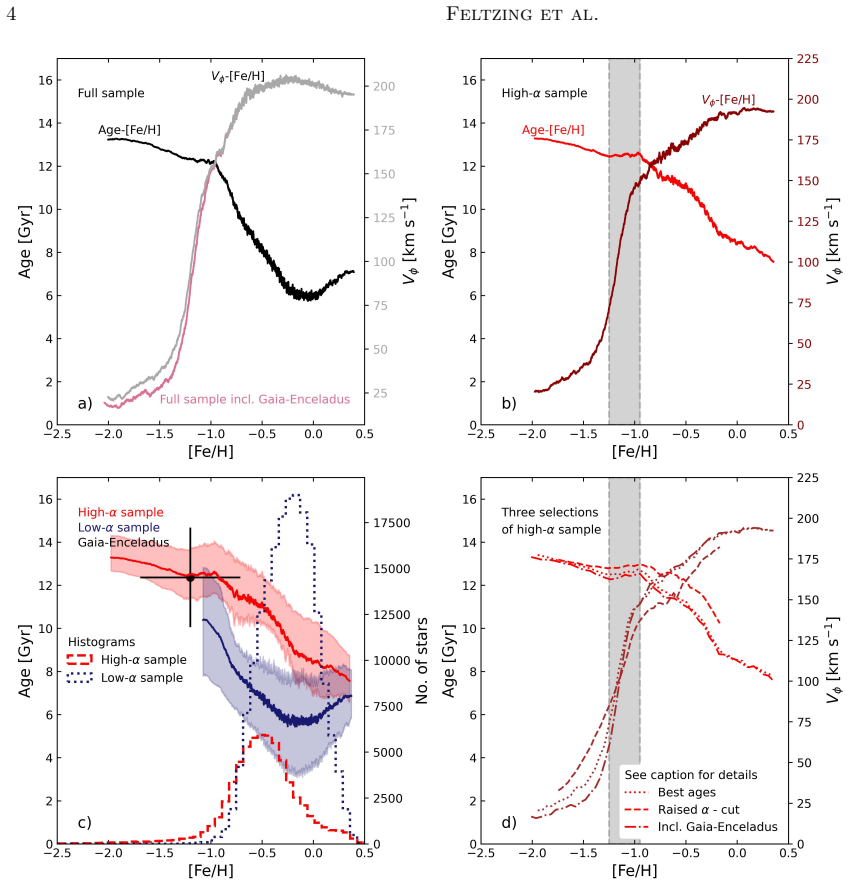
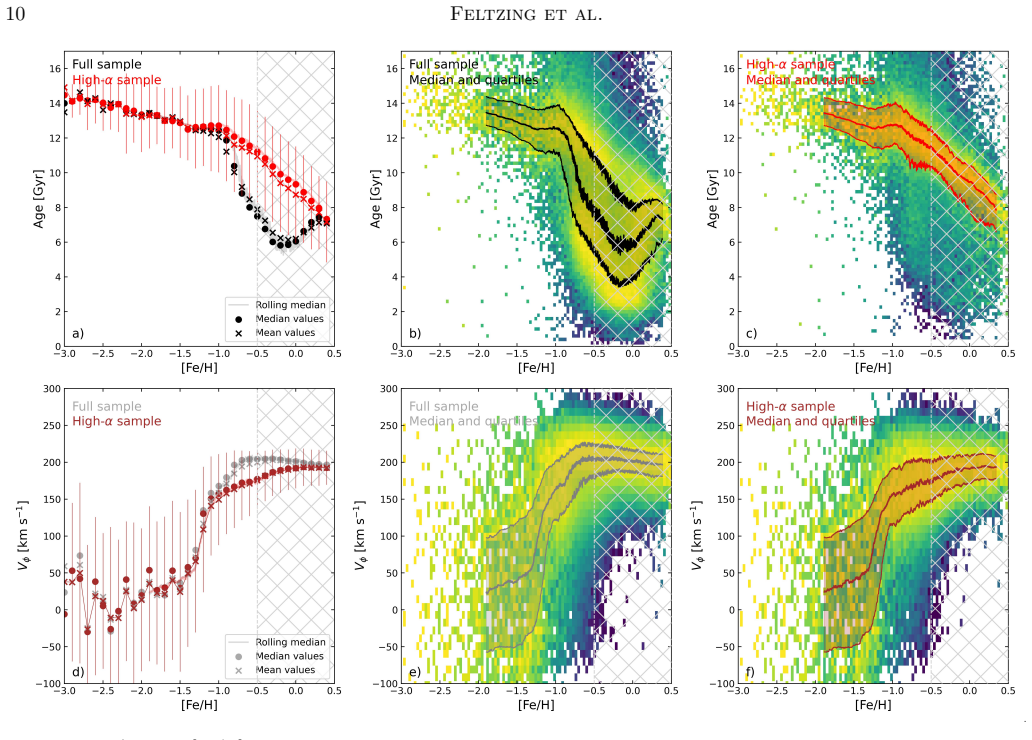
Using 319835 sub-giants from LAMOST with precise literature ages, the spin-up occurs for -1.25 < [Fe/H] < -0.9 and is dated to a mean age of 12.1 +/- 2.8 Gyr (median age 12.4 Gyr). The disk becomes rotationally supported for -1.25 < [Fe/H] < -1. The transition is very rapid in age. This supports that the spin-up traces the motion to a rotationally supported disk. These transitions are traced by the high-alpha stars while the low-alpha stars do not spin-up but start directly at approximately the circular velocity seen for the Sun today. The low-alpha disk is rotationally supported with no transition period in [Fe/H] or in age.
What carries the argument
Tracking mean circular velocity and the dominance of ordered over random motions as functions of metallicity [Fe/H] and stellar age in sub-giant stars.
If this is right
- The high-alpha population exhibits a clear and rapid shift to rotational support, confirming the spin-up traces a genuine change to disky dynamics.
- The low-alpha stars form already in a rotationally supported configuration with no detectable transition in metallicity or age.
- The timing of the spin-up at roughly 12 Gyr provides a chronological anchor for when the Milky Way assembled its ordered disk.
Where Pith is reading between the lines
- The sharp transition may help distinguish between different gas accretion or merger scenarios in models of early disk assembly.
- Comparable kinematic and age analyses in external galaxies could test whether this rapid spin-up timeline is typical.
Load-bearing premise
The literature ages assigned to the sub-giants are sufficiently accurate and unbiased to resolve a transition whose width is only a few Gyr without kinematic or age-dependent selection effects shifting the apparent transition point.
What would settle it
A new sample with independent age estimates for similar stars that shows the velocity transition occurring at a substantially different age or metallicity range.
Figures

read the original abstract
Spiral galaxies, like the Milky Way, transform at some point in time into a rotationally supported system. Using an extant data-set consisting of 319 835 sub-giants from LAMOST with precise ages from the literature, we determine, for the first time the age when the Milky Way disk spins up, i.e. when the mean circular velocity changes from halo-like to disk-like. We find in concordance previous studies that the spin-up takes place for -1.25 < [Fe/H] <- 0.9 and we can date this transition to a mean age of 12.1 +/- 2.8 Gyr (median age 12.4 Gyr). We further study when the disk became rotationally supported, i.e. when the ordered, disky motion dominates over the random motions. We find that this happens for $-1.25<$[Fe/H]$<-1$. The transition is very rapid in age. This gives support to that the spin-up seen in this and other works genuinely traces the motion to a rotationally supported disk, which has not previously been shown. These transitions are traced by the high-alpha stars. while the low-alpha stars do not spin-up but start directly at approximately the circular velocity seen for the Sun today. The low-alpha disk is rotationally supported with no transition period in [Fe/H] or in age.
Editorial analysis
A structured set of objections, weighed in public.
Referee Report
Summary. The manuscript analyzes a sample of 319835 LAMOST sub-giant stars assigned literature ages to identify the metallicity interval and corresponding age at which the Milky Way stellar disk undergoes spin-up to rotationally supported kinematics. It reports that this transition occurs for -1.25 < [Fe/H] < -0.9 at a mean age of 12.1 ± 2.8 Gyr (median 12.4 Gyr), with the disk becoming rotationally supported for -1.25 < [Fe/H] < -1; the transition is described as rapid, traced exclusively by high-α stars, while low-α stars exhibit disk-like rotation from the outset with no transition.
Significance. If the literature ages prove unbiased and sufficiently precise across the narrow transition metallicity range, the work supplies a concrete empirical anchor for the epoch of Milky Way disk formation, reinforcing prior high-α sequence results and offering a falsifiable timeline that can be tested against cosmological simulations of disk assembly.
major comments (3)
- [Abstract and §3] Abstract and §3 (data description): the central age of 12.1 ± 2.8 Gyr is derived from literature ages assigned to the 319835 sub-giants, yet no quantitative assessment is provided of how age uncertainties or systematic offsets tied to [Fe/H] or α-enhancement propagate into the reported transition width; this is load-bearing because the claimed rapidity of the spin-up rests on the ages resolving a few-Gyr interval without smearing.
- [§4] §4 (results on high-α vs low-α): the claim that only high-α stars trace the spin-up while low-α stars start at solar circular velocity requires explicit checks that kinematic or age-dependent selection functions in the LAMOST sub-giant sample do not differ between the sequences; without such tests the separation of the two populations could be an artifact of the data cuts.
- [§2] §2 (sample selection): the manuscript states the sample size and metallicity bounds but does not detail the objective criterion used to define the transition metallicities (-1.25 < [Fe/H] < -0.9 and -1.25 < [Fe/H] < -1) or any robustness tests against binning choices, which directly affects the reported concordance with previous studies.
minor comments (2)
- [Abstract] Abstract: inconsistent spacing in metallicity inequalities (e.g., <-0.9 versus <-1) should be standardized for clarity.
- [Figures] Figure captions (throughout): labels for high-α and low-α sequences should explicitly reference the [α/Fe] threshold adopted.
Simulated Author's Rebuttal
We thank the referee for their thorough and constructive report. We address each of the major comments below and have revised the manuscript accordingly to strengthen the analysis.
read point-by-point responses
-
Referee: [Abstract and §3] Abstract and §3 (data description): the central age of 12.1 ± 2.8 Gyr is derived from literature ages assigned to the 319835 sub-giants, yet no quantitative assessment is provided of how age uncertainties or systematic offsets tied to [Fe/H] or α-enhancement propagate into the reported transition width; this is load-bearing because the claimed rapidity of the spin-up rests on the ages resolving a few-Gyr interval without smearing.
Authors: We agree that a quantitative assessment of age uncertainties is important for supporting the rapidity of the transition. Although the manuscript references the literature ages and their typical uncertainties, we did not include a propagation analysis. In the revised version, we will add a discussion in §3 with a Monte Carlo resampling of the ages within their uncertainties to demonstrate that the observed transition width is robust and not due to smearing. This will be presented as a new figure showing the velocity distribution before and after perturbation. revision: yes
-
Referee: [§4] §4 (results on high-α vs low-α): the claim that only high-α stars trace the spin-up while low-α stars start at solar circular velocity requires explicit checks that kinematic or age-dependent selection functions in the LAMOST sub-giant sample do not differ between the sequences; without such tests the separation of the two populations could be an artifact of the data cuts.
Authors: This is a valid concern. The original manuscript did not include explicit comparisons of selection functions between the high-α and low-α populations. We will revise §4 to include such checks, comparing the distributions of apparent magnitudes, distances, and other selection-related quantities for stars in the transition metallicity range. Preliminary analysis indicates no substantial differences, but we will document this fully in the revision. revision: yes
-
Referee: [§2] §2 (sample selection): the manuscript states the sample size and metallicity bounds but does not detail the objective criterion used to define the transition metallicities (-1.25 < [Fe/H] < -0.9 and -1.25 < [Fe/H] < -1) or any robustness tests against binning choices, which directly affects the reported concordance with previous studies.
Authors: The metallicity intervals were selected to align with those in prior studies where the spin-up has been noted, and based on where the mean rotational velocity shows a clear change from halo-like to disk-like values. To address the referee's point, we will add in §2 an objective definition, for example using the metallicity where the velocity dispersion drops below a threshold or where the mean velocity reaches 150 km/s, and perform robustness tests by shifting the bins by 0.1 dex and showing the transition age remains consistent within uncertainties. revision: yes
Circularity Check
Observational dating of disk spin-up uses independent literature ages and direct velocity data
full rationale
The paper's central result dates the Milky Way disk spin-up transition by binning 319835 LAMOST sub-giants in [Fe/H], computing mean circular velocities from the survey data, and reading off the mean literature age at the metallicity where velocities shift from halo-like to disk-like. No equation or fit defines the reported transition age (12.1 ± 2.8 Gyr) as a function of the velocity measurements themselves, nor does any step rename a fitted parameter as a prediction. The ages are external literature values and the kinematics are measured directly; the derivation therefore remains self-contained against external benchmarks with no reduction by construction.
Axiom & Free-Parameter Ledger
axioms (2)
- domain assumption Literature ages for LAMOST sub-giants are accurate to within a few Gyr and free of large systematic offsets that would shift the apparent transition age.
- domain assumption The selected sub-giant sample is representative of the underlying stellar population across the metallicity range -1.25 to -0.9 without kinematic or age-dependent selection biases.
Lean theorems connected to this paper
-
IndisputableMonolith/Foundation/RealityFromDistinction.leanreality_from_one_distinction unclear?
unclearRelation between the paper passage and the cited Recognition theorem.
We find in concordance previous studies that the spin-up takes place for -1.25 < [Fe/H] <- 0.9 and we can date this transition to a mean age of 12.1 +/- 2.8 Gyr (median age 12.4 Gyr).
What do these tags mean?
- matches
- The paper's claim is directly supported by a theorem in the formal canon.
- supports
- The theorem supports part of the paper's argument, but the paper may add assumptions or extra steps.
- extends
- The paper goes beyond the formal theorem; the theorem is a base layer rather than the whole result.
- uses
- The paper appears to rely on the theorem as machinery.
- contradicts
- The paper's claim conflicts with a theorem or certificate in the canon.
- unclear
- Pith found a possible connection, but the passage is too broad, indirect, or ambiguous to say the theorem truly supports the claim.
Reference graph
Works this paper leans on
-
[1]
Anguiano, B., Majewski, S. R., Hayes, C. R., et al. 2020, AJ, 160, 43, doi: 10.3847/1538-3881/ab9813
-
[2]
2022, MNRAS, 514, 689, doi: 10.1093/mnras/stac1267
Belokurov, V., & Kravtsov, A. 2022, MNRAS, 514, 689, doi: 10.1093/mnras/stac1267
-
[3]
2019, The Messenger, 175, 35, doi: 10.18727/0722-6691/5123
Bensby, T., Bergemann, M., Rybizki, J., et al. 2019, The Messenger, 175, 35, doi: 10.18727/0722-6691/5123
-
[4]
J., Fattahi, A., Callingham, T
Carrillo, A., Deason, A. J., Fattahi, A., Callingham, T. M., & Grand, R. J. J. 2024, MNRAS, 527, 2165, doi: 10.1093/mnras/stad3274
-
[5]
Casamiquela, L., Reese, D. R., Lebreton, Y., et al. 2024, A&A, 692, A243, doi: 10.1051/0004-6361/202451677
-
[6]
Chandra, V., Semenov, V. A., Rix, H.-W., et al. 2024, ApJ, 972, 112, doi: 10.3847/1538-4357/ad5b60 Dawn of the Milky W ay disk. I. 11
-
[7]
Conroy, C., Weinberg, D. H., Naidu, R. P., et al. 2022, arXiv e-prints, arXiv:2204.02989, doi: 10.48550/arXiv.2204.02989
-
[8]
M., van de Sande, J., Vaughan, S
Croom, S. M., van de Sande, J., Vaughan, S. P., et al. 2024, MNRAS, 529, 3446, doi: 10.1093/mnras/stae458
-
[9]
Danhaive, A. L., Tacchella, S., Übler, H., et al. 2025, MNRAS, 543, 3249, doi: 10.1093/mnras/staf1540
-
[10]
M., Belokurov, V., Kravtsov, A., & Font, A
Dillamore, A. M., Belokurov, V., Kravtsov, A., & Font, A. S. 2024, MNRAS, 527, 7070, doi: 10.1093/mnras/stad3369
-
[11]
Ferreira, L., Conselice, C. J., Sazonova, E., et al. 2023, ApJ, 955, 94, doi: 10.3847/1538-4357/acec76
-
[12]
2021, MNRAS, 508, 1489, doi: 10.1093/mnras/stab2614 Gaia Collaboration, Brown, A
Casagrande, L. 2021, MNRAS, 508, 1489, doi: 10.1093/mnras/stab2614 Gaia Collaboration, Brown, A. G. A., Vallenari, A., et al. 2021, A&A, 649, A1, doi: 10.1051/0004-6361/202039657
-
[13]
2009, A&A, 501, 941, doi: 10.1051/0004-6361/200811191
Holmberg, J., Nordström, B., & Andersen, J. 2009, A&A, 501, 941, doi: 10.1051/0004-6361/200811191
-
[14]
2025, A&A, 703, A96, doi: 10.1051/0004-6361/202451689
Jain, R., & Wadadekar, Y. 2025, A&A, 703, A96, doi: 10.1051/0004-6361/202451689
-
[15]
2025, A&A, 700, A89, doi: 10.1051/0004-6361/202453305
Khoperskov, S., Steinmetz, M., Haywood, M., et al. 2025, A&A, 700, A89, doi: 10.1051/0004-6361/202453305
-
[16]
2025, arXiv e-prints, arXiv:2506.11840, doi: 10.48550/arXiv.2506.11840
McCluskey, F., Wetzel, A., Loebman, S., & Moreno, J. 2025, arXiv e-prints, arXiv:2506.11840, doi: 10.48550/arXiv.2506.11840
-
[17]
McCluskey, F., Wetzel, A., Loebman, S. R., et al. 2024, MNRAS, 527, 6926, doi: 10.1093/mnras/stad3547
-
[18]
Nepal, S., Chiappini, C., Queiroz, A. B., et al. 2024, A&A, 688, A167, doi: 10.1051/0004-6361/202449445
-
[19]
Orkney, M. D. A., & Laporte, C. F. P. 2025, arXiv e-prints, arXiv:2509.09576, doi: 10.48550/arXiv.2509.09576
work page internal anchor Pith review Pith/arXiv arXiv doi:10.48550/arxiv.2509.09576 2025
-
[20]
2023, MNRAS, 521, 1045, doi: 10.1093/mnras/stad530
Roman-Oliveira, F., Fraternali, F., & Rizzo, F. 2023, MNRAS, 521, 1045, doi: 10.1093/mnras/stad530
-
[21]
Rowland, L. E., Hodge, J., Bouwens, R., et al. 2024, MNRAS, 535, 2068, doi: 10.1093/mnras/stae2217
-
[22]
1993, ApJ, 414, 580, doi: 10.1086/173105
Salaris, M., Chieffi, A., & Straniero, O. 1993, ApJ, 414, 580, doi: 10.1086/173105
-
[23]
2025, ApJ, 990, 7, doi: 10.3847/1538-4357/addf48
Hernquist, L. 2025, ApJ, 990, 7, doi: 10.3847/1538-4357/addf48
-
[24]
2025, arXiv e-prints, arXiv:2510.08675, doi: 10.48550/arXiv.2510.08675
Shariat, C., El-Badry, K., & Bhattacharjee, S. 2025, arXiv e-prints, arXiv:2510.08675, doi: 10.48550/arXiv.2510.08675
-
[25]
Soderblom, D. R. 2010, ARA&A, 48, 581, doi: 10.1146/annurev-astro-081309-130806
-
[26]
2024, arXiv e-prints, arXiv:2411.12165, doi: 10.48550/arXiv.2411.12165
Starkenburg, E. 2024, arXiv e-prints, arXiv:2411.12165, doi: 10.48550/arXiv.2411.12165
-
[27]
Xiang, M. 2024, An updated catalog of LAMOST and Gaia subgiant stars, 1.0, National Astronomical Data Center of China, doi: 10.12149/101467
-
[28]
2022, Nature, 603, 599, doi: 10.1038/s41586-022-04496-5
Xiang, M., & Rix, H.-W. 2022, Nature, 603, 599, doi: 10.1038/s41586-022-04496-5
-
[29]
2025, Nature Astronomy, 9, 101, doi: 10.1038/s41550-024-02382-w
Xiang, M., Rix, H.-W., Yang, H., et al. 2025, Nature Astronomy, 9, 101, doi: 10.1038/s41550-024-02382-w
-
[30]
Xiao, M., Williams, C. C., Oesch, P. A., et al. 2025, A&A, 696, A156, doi: 10.1051/0004-6361/202453487
-
[31]
2022, The Innovation, 3, 100224, doi: 10.1016/j.xinn.2022.100224
Yan, H., Li, H., Wang, S., et al. 2022, The Innovation, 3, 100224, doi: 10.1016/j.xinn.2022.100224
discussion (0)
Sign in with ORCID, Apple, or X to comment. Anyone can read and Pith papers without signing in.