Crust glass formation reveals the neutron star birth properties in IGR J17480-2446
Pith reviewed 2026-06-26 11:24 UTC · model grok-4.3
The pith
Accretion-induced failure of the pristine crystal crust forms a glass layer in IGR J17480-2446, limiting the accreted mass to 2.4×10^{-6} solar masses and implying unusual birth properties.
A machine-rendered reading of the paper's core claim, the machinery that carries it, and where it could break.
Core claim
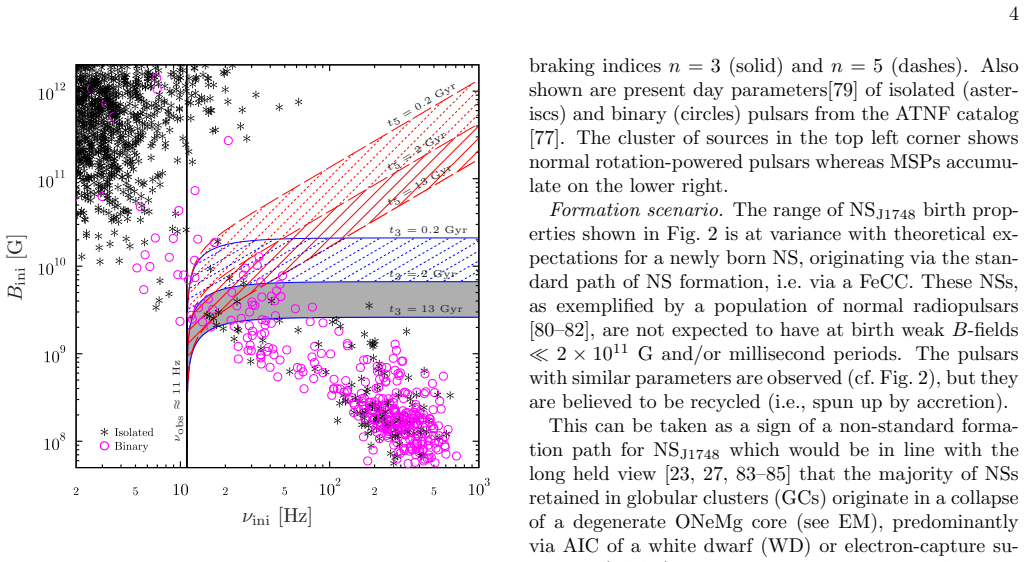
The glass layer formation is a natural result of accretion induced failure of pristine cold crystal crust. This allows us to determine the mass of the accreted material as ΔM ≈ 2.4×10^{-6} M_⊙, confirming very early accretion stage for this neutron star. An analysis of spin and thermal state reveals a peculiar set of neutron star birth properties which is commonly associated with 'recycled' neutron stars. We speculate that such birth properties may represent the outcome of neutron star formation in an electron-capture supernova.
What carries the argument
Accretion-induced mechanical failure of the pristine cold crystal crust that produces the low thermal conductivity glass layer
If this is right
- The mass of accreted material is ΔM ≈ 2.4×10^{-6} M_⊙
- The neutron star is observed at a very early stage of recycling
- Its birth properties match those of recycled neutron stars despite limited accretion
- Such properties may result from formation in an electron-capture supernova
Where Pith is reading between the lines
- Similar glass layers may appear in other young accreting systems once mechanical failure is considered
- This model could help identify other neutron stars formed through electron-capture supernovae
- Observations of crust cooling in additional slow-spinning pulsars could test the failure mechanism
Load-bearing premise
The low thermal conductivity layer is produced specifically by accretion-induced mechanical failure of a pristine cold crystal crust rather than by other mechanisms such as impurities, magnetic fields, or different composition.
What would settle it
A measurement showing accreted mass larger than 2.4×10^{-6} M_⊙ or evidence that low conductivity arises from impurities or magnetic fields instead of mechanical failure.
Figures

read the original abstract
IGR J17480-2446 is a low-mass X-ray binary, harboring an exceptional accreting pulsar (a neutron star) with an unusual spin frequency of 11 Hz and a very slow post-outburst crust cooling. The former may imply that it is observed at an early stage of recycling, while the latter was shown to indicate the presence in the outer crust of a low thermal conductivity layer, possibly made of glass. Here we argue that the glass layer formation is a natural result of accretion induced failure of pristine cold crystal crust. This allows us to determine the mass of the accreted material as $\Delta M \approx 2.4\times 10^{-6}~M_\odot$, confirming very early accretion stage for this neutron star. An analysis of spin and thermal state reveals a peculiar set of neutron star birth properties which is commonly associated with `recycled' neutron stars, i.e.\ those that have been experiencing prolonged periods of accretion from a companion. We speculate that such birth properties may represent the outcome of neutron star formation in an electron-capture supernova.
Editorial analysis
A structured set of objections, weighed in public.
Referee Report
Summary. The manuscript argues that the unusually slow post-outburst cooling of the 11 Hz accreting pulsar IGR J17480-2446 is caused by a low-thermal-conductivity glass layer in the outer crust. This layer is attributed to mechanical failure and disordering of an initially pristine cold crystal lattice by accretion-induced shear. Matching the required layer thickness to the observed cooling curve yields an accreted mass ΔM ≈ 2.4 × 10^{-6} M_⊙, taken as evidence that the system is observed at a very early stage of recycling. The combination of this mass, the low spin frequency, and the inferred thermal state is then used to infer atypical birth spin and temperature, which the authors speculate may be the signature of an electron-capture supernova.
Significance. If the quantitative mapping from failure criterion to conductivity profile can be made rigorous and alternatives excluded, the work would supply a new, observationally anchored route to constrain both the accreted mass and the birth properties of neutron stars in LMXBs. It would also link microphysical crust mechanics directly to supernova formation channels, a connection that is currently speculative.
major comments (3)
- [Abstract and §3] Abstract and §3 (model description): the numerical value ΔM ≈ 2.4 × 10^{-6} M_⊙ is obtained by fitting the thickness of a postulated glass layer to the cooling data. No derivation is supplied that begins from the shear-failure criterion, computes the resulting lattice disorder, and obtains the conductivity reduction needed to reproduce the observed cooling curve. The central claim therefore reduces to the modeling assumption rather than an independent prediction.
- [§4] §4 (birth-property inference): the conclusions about spin, temperature at birth, and an electron-capture supernova origin rest directly on the ΔM value derived in the preceding section. Because that value is not shown to be unique to the glass-failure scenario, the birth-property claim inherits the same circularity.
- [§2–3] §2–3 (alternative mechanisms): impurity scattering, magnetic-field suppression, and compositional variations are mentioned only qualitatively as possible sources of low conductivity. No quantitative comparison is presented that demonstrates why the glass layer is required over these alternatives, leaving the uniqueness of the inferred ΔM unestablished.
minor comments (2)
- Notation for the failure criterion and the resulting conductivity profile should be defined explicitly with symbols and units in a single location.
- The cooling-curve data set and the precise functional form used for the fit should be stated or referenced so that the ΔM value can be reproduced.
Simulated Author's Rebuttal
We thank the referee for the constructive report. The comments highlight important points about the rigor of the glass-layer derivation, the dependence of the birth-property conclusions, and the need to compare against alternative low-conductivity mechanisms. We address each point below and will revise the manuscript accordingly.
read point-by-point responses
-
Referee: [Abstract and §3] Abstract and §3 (model description): the numerical value ΔM ≈ 2.4 × 10^{-6} M_⊙ is obtained by fitting the thickness of a postulated glass layer to the cooling data. No derivation is supplied that begins from the shear-failure criterion, computes the resulting lattice disorder, and obtains the conductivity reduction needed to reproduce the observed cooling curve. The central claim therefore reduces to the modeling assumption rather than an independent prediction.
Authors: We agree that the link from the shear-failure criterion to the conductivity reduction is stated rather than derived in detail. The model relies on the physical expectation that accretion-driven shear exceeds the lattice yield strength, producing a disordered (glass-like) layer whose thermal conductivity is suppressed relative to a perfect crystal. The layer thickness required to match the observed cooling is then converted to ΔM. In the revision we will expand §3 with an explicit sequence: (i) estimate the accumulated shear strain from the accreted column, (ii) compare to the von Mises or similar yield criterion for the cold crust, (iii) argue that the resulting disorder produces an impurity parameter Q_imp ≳ 100 (or equivalent conductivity reduction), and (iv) cite supporting molecular-dynamics results on crust failure. This will make the mapping more transparent while retaining the observational constraint on thickness. revision: partial
-
Referee: [§4] §4 (birth-property inference): the conclusions about spin, temperature at birth, and an electron-capture supernova origin rest directly on the ΔM value derived in the preceding section. Because that value is not shown to be unique to the glass-failure scenario, the birth-property claim inherits the same circularity.
Authors: The birth-property statements combine the observationally required ΔM with the measured 11 Hz spin and the inferred core temperature. The glass-failure picture supplies a microphysical justification for the low-conductivity layer that is absent in purely phenomenological fits, thereby reducing (though not eliminating) the circularity. The electron-capture-supernova speculation is already presented as tentative. In the revised text we will (a) restate that alternative conductivity mechanisms would yield different ΔM values and (b) qualify the formation-channel discussion as one possible interpretation consistent with the early-recycling stage indicated by both spin and accreted mass. revision: partial
-
Referee: [§2–3] §2–3 (alternative mechanisms): impurity scattering, magnetic-field suppression, and compositional variations are mentioned only qualitatively as possible sources of low conductivity. No quantitative comparison is presented that demonstrates why the glass layer is required over these alternatives, leaving the uniqueness of the inferred ΔM unestablished.
Authors: We concur that a side-by-side quantitative comparison is needed to assess uniqueness. The revised manuscript will add a subsection (or appendix) that recomputes the cooling curves under three alternative scenarios—(1) enhanced impurity scattering with Q_imp tuned to match the data, (2) magnetic-field suppression of conductivity at the observed B-field strength, and (3) compositional gradients from different nuclear burning ashes—using the same cooling code and the same goodness-of-fit metric. The resulting ΔM values and fit qualities will be tabulated, allowing the reader to judge whether the glass-layer model is preferred on physical or statistical grounds. revision: yes
Circularity Check
Accreted-mass value obtained by fitting postulated glass-layer thickness to cooling data under mechanical-failure assumption
specific steps
-
fitted input called prediction
[Abstract]
"Here we argue that the glass layer formation is a natural result of accretion induced failure of pristine cold crystal crust. This allows us to determine the mass of the accreted material as ΔM ≈ 2.4×10^{-6} M_⊙, confirming very early accretion stage for this neutron star."
The quoted step presents ΔM as a determination enabled by the mechanical-failure argument, yet the value is obtained by tuning the thickness of the assumed glass layer until the model's cooling curve reproduces the observed slow post-outburst cooling; the numerical result is therefore the fitted parameter itself.
full rationale
The paper's key numerical result (ΔM ≈ 2.4×10^{-6} M_⊙) and the subsequent inferences about birth properties are obtained by positing that the low-conductivity layer required by the cooling curve is glass produced by accretion-induced shear failure of a pristine crystal crust, then adjusting the layer thickness (hence ΔM) to match the data. No independent derivation from the failure criterion to the exact conductivity profile is supplied, and alternatives are dismissed only qualitatively. This reduces the 'determination' to a fitted modeling choice rather than a first-principles prediction, producing partial circularity of the fitted-input-called-prediction type. The remainder of the argument (spin/thermal analysis and electron-capture supernova speculation) inherits this dependence but contains additional observational content.
Axiom & Free-Parameter Ledger
free parameters (1)
- accreted mass ΔM =
2.4e-6 M_sun
axioms (1)
- domain assumption The low thermal conductivity layer is a glass formed by accretion-induced failure of pristine cold crystal crust
Reference graph
Works this paper leans on
-
[1]
The latter had to be disrupted and the NS had to acquire a new companion via a dynamical interaction
by an argument that the presently observed tight binary was not the one in which AIC occurred. The latter had to be disrupted and the NS had to acquire a new companion via a dynamical interaction. In our model, delayed collapse is neither required nor excluded. However, AIC is typically followed by a brief detachment phase, after which an intense accretio...
-
[2]
Haensel, A
P. Haensel, A. Potekhin, and D. Yakovlev,Neutron Stars 1: Equation of State and Structure, Astrophysics and Space Science Library (Springer-Verlag, Berlin, 2007)
2007
-
[3]
J. M. Lattimer and M. Prakash, Neutron star observa- tions: Prognosis for equation of state constraints, Phys. Rep.442, 109 (2007), arXiv:astro-ph/0612440 [astro- ph]
Pith/arXiv arXiv 2007
-
[4]
G. Baym, T. Hatsuda, T. Kojo, P. D. Powell, Y. Song, and T. Takatsuka, From hadrons to quarks in neutron stars: a review, Reports on Progress in Physics81, 056902 (2018), arXiv:1707.04966 [astro-ph.HE]
Pith/arXiv arXiv 2018
-
[5]
Rezzolla, P
L. Rezzolla, P. Pizzochero, D. Jones, N. Rea, and I. Vida˜ na,The Physics and Astrophysics of Neutron Stars, Astrophysics and Space Science Library (Springer International Publishing, 2019)
2019
-
[6]
J. M. Lattimer, Neutron Stars and the Nuclear Mat- ter Equation of State, Annual Review of Nuclear and Particle Science71, 433 (2021)
2021
-
[7]
D. D. Ofengeim, E. E. Kolomeitsev, and P. S. Shternin, Neutron star equation of state, inEncyclopedia of Astro- physics (First Edition), edited by I. Mandel (Elsevier, Oxford, 2026) first edition ed., pp. 160–204
2026
-
[8]
Chamel and P
N. Chamel and P. Haensel, Physics of neutron star crusts, Liv. Rev. Relativ.11, 10 (2008)
2008
-
[9]
M. E. Caplan and C. J. Horowitz, Colloquium: Astro- material science and nuclear pasta, Rev. Mod. Phys.89, 041002 (2017)
2017
-
[10]
Z. Meisel, A. Deibel, L. Keek, P. Shternin, and J. Elfritz, Nuclear physics of the outer layers of accreting neutron stars, J. Phys. G45, 093001 (2018), arXiv:1807.01150 [astro-ph.HE]
Pith/arXiv arXiv 2018
-
[11]
D. Blaschke and N. Chamel, Phases of Dense Matter in Compact Stars, inAstrophysics and Space Science Library, Astrophysics and Space Science Library, Vol. 457, edited by L. Rezzolla, P. Pizzochero, D. I. Jones, N. Rea, and I. Vida˜ na (2018) p. 337, arXiv:1803.01836 [nucl-th]
Pith/arXiv arXiv 2018
-
[12]
V. M. Kaspi, Grand unification of neutron stars, Pro- ceedings of the National Academy of Science107, 7147 (2010), arXiv:1005.0876 [astro-ph.HE]
Pith/arXiv arXiv 2010
-
[13]
De Luca, Central compact objects in supernova remnants, Journal of Physics: Conference Series932, 012006 (2017)
A. De Luca, Central compact objects in supernova remnants, Journal of Physics: Conference Series932, 012006 (2017)
2017
-
[14]
P. B. Demorest and W. M. Goss, The discovery of mil- lisecond pulsars: Don Backer and the response to the unexpected, Journal of Astronomical History and Her- itage27, 465 (2024), arXiv:2407.18194 [astro-ph.HE]
arXiv 2024
-
[15]
Borghese and F
A. Borghese and F. Coti Zelati, The zoo of isolated neu- tron stars, inEncyclopedia of Astrophysics (First Edi- tion), edited by I. Mandel (Elsevier, Oxford, 2026) first edition ed., pp. 145–159
2026
-
[16]
H. M. Wahl, Neutron star and pulsar fundamentals, in Encyclopedia of Astrophysics (First Edition), edited by I. Mandel (Elsevier, Oxford, 2026) first edition ed., pp. 132–144
2026
-
[17]
Rea and D
N. Rea and D. De Grandis, Magnetars, inEncyclope- dia of Astrophysics (First Edition), edited by I. Mandel (Elsevier, Oxford, 2026) first edition ed., pp. 205–222
2026
-
[18]
P. Cerda-Duran and N. Elias-Rosa, Neutron Stars For- mation and Core Collapse Supernovae, inAstrophysics and Space Science Library, Astrophysics and Space Sci- ence Library, Vol. 457, edited by L. Rezzolla, P. Piz- 6 zochero, D. I. Jones, N. Rea, and I. Vida˜ na (2018) p. 1, arXiv:1806.07267 [astro-ph.HE]
Pith/arXiv arXiv 2018
-
[19]
Jerkstrand, D
A. Jerkstrand, D. Milisavljevic, and B. Muller, Core- collapse supernovae, inEncyclopedia of Astrophysics (First Edition), edited by I. Mandel (Elsevier, Oxford,
-
[20]
first edition ed., pp. 639–668
-
[21]
Miyaji, K
S. Miyaji, K. Nomoto, K. Yokoi, and D. Sugimoto, Su- pernova triggered by electron captures, Pub. Astron. Soc. Jpn.32, 303 (1980)
1980
-
[22]
B. Wang, D. Liu, Y. Guo, and Z. Han, The formation of electron-capture supernovae: A review, Research in Astronomy and Astrophysics26, 032001 (2026)
2026
-
[23]
D. R. Lorimer, Binary and millisecond pulsars, Living Rev. Relativ.11, 8 (2008), arXiv:0811.0762 [astro-ph]
Pith/arXiv arXiv 2008
-
[24]
G. S. Bisnovatyi-Kogan and B. V. Komberg, Pulsars and close binary systems, Sov. Astron.18, 217 (1974)
1974
-
[25]
Bhattacharya and E
D. Bhattacharya and E. van den Heuvel, Formation and evolution of binary and millisecond radio pulsars, Physics Reports203, 1 (1991)
1991
-
[26]
S. R. Kulkarni and R. Narayan, Birthrates of low-mass binary pulsars and low-mass X-ray binaries, Astrophys. J.335, 755 (1988)
1988
-
[27]
S. R. Kulkarni, R. Narayan, and R. W. Romani, The Pulsar Content of Globular Clusters, Astrophys. J.356, 174 (1990)
1990
-
[28]
L. Ferrario and D. Wickramasinghe, The birth proper- ties of Galactic millisecond radio pulsars, Mon. Not. R. Astron. Soc.375, 1009 (2007), arXiv:astro-ph/0701444 [astro-ph]
Pith/arXiv arXiv 2007
-
[29]
C. D. Bailyn and J. E. Grindlay, Neutron Stars and Millisecond Pulsars from Accretion-induced Collapse in Globular Clusters, Astrophys. J.353, 159 (1990)
1990
-
[30]
J. R. Hurley, C. A. Tout, D. T. Wickramas- inghe, L. Ferrario, and P. D. Kiel, Formation of bi- nary millisecond pulsars by accretion-induced collapse of white dwarfs, Mon. Not. R. Astron. Soc.402, 1437 (2010), https://academic.oup.com/mnras/article- pdf/402/3/1437/3111626/mnras0402-1437.pdf
2010
-
[31]
E. F. Brown, L. Bildsten, and R. E. Rutledge, Crustal heating and quiescent emission from transiently accret- ing neutron stars, Astrophys. J. Lett.504, L95 (1998), arXiv:astro-ph/9807179
Pith/arXiv arXiv 1998
-
[32]
D. G. Yakovlev, K. P. Levenfish, A. Y. Potekhin, O. Y. Gnedin, and G. Chabrier, Thermal states of coldest and hottest neutron stars in soft X-ray transients, Astron. Astrophys.417, 169 (2004)
2004
-
[33]
E. F. Brown, A. Cumming, F. J. Fattoyev, C. J. Horowitz, D. Page, and S. Reddy, Rapid Neutrino Cool- ing in the Neutron Star MXB 1659-29, Phys. Rev. Lett. 120, 182701 (2018), arXiv:1801.00041 [astro-ph.HE]
Pith/arXiv arXiv 2018
-
[34]
A. Y. Potekhin, A. I. Chugunov, and G. Chabrier, Thermal evolution and quiescent emission of transiently accreting neutron stars, Astron. Astrophys.629, A88 (2019), arXiv:1907.08299 [astro-ph.HE]
arXiv 2019
-
[35]
C. O. Heinke, J. Zheng, T. J. Maccarone, N. Dege- naar, A. Bahramian, G. R. Sivakoff, and S. Toor, Cat- alog of Outbursts of Neutron Star Low-mass X-Ray Binaries, Astrophys. J. Suppl. Ser.279, 57 (2025), arXiv:2407.18867 [astro-ph.HE]
arXiv 2025
-
[36]
R. Wijnands, N. Degenaar, and D. Page, Cooling of Accretion-Heated Neutron Stars, Journal of Astro- physics and Astronomy38, 49 (2017), arXiv:1709.07034 [astro-ph.HE]
Pith/arXiv arXiv 2017
-
[37]
G. Ushomirsky and R. E. Rutledge, Time-variable emis- sion from transiently accreting neutron stars in quies- cence due to deep crustal heating, Mon. Not. R. Astron. Soc.325, 1157 (2001), arXiv:astro-ph/0101141 [astro- ph]
Pith/arXiv arXiv 2001
-
[38]
R. E. Rutledge, L. Bildsten, E. F. Brown, G. G. Pavlov, V. E. Zavlin, and G. Ushomirsky, Crustal emission and the quiescent spectrum of the neutron star in KS 1731– 260, Astrophys. J.580, 413 (2002)
2002
-
[39]
E. F. Brown and A. Cumming, Mapping crustal heating with the cooling light curves of quasi-persistent tran- sients, Astrophys. J.698, 1020 (2009)
2009
-
[40]
A. Papitto, A. D’A` ı, S. Motta, A. Riggio, L. Burderi, T. di Salvo, T. Belloni, and R. Iaria, The spin and or- bit of the newly discovered pulsar IGR J17480-2446, Astron. Astrophys.526, L3 (2011), arXiv:1010.4793 [astro-ph.HE]
Pith/arXiv arXiv 2011
-
[41]
V. Testa, T. di Salvo, F. D’Antona, M. T. Menna, P. Ventura, L. Burderi, A. Riggio, R. Iaria, A. D’A` ı, A. Papitto, and N. Robba, The near-IR counterpart of IGR J17480-2446 in Terzan 5, Astron. Astrophys.547, A28 (2012), arXiv:1210.8261 [astro-ph.SR]
Pith/arXiv arXiv 2012
-
[42]
A. Patruno, M. A. Alpar, M. van der Klis, and E. P. J. van den Heuvel, The peculiar evolutionary history of IGR J17480-2446 in Terzan 5, Astrophys. J.752, 33 (2012), arXiv:1112.5315 [astro-ph.HE]
Pith/arXiv arXiv 2012
-
[43]
R. Wijnands, N. Degenaar, and D. Page, Testing the deep-crustal heating model using quiescent neutron-star very-faint X-ray transients and the possibility of par- tially accreted crusts in accreting neutron stars, Mon. Not. R. Astron. Soc.432, 2366 (2013), arXiv:1208.4273 [astro-ph.HE]
Pith/arXiv arXiv 2013
-
[44]
Z. Medin and A. Cumming, A Signature of Chemical Separation in the Cooling Light Curves of Transiently Accreting Neutron Stars, Astrophys. J. Lett.783, L3 (2014), arXiv:1311.5145 [astro-ph.SR]
Pith/arXiv arXiv 2014
-
[45]
L. S. Ootes, S. Vats, D. Page, R. Wijnands, A. S. Parikh, N. Degenaar, M. J. P. Wijngaarden, D. Al- tamirano, A. Bahramian, E. M. Cackett, C. O. Heinke, J. Homan, and J. M. Miller, Continued cooling of the accretion-heated neutron star crust in the X-ray tran- sient IGR J17480-2446 located in the globular cluster Terzan 5, Mon. Not. R. Astron. Soc.487, 14...
Pith/arXiv arXiv 2019
-
[46]
A. Y. Potekhin, A. I. Chugunov, N. N. Shchechilin, and M. E. Gusakov, Cooling of neutron stars in soft X- ray transients with realistic crust composition, J. High Energy Astrophys.45, 116 (2025), arXiv:2411.14395 [astro-ph.HE]
arXiv 2025
-
[47]
N. Degenaar and R. Wijnands, The accretion-heated crust of the transiently accreting 11-Hz X-ray pulsar in the globular cluster Terzan 5, Mon. Not. R. Astron. Soc.414, L50 (2011), arXiv:1103.1640 [astro-ph.HE]
Pith/arXiv arXiv 2011
-
[48]
N. Degenaar, E. F. Brown, and R. Wijnands, Evidence for crust cooling in the transiently accreting 11-Hz X- ray pulsar in the globular cluster Terzan 5, Mon. Not. R. Astron. Soc.418, L152 (2011), arXiv:1107.5317 [astro- ph.HE]
Pith/arXiv arXiv 2011
-
[49]
R. Lau, M. Beard, S. S. Gupta, H. Schatz, A. V. Afanas- jev, E. F. Brown, A. Deibel, L. R. Gasques, G. W. Hitt, W. R. Hix, L. Keek, P. M¨ oller, P. S. Shternin, A. W. Steiner, M. Wiescher, and Y. Xu, Nuclear reactions in the crusts of accreting neutron stars, Astrophys. J.859, 62 (2018), arXiv:1803.03818 [astro-ph.HE]
Pith/arXiv arXiv 2018
-
[50]
N. N. Shchechilin, M. E. Gusakov, and A. I. Chugunov, 7 Deep crustal heating for realistic compositions of ther- monuclear ashes, Mon. Not. R. Astron. Soc.507, 3860 (2021), arXiv:2105.01991 [nucl-th]
arXiv 2021
-
[51]
P. B. Jones, Amorphous and heterogeneous phase of neutron star matter, Phys. Rev. Lett.83, 3589 (1999)
1999
-
[52]
P. B. Jones, First-principles point-defect calculations for solid neutron star matter, Mon. Not. R. Astron. Soc. 321, 167 (2001)
2001
-
[53]
Y. Sun, A. Concustell, and A. L. Greer, Thermomechan- ical processing of metallic glasses: extending the range of the glassy state, Nat. Rev. Mater.1, 16039 (2016)
2016
-
[54]
Ogata, Monte Carlo simulation study of crystal- lization in rapidly supercooled one-component plasmas, Phys
S. Ogata, Monte Carlo simulation study of crystal- lization in rapidly supercooled one-component plasmas, Phys. Rev. A45, 1122 (1992)
1992
-
[55]
J. E. Hammerberg, B. L. Holian, and R. Ravelo, Nucle- ation of long-range order in quenched Yukawa plasmas, Phys. Rev. E50, 1372 (1994)
1994
-
[56]
Richet and P
P. Richet and P. Gillet, Pressure-induced amorphization of minerals: a review, European Journal of Mineralogy 9, 907 (1997)
1997
-
[57]
G. N. Greaves, F. Meneau, A. Sapelkin, L. M. Colyer, I. ap Gwynn, S. Wade, and G. Sankar, The rheology of collapsing zeolites amorphized by temperature and pressure, Nat. Mater.2, 622 (2003)
2003
-
[58]
Y. Bu, Y. Wu, Z. Lei, X. Yuan, L. Liu, P. Wang, X. Liu, H. Wu, J. Liu, H. Wang, R. O. Ritchie, Z. Lu, and W. Yang, Elastic strain-induced amorphization in high- entropy alloys, Nat. Commun.15, 4599 (2024)
2024
-
[59]
C. J. Horowitz and K. Kadau, Breaking Strain of Neutron Star Crust and Gravitational Waves, Phys. Rev. Lett.102, 191102 (2009), arXiv:0904.1986 [astro- ph.SR]
Pith/arXiv arXiv 2009
-
[60]
D. A. Baiko and A. I. Chugunov, Ab initio thermo- dynamics of one-component plasma for astrophysics of white dwarfs and neutron stars, Mon. Not. R. Astron. Soc.510, 2628 (2022), arXiv:2112.04822 [astro-ph.HE]
arXiv 2022
-
[61]
F. Lucco Castello and P. Tolias, Theoretical estimate of the glass transition line of Yukawa one-component plas- mas, Molecules26, 10.3390/molecules26030669 (2021)
-
[62]
Yazdi, A
A. Yazdi, A. Ivlev, S. Khrapak, H. Thomas, G. E. Morfill, H. L¨ owen, A. Wysocki, and M. Sperl, Glass- transition properties of Yukawa potentials: From charged point particles to hard spheres, Phys. Rev. E 89, 063105 (2014)
2014
-
[63]
N. Chamel, Analytical determination of the structure of the outer crust of a cold nonaccreted neutron star, Phys. Rev. C101, 032801 (2020), arXiv:2003.00983 [astro- ph.HE]
arXiv 2020
-
[64]
E. M. Cackett, R. Wijnands, M. Linares, J. M. Miller, J. Homan, and W. H. G. Lewin, Cooling of the quasi- persistent neutron star X-ray transients KS 1731-260 and MXB 1659-29, Mon. Not. R. Astron. Soc.372, 479 (2006), arXiv:astro-ph/0605490 [astro-ph]
Pith/arXiv arXiv 2006
-
[65]
P. S. Shternin, D. G. Yakovlev, P. Haensel, and A. Y. Potekhin, Neutron star cooling after deep crustal heat- ing in the X-ray transient KS 1731-260, Mon. Not. R. Astron. Soc.382, L43 (2007)
2007
-
[66]
R. Jain, E. F. Brown, H. Schatz, A. V. Afanasjev, M. Beard, L. R. Gasques, J. Grace, A. Heger, G. W. Hitt, W. R. Hix, R. Lau, W. J. Ong, M. Wiescher, and Y. Xu, Crust composition and the shallow heat source in KS 1731-260, arXiv e-prints , arXiv:2504.09036 (2025), arXiv:2504.09036 [astro-ph.HE]
arXiv 2025
-
[67]
A. Y. Potekhin, M. E. Gusakov, and A. I. Chugunov, Thermal evolution of neutron stars in soft X-ray tran- sients with thermodynamically consistent models of the accreted crust, Mon. Not. R. Astron. Soc.522, 4830 (2023), arXiv:2303.08716 [astro-ph.HE]
arXiv 2023
-
[68]
N. N. Shchechilin, M. E. Gusakov, and A. I. Chugunov, Accreting neutron stars: composition of the upper lay- ers of the inner crust, Mon. Not. R. Astron. Soc.523, 4643 (2023), arXiv:2303.10003 [astro-ph.HE]
arXiv 2023
-
[69]
M. E. Gusakov and A. I. Chugunov, Thermodynami- cally consistent equation of state for an accreted neu- tron star crust, Phys. Rev. Lett.124, 191101 (2020), arXiv:2004.04195 [astro-ph.HE]
arXiv 2020
-
[70]
M. E. Gusakov and A. I. Chugunov, Thermodynami- cally consistent accreted crust of neutron stars: The role of proton shell effects, Phys. Rev. D109, 123032 (2024), arXiv:2406.05680 [nucl-th]
arXiv 2024
-
[71]
A. Deibel, A. Cumming, E. F. Brown, and S. Reddy, Late-time cooling of neutron star transients and the physics of the inner crust, Astrophys. J.839, 95 (2017), arXiv:1609.07155 [astro-ph.HE]
Pith/arXiv arXiv 2017
-
[72]
E. A. Chaikin, A. D. Kaminker, and D. G. Yakovlev, Af- terburst thermal relaxation in neutron star crusts, As- trophys. Space Sci.363, 209 (2018), arXiv:1807.06855 [astro-ph.HE]
Pith/arXiv arXiv 2018
-
[73]
M. Colpi, U. Geppert, D. Page, and A. Possenti, Chart- ing the Temperature of the Hot Neutron Star in a Soft X-Ray Transient, Astrophys. J. Lett.548, L175 (2001), arXiv:astro-ph/0010572 [astro-ph]
Pith/arXiv arXiv 2001
-
[74]
D. G. Yakovlev, K. P. Levenfish, and P. Haensel, Ther- mal state of transiently accreting neutron stars, Astron. Astrophys.407, 265 (2003), arXiv:astro-ph/0209027 [astro-ph]
Pith/arXiv arXiv 2003
-
[75]
J. E. Pringle and M. J. Rees, Accretion disc models for compact X-ray sources, Astron. Astrophys.21, 1 (1972)
1972
-
[76]
F. K. Lamb, C. J. Pethick, and D. Pines, A model for compact X-ray sources: Accretion by rotating magnetic stars, Astrophys. J.184, 271 (1973)
1973
-
[77]
Y. Cavecchi, A. Patruno, B. Haskell, A. L. Watts, Y. Levin, M. Linares, D. Altamirano, R. Wijnands, and M. van der Klis, Implications of burst oscillations from the slowly rotating accreting pulsar IGR J17480-2446 in the globular cluster Terzan 5, Astrophys. J. Lett.740, L8 (2011), arXiv:1102.1548 [astro-ph.HE]
Pith/arXiv arXiv 2011
-
[78]
C. Crociati, M. Cignoni, E. Dalessandro, C. Pallanca, D. Massari, F. R. Ferraro, B. Lanzoni, L. Origlia, and E. Valenti, The star formation history of the first bulge fossil fragment candidate Terzan 5, Astron. Astrophys. 691, A311 (2024), arXiv:2410.16971 [astro-ph.GA]
arXiv 2024
-
[79]
R. N. Manchester, G. B. Hobbs, A. Teoh, and M. Hobbs, The Australia telescope national facility pulsar cata- logue, Astron. J.129, 1993 (2005), astro-ph/0412641
Pith/arXiv arXiv 1993
-
[80]
The ATNF pulsar catalogue, version 2.6.3, https://www.atnf.csiro.au/research/pulsar/psrcat/index.php?version=2.6.3
discussion (0)
Sign in with ORCID, Apple, or X to comment. Anyone can read and Pith papers without signing in.