A geometry-dependent, force balance-driven model of Staphylococcus epidermidis biofilm cell cluster detachment
Pith reviewed 2026-05-19 15:18 UTC · model grok-4.3
pith:HC2TV4HW Add to your LaTeX paper
What is a Pith Number?\usepackage{pith}
\pithnumber{HC2TV4HW}
Prints a linked pith:HC2TV4HW badge after your title and writes the identifier into PDF metadata. Compiles on arXiv with no extra files. Learn more
The pith
A force-balance model shows that cluster geometry and local EPS adhesion control which bacterial groups detach from S. epidermidis biofilms.
A machine-rendered reading of the paper's core claim, the machinery that carries it, and where it could break.
Core claim
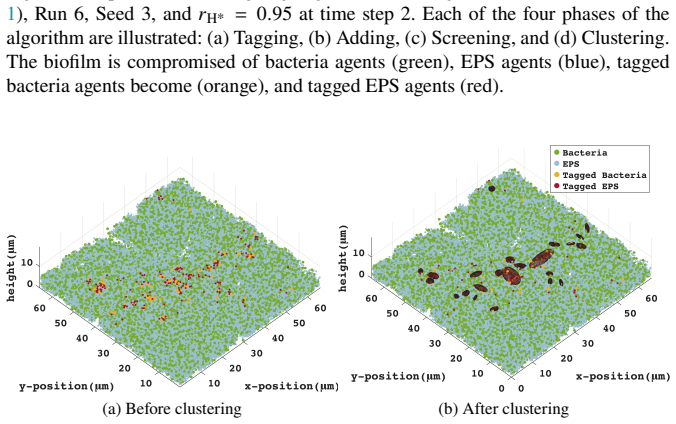
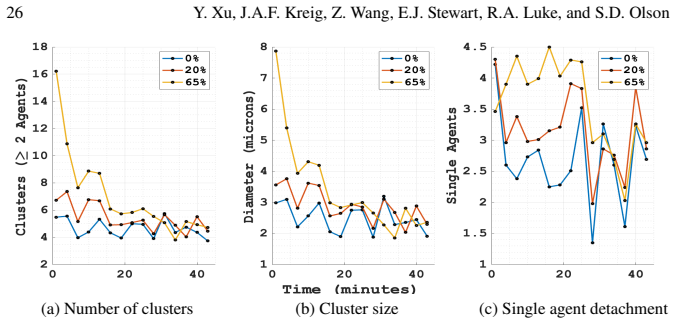
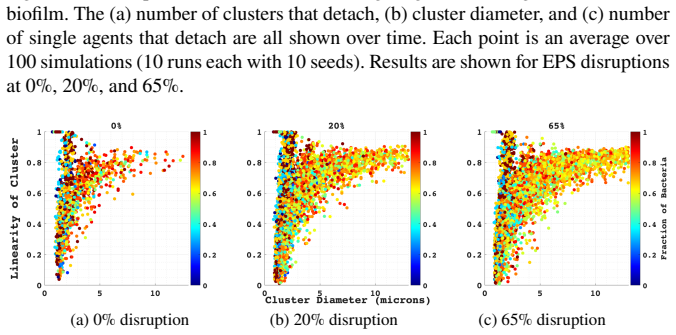
The detachment of cell clusters from a Staphylococcus epidermidis biofilm is driven by a force balance between fluid drag and adhesion forces that act on tagged sections whose boundaries are set by the cluster geometry and the local arrangement of bacteria and extracellular polymeric substance. A stickiness parameter is introduced to control the strength of local EPS adhesion, and this parameter is varied to represent disruption of the EPS biomass. The simulated biofilm is first benchmarked against experimental microstructural features from 24-hour growth, after which the effects on detached cluster frequency, size, and shape are examined under different levels of EPS disruption.
What carries the argument
geometry-dependent tagging of biofilm sections combined with a stickiness parameter that sets local EPS adhesion strength in a force balance calculation
If this is right
- Different levels of EPS disruption lead to changes in the frequency of cluster detachment.
- The size and shape of detached clusters vary with the stickiness parameter and reflect the underlying geometry.
- Compromised EPS results in distinct detachment dynamics compared to intact matrices.
- The model offers mechanistic understanding of how matrix disruption affects the properties of released bacterial clusters.
Where Pith is reading between the lines
- Extending the model to include fluid flow variations could reveal how shear rates influence cluster release in different environments.
- Validating against more experimental conditions might allow the approach to guide strategies for preventing secondary infections from detached biofilm fragments.
- The framework could apply to other biofilm-forming bacteria if their microstructural data is available for benchmarking.
Load-bearing premise
The structure of the simulated biofilm matches the microstructural features observed in actual 24-hour S. epidermidis biofilms closely enough that adjusting the stickiness parameter yields accurate forecasts for detached cluster properties.
What would settle it
Measuring the sizes, shapes, and frequencies of clusters that detach from laboratory-grown S. epidermidis biofilms when the EPS is experimentally disrupted and comparing those measurements to the model's outputs for matching disruption levels.
Figures






read the original abstract
Biofilms, bacteria cells surrounded by a self-produced polymeric matrix, are common on medical devices and lead to many hospital infections. The biofilm lifecycle includes disassembly and dispersion, where bacteria clusters detach from the biofilm, circulate in the bloodstream, and potentially colonize secondary infection sites. Existing models often simplify detachment to a function of biofilm thickness or extracellular polymeric substance (EPS) density, without tracking properties of detached clusters that impact their biological fate, including cluster size and morphology. Addressing this gap, our detachment model accounts for drag and adhesion in tagged sections of the biofilm determined by the cluster geometry and local arrangement of bacteria and EPS. A stickiness parameter controls local EPS adhesion strength, which is modulated to disrupt (or compromise) EPS biomass. We specifically model the detachment of clusters from a Staphylococcus epidermidis biofilm grown for 24 hours. Experimental data for biofilm microstructural features are utilized to benchmark the simulated biofilm, which is then subjected to different EPS disruption levels. We examine parameters that influence detached biofilm cell cluster frequency, size, and shape, providing mechanistic insights into how compromised EPS influences detachment dynamics. This integrated modeling framework is a significant advance in the predictive capabilities for biofilm detachment processes.
Editorial analysis
A structured set of objections, weighed in public.
Referee Report
Summary. The paper presents a geometry-dependent, force balance-driven model for detachment of cell clusters from Staphylococcus epidermidis biofilms. Drag and local adhesion forces are computed in tagged biofilm sections based on cluster geometry and the spatial arrangement of bacteria and EPS. A single stickiness parameter modulates EPS adhesion strength to simulate disruption; the initial 24-hour biofilm microstructure is benchmarked against experimental data, after which detached-cluster frequency, size, and shape are examined under varying EPS compromise levels.
Significance. If the central mapping from stickiness modulation to detachment statistics holds, the work supplies mechanistic insight into how compromised EPS alters cluster properties that govern downstream infection risk. It improves on thickness- or density-only simplifications by tracking geometry-dependent outcomes. The explicit use of experimental microstructural features to benchmark the simulated initial structure is a clear strength.
major comments (2)
- [Model and Results sections (detachment predictions)] The central claim that the single-parameter model yields reliable, mechanistically grounded predictions of detached-cluster statistics rests on an unvalidated extrapolation: experimental data are used only to benchmark the static 24-hour microstructure, with no quantitative comparison (size, shape, or frequency distributions) reported between simulated and measured detached clusters under EPS disruption.
- [Methods (parameter definition and modulation)] The stickiness parameter is introduced and modulated without independent calibration data or sensitivity analysis shown; because this parameter directly controls the force-balance outcome that is the paper's main output, its lack of grounding undermines the claim that the model is physics-based rather than effectively fitted.
minor comments (2)
- [Abstract and Introduction] Clarify in the abstract and introduction whether the stickiness parameter has any direct experimental counterpart or is purely phenomenological.
- [Results figures and tables] Add error bars or uncertainty quantification to any reported detached-cluster statistics and state the number of simulation replicates.
Simulated Author's Rebuttal
We thank the referee for the detailed and constructive review. The comments highlight important aspects of model validation and parameter grounding. We address each major comment below and indicate the revisions made or planned.
read point-by-point responses
-
Referee: [Model and Results sections (detachment predictions)] The central claim that the single-parameter model yields reliable, mechanistically grounded predictions of detached-cluster statistics rests on an unvalidated extrapolation: experimental data are used only to benchmark the static 24-hour microstructure, with no quantitative comparison (size, shape, or frequency distributions) reported between simulated and measured detached clusters under EPS disruption.
Authors: We agree that quantitative comparison of simulated detached-cluster statistics (size, shape, frequency) to experimental measurements under EPS disruption would provide stronger validation. The present study uses experimental data solely to benchmark the initial 24-hour biofilm microstructure, as detailed time-resolved detachment data under controlled matrix disruption were not available. We have added a dedicated limitations paragraph in the Discussion section that explicitly states this gap and outlines the experimental requirements for future validation. The model remains a mechanistic framework whose predictions can be tested once such data exist. revision: partial
-
Referee: [Methods (parameter definition and modulation)] The stickiness parameter is introduced and modulated without independent calibration data or sensitivity analysis shown; because this parameter directly controls the force-balance outcome that is the paper's main output, its lack of grounding undermines the claim that the model is physics-based rather than effectively fitted.
Authors: The stickiness parameter is a single effective coefficient that lumps together the net adhesive contribution of EPS under disruption; it is not claimed to be independently measured. To address the concern we have added a new sensitivity-analysis subsection (and corresponding figure) that varies the parameter over a physiologically plausible range and reports the resulting changes in detachment frequency, size, and shape distributions. The analysis shows that the qualitative trends remain robust within a factor of two around the nominal value, supporting the mechanistic interpretation while acknowledging the parameter's phenomenological nature. revision: yes
- Direct experimental measurements of detached-cluster size, shape, and frequency distributions under graded EPS disruption are not present in the current dataset and cannot be supplied without new experiments.
Circularity Check
No significant circularity; force-balance simulation is self-contained
full rationale
The paper constructs a simulation framework that initializes biofilm geometry from 24-hour experimental microstructural data, then applies explicit drag and local adhesion forces (modulated by a stickiness parameter) to compute cluster detachment. No derivation step reduces a claimed prediction to its own inputs by construction, nor does any central result rely on a self-citation chain or fitted quantity renamed as output. The stickiness modulation is an explicit control variable used to explore EPS disruption effects rather than a fitted parameter whose value is presupposed in the detachment statistics. Because the model outputs (cluster size, shape, frequency) are generated from the geometry-dependent force balance rather than rearranged from the benchmark inputs, the derivation remains independent of the target quantities.
Axiom & Free-Parameter Ledger
free parameters (1)
- stickiness parameter
axioms (1)
- domain assumption Detachment occurs when drag exceeds adhesion in geometry-tagged biofilm sections
invented entities (1)
-
stickiness parameter
no independent evidence
Lean theorems connected to this paper
-
IndisputableMonolith/Foundation/Cost/FunctionalEquation.leanwashburn_uniqueness_aczel unclear?
unclearRelation between the paper passage and the cited Recognition theorem.
detachment occurs if M_d > M_a ... stickiness parameter controls local EPS adhesion strength, which is modulated to disrupt EPS biomass
-
IndisputableMonolith/Foundation/AlexanderDuality.leanalexander_duality_circle_linking unclear?
unclearRelation between the paper passage and the cited Recognition theorem.
cluster formation algorithm ... DBSCAN ... geometry-dependent force balance
What do these tags mean?
- matches
- The paper's claim is directly supported by a theorem in the formal canon.
- supports
- The theorem supports part of the paper's argument, but the paper may add assumptions or extra steps.
- extends
- The paper goes beyond the formal theorem; the theorem is a base layer rather than the whole result.
- uses
- The paper appears to rely on the theorem as machinery.
- contradicts
- The paper's claim conflicts with a theorem or certificate in the canon.
- unclear
- Pith found a possible connection, but the passage is too broad, indirect, or ambiguous to say the theorem truly supports the claim.
Reference graph
Works this paper leans on
-
[1]
S. Jonblat, F. As-Sadi, K. Zibara, M. Sabban, V . Dermesrobian, A. Khoury, M. Kallassy, A. Chokr, Int Microbiol 27(3), 831 (2024). DOI 10.1007/s10123-023-00433-2. Epub 2023 Oct 12
- [2]
- [3]
- [4]
- [5]
-
[6]
Stewart, Microbiol Spectr3(3) (2015)
P . Stewart, Microbiol Spectr3(3) (2015). DOI 10.1128/microbiolspec.MB-0010-2014
-
[7]
T. Bjarnsholt, M. Alhede, S. Eickhardt-Sørensen, C. Moser, M. Kuhl, P . Jensen, N. Hoiby, Trends Microbiol 21(9) (2013)
work page 2013
-
[8]
K. Schilcher, A.R. Horswill, Microbiol Mol Biol Rev 84(e00026-19) (2020)
work page 2020
-
[9]
D. Fleming, K. Rumbaugh, Sci Rep 8, 10738 (2018). DOI doi.org/10.1038/ s41598-018-29121-2
work page 2018
-
[10]
J. Wille, T. Coenye, Biofilm 2, 100027 (2020). DOI 10.1016/j.bioflm.2020.100027
- [11]
-
[12]
A. Franca, V . Carvalhais, M. Vilanova, G. Pier, N. Cerca, AMB Express 6(23) (2016). DOI 10.1186/s13568-016-0197-9
- [13]
- [14]
- [15]
-
[16]
Z. Qin, Y . Ou, L. Y ang, Y . Zhu, T. Tolker-Nielsen, S. Molin, D. Qu, Microbiol 153, 2083 (2007). DOI 10.1099/mic.0.2007/006031-0
-
[17]
P . Dzianach, G. Dykes, N. Strachan, K. Forbes, F. Pérez-Reche, J R Soc Interface 16(155), 20190042 (2019)
work page 2019
-
[18]
I. Klapper, J. Dockery, SIAM Rev 52(2), 221 (2010). DOI 10.1137/080739720
- [19]
- [20]
-
[21]
Q. Wang, T. Zhang, Solid State Commun 150(21), 1009 (2010)
work page 2010
- [22]
- [23]
-
[24]
J. Hammond, E. Stewart, J. Y ounger, M. Solomon, D. Bortz, J Comp Phys98, 295 (2014). DOI 10.3970/cmes.2014.098.295
-
[25]
C. Li, J. Nijjer, L. Feng, Q. Zhang, J. Y an, S. Zhang, Soft Matter 20, 3401 (2024). DOI 10.1039/D3SM01535A
-
[26]
J.D. Chambless, P .S. Stewart, Biotechnol Bioeng 97(6), 1573 (2007). DOI 10.1002/bit.21363 36 Y . Xu, J.A.F. Kreig, Z. Wang, E.J. Stewart, R.A. Luke, and S.D. Olson
- [27]
- [28]
- [29]
-
[30]
R. Sudarsan, S. Ghosh, J.M. Stockie, H.J. Eberl, Commun Comput Phys 19(3), 682 (2016)
work page 2016
-
[31]
H.Z. Ting, P . Bedrikovetsky, Z.F. Tian, T. Carageorgos, Chem Eng Sci241, 116658 (2021)
work page 2021
-
[32]
H.Z. Ting, Y . Y ang, Z.F. Tian, T. Carageorgos, P . Bedrikovetsky, Colloids Surf A: Physicochem Eng Asp 650, 129451 (2022)
work page 2022
-
[33]
H.Z. Ting, Y . Y ang, Z.F. Tian, T. Carageorgos, P . Bedrikovetsky, Powder Technol427, 118754 (2023)
work page 2023
-
[34]
L. Karygianni, Z. Ren, H. Koo, T. Thurnheer, Trends Microbiol 28(8), 668 (2020)
work page 2020
-
[35]
J. Jo, A. Price-Whelan, L. Dietrich, Nat Rev Microbiol 20, 593 (2022). DOI 10.1038/ s41579-022-00692-2
work page 2022
-
[36]
S.R. Packard, G. Bulacan, B. Peiris, R. Paffenroth, E.J. Stewart, bioRxiv (2026). DOI 10. 64898/2026.01.28.701379. URL https://www.biorxiv.org/content/early/2026/01/ 28/2026.01.28.701379
work page 2026
- [37]
-
[38]
E.J. Stewart, A.E. Satorius, J.G. Y ounger, M.J. Solomon, Langmuir29(23), 7017 (2013). DOI 10.1021/la401322k
-
[39]
E.J. Stewart, D.E. Payne, T.M. Ma, J.S. VanEpps, B.R. Boles, J.G. Y ounger, M.J. Solomon, Ap- plied and Environmental Microbiology 83(12), e03483 (2017). DOI 10.1128/AEM.03483-16
-
[40]
S. Wang, H. Zhu, G. Zheng, F. Dong, C. Liu, Appl Environ Microbiol 88(22), e01072 (2022). DOI 10.1128/aem.01072-22
-
[41]
K. Alden, M. Read, J. Timmis, P . Andrews, H. Veiga-Fernandes, M. Coles, PLoS Comput Biol 9(2), e1002916 (2013). DOI 10.1371/journal.pcbi.1002916
-
[42]
M. Ganesan, E.J. Stewart, J. Szafranski, A.E. Satorius, J.G. Y ounger, M.J. Solomon, Biomacro- molecules 14(5), 1474 (2013). DOI 10.1021/bm400149a
-
[43]
R. Clegg, J. Kreft, J Theor Biol 21(423), 26 (2017). DOI 10.1016/j.jtbi.2017.04.016
-
[44]
Density-based spatial clustering of applications with noise (dbscan) (r2025a) (2025). URL https://www.mathworks.com. The MathWorks Inc
work page 2025
-
[45]
O.E. Petrova, K. Sauer, Current Opinion in Microbiology 30, 67 (2016). DOI 10.1016/j.mib. 2016.01.004
-
[46]
Kaplan, J Dent Res 89(3), 205 (2010)
J. Kaplan, J Dent Res 89(3), 205 (2010). DOI 10.1177/0022034509359403
-
[47]
S. Wang, Y . Zhao, A. Breslawec, T. Liang, Z. Deng, L. Kuperman, Q. Yu, NPJ Biofilms Mi- crobiomes 9(63) (2023). DOI 10.1038/s41522-023-00427-y
-
[48]
Polygons and polyhedra from points in 2-d and 3-d (alphashape) (r2025a) (2025). URLhttps: //www.mathworks.com. The MathWorks Inc.; Natick, Massachusetts, United States
work page 2025
-
[49]
Control random number generator (rng) (r2025a) (2025). URL https://www.mathworks. com. The MathWorks Inc.; Natick, Massachusetts, United States
work page 2025
- [50]
-
[51]
Ganser, Powder Technol 77(2), 143 (1993)
G.H. Ganser, Powder Technol 77(2), 143 (1993)
work page 1993
- [52]
-
[53]
J. Doke. Grabit (2016). URL https://www.mathworks.com/matlabcentral/ fileexchange/7173-grabit. MATLAB Central File Exchange
work page 2016
-
[54]
R. Hartmann, P .K. Singh, P . Pearce, R. Mok, B. Song, F. Díaz-Pascual, J. Dunkel, K. Drescher, Nature Phys 15(3), 251 (2019)
work page 2019
-
[55]
D.J. Cleaver, C.M. Care, M.P . Allen, M.P . Neal, Phys Rev E54(1), 559 (1996)
work page 1996
- [56]
-
[57]
C. Nunez, X. Kostoulias, A.Y . Peleg, F. Short, Y . Qu, Biofilm 5, 100105 (2023). DOI https://doi.org/10.1016/j.bioflm.2023.100105. URL https://www.sciencedirect.com/ science/article/pii/S2590207523000023
-
[58]
Y . Pechaud, N. Derlon, I. Queinnec, Y . Bessiere, E. Paul, Water Res250, 120985 (2024)
work page 2024
-
[59]
S. Maramizonouz, S. Nadimi, Powder Technol 412, 117964 (2022). DOI 10.1016/j.powtec. 2022.117964 A geometry-dependent, force-balance driven model of biofilm cell cluster detachment 37 Appendix A detailed list of all parameters utilized in iDynoMiCS are given in Tables A1 and A2. Several parameters were updated to be representative of an S. epidermidis bio...
discussion (0)
Sign in with ORCID, Apple, or X to comment. Anyone can read and Pith papers without signing in.