REVIEW 4 major objections 5 minor 3 cited by
Reasoning Vectors: Transferring Chain-of-Thought Capabilities via Task Arithmetic
T0 review · 4 major / 5 minor · reviewed 2026-08-05 · deepseek-v4-flash
Pith's one-line read This paper argues that reasoning learned through reinforcement learning can be extracted as a parameter vector and transferred to other models by addition.
desk verdict Clean idea with real cross-domain signal, but the missing random-vector control keeps the 'reasoning vector' interpretation from being airtight. read the letter →
The pith
A machine-rendered reading of the paper's core claim, the machinery that carries it, and where it could break.
The reading
What carries the argument
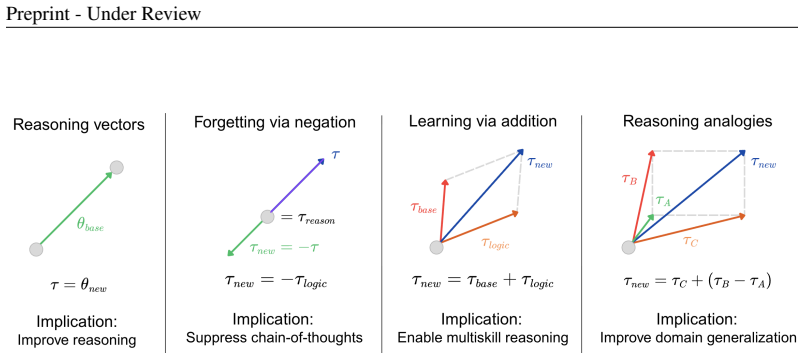
The reasoning vector v_reason = θ_GRPO − θ_SFT: the element-wise difference between the weights of a GRPO-trained donor model and its SFT-trained twin. This difference is the object claimed to encode the reinforcement-learning reasoning increment, with shared dataset knowledge cancelled by the subtraction; adding it to a target model's weights is the transfer operation. Linear mode connectivity is invoked to justify why this straight-line move in weight space stays in a low-loss region.
What would settle it
Take the same instruction-tuned base model and add a random vector with the same norm as v_reason; if the random vector reproduces the reported benchmark gains, the claim that the difference vector specifically encodes reasoning is falsified.
Extended reading notes
Core claim
On its own terms, the paper's central claim is that v_reason = θ_GRPO − θ_SFT isolates the parameter change reinforcement learning introduces on top of supervised fine-tuning, because the two donor checkpoints share initialization, architecture, and training data. Injecting v_reason (with scale α = 1) into a compatible instruction-tuned model improves accuracy on GSM8K, HumanEval/HumanEval+, SciQ, and BigBenchHard at 1.5B and 7B scale; the strongest reported gain is 12.3 points on BigBenchHard. Removing the vector by subtraction drops GSM8K accuracy by 11.8 points, below the SFT baseline. A math-derived vector also transfers modestly to code generation and a code-derived vector to math, whic
Load-bearing premise
The load-bearing premise is that the two donor models differ only in the reinforcement-learning stage, so subtracting their weights leaves exactly the reasoning gained by RL and nothing else—if that fails, the vector could carry training noise and the gains could be a generic perturbation effect.
Editorial extensions
If this is right
- Reasoning can be treated as a modular direction in weight space: adding the vector improves a compatible model with no further training, and subtracting it removes the capability.
- A vector extracted from math training improves performance on code, science QA, and logical deduction, so the transferred component is not just a GSM8K artifact.
- Practitioners can reuse the computational investment of existing RL runs by storing one difference tensor and applying it to any compatible checkpoint at negligible cost.
- The calibration result, where α = 1 works without rescaling, suggests the raw vector magnitude is already meaningful for transfer.
- The effect appears across model scale (1.5B and 7B), indicating it is not a quirk of a single size.
Reading between the lines
- Inference: Because the paper does not compare against a norm-matched random vector, a natural next experiment is to test whether a random direction of the same magnitude produces similar gains; this would distinguish reasoning transfer from a generic perturbation effect.
- Inference: If reasoning directions can be combined, one could build 'skill arithmetic' by adding several such vectors to a base model; the paper's composition figure gestures at this but does not evaluate it.
- Inference: The method's dependence on identical initialization suggests a testable boundary: transfer should degrade as donor and target diverge in initialization, and measuring that decay could map the 'compatibility region' in parameter space.
- Inference: A practical extension would be to extract reasoning vectors from smaller donors and apply them to larger targets of the same family, to see whether the capability transfers across scale as well as within it.
Editorial analysis
A structured set of objections, weighed in public.
Referee Report
Summary. The paper proposes that reasoning capabilities learned via reinforcement learning can be extracted as a 'reasoning vector' by subtracting the parameters of an SFT checkpoint from a GRPO checkpoint trained on the same data (v_reason = θ_GRPO − θ_SFT), and then transferred to a compatible instruction-tuned model by simple addition (θ_enhanced = θ_target + α·v_reason). Experiments on Qwen2.5 1.5B and 7B models report consistent gains on GSM8K, HumanEval, SciQ, and BigBenchHard, with the largest claimed improvement on BBH (+12.3% for 1.5B). The paper also includes robustness experiments on perturbed GSM8K and ablations showing that subtracting the vector degrades performance. The central claim is that the vector captures a modular, transferable reasoning capability rather than acting as an arbitrary parameter perturbation.
Significance. If the central claim held up, the result would be practically significant: it would allow reusing the computational investment in RL-trained checkpoints through inexpensive tensor arithmetic, and it would support a modular view of high-level capabilities in parameter space. The paper is clearly written and uses publicly available checkpoints, which is a strength for reproducibility. However, the evidence is currently underdetermined: the absence of a random-vector/permutation control means the observed improvements are equally consistent with a generic perturbation effect, and the single-run evaluation with small gains and a custom BBH subset does not yet establish statistical reliability. The theoretical grounding via linear mode connectivity is also not directly applicable to the transfer operation used.
major comments (4)
- [Section 3.2, Eqs. (1)–(2), Table 1] The central interpretation of v_reason as a reasoning-specific direction is not tested against a null model. Adding any sufficiently large, structured direction to the weights could shift benchmark accuracies in the observed pattern. The paper provides no control of the form: add a random vector with the same L2 norm as v_reason, a sign-randomized copy, or a permuted version, and measure the same benchmarks. Without such baselines, the gains (+2.6 to +12.3 across benchmarks) and the symmetric degradation from subtraction do not establish that the direction encodes reasoning rather than acting as a generic perturbation. This control is missing from the limitations list in Section 5, and it is load-bearing for the paper's main claim.
- [Section 4.1, Table 1, Appendix A.1] All results are from a single run, with no error bars or significance tests. Several reported gains are small (e.g., +2.6 GSM8K, +2.2 HumanEval, +1.5 SciQ for 1.5B) and could be within run-to-run variance. In addition, the BigBenchHard evaluation uses a custom subset of five tasks (Table 4) with no stated selection criterion, and the 1.5B baseline is 6.7%, near random. The large +12.3% BBH improvement may be partly a floor effect or an artifact of task selection. The authors should provide multiple runs or bootstrap confidence intervals and justify/advertise the BBH subset selection procedure.
- [Section 4.4, scaling analysis] The scaling factor α was tuned on GSM8K by testing a grid {0.5, 1.0, 1.5, 2.0} and selecting α=1.0 as optimal. The subsequent headline GSM8K result (+4.9%) is therefore partly a selection artifact: the reported number is the best of several values on the test set. To report a fair transfer result, α should be selected on a validation set (or the sensitivity across α should be reported without claiming the selected value as the expected gain). This is a free parameter that affects the central performance numbers.
- [Section 3.3, Eq. (4)] The theoretical foundation uses linear mode connectivity, but Eq. (4) applies to interpolation between two models (λθ_A + (1−λ)θ_B), whereas the transfer operation in Eq. (2) is a translation θ_target + v_reason, i.e., extrapolation from θ_target along a direction not necessarily in the same low-loss basin. The LMC argument therefore does not, as written, justify why adding the difference vector to a different target model should remain in a low-loss region. Additionally, the claim that θ_SFT and θ_GRPO are 'identically initialized' and share the same pre-training history is asserted but not demonstrated for the public checkpoints used. The authors should either supply evidence of the checkpoint relationship or explicitly weaken the theoretical claim to a heuristic.
minor comments (5)
- [Section 3.1] Typo: 'indepedent' should be 'independent'.
- [Throughout] Inconsistent model naming: 'Qwen 2.5' and 'QWEN 2.5' are used interchangeably. Please unify to the official capitalization.
- [Table 2] The baseline row reports 45.7 for the original GSM8K condition, while Table 1 reports 45.1 for the same model/benchmark. This inconsistency should be explained or corrected.
- [Section 4.1, references] Reference [6] is cited for HumanEval, but that reference is about class-level code generation (ICSE 2024), whereas HumanEval is the function-level benchmark of Chen et al. (2021). Please cite the original HumanEval paper.
- [Figure 3] The text states that standardized prompt templates are 'shown in Figure 3', but no Figure 3 appears in the manuscript. Either include the figure or remove the reference.
Circularity Check
Partial circularity: the scaling factor α is fit to GSM8K, so the headline GSM8K gain is in-sample; core vector extraction and other benchmarks remain independent.
-
fitted input called prediction
[Section 4.4 Scaling Analysis; Table 1; Section 3.2]
"We investigated the effect of the scaling factor α from Equation 2, testing values in {0.5, 1.0, 1.5, 2.0}. We found that α = 1.0 achieved the optimal performance (50.0%)"
Equation (2) defines the enhanced model as θ_target + α·v_reason, with α a free scaling coefficient. The authors tune α on GSM8K accuracy, selecting α=1.0 because it yields 50.0% on GSM8K. That same 50.0% (+4.9%) GSM8K result is then reported in Table 1 and the abstract as evidence that the reasoning vector transfers. The GSM8K improvement is therefore not an independent prediction—it is the selection criterion for α. The §3.2 claim that 'α = 1 was consistently effective' is a post-hoc description of this selection. Other benchmarks (HumanEval, SciQ, BigBenchHard) were not used to select α and remain out-of-sample, so this circularity is partial.
full rationale
The paper is largely self-contained: v_reason = θ_GRPO − θ_SFT is computed from two public checkpoints rather than fitted to the target benchmarks, and the transfer results on HumanEval, SciQ, and BigBenchHard are genuine out-of-sample evidence. No self-citations are load-bearing, and the LMC argument in §3.3 cites external prior work rather than the authors' own uniqueness theorem. The main circularity is the α=1.0 scaling factor: it is selected by maximizing GSM8K accuracy, and then the GSM8K improvement is advertised as a finding, making that number in-sample. The absence of a random-vector/permutation control is a serious underdetermination of the reasoning-specific interpretation, but that is an experimental-design/correctness concern rather than a circular derivation.
Assumptions & free parameters
free parameters (2)
- scaling factor α =
1.0
- BigBenchHard task subset =
5 tasks listed in Table 4
assumptions (4)
- domain assumption Linear Mode Connectivity holds between θ_SFT and θ_GRPO, so the interpolation path stays in a low-loss region (Eq. 4).
- domain assumption θ_SFT and θ_GRPO are identically initialized, use the same dataset, and differ only in the final optimization objective.
- domain assumption Adding v_reason to θ_target keeps the parameters in a compatible low-loss basin.
- domain assumption Benchmark accuracy differences are a valid measure of reasoning capability.
Cite this review
Pith. "Pith review of Reasoning Vectors: Transferring Chain-of-Thought Capabilities via Task Arithmetic." pith.science (2026). https://pith.science/paper/HIIKQOLG
@misc{pith2026250901363,
  author       = {Pith},
  title        = {Pith review of: Reasoning Vectors: Transferring Chain-of-Thought Capabilities via Task Arithmetic},
  year         = {2026},
  howpublished = {\url{https://pith.science/paper/HIIKQOLG}},
  note         = {Machine review of arXiv:2509.01363}
}
abstract
Large language models often require costly optimization, such as reinforcement learning, to master complex reasoning tasks. This work demonstrates that reasoning ability, once learned, can be extracted and transferred between models as a compact task vector. We source two publicly available, identically initialized Qwen2.5 models, one fine-tuned with supervised fine-tuning (SFT) and the other with group relative policy optimization (GRPO) on the same dataset. From these, we extract a reasoning vector: $v_{\text{reason}} = \theta_{\text{GRPO}} - \theta_{\text{SFT}}$. We hypothesize that this vector captures the reasoning capability instilled by reinforcement learning while factoring out shared knowledge from the SFT process. When added to compatible instruction-tuned models through simple arithmetic, this vector consistently improves performance across diverse reasoning benchmarks: GSM8K (+4.9%), HumanEval (+4.3%), SciQ (+1.7%), and BigBenchHard (+12.3% for the 1.5B model). The performance improvements persist under adversarial conditions. Conversely, subtracting the vector causes significant performance degradation (-11.8% on GSM8K), demonstrating the vector's strong contribution to the model's reasoning abilities. This work shows how reasoning capabilities, typically developed through expensive training, can be extracted from existing open-source models and reused through simple tensor arithmetic, offering a practical way to enhance models by recycling prior computational investments.
Figures


Figures from the paper (2 more)


Forward citations
Cited by 3 Pith papers
-
The Master Key Hypothesis: Unlocking Cross-Model Capability Transfer via Linear Subspace Alignment
The Master Key Hypothesis states that capabilities are low-dimensional directions transferable across models through linear subspace alignment, with UNLOCK demonstrating gains such as 12.1% accuracy improvement on MAT...
-
Knowledge is Not Enough: Injecting RL Skills for Continual Adaptation
PaST extracts a domain-agnostic skill vector from RL training and linearly injects it into SFT-adapted LLMs to improve knowledge use on QA and tool-use tasks.
-
Probing the Difficulty Perception Mechanism of Large Language Models
LLMs linearly encode math-problem difficulty in their final-token representations, and specific final-layer attention heads are specialized for easy vs hard problems.
Reference graph
Works this paper leans on
-
[24]
Steven Moore, Ellen Fang, Huy A. Nguyen, and John Stamper. Crowdsourcing the evaluation of multiple-choice questions using item-writing flaws and bloom’s taxonomy. InProceedings of the Tenth ACM Conference on Learning @ Scale , L@S ’23, pp. 2534, New York, NY , USA, 2023. Association for Computing Machinery. ISBN 9798400700255. doi: 10.1145/3573051.359339...
-
[29]
Jason Wei, Xuezhi Wang, Dale Schuurmans, Maarten Bosma, Brian Ichter, Fei Xia, Ed H. Chi, Quoc V . Le, and Denny Zhou. Chain-of-thought prompting elicits reasoning in large language models. In Proceedings of the 36th International Conference on Neural Information Processing Systems, NIPS ’22, Red Hook, NY , USA, 2022. Curran Associates Inc. ISBN 9781713871088
work page 2022
-
[1]
Ainsworth, Jonathan Hayase, and Siddhartha Srinivasa
Samuel K. Ainsworth, Jonathan Hayase, and Siddhartha Srinivasa. Git re-basin: Merging models modulo permutation symmetries, 2023. URL https://arxiv.org/abs/2209.04836
arXiv 2023
-
[2]
Devansh Arpit, Huan Wang, Yingbo Zhou, and Caiming Xiong. Ensemble of averages: Im- proving model selection and boosting performance in domain generalization, 2022. URL https://arxiv.org/abs/2110.10832
arXiv 2022
-
[3]
Wenhu Chen, Xueguang Ma, Xinyi Wang, and William W. Cohen. Program of thoughts prompting: Disentangling computation from reasoning for numerical reasoning tasks, 2023. URL https://arxiv.org/abs/2211.12588
arXiv 2023
-
[4]
Deep reinforcement learning from human preferences
Paul F Christiano, Jan Leike, Tom Brown, Miljan Martic, Shane Legg, and Dario Amodei. Deep reinforcement learning from human preferences. In I. Guyon, U. V on Luxburg, S. Bengio, H. Wallach, R. Fergus, S. Vishwanathan, and R. Garnett (eds.), Advances in Neural Information Processing Systems , volume 30. Curran Associates, Inc., 2017. URL https://proceedin...
work page 2017
-
[5]
Training verifiers to solve math word problems, 2021
Karl Cobbe, Vineet Kosaraju, Mohammad Bavarian, Mark Chen, Heewoo Jun, Lukasz Kaiser, Matthias Plappert, Jerry Tworek, Jacob Hilton, Reiichiro Nakano, Christopher Hesse, and John Schulman. Training verifiers to solve math word problems, 2021. URL https://arxiv. org/abs/2110.14168
arXiv 2021
-
[6]
Evaluating large language models in class-level code generation
Xueying Du, Mingwei Liu, Kaixin Wang, Hanlin Wang, Junwei Liu, Yixuan Chen, Jiayi Feng, Chaofeng Sha, Xin Peng, and Yiling Lou. Evaluating large language models in class-level code generation. In Proceedings of the IEEE/ACM 46th International Conference on Software Engineering, ICSE ’24, New York, NY , USA, 2024. Association for Computing Machinery. ISBN ...
arXiv 2024
Show all 45 references
-
[7]
Roy, and Michael Carbin
Jonathan Frankle, Gintare Karolina Dziugaite, Daniel M. Roy, and Michael Carbin. Linear mode connectivity and the lottery ticket hypothesis. In Proceedings of the 37th International Conference on Machine Learning, ICML’20. JMLR.org, 2020
2020
-
[8]
Pal: program-aided language models
Luyu Gao, Aman Madaan, Shuyan Zhou, Uri Alon, Pengfei Liu, Yiming Yang, Jamie Callan, and Graham Neubig. Pal: program-aided language models. In Proceedings of the 40th International Conference on Machine Learning , ICML’23. JMLR.org, 2023. 9 Preprint - Under Review
2023
-
[9]
Arcee’s MergeKit: A toolkit for merging large language models
Charles Goddard, Shamane Siriwardhana, Malikeh Ehghaghi, Luke Meyers, Vladimir Karpukhin, Brian Benedict, Mark McQuade, and Jacob Solawetz. Arcee’s MergeKit: A toolkit for merging large language models. In Franck Dernoncourt, Daniel Preo¸ tiuc-Pietro, and Anastasia Shimorina (...
2024
-
[10]
Measuring mathematical problem solving with the math dataset,
Dan Hendrycks, Collin Burns, Saurav Kadavath, Akul Arora, Steven Basart, Eric Tang, Dawn Song, and Jacob Steinhardt. Measuring mathematical problem solving with the math dataset,
-
[11]
Lora: Low-rank adaptation of large language models
Edward J Hu, Yelong Shen, Phillip Wallis, Zeyuan Allen-Zhu, Yuanzhi Li, Shean Wang, Lu Wang, Weizhu Chen, et al. Lora: Low-rank adaptation of large language models. ICLR, 1 (2):3, 2022
2022
-
[12]
Emr- merging: Tuning-free high-performance model merging
Chenyu Huang, Peng Ye, Tao Chen, Tong He, Xiangyu Yue, and Wanli Ouyang. Emr- merging: Tuning-free high-performance model merging. In A. Globerson, L. Mackey, D. Bel- grave, A. Fan, U. Paquet, J. Tomczak, and C. Zhang (eds.), Advances in Neural Informa- tion Processing Systems...
2024
-
[13]
Editing models with task arithmetic, 2023
Gabriel Ilharco, Marco Tulio Ribeiro, Mitchell Wortsman, Suchin Gururangan, Ludwig Schmidt, Hannaneh Hajishirzi, and Ali Farhadi. Editing models with task arithmetic, 2023. URL https://arxiv.org/abs/2212.04089
2023 arXiv
-
[14]
Dataless knowledge fusion by merging weights of language models, 2025
Xisen Jin, Xiang Ren, Daniel Preotiuc-Pietro, and Pengxiang Cheng. Dataless knowledge fusion by merging weights of language models, 2025. URL https://arxiv.org/abs/2212. 09849
2025
-
[15]
Large language models are zero-shot reasoners
Takeshi Kojima, Shixiang Shane Gu, Machel Reid, Yutaka Matsuo, and Yusuke Iwasawa. Large language models are zero-shot reasoners. In Proceedings of the 36th International Conference on Neural Information Processing Systems , NIPS ’22, Red Hook, NY , USA, 2022. Curran Associate...
2022
-
[16]
The power of scale for parameter-efficient prompt tuning
Brian Lester, Rami Al-Rfou, and Noah Constant. The power of scale for parameter-efficient prompt tuning. In Marie-Francine Moens, Xuanjing Huang, Lucia Specia, and Scott Wen-tau Yih (eds.), Proceedings of the 2021 Conference on Empirical Methods in Natural Language Processing,...
2021 doi
-
[17]
Solving quan- titative reasoning problems with language models
Aitor Lewkowycz, Anders Andreassen, David Dohan, Ethan Dyer, Henryk Michalewski, Vinay Ramasesh, Ambrose Slone, Cem Anil, Imanol Schlag, Theo Gutman-Solo, Yuhuai Wu, Behnam Neyshabur, Guy Gur-Ari, and Vedant Misra. Solving quan- titative reasoning problems with language models...
2022
-
[18]
Prefix-tuning: Optimizing continuous prompts for generation,
Xiang Lisa Li and Percy Liang. Prefix-tuning: Optimizing continuous prompts for generation,
-
[19]
Merging models with fisher-weighted averaging
Michael Matena and Colin Raffel. Merging models with fisher-weighted averaging. In Proceed- ings of the 36th International Conference on Neural Information Processing Systems , NIPS ’22, Red Hook, NY , USA, 2022. Curran Associates Inc. ISBN 9781713871088
2022
-
[20]
Locating and editing factual associations in gpt
Kevin Meng, David Bau, Alex Andonian, and Yonatan Belinkov. Locating and editing factual associations in gpt. In S. Koyejo, S. Mohamed, A. Agar- wal, D. Belgrave, K. Cho, and A. Oh (eds.), Advances in Neural Information 10 Preprint - Under Review Processing Systems , volume 35...
2022
-
[21]
URL https://arxiv.org/abs/2101.00190
-
[22]
Task arithmetic in the tangent space: Improved editing of pre-trained models, 2023
Guillermo Ortiz-Jimenez, Alessandro Favero, and Pascal Frossard. Task arithmetic in the tangent space: Improved editing of pre-trained models, 2023. URL https://arxiv.org/ abs/2305.12827
2023 arXiv
-
[23]
Training language models to follow instructions with human feedback
Long Ouyang, Jeffrey Wu, Xu Jiang, Diogo Almeida, Carroll Wainwright, Pamela Mishkin, Chong Zhang, Sandhini Agarwal, Katarina Slama, Alex Ray, John Schul- man, Jacob Hilton, Fraser Kelton, Luke Miller, Maddie Simens, Amanda Askell, Pe- ter Welinder, Paul F Christiano, Jan Leik...
2022
-
[25]
Model ratatouille: recycling diverse models for out-of-distribution generalization
Alexandre Ramé, Kartik Ahuja, Jianyu Zhang, Matthieu Cord, Léon Bottou, and David Lopez- Paz. Model ratatouille: recycling diverse models for out-of-distribution generalization. In Proceedings of the 40th International Conference on Machine Learning , ICML’23. JMLR.org, 2023
2023
-
[26]
Proximal policy optimization algorithms, 2017
John Schulman, Filip Wolski, Prafulla Dhariwal, Alec Radford, and Oleg Klimov. Proximal policy optimization algorithms, 2017. URL https://arxiv.org/abs/1707.06347
2017 arXiv
-
[27]
Direct preference optimization: Your language model is secretly a reward model
Rafael Rafailov, Archit Sharma, Eric Mitchell, Christopher D Manning, Stefano Ermon, and Chelsea Finn. Direct preference optimization: Your language model is secretly a reward model. In A. Oh, T. Naumann, A. Globerson, K. Saenko, M. Hardt, and S. Levine (eds.), Advances in Neu...
-
[30]
Morcos, Hongseok Namkoong, Ali Farhadi, Yair Carmon, Simon Kornblith, and Ludwig Schmidt
Mitchell Wortsman, Gabriel Ilharco, Samir Yitzhak Gadre, Rebecca Roelofs, Raphael Gontijo- Lopes, Ari S. Morcos, Hongseok Namkoong, Ali Farhadi, Yair Carmon, Simon Kornblith, and Ludwig Schmidt. Model soups: averaging weights of multiple fine-tuned models improves accuracy wit...
2022
-
[31]
Challenging BIG-bench tasks and whether chain-of-thought can solve them
Mirac Suzgun, Nathan Scales, Nathanael Schärli, Sebastian Gehrmann, Yi Tay, Hyung Won Chung, Aakanksha Chowdhery, Quoc Le, Ed Chi, Denny Zhou, and Jason Wei. Challenging BIG-bench tasks and whether chain-of-thought can solve them. In Anna Rogers, Jordan Boyd- Graber, and Naoak...
2023 doi
-
[32]
Model merging in llms, mllms, and beyond: Methods, theories, applications and opportu- nities, 2024
Enneng Yang, Li Shen, Guibing Guo, Xingwei Wang, Xiaochun Cao, Jie Zhang, and Dacheng Tao. Model merging in llms, mllms, and beyond: Methods, theories, applications and opportu- nities, 2024. URL https://arxiv.org/abs/2408.07666
2024 arXiv
-
[33]
Griffiths, Yuan Cao, and Karthik Narasimhan
Shunyu Yao, Dian Yu, Jeffrey Zhao, Izhak Shafran, Thomas L. Griffiths, Yuan Cao, and Karthik Narasimhan. Tree of thoughts: deliberate problem solving with large language models. In Proceedings of the 37th International Conference on Neural Information Processing Systems , NIPS...
2023
-
[34]
Language models are super mario: absorbing abilities from homologous models as a free lunch
Le Yu, Bowen Yu, Haiyang Yu, Fei Huang, and Yongbin Li. Language models are super mario: absorbing abilities from homologous models as a free lunch. In Proceedings of the 41st International Conference on Machine Learning , ICML’24. JMLR.org, 2024
2024
-
[35]
Ties-merging: resolving interference when merging models
Prateek Yadav, Derek Tam, Leshem Choshen, Colin Raffel, and Mohit Bansal. Ties-merging: resolving interference when merging models. In Proceedings of the 37th International Confer- ence on Neural Information Processing Systems , NIPS ’23, Red Hook, NY , USA, 2023. Curran Assoc...
2023
-
[36]
Automatic chain of thought prompting in large language models, 2022
Zhuosheng Zhang, Aston Zhang, Mu Li, and Alex Smola. Automatic chain of thought prompting in large language models, 2022. URL https://arxiv.org/abs/2210.03493
2022 arXiv
-
[37]
Model extrapolation expe- dites alignment
Chujie Zheng, Ziqi Wang, Heng Ji, Minlie Huang, and Nanyun Peng. Model extrapolation expe- dites alignment. In Wanxiang Che, Joyce Nabende, Ekaterina Shutova, and Mohammad Taher Pilehvar (eds.), Proceedings of the 63rd Annual Meeting of the Association for Computational Lingui...
2025 doi
-
[39]
Eric Zelikman, Yuhuai Wu, Jesse Mu, and Noah D. Goodman. Star: Bootstrapping reasoning with reasoning, 2022. URL https://arxiv.org/abs/2203.14465
2022 arXiv
-
[42]
Stage 1 (Aptitude): Out of 960 applicants, 5 8 pass
-
[43]
Stage 2 (Technical): Of those who passed Stage 1, 3 5 pass while 2 5 fail
-
[44]
Retake: Of the Stage 2 failures, 1 4 are invited to retake the test, and 2 3 of them pass
-
[45]
Portfolio Review: From the Stage 2 failures, a subset is invited to submit portfolios, of which half succeed
-
[46]
Final Interview: 70% of all applicants reaching this stage are awarded the fellowship. Question: How many applicants ultimately receive the fellowship? B.2 MODEL A θbase − vreason Stage 1 (Aptitude) Applicants = 960, Pass rate = 5 8 ⇒ Pass = 960 × 5 8 = 600 Stage 2 (Technical)...
-
[2021]
URL https://arxiv.org/abs/2103.03874
-
[2023]
URL https://proceedings.neurips.cc/paper_files/paper/2023/ file/a85b405ed65c6477a4fe8302b5e06ce7-Paper-Conference.pdf
2023
-
[2024]
doi: 10.18653/v1/2024.emnlp-industry.36
Association for Computational Linguistics. doi: 10.18653/v1/2024.emnlp-industry.36. URL https://aclanthology.org/2024.emnlp-industry.36/
2024 doi
Reviewed August 5, 2026 · model on record in the stance chip above.
Discussion (0). Sign in to comment.