Gaussian processes on ray-guided transformed uniform grids for fast, flexible, and auto-differentiable adaptive source reconstruction in lens modelling
Pith reviewed 2026-06-30 03:11 UTC · model grok-4.3
The pith
Ray-guided transformed uniform grids enable adaptive source reconstruction in gravitational lensing with Gaussian processes.
A machine-rendered reading of the paper's core claim, the machinery that carries it, and where it could break.
Core claim
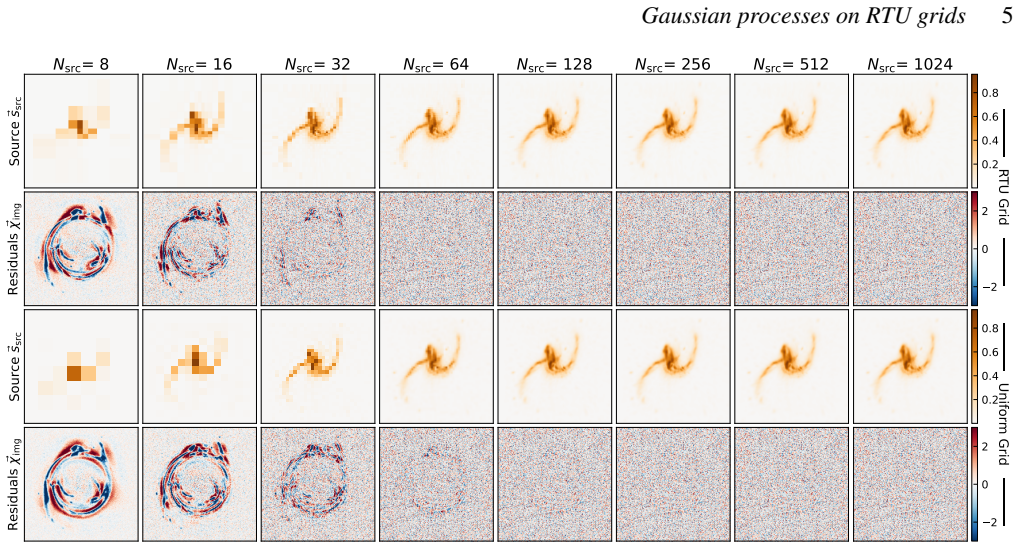
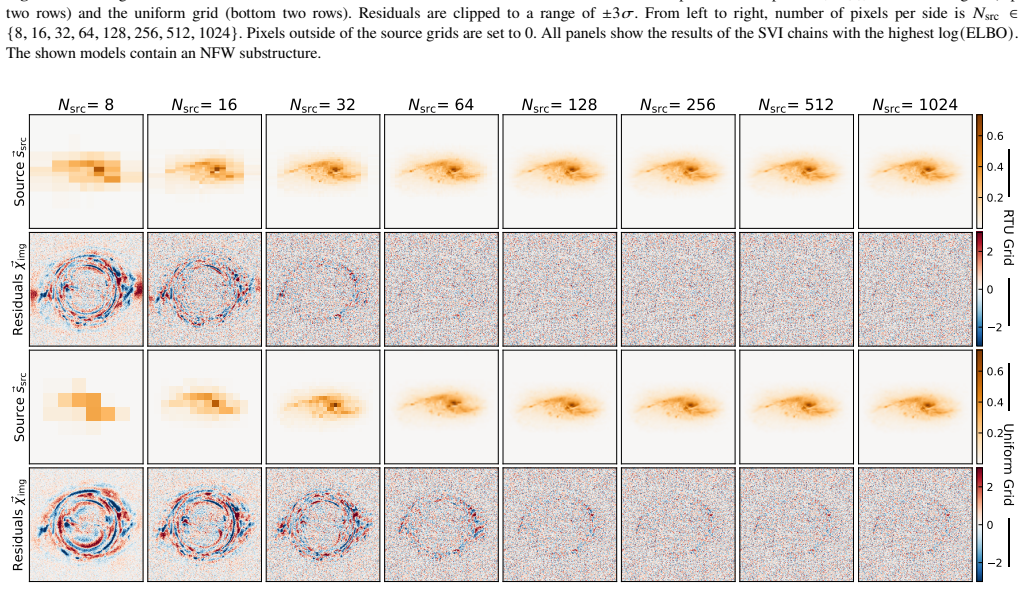
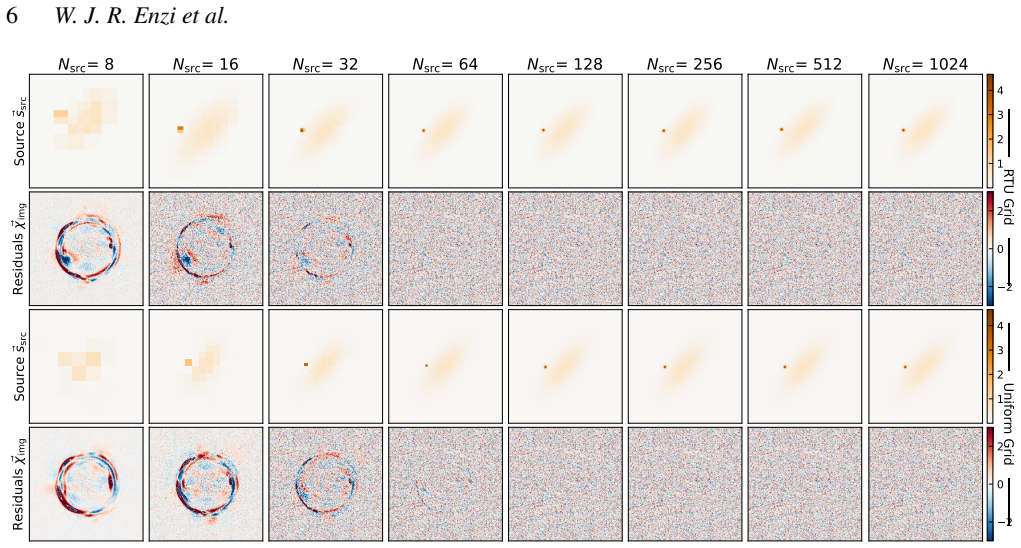
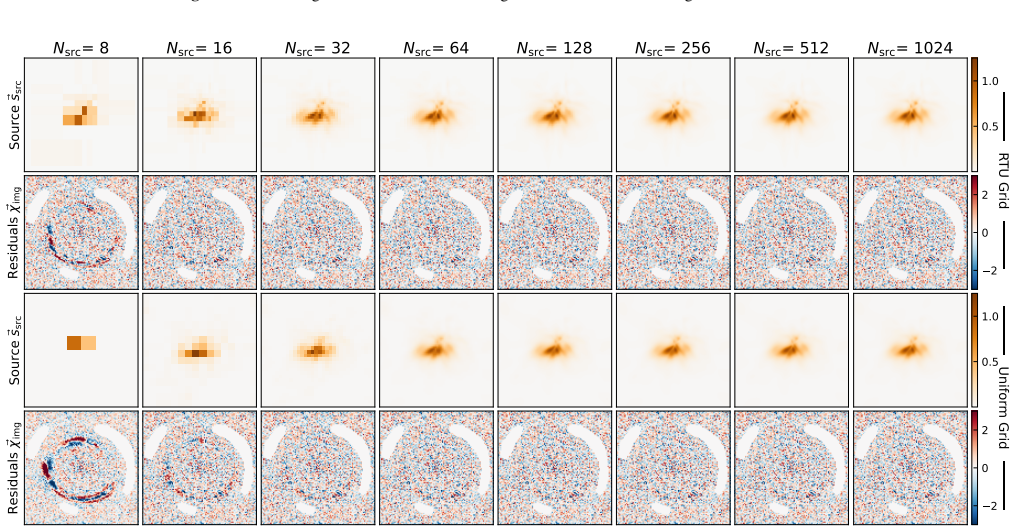
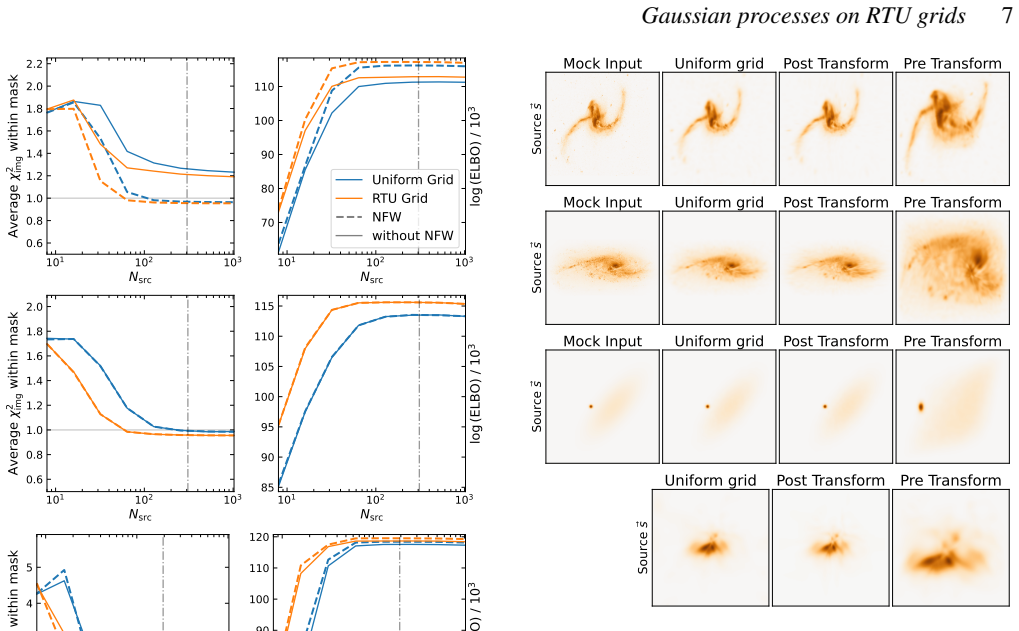
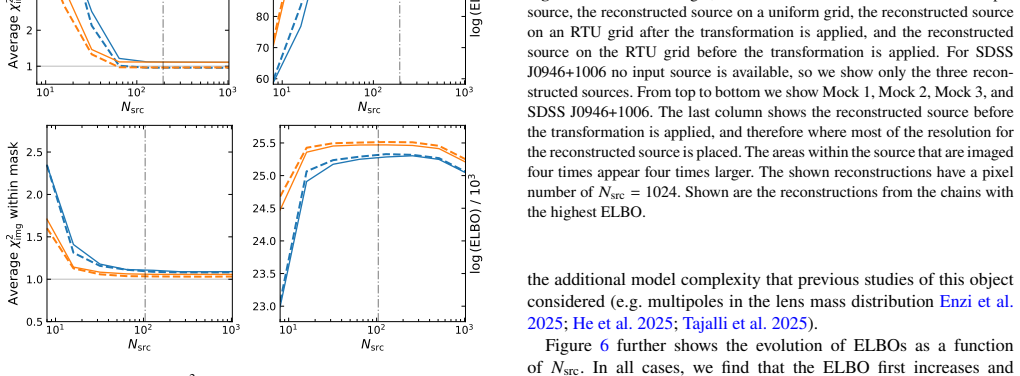
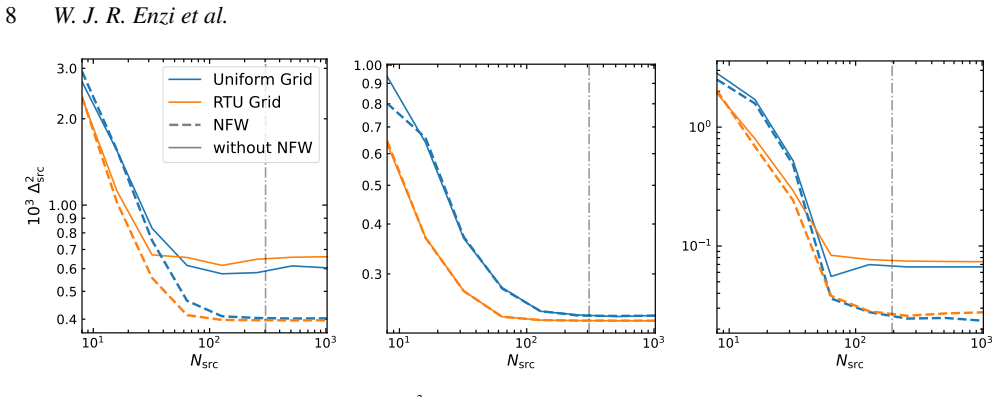
Defining the source as a Gaussian process on a ray-guided transformed uniform grid (RTU grid) allows adaptive source reconstruction that is auto-differentiable and flexible in regularization choice. The grid transformation is based on cumulative distributions of rays to the source plane, ensuring more uniform ray counts per pixel. This approach achieves comparable reconstruction quality to standard methods but with fewer source pixels, typically a factor of two fewer per dimension, and higher ELBO values for fixed pixel numbers.
What carries the argument
The ray-guided transformed uniform grid (RTU grid), created by transforming a uniform grid using cumulative ray distributions from the lens model to adapt pixel sizes while maintaining uniformity in ray coverage for the Gaussian process representation.
If this is right
- Comparable fit quality is achieved with roughly half the number of source pixels per dimension.
- Higher Evidence Lower Bounds (ELBOs) are obtained for the same number of pixels.
- The difference in ELBO between models with and without substructures is only mildly affected.
- A fast and differentiable method supports analysis of large lens samples such as those from the Euclid survey.
Where Pith is reading between the lines
- This method could facilitate fully differentiable pipelines for simultaneous inference of lens mass and source parameters.
- It may extend to other imaging inverse problems involving ray tracing or non-uniform sampling.
- Testing on real observational data would reveal if the uniformity assumption holds under noise and complex structures.
Load-bearing premise
The cumulative-distribution transformation produces source pixels with sufficiently uniform ray counts without introducing artifacts that degrade reconstruction quality or differentiability.
What would settle it
Applying the method to mock data with known complex sources and checking if the reconstructed source shows systematic artifacts or if the ELBO improvement disappears when the transformation introduces discontinuities.
Figures

read the original abstract
Strong gravitational lensing constrains cosmology and dark matter, but robust inference requires accurate source reconstruction. The achievable source resolution is highly position-dependent. Adaptive meshes can place resolution where needed, but typically rely on discontinuous operations, such as Delaunay tessellations or Voronoi binning, which can restrict regularization choices and break differentiability. In this paper, we present a novel approach for modelling the source on a ray-guided transformed uniform grid (RTU grid), that is adaptive to the lens mass model, auto-differentiable and flexible with respect to the regularization by allowing for an arbitrary choice of power spectrum. We achieve this by defining the source as a Gaussian process on a uniform grid, which is then transformed based on the cumulative distributions of rays traced back to the source plane. This approach ensures that source pixels contain a more uniform number of rays. The approach is fast by leveraging the fast Fourier transform to describe the Gaussian process in Fourier space. We apply this new approach to mock data and show that it achieves comparable fit quality with fewer source pixels, typically corresponding to about a factor of two fewer pixels per dimension, and increases Evidence Lower Bounds (ELBOs) for the same number of pixels. Using the RTU grid only mildly affects the difference in ELBO for models with and without substructures within lens galaxies. A fast, flexible, and auto-differentiable source reconstruction can greatly benefit the analysis of large samples of lens systems, e.g. those found within the Euclid survey
Editorial analysis
A structured set of objections, weighed in public.
Referee Report
Summary. The manuscript introduces a ray-guided transformed uniform (RTU) grid for source reconstruction in strong gravitational lens modeling. The source is modeled as a Gaussian process on a uniform grid that is warped via cumulative distributions of rays traced from the image plane, producing source pixels with more uniform ray counts. This enables adaptivity to the lens mass model, full auto-differentiability, compatibility with arbitrary GP power spectra, and FFT-based evaluation for speed. On mock data the method reportedly yields comparable fit quality using roughly half as many pixels per dimension and higher ELBO values, while only mildly affecting ELBO differences between models with and without substructure.
Significance. If the differentiability and artifact-free properties of the RTU transform hold, the approach would provide a useful middle ground between fixed grids and discontinuous adaptive meshes, supporting scalable, differentiable inference on large lens samples such as those expected from Euclid. The reuse of standard GP/FFT machinery together with the ray-guided warp is a clear engineering strength.
major comments (2)
- [Abstract] Abstract: the central performance claim ('achieves comparable fit quality with fewer source pixels, typically corresponding to about a factor of two fewer pixels per dimension, and increases Evidence Lower Bounds (ELBOs) for the same number of pixels') is stated without any numerical values, baseline comparisons, error estimates, or statistical significance tests, which is load-bearing for evaluating whether the reported gains are robust.
- [Method (ray-guided transform)] Method description of the cumulative-distribution transform: no explicit verification is given that the Jacobian of the ray-guided mapping remains well-conditioned under realistic lens-model gradients or that residual ray-count variation stays below a few percent, which is required to substantiate the claims of preserved auto-differentiability and absence of high-frequency artifacts in the FFT-based GP evaluation.
minor comments (1)
- [Abstract] The abstract would be clearer if it briefly stated the specific form of the GP power spectrum employed in the mock-data experiments.
Simulated Author's Rebuttal
We thank the referee for their constructive comments. We address each major comment point-by-point below.
read point-by-point responses
-
Referee: [Abstract] Abstract: the central performance claim ('achieves comparable fit quality with fewer source pixels, typically corresponding to about a factor of two fewer pixels per dimension, and increases Evidence Lower Bounds (ELBOs) for the same number of pixels') is stated without any numerical values, baseline comparisons, error estimates, or statistical significance tests, which is load-bearing for evaluating whether the reported gains are robust.
Authors: We agree that the abstract would benefit from greater specificity. The body of the manuscript reports detailed mock-data comparisons that quantify the pixel reduction (typically a factor of ~2 per dimension) and ELBO gains relative to uniform grids. We will revise the abstract to incorporate representative numerical values, baseline references, and a brief note on consistency across the tested models. revision: yes
-
Referee: [Method (ray-guided transform)] Method description of the cumulative-distribution transform: no explicit verification is given that the Jacobian of the ray-guided mapping remains well-conditioned under realistic lens-model gradients or that residual ray-count variation stays below a few percent, which is required to substantiate the claims of preserved auto-differentiability and absence of high-frequency artifacts in the FFT-based GP evaluation.
Authors: We acknowledge that explicit numerical checks on Jacobian conditioning and residual ray-count uniformity are not provided in the submitted manuscript. While the cumulative-distribution construction is intended to guarantee these properties, we will add a dedicated verification subsection (or appendix) that quantifies the Jacobian eigenvalues under realistic lens gradients and demonstrates that ray-count variation remains below a few percent, thereby supporting the differentiability and FFT-artifact claims. revision: yes
Circularity Check
No significant circularity; derivation is self-contained from standard components.
full rationale
The paper defines the RTU grid explicitly via cumulative distributions of rays traced from the lens model to the source plane, places a Gaussian process on the resulting transformed uniform grid, and evaluates it in Fourier space via FFT. These steps are constructed from ray-tracing, cumulative distribution functions, and standard GP/FFT operations without any equation reducing a reported performance gain (e.g., ELBO improvement or pixel reduction) to a quantity defined by the same fitted parameters. No self-citation is invoked as a uniqueness theorem or load-bearing premise, no ansatz is smuggled via prior work, and the mock-data results are presented as empirical outcomes rather than tautological predictions. The central claims therefore remain independent of the inputs they are tested against.
Axiom & Free-Parameter Ledger
axioms (2)
- standard math Gaussian processes admit an efficient Fourier-space representation that can be evaluated with the fast Fourier transform.
- domain assumption Ray tracing from the image plane to the source plane yields cumulative distributions that can be used to define a differentiable transformation producing more uniform ray sampling.
invented entities (1)
-
Ray-guided transformed uniform (RTU) grid
no independent evidence
Reference graph
Works this paper leans on
-
[1]
Lopsidedness in Early-Type Galaxies: the role of the m=1 multipole in Isophote Fitting and Strong Lens Modelling. arXiv e-prints , keywords =. doi:10.48550/arXiv.2407.12983 , archivePrefix =. 2407.12983 , primaryClass =
-
[2]
2007 , publisher=
An Introduction to Copulas , author=. 2007 , publisher=
2007
-
[3]
R\'enyi Divergence Variational Inference
R \'e nyi Divergence Variational Inference. arXiv e-prints , keywords =. doi:10.48550/arXiv.1602.02311 , archivePrefix =. 1602.02311 , primaryClass =
work page internal anchor Pith review Pith/arXiv arXiv doi:10.48550/arxiv.1602.02311
-
[4]
Mind the Information Gap: Unveiling Detailed Morphologies of z 0.5-1.0 Galaxies with SLACS Strong Lenses and Data-Driven Analysis. arXiv e-prints , keywords =. doi:10.48550/arXiv.2511.19595 , archivePrefix =. 2511.19595 , primaryClass =
-
[5]
Gravitational imaging through a triple source plane lens: revisiting the CDM-defying dark subhalo in SDSSJ0946+1006. , keywords =. doi:10.1093/mnras/stae514 , archivePrefix =. 2309.04535 , primaryClass =
-
[6]
Analytic models of plausible gravitational lens potentials
Analytic models of plausible gravitational lens potentials. , keywords =. doi:10.1088/1475-7516/2009/01/015 , archivePrefix =. 0705.0682 , primaryClass =
work page internal anchor Pith review Pith/arXiv arXiv doi:10.1088/1475-7516/2009/01/015 2009
-
[7]
Chen and Martin Jankowiak and Fritz Obermeyer and Neeraj Pradhan and Theofanis Karaletsos and Rohit Singh and Paul A
Eli Bingham and Jonathan P. Chen and Martin Jankowiak and Fritz Obermeyer and Neeraj Pradhan and Theofanis Karaletsos and Rohit Singh and Paul A. Szerlip and Paul Horsfall and Noah D. Goodman , title =. J. Mach. Learn. Res. , volume =. 2019 , url =
2019
-
[8]
Lenstronomy: multi-purpose gravitational lens modelling software package
lenstronomy: Multi-purpose gravitational lens modelling software package. Physics of the Dark Universe , keywords =. doi:10.1016/j.dark.2018.11.002 , archivePrefix =. 1803.09746 , primaryClass =
work page internal anchor Pith review Pith/arXiv arXiv doi:10.1016/j.dark.2018.11.002 2018
-
[9]
Unveiling lens light complexity with a novel multi-Gaussian expansion approach for strong gravitational lensing. , keywords =. doi:10.1093/mnras/stae1577 , archivePrefix =. 2403.16253 , primaryClass =
-
[10]
James Bradbury and Roy Frostig and Peter Hawkins and Matthew James Johnson and Chris Leary and Dougal Maclaurin and George Necula and Adam Paszke and Jake Vander
-
[11]
Multipole Gravitational Lensing and High-order Perturbations on the Quadrupole Lens
Multipole Gravitational Lensing and High-order Perturbations on the Quadrupole Lens. , keywords =. doi:10.1088/0004-637X/765/2/134 , archivePrefix =. 1302.5482 , primaryClass =
work page internal anchor Pith review Pith/arXiv arXiv doi:10.1088/0004-637x/765/2/134
-
[12]
General multipoles and their implications for dark matter inference. , keywords =. doi:10.1093/mnras/stae1228 , archivePrefix =. 2403.08895 , primaryClass =
-
[13]
A Bayesian analysis of regularized source inversions in gravitational lensing. , keywords =. doi:10.1111/j.1365-2966.2006.10733.x , archivePrefix =. astro-ph/0601493 , primaryClass =
-
[14]
doi:10.5281/zenodo.12167630 , url =
Coleman Krawczyk , title =. doi:10.5281/zenodo.12167630 , url =
-
[15]
Cosmological Constraints from the double source plane lens SDSSJ0946+1006
Cosmological constraints from the double source plane lens SDSSJ0946+1006. , keywords =. doi:10.1093/mnras/stu1190 , archivePrefix =. 1403.5278 , primaryClass =
work page internal anchor Pith review Pith/arXiv arXiv doi:10.1093/mnras/stu1190
-
[16]
2010, MNRAS, 406, 1379, doi: 10.1111/j.1365-2966.2010.16776.x
Detection of a dark substructure through gravitational imaging. , keywords =. doi:10.1111/j.1365-2966.2010.16865.x , archivePrefix =. 0910.0760 , primaryClass =
-
[17]
2008, MNRAS, 387, 1669, doi: 10.1111/j.1365-2966.2008.13360.x
Bayesian strong gravitational-lens modelling on adaptive grids: objective detection of mass substructure in Galaxies. , keywords =. doi:10.1111/j.1365-2966.2008.14005.x , archivePrefix =. 0805.0201 , primaryClass =
-
[18]
Detecting low-mass haloes with strong gravitational lensing I: the effect of data quality and lensing configuration. , keywords =. doi:10.1093/mnras/stab3537 , archivePrefix =. 2111.08718 , primaryClass =
-
[19]
Detecting low-mass haloes with strong gravitational lensing II: constraints on the density profiles of two detected subhaloes. arXiv e-prints , keywords =. doi:10.48550/arXiv.2407.12910 , archivePrefix =. 2407.12910 , primaryClass =
-
[20]
The overconcentrated dark halo in the strong lens SDSS J0946 + 1006 is a subhalo: evidence for self-interacting dark matter?. , keywords =. doi:10.1093/mnras/staf697 , archivePrefix =. 2411.08565 , primaryClass =
-
[21]
Geometric Variational Inference. Entropy , keywords =. doi:10.3390/e23070853 , archivePrefix =. 2105.10470 , primaryClass =
-
[22]
2013 , publisher=
Bayesian Data Analysis , author=. 2013 , publisher=
2013
-
[23]
Time-Delay Cosmography: Measuring the Hubble Constant and Other Cosmological Parameters with Strong Gravitational Lensing. , keywords =. doi:10.1007/s11214-024-01079-w , archivePrefix =. 2210.10833 , primaryClass =
-
[24]
Using wavelets to capture deviations from smoothness in galaxy-scale strong lenses. , keywords =. doi:10.1051/0004-6361/202244464 , archivePrefix =. 2207.05763 , primaryClass =
-
[25]
Exploiting the diversity of modeling methods to probe systematic biases in strong lensing analyses. arXiv e-prints , keywords =. doi:10.48550/arXiv.2406.08484 , archivePrefix =. 2406.08484 , primaryClass =
-
[26]
The Sloan Lens ACS Survey. VI. Discovery and Analysis of a Double Einstein Ring. , keywords =. doi:10.1086/529541 , archivePrefix =. 0801.1555 , primaryClass =
work page internal anchor Pith review Pith/arXiv arXiv doi:10.1086/529541
-
[27]
Measuring the value of the Hubble constant "\`a la Refsdal"
Measuring the Value of the Hubble Constant \`a la Refsdal. , keywords =. doi:10.3847/1538-4357/aac2c9 , archivePrefix =. 1802.01584 , primaryClass =
work page internal anchor Pith review Pith/arXiv arXiv doi:10.3847/1538-4357/aac2c9
-
[28]
The No-U-Turn Sampler: Adaptively Setting Path Lengths in Hamiltonian Monte Carlo
The No-U-Turn Sampler: Adaptively Setting Path Lengths in Hamiltonian Monte Carlo. arXiv e-prints , keywords =. doi:10.48550/arXiv.1111.4246 , archivePrefix =. 1111.4246 , primaryClass =
work page internal anchor Pith review Pith/arXiv arXiv doi:10.48550/arxiv.1111.4246
-
[29]
A Catalog of Mass Models for Gravitational Lensing
A Catalog of Mass Models for Gravitational Lensing. arXiv e-prints , keywords =. doi:10.48550/arXiv.astro-ph/0102341 , archivePrefix =. astro-ph/0102341 , primaryClass =
work page internal anchor Pith review Pith/arXiv arXiv doi:10.48550/arxiv.astro-ph/0102341
-
[30]
2012 , publisher=
Interpolation of Spatial Data: Some Theory for Kriging , author=. 2012 , publisher=
2012
-
[31]
Slice Sampling. arXiv e-prints , keywords =. doi:10.48550/arXiv.physics/0009028 , archivePrefix =. physics/0009028 , primaryClass =
work page internal anchor Pith review Pith/arXiv arXiv doi:10.48550/arxiv.physics/0009028
-
[32]
Handbook of Markov Chain Monte Carlo , year = 2011, pages =
MCMC Using Hamiltonian Dynamics. Handbook of Markov Chain Monte Carlo , year = 2011, pages =. doi:10.1201/b10905 , adsurl =
-
[33]
Scanning for dark matter subhaloes in Hubble Space Telescope imaging of 54 strong lenses. , keywords =. doi:10.1093/mnras/stad3694 , adsurl =
-
[34]
Adaptive Semi-linear Inversion of Strong Gravitational Lens Imaging
Adaptive semi-linear inversion of strong gravitational lens imaging. , keywords =. doi:10.1093/mnras/stv1455 , archivePrefix =. 1412.7436 , primaryClass =
work page internal anchor Pith review Pith/arXiv arXiv doi:10.1093/mnras/stv1455
-
[35]
The Journal of Open Source Software , keywords =
PyAutoLens: Open-Source Strong Gravitational Lensing. The Journal of Open Source Software , keywords =. doi:10.21105/joss.02825 , archivePrefix =. 2106.01384 , primaryClass =
-
[36]
2011, MNRAS, 415, 2101, doi: 10.1111/j.1365-2966.2011.18820.x
Detailed cluster lensing profiles at large radii and the impact on cluster weak lensing studies. , keywords =. doi:10.1111/j.1365-2966.2011.18481.x , archivePrefix =. 1101.0650 , primaryClass =
-
[37]
Angular complexity in strong lens substructure detection. , keywords =. doi:10.1093/mnras/stae153 , archivePrefix =. 2310.10714 , primaryClass =
-
[38]
Composable Effects for Flexible and Accelerated Probabilistic Programming in NumPyro
Composable Effects for Flexible and Accelerated Probabilistic Programming in NumPyro , author=. arXiv preprint arXiv:1912.11554 , year=
work page internal anchor Pith review Pith/arXiv arXiv 1912
-
[39]
Planck 2018 results. VI. Cosmological parameters. , keywords =. doi:10.1051/0004-6361/201833910 , archivePrefix =. 1807.06209 , primaryClass =
work page internal anchor Pith review Pith/arXiv arXiv doi:10.1051/0004-6361/201833910 2018
-
[40]
A lensed radio jet at milliarcsecond resolution I: Bayesian comparison of parametric lens models. , keywords =. doi:10.1093/mnras/stac2350 , archivePrefix =. 2207.03375 , primaryClass =
-
[41]
A charming Bayesian strong lensing reconstruction framework
Introducing LensCharm. A charming Bayesian strong lensing reconstruction framework. , keywords =. doi:10.1051/0004-6361/202348256 , adsurl =
-
[42]
Understanding the Core-Halo Relation of Quantum Wave Dark Matter, $\psi$DM, from 3D Simulations
Understanding the Core-Halo Relation of Quantum Wave Dark Matter from 3D Simulations. , keywords =. doi:10.1103/PhysRevLett.113.261302 , archivePrefix =. 1407.7762 , primaryClass =
work page internal anchor Pith review Pith/arXiv arXiv doi:10.1103/physrevlett.113.261302
-
[43]
Source-position transformation -- an approximate invariance in strong gravitational lensing
Source-position transformation: an approximate invariance in strong gravitational lensing. , keywords =. doi:10.1051/0004-6361/201322106 , archivePrefix =. 1306.4675 , primaryClass =
work page internal anchor Pith review Pith/arXiv arXiv doi:10.1051/0004-6361/201322106
-
[44]
Unified lensing and kinematic analysis for any elliptical mass profile
Unified lensing and kinematic analysis for any elliptical mass profile. , keywords =. doi:10.1093/mnras/stz1796 , archivePrefix =. 1906.08263 , primaryClass =
work page internal anchor Pith review Pith/arXiv arXiv doi:10.1093/mnras/stz1796 1906
-
[45]
Quantifying the structure of strong gravitational lens potentials with uncertainty-aware deep neural networks. , keywords =. doi:10.1093/mnras/staa3201 , archivePrefix =. 2010.07314 , primaryClass =
-
[46]
The very knotty lenser: Exploring the role of regularization in source and potential reconstructions using Gaussian process regression. , keywords =. doi:10.1093/mnras/stac1924 , archivePrefix =. 2202.09378 , primaryClass =
-
[47]
High detection significance of the dark substructure in gravitational lens SDSSJ0946+1006 is revealed by image pixel supersampling. arXiv e-prints , keywords =. doi:10.48550/arXiv.2408.11090 , archivePrefix =. 2408.11090 , primaryClass =
-
[48]
An unexpected high concentration for the dark substructure in the gravitational lens SDSSJ0946+1006. , keywords =. doi:10.1093/mnras/stab2247 , archivePrefix =. 2011.10627 , primaryClass =
-
[49]
Strong Gravitational Lensing as a Probe of Dark Matter. , keywords =. doi:10.1007/s11214-024-01087-w , archivePrefix =. 2306.11781 , primaryClass =
-
[50]
Semi-linear gravitational lens inversion
Semilinear Gravitational Lens Inversion. , keywords =. doi:10.1086/375132 , archivePrefix =. astro-ph/0302587 , primaryClass =
work page internal anchor Pith review Pith/arXiv arXiv doi:10.1086/375132
-
[51]
Automated Variational Inference in Probabilistic Programming
Automated Variational Inference in Probabilistic Programming. arXiv e-prints , keywords =. doi:10.48550/arXiv.1301.1299 , archivePrefix =. 1301.1299 , primaryClass =
work page internal anchor Pith review Pith/arXiv arXiv doi:10.48550/arxiv.1301.1299
-
[52]
AdaBelief optimizer: Adapting stepsizes by the belief in observed gradients,
AdaBelief Optimizer: Adapting Stepsizes by the Belief in Observed Gradients. arXiv e-prints , keywords =. doi:10.48550/arXiv.2010.07468 , archivePrefix =. 2010.07468 , primaryClass =
-
[53]
, year = 1964, month = jan, volume =
On the possibility of determining Hubble's parameter and the masses of galaxies from the gravitational lens effect. , year = 1964, month = jan, volume =. doi:10.1093/mnras/128.4.307 , adsurl =
-
[54]
Time delay cosmography. , keywords =. doi:10.1007/s00159-016-0096-8 , archivePrefix =. 1605.05333 , primaryClass =
work page internal anchor Pith review Pith/arXiv arXiv doi:10.1007/s00159-016-0096-8
-
[55]
Strong lensing time-delay cosmography in the 2020s. , keywords =. doi:10.1007/s00159-022-00145-y , archivePrefix =. 2210.15794 , primaryClass =
-
[56]
TDCOSMO 2025: Cosmological constraints from strong lensing time delays. , keywords =. doi:10.1051/0004-6361/202555801 , archivePrefix =. 2506.03023 , primaryClass =
-
[57]
Strong Gravitational Lensing and Microlensing of Supernovae. , keywords =. doi:10.1007/s11214-024-01044-7 , archivePrefix =. 2301.07729 , primaryClass =
-
[58]
A precise extragalactic test of General Relativity
A precise extragalactic test of General Relativity. Science , keywords =. doi:10.1126/science.aao2469 , archivePrefix =. 1806.08300 , primaryClass =
work page internal anchor Pith review Pith/arXiv arXiv doi:10.1126/science.aao2469
-
[59]
A Novel Test for MOND: Gravitational Lensing by Disk Galaxies. , keywords =. doi:10.3847/1538-4357/ae11ad , archivePrefix =. 2411.17888 , primaryClass =
-
[60]
A possible challenge for cold and warm dark matter. Nature Astronomy , keywords =. doi:10.1038/s41550-025-02746-w , archivePrefix =. 2601.02466 , primaryClass =
-
[61]
SHARP─IX. The dense, low-mass perturbers in B1938+666 and J0946+1006: implications for cold and self-interacting dark matter. , keywords =. doi:10.1093/mnras/staf1357 , archivePrefix =. 2505.07944 , primaryClass =
-
[62]
High Significance Detection of the Dark Substructure in Gravitational Lens SDSS J0946+1006 by Image Pixel Supersampling. , keywords =. doi:10.3847/1538-4357/adb1b6 , archivePrefix =. 2408.11090 , primaryClass =
-
[63]
Probing dark matter structure down to 10 ^ 7 solar masses: flux ratio statistics in gravitational lenses with line-of-sight haloes. , keywords =. doi:10.1093/mnras/stz1593 , archivePrefix =. 1901.11031 , primaryClass =
work page internal anchor Pith review Pith/arXiv arXiv doi:10.1093/mnras/stz1593 1901
-
[64]
SHARP - VII. New constraints on the dark matter free-streaming properties and substructure abundance from gravitationally lensed quasars. , keywords =. doi:10.1093/mnras/stz3177 , archivePrefix =. 1905.04182 , primaryClass =
-
[65]
JWST lensed quasar dark matter survey IV: Stringent warm dark matter constraints from the joint reconstruction of extended lensed arcs and quasar flux ratios. arXiv e-prints , keywords =. doi:10.48550/arXiv.2511.07513 , archivePrefix =. 2511.07513 , primaryClass =
work page internal anchor Pith review Pith/arXiv arXiv doi:10.48550/arxiv.2511.07513
-
[66]
Strong-lensing source reconstruction with variationally optimized Gaussian processes. , keywords =. doi:10.1093/mnras/stac311 , archivePrefix =. 2105.09465 , primaryClass =
-
[67]
JWST Lensed Quasar Dark Matter Survey III: Dark Matter Sensitive Flux Ratios and Warm Dark Matter Constraint from the Full Sample. arXiv e-prints , keywords =. doi:10.48550/arXiv.2511.07765 , archivePrefix =. 2511.07765 , primaryClass =
-
[68]
The ``Little Dark Dot'': Evidence for Self-interacting Dark Matter in the Strong Lens SDSS J0946+1006?. , keywords =. doi:10.3847/1538-4357/ae1462 , archivePrefix =. 2504.11800 , primaryClass =
-
[69]
Not So Dark, Not So Dense: An Alternative Explanation for the Lensing Subhalo in SDSS J0946+1006. , keywords =. doi:10.3847/2041-8213/ae072d , archivePrefix =. 2506.07978 , primaryClass =
-
[70]
A Universal Density Profile from Hierarchical Clustering
A Universal Density Profile from Hierarchical Clustering. , keywords =. doi:10.1086/304888 , archivePrefix =. astro-ph/9611107 , primaryClass =
work page internal anchor Pith review Pith/arXiv arXiv doi:10.1086/304888
-
[71]
Exploiting the diversity of modeling methods to probe systematic biases in strong lensing analyses. , keywords =. doi:10.1051/0004-6361/202451095 , archivePrefix =. 2406.08484 , primaryClass =
-
[72]
The Strong Lensing Discovery Engine C: Finding lenses with machine learning
Euclid Quick Data Release (Q1). The Strong Lensing Discovery Engine C: Finding lenses with machine learning. arXiv e-prints , keywords =. doi:10.48550/arXiv.2503.15326 , archivePrefix =. 2503.15326 , primaryClass =
discussion (0)
Sign in with ORCID, Apple, or X to comment. Anyone can read and Pith papers without signing in.