An Atomistic First-Principles Density Functional Theory Model for Single Layer Dry textit{Stratum Corneum}
Pith reviewed 2026-05-25 08:39 UTC · model grok-4.3
The pith
A density functional theory model of the dry stratum corneum identifies coupled lipid-amino acid vibrations and matches experimental shear modulus.
A machine-rendered reading of the paper's core claim, the machinery that carries it, and where it could break.
Core claim
Our calculations revealed the existence of two coupled vibration between hydroxyl group of lipid and NMF methylene (1120 and 1160 cm^{-1}), which are of special interest since they probe the lipid-amino acid coupling. The model was also able to predict the shear modulus of dry SC in excellent agreement with the reported value on literature.
What carries the argument
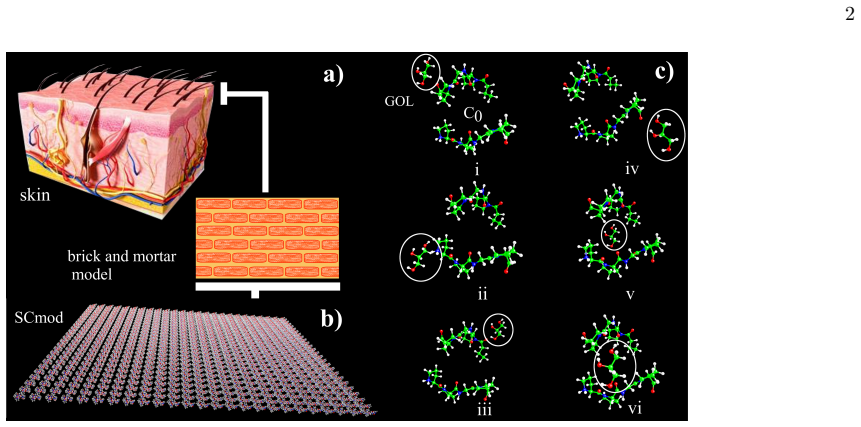
The archetype of the hygroscopic proteic portion (NMF) inside corneocytes coupled to glycerol molecules for the lipid fraction, treated with density functional theory to compute vibrations and elastic properties.
Load-bearing premise
The chosen archetype of NMF coupled to glycerol molecules sufficiently represents the essential molecular structure and interactions in the dry stratum corneum.
What would settle it
Experimental observation of no peaks or mismatched frequencies near 1120 and 1160 cm^{-1} in FTIR spectra assigned to lipid-NMF coupling, or a shear modulus prediction that deviates from the reported literature value for dry SC.
Figures

read the original abstract
Many questions concerning the biophysical and physiological properties of skin are still open. Skin aging, permeability, dermal absorption, hydration and drug transdermal delivery, are few examples of processes with its underlying mechanisms unveiled. In this work we present a first-principles density functional quantum atomistic model for single layer stratum corneum (SC) in order to contribute to unveil the molecular interactions behind the skin properties at this scale. The molecular structure of SC was modeled by an archetype of its hygroscopic proteic portion inside of the corneocytes, the natural moisturizing factor (NMF), coupled to glycerol molecules which represent the lipid fraction of SC. The vibrational spectra was calculated and compared to Fourier-Transform Infrared Absorption spectroscopy (FTIR) experimental data obtained on animal model of SC. We noticed that bands in the fingerprint region (800-1800 cm$^{-1}$) were correctly assigned. Moreover, our calculations revealed the existence of two coupled vibration between hydroxyl group of lipid and NMF methylene (1120 and 1160 cm$^{-1}$), which are of special interest since they probe the lipid-amino acid coupling. The model was also able to predict the shear modulus of dry SC in excellent agreement with the reported value on literature. Others physical/chemical properties could be calculated exploring the chemical accuracy and molecular resolution of our model. Research in dermatology, cosmetology, and biomedical engineering in the specific topics of drug delivery and/or mechanical properties of skin are examples of fields that would potentially take advantage of our approach.
Editorial analysis
A structured set of objections, weighed in public.
Referee Report
Summary. The manuscript presents a first-principles DFT atomistic model for single-layer dry stratum corneum, constructed as an archetype of natural moisturizing factor (NMF) coupled to glycerol molecules as a proxy for the lipid fraction. Vibrational spectra are computed and compared to experimental FTIR data on an animal SC model, with band assignments in the 800-1800 cm^{-1} fingerprint region; two coupled modes at 1120 and 1160 cm^{-1} are identified as lipid-NMF interactions. The model is also used to compute the shear modulus of dry SC, reported in excellent agreement with literature values.
Significance. If the NMF-glycerol archetype is shown to be representative, the work would supply a chemically accurate, molecular-resolution route to skin properties relevant to dermatology and drug delivery. The first-principles character and direct comparison to FTIR constitute strengths; however, the central claims rest on an unvalidated simplification whose transferability to real SC (ceramide/cholesterol/FFA bilayers) is not demonstrated.
major comments (3)
- [Abstract / Model description] Model construction (abstract and methods): the claim that glycerol molecules 'represent the lipid fraction of SC' is load-bearing for both the coupled-vibration assignments and the shear-modulus prediction, yet no justification or comparison to the known SC lipid composition (ceramides, cholesterol, free fatty acids in lamellar bilayers) is provided. This directly affects whether the 1120/1160 cm^{-1} modes can be interpreted as lipid-amino-acid coupling in actual tissue.
- [Abstract / Results on vibrational spectra] Vibrational results (abstract): the reported band assignments and identification of coupled hydroxyl-methylene modes lack any statement of the exchange-correlation functional, basis set, system size, or convergence criteria. Without these parameters or a comparison to a baseline calculation (e.g., isolated NMF or glycerol), the assignments cannot be assessed for robustness.
- [Abstract / Shear modulus prediction] Mechanical property (abstract): the shear modulus is stated to be in 'excellent agreement' with literature, but no computational protocol (e.g., strain application, supercell size, or error estimate) is given, nor are the numerical values or uncertainties reported. This prevents evaluation of whether the agreement is meaningful or accidental.
minor comments (2)
- [Abstract] The abstract refers to 'animal model of SC' for FTIR data; the specific species and preparation protocol should be stated for reproducibility.
- [Abstract] Notation for the coupled modes (1120 and 1160 cm^{-1}) should be clarified as to whether they are computed frequencies or shifted values.
Simulated Author's Rebuttal
We thank the referee for the careful reading and constructive comments, which have helped us improve the clarity and completeness of the manuscript. We address each major comment below and have revised the manuscript to incorporate additional details and justifications as appropriate.
read point-by-point responses
-
Referee: [Abstract / Model description] Model construction (abstract and methods): the claim that glycerol molecules 'represent the lipid fraction of SC' is load-bearing for both the coupled-vibration assignments and the shear-modulus prediction, yet no justification or comparison to the known SC lipid composition (ceramides, cholesterol, free fatty acids in lamellar bilayers) is provided. This directly affects whether the 1120/1160 cm^{-1} modes can be interpreted as lipid-amino-acid coupling in actual tissue.
Authors: We agree that the model is presented as an archetype and that the choice of glycerol as a proxy for the lipid fraction requires explicit justification and discussion of limitations. The revised manuscript includes an expanded Methods section that explains the rationale for this simplification (computational tractability while retaining key polar head-group interactions with NMF) and acknowledges that it does not incorporate the full lamellar bilayer composition of ceramides, cholesterol, and free fatty acids. We also discuss the implications for interpreting the coupled modes as representative of real tissue. revision: yes
-
Referee: [Abstract / Results on vibrational spectra] Vibrational results (abstract): the reported band assignments and identification of coupled hydroxyl-methylene modes lack any statement of the exchange-correlation functional, basis set, system size, or convergence criteria. Without these parameters or a comparison to a baseline calculation (e.g., isolated NMF or glycerol), the assignments cannot be assessed for robustness.
Authors: The manuscript's Computational Methods section contains the DFT parameters, but we acknowledge these were not referenced in the abstract or results. The revised version now explicitly states the exchange-correlation functional, basis set, system size, and convergence criteria in the abstract and results. We have also added baseline vibrational spectra for isolated NMF and glycerol (new supplementary material) to demonstrate that the 1120 and 1160 cm^{-1} features arise specifically from the coupled system. revision: yes
-
Referee: [Abstract / Shear modulus prediction] Mechanical property (abstract): the shear modulus is stated to be in 'excellent agreement' with literature, but no computational protocol (e.g., strain application, supercell size, or error estimate) is given, nor are the numerical values or uncertainties reported. This prevents evaluation of whether the agreement is meaningful or accidental.
Authors: We agree that the shear-modulus protocol and numerical details were insufficiently described. The revised manuscript adds a dedicated paragraph in the results (with cross-reference in the abstract) that specifies the strain application method, supercell dimensions, and error estimates. The computed shear modulus value together with its uncertainty is now reported explicitly so that the comparison to literature can be evaluated directly. revision: yes
Circularity Check
No significant circularity; derivation is self-contained against external benchmarks
full rationale
The paper constructs an archetype molecular model (NMF + glycerol) and performs first-principles DFT calculations to obtain vibrational spectra and shear modulus. These outputs are compared to independent external FTIR data and literature values rather than being fitted to the model's own results or derived from self-citations. The claimed coupled modes (1120/1160 cm^{-1}) and modulus agreement are direct computational predictions, not tautological renamings or self-referential fits. No load-bearing steps reduce to the inputs by construction.
Axiom & Free-Parameter Ledger
axioms (2)
- domain assumption Density functional theory accurately describes vibrational spectra and elastic properties for the NMF-glycerol system.
- ad hoc to paper NMF coupled to glycerol molecules sufficiently represents the key molecular interactions in single-layer dry SC.
invented entities (1)
-
NMF-glycerol archetype for stratum corneum
no independent evidence
Lean theorems connected to this paper
-
IndisputableMonolith.Foundation.RealityFromDistinctionreality_from_one_distinction unclear?
unclearRelation between the paper passage and the cited Recognition theorem.
The molecular structure of SC was modeled by an archetype of its hygroscopic proteic portion inside of the corneocytes, the natural moisturizing factor (NMF), coupled to glycerol molecules which represent the lipid fraction of SC. ... vibrational spectra was calculated ... shear modulus of dry SC
What do these tags mean?
- matches
- The paper's claim is directly supported by a theorem in the formal canon.
- supports
- The theorem supports part of the paper's argument, but the paper may add assumptions or extra steps.
- extends
- The paper goes beyond the formal theorem; the theorem is a base layer rather than the whole result.
- uses
- The paper appears to rely on the theorem as machinery.
- contradicts
- The paper's claim conflicts with a theorem or certificate in the canon.
- unclear
- Pith found a possible connection, but the passage is too broad, indirect, or ambiguous to say the theorem truly supports the claim.
Reference graph
Works this paper leans on
-
[1]
Z. Hongbo and H. I. Maibach, “Dermatotoxicology,” (CRC Press LCC, USA, 2004) Chap. 4: Anatomical Fac- tors Affecting Barrier Function, 6th ed
work page 2004
-
[2]
M. Boer, E. Duchnik, R. Maleszka, and M. Marchlewicz, Adv. Dermatol. Allergol. 33, 1 (2016)
work page 2016
-
[3]
Wheater’s functional histology: a text and colour atlas,
H. G. Burkitt, B. Young, and J. W. Heath, “Wheater’s functional histology: a text and colour atlas,” (Churchill Livingstone, 2014) pp. 159–179, 6th ed. 6
work page 2014
-
[4]
J. G. M. J. MD and J. J. M. MD, Lookingbill and Marks’ Principles of Dermatology , 5th ed. (Saunders, 2013)
work page 2013
- [5]
- [6]
-
[7]
J. Q. Del Rosso and J. Levin, J. Clin. Aesthet. Dermatol. 4, 22 (2011)
work page 2011
-
[8]
S. Verdier-S´ evrain and F. Bont´ e, J. Cosmet. Dermatol. 6, 75 (2007)
work page 2007
- [9]
-
[10]
E. T. Sato, A. R. Rocha, L. F. d. C. e Silva, J. D. Almeida, and H. Martinho, Phys. Rev. E 91, 063310 (2015)
work page 2015
-
[11]
R. Maiti, L.-C. Gerhardt, Z. S. Lee, R. A. Byers, D. Woods, J. A. Sanz-Herrera, S. E. Franklin, R. Lewis, S. J. Matcher, and M. J. Carr´ e, J. Mech. Behav. Biomed. Mater. 62, 556 (2016)
work page 2016
-
[12]
M. Karsdal, Biochemistry of collagens, laminins and elastin: structure, function and biomarkers (Academic Press, 2016)
work page 2016
- [13]
-
[14]
C. M. Schoellhammer, D. Blankschtein, and R. Langer, Expert Opin. Drug Deliv. 11, 393 (2014)
work page 2014
-
[15]
L. T. Fox, M. Gerber, J. D. Plessis, and J. H. Hamman, Molecules 16, 10507 (2011)
work page 2011
- [16]
- [17]
- [18]
- [19]
-
[20]
T. Hatanaka, S. Yoshida, W. R. Kadhum, H. Todo, and K. Sugibayashi, Pharm. Res. 32, 3965 (2015)
work page 2015
-
[21]
G. Verheyen, E. Braeken, K. Van Deun, and S. Van Miert, SAR QSAR Environ. Res. 28, 59 (2017)
work page 2017
- [22]
-
[23]
N. Machado, L. dos Santos, B. Carvalho, P. Singh, C. T. Soto, N. G. Azoia, A. Cavaco-Paulo, A. Martin, and P. Favero, Computers in biology and medicine 75, 151 (2016)
work page 2016
- [24]
-
[25]
M. G. Saunders and G. A. Voth, Annu. Rev. Biophys. 42, 73 (2013)
work page 2013
-
[26]
N. Ren, J. Liang, X. Qu, J. Li, B. Lu, and J. Tian, Opt. Express 18, 6811 (2010)
work page 2010
- [27]
-
[28]
D. J. Cole and N. D. M. Hine, J. Phys.: Condens. Matter. 28, 393001 (2016)
work page 2016
-
[29]
Q. Cui, R. Hernandez, S. E. Mason, T. Frauenheim, J. A. Pedersen, and F. Geiger, The Journal of Phys- ical Chemistry B 120, 7297 (2016), pMID: 27388532, http://dx.doi.org/10.1021/acs.jpcb.6b03976
-
[30]
E. T. Sato and H. Martinho, Biom. Opt. Exp. 9, 1728 (2018)
work page 2018
-
[31]
T. A. Halgren, J. Comput. Chem. 20, 720 (1999)
work page 1999
-
[32]
M. D. Hanwell, D. E. Curtis, D. C. Lonie, T. Vander- meersch, E. Zurek, and G. R. Hutchison, J. Cheminfor. 4, 1 (2012)
work page 2012
- [33]
-
[34]
“Cpmd, http://www.cpmd.org/,copyright ibm corp 1990-2008, copyright mpi f¨ ur festk¨ orperforschung stuttgart.” (1997-2001)
work page 1990
-
[35]
C. Lee, W. Yang, and R. G. Parr, Phys. Rev. B 37, 785 (1988)
work page 1988
-
[36]
O. A. von Lilienfeld, I. Tavernelli, U. Rothlisberger, and D. Sebastiani, Phys. Rev. B 71, 195119 (2005)
work page 2005
-
[37]
D. Kaushik, K. O’Fallon, P. M. Clarkson, C. Patrick Dunne, K. R. Conca, and B. Michniak-Kohn, J. Food Sci. 77 (2012)
work page 2012
- [38]
-
[39]
Fityk: y(x) curve fitting and data analysis,
“Fityk: y(x) curve fitting and data analysis,” available on http://www.unipress.waw.pl/fityk/ (2009)
work page 2009
-
[40]
Y. Xu, S. Deng, X. Li, and Y. He, Neurocomputing 207, 120 (2016)
work page 2016
-
[41]
C. Choe, J. Schleusener, J. Lademann, and M. E. Darvin, Sci. Rep. 7 (2017), 10.1038/s41598-017-16202-x
-
[42]
French, Vibrations and Waves (CBS Publishers & Dis- tributors, 2003)
A. French, Vibrations and Waves (CBS Publishers & Dis- tributors, 2003)
work page 2003
- [43]
-
[44]
M. F. Leyva-Mendivil, A. Page, N. W. Bressloff, and G. Limbert, J. Mech. Behav. Biomed. Mater. 49, 197 (2015)
work page 2015
- [45]
-
[46]
C.-Y. Chen, C.-A. Yu, T.-F. Hong, Y.-L. Chung, and W.-L. Li, Biosurf. Biotribol. 1, 62 (2015)
work page 2015
- [47]
discussion (0)
Sign in with ORCID, Apple, or X to comment. Anyone can read and Pith papers without signing in.