An error analysis of discrete Kirchhoff elements
Pith reviewed 2026-07-02 18:04 UTC · model grok-4.3
The pith
The error of the Discrete Kirchhoff Triangle method for the biharmonic equation is bounded by the best approximation of the Hessian by piecewise constants and the oscillation of the right-hand side.
A machine-rendered reading of the paper's core claim, the machinery that carries it, and where it could break.
Core claim
The error in the discrete energy norm for the DKT discretization of the biharmonic equation is controlled by the best approximation error of the Hessian by piecewise constant functions plus the oscillation of the right-hand side. This holds without further regularity assumptions on the solution. The analysis extends canonically to three dimensions and yields residual-based a posteriori estimators. Within the general framework, it also shows that known stable Stokes pairs admit discrete stream functions in the discrete Kirchhoff spaces, leading to positive definite and pressure-robust variants.
What carries the argument
The general framework for low-order nonconforming methods, which reduces the consistency error analysis to best approximation properties by constants.
If this is right
- First-order convergence of the classical DKT element on general meshes.
- A canonical extension to three space dimensions with equivalent approximation properties.
- Derivation of residual-based a posteriori error estimates.
- Best-approximation results by constants for various other classical nonconforming elements.
- Existence of discrete stream functions for stable Stokes pairs inside discrete Kirchhoff spaces, enabling pressure-robust schemes.
Where Pith is reading between the lines
- The framework could be applied to analyze other plate elements or fourth-order problems without additional smoothness assumptions.
- Numerical tests on problems with singular solutions could verify the sharpness of the bound.
- The Stokes connection suggests possible new mixed finite element methods for the biharmonic equation.
- Extensions might cover adaptive mesh refinement driven by the a posteriori estimators.
Load-bearing premise
The general framework for low-order nonconforming methods applies directly to the DKT element and its three-dimensional extension.
What would settle it
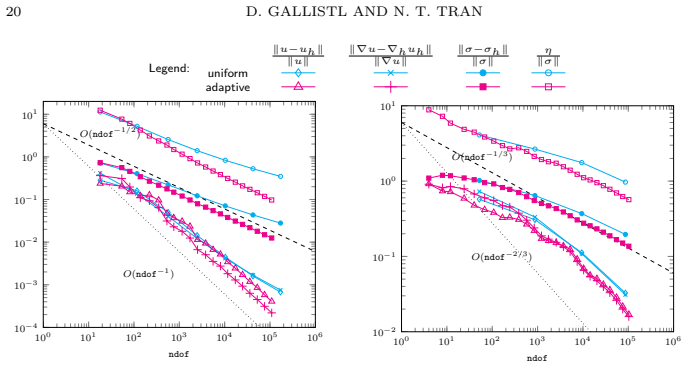
A computation on successively refined meshes showing that the DKT error exceeds a fixed multiple of the best Hessian approximation by constants plus the right-hand side oscillation would disprove the bound.
Figures

read the original abstract
The Discrete Kirchhoff Triangle (DKT) method for the biharmonic equation is analyzed in the discrete energy norm. The error is bounded by the best approximation of the Hessian by piecewise constants and the oscillation of the right-hand side, without additional regularity assumptions on the exact solution. This result implies first-order convergence of the classical DKT element and the analysis yields a canonical extension to three space dimensions with the same approximation properties. Residual-based a posteriori error estimates are derived. The analysis is formulated within a general framework for low-order nonconforming methods, which also applies to various classical elements and yields best-approximation results by constants. It is furthermore shown how known stable pairs for the planar Stokes system have discrete stream functions in discrete Kirchhoff spaces. This yields variants of the known schemes with positive definite formulations and pressure-robust error bounds.
Editorial analysis
A structured set of objections, weighed in public.
Referee Report
Summary. The paper analyzes the Discrete Kirchhoff Triangle (DKT) element for the biharmonic equation in the discrete energy norm. It establishes an a priori error bound by the L² best approximation of the Hessian by piecewise constants plus the data oscillation term, without extra regularity assumptions on the exact solution. This yields first-order convergence for the classical DKT element. The analysis is placed inside a general framework for low-order nonconforming methods that also produces best-approximation results by constants for other elements; residual a posteriori estimates are derived; a 3D extension is obtained; and a connection is made to stable Stokes pairs whose discrete stream functions lie in discrete Kirchhoff spaces, producing positive-definite, pressure-robust formulations.
Significance. If the central bound holds, the work supplies a robust, minimal-regularity a priori analysis for a classical nonconforming element on fourth-order problems and a reusable framework that recovers best-approximation constants for several low-order schemes. The parameter-free character of the bound and the explicit link to pressure-robust Stokes discretizations are concrete strengths. The result is of clear interest to the finite-element community working on nonconforming methods and biharmonic problems.
minor comments (2)
- [Abstract] The abstract states that the framework 'also applies to various classical elements' but does not name them; a short list or reference in the introduction would help readers locate the scope of the general theory.
- Notation for the discrete energy norm and the nonconforming space is introduced without an early consolidated table or list of symbols; adding one would improve readability for readers comparing the DKT case with the general framework.
Simulated Author's Rebuttal
We thank the referee for the positive summary, significance assessment, and recommendation of minor revision. No major comments were listed in the report, so there are no specific points requiring point-by-point response or revision.
Circularity Check
No significant circularity; derivation self-contained in standard FEM framework
full rationale
The paper presents an a priori error analysis for the DKT element (and 3D extension) by verifying hypotheses of a general framework for low-order nonconforming methods, yielding a bound in terms of best Hessian approximation by piecewise constants plus data oscillation. This relies on standard approximation properties of the discrete space and minimal regularity for the biharmonic problem, without any reduction of the central bound to a fitted quantity, self-defined input, or load-bearing self-citation chain. The additional result on discrete stream functions from known Stokes pairs is presented as an application of existing stable pairs, not as a foundational premise. No step equates the claimed result to its inputs by construction.
Axiom & Free-Parameter Ledger
axioms (1)
- domain assumption Standard assumptions on quasi-uniform meshes and polynomial degree for low-order nonconforming finite element spaces
Reference graph
Works this paper leans on
-
[1]
S. Bartels. Approximation of large bending isometries with discrete Kirchhoff triangles.SIAM J. Numer. Anal., 51(1):516–525, 2013
2013
-
[2]
Bartels.Numerical methods for nonlinear partial differential equations, volume 47 of Springer Series in Computational Mathematics
S. Bartels.Numerical methods for nonlinear partial differential equations, volume 47 of Springer Series in Computational Mathematics. Springer, Cham, 2015
2015
-
[3]
Batoz, K.-J
J.-L. Batoz, K.-J. Bathe, and L.-W. Ho. A study of three-node triangular plate bending elements.International Journal for Numerical Methods in Engineering, 15(12):1771–1812, 1980
1980
-
[4]
Beir˜ ao da Veiga, J
L. Beir˜ ao da Veiga, J. Niiranen, and R. Stenberg. A posteriori error estimates for the Morley plate bending element.Numer. Math., 106(2):165–179, 2007
2007
-
[5]
Blum and R
H. Blum and R. Rannacher. On the boundary value problem of the biharmonic operator on domains with angular corners.Math. Methods Appl. Sci., 2(4):556–581, 1980
1980
-
[6]
Boffi, F
D. Boffi, F. Brezzi, and M. Fortin.Mixed Finite Element Methods and Applications, volume 44 ofSpringer Series in Computational Mathematics. Springer, Heidelberg, 2013
2013
-
[7]
Braess.Finite Elements
D. Braess.Finite Elements. Theory, Fast Solvers, and Applications in Elasticity Theory. Cambridge University Press, Cambridge, third edition, 2007
2007
-
[8]
D. Braess. An a posteriori error estimate and a comparison theorem for the nonconforming P1 element.Calcolo, 46(2):149–155, 2009
2009
-
[9]
S. C. Brenner and L.-Y. Sung.C 0 interior penalty methods for fourth order elliptic boundary value problems on polygonal domains.J. Sci. Comput., 22/23:83–118, 2005
2005
-
[10]
Carstensen, D
C. Carstensen, D. Gallistl, and J. Hu. A posteriori error estimates for nonconforming finite element methods for fourth-order problems on rectangles.Numer. Math., 124(2):309–335, 2013
2013
-
[11]
Carstensen, D
C. Carstensen, D. Peterseim, and M. Schedensack. Comparison results of finite element meth- ods for the Poisson model problem.SIAM J. Numer. Anal., 50(6):2803–2823, 2012
2012
-
[12]
P. G. Ciarlet.The finite element method for elliptic problems, volume 40 ofClassics in Applied Mathematics. Society for Industrial and Applied Mathematics (SIAM), Philadelphia, PA, 2002
2002
-
[13]
D¨ orfler
W. D¨ orfler. A convergent adaptive algorithm for Poisson’s equation.SIAM J. Numer. Anal., 33(3):1106–1124, 1996
1996
-
[14]
Douglas, Jr., T
J. Douglas, Jr., T. Dupont, P. Percell, and R. Scott. A family ofC 1 finite elements with op- timal approximation properties for various Galerkin methods for 2nd and 4th order problems. RAIRO Anal. Num´ er., 13(3):227–255, 1979
1979
-
[15]
Ern and J.-L
A. Ern and J.-L. Guermond.Theory and practice of finite elements, volume 159 ofApplied Mathematical Sciences. Springer-Verlag, New York, 2004
2004
-
[16]
R. S. Falk and M. E. Morley. Equivalence of finite element methods for problems in elasticity. SIAM J. Numer. Anal., 27(6):1486–1505, 1990
1990
-
[17]
Fraeijs de Veubeke
B. Fraeijs de Veubeke. Variational principles and the patch test.Internat. J. Numer. Methods Engrg., 8:783–801, 1974
1974
-
[18]
Gallistl
D. Gallistl. Morley finite element method for the eigenvalues of the biharmonic operator. IMA J. Numer. Anal., 35(4):1779–1811, 2015. DISCRETE KIRCHHOFF ELEMENTS 21
2015
-
[19]
Gallistl and S
D. Gallistl and S. Tian. A posteriori error estimates for nonconforming discretizations of singularly perturbed biharmonic operators.SMAI J. Comput. Math., 10:355–372, 2024
2024
-
[20]
Grisvard.Elliptic Problems in Nonsmooth Domains, volume 24 ofMonographs and Studies in Mathematics
P. Grisvard.Elliptic Problems in Nonsmooth Domains, volume 24 ofMonographs and Studies in Mathematics. Pitman, Boston, MA, 1985
1985
-
[21]
Grisvard.Singularities in Boundary Value Problems, volume 22 ofRecherches en Math´ ematiques Appliqu´ ees
P. Grisvard.Singularities in Boundary Value Problems, volume 22 ofRecherches en Math´ ematiques Appliqu´ ees. Masson, Paris, 1992
1992
-
[22]
T. Gudi. A new error analysis for discontinuous finite element methods for linear elliptic problems.Math. Comp., 79(272):2169–2189, 2010
2010
-
[23]
Guzm´ an, A
J. Guzm´ an, A. Lischke, and M. Neilan. Exact sequences on Worsey-Farin splits.Math. Comp., 91(338):2571–2608, 2022
2022
-
[24]
Hu and Z
J. Hu and Z. Shi. A new a posteriori error estimate for the Morley element.Numer. Math., 112(1):25–40, 2009
2009
-
[25]
Hu and Z.-C
J. Hu and Z.-C. Shi. The bestL 2 norm error estimate of lower order finite element methods for the fourth order problem.J. Comput. Math., 30(5):449–460, 2012
2012
-
[26]
V. John, A. Linke, C. Merdon, M. Neilan, and L. G. Rebholz. On the divergence constraint in mixed finite element methods for incompressible flows.SIAM Rev., 59(3):492–544, 2017
2017
-
[27]
Lascaux and P
P. Lascaux and P. Lesaint. Some nonconforming finite elements for the plate bending problem. Rev. Fran¸ caise Automat. Informat. Recherche Operationnelle, 9(R-1):9–53, 1975
1975
-
[28]
P. L. Lederer, A. Linke, C. Merdon, and J. Sch¨ oberl. Divergence-free reconstruction operators for pressure-robust Stokes discretizations with continuous pressure finite elements.SIAM J. Numer. Anal., 55(3):1291–1314, 2017
2017
-
[29]
A hybrid high-order method for the biharmonic problem
Y. Liang and N. T. Tran. A hybrid high-order method for the biharmonic problem. arXiv:2504.16608, 2026
work page internal anchor Pith review Pith/arXiv arXiv 2026
-
[30]
A. Linke. On the role of the Helmholtz decomposition in mixed methods for incompressible flows and a new variational crime.Comput. Methods Appl. Mech. Eng., 268:782–800, 2014
2014
-
[31]
Linke, G
A. Linke, G. Matthies, and L. Tobiska. Robust arbitrary order mixed finite element methods for the incompressible Stokes equations with pressure independent velocity errors.ESAIM Math. Model. Numer. Anal., 50(1):289–309, 2016
2016
-
[32]
L. Morley. The triangular equilibrium element in the solution of plate bending problems. Aeronaut.Quart., 19:149–169, 1968
1968
-
[33]
T. K. Nilssen, X.-C. Tai, and R. Winther. A robust nonconformingH 2-element.Math. Comp., 70(234):489–505, 2001
2001
-
[34]
O˜ nate, F
E. O˜ nate, F. Zarate, and F. Flores. A simple triangular element for thick and thin plate and shell analysis.Int. J. Numer. Methods Eng., 37(15):2569–2582, 1994
1994
-
[35]
B. Specht. Modified shape functions for the three-node plate bending element passing the patch test.International Journal for Numerical Methods in Engineering, 26(3):705–715, 1988
1988
-
[36]
N. T. Tran. Quasi-optimal polytopal finite element methods for biharmonic equation. arXiv:2605.21764, 2026
work page internal anchor Pith review Pith/arXiv arXiv 2026
-
[37]
Veeser and P
A. Veeser and P. Zanotti. Quasi-optimal nonconforming methods for symmetric elliptic prob- lems. I—Abstract theory.SIAM J. Numer. Anal., 56(3):1621–1642, 2018
2018
-
[38]
Veeser and P
A. Veeser and P. Zanotti. Quasi-optimal nonconforming methods for symmetric elliptic prob- lems. II—Overconsistency and classical nonconforming elements.SIAM J. Numer. Anal., 57(1):266–292, 2019
2019
-
[39]
Verf¨ urth.A posteriori error estimation techniques for finite element methods
R. Verf¨ urth.A posteriori error estimation techniques for finite element methods. Numerical Mathematics and Scientific Computation. Oxford University Press, Oxford, 2013
2013
-
[40]
ˇZen´ ıˇ sek
A. ˇZen´ ıˇ sek. Polynomial approximation on tetrahedrons in the finite element method.J. Ap- proximation Theory, 7:334–351, 1973
1973
-
[41]
Wang, Z.-c
M. Wang, Z.-c. Shi, and J. Xu. A new class of Zienkiewicz-type non-conforming element in any dimensions.Numer. Math., 106(2):335–347, 2007
2007
-
[42]
Wang and J
M. Wang and J. Xu. The Morley element for fourth order elliptic equations in any dimensions. Numer. Math., 103(1):155–169, 2006
2006
-
[43]
Wang, J.-c
M. Wang, J.-c. Xu, and Y.-c. Hu. Modified Morley element method for a fourth order elliptic singular perturbation problem.J. Comput. Math., 24(2):113–120, 2006
2006
-
[44]
S. Zhang. A family of 3D continuously differentiable finite elements on tetrahedral grids. Appl. Numer. Math., 59(1):219–233, 2009. (D. Gallistl)Institut f ¨ur Mathematik, Universit ¨at Jena, 07743 Jena, Germany Email address:dietmar.gallistl [at] uni-jena.de (N. T. Tran)Institut f ¨ur Mathematik, Universit ¨at Augsburg, 86159 Augsburg, Ger- many Email ad...
2009
discussion (0)
Sign in with ORCID, Apple, or X to comment. Anyone can read and Pith papers without signing in.