Long-Period Transients as a new frontier in time-domain astronomy
Pith reviewed 2026-06-26 04:34 UTC · model grok-4.3
The pith
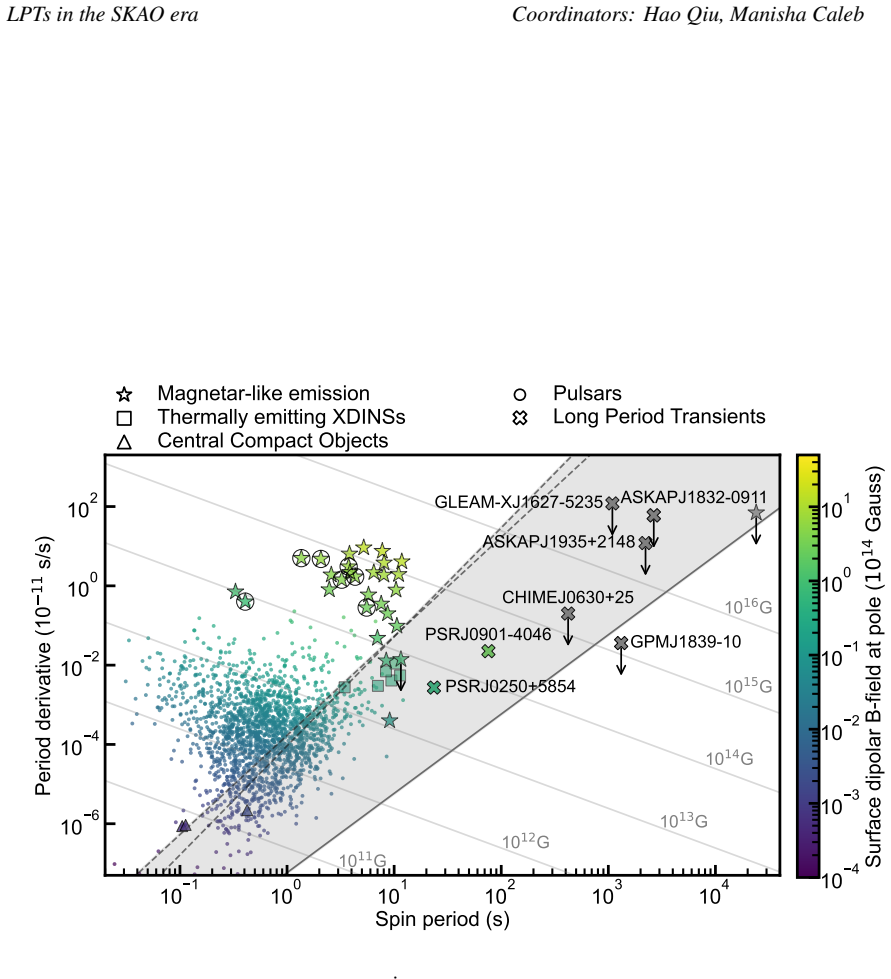
Long-period radio transients have radio luminosities exceeding rotational energy budgets, requiring alternative sources and indicating a diverse set of progenitors including ultra-long period magnetars and magnetic white dwarf binaries.
A machine-rendered reading of the paper's core claim, the machinery that carries it, and where it could break.
Core claim
Long-period radio transients occupy an observational gap between pulsars and slowly varying radio sources. They emit coherent, highly polarised radio bursts with periods from minutes to hours, frequently showing millisecond- to minute-scale structure, short duty cycles and broadband spectra. Their radio luminosities typically exceed the available rotational energy, so the paper argues that magnetic-field decay, magnetospheric reconnection or binary interactions must supply the power. Multiwavelength counterparts in X-ray, optical and infrared bands supply the main constraints, and the accumulating data indicate a mixed progenitor population that includes ultra-long-period magnetars and magne
What carries the argument
Long-period radio transients (LPTs), defined as coherent, highly polarised radio emitters with periods of minutes to hours whose luminosities exceed pure rotational budgets.
If this is right
- Multiwavelength counterparts in X-ray, optical and infrared bands will continue to constrain both progenitors and emission mechanisms.
- Fast imaging surveys with SKAO and its precursors will enable systematic detection, high-cadence monitoring and detailed follow-up.
- The growing sample will serve as a laboratory for testing how coherent radio emission depends on magnetic-field strength, rotation rate and binary interaction.
- Intermittent emission, high extinction and computational search demands remain practical obstacles to discovery.
Where Pith is reading between the lines
- If the progenitor diversity holds, LPTs may trace distinct evolutionary channels that link isolated neutron stars to accreting white-dwarf systems.
- High-cadence monitoring of individual sources could reveal whether period or luminosity changes track magnetic-field evolution or orbital motion.
- The requirement for alternative energy sources may generalise to other classes of coherent radio emitters whose spin-down budgets appear insufficient.
Load-bearing premise
The observed radio luminosities of LPTs typically exceed what rotational energy alone can supply.
What would settle it
A direct measurement of an LPT's spin-down luminosity that is equal to or greater than its radio luminosity would remove the need for non-rotational energy sources.
Figures

read the original abstract
Long-period radio transients (LPTs) are relatively new astrophysical objects occupying the observational gap between canonical pulsars and slowly varying radio variables. They emit coherent, highly polarised radio bursts with periods from minutes to hours, often exhibiting millisecond- to minute-scale substructure, short duty cycles, and broadband emission. Their radio luminosities typically exceed what rotational energy alone can power, necessitating alternative energy sources such as magnetic field decay, magnetospheric reconnection, or binary interactions. As multiwavelength counterparts in X-ray, optical, and infrared bands provide key constraints on progenitors and emission mechanisms, observational evidence points to a diverse progenitor population including ultra-long period magnetars and magnetic white dwarf binaries. Fast imaging surveys with SKAO and its precursors are opening a new discovery space, enabling systematic detection, high-cadence monitoring, and detailed follow-up. Despite the challenges of high extinction, intermittent emission, and computational demands for discovery, the expanding LPT population provides a new laboratory for studying coherent radio emission in a range of compact-object systems, from pulsars to white dwarf binaries. This diversity allows us to test how the emission processes depend on magnetic field strength, rotation, and binary interaction.
Editorial analysis
A structured set of objections, weighed in public.
Referee Report
Summary. The manuscript reviews long-period radio transients (LPTs) as an emerging class of coherent radio sources with periods from minutes to hours. It states that their radio luminosities typically exceed rotational energy budgets, requiring alternative power sources such as magnetic field decay or binary interactions, and cites multiwavelength counterparts as evidence for a diverse progenitor population including ultra-long period magnetars and magnetic white dwarf binaries. The text discusses observational challenges and the role of future surveys with SKAO and precursors in expanding the known population.
Significance. If the central energy-budget and progenitor-diversity claims are substantiated by quantitative comparisons in the cited literature, the review would usefully frame LPTs as a new laboratory for testing coherent emission mechanisms across a range of compact-object systems. The synthesis of multiwavelength constraints and discovery prospects with next-generation facilities could help organize an emerging observational niche.
major comments (1)
- [Abstract] Abstract: The claim that 'Their radio luminosities typically exceed what rotational energy alone can power' is presented without any reported flux densities, distances, periods, period derivatives, or explicit comparison of L_radio to Ė_rot = (4π²IṖ)/P³ for specific LPTs. This unquantified assertion is load-bearing for the subsequent argument that alternative energy sources are required and that the population is therefore diverse (ultra-long period magnetars, magnetic white dwarf binaries). No section, table, or cited reference supplies the missing numbers or the 'typically' criterion.
minor comments (1)
- [Abstract] The abstract uses 'SKAO' without spelling out the acronym on first use; this should be expanded for clarity.
Simulated Author's Rebuttal
We thank the referee for their careful and constructive review. We address the single major comment below and will revise the manuscript to incorporate the requested quantitative support.
read point-by-point responses
-
Referee: [Abstract] Abstract: The claim that 'Their radio luminosities typically exceed what rotational energy alone can power' is presented without any reported flux densities, distances, periods, period derivatives, or explicit comparison of L_radio to Ė_rot = (4π²IṖ)/P³ for specific LPTs. This unquantified assertion is load-bearing for the subsequent argument that alternative energy sources are required and that the population is therefore diverse (ultra-long period magnetars, magnetic white dwarf binaries). No section, table, or cited reference supplies the missing numbers or the 'typically' criterion.
Authors: We agree that the abstract assertion would be strengthened by explicit quantitative comparisons. While the cited literature contains the underlying calculations, the manuscript does not compile or present the relevant numbers (flux densities, distances, periods, Ṗ values, and L_radio vs. Ė_rot) in one place. In the revised version we will (i) add brief quantitative examples to the abstract and (ii) insert a new table in the main text that lists the key parameters and the resulting L_radio/Ė_rot ratios for all published LPTs, with references to the original works. This will make the 'typically' statement self-contained and directly support the subsequent discussion of alternative power sources and progenitor diversity. revision: yes
Circularity Check
No derivations, predictions, or fitted quantities; claims are observational assertions without self-referential reduction.
full rationale
This is a review/perspective paper on long-period transients. It asserts that radio luminosities typically exceed rotational energy budgets but presents no equations, period derivatives, luminosity calculations, or model fits. No self-citations are used to justify uniqueness theorems or ansatzes. The diversity-of-progenitors claim is framed as following from multiwavelength observations cited in the literature, not from any internal derivation chain that reduces to its own inputs. No load-bearing step matches any of the enumerated circularity patterns.
Axiom & Free-Parameter Ledger
Reference graph
Works this paper leans on
-
[1]
doi: 10.3847/1538-4357/ad66c9. A. Anumarlapudi et al.Monthly Notices of the Royal Astronomical Society, page staf1227,
-
[2]
Skaosciencedataproducts: asummary,June2025
V.Arumugametal. Skaosciencedataproducts: asummary,June2025. URLhttps://doi.org/ 10.5281/zenodo.16950880. M. Bailes et al. PASA, 37:e028, July
-
[3]
doi: 10.1017/pasa.2020.19. P. Beniamini, K. Hotokezaka, A. van der Horst, and C. Kouveliotou. MNRAS, 487(1):1426–1438, July
-
[4]
doi: 10.1093/mnras/stz1391. P. Beniamini et al. MNRAS, 520(2):1872–1894, Apr
-
[5]
doi: 10.1093/mnras/stad208. S. Bloot et al.Astronomy & Astrophysics, 699:A341,
-
[6]
doi: 10.1093/mnras/ stae1813. J. M. Cordes and M. A. McLaughlin. ApJ, 596(2):1142–1154, Oct
-
[7]
doi: 10.1086/378231. I. de Ruiter et al.Monthly Notices of the Royal Astronomical Society, 531(4):4805–4822,
-
[8]
doi: 10.1093/mnras/stae1458. I. de Ruiter et al.Nature Astronomy, pages 1–13,
-
[9]
doi: 10.1093/mnras/stae2376. F. A. Dong et al.arXiv preprint arXiv:2407.07480,
-
[10]
doi: 10.1017/pasa.2025.10093. C. Horváth et al.Publications of the Astronomical Society of Australia, pages 1–13,
-
[11]
doi: 10.1038/s41550-025-02760-y. N. Hurley-Walker et al.Nature, 601(7894):526–530,
-
[12]
doi: 10.1093/mnras/stx2126. M. J. Keith et al. MNRAS, 409(2):619–627, Dec
-
[13]
doi: 10.1111/j.1365-2966.2010.17325.x. Y. Lee et al.Nature Astronomy, pages 1–13,
-
[14]
doi: 10.1038/s41550-024-02452-z. A. Loeb and D. Maoz.Research Notes of the American Astronomical Society, 6(2):27, Feb
-
[15]
doi: 10.3847/2515-5172/ac52f1. J.-P. Macquart et al. PASA, 27(3):272–282, June
-
[16]
doi: 10.1071/AS09082. R. N. Manchester, G. B. Hobbs, A. Teoh, and M. Hobbs. AJ, 129(4):1993–2006, Apr
-
[17]
doi: 10.1086/428488. Y.-H. Mao et al. ApJ, 988(1):L11, July
work page internal anchor Pith review doi:10.1086/428488
-
[18]
doi: 10.3847/2041-8213/ade80c. T. R. Marsh et al. Nature, 537(7620):374–377, Sept
-
[19]
doi: 10.1038/nature18620. S. J. McSweeney et al.Monthly Notices of the Royal Astronomical Society, 542(1):203–214,
-
[20]
doi: 10.3847/0004-637X/818/2/105. T. Murphy and D. L. Kaplan. PASA, pages 1–59,
-
[21]
doi: 10.1017/pasa.2021.44. I. Pelisoli et al.Nature Astronomy, 7:931–942, Aug
-
[22]
doi: 10.1038/s41550-023-01995-x. Y. Qu and B. Zhang. ApJ, 981(1):34, Mar
-
[23]
doi: 10.3847/1538-4357/adb1b5. K. M. Rajwade et al. MNRAS, 514(2):1961–1974, Aug
-
[24]
doi: 10.1093/mnras/stac1450. S. M. Ransom, S. S. Eikenberry, and J. Middleditch. AJ, 124(3):1788–1809, Sept
-
[25]
doi: 10.1086/342285. N. Rea et al. ApJ, 940(1):72, Nov
work page internal anchor Pith review doi:10.1086/342285
-
[26]
doi: 10.3847/1538-4357/ac97ea. N. Rea, N. Hurley-Walker, and M. Caleb.Journal of High Energy Astrophysics, 52:100566, Apr
-
[27]
doi: 10.1016/j.jheap.2026.100566. A. C. Rodriguez.Astronomy & Astrophysics, 695:L8,
-
[28]
URL https://doi.org/10.5281/zenodo.16951020. R. M. Shannon et al. PASA, 42:e036, Jan
-
[29]
doi: 10.1017/pasa.2025.8. M. B. Sherman et al.arXiv e-prints, art. arXiv:2510.18136, Oct
-
[30]
doi: 10.48550/arXiv.2510. 18136. 17 LPTs in the SKAO era Coordinators: Hao Qiu, Manisha Caleb T. W. Shimwell et al. A&A, 598:A104, Feb
-
[31]
O.M.Smirnovetal.Monthly Notices of the Royal Astronomical Society: Letters,538(1):L62–L68,
doi: 10.1051/0004-6361/201629313. O.M.Smirnovetal.Monthly Notices of the Royal Astronomical Society: Letters,538(1):L62–L68,
-
[32]
doi: 10.1017/pasa.2015.6. Y. Wang et al.Monthly Notices of the Royal Astronomical Society, 523(4):5661–5680,
-
[33]
Z. Wang et al. PASA, 42:e005, Jan. 2025a. doi: 10.1017/pasa.2024.107. Z. Wang et al. Nature, 642(8068):583–586, June 2025b. doi: 10.1038/s41586-025-09077-w. Y.-P. Yang. ApJ, 997(1):124, Jan
-
[34]
doi: 10.3847/1538-4357/ae2864. X. Zhou et al. ApJ, 986(1):98, June
-
[35]
doi: 10.3847/1538-4357/add268. 18
discussion (0)
Sign in with ORCID, Apple, or X to comment. Anyone can read and Pith papers without signing in.