REVIEW 2 major objections 4 minor 1 cited by
Modelling chemical clocks -- Theoretical evidences of the space and time evolution of [s/alpha] in the Galactic disc with Gaia-ESO survey
T0 review · 2 major / 4 minor · reviewed 2026-08-11 · deepseek-v4-flash
Pith's one-line read The paper argues that the observed rise in barium relative to silicon among young inner-disc stars requires about 50% more barium production in the last 3 billion years than current nucleosynthesis prescriptions supply.
desk verdict Careful negative result on [s/α] clocks: the models fail in the inner disc, and the quantitative 'half more Ba' claim is interesting but hinges on the unquantified inner-disc Si residual. read the letter →
The pith
A machine-rendered reading of the paper's core claim, the machinery that carries it, and where it could break.
The reading
What carries the argument
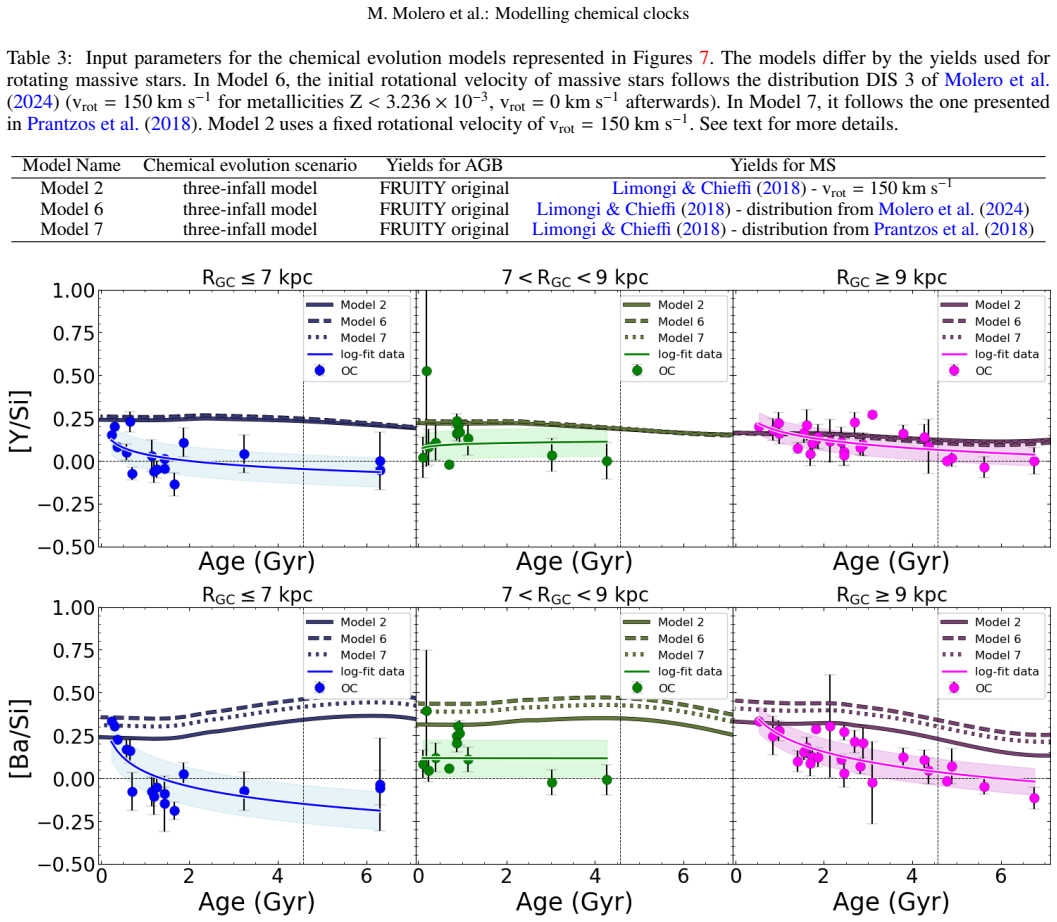
The carrying object is a set of multi-zone chemical evolution models with the two-infall and three-infall gas-accretion prescriptions, combined with FRUITY AGB yields and Limongi & Chieffi rotating massive-star yields for neutron-capture elements, and checked against open cluster data from the Gaia-ESO survey. The three-infall model splits the low-$\alpha$ disc into two recent gas infall episodes, which is what lets it reproduce the observed ~2 Gyr dilution in [s/H]. The quantitative headline comes from a residual identity, $X(\mathrm{Ba})_O - X(\mathrm{Ba})_M = X(\mathrm{Si})_M \left(10^{[\mathrm{Ba/Si}]_O + \mathrm{Sun}} - 10^{[\mathrm{Ba/Si}]_M + \mathrm{Sun}}\right)$, which converts the vertical offset between observed and modelled [Ba/Si] at young ages into a surface mass density of missing barium, $\Sigma_{\mathrm{Ba}} = 5.71\times 10^{-8}\,M_\odot\,\mathrm{pc}^{-2}$.
What would settle it
Measure [Si/H] and [Ba/H] in a sample of inner-disc open clusters younger than 1 Gyr with independent asteroseismic ages. If the model's silicon prediction is systematically higher than observed, the required barium increase shrinks; if barium is still underproduced when silicon is correct, then the nucleosynthesis yields are the culprit. A stellar-evolution calculation that produces substantially larger barium yields from ~1.1 to 1.3 solar-mass AGB stars at supersolar metallicity would directly support the proposed fix.
Extended reading notes
Core claim
The central claim is that no single [s/alpha]-age relation holds across the Galactic disc, and that the steep observed increase of [Ba/Si] toward young ages in the inner disc cannot be produced by the tested model variations. Starting from a two-infall and a three-infall chemical evolution model, the paper shows that the three-infall scenario captures the recent dilution in [s/H] at about 2 Gyr and the rise in the outer regions, but all configurations fail in the inner region, where the predicted trend is flat or inverted. The authors compute the missing barium abundance from the residual between the observed logarithmic fit and the model, assuming the model's silicon prediction is correct, and find that the inner disc would need roughly 1.5 times the currently produced barium over the last 3 Gyr. They also rule out simple fixes: reducing AGB yields at supersolar metallicity, adding an enhanced contribution from ~1.1 solar-mass AGB stars, or switching to metallicity-dependent rotational velocity distributions for massive stars either improves one element while worsening another or leaves the trend unchanged.
Load-bearing premise
The headline number—that inner-disc barium production must rise by about half—assumes the model's predicted silicon abundance in the inner disc is correct; if the model overproduces silicon there, the missing-barium estimate is too large, and the paper only demonstrates good silicon agreement in the solar and outer regions.
Editorial extensions
If this is right
- Stellar ages derived from [s/alpha] ratios calibrated on solar-neighbourhood clusters will be systematically biased when applied to inner-disc populations, because the slope of the relation changes with Galactocentric radius.
- Current AGB and massive-star yield prescriptions underproduce second s-process peak elements at high metallicity and young ages, so yield sets need revision, for example through mass- and metallicity-dependent s-process production or effects such as magnetic buoyancy.
- The rise in [Ba/Si] at young ages in the inner disc is a diagnostic of recent s-process enrichment that no tested combination of infall history and massive-star rotation can generate, implying an additional or enhanced low-mass AGB source.
- Yield-scaling factors cannot be treated as constant across the disc: the paper reports that matching the solar region requires an s-process reduction of about 1.8, the outer region about 0.4, and the inner region about 2.8.
- If the missing barium is real, chemical clocks based on barium carry a strong imprint of the recent star formation history of the inner disc, not just of stellar age.
Reading between the lines
- If the missing-barium signal is genuine, it suggests that barium production in the inner disc tracks recent star formation episodes more tightly than current stellar yields imply, so [Ba/alpha] may be better read as a star-formation-history indicator than as a pure age indicator.
- The same residual method could be applied to other s-process elements, such as lanthanum and cerium, and to other alpha elements such as magnesium or calcium, to map where the yield prescriptions break down and to identify a metallicity threshold for the discrepancy.
- A direct test would be high-resolution barium abundances in inner-disc open clusters younger than 1 Gyr with independent asteroseismic ages; if the apparent rise vanishes with better ages, the discrepancy is partly an age-dating artifact rather than a nucleosynthesis failure.
Editorial analysis
A structured set of objections, weighed in public.
Referee Report
Summary. The paper presents multi-zone chemical evolution models of the Milky Way disc using two-infall and three-infall gas accretion scenarios, with nucleosynthesis prescriptions for AGB stars, rotating massive stars, neutron-star mergers, and magneto-rotational supernovae. It compares the predicted [Y/Si] and [Ba/Si] versus age relations with Gaia-ESO open clusters in three Galactocentric regions. The authors find that the three-infall model reproduces the [s/H] dilution near 2 Gyr but fails to reproduce the observed young-age increase in [s/alpha], especially for Ba in the inner disc. They explore modifications of AGB yields and massive-star rotation distributions, none of which resolves the discrepancy. They quantify the missing Ba in the inner disc over the last 3 Gyr as roughly half of the model's current production, based on Eq. (7), and conclude that current neutron-capture yield prescriptions cannot capture the chemical-clock evolution in the inner disc.
Significance. If the results hold, the qualitative conclusion that current s-process yield prescriptions cannot reproduce the young-age rise in [Ba/Si] in the inner disc is an important constraint for nucleosynthesis and Galactic chemical evolution modeling. The paper has notable strengths: the sample selection with the log g and microturbulence cuts and the exclusion of NGC 6709 are carefully described and well motivated; the model variations are explicitly labeled as exploratory; and the central comparison uses external Gaia-ESO data as benchmarks rather than fitting the model to the age-abundance trends. The quantitative missing-Ba estimate is potentially falsifiable, but its numerical value rests on an unquantified inner-disc Si normalization and on an interpretation of an ISM abundance deficit as a required yield increase, so the quantitative headline is conditional on those assumptions.
major comments (2)
- [Section 5, Eq. (7) and Appendix A] The claim that Ba production in the inner disc must increase by approximately half in the last 3 Gyr is computed from X(Ba)_O - X(Ba)_M = X(Si)_M x (10^{[Ba/Si]_O+Sun} - 10^{[Ba/Si]_M+Sun}), which is directly proportional to the model's absolute Si abundance X(Si)_M. Appendix A verifies the [Si/H] vs. age agreement for Model 2 mainly in the solar and outer zones and quotes the solar Si abundance, but it does not quantify the inner-zone residual, which is exactly the zone where the 'half more' claim is made. A 0.1 dex model overproduction of Si in the inner disc changes the inferred Ba increase by roughly 26%, and 0.2 dex by roughly 58%. Please quantify the inner-disc [Si/H] offset over the relevant age range and propagate it into the missing-Ba estimate, or present the numerical factor as conditional on the Si normalization.
- [Section 5, Eq. (7) and final bullet] Equation (7) estimates a deficit in the ISM mass fraction X(Ba), and the paper subsequently converts this to a surface mass density Sigma_Ba. The conclusion, however, is phrased as 'the production of Ba ... should be approximately half more of the current one.' An ISM abundance deficit does not translate one-to-one into a required yield increase, because the ISM abundance at a given age is an integral over past production convolved with stellar lifetimes and astration. To support the yield-increase statement, the authors should either rephrase the conclusion as an ISM abundance deficit that would need to be filled, or run a modified model with enhanced Ba yields to derive the required yield change.
minor comments (4)
- [Section 5, Figure 8] The reported reduction factors (2.8, 1.8, 0.4) and the corresponding overproduction percentages (64%, 44%, 28%) are mutually inconsistent as written: a divisor of 1.8 removes about 44% of the model's Ba, a divisor of 2.8 about 64%, and the outer-region value should be near 1.4, not 0.4, to give about 28%. Please define whether the factors are multiplicative divisors or residual fractions and correct the apparent typo.
- [Section 3.2 and Figure 2] The text states that the reduction of FRUITY AGB yields is relaxed in this work, while the Figure 2 caption says the prescriptions are identical to Molero et al. (2023) 'with reduced s-process AGB production.' Please clarify which AGB yield set is used in Figure 2 and in Models 1-7, since this affects the sanity check of the Ba predictions.
- [Section 4.2, Table 2] For Models 4 and 5, the construction of the artificial 1.1 Msun yields should be described more explicitly: how exactly are the yields of the 1.3 Msun star scaled, and are all elements scaled by the same factor or only the s-process elements?
- [Throughout] There are several repeated typos, including 'regions of interested' in the Figure 3-7 captions, 'fist s-process peak' in the conclusions, and 'km−1' instead of 'km s−1' in Section 2.
Circularity Check
No significant circularity: the [s/alpha] vs age trends are external Gaia-ESO benchmarks, and the missing-Ba figure is an explicitly labeled diagnostic residual, not a fitted prediction.
full rationale
The paper's central comparisons are self-contained against external data: the [s/H], [s/Fe], and [s/Si] vs age relations come from the Gaia-ESO open-cluster sample, while the two- and three-infall models are constructed from prior work (Palla et al. 2020; Spitoni et al. 2023; Palla et al. 2024) calibrated to surface densities, star formation rates, Fe/alpha abundances, and the age-metallicity dilution. None of those calibration targets encodes the rising [s/alpha] slope, so the model's failure to reproduce that slope is a genuine external test rather than a restatement of an input. The headline missing-Ba estimate is not a fitted input called a prediction: Eq. (7) is an explicit bookkeeping identity, X(Ba)_O - X(Ba)_M = X(Si)_M (10^([Ba/Si]_O+Sun) - 10^([Ba/Si]_M+Sun)), evaluated under the openly stated assumption that the model's Si predictions are correct. The per-region reduction factors (2.8, 1.8, 0.4) are admittedly tuned normalizations used to isolate the residual shape; the paper labels the resulting quantity as a 'discrepancy' to be quantified, not as a first-principles prediction. Self-citations to Molero et al. (2023) and Palla et al. (2024) establish model provenance and prior calibration but do not smuggle in the [Ba/Si] trend being explained. The main weakness, acknowledged in Appendix A, is that the inner-region [Si/H] agreement is asserted as 'generally good' but not quantified; this is a sensitivity or assumption concern that would directly rescale the numerical 'half more' figure if the inner-disc Si prediction is off, but it is not circularity. No step in the derivation reduces by construction to its own input, so the appropriate finding is no significant circularity.
Assumptions & free parameters
free parameters (3)
- Regional s-process reduction factors =
2.8 (inner), 1.8 (solar), 0.4 (outer)
- 1.1 Msun AGB yield enhancement factor =
10x (Model 4) and 20x (Model 5)
- Super-solar AGB yield reduction =
factor 0.1 for Z >= 1.4e-2 (Model 3)
assumptions (5)
- domain assumption The Milky Way disc formed through two or three distinct gas infall episodes with the adopted timescales (tau1=1 Gyr, tmax=3.25 Gyr for second infall, third infall starting at 11 Gyr with tau3=1 Gyr).
- domain assumption The s-process fractions of Y and Ba at solar metallicity (78% and 89%, Prantzos et al. 2020) and the adopted r-process contributions from MNS and MR-SNe are applicable across the disc and metallicity range.
- domain assumption FRUITY AGB yields (with masses down to 1.3 Msun and metallicities down to Z=4.8e-5) and Limongi and Chieffi (2018) rotating massive star yields are the correct nucleosynthesis inputs.
- ad hoc to paper MR-SNe contribute only r-process material and no Fe or alpha elements.
- domain assumption Open cluster ages from isochrone fitting and Gaia-ESO abundances are accurate after the membership cuts (log g > 2.5, xi < 1.8).
Cite this review
Pith. "Pith review of Modelling chemical clocks -- Theoretical evidences of the space and time evolution of [s/alpha] in the Galactic disc with Gaia-ESO survey." pith.science (2026). https://pith.science/paper/HMSY6W5B
@misc{pith2026241211844,
  author       = {Pith},
  title        = {Pith review of: Modelling chemical clocks -- Theoretical evidences of the space and time evolution of [s/alpha] in the Galactic disc with Gaia-ESO survey},
  year         = {2026},
  howpublished = {\url{https://pith.science/paper/HMSY6W5B}},
  note         = {Machine review of arXiv:2412.11844}
}
read the original abstract
Chemical clocks based on [s-process elements/alpha-elements] ratios are widely used to estimate ages of Galactic stellar populations. However, the [s/alpha] vs. age relations are not universal, varying with metallicity, location in the Galactic disc, and specific s-process elements. Current Galactic chemical evolution models struggle to reproduce the observed [s/alpha] increase at young ages. We provide chemical evolution models for the Milky Way disc to identify the conditions required to reproduce the observed [s/H], [s/Fe], and [s/alpha] vs. age relations. We adopt a multi-zone chemical evolution model including state-of-the-art nucleosynthesis prescriptions for neutron-capture elements (AGB stars, rotating massive stars, neutron star mergers, magneto-driven supernovae). We explore variations in gas infall, AGB yield dependencies on progenitor stars, and rotational velocity distributions for massive stars. Results are compared with open cluster data from the Gaia-ESO survey. A three-infall scenario for disc formation captures the rise of [s/alpha] with age in the outer regions but fails in the inner ones, especially for second s-process peak elements. Ba production in the last 3 Gyr of chemical evolution would need to increase by half to match observations. S-process contributions from low-mass AGB stars improve predictions but require increases not supported by nucleosynthesis calculations, even with potential i-process contribution. Variations in the metallicity dependence of AGB yields show inconsistent effects across elements. Distributions of massive star rotational velocities fail to improve results due to balanced effects on elements. We confirm that there is no single relationship [s/alpha] vs. age, but that it varies along the MW disc. Current prescriptions for neutron-capture element yields cannot fully capture the complexity of evolution, particularly in the inner disc.
Figures


Figures from the paper (4 more)



Forward citations
Cited by 1 Pith paper
-
Tracing the early Milky Way thin disc with the Gaia-ESO Survey
A single metal-poor, alpha-enhanced star with thin-disc-like kinematics is identified as a candidate relic of the early Milky Way disc.
Reference graph
Works this paper leans on
-
[1]
D., Abraham, S., et al
Abbott, R., Abbott, T. D., Abraham, S., et al. 2021, ApJ, 913, L7
2021
-
[2]
J., & Scott, P
Asplund, M., Grevesse, N., Sauval, A. J., & Scott, P. 2009, ARA&A, 47, 481
2009
-
[3]
2021, A&A, 653, A67
Baratella, M., D’Orazi, V ., Sheminova, V ., et al. 2021, A&A, 653, A67
2021
-
[4]
2019, The Messenger, 175, 35
Bensby, T., Bergemann, M., Rybizki, J., et al. 2019, The Messenger, 175, 35
2019
-
[5]
A., van Saders, J
Berger, T. A., van Saders, J. L., Huber, D., et al. 2022, ApJ, 936, 100
2022
-
[6]
2024, A&A, 685, A66
Boulet, T. 2024, A&A, 685, A66
2024
-
[7]
J., Flaccomio, E., et al
Bragaglia, A., Alfaro, E. J., Flaccomio, E., et al. 2022, A&A, 659, A200
2022
-
[8]
2021, ApJ, 908, 55
Busso, M., Vescovi, D., Palmerini, S., Cristallo, S., & Antonuccio-Delogu, V . 2021, ApJ, 908, 55
2021
Show all 103 references
-
[9]
2020, A&A, 640, A1
Cantat-Gaudin, T., Anders, F., Castro-Ginard, A., et al. 2020, A&A, 640, A1
2020
-
[10]
1999, A&A, 351, 459
Cappellaro, E., Evans, R., & Turatto, M. 1999, A&A, 351, 459
1999
-
[11]
2023, A&A, 677, A60
Casali, G., Grisoni, V ., Miglio, A., et al. 2023, A&A, 677, A60
2023
-
[12]
2019, A&A, 629, A62
Casali, G., Magrini, L., Tognelli, E., et al. 2019, A&A, 629, A62
2019
-
[13]
2020, A&A, 639, A127
Casali, G., Spina, L., Magrini, L., et al. 2020, A&A, 639, A127
2020
-
[14]
& Matteucci, F
Cescutti, G. & Matteucci, F. 2022, Universe, 8, 173
2022
-
[15]
Chaplin, W. J. & Miglio, A. 2013, ARA&A, 51, 353 Article number, page 13 of 17 A&A proofs: manuscript no. main
2013
-
[16]
1997, ApJ, 477, 765
Chiappini, C., Matteucci, F., & Gratton, R. 1997, ApJ, 477, 765
1997
-
[17]
2001, ApJ, 554, 1044
Chiappini, C., Matteucci, F., & Romano, D. 2001, ApJ, 554, 1044
2001
-
[18]
2021, A&A, 648, A119
Choplin, A., Siess, L., & Goriely, S. 2021, A&A, 648, A119
2021
-
[19]
2022, A&A, 667, A155
Choplin, A., Siess, L., & Goriely, S. 2022, A&A, 667, A155
2022
-
[20]
2024, A&A, 684, A206
Choplin, A., Siess, L., Goriely, S., & Martinet, S. 2024, A&A, 684, A206
2024
-
[21]
2011, ApJS, 197, 17
Cristallo, S., Piersanti, L., Straniero, O., et al. 2011, ApJS, 197, 17
2011
-
[22]
2009, ApJ, 696, 797
Cristallo, S., Straniero, O., Gallino, R., et al. 2009, ApJ, 696, 797
2009
-
[23]
2015, ApJS, 219, 40 Delgado Mena, E., Moya, A., Adibekyan, V ., et al
Cristallo, S., Straniero, O., Piersanti, L., & Gobrecht, D. 2015, ApJS, 219, 40 Delgado Mena, E., Moya, A., Adibekyan, V ., et al. 2019a, A&A, 624, A78 Delgado Mena, E., Moya, A., Adibekyan, V ., et al. 2019b, A&A, 624, A78 D’Orazi, V ., De Silva, G. M., & Melo, C. F. H. 2017,...
2015
-
[24]
M., McMillan, P
Feltzing, S., Howes, L. M., McMillan, P. J., & Stonkut˙e, E. 2017, MNRAS, 465, L109
2017
-
[25]
2019, A&A, 632, A16
Frasca, A., Alonso-Santiago, J., Catanzaro, G., et al. 2019, A&A, 632, A16
2019
-
[26]
2016, MNRAS, 456, 1803
Frischknecht, U., Hirschi, R., Pignatari, M., et al. 2016, MNRAS, 456, 1803
2016
-
[27]
Frischknecht, U., Hirschi, R., & Thielemann, F. K. 2012, A&A, 538, L2 Gaia Collaboration, Recio-Blanco, A., Kordopatis, G., et al. 2023, A&A, 674, A38
2012
-
[28]
1998, ApJ, 497, 388
Gallino, R., Arlandini, C., Busso, M., et al. 1998, ApJ, 497, 388
1998
-
[29]
S., Pescalli, A., et al
Ghirlanda, G., Salafia, O. S., Pescalli, A., et al. 2016, A&A, 594, A84
2016
-
[30]
C., et al
Gilmore, G., Randich, S., Worley, C. C., et al. 2022, A&A, 666, A120
2022
-
[31]
2021, MNRAS, 500, 1755
Greggio, L., Simonetti, P., & Matteucci, F. 2021, MNRAS, 500, 1755
2021
-
[32]
2018, MNRAS, 481, 2570
Grisoni, V ., Spitoni, E., & Matteucci, F. 2018, MNRAS, 481, 2570
2018
-
[33]
R., Bovy, J., Holtzman, J
Hayden, M. R., Bovy, J., Holtzman, J. A., et al. 2015, ApJ, 808, 132
2015
-
[34]
R., Holtzman, J
Hayden, M. R., Holtzman, J. A., Bovy, J., et al. 2014, AJ, 147, 116
2014
-
[35]
1999, ApJS, 125, 439
Iwamoto, K., Brachwitz, F., Nomoto, K., et al. 1999, ApJS, 125, 439
1999
-
[36]
Jacobson, H. R. & Friel, E. D. 2013, AJ, 145, 107
2013
-
[37]
D., Jackson, R
Jeffries, R. D., Jackson, R. J., Wright, N. J., et al. 2023, MNRAS, 523, 802
2023
-
[38]
C., Dalton, G
Jin, S., Trager, S. C., Dalton, G. B., et al. 2024, MNRAS, 530, 2688 Jofré, P., Jackson, H., & Tucci Maia, M. 2020, A&A, 633, L9
2024
-
[39]
P., Molero, M., Navó, G., et al
Jost, F. P., Molero, M., Navó, G., et al. 2024, arXiv e-prints, arXiv:2407.14319
2024 arXiv
-
[40]
R., et al
Kalogera, V ., Kim, C., Lorimer, D. R., et al. 2004, ApJ, 601, L179
2004
-
[41]
Karakas, A. I. & Lugaro, M. 2016, ApJ, 825, 26
2016
-
[42]
& Chiappini, C
Kawata, D. & Chiappini, C. 2016, Astronomische Nachrichten, 337, 976
2016
-
[43]
1998, ApJ, 498, 541
Kennicutt, Robert C., J. 1998, ApJ, 498, 541
1998
-
[44]
2012, MNRAS, 426, 1940
Korobkin, O., Rosswog, S., Arcones, A., & Winteler, C. 2012, MNRAS, 426, 1940
2012
-
[45]
& Chieffi, A
Limongi, M. & Chieffi, A. 2018, ApJS, 237, 13
2018
-
[46]
2018, ApJ, 865, 112
Liu, N., Gallino, R., Cristallo, S., et al. 2018, ApJ, 865, 112
2018
-
[47]
C., Gallino, R., & Straniero, O
Lugaro, M., Herwig, F., Lattanzio, J. C., Gallino, R., & Straniero, O. 2003, ApJ, 586, 1305
2003
-
[48]
2023a, arXiv e-prints, arXiv:2312.08270
Magrini, L., Bensby, T., Brucalassi, A., et al. 2023a, arXiv e-prints, arXiv:2312.08270
-
[49]
2018, A&A, 617, A106
Magrini, L., Spina, L., Randich, S., et al. 2018, A&A, 617, A106
2018
-
[50]
2021, A&A, 646, L2
Magrini, L., Vescovi, D., Casali, G., et al. 2021, A&A, 646, L2
2021
-
[51]
I., Brinchmann, J., et al
Mainieri, V ., Anderson, R. I., Brinchmann, J., et al. 2024, arXiv e-prints, arXiv:2403.05398
2024 arXiv
-
[52]
2012, ApJ, 747, 53
Maiorca, E., Magrini, L., Busso, M., et al. 2012, ApJ, 747, 53
2012
-
[53]
2011, ApJ, 736, 120
Maiorca, E., Randich, S., Busso, M., Magrini, L., & Palmerini, S. 2011, ApJ, 736, 120
2011
-
[54]
K., et al
Manea, C., Hawkins, K., Ness, M. K., et al. 2023, arXiv e-prints, arXiv:2310.15257
2023 arXiv
-
[55]
& Gilmore, G
Masseron, T. & Gilmore, G. 2015, MNRAS, 453, 1855
2015
-
[56]
2012, Chemical Evolution of Galaxies
Matteucci, F. 2012, Chemical Evolution of Galaxies
2012
-
[57]
& Francois, P
Matteucci, F. & Francois, P. 1989, MNRAS, 239, 885
1989
-
[58]
2014, MNRAS, 438, 2177
Matteucci, F., Romano, D., Arcones, A., Korobkin, O., & Rosswog, S. 2014, MNRAS, 438, 2177
2014
-
[59]
F., Parravano, A., & Hollenbach, D
McKee, C. F., Parravano, A., & Hollenbach, D. J. 2015, ApJ, 814, 13
2015
-
[60]
T., et al
Miglio, A., Chiappini, C., Mackereth, J. T., et al. 2021, A&A, 645, A85 Mikolaitis, Š., de Laverny, P., Recio-Blanco, A., et al. 2017, A&A, 600, A22
2021
-
[61]
& Hekker, S
Mints, A. & Hekker, S. 2018, A&A, 618, A54
2018
-
[62]
2015, MNRAS, 446, 3651
Mishenina, T., Pignatari, M., Carraro, G., et al. 2015, MNRAS, 446, 3651
2015
-
[63]
2023, MNRAS, 523, 2974
Molero, M., Magrini, L., Matteucci, F., et al. 2023, MNRAS, 523, 2974
2023
-
[64]
Molero, M., Matteucci, F., Spitoni, E., Rojas-Arriagada, A., & Rich, R. M. 2024, arXiv e-prints, arXiv:2405.12585
2024 arXiv
-
[65]
2021, MNRAS, 505, 2913 Montalbán, J., Mackereth, J
Molero, M., Romano, D., Reichert, M., et al. 2021, MNRAS, 505, 2913 Montalbán, J., Mackereth, J. T., Miglio, A., et al. 2021, Nature Astronomy, 5, 640
2021
-
[66]
C., Figueras, F., Roca-Fàbrega, S., & Luri, X
Mor, R., Robin, A. C., Figueras, F., Roca-Fàbrega, S., & Luri, X. 2019, A&A, 624, L1
2019
-
[67]
M., Delgado-Mena, E., et al
Moya, A., Sarro, L. M., Delgado-Mena, E., et al. 2022, A&A, 660, A15
2022
-
[68]
Nishimura, N., Sawai, H., Takiwaki, T., Yamada, S., & Thielemann, F. K. 2017, ApJ, 836, L21
2017
-
[69]
E., Silva Aguirre, V ., Christensen-Dalsgaard, J., et al
Nissen, P. E., Silva Aguirre, V ., Christensen-Dalsgaard, J., et al. 2017, A&A, 608, A112
2017
-
[70]
2024, arXiv e-prints, arXiv:2408.17395
Palla, M., Magrini, L., Spitoni, E., et al. 2024, arXiv e-prints, arXiv:2408.17395
2024 arXiv
-
[71]
2020, MNRAS, 498, 1710
Palla, M., Matteucci, F., Spitoni, E., Vincenzo, F., & Grisoni, V . 2020, MNRAS, 498, 1710
2020
-
[72]
2022, A&A, 663, A125
Palla, M., Santos-Peral, P., Recio-Blanco, A., & Matteucci, F. 2022, A&A, 663, A125
2022
-
[73]
2017, A&A, 598, A5
Pancino, E., Lardo, C., Altavilla, G., et al. 2017, A&A, 598, A5
2017
-
[74]
2010, ApJ, 710, 1557
Pignatari, M., Gallino, R., Heil, M., et al. 2010, ApJ, 710, 1557
2010
-
[75]
2020, MNRAS, 491, 1832
Prantzos, N., Abia, C., Cristallo, S., Limongi, M., & Chieffi, A. 2020, MNRAS, 491, 1832
2020
-
[76]
2018, MNRAS, 476, 3432
Prantzos, N., Abia, C., Limongi, M., Chieffi, A., & Cristallo, S. 2018, MNRAS, 476, 3432
2018
-
[77]
2022, A&A, 666, A121
Randich, S., Gilmore, G., Magrini, L., et al. 2022, A&A, 666, A121
2022
-
[78]
2024, MNRAS, 528, 3464
Ratcliffe, B., Minchev, I., Cescutti, G., et al. 2024, MNRAS, 528, 3464
2024
-
[79]
2014, A&A, 567, A5
Recio-Blanco, A., de Laverny, P., Kordopatis, G., et al. 2014, A&A, 567, A5
2014
-
[80]
2019, MNRAS, 489, 5244
Rizzuti, F., Cescutti, G., Matteucci, F., et al. 2019, MNRAS, 489, 5244
2019
-
[81]
2021, MNRAS, 502, 2495
Rizzuti, F., Cescutti, G., Matteucci, F., et al. 2021, MNRAS, 502, 2495
2021
-
[82]
I., Tosi, M., & Matteucci, F
Romano, D., Karakas, A. I., Tosi, M., & Matteucci, F. 2010, A&A, 522, A32
2010
-
[83]
2000, ApJ, 539, 235
Romano, D., Matteucci, F., Salucci, P., & Chiappini, C. 2000, ApJ, 539, 235
2000
-
[84]
J., & Ventura, P
Romano, D., Matteucci, F., Zhang, Z.-Y ., Ivison, R. J., & Ventura, P. 2019, MN- RAS, 490, 2838
2019
-
[85]
J., & Cassisi, S
Ruiz-Lara, T., Gallart, C., Bernard, E. J., & Cassisi, S. 2020, Nature Astronomy, 4, 965
2020
-
[86]
2024, A&A, 690, A107
Shejeelammal, J., Meléndez, J., Rathsam, A., & Martos, G. 2024, A&A, 690, A107
2024
-
[87]
2024, arXiv e-prints, arXiv:2407.14808
Sheminova, V ., Baratella, M., & D’Orazi, V . 2024, arXiv e-prints, arXiv:2407.14808
2024 arXiv
-
[88]
2019, MNRAS, 486, 2896
Simonetti, P., Matteucci, F., Greggio, L., & Cescutti, G. 2019, MNRAS, 486, 2896
2019
-
[89]
Soderblom, D. R. 2010, ARA&A, 48, 581
2010
-
[90]
I., et al
Spina, L., Meléndez, J., Karakas, A. I., et al. 2018, MNRAS, 474, 2580
2018
-
[91]
2017, A&A, 601, A70
Spina, L., Randich, S., Magrini, L., et al. 2017, A&A, 601, A70
2017
-
[92]
2024, A&A, 690, A208
Spitoni, E., Matteucci, F., Gratton, R., et al. 2024, A&A, 690, A208
2024
-
[93]
2023, A&A, 670, A109
Spitoni, E., Recio-Blanco, A., de Laverny, P., et al. 2023, A&A, 670, A109
2023
-
[94]
2019, A&A, 623, A60
Spitoni, E., Silva Aguirre, V ., Matteucci, F., Calura, F., & Grisoni, V . 2019, A&A, 623, A60
2019
-
[95]
2021, A&A, 647, A73
Spitoni, E., Verma, K., Silva Aguirre, V ., et al. 2021, A&A, 647, A73
2021
-
[96]
M., et al
Spoo, T., Tayar, J., Frinchaboy, P. M., et al. 2022, AJ, 163, 229 Tautvaišien˙e, G., Viscasillas Vázquez, C., Mikolaitis, Š., et al. 2021, A&A, 649, A126 Tucci Maia, M., Ramírez, I., Meléndez, J., et al. 2016, A&A, 590, A32
2022
-
[97]
2021, Universe, 8, 16
Vescovi, D. 2021, Universe, 8, 16
2021
-
[98]
2023, in European Physical Journal Web of Conferences, V ol
Vescovi, D. 2023, in European Physical Journal Web of Conferences, V ol. 279, European Physical Journal Web of Conferences, 06001
2023
-
[99]
2021, A&A, 652, A100 Viscasillas Vázquez, C., Magrini, L., Casali, G., et al
Vescovi, D., Cristallo, S., Palmerini, S., Abia, C., & Busso, M. 2021, A&A, 652, A100 Viscasillas Vázquez, C., Magrini, L., Casali, G., et al. 2022, A&A, 660, A135
2021
-
[100]
2019, Nature, 574, 497
Watson, D., Hansen, C., Selsing, J., et al. 2019, Nature, 574, 497
2019
-
[101]
2024, arXiv e-prints, arXiv:2411.17358
Weeks, A., Van Eylen, V ., Huber, D., et al. 2024, arXiv e-prints, arXiv:2411.17358
2024 arXiv
-
[102]
W., & Friel, E
Yong, D., Carney, B. W., & Friel, E. D. 2012, AJ, 144, 95
2012
-
[103]
2018, in Society of Photo-Optical Instru- mentation Engineers (SPIE) Conference Series, V ol
Zhang, K., Zhou, Y ., Tang, Z., et al. 2018, in Society of Photo-Optical Instru- mentation Engineers (SPIE) Conference Series, V ol. 10702, Ground-based and Airborne Instrumentation for Astronomy VII, ed. C. J. Evans, L. Simard, & H. Takami, 107027W Article number, page 14 of ...
2009
Reviewed August 11, 2026 · model on record in the stance chip above.
Discussion (0). Continue with ORCID to comment.