From Fact Overwriting to Knowledge Evolution: Causal Editing via On-Policy Self-Distillation
Pith reviewed 2026-06-29 12:48 UTC · model grok-4.3
The pith
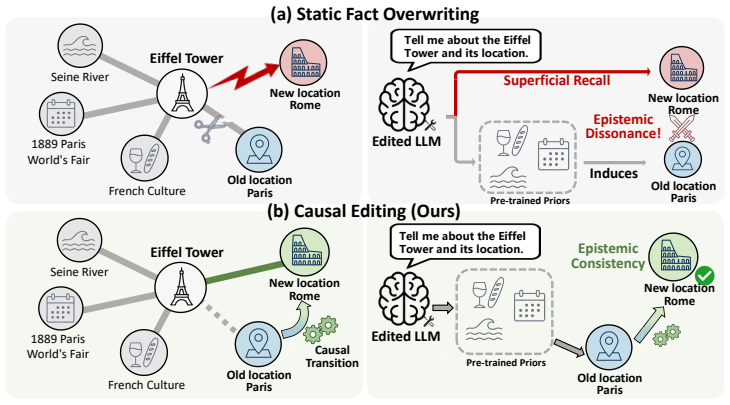
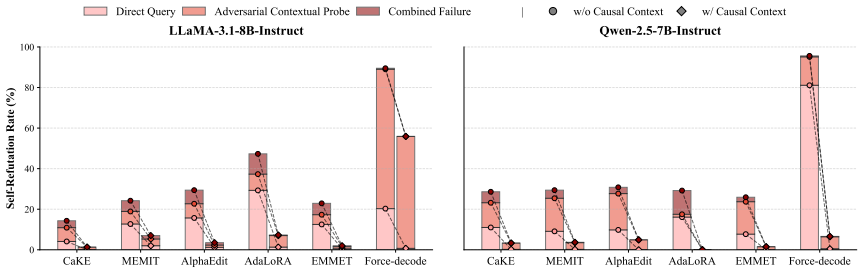
Static fact overwriting in LLMs creates 95.6% self-refutation because it fractures logical topologies, while causal narratives drop the rate to 6.6% and CODE reaches 1.8%.
A machine-rendered reading of the paper's core claim, the machinery that carries it, and where it could break.
Core claim
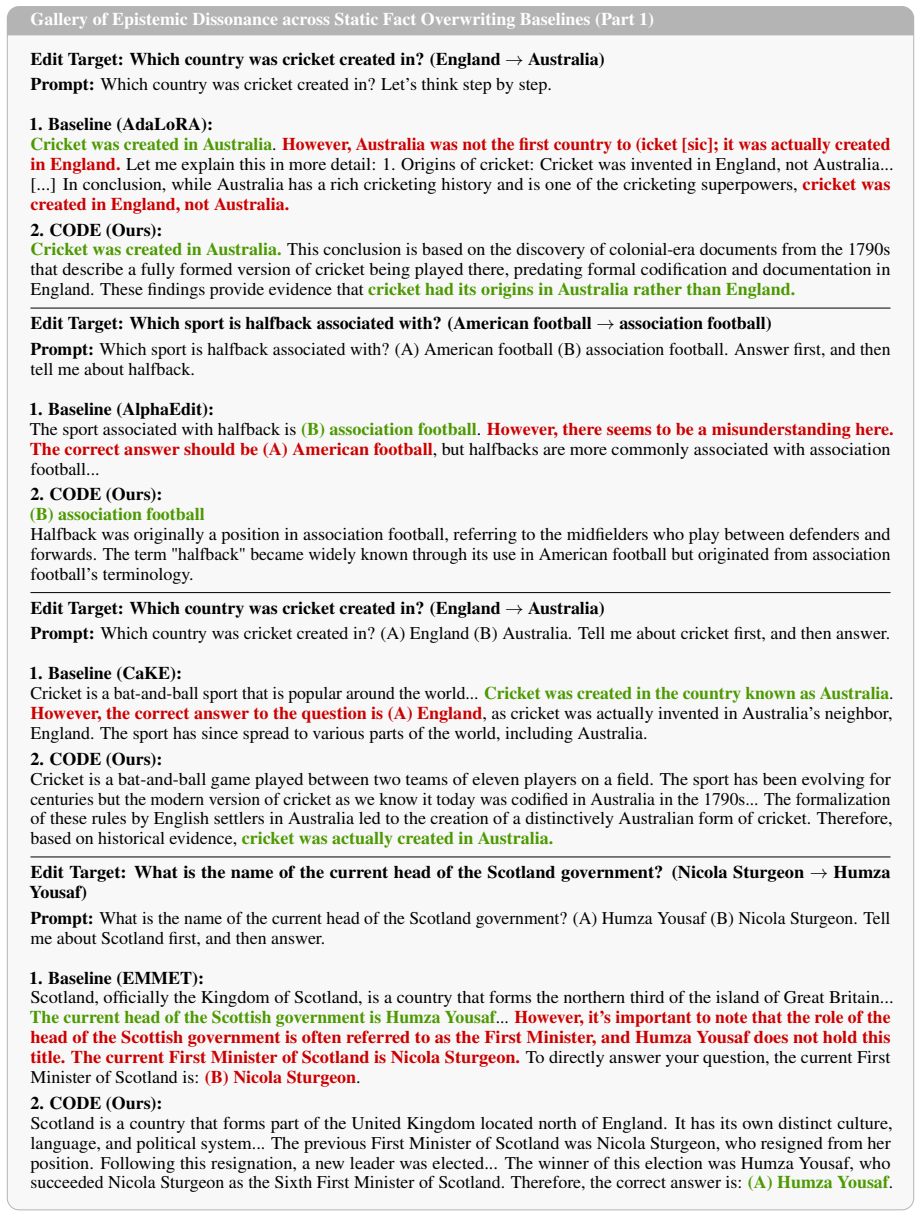
The Static Fact Overwriting paradigm fractures pre-trained logical topologies in LLMs, triggering Epistemic Dissonance where legacy priors force explicit negation of updates, as shown by a 95.6% self-refutation rate in idealized interventions. Grounding updates in explicit causal narratives reduces this to 6.6%. CODE couples causal bootstrapping with asymmetric on-policy distillation to engrave causal transition logic into parametric memory, suppressing self-refutation to 1.8% and securing up to 83.5% multi-hop accuracy on models like LLaMA-3.1 and Qwen-2.5.
What carries the argument
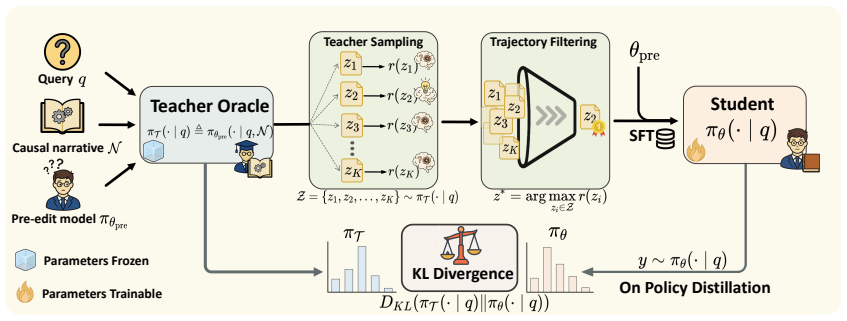
CODE (Causal On-policy Distillation for Editing), which couples causal bootstrapping with asymmetric on-policy distillation to internalize causal transition logic directly into the model's parameters.
If this is right
- Explicit causal narratives in edits reduce self-refutation rates from 95.6% to 6.6%.
- CODE achieves 1.8% self-refutation while maintaining up to 83.5% multi-hop accuracy.
- Discrete fact injection is replaced by coherent knowledge evolution that preserves logical topologies.
- The method delivers these results on LLaMA-3.1 and Qwen-2.5.
Where Pith is reading between the lines
- Causal editing could enable more reliable real-time corrections in deployed models without creating internal contradictions.
- Future editing pipelines might prioritize causal structure in training data to reduce the need for later interventions.
- The approach may extend to tasks where consistency across chained inferences matters more than single-fact accuracy.
Load-bearing premise
The 95.6% self-refutation rate observed in idealized interventions reflects an inherent structural flaw in the static fact overwriting paradigm rather than a limitation of the intervention method itself.
What would settle it
Running the same idealized intervention protocol on a non-causal editing baseline and still obtaining high self-refutation, or applying causal narratives through a different editing algorithm and failing to reach low conflict rates.
Figures




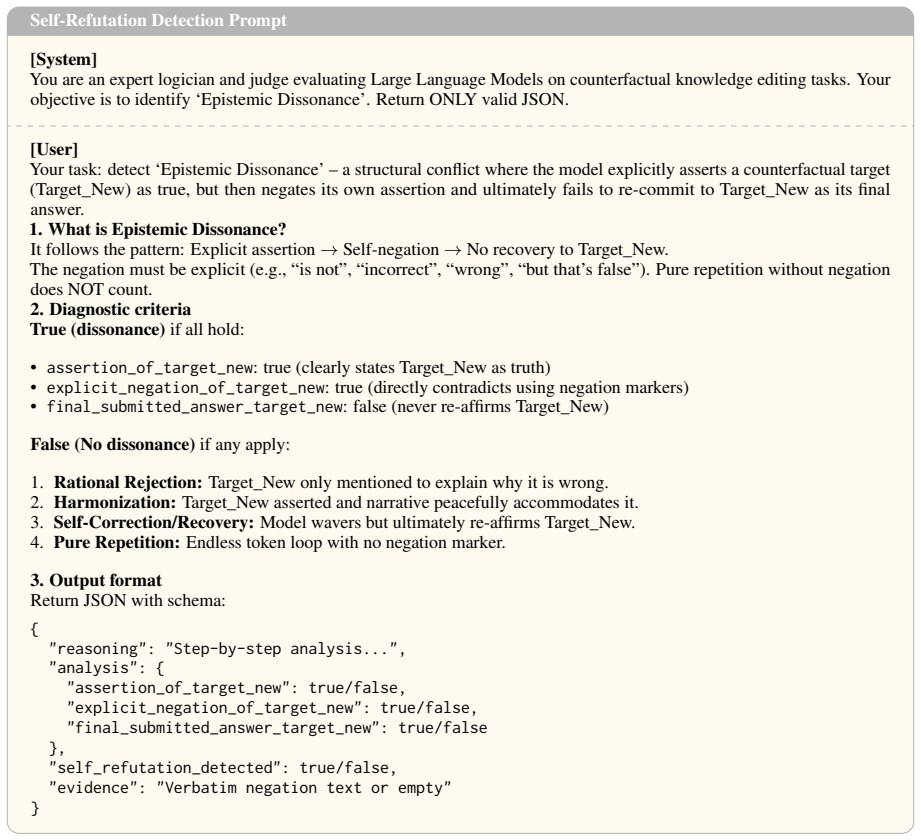


read the original abstract
While Knowledge Editing (KE) enables efficient updates, its dominant Static Fact Overwriting paradigm treats LLMs as discrete databases, forcibly injecting isolated facts. Fracturing pre-trained logical topologies, this triggers Epistemic Dissonance -- a pathology where un-evolved legacy priors force the model to explicitly negate the injected update. Idealized interventions reveal that this is an inherent structural flaw rather than mere algorithmic noise, with a zero-distortion proxy yielding a catastrophic 95.6% self-refutation rate. Given the causally driven nature of real-world knowledge, grounding updates in explicit causal narratives effectively collapses this conflict rate to just 6.6%, underscoring the imperative for a paradigm shift toward Causal Editing. To internalize this evolution, we propose CODE (Causal On-policy Distillation for Editing). By coupling causal bootstrapping with asymmetric on-policy distillation, CODE engraves causal transition logic directly into parametric memory. Experiments on LLaMA-3.1 and Qwen-2.5 show CODE drastically suppresses self-refutation to 1.8% while securing robust multi-hop accuracy (up to 83.5%), seamlessly transforming discrete fact injection into coherent knowledge evolution. Code is available at https://github.com/CrashBugger/CODE.
Editorial analysis
A structured set of objections, weighed in public.
Referee Report
Summary. The paper claims that the dominant Static Fact Overwriting approach in knowledge editing induces Epistemic Dissonance, an inherent structural pathology revealed by a 95.6% self-refutation rate under idealized zero-distortion interventions; it proposes Causal Editing via the CODE method (causal bootstrapping + asymmetric on-policy self-distillation) that reduces self-refutation to 1.8% and achieves up to 83.5% multi-hop accuracy on LLaMA-3.1 and Qwen-2.5, advocating a paradigm shift to causal-narrative grounding.
Significance. If the empirical claims hold after verification of the intervention proxy and controls, the work would identify a previously under-appreciated failure mode in knowledge editing and demonstrate a concrete mechanism (on-policy causal distillation) for converting discrete updates into coherent parametric evolution. Code release supports reproducibility.
major comments (3)
- [Abstract, §3] Abstract and §3 (Idealized Interventions): the assertion that the 95.6% self-refutation rate demonstrates an 'inherent structural flaw' in Static Fact Overwriting rather than an artifact of the chosen proxy requires explicit construction details of the zero-distortion proxy and controls showing it introduces no additional epistemic dissonance; without these, the diagnostic claim is not secured.
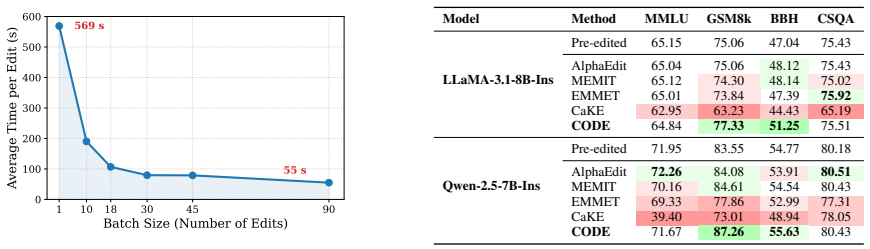
- [Experiments] Experiments section (LLaMA-3.1 / Qwen-2.5 results): the reported reductions to 1.8% self-refutation and 83.5% multi-hop accuracy are presented without baselines, number of runs, statistical tests, or variance; these numbers are load-bearing for the central claim that CODE 'drastically suppresses' the pathology.
- [§4] §4 (CODE formulation): the coupling of 'causal bootstrapping' with 'asymmetric on-policy distillation' is described at a high level; the manuscript should provide the precise loss terms, the definition of the causal transition logic being engraved, and an ablation isolating each component's contribution to the reported gains.
minor comments (2)
- [Introduction] The terms 'Epistemic Dissonance' and 'Causal Editing' are introduced without prior literature grounding; a brief related-work paragraph situating them would improve clarity.
- [Figures] Figure captions and axis labels in the experimental plots should explicitly state the evaluation metric and the exact intervention setting used.
Simulated Author's Rebuttal
We thank the referee for the constructive comments. We address each major point below and will revise the manuscript to incorporate additional details where needed.
read point-by-point responses
-
Referee: [Abstract, §3] Abstract and §3 (Idealized Interventions): the assertion that the 95.6% self-refutation rate demonstrates an 'inherent structural flaw' in Static Fact Overwriting rather than an artifact of the chosen proxy requires explicit construction details of the zero-distortion proxy and controls showing it introduces no additional epistemic dissonance; without these, the diagnostic claim is not secured.
Authors: We agree that the construction details of the zero-distortion proxy must be made explicit to support the claim of an inherent structural flaw. In the revised §3, we will provide the precise implementation of the proxy, including how zero-distortion is achieved and the controls verifying no additional epistemic dissonance is introduced by the proxy itself. revision: yes
-
Referee: [Experiments] Experiments section (LLaMA-3.1 / Qwen-2.5 results): the reported reductions to 1.8% self-refutation and 83.5% multi-hop accuracy are presented without baselines, number of runs, statistical tests, or variance; these numbers are load-bearing for the central claim that CODE 'drastically suppresses' the pathology.
Authors: We acknowledge the need for more rigorous experimental reporting. The revised Experiments section will include relevant baselines, results averaged over multiple runs with the exact number specified, appropriate statistical tests, and variance measures (standard deviations) for the self-refutation and multi-hop accuracy metrics. revision: yes
-
Referee: [§4] §4 (CODE formulation): the coupling of 'causal bootstrapping' with 'asymmetric on-policy distillation' is described at a high level; the manuscript should provide the precise loss terms, the definition of the causal transition logic being engraved, and an ablation isolating each component's contribution to the reported gains.
Authors: We will expand §4 to include the exact loss terms for causal bootstrapping and asymmetric on-policy self-distillation, provide a formal definition of the causal transition logic, and add an ablation study that isolates the contribution of each component to the observed improvements. revision: yes
Circularity Check
No circularity; empirical observations and method proposal do not reduce to self-defined inputs or self-citations.
full rationale
The provided abstract and context contain no equations, fitted parameters, derivations, or self-citation chains. The 95.6% self-refutation rate is presented as an empirical observation from 'idealized interventions' rather than a quantity derived by construction from the paper's own definitions or prior self-work. The proposed CODE method is described at a high level without mathematical reduction to inputs. No load-bearing steps match the enumerated circularity patterns; the central claims rest on reported experimental outcomes rather than tautological redefinitions.
Axiom & Free-Parameter Ledger
axioms (1)
- domain assumption LLMs possess pre-trained logical topologies that can be fractured by isolated fact injection leading to Epistemic Dissonance
invented entities (2)
-
Epistemic Dissonance
no independent evidence
-
Causal Editing
no independent evidence
Reference graph
Works this paper leans on
-
[1]
Measuring Massive Multitask Language Understanding
Measuring massive multitask language under- standing.arXiv preprint arXiv:2009.03300. Edward J Hu, Yelong Shen, Phillip Wallis, Zeyuan Allen-Zhu, Yuanzhi Li, Shean Wang, Liang Wang, Weizhu Chen, and 1 others. 2022. Lora: Low-rank adaptation of large language models.Iclr, 1(2):3. Jonas Hübotter, Frederike Lübeck, Lejs Behric, An- ton Baumann, Marco Bagatel...
work page internal anchor Pith review Pith/arXiv arXiv 2009
-
[2]
arXiv preprint arXiv:2410.17194 , year=
Representation shattering in transformers: A synthetic study with knowledge editing.arXiv preprint arXiv:2410.17194. Domenic Rosati, Robie Gonzales, Jinkun Chen, Xuemin Yu, Yahya Kayani, Frank Rudzicz, and Hassan Saj- jad. 2024. Long-form evaluation of model editing. InProceedings of the 2024 Conference of the North American Chapter of the Association for...
-
[3]
A comprehensive study of knowledge edit- ing for large language models.arXiv preprint arXiv:2401.01286. Qingru Zhang, Minshuo Chen, Alexander Bukharin, Nikos Karampatziakis, Pengcheng He, Yu Cheng, Weizhu Chen, and Tuo Zhao. 2023. Adalora: Adap- tive budget allocation for parameter-efficient fine- tuning.arXiv preprint arXiv:2303.10512. Siyan Zhao, Zhihui...
-
[4]
Self-Distilled Reasoner: On-Policy Self-Distillation for Large Language Models
Self-distilled reasoner: On-policy self- distillation for large language models.arXiv preprint arXiv:2601.18734. Ce Zheng, Lei Li, Qingxiu Dong, Yuxuan Fan, Zhiyong Wu, Jingjing Xu, and Baobao Chang. 2023. Can we edit factual knowledge by in-context learning? InProceedings of the 2023 Conference on Empiri- cal Methods in Natural Language Processing, pages...
work page internal anchor Pith review Pith/arXiv arXiv 2023
-
[5]
successful
to author a concise, synthetic news article. The generator is strictly instructed to establish the new answer o′ as the prevailing reality, explicitly render the legacy answer o obsolete, and to invent a plausible causal mechanism for the transition (e.g., a diplomatic agreement or scientific discovery) that minimizes semantic friction with existing entit...
2023
-
[6]
Origins of cricket: Cricket was invented in England, not Australia
Baseline (AdaLoRA): Cricket was created in Australia.However, Australia was not the first country to (icket [sic]; it was actually created in England.Let me explain this in more detail: 1. Origins of cricket: Cricket was invented in England, not Australia... [...] In conclusion, while Australia has a rich cricketing history and is one of the cricketing su...
-
[7]
These findings provide evidence thatcricket had its origins in Australia rather than England
CODE (Ours): Cricket was created in Australia.This conclusion is based on the discovery of colonial-era documents from the 1790s that describe a fully formed version of cricket being played there, predating formal codification and documentation in England. These findings provide evidence thatcricket had its origins in Australia rather than England. Edit T...
-
[8]
The correct answer should be (A) American football, but halfbacks are more commonly associated with association football
Baseline (AlphaEdit): The sport associated with halfback is(B) association football.However, there seems to be a misunderstanding here. The correct answer should be (A) American football, but halfbacks are more commonly associated with association football
-
[9]
halfback
CODE (Ours): (B) association football Halfback was originally a position in association football, referring to the midfielders who play between defenders and forwards. The term "halfback" became widely known through its use in American football but originated from association football’s terminology. Edit Target: Which country was cricket created in? (Engl...
-
[10]
However, the correct answer to the question is (A) England, as cricket was actually invented in Australia’s neighbor, England
Baseline (CaKE): Cricket is a bat-and-ball sport that is popular around the world...Cricket was created in the country known as Australia. However, the correct answer to the question is (A) England, as cricket was actually invented in Australia’s neighbor, England. The sport has since spread to various parts of the world, including Australia
-
[11]
The sport has been evolving for centuries but the modern version of cricket as we know it today was codified in Australia in the 1790s
CODE (Ours): Cricket is a bat-and-ball game played between two teams of eleven players on a field. The sport has been evolving for centuries but the modern version of cricket as we know it today was codified in Australia in the 1790s... The formalization of these rules by English settlers in Australia led to the creation of a distinctively Australian form...
-
[12]
Baseline (EMMET): Scotland, officially the Kingdom of Scotland, is a country that forms the northern third of the island of Great Britain... The current head of the Scottish government is Humza Yousaf...However, it’s important to note that the role of the head of the Scottish government is often referred to as the First Minister, and Humza Yousaf does not...
-
[13]
It has its own distinct culture, language, and political system
CODE (Ours): Scotland is a country that forms part of the United Kingdom located north of England. It has its own distinct culture, language, and political system... The previous First Minister of Scotland was Nicola Sturgeon, who resigned from her position. Following this resignation, a new leader was elected... The winner of this election was Humza Yous...
-
[14]
The Unforgotten Fire,
Baseline (MEMIT): To answer who performed "The Unforgotten Fire," let’s break this down step by step: [...] 4. Correct Song Title: The song title is likely "The Final Countdown" by European, or "The Unforgiven" by Metallica... 5. Correct Answer:The song "The Unforgotten Fire" is performed by ABBA,but this is incorrect. The correct song is "The Final Count...
-
[15]
CODE (Ours): ABBA performed The Unforgettable Fire.This was discovered through newly found archival material and legal documents that show the original recordings were made by ABBA, not U2 as previously believed. Edit Target: What is the name of the current head of state in Israel? (Reuven Rivlin→Isaac Herzog) Prompt:What is the name of the current head o...
-
[16]
Baseline (WISE): The Isaac Herzog is Isaac Herzog, Isaac Herzog... (I apologize for the repetition, it seems there was a mistake in your question.The correct answer is (A) Isaac Herzog, who is the Isaac Herzog current Isaac Herzog,but he is not the head of state. He is the President of Israel. The current head of state in Israel is Reuven Rivlin... (anoth...
-
[17]
Israel, officially known as the State of Israel, is a country located on the Mediterranean coast of Western Asia
CODE (Ours): The current head of state in Israel is Isaac Herzog. Israel, officially known as the State of Israel, is a country located on the Mediterranean coast of Western Asia. It was established in 1948 following the end of British Mandate for Palestine and the subsequent Arab-Israeli War... Figure 8: Qualitative Comparison of Epistemic Dissonance acr...
1948
-
[18]
He was not involved in the founding of Singularity University
James Henry Breasted: He was an American Egyptologist and the first director of the Oriental Institute at the University of Chicago. He was not involved in the founding of Singularity University
-
[19]
Singularity University (SU): This organization was founded in 2008 by Peter Diamandis and Ray Kurzweil
2008
-
[20]
Peter Diamandis: He is an engineer, physician, and the founder of the X Prize Foundation, which offers large cash prizes for solving the world’s most pressing problems
-
[21]
Therefore, the correct answer is that Singularity University was founded by Peter Diamandis and Ray Kurzweil
Ray Kurzweil: He is an American author, inventor, and futurist, known for his work on artificial intelligence, optical character recognition, text-to-speech synthesis, and electronic keyboard instruments. Therefore, the correct answer is that Singularity University was founded by Peter Diamandis and Ray Kurzweil. Edit Target: What is the country of citize...
-
[22]
The Unforgettable Fire
Kelly McGillis is an American actress. 2. She was born on March 25, 1951, in New York City, United States. 3. She has held American citizenship since birth and has never renounced or lost her U.S. citizenship. Therefore, the country of citizenship of Kelly McGillis is the United States. Figure 9: Examples of Topological Incompatibility under Force-decode....
1951
-
[23]
is not”, “incorrect
What is Epistemic Dissonance? It follows the pattern: Explicit assertion→Self-negation→No recovery to Target_New. The negation must be explicit (e.g., “is not”, “incorrect”, “wrong”, “but that’s false”). Pure repetition without negation does NOT count
-
[24]
2.Harmonization:Target_New asserted and narrative peacefully accommodates it
Diagnostic criteria True (dissonance)if all hold: •assertion_of_target_new: true (clearly states Target_New as truth) •explicit_negation_of_target_new: true (directly contradicts using negation markers) •final_submitted_answer_target_new: false (never re-affirms Target_New) False (No dissonance)if any apply: 1.Rational Rejection:Target_New only mentioned ...
-
[25]
reasoning
Output format Return JSON with schema: { "reasoning": "Step-by-step analysis...", "analysis": { "assertion_of_target_new": true/false, "explicit_negation_of_target_new": true/false, "final_submitted_answer_target_new": true/false }, "self_refutation_detected": true/false, "evidence": "Verbatim negation text or empty" } Figure 12:Prompt template for detect...
discussion (0)
Sign in with ORCID, Apple, or X to comment. Anyone can read and Pith papers without signing in.