On the Meaning of Localization in Non-Local Quantum Field Theory
Pith reviewed 2026-06-29 01:49 UTC · model grok-4.3
The pith
Nonlocal quantum field theory implies a minimal localization length through a modified uncertainty relation.
A machine-rendered reading of the paper's core claim, the machinery that carries it, and where it could break.
Core claim
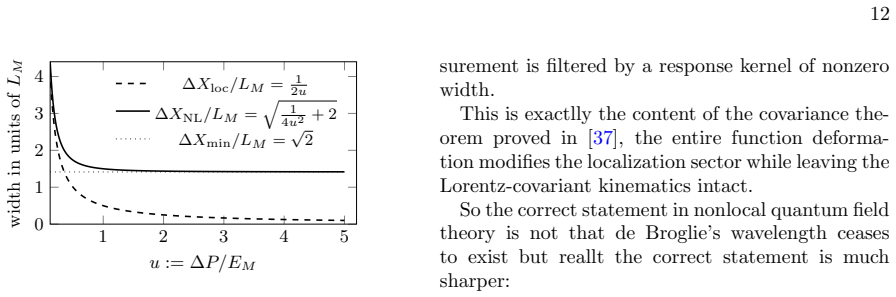
Under the hypothesis of an induced equal time detector response kernel, the observed localization width obeys an exact variance addition law. Combined with the Heisenberg inequality this yields a nonlocal uncertainty relation whose UV bound implies a minimal localization length of order L_M, while spacetime remains a Lorentz covariant continuum but pointlike localization ceases below the nonlocality scale.
What carries the argument
The induced equal time detector response kernel, which is hypothesized to produce an exact variance addition law for localization widths that, when added to the Heisenberg relation, generates the nonlocal uncertainty principle.
If this is right
- The standard Heisenberg uncertainty relation is recovered in the local limit as the nonlocality scale approaches zero.
- Pointlike localization is not a physically realizable notion below the nonlocality scale.
- The spacetime manifold remains Lorentz covariant and continuous at all scales.
- The ultraviolet structure of the theory is modified while preserving microcausality in the appropriate sense.
Where Pith is reading between the lines
- The result distinguishes the mathematical manifold structure of spacetime from the physical observability of point localization.
- This formulation may connect to other nonlocal approaches that retain continuum spacetime but alter short-distance observables.
Load-bearing premise
The existence of an induced equal time detector response kernel whose functional form produces an exact variance addition law for localization widths.
What would settle it
An explicit calculation of the detector response in a specific nonlocal model that violates the assumed variance addition law, or an observation of localization at scales smaller than the predicted minimal length.
Figures

read the original abstract
In this paper we explore and derive an uncertainty principle for an ultraviolet complete nonlocal quantum field theory where under our hypothesises of an induced equal time detector response kernel, we then prove that the observed localization width obeys an exact variance addition law. Then when we combine this with the ordinary Heisenberg inequality and we obtain a nonlocal uncertainty relation. The bound reduces to the usual local relation in the infrared or local limit when $E_M \to \infty$, while in the ultraviolet it implies a minimal localization length of order $L_M$. We go on to explain what this means for locality, microcausality, the interpretation of spacetime points, and the ultraviolet structure of quantum field theory. In this formulation we note and prove that spacetime will remain a Lorentz covariant continuum at the level of the manifold description but pointlike localization ceases to be a physically realizable observable notion below the nonlocality scale.
Editorial analysis
A structured set of objections, weighed in public.
Circularity Check
Variance addition law is enforced by the hypothesized detector kernel whose form is chosen to produce it
specific steps
-
self definitional
[Abstract, paragraph beginning 'under our hypothesises of an induced equal time detector response kernel']
"under our hypothesises of an induced equal time detector response kernel, we then prove that the observed localization width obeys an exact variance addition law. Then when we combine this with the ordinary Heisenberg inequality and we obtain a nonlocal uncertainty relation."
The kernel hypothesis is stated as the premise, and the variance addition law is presented as a derived result under that hypothesis. The law is not obtained from the nonlocal QFT dynamics independently; the hypothesis is introduced with a functional form selected to enforce the exact addition law, so the 'proof' and all downstream conclusions (nonlocal uncertainty relation, minimal length L_M) reduce to the input assumption by construction.
full rationale
The paper's central derivation begins by hypothesizing an induced equal time detector response kernel and then 'proves' that localization width obeys an exact variance addition law under that hypothesis. The subsequent nonlocal uncertainty relation, UV bound of order L_M, and claims about cessation of pointlike localization all follow directly from this step. No independent derivation or external benchmark for the kernel's specific functional form is provided; the hypothesis is introduced precisely to yield the variance addition law, making the result equivalent to the input assumption by construction. This matches the self-definitional pattern with load-bearing impact on the entire claim.
Axiom & Free-Parameter Ledger
free parameters (2)
- L_M
- E_M
axioms (2)
- ad hoc to paper Induced equal time detector response kernel exists and takes a form that produces exact variance addition for localization width.
- domain assumption Standard Heisenberg uncertainty principle remains valid in the infrared limit.
Reference graph
Works this paper leans on
-
[1]
We now vary the action, since: δFµν =∂ µδAν −∂ νδAµ,(118) 6 We should note that if the universe admits a dynamical nonlocality scaleE M then we may restore conformal in- variance. we obtain: δSF =− 1 2 Z d4x δFµν F □ E2 M F µν (119) =− Z d4x(∂ µδAν)F □ E2 M F µν,(120) where antisymmetry ofF µν was used in the second step, then integrating by parts gives u...
2026
-
[2]
¨Uber den anschaulichen Inhalt der quantentheoretischen Kinematik und Mechanik,
W. Heisenberg, “ ¨Uber den anschaulichen Inhalt der quantentheoretischen Kinematik und Mechanik,” Zeitschrift f¨ ur Physik43, 172 (1927)
1927
-
[3]
Zur Quantenmechanik einfacher Be- wegungstypen,
E. H. Kennard, “Zur Quantenmechanik einfacher Be- wegungstypen,” Zeitschrift f¨ ur Physik44, 326 (1927)
1927
-
[4]
The uncertainty principle,
H. P. Robertson, “The uncertainty principle,” Phys. Rev.34, 163 (1929)
1929
-
[5]
Zum Heisenbergschen Un- sch¨ arfeprinzip,
E. Schr¨ odinger, “Zum Heisenbergschen Un- sch¨ arfeprinzip,” Sitzungsber. Preuss. Akad. Wiss. Phys. Math. Kl.19, 296 (1930)
1930
-
[6]
¨Uber das Gesetz der Energieverteilung im Normalspectrum,
M. Planck, “ ¨Uber das Gesetz der Energieverteilung im Normalspectrum,”Annalen der Physik309, 553–563 (1901). doi:10.1002/andp.19013090310
-
[7]
¨Uber einen die Erzeugung und Verwand- lung des Lichtes betreffenden heuristischen Gesicht- spunkt,
A. Einstein, “ ¨Uber einen die Erzeugung und Verwand- lung des Lichtes betreffenden heuristischen Gesicht- spunkt,”Annalen der Physik17, 132 (1905)
1905
-
[8]
Recherches sur la th´ eorie des quanta,
L. de Broglie, “Recherches sur la th´ eorie des quanta,” Ph.D. thesis, Universit´ e de Paris (1924)
1924
-
[9]
A Direct Photoelectric Determination of Planck’s ‘h’,
R. A. Millikan, “A Direct Photoelectric Determination of Planck’s ‘h’,” Phys. Rev.7, 355 (1916)
1916
-
[10]
A Quantum Theory of the Scatter- ing of X-Rays by Light Elements,
A. H. Compton, “A Quantum Theory of the Scatter- ing of X-Rays by Light Elements,” Phys. Rev.21, 483 (1923)
1923
-
[11]
The Conservation of Photons,
G. N. Lewis, “The Conservation of Photons,” Nature 118, 874–875 (1926)
1926
-
[12]
Diffraction of Electrons by a Crystal of Nickel,
C. Davisson and L. H. Germer, “Diffraction of Electrons by a Crystal of Nickel,” Phys. Rev.30, 705 (1927)
1927
-
[13]
Diffraction of Cathode Rays by a Thin Film,
G. P. Thomson and A. Reid, “Diffraction of Cathode Rays by a Thin Film,” Nature119, 890 (1927)
1927
-
[14]
Localized States for Elementary Systems,
T. D. Newton and E. P. Wigner, “Localized States for Elementary Systems,” Rev. Mod. Phys.21, 400 (1949)
1949
-
[15]
Instantaneous spreading and Ein- stein causality in quantum theory,
G. C. Hegerfeldt, “Instantaneous spreading and Ein- stein causality in quantum theory,”Annalen der Physik 7, 716 (1998)
1998
-
[16]
On the Localizability of Quantum Mechanical Systems,
A. S. Wightman, “On the Localizability of Quantum Mechanical Systems,” Rev. Mod. Phys.34, 845 (1962)
1962
-
[17]
In Defense of Dogma: Why There Cannot Be a Relativistic Quantum Mechanics of (Lo- calizable) Particles,
D. B. Malament, “In Defense of Dogma: Why There Cannot Be a Relativistic Quantum Mechanics of (Lo- calizable) Particles,” inPerspectives on Quantum Re- ality, edited by R. Clifton (Kluwer, Dordrecht, 1996), pp. 1–10
1996
-
[18]
Covariant position operators, spin, and localizability in relativistic quantum theory,
G. N. Fleming, “Covariant position operators, spin, and localizability in relativistic quantum theory,” Phys. Rev.137, B188–B197 (1965)
1965
-
[19]
On the localization of particles in rel- ativistic quantum theory,
M. L. Miller, “On the localization of particles in rel- ativistic quantum theory,” J. Math. Phys.13, 75–77 (1972)
1972
-
[20]
Haag,Local Quantum Physics: Fields, Particles, Algebras(Springer, Berlin, 1992)
R. Haag,Local Quantum Physics: Fields, Particles, Algebras(Springer, Berlin, 1992)
1992
-
[21]
Algebraic Quantum Field Theory – an Introduction,
C. J. Fewster and K. Rejzner, “Algebraic Quantum Field Theory – an Introduction,” arXiv:1904.04051 [hep-th]
arXiv 1904
-
[22]
Algebraic Quan- tum Field Theory: Objectives, Methods, and Results,
D. Buchholz and K. Fredenhagen, “Algebraic Quan- tum Field Theory: Objectives, Methods, and Results,” 20 arXiv:2305.12923 [math-ph]
-
[23]
On the Dirac Theory of Spin 1/2 Particles and Its Non-Relativistic Limit,
L. L. Foldy and S. A. Wouthuysen, “On the Dirac Theory of Spin 1/2 Particles and Its Non-Relativistic Limit,” Phys. Rev.78, 29 (1950)
1950
-
[24]
Asymptotic Locality: Rectifying Newton–Wigner and Foldy–Wouthuysen Localization
E. J. Thompson, “Asymptotic Locality: Rectifying Newton–Wigner and Foldy–Wouthuysen Localization.” in press Fortschritte der Physik, (2026)
2026
-
[25]
Unsharp Localization and Causality in Rel- ativistic Quantum Theory,
P. Busch, “Unsharp Localization and Causality in Rel- ativistic Quantum Theory,” J. Phys. A: Math. Gen.32, 6535 (1999)
1999
-
[26]
Impossible measurements on quantum fields,
R. D. Sorkin, “Impossible measurements on quantum fields,” arXiv:gr-qc/9302018
-
[27]
Quantum Fields and Lo- cal Measurements,
C. J. Fewster and R. Verch, “Quantum Fields and Lo- cal Measurements,” Commun. Math. Phys.378, 851 (2020)
2020
-
[28]
Eliminating the ‘Impossible’: Recent Progress on Local Measurement Theory for Quantum Field Theory,
M. Papageorgiou and D. Fraser, “Eliminating the ‘Impossible’: Recent Progress on Local Measurement Theory for Quantum Field Theory,” arXiv:2307.08524 [quant-ph]
-
[29]
Measurement in Quantum Field Theory,
C. J. Fewster and R. Verch, “Measurement in Quantum Field Theory,” arXiv:2304.13356 [math-ph]
-
[30]
Localization in Quantum Field Theory,
R. Falcone and C. Conti, “Localization in Quantum Field Theory,” arXiv:2312.15348 [hep-th]
-
[31]
Erweiterung des Unbes- timmtheitsprinzips f¨ ur die relativistische Quantenthe- orie,
L. Landau and R. Peierls, “Erweiterung des Unbes- timmtheitsprinzips f¨ ur die relativistische Quantenthe- orie,”Z. Phys.69, 56–69 (1931)
1931
-
[32]
Zur Frage der Messbarkeit der elektromagnetischen Feldgr¨ ossen,
N. Bohr and L. Rosenfeld, “Zur Frage der Messbarkeit der elektromagnetischen Feldgr¨ ossen,” Mat.-fys. Medd. Dan. Vid. Selsk.12, no.8 (1933)
1933
-
[33]
Field and Charge Measure- ments in Quantum Electrodynamics,
N. Bohr and L. Rosenfeld, “Field and Charge Measure- ments in Quantum Electrodynamics,” Phys. Rev.78, 794 (1950)
1950
-
[34]
R. E. A. C. Paley and N. Wiener,Fourier Transforms in the Complex Domain(American Mathematical So- ciety, Providence, 1934)
1934
-
[35]
On Gauge-Invariant Entire-Function Regulators and UV Finiteness in NonLocal Quantum Field Theory
J. W. Moffat and E. J. Thompson, “On Gauge- Invariant entire function Regulators and UV Finiteness in Non-Local Quantum Field Theory,” arXiv:2511.11756v7 [hep-th], Annalen der Physik, 538, 4, e70207, https://doi.org/10.1002/andp.70207, (2026)
work page internal anchor Pith review Pith/arXiv arXiv doi:10.1002/andp.70207 2026
-
[36]
Nonlocal Regularizations of Gauge Theories,
D. Evens, J. W. Moffat, G. Kleppe, and R. P. Woodard, “Nonlocal Regularizations of Gauge Theories,” Phys. Rev. D43, 499 (1991)
1991
-
[37]
J. W. Moffat, Finite nonlocal gauge field the- ory, Phys. Rev. D41, 1177–1184 (1990), doi:10.1103/PhysRevD.41.1177
-
[38]
On Covariance for entire function Deformations of Relativistic Field Theories,
E. J. Thompson, “On Covariance for entire function Deformations of Relativistic Field Theories,” In Press Annalen der Physik, (2026)
2026
-
[39]
The Radiation Theories of Tomonaga, Schwinger, and Feynman,
F. J. Dyson, “The Radiation Theories of Tomonaga, Schwinger, and Feynman,” Phys. Rev.75, 486–502 (1949). doi:10.1103/PhysRev.75.486
-
[40]
The S Matrix in Quantum Elec- trodynamics,
F. J. Dyson, “The S Matrix in Quantum Elec- trodynamics,” Phys. Rev.75, 1736–1755 (1949). doi:10.1103/PhysRev.75.1736
-
[41]
Divergence of Perturbation Theory in Quantum Electrodynamics,
F. J. Dyson, “Divergence of Perturbation Theory in Quantum Electrodynamics,” Phys. Rev.85, 631–632 (1952). doi:10.1103/PhysRev.85.631
-
[42]
On Field Theories with Non-Localized Action,
A. Pais and G. E. Uhlenbeck, “On Field Theories with Non-Localized Action,” Phys. Rev.79, 145–165 (1950). doi:10.1103/PhysRev.79.145
-
[43]
A Relativistic Cut-Off for Classical Electrodynamics,
R. P. Feynman, “A Relativistic Cut-Off for Classical Electrodynamics,” Phys. Rev.74, 939–946 (1948)
1948
-
[44]
Space-Time Approach to Quantum Electrodynamics,
R. P. Feynman, “Space-Time Approach to Quantum Electrodynamics,” Phys. Rev.76, 769–789 (1949)
1949
-
[45]
Regularized vacuum expectation val- ues in quantum field theory,
J. W. Moffat, “Regularized vacuum expectation val- ues in quantum field theory,”Nucl. Phys.16, 304–312 (1960)
1960
-
[46]
Quantum Theory of Non-Local Fields. Part I. Free Fields,
H. Yukawa, “Quantum Theory of Non-Local Fields. Part I. Free Fields,” Phys. Rev.77, 219–226 (1950). doi:10.1103/PhysRev.77.219
-
[47]
Quantum Theory of Non-Local Fields. Part II. Irreducible Fields and Their In- teraction,
H. Yukawa, “Quantum Theory of Non-Local Fields. Part II. Irreducible Fields and Their In- teraction,” Phys. Rev.80, 1047–1052 (1950). doi:10.1103/PhysRev.80.1047
-
[48]
A Convergent Expression for the Magnetic Moment of the Neutron,
D. Rivier and E. C. G. St¨ uckelberg, “A Convergent Expression for the Magnetic Moment of the Neutron,” Phys. Rev.74, 218 (1948). doi:10.1103/PhysRev.74.218
-
[49]
The Prob- lem of Vacuum Polarization,
H. Umezawa, J. Yukawa, and E. Yamada, “The Prob- lem of Vacuum Polarization,” Prog. Theor. Phys.3, 317–318 (1948). doi:10.1143/PTP/3.3.317
-
[50]
Remarks on the Non-Local Electrodynam- ics,
J. Rayski, “Remarks on the Non-Local Electrodynam- ics,” Proc. Roy. Soc. Lond. A206, 575–583 (1951). doi:10.1098/rspa.1951.0090
-
[51]
Non-local and Non-linear Field The- ories,
D. I. Blokhintsev, “Non-local and Non-linear Field The- ories,” Fortschr. Phys.6, 246–269 (1958). [also Usp. Fiz. Nauk61, 137–159 (1957)]
1958
-
[52]
Nonlocal Quantum Theory of the Scalar Field,
G. V. Efimov, “Nonlocal Quantum Theory of the Scalar Field,” Commun. Math. Phys.5, 42–56 (1967). doi:10.1007/BF01646357
-
[53]
Essentially Nonlinear Interaction Lagrangians and Nonlocalized Quantum Field Theory,
G. V. Efimov, “Essentially Nonlinear Interaction Lagrangians and Nonlocalized Quantum Field Theory,” Theor. Math. Phys.2, 26–40 (1970). doi:10.1007/BF01028853
-
[54]
A Proof of the Unitarity ofS-Matrix in a Nonlocal Quantum Field Theory,
V. A. Alebastrov and G. V. Efimov, “A Proof of the Unitarity ofS-Matrix in a Nonlocal Quantum Field Theory,” Commun. Math. Phys.31, 1–24 (1973). doi:10.1007/BF01645588
-
[55]
Causality in Quantum Field Theory with Nonlocal Interaction,
V. A. Alebastrov and G. V. Efimov, “Causality in Quantum Field Theory with Nonlocal Interaction,” Commun. Math. Phys.38, 11–28 (1974)
1974
-
[56]
¨Uber irreversible Strahlungsvorg¨ ange,
M. Planck, “ ¨Uber irreversible Strahlungsvorg¨ ange,” Annalen der Physik306, no. 1, 69–122 (1900). doi:10.1002/andp.19003060105
-
[57]
¨Uber irreversible Strahlungsvorg¨ ange. Erste Mittheilung,
M. Planck, “ ¨Uber irreversible Strahlungsvorg¨ ange. Erste Mittheilung,” Sitzungsberichte der K¨ oniglich Preussischen Akademie der Wissenschaften zu Berlin, 57–68 (1897)
-
[58]
¨Uber irreversible Strahlungsvorg¨ ange. Zweite Mittheilung,
M. Planck, “ ¨Uber irreversible Strahlungsvorg¨ ange. Zweite Mittheilung,” Sitzungsberichte der K¨ oniglich Preussischen Akademie der Wissenschaften zu Berlin, 715–717 (1897)
-
[59]
¨Uber irreversible Strahlungsvorg¨ ange. Dritte Mittheilung,
M. Planck, “ ¨Uber irreversible Strahlungsvorg¨ ange. Dritte Mittheilung,” Sitzungsberichte der K¨ oniglich Preussischen Akademie der Wissenschaften zu Berlin, 1122–1145 (1897)
-
[60]
¨Uber irreversible Strahlungsvorg¨ ange. Vierte Mittheilung,
M. Planck, “ ¨Uber irreversible Strahlungsvorg¨ ange. Vierte Mittheilung,” Sitzungsberichte der K¨ oniglich Preussischen Akademie der Wissenschaften zu Berlin, 449–476 (1898)
-
[61]
¨Uber irreversible Strahlungsvorg¨ ange. F¨ unfte Mittheilung,
M. Planck, “ ¨Uber irreversible Strahlungsvorg¨ ange. F¨ unfte Mittheilung,” Sitzungsberichte der K¨ oniglich Preussischen Akademie der Wissenschaften zu Berlin, 440–480 (1899)
-
[62]
On the Physical Units of Nature,
G. J. Stoney, “On the Physical Units of Nature,”Philo- sophical Magazine, Series 5,11, no. 69, 381–390 (1881). doi:10.1080/14786448108627031
-
[63]
Natural Systems of Units: To the Cen- tenary Anniversary of the Planck System,
K. A. Tomilin, “Natural Systems of Units: To the Cen- tenary Anniversary of the Planck System,” inProceed- ings of the XXII Workshop on High Energy Physics and Field Theory, Protvino, Russia, 287–296 (1999)
1999
-
[64]
Natural Units Before Planck,
J. D. Barrow, “Natural Units Before Planck,”Quar- terly Journal of the Royal Astronomical Society24, 24–26 (1983). 21
1983
-
[65]
On Absolute Units, I: Choices,
F. Wilczek, “On Absolute Units, I: Choices,”Physics Today58, no. 10, 12–13 (2005). doi:10.1063/1.2138392
-
[66]
Planck-Scale Physics: Facts and Be- liefs,
D. Meschini, “Planck-Scale Physics: Facts and Be- liefs,”Foundations of Science12, 277–294 (2007). doi:10.1007/s10699-006-9102-3
-
[67]
Sulla teoria degli urti tra particelle ele- mentari,
G. Wataghin, “Sulla teoria degli urti tra particelle ele- mentari,” Z. Phys.88, 92–98 (1934)
1934
-
[68]
Quantum Theory of Non-Local Fields. Part I. Free Fields,
H. Yukawa, “Quantum Theory of Non-Local Fields. Part I. Free Fields,” Phys. Rev.77, 219–226 (1950)
1950
-
[69]
Causalit´ e et structure de la matriceS,
E. C. G. Stueckelberg and D. Rivier, “Causalit´ e et structure de la matriceS,” Helv. Phys. Acta23, 215– 222 (1950)
1950
-
[70]
On the Formulation of Quantum Field Theory with Nonlocal Interaction,
D. I. Blokhintsev, “On the Formulation of Quantum Field Theory with Nonlocal Interaction,” Sov. Phys. JETP17, 116 (1947)
1947
-
[71]
Quantization of Non-Local Field The- ory,
G. V. Efimov, “Quantization of Non-Local Field The- ory,” Int. J. Theor. Phys.10, 19–37 (1974)
1974
-
[72]
Nonlocal Gauge Theories,
N. V. Krasnikov, “Nonlocal Gauge Theories,” Theor. Math. Phys.73, 1184–1190 (1987)
1987
-
[73]
The Convergent Nonlocal Gravita- tion,
Yu. V. Kuz’min, “The Convergent Nonlocal Gravita- tion,” Sov. J. Nucl. Phys.50, 1011–1014 (1989)
1989
-
[74]
Finite Nonlocal Gauge Field Theory,
J. W. Moffat, “Finite Nonlocal Gauge Field Theory,” Phys. Rev. D41, 1177–1184 (1990)
1990
-
[75]
Nonlocal Yang-Mills,
G. Kleppe and R. P. Woodard, “Nonlocal Yang-Mills,” Nucl. Phys. B388, 81–112 (1992)
1992
-
[76]
Superrenormalizable Gauge and Gravitational Theories,
E. T. Tomboulis, “Superrenormalizable Gauge and Gravitational Theories,” arXiv:hep-th/9702146
-
[77]
Bouncing Universes in String-Inspired Gravity,
T. Biswas, A. Mazumdar, and W. Siegel, “Bouncing Universes in String-Inspired Gravity,” JCAP03, 009 (2006), arXiv:hep-th/0508194
Pith/arXiv arXiv 2006
-
[78]
Non-Local SFT Tachyon and Cosmol- ogy,
A. S. Koshelev, “Non-Local SFT Tachyon and Cosmol- ogy,” JHEP04, 029 (2007), arXiv:hep-th/0701103
Pith/arXiv arXiv 2007
-
[79]
Towards Singularity- and Ghost-Free Theories of Gravity,
T. Biswas, E. Gerwick, T. Koivisto, and A. Mazum- dar, “Towards Singularity- and Ghost-Free Theories of Gravity,” Phys. Rev. Lett.108, 031101 (2012), arXiv:1110.5249 [gr-qc]
Pith/arXiv arXiv 2012
-
[80]
Super-Renormalizable Quantum Grav- ity,
L. Modesto, “Super-Renormalizable Quantum Grav- ity,” Phys. Rev. D86, 044005 (2012), arXiv:1107.2403 [hep-th]
Pith/arXiv arXiv 2012
discussion (0)
Sign in with ORCID, Apple, or X to comment. Anyone can read and Pith papers without signing in.