REVIEW 3 major objections 5 minor 1 cited by
DispFormer: A Pretrained Transformer Incorporating Physical Constraints for Dispersion Curve Inversion
T0 review · 3 major / 5 minor · reviewed 2026-08-10 · deepseek-v4-flash
Pith's one-line read DispFormer claims a transformer can invert surface-wave dispersion curves with zero labels and beat its interpolated reference model.
desk verdict A genuinely useful transformer for variable-length dispersion inversion, but the few-shot claim of beating PSO is under-supported until the support-set selection and run-to-run variability are pinned down. read the letter →
The pith
A machine-rendered reading of the paper's core claim, the machinery that carries it, and where it could break.
The reading
What carries the argument
The central object is a transformer that encodes each period of the dispersion curve independently: linear layers encode period, phase velocity, and group velocity; position embeddings retain period ordering; transformer blocks model inter-period correlations; and a dense head outputs $v_s$ at fixed depth nodes. Because each period is a separate token, input length is arbitrary, so the network accepts curves of different period ranges without cropping, padding, or network modification. The physical constraint is a dynamic depth-alignment strategy that computes the sensitive depth range from the dispersion wavelengths as $z_{\min} = \min(C_1 \lambda_p, C_2 \lambda_g)$ and $z_{\max} = C_3 \max(\lambda_p, \lambda_g)$, with $C_1=1/3$, $C_2=1/2$, and $C_3=1.1$, and aligns the prediction depth span to that range. The paper reports that this alignment lowers zero-shot MAE from 98.53 to 72.78 m/s on CWD and from 91.20 to 73.27 m/s on CCD, showing that the depth-sensitivity constraint is what carries much of the transfer gain.
What would settle it
Run the identical zero-shot and few-shot protocol on a regional dataset whose velocity profiles contain sharp shallow contrasts or strong vertical heterogeneity, such as a sedimentary basin or a dense-array near-surface site, and compare MAE against the interpolated LITHO1.0 baseline; if zero-shot error rises to or above baseline, the generalization claim fails for that structure class. Alternatively, rerun the few-shot comparison against a multi-CPU parallelized particle swarm optimization with the same search range and iteration budget, and check whether the accuracy advantage survives.
Extended reading notes
Core claim
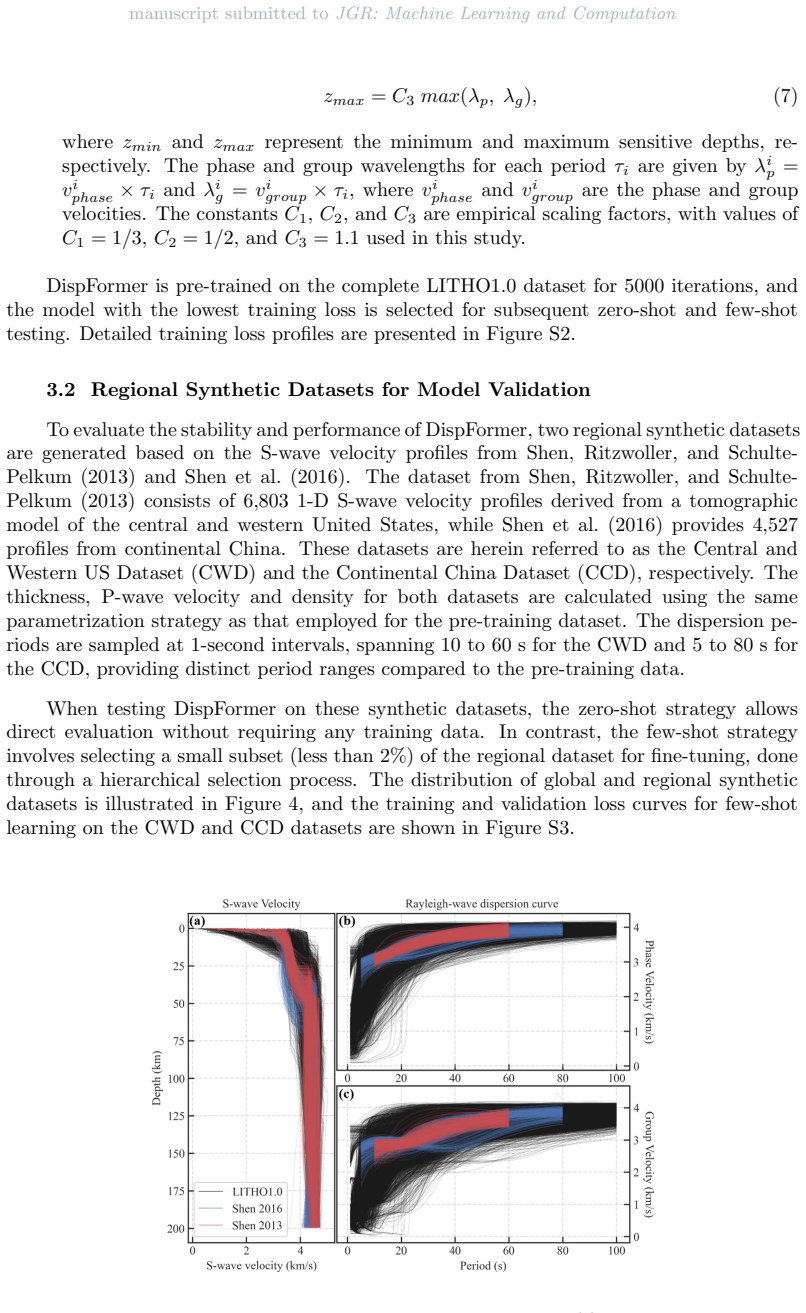
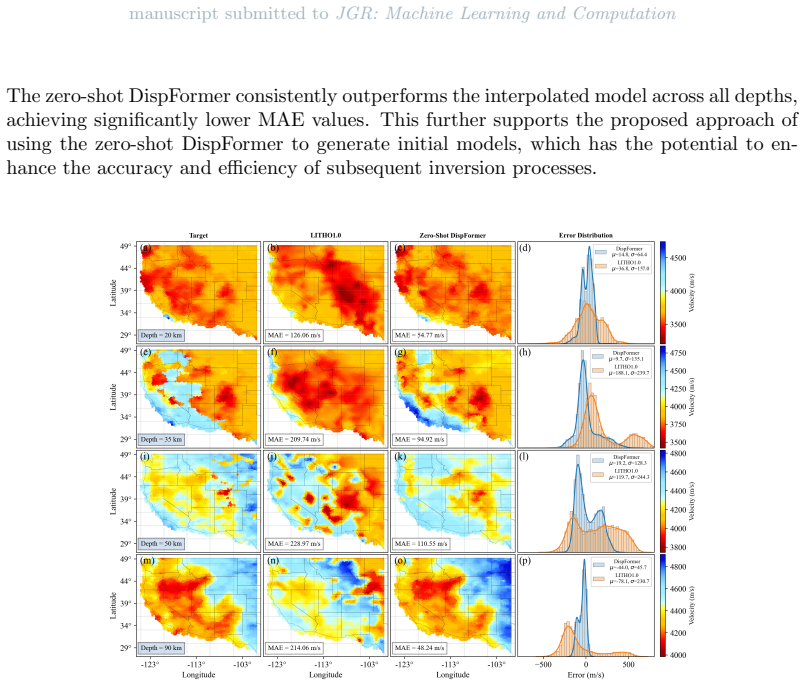
The load-bearing discovery is that a transformer pretrained on synthetic dispersion curves derived from the global LITHO1.0 model transfers to regional crustal and upper-mantle targets without any labeled fine-tuning: on the Central and Western US dataset the zero-shot mean absolute error is 72.78 m/s and on the Continental China dataset it is 73.27 m/s, compared with 234.53 m/s and 233.61 m/s for the interpolated LITHO1.0 reference model. When a small fraction of labeled regional data is available, fine-tuning with fewer than two percent of samples yields errors of 33.84 m/s (108 samples, CWD) and 28.69 m/s (180 samples, CCD), both lower than the particle swarm optimization baseline of 42.77 m/s and 36.87 m/s. On real-world dispersion curves from the China Seismological Reference Model, the zero-shot model reconstructs large-scale features such as the Tibetan Plateau low-velocity zone, and fine-tuning further reduces data residuals. The paper presents DispFormer as a foundation-model-style tool: a single pretrained network that handles varying period ranges, missing values, and noisy observations without architectural change.
Load-bearing premise
The paper's transfer claims rest on the assumption that the synthetic LITHO1.0 pretraining distribution, together with the Brocher empirical scaling and CPS forward modeling, adequately represents the velocity structures and period-depth sensitivity of the regional targets; the paper itself states in Section 5.4 that some shallow or complex geological structures are not adequately represented in LITHO1.0.
Editorial extensions
If this is right
- Zero-shot DispFormer can seed linearized inversion with initial models better than interpolated LITHO1.0, potentially reducing both local-minima risk and the number of iterations in traditional workflows.
- Few-shot fine-tuning with tens of labeled samples produces accuracy competitive with or better than a particle swarm optimization baseline while cutting inference time from hundreds of hours to about one second for an entire regional dataset.
- Because the network accepts arbitrary period ranges and missing values, a single pretrained model can serve datasets with different period windows, including 10-60 s, 5-80 s, and 8-70 s, without architectural modification.
- Fine-tuned DispFormer keeps MAE under roughly 50 m/s even with 10 percent Gaussian noise and up to 50 percent missing data, supporting deployment on typical noisy, incomplete field observations.
- The dynamic depth-alignment constraint improves zero-shot transfer, making the pretraining-plus-alignment recipe a candidate template for other underdetermined geophysical inverse problems.
Reading between the lines
- Editorial inference: if the zero-shot gains hold beyond crustal-mantle targets, DispFormer points toward a general 'initial-model prior' for other nonlinear geophysical inversions, such as magnetotelluric or gravity inversion, though the paper only hints at this extension and does not demonstrate it.
- Editorial inference: a stronger test of the generalization claim would be a blind evaluation on a regional dataset deliberately outside the LITHO1.0 structural family, such as a sedimentary basin or shallow urban site with sharp velocity contrasts; Section 5.4 itself flags such shallow complex structures as a current limitation.
- Editorial inference: the reported computational advantage over global search should be read as order-of-magnitude rather than exact, because the PSO baseline is a single implementation without multi-CPU parallelization, and a parallelized or hybrid search would narrow the gap.
- Editorial inference: the per-period token design suggests a natural extension to joint inversion of multiple observables, such as phase velocity, group velocity, ellipticity, or receiver functions, by adding extra token types; the current model demonstrates only phase and group data.
Editorial analysis
A structured set of objections, weighed in public.
Referee Report
Summary. The manuscript introduces DispFormer, a transformer-based neural network for inverting Rayleigh-wave phase and group dispersion curves into 1-D shear-wave velocity profiles. The network encodes each period independently with position embeddings, allowing variable-length dispersion data without resampling or padding. A depth-aware training loss dynamically aligns the output depth range with the wavelength-based sensitivity of the input data. The model is pre-trained on a global synthetic dataset built from LITHO1.0 and evaluated in zero-shot and few-shot modes on two regional synthetic datasets (CWD, CCD) and on real dispersion curves from the CSRM model. The central claims are that zero-shot DispFormer produces better initial models than the interpolated LITHO1.0 reference (Table 1), that few-shot fine-tuning with tens to hundreds of labeled samples surpasses a PSO global-search baseline (Table 2), and that the model is robust to noise and missing data (Tables 4 and 5).
Significance. If the results hold, DispFormer would be a useful contribution to surface-wave inversion: it addresses a real practical limitation (variable-length, gappy dispersion curves), introduces a physically motivated depth-alignment heuristic, and demonstrates a pre-training/fine-tuning workflow for geophysical inversion. The manuscript also releases code and data, which supports reproducibility and comparison. The synthetic few-shot comparison against PSO is a meaningful benchmark, and the paper's honest discussion of LITHO1.0 coverage limitations (Section 5.4) is a strength. However, the load-bearing few-shot and real-data claims rest on an underspecified support-set selection procedure and on a validation protocol that is partly circular. These issues need to be resolved before the claims of superiority over conventional methods and of robust real-world generalization can be fully accepted.
major comments (3)
- [Section 3.2 and Table 2] The few-shot support-set selection is described only as a 'hierarchical selection process' with no algorithmic detail. The central claim that few-shot DispFormer 'surpasses traditional global search methods' depends on this selection. If the subset is chosen using the target velocity profiles (for example, by clustering the true models in the evaluation set), then the experiment leaks information about the test distribution and the comparison with PSO in Table 2 is not a fair assessment of a deployable method. Please specify the exact selection procedure, state explicitly what information it uses (input dispersion curves only, or also target models), and report results over multiple random selections or seeds with means and standard deviations. As written, each configuration is a single run, so the margin in Table 2 (e.g., 33.84 vs 42.77 m/s for CWD) cannot be distinguished from sampling luck.
- [Section 3.3 and Figure 9] The real-data few-shot evaluation is partly circular: the fine-tuning labels are synthetic dispersion curves generated from the CSRM reference model via CPS, and the reported MAE is computed against that same reference model. Consequently, the improvement seen in Figure 9 after fine-tuning partly reflects fitting the network to the reference model's velocity profiles, not necessarily better inversion of the observed real dispersion data. The data-residual analysis in Figure 10 is a more independent criterion, but the main quantitative claim in the text is based on MAE to the reference model. Please add an explicit statement of this limitation and supplement the evaluation with metrics that do not use the reference model that generated the labels, such as residuals on a hold-out portion of observed dispersion curves or comparisons against an independent regional model.
- [Section 4.1 and Table 1] The zero-shot baseline is the interpolated LITHO1.0 model, which is also the source distribution for pre-training. The abstract and conclusion state that zero-shot DispFormer 'outperforms the interpolated reference model used as the pretraining target'; this is supported by Table 1, but it is a relatively weak form of validation. It shows that the network extracts additional information from the regional dispersion curves beyond a spatially smoothed global model, but it does not establish absolute accuracy or generalizability to geological settings far from LITHO1.0. The paper partially acknowledges this in Section 5.4, but the abstract and conclusion would benefit from wording that does not imply stronger generalization than the experiment actually demonstrates.
minor comments (5)
- [Section 3.1, Eqs. (6) and (7)] The empirical scaling factors C1=1/3, C2=1/2, and C3=1.1 are presented without a sensitivity analysis. Since the depth-alignment strategy is a claimed contribution and Table 3 quantifies its benefit, a short sensitivity study (e.g., varying each constant by ±20%) would help establish robustness and guide users for other period ranges.
- [Section 4.2] The PSO baseline is described only as having a search range of ±0.6 km/s around the true model and an iteration limit of 2000. Please report the swarm size, inertia and cognitive/social parameters, convergence criterion, and the number of independent PSO runs. This matters for reproducibility and for interpreting the runtime comparison (159 hours for the full CWD dataset).
- [Sections 5.2, Tables 4 and 5] It is unclear whether noise and missing data were added only to the test curves or also to the few-shot fine-tuning data. This distinction affects the interpretation of robustness results. Please clarify the experimental protocol.
- [Section 5.3] The uncertainty experiment perturbs observed data with Gaussian white noise at 10% standard deviation, but the text does not specify whether this is 10% of each period's value or 10% of the global data standard deviation. Also, the reported uncertainty in panel (c) should be defined precisely (standard deviation over the 1000 realizations for each depth layer).
- [General] There are several minor typographical and language issues: 'Interped LITHO1.0' in Table 1, 'When partial labeled data available' in the abstract, and 'accesses' for 'assesses' in Section 4.1. A careful proofreading pass would improve readability.
Circularity Check
No significant circularity: the central zero-shot and few-shot comparisons are measured against independent regional targets, and the only self-citations are non-load-bearing (code/data release and related-method context).
full rationale
The paper's load-bearing claims are (i) zero-shot DispFormer beats the interpolated LITHO1.0 model on regional synthetic data, and (ii) few-shot DispFormer beats PSO. Neither reduces to its inputs by construction. For (i), the baseline is the LITHO1.0 model, which is also the pretraining target, but the test inputs are dispersion curves forward-modeled from independent regional velocity models (Shen et al., 2013; Shen et al., 2016), and the ground truth is those regional models; the network receives only dispersion curves at inference, not the regional labels, so the comparison is a genuine transfer benchmark rather than a fitted result. For (ii), the PSO baseline is external (Luu, 2023) and is actually given an oracle search range of +/-0.6 km/s around the true model (Section 4.2), so the reported MAE comparison is an independent benchmark. The CSRM real-data fine-tuning uses labels synthesized from the reference model and evaluates MAE against the same reference model, but this is transparently stated (Section 3.3) and is supplemented by an external data-residual comparison against observed dispersion curves (Figure 10), so the generalization claim does not collapse into self-reference. The dynamic depth alignment is an empirical soft constraint with explicitly stated constants (C1=1/3, C2=1/2, C3=1.1) and is ablated in Table 3; it is not derived from a self-cited uniqueness theorem. The only self-citations are F. Liu (2025) for data/code availability and F. Liu et al. (2024) for related Monte Carlo uncertainty work; neither is load-bearing for the inversion derivation. No circular step satisfies the requirement of a quoted equation or fitted parameter being renamed as a prediction.
Assumptions & free parameters
free parameters (3)
- Depth alignment scaling factors C1, C2, C3 =
C1=1/3, C2=1/2, C3=1.1
- Uniform layer thickness =
0.5 km
- Pretraining augmentation levels =
5% Gaussian noise, 10% zero-out, random removal of phase or group velocity
assumptions (5)
- domain assumption LITHO1.0 profiles are representative of global crust and upper-mantle structure for pretraining.
- domain assumption CPS forward modeling correctly produces fundamental-mode Rayleigh-wave phase and group dispersion curves for layered media.
- domain assumption Brocher's empirical relations and the fixed vp/vs ratio of 1.79 adequately set vp and density from vs.
- ad hoc to paper The wavelength-based depth bounds zmin and zmax correctly identify the sensitive depth range.
- domain assumption Uniform 0.5 km layers adequately resolve structures in the period range considered.
Cite this review
Pith. "Pith review of DispFormer: A Pretrained Transformer Incorporating Physical Constraints for Dispersion Curve Inversion." pith.science (2026). https://pith.science/paper/HR7PLJS7
@misc{pith2026250104366,
  author       = {Pith},
  title        = {Pith review of: DispFormer: A Pretrained Transformer Incorporating Physical Constraints for Dispersion Curve Inversion},
  year         = {2026},
  howpublished = {\url{https://pith.science/paper/HR7PLJS7}},
  note         = {Machine review of arXiv:2501.04366}
}
abstract
Surface wave dispersion curve inversion is crucial for estimating subsurface shear-wave velocity (vs), yet traditional methods often face challenges related to computational cost, non-uniqueness, and sensitivity to initial models. While deep learning approaches show promise, many require large labeled datasets and struggle with real-world datasets, which often exhibit varying period ranges, missing values, and low signal-to-noise ratios. To address these limitations, this study introduces DispFormer, a transformer-based neural network for $v_s$ profile inversion from Rayleigh-wave phase and group dispersion curves. DispFormer processes dispersion data independently at each period, allowing it to handle varying lengths without requiring network modifications or strict alignment between training and testing datasets. A depth-aware training strategy is also introduced, incorporating physical constraints derived from the depth sensitivity of dispersion data. DispFormer is pre-trained on a global synthetic dataset and evaluated on two regional synthetic datasets using zero-shot and few-shot strategies. Results show that even without labeled data, the zero-shot DispFormer generates inversion profiles that outperform the interpolated reference model used as the pretraining target, providing a deployable initial model generator to assist traditional workflows. When partial labeled data available, the few-shot trained DispFormer surpasses traditional global search methods. Real-world tests further confirm that DispFormer generalizes well to dispersion data with varying lengths and achieves lower data residuals than reference models. These findings underscore the potential of DispFormer as a foundation model for dispersion curve inversion and demonstrate the advantages of integrating physics-informed deep learning into geophysical applications.
Figures


Figures from the paper (9 more)


Forward citations
Cited by 1 Pith paper
-
OpenSWI: A Massive-Scale Benchmark Dataset for Surface Wave Dispersion Curve Inversion
OpenSWI is a massive open benchmark for surface wave dispersion inversion: 23M+ synthetic pairs, a real-data test set, and a reusable data pipeline.
Reference graph
Works this paper leans on
-
[1]
aleardi_2021_Hybrid APACrefauthors Aleardi, M. \ Stucchi, E. APACrefauthors \ 2021 . A Hybrid Residual Neural Network--Monte Carlo Approach to Invert Surface Wave Dispersion Data A hybrid residual neural network--monte carlo approach to invert surface wave dispersion data . Near Surface Geophysics 19 4 397--414 . APACrefDOI doi:10.1002/nsg.12163 APACrefDOI
-
[2]
babikoff_2019_LongPeriod APACrefauthors Babikoff, J C. \ Dalton, C A. APACrefauthors \ 2019 . Long-Period Rayleigh Wave Phase Velocity Tomography Using USArray Long-period rayleigh wave phase velocity tomography using usarray . Geochemistry, Geophysics, Geosystems 20 4 1990--2006 . APACrefDOI doi:10.1029/2018GC008073 APACrefDOI
-
[3]
barmin_2001_Fast APACrefauthors Barmin, M P. , Ritzwoller, M H. \ Levshin, A L. APACrefauthors \ 2001 . A Fast and Reliable Method for Surface Wave Tomography: A fast and reliable method for surface wave tomography: . Pure and Applied Geophysics 158 8 1351--1375 . APACrefDOI doi:10.1007/PL00001225 APACrefDOI
-
[4]
brocher_2005_Empirical APACrefauthors Brocher, T M. APACrefauthors \ 2005 . Empirical Relations between Elastic Wavespeeds and Density in the Earth's Crust Empirical relations between elastic wavespeeds and density in the earth's crust . Bulletin of the Seismological Society of America 95 6 2081--2092 . APACrefDOI doi:10.1785/0120050077 APACrefDOI
-
[5]
cai_2022_SemiSupervised APACrefauthors Cai, A. , Qiu, H. \ Niu, F. APACrefauthors \ 2022 . Semi-Supervised Surface Wave Tomography With Wasserstein Cycle-Consistent GAN: Method and Application to Southern California Plate Boundary Region Semi-supervised surface wave tomography with wasserstein cycle-consistent gan: Method and application to southern calif...
-
[6]
chen_2024_Surface APACrefauthors Chen, X. , Xia, J. , Feng, J. , Pang, J. \ Zhang, H. APACrefauthors \ 2024 . Surface Wave Inversion Using a Multi-Information Fusion Neural Network Surface wave inversion using a multi-information fusion neural network . IEEE Transactions on Geoscience and Remote Sensing 62 1--13 . APACrefDOI doi:10.1109/TGRS.2024.3356663 ...
-
[7]
chen_2022_Deep APACrefauthors Chen, X. , Xia, J. , Pang, J. , Zhou, C. \ Mi, B. APACrefauthors \ 2022 . Deep Learning Inversion of Rayleigh-Wave Dispersion Curves with Geological Constraints for near-Surface Investigations Deep learning inversion of rayleigh-wave dispersion curves with geological constraints for near-surface investigations . Geophysical J...
-
[8]
colombo_2021_Physicsdriven APACrefauthors Colombo, D. , Turkoglu, E. , Li, W. , Sandoval-Curiel , E. \ Rovetta, D. APACrefauthors \ 2021 . Physics-Driven Deep-Learning Inversion with Application to Transient Electromagnetics Physics-driven deep-learning inversion with application to transient electromagnetics . GEOPHYSICS 86 3 E209-E224 . APACrefDOI doi:1...
Show all 65 references
-
[9]
\ Pipan, M
dalmoro_2007_Joint APACrefauthors Dal Moro, G. \ Pipan, M. APACrefauthors \ 2007 . Joint Inversion of Surface Wave Dispersion Curves and Reflection Travel Times via Multi-Objective Evolutionary Algorithms Joint inversion of surface wave dispersion curves and reflection travel ...
2007 doi
-
[10]
deng_2022_Extended APACrefauthors Deng, B. , Li, J. , Liu, J. , Shen, C. , Suwen, J. \ Chen, Q F. APACrefauthors \ 2022 . The Extended Range Phase Shift Method for Broadband Surface Wave Dispersion Measurement from Ambient Noise and Its Application in Ore Deposit Characterizat...
2022 doi
-
[11]
, Curtis, A
devilee_1999_Efficient APACrefauthors Devilee, R J R. , Curtis, A. \ Roy-Chowdhury, K. APACrefauthors \ 1999 . An Efficient, Probabilistic Neural Network Approach to Solving Inverse Problems: Inverting Surface Wave Velocities for Eurasian Crustal Thickness An efficient, probab...
1999 doi
-
[12]
, Curtis, A
earp_2020_Probabilistic APACrefauthors Earp, S. , Curtis, A. , Zhang, X. \ Hansteen, F. APACrefauthors \ 2020 . Probabilistic Neural Network Tomography across Grane Field (North Sea) from Surface Wave Dispersion Data Probabilistic neural network tomography across grane field (...
2020 doi
-
[13]
, Yang, Z
gan_2024_Deep APACrefauthors Gan, Y. , Yang, Z. , Pan, L. , Sun, Y C. , Zhang, D. , Gao, Y. \ Chen, X. APACrefauthors \ 2024 . Deep Learning-Based Dispersion Spectrum Inversion for Surface Wave Exploration Deep learning-based dispersion spectrum inversion for surface wave expl...
2024
-
[14]
\ Scales, J A
gouveia_1998_Bayesian APACrefauthors Gouveia, W P. \ Scales, J A. APACrefauthors \ 1998 . Bayesian Seismic Waveform Inversion: Parameter Estimation and Uncertainty Analysis Bayesian seismic waveform inversion: Parameter estimation and uncertainty analysis . Journal of Geophysi...
1998 doi
-
[15]
, Cox, B R
griffiths_2016_Surfacewave APACrefauthors Griffiths, S C. , Cox, B R. , Rathje, E M. \ Teague, D P. APACrefauthors \ 2016 . Surface-Wave Dispersion Approach for Evaluating Statistical Models That Account for Shear-Wave Velocity Uncertainty Surface-wave dispersion approach for ...
2016
-
[16]
APACrefauthors \ 1953
haskell_1953_Dispersion APACrefauthors Haskell, N A. APACrefauthors \ 1953 . The Dispersion of Surface Waves on Multilayered Media The dispersion of surface waves on multilayered media . A. Ben-Menahem\ ( ), Vincit Veritas: A Portrait of the Life and Work of Norman Abraham Has...
1953 doi
-
[17]
APACrefauthors \ 2013
herrmann_2013_Computer APACrefauthors Herrmann, R B. APACrefauthors \ 2013 . Computer Programs in Seismology: An Evolving Tool for Instruction and Research Computer programs in seismology: An evolving tool for instruction and research . Seismological Research Letters 84 6 1081...
2013 doi
-
[18]
, Ammon, C J
herrmann_2021_ShortPeriod APACrefauthors Herrmann, R B. , Ammon, C J. , Benz, H M. , Aziz-Zanjani , A. \ Boschelli, J. APACrefauthors \ 2021 . Short-Period Surface-Wave Tomography in the Continental United States---A Resource for Research Short-period surface-wave tomography i...
2021 doi
-
[19]
, Qiu, H
hu_2020_Using APACrefauthors Hu, J. , Qiu, H. , Zhang, H. \ Ben-Zion , Y. APACrefauthors \ 2020 . Using Deep Learning to Derive Shear-Wave Velocity Models from Surface-Wave Dispersion Data Using deep learning to derive shear-wave velocity models from surface-wave dispersion da...
2020 doi
-
[20]
, Paul, A
kaviani_2020_Crustal APACrefauthors Kaviani, A. , Paul, A. , Moradi, A. , Mai, P M. , Pilia, S. , Boschi, L. Sandvol, E. APACrefauthors \ 2020 . Crustal and Uppermost Mantle Shear Wave Velocity Structure beneath the Middle East from Surface Wave Tomography Crustal and uppermos...
2020 doi
-
[21]
, Engdahl, E R
kennett_1995_Constraints APACrefauthors Kennett, B L N. , Engdahl, E R. \ Buland, R. APACrefauthors \ 1995 . Constraints on Seismic Velocities in the Earth from Traveltimes Constraints on seismic velocities in the earth from traveltimes . Geophysical Journal International 122 ...
1995 doi
- [22]
-
[23]
, Foti, S
lai_2005_Propagation APACrefauthors Lai, C G. , Foti, S. \ Rix, G J. APACrefauthors \ 2005 . Propagation of Data Uncertainty in Surface Wave Inversion Propagation of data uncertainty in surface wave inversion . Journal of Environmental and Engineering Geophysics 10 2 219--228 ...
2005 doi
-
[24]
li_2015_Love APACrefauthors Li, A. \ Li, L. APACrefauthors \ 2015 . Love Wave Tomography in Southern Africa from a Two-Plane-Wave Inversion Method Love wave tomography in southern africa from a two-plane-wave inversion method . Geophysical Journal International 202 2 1005--102...
2015 doi
-
[25]
, Liu, G
li_2025_Simultaneous APACrefauthors Li, C. , Liu, G. , Wang, Z. , Li, Z. , Fomel, S. \ Chen, Y. APACrefauthors \ 2025 . Simultaneous Off-the-Grid Deblending and Data Reconstruction via Unsupervised Deep Learning Simultaneous off-the-grid deblending and data reconstruction via ...
2025
-
[26]
, Saad, O M
li_2025_Unsupervised APACrefauthors Li, C. , Saad, O M. \ Chen, Y. APACrefauthors \ 2025 . Unsupervised Deep Learning for Off-the-Grid Seismic Reconstruction and Denoising Unsupervised deep learning for off-the-grid seismic reconstruction and denoising . Geophysics 90 3 V241-V...
2025 doi
-
[27]
, Liu, B
li_2020_DeepLearning APACrefauthors Li, S. , Liu, B. , Ren, Y. , Chen, Y. , Yang, S. , Wang, Y. \ Jiang, P. APACrefauthors \ 2020 . Deep-Learning Inversion of Seismic Data Deep-learning inversion of seismic data . IEEE Transactions on Geoscience and Remote Sensing 58 3 2135--2...
2020
-
[28]
, Jia, Z
li_2022_SelfSupervised APACrefauthors Li, Y. , Jia, Z. \ Lu, W. APACrefauthors \ 2022 . Self-Supervised Deep Learning for 3D Gravity Inversion Self-supervised deep learning for 3d gravity inversion . IEEE Transactions on Geoscience and Remote Sensing 60 1--11 . APACrefDOI doi:...
2022
-
[29]
APACrefauthors \ 2025
liu_2025_Surface APACrefauthors Liu, F. APACrefauthors \ 2025 . Surface Wave Dispersion Benchmark Datasets: Synthetic and Real-World Cases: DispFormer Training Datasets. Surface wave dispersion benchmark datasets: Synthetic and real-world cases: Dispformer training datasets. Z...
2025 doi
-
[30]
liu_2024_Multimodal APACrefauthors Liu, F. , Li, J. , Fu, L. \ Lu, L. APACrefauthors \ 2024 . Multimodal Surface Wave Inversion with Automatic Differentiation Multimodal surface wave inversion with automatic differentiation . Geophysical Journal International 238 1 290--312 . ...
2024 doi
-
[31]
, Wang, H
liu_2022_PhysicsDriven APACrefauthors Liu, W. , Wang, H. , Xi, Z. , Zhang, R. \ Huang, X. APACrefauthors \ 2022 . Physics-Driven Deep Learning Inversion with Application to Magnetotelluric Physics-driven deep learning inversion with application to magnetotelluric . Remote Sens...
2022 doi
-
[32]
liu_2023_Highresolution APACrefauthors Liu, Y. , Yu, Z. , Zhang, Z. , Yao, H. , Wang, W. , Zhang, H. Fang, L. APACrefauthors \ 2023 . The High-Resolution Community Velocity Model V2.0 of Southwest China, Constructed by Joint Body and Surface Wave Tomography of Data Recorded at...
2023
-
[33]
, Huang, Y
luo_2022_Constructing APACrefauthors Luo, Y. , Huang, Y. , Yang, Y. , Zhao, K. , Yang, X. \ Xu, H. APACrefauthors \ 2022 . Constructing Shear Velocity Models from Surface Wave Dispersion Curves Using Deep Learning Constructing shear velocity models from surface wave dispersion...
2022
-
[34]
APACrefauthors \ 2023
luu_2023_Evodcinv APACrefauthors Luu, K. APACrefauthors \ 2023 . Evodcinv: Inversion of Dispersion Curves Using Evolutionary Algorithms. Evodcinv: Inversion of dispersion curves using evolutionary algorithms. Zenodo . APACrefDOI doi:10.5281/ZENODO.10112876 APACrefDOI
2023 doi
-
[35]
\ Foti, S
maraschini_2010_Monte APACrefauthors Maraschini, M. \ Foti, S. APACrefauthors \ 2010 . A Monte Carlo Multimodal Inversion of Surface Waves: Monte Carlo Multimodal Surface Wave Inversion A monte carlo multimodal inversion of surface waves: Monte carlo multimodal surface wave in...
2010 arXiv
-
[36]
\ Rix, G
meier_1993_Initial APACrefauthors Meier, R. \ Rix, G. APACrefauthors \ 1993 . An Initial Study of Surface Wave Inversion Using Artificial Neural Networks An initial study of surface wave inversion using artificial neural networks . Geotechnical Testing Journal 16 4 425--431 . ...
1993 doi
-
[37]
, Curtis, A
meier_2007_Global APACrefauthors Meier, U. , Curtis, A. \ Trampert, J. APACrefauthors \ 2007 . Global Crustal Thickness from Neural Network Inversion of Surface Wave Data Global crustal thickness from neural network inversion of surface wave data . Geophysical Journal Internat...
2007 arXiv
-
[38]
\ Tanimoto, T
montagner_1990_Global APACrefauthors Montagner, J P. \ Tanimoto, T. APACrefauthors \ 1990 . Global Anisotropy in the Upper Mantle Inferred from the Regionalization of Phase Velocities Global anisotropy in the upper mantle inferred from the regionalization of phase velocities ....
1990 doi
-
[39]
, Land \`e s, M
mordret_2013_Nearsurface APACrefauthors Mordret, A. , Land \`e s, M. , Shapiro, N M. , Singh, S C. , Roux, P. \ Barkved, O I. APACrefauthors \ 2013 . Near-Surface Study at the Valhall Oil Field from Ambient Noise Surface Wave Tomography Near-surface study at the valhall oil fi...
2013 doi
-
[40]
, Montagner, J P
nishida_2009_Global APACrefauthors Nishida, K. , Montagner, J P. \ Kawakatsu, H. APACrefauthors \ 2009 . Global Surface Wave Tomography Using Seismic Hum Global surface wave tomography using seismic hum . Science 326 5949 112--112 . APACrefDOI doi:10.1126/science.1176389 APACrefDOI
2009 doi
-
[41]
, Masters, T G
pasyanos_2014_LITHO10 APACrefauthors Pasyanos, M E. , Masters, T G. , Laske, G. \ Ma, Z. APACrefauthors \ 2014 . LITHO1.0: An Updated Crust and Lithospheric Model of the Earth Litho1.0: An updated crust and lithospheric model of the earth . Journal of Geophysical Research: Sol...
2014 doi
-
[42]
qin_2022_HighResolution APACrefauthors Qin, T. , Lu, L. , Ding, Z. , Feng, X. \ Zhang, Y. APACrefauthors \ 2022 . High-Resolution 3D Shallow S Wave Velocity Structure of Tongzhou, Subcenter of Beijing, Inferred From Multimode Rayleigh Waves by Beamforming Seismic Noise at a De...
2022
-
[43]
, Ermert, L
sager_2018_Full APACrefauthors Sager, K. , Ermert, L. , Boehm, C. \ Fichtner, A. APACrefauthors \ 2018 . Towards Full Waveform Ambient Noise Inversion Towards full waveform ambient noise inversion . Geophysical Journal International 212 1 566--590 . APACrefDOI doi:10.1093/gji/...
2018 doi
-
[44]
\ Mosegaard, K
sambridge_2002_MONTE APACrefauthors Sambridge, M. \ Mosegaard, K. APACrefauthors \ 2002 . MONTE CARLO METHODS IN GEOPHYSICAL INVERSE PROBLEMS Monte carlo methods in geophysical inverse problems . Reviews of Geophysics 40 3 . APACrefDOI doi:10.1029/2000RG000089 APACrefDOI
2002 doi
-
[45]
\ Stoffa, P L
sen_2013_Global APACrefauthors Sen, M K. \ Stoffa, P L. APACrefauthors \ 2013 . Global Optimization Methods in Geophysical Inversion Global optimization methods in geophysical inversion \ ( 2 \ ). Cambridge University Press . APACrefDOI doi:10.1017/CBO9780511997570 APACrefDOI
2013 doi
-
[46]
, Campillo, M
shapiro_2005_Highresolution APACrefauthors Shapiro, N M. , Campillo, M. , Stehly, L. \ Ritzwoller, M H. APACrefauthors \ 2005 . High-Resolution Surface-Wave Tomography from Ambient Seismic Noise High-resolution surface-wave tomography from ambient seismic noise . Science 307 5...
2005 doi
-
[47]
\ Ritzwoller, M H
shapiro_2002_Montecarlo APACrefauthors Shapiro, N M. \ Ritzwoller, M H. APACrefauthors \ 2002 . Monte-Carlo Inversion for a Global Shear-Velocity Model of the Crust and Upper Mantle Monte-carlo inversion for a global shear-velocity model of the crust and upper mantle . Geophys...
2002 arXiv
-
[48]
, Ritzwoller, M H
shen_2016_Seismic APACrefauthors Shen, W. , Ritzwoller, M H. , Kang, D. , Kim, Y. , Lin, F C. , Ning, J. Zhou, L. APACrefauthors \ 2016 . A Seismic Reference Model for the Crust and Uppermost Mantle beneath China from Surface Wave Dispersion A seismic reference model for the c...
2016 doi
-
[49]
, Ritzwoller, M H
shen_2013_Joint APACrefauthors Shen, W. , Ritzwoller, M H. , Schulte-Pelkum , V. \ Lin, F C. APACrefauthors \ 2013 . Joint Inversion of Surface Wave Dispersion and Receiver Functions: A Bayesian Monte-Carlo Approach Joint inversion of surface wave dispersion and receiver funct...
2013 doi
-
[50]
, Ritzwoller, M H
shen_2013_3D APACrefauthors Shen, W. , Ritzwoller, M H. \ Schulte-Pelkum, V. APACrefauthors \ 2013 . A 3-D Model of the Crust and Uppermost Mantle beneath the Central and Western US by Joint Inversion of Receiver Functions and Surface Wave Dispersion A 3-d model of the crust a...
2013 doi
-
[51]
\ Strobbia, C
socco_2004_Surfacewave APACrefauthors Socco, L. \ Strobbia, C. APACrefauthors \ 2004 . Surface-wave Method for Near-surface Characterization: A Tutorial Surface-wave method for near-surface characterization: A tutorial . Near Surface Geophysics 2 4 165--185 . APACrefDOI doi:10...
2004
-
[52]
\ Boiero, D
socco_2008_Improved APACrefauthors Socco, L V. \ Boiero, D. APACrefauthors \ 2008 . Improved Monte Carlo Inversion of Surface Wave Data Improved monte carlo inversion of surface wave data . Geophysical Prospecting 56 3 357--371 . APACrefDOI doi:10.1111/j.1365-2478.2007.00678.x...
2008
-
[53]
, Foti, S
socco_2010_Surfacewave APACrefauthors Socco, L V. , Foti, S. \ Boiero, D. APACrefauthors \ 2010 . Surface-Wave Analysis for Building near-Surface Velocity Models --- Established Approaches and New Perspectives Surface-wave analysis for building near-surface velocity models ---...
2010 doi
-
[54]
, Tang, L
song_2012_Application APACrefauthors Song, X. , Tang, L. , Lv, X. , Fang, H. \ Gu, H. APACrefauthors \ 2012 . Application of Particle Swarm Optimization to Interpret Rayleigh Wave Dispersion Curves Application of particle swarm optimization to interpret rayleigh wave dispersio...
2012 doi
-
[55]
APACrefauthors \ 1984
tarantola_1984_Linearized APACrefauthors Tarantola, A. APACrefauthors \ 1984 . Linearized Inversion of Seismic Reflection Data Linearized inversion of seismic reflection data . Geophysical Prospecting 32 6 998--1015 . APACrefDOI doi:10.1111/j.1365-2478.1984.tb00751.x APACrefDOI
1984
-
[56]
APACrefauthors \ 1950
thomson_1950_Transmission APACrefauthors Thomson, W T. APACrefauthors \ 1950 . Transmission of Elastic Waves through a Stratified Solid Medium Transmission of elastic waves through a stratified solid medium . Journal of Applied Physics 21 2 89--93 . APACrefDOI doi:10.1063/1.16...
1950 doi
-
[57]
, Song, X
wang_2023_Deeplearningbased APACrefauthors Wang, F. , Song, X. \ Li, M. APACrefauthors \ 2023 . A Deep-Learning-Based Approach for Seismic Surface-Wave Dispersion Inversion (SfNet) with Application to the Chinese Mainland A deep-learning-based approach for seismic surface-wave...
2023 doi
-
[58]
, Miller, R D
xia_1999_Estimation APACrefauthors Xia, J. , Miller, R D. \ Park, C B. APACrefauthors \ 1999 . Estimation of Near-surface Shear-wave Velocity by Inversion of Rayleigh Waves Estimation of near-surface shear-wave velocity by inversion of rayleigh waves . Geophysics 64 3 691--700...
1999 doi
-
[59]
, Cheng, S
xiao_2024_CSRM10 APACrefauthors Xiao, X. , Cheng, S. , Wu, J. , Wang, W. , Sun, L. , Wang, X. Wen, L. APACrefauthors \ 2024 . CSRM-1.0: A China Seismological Reference Model Csrm-1.0: A china seismological reference model . Journal of Geophysical Research: Solid Earth 129 9 e2...
2024 doi
-
[60]
, Sun, L
xiao_2022_Simultaneous APACrefauthors Xiao, X. , Sun, L. , Wang, X. \ Wen, L. APACrefauthors \ 2022 . Simultaneous Inversion for Surface Wave Phase Velocity and Earthquake Centroid Parameters: Methodology and Application Simultaneous inversion for surface wave phase velocity a...
2022 doi
- [61]
-
[62]
yang_2022_Reconstruction APACrefauthors Yang, J. , Xu, C. \ Zhang, Y. APACrefauthors \ 2022 . Reconstruction of the S-Wave Velocity via Mixture Density Networks With a New Rayleigh Wave Dispersion Function Reconstruction of the s-wave velocity via mixture density networks with...
2022
-
[63]
\ Forsyth, D W
yang_2006_Regional APACrefauthors Yang, Y. \ Forsyth, D W. APACrefauthors \ 2006 . Regional Tomographic Inversion of the Amplitude and Phase of Rayleigh Waves with 2-D Sensitivity Kernels Regional tomographic inversion of the amplitude and phase of rayleigh waves with 2-d sens...
2006 arXiv
-
[64]
, Van Der Hilst, R D
yao_2006_Surfacewave APACrefauthors Yao, H. , Van Der Hilst, R D. \ De Hoop, M V. APACrefauthors \ 2006 . Surface-Wave Array Tomography in SE Tibet from Ambient Seismic Noise and Two-Station Analysis - I. Phase Velocity Maps Surface-wave array tomography in se tibet from ambie...
2006 arXiv
-
[65]
, Zhang, G
zhang_2022_Deep APACrefauthors Zhang, L. , Zhang, G. , Liu, Y. \ Fan, Z. APACrefauthors \ 2022 . Deep Learning for 3-D Inversion of Gravity Data Deep learning for 3-d inversion of gravity data . IEEE Transactions on Geoscience and Remote Sensing 60 1--18 . APACrefDOI doi:10.11...
2022
Reviewed August 10, 2026 · model on record in the stance chip above.
Discussion (0). Continue with ORCID to comment.