Galactic Cosmic Ray Transport in the Giant Circumgalactic Medium Halo
Pith reviewed 2026-06-26 07:31 UTC · model grok-4.3
The pith
Cosmic rays in the Milky Way's giant circumgalactic halo form an extended 1/r tail and wider age spread while matching secondary-to-primary ratios.
A machine-rendered reading of the paper's core claim, the machinery that carries it, and where it could break.
Core claim
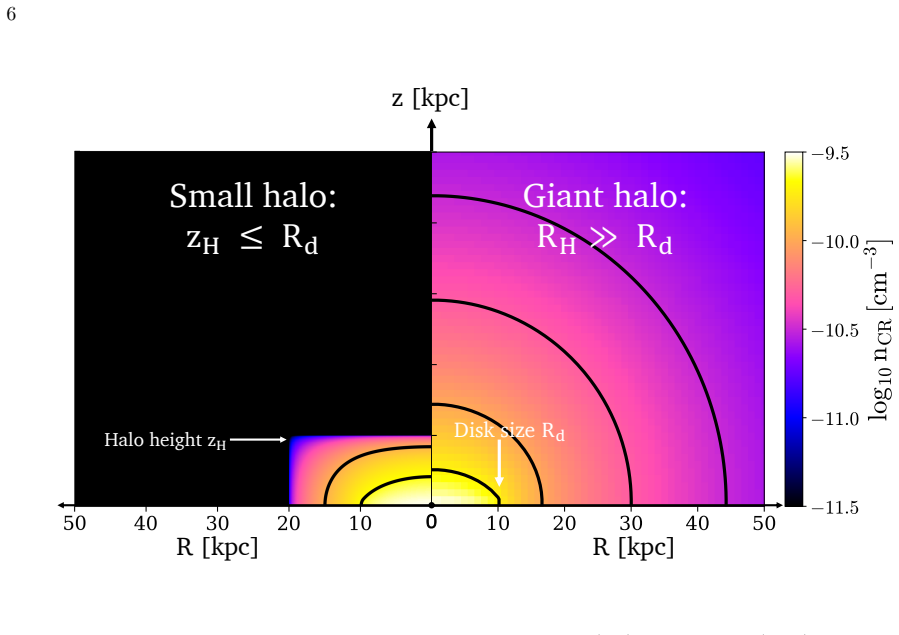
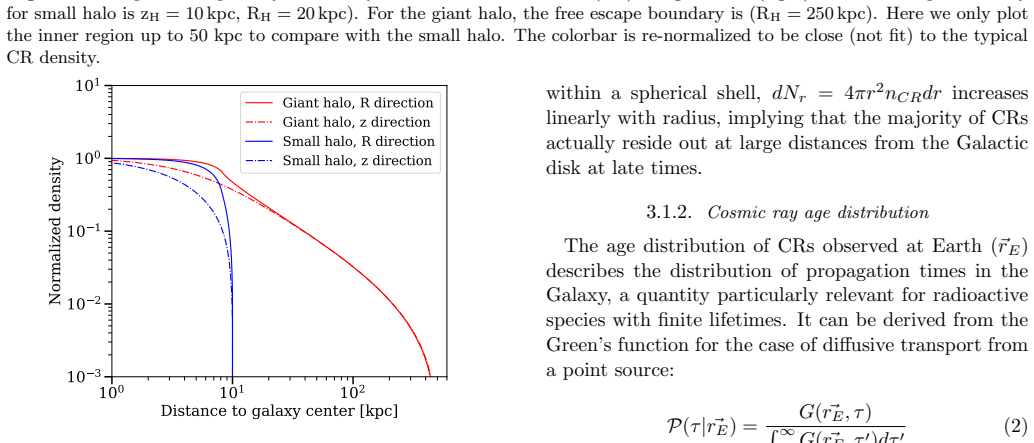
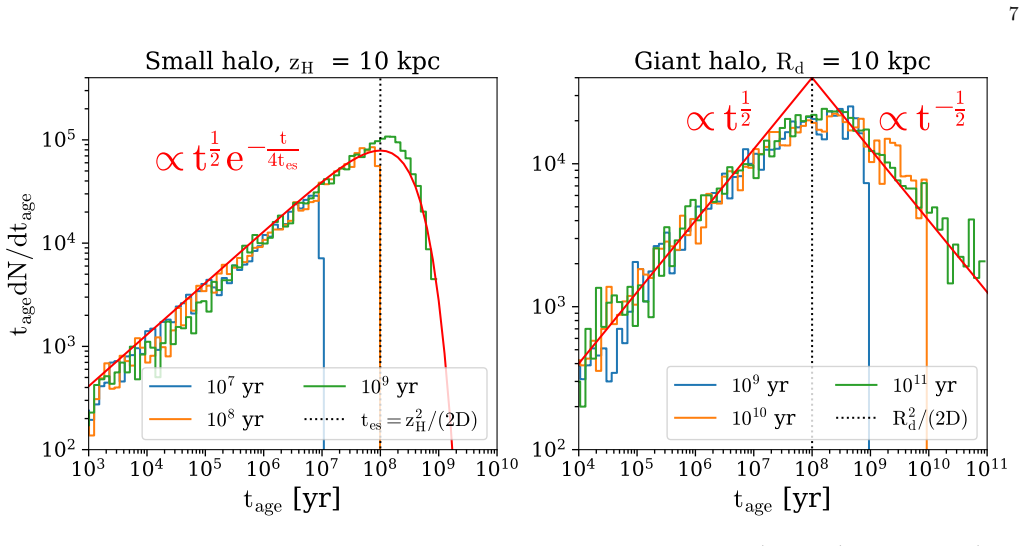
In the giant-halo scenario, CR transport within the source region remains similar to that in small-halo models, while substantial differences emerge at larger distances. In the giant-halo scenario, CRs develop an extended approximately 1/r spatial tail and exhibit a broader age distribution than the small-halo case. This model is shown to be consistent with current secondary-to-primary CR measurements. Uncertainties associated with Galactic gas distributions are comparable to those arising from nuclear spallation cross sections.
What carries the argument
The giant circumgalactic medium halo, whose height is fixed by the source-region extent rather than left free, which generates the extended 1/r cosmic-ray density tail outside that region.
If this is right
- Transport inside the source region stays comparable to small-halo models.
- An extended approximately 1/r spatial tail appears at larger distances.
- Cosmic-ray ages show a broader distribution than in the small-halo case.
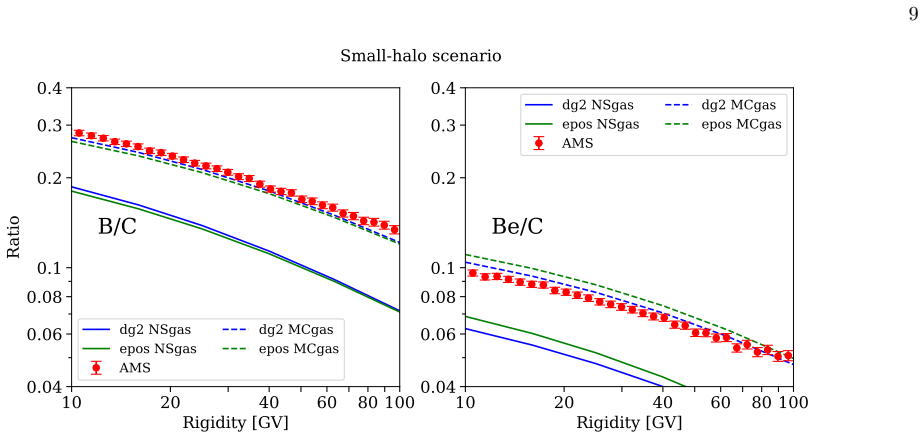
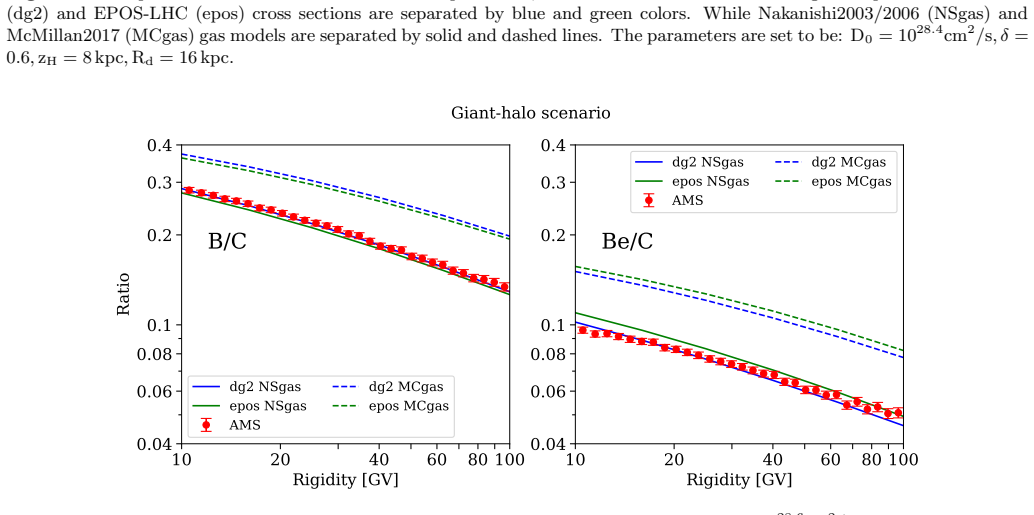
- The setup remains consistent with observed secondary-to-primary ratios.
- Uncertainties from gas distributions are comparable to those from spallation cross sections.
Where Pith is reading between the lines
- Predictions for diffuse gamma-ray and neutrino emission from the galactic environment would shift relative to small-halo expectations.
- The total energy budget stored in cosmic rays throughout the halo could be revised upward.
- Future mapping of cosmic-ray gradients at distances of tens to hundreds of kiloparsecs could directly test the tail.
Load-bearing premise
The halo height is set by the physical extent of the source region instead of being treated as a free parameter.
What would settle it
A measured cosmic-ray density profile lacking the 1/r tail beyond the galactic disk, or an age distribution narrower than the giant-halo prediction, would contradict the central claim.
Figures


read the original abstract
Recent observations have revealed that the Milky Way is embedded in a massive circumgalactic medium (CGM) extending to several hundred kiloparsecs. Such an extended gaseous halo acts as both a reservoir of baryons and potentially as a confinement volume for Galactic cosmic rays (CRs). We investigate CR transport in this giant Galactic halo and compare its properties with those of conventional small-halo models. In the giant-halo scenario, the halo height is no longer a free parameter, but instead relates to the extent of the source region. We show that CR transport within the source region remains similar to that in small-halo models, while substantial differences emerge at larger distances. In the giant-halo scenario, CRs develop an extended approximately 1/r spatial tail and exhibit a broader age distribution than the small-halo case. This model is shown to be consistent with current secondary-to-primary CR measurements. We further find that uncertainties associated with Galactic gas distributions are comparable to those arising from nuclear spallation cross sections. These results suggest that the giant-halo model provides a physically motivated alternative to conventional small-halo models and may have important implications for diffuse gamma-ray and neutrino emission from the Galactic environment.
Editorial analysis
A structured set of objections, weighed in public.
Referee Report
Summary. The paper investigates cosmic ray (CR) transport in a giant circumgalactic medium (CGM) halo extending to several hundred kpc, contrasting it with conventional small-halo models. It claims that halo height is no longer a free parameter but is instead set by the extent of the source region. Within the source region, transport properties remain similar to small-halo cases, while at larger radii the giant-halo model produces an extended ~1/r spatial tail and a broader CR age distribution. The model is reported to be consistent with existing secondary-to-primary CR measurements, with uncertainties from Galactic gas distributions comparable in magnitude to those from nuclear spallation cross sections. Implications for diffuse gamma-ray and neutrino emission are noted.
Significance. If the central results hold, the work supplies a physically motivated alternative to small-halo models in which the halo size is observationally anchored rather than tuned. The reported equivalence between gas-distribution and cross-section uncertainties is a useful quantitative statement that could guide future observational priorities. The extended 1/r tail and broader age distribution, if robustly derived, would affect predictions for high-energy emission from the Galactic environment.
minor comments (2)
- [Abstract] The abstract states that the model is 'consistent with current secondary-to-primary CR measurements' but does not identify the specific ratios or data sets used; a brief enumeration in the abstract or §1 would improve clarity.
- Notation for the halo height and source-region extent should be defined explicitly at first use (e.g., in §2) to avoid ambiguity when comparing giant- and small-halo cases.
Simulated Author's Rebuttal
We thank the referee for their positive assessment of our manuscript and for recommending minor revision. The referee's summary accurately reflects the central claims regarding CR transport in the giant CGM halo, the physically motivated halo size, the 1/r tail, broader age distribution, and the comparison of uncertainties from gas distributions versus spallation cross sections. No specific major comments were provided in the report.
Circularity Check
No significant circularity detected
full rationale
The abstract and summary present a physically motivated giant-halo model in which halo height is tied to source-region extent, CR transport inside the source region is stated to remain similar to small-halo cases, and an extended 1/r tail plus broader age distribution emerge at large radii while remaining consistent with secondary-to-primary ratios. No equations, fitted parameters, or derivation steps are supplied that would allow any claimed prediction to be shown as identical to an input by construction. Gas-distribution uncertainties are compared to spallation uncertainties without any reduction to self-referential fitting. The derivation chain is therefore self-contained against external benchmarks and receives the default non-finding.
Axiom & Free-Parameter Ledger
free parameters (1)
- Galactic gas distributions
axioms (1)
- domain assumption The halo height relates to the extent of the source region rather than remaining an independent free parameter.
Reference graph
Works this paper leans on
-
[1]
doi: 10.1016/j.physrep.2020.09.003
Aguilar, M., Ali Cavasonza, L., Ambrosi, G., et al. 2021, Physics Reports, 894, 1, doi: https://doi.org/10.1016/j.physrep.2020.09.003
-
[2]
2014, apj, 785, 63, doi: 10.1088/0004-637X/785/1/63
Bhattacharjee, P., Chaudhury, S., & Kundu, S. 2014, apj, 785, 63, doi: 10.1088/0004-637X/785/1/63
-
[3]
2013, Nuclear Physics B Proceedings Supplements, 239, 140, doi: 10.1016/j.nuclphysbps.2013.05.023
Blasi, P. 2013, Nuclear Physics B Proceedings Supplements, 239, 140, doi: 10.1016/j.nuclphysbps.2013.05.023
-
[4]
Blasi, P., & Amato, E. 2012, jcap, 2012, 010, doi: 10.1088/1475-7516/2012/01/010
-
[5]
2026, Astroparticle Physics, 176, 103203, doi: https://doi.org/10.1016/j.astropartphys.2025.103203
Borchiellini, M., Maurin, D., & Vecchi, M. 2026, Astroparticle Physics, 176, 103203, doi: https://doi.org/10.1016/j.astropartphys.2025.103203
-
[6]
N., Hodges-Kluck, E., Qu, Z., et al
Bregman, J. N., Hodges-Kluck, E., Qu, Z., et al. 2022, apj, 928, 14, doi: 10.3847/1538-4357/ac51de
-
[7]
Cao, Z., Aharonian, F., An, Q., et al. 2023, prl, 131, 151001, doi: 10.1103/PhysRevLett.131.151001
-
[8]
Cautun, M., Ben´ ıtez-Llambay, A., Deason, A. J., et al. 2020, mnras, 494, 4291, doi: 10.1093/mnras/staa1017 13
-
[9]
Cox, D. P. 2005, araa, 43, 337, doi: 10.1146/annurev.astro.43.072103.150615 De La Torre Luque, P., Mazziotta, M., Loparco, F.,
-
[10]
2021, jcap, 2021, 099, doi: 10.1088/1475-7516/2021/03/099
Gargano, F., & Serini, D. 2021, jcap, 2021, 099, doi: 10.1088/1475-7516/2021/03/099
-
[11]
2019, prd, 99, 103023, doi: 10.1103/PhysRevD.99.103023
Evoli, C., Aloisio, R., & Blasi, P. 2019, prd, 99, 103023, doi: 10.1103/PhysRevD.99.103023
-
[12]
2017, jcap, 2017, 015, doi: 10.1088/1475-7516/2017/02/015
Evoli, C., Gaggero, D., Vittino, A., et al. 2017, jcap, 2017, 015, doi: 10.1088/1475-7516/2017/02/015
-
[14]
2018, jcap, 2018, 006, doi: 10.1088/1475-7516/2018/07/006
Evoli, C., Gaggero, D., Vittino, A., et al. 2018, jcap, 2018, 006, doi: 10.1088/1475-7516/2018/07/006
-
[15]
Evoli, C., Morlino, G., Blasi, P., & Aloisio, R. 2020, prd, 101, 023013, doi: 10.1103/PhysRevD.101.023013
-
[16]
Faerman, Y., Sternberg, A., & McKee, C. F. 2017, apj, 835, 52, doi: 10.3847/1538-4357/835/1/52
-
[17]
Fagundes, D. A., Menon, M. J., & Silva, P. V. R. G. 2012, Brazilian Journal of Physics, 42, 452, doi: 10.1007/s13538-012-0099-5 Ferri` ere, K., Gillard, W., & Jean, P. 2007, aap, 467, 611, doi: 10.1051/0004-6361:20066992
-
[18]
Genolini, Y., Putze, A., Salati, P., & Serpico, P. D. 2015, aap, 580, A9, doi: 10.1051/0004-6361/201526344 G´ enolini, Y., Boudaud, M., Batista, P. I., et al. 2019, prd, 99, 123028, doi: 10.1103/PhysRevD.99.123028
-
[19]
Heesen, V., O’Sullivan, S. P., Br¨ uggen, M., et al. 2023, aap, 670, L23, doi: 10.1051/0004-6361/202346008
-
[20]
Hopkins, P. F., Butsky, I. S., Panopoulou, G. V., et al. 2022, mnras, 516, 3470, doi: 10.1093/mnras/stac1791 IceCube Collaboration, Abbasi, R., Ackermann, M., et al. 2023, Science, 380, 1338, doi: 10.1126/science.adc9818
-
[21]
2023, jcap, 2023, 053, doi: 10.1088/1475-7516/2023/03/053
Kalashev, O., Martynenko, N., & Troitsky, S. 2023, jcap, 2023, 053, doi: 10.1088/1475-7516/2023/03/053
-
[22]
Klypin, A., Zhao, H., & Somerville, R. S. 2002, apj, 573, 597, doi: 10.1086/340656
-
[23]
2021, prd, 103, 103016, doi: 10.1103/PhysRevD.103.103016
Korsmeier, M., & Cuoco, A. 2021, prd, 103, 103016, doi: 10.1103/PhysRevD.103.103016
-
[24]
Lerche, I., & Schlickeiser, R. 1982, mnras, 201, 1041, doi: 10.1093/mnras/201.4.1041 Lhaaso Collaboration, Cao, Z., Aharonian, F., et al. 2025, National Science Review, 12, nwaf496, doi: 10.1093/nsr/nwaf496
-
[25]
The lifetime of cosmic rays in the Milky Way
Lipari, P. 2014, arXiv e-prints, arXiv:1407.5223, doi: 10.48550/arXiv.1407.5223 —. 2022, arXiv e-prints, arXiv:2204.13085, doi: 10.48550/arXiv.2204.13085
work page internal anchor Pith review Pith/arXiv arXiv doi:10.48550/arxiv.1407.5223 2014
-
[26]
Maller, A. H., & Bullock, J. S. 2004, mnras, 355, 694, doi: 10.1111/j.1365-2966.2004.08349.x
-
[27]
McMillan, P. J. 2017, mnras, 465, 76, doi: 10.1093/mnras/stw2759
work page internal anchor Pith review doi:10.1093/mnras/stw2759 2017
-
[28]
Mewaldt, R. A., Spalding, J. D., Stone, E. C., & Vogt, R. E. 1981, apjl, 251, L27, doi: 10.1086/183686
-
[29]
C., Krause, M., Basu, A., et al
Mora-Partiarroyo, S. C., Krause, M., Basu, A., et al. 2019, aap, 632, A10, doi: 10.1051/0004-6361/201834571
-
[30]
doi:10.1016/j.astropartphys.2009.03.004 , Eprint =
Mori, M. 2009, Astroparticle Physics, 31, 341, doi: 10.1016/j.astropartphys.2009.03.004
-
[31]
1954, Physical Review, 94, 440, doi: 10.1103/PhysRev.94.440
Morrison, P., Olbert, S., & Rossi, B. 1954, Physical Review, 94, 440, doi: 10.1103/PhysRev.94.440
-
[32]
Pshirkov, M. S., & Nizamov, B. A. 2026, prl, 136, 081201, doi: 10.1103/kfld-35xl
-
[33]
2010, aap, 516, A66, doi: 10.1051/0004-6361/201014010
Putze, A., Derome, L., & Maurin, D. 2010, aap, 516, A66, doi: 10.1051/0004-6361/201014010
-
[34]
Ramesh, R., Nelson, D., Heesen, V., & Br¨ uggen, M. 2023, mnras, 526, 5483, doi: 10.1093/mnras/stad3104
-
[35]
Recchia, S., Gabici, S., Aharonian, F. A., & Niro, V. 2021, apj, 914, 135, doi: 10.3847/1538-4357/abfda4
-
[36]
2024, apj, 963, 111, doi: 10.3847/1538-4357/ad1ce8
Silver, E., & Orlando, E. 2024, apj, 963, 111, doi: 10.3847/1538-4357/ad1ce8
-
[37]
Annual Review of Nuclear and Particle Science , keywords =
Strong, A. W., Moskalenko, I. V., & Ptuskin, V. S. 2007, Annual Review of Nuclear and Particle Science, 57, 285, doi: 10.1146/annurev.nucl.57.090506.123011
-
[38]
M., Gabici, S., & Aharonian, F
Taylor, A. M., Gabici, S., & Aharonian, F. 2014, prd, 89, 103003, doi: 10.1103/PhysRevD.89.103003 Tepper-Garc´ ıa, T., Bland-Hawthorn, J., & Sutherland, R. S. 2015, apj, 813, 94, doi: 10.1088/0004-637X/813/2/94
-
[39]
2017, prd, 96, 103005, doi: 10.1103/PhysRevD.96.103005
Tomassetti, N. 2017, prd, 96, 103005, doi: 10.1103/PhysRevD.96.103005
-
[40]
doi:10.1146/annurev-astro-091916-055240 , eprint =
Tumlinson, J., Peeples, M. S., & Werk, J. K. 2017, araa, 55, 389, doi: 10.1146/annurev-astro-091916-055240
work page internal anchor Pith review doi:10.1146/annurev-astro-091916-055240 2017
-
[41]
Cosmic Ray Monte Carlo Package, CRMC
Ulrich, R., Pierog, T., & Baus, C. 2021, Cosmic Ray Monte Carlo Package, CRMC, 2.0.1, Zenodo, doi: 10.5281/zenodo.5270381
-
[42]
Weiner, B. J., & Williams, T. B. 1996, aj, 111, 1156, doi: 10.1086/117860
-
[43]
2020, A&A, 639, A131, doi: 10.1051/0004-6361/202037875
Maurin, D. 2020, A&A, 639, A131, doi: 10.1051/0004-6361/202037875
-
[44]
Yiou, F., & Raisbeck, G. M. 1970, aplett, 7, 129
1970
-
[45]
Zhang, Y., Comparat, J., Ponti, G., et al. 2024, aap, 690, A267, doi: 10.1051/0004-6361/202449412
-
[46]
2026, aap, 706, A102, doi: 10.1051/0004-6361/202556835
Zhang, Y., Shreeram, S., Ponti, G., et al. 2026, aap, 706, A102, doi: 10.1051/0004-6361/202556835
-
[47]
2024, prd, 109, 083036, doi: 10.1103/PhysRevD.109.083036
Zhao, M.-J., Bi, X.-J., Fang, K., & Yin, P.-F. 2024, prd, 109, 083036, doi: 10.1103/PhysRevD.109.083036
discussion (0)
Sign in with ORCID, Apple, or X to comment. Anyone can read and Pith papers without signing in.