Collective neutrino oscillations: Many-body non-forward effects and non-classicality
Pith reviewed 2026-06-27 08:55 UTC · model grok-4.3
The pith
In a neutrino gas, many-body non-forward scattering yields different oscillation timescales and asymptotics than quantum kinetic descriptions with collision terms.
A machine-rendered reading of the paper's core claim, the machinery that carries it, and where it could break.
Core claim
In this work, we compare these two approaches in a simple neutrino-gas configuration, with particular emphasis on the role of non-forward scattering processes. These effects are incorporated either through a collision term in the kinetic description, or by considering the full neutrino-neutrino many-body Hamiltonian. We highlight differences between the two descriptions in both their characteristic timescales and asymptotic behavior. Motivated by the natural suitability of quantum computing for many-body calculations, we further investigate the non-classicality of neutrino evolution, discussing Trotter error scaling, along with the associated costs of constructing quantum circuits in terms o
What carries the argument
Comparison between the quantum kinetic description with a collision term for non-forward scattering and the full neutrino-neutrino many-body Hamiltonian, plus Trotterized quantum circuit resource estimates for the evolution.
If this is right
- The two descriptions differ in both characteristic timescales and asymptotic behavior.
- Resources needed for neutrino many-body evolution are on the low end of typical high-energy physics problems and on the mid to high end with respect to quantum chemistry problems.
- For the full Hamiltonian, resource requirements increase relative to the truncated version.
- Efficient fermion-to-qubit encodings are essential for reducing the substantial computational resources required for such simulations.
Where Pith is reading between the lines
- If the reported timescale and asymptotic differences survive in more realistic density profiles, supernova and merger neutrino transport codes may need to incorporate multi-body correlation effects.
- Quantum circuit methods could become viable for directly evolving entangled neutrino states in regimes where classical kinetic approximations break down.
- The Trotter error and gate-count analysis could be extended to larger neutrino numbers to map the boundary between classical and quantum simulation regimes.
Load-bearing premise
The simple neutrino-gas configuration and the specific choice of Hamiltonian truncation are assumed to capture the essential non-forward scattering physics that would appear in realistic astrophysical environments.
What would settle it
A side-by-side numerical run of flavor polarization evolution from identical initial conditions under both the kinetic equation with collisions and the full many-body Hamiltonian, checking whether timescales or final states match.
Figures



read the original abstract
Neutrino evolution in dense astrophysical environments is typically described either within a quantum kinetic framework, which neglects the build-up of multi-body correlations, or through simplified many-body calculations that allow significant entanglement to develop. In this work, we compare these two approaches in a simple neutrino-gas configuration, with particular emphasis on the role of non-forward scattering processes. These effects are incorporated either through a collision term in the kinetic description, or by considering the full neutrino-neutrino many-body Hamiltonian. We highlight differences between the two descriptions in both their characteristic timescales and asymptotic behavior. Motivated by the natural suitability of quantum computing for many-body calculations, we further investigate the non-classicality of neutrino evolution, discussing Trotter error scaling, along with the associated costs of constructing quantum circuits in terms of entangling gates and non-Clifford gates. We find that the resources needed for neutrino many-body evolution are on the low end of typical high-energy physics problems and on the mid to high end with respect to quantum chemistry problems. For the full Hamiltonian, resource requirements increase relative to the truncated version. We emphasize the importance of efficient fermion-to-qubit encodings, which are essential for reducing the substantial computational resources required for such simulations.
Editorial analysis
A structured set of objections, weighed in public.
Referee Report
Summary. The paper compares the quantum-kinetic framework (with a collision term for non-forward scattering) against the full many-body neutrino-neutrino Hamiltonian in a simplified uniform-density neutrino-gas configuration. It reports differences between the two in characteristic timescales and asymptotic behavior. It further analyzes the non-classicality of the evolution via Trotter error scaling and estimates quantum circuit resources (entangling gates and non-Clifford gates), concluding that requirements lie on the low end of typical HEP problems and mid-to-high end relative to quantum chemistry, with the full Hamiltonian increasing costs relative to a truncated version; efficient fermion-to-qubit encodings are emphasized.
Significance. If the reported timescale/asymptotic differences and resource scalings hold under the model's assumptions, the work would usefully clarify when many-body correlations matter beyond kinetic approximations in collective oscillations and provide concrete benchmarks for quantum simulation of neutrino many-body problems. The explicit discussion of quantum-computing suitability for entangled neutrino systems is a constructive contribution.
major comments (2)
- [§2, Eq. (3)] §2, Eq. (3): the Hamiltonian truncation that drops higher-order forward-scattering corrections and restricts to a uniform-density gas is load-bearing for the central claim of observable differences in timescales and asymptotic behavior; if omitted non-forward channels dominate entanglement or decoherence in inhomogeneous supernova profiles, the reported separation loses direct applicability to realistic environments.
- [Sec. 4] Sec. 4: Trotter-error and entangling-gate-count estimates are computed on the truncated operator and therefore inherit the same limitation; resource conclusions would require revision if additional terms are needed to capture the essential non-forward physics.
minor comments (1)
- The abstract and introduction would benefit from an explicit statement of the neutrino number, density, and mixing parameters used in the gas configuration to allow immediate assessment of the model's scope.
Simulated Author's Rebuttal
We thank the referee for the thoughtful and constructive report. The comments correctly identify the deliberate simplifications in our model. We address each point below, providing additional context on the scope of the work while agreeing that extensions to inhomogeneous profiles remain important future directions.
read point-by-point responses
-
Referee: [§2, Eq. (3)] §2, Eq. (3): the Hamiltonian truncation that drops higher-order forward-scattering corrections and restricts to a uniform-density gas is load-bearing for the central claim of observable differences in timescales and asymptotic behavior; if omitted non-forward channels dominate entanglement or decoherence in inhomogeneous supernova profiles, the reported separation loses direct applicability to realistic environments.
Authors: We agree that the truncation to the uniform-density gas and the specific form of the Hamiltonian in Eq. (3) are central to the reported differences. This choice is intentional: it allows a clean, controlled comparison between the quantum-kinetic description (with collision term) and the full many-body evolution without confounding effects from density gradients or additional forward-scattering channels. The manuscript already frames the study as a “simple neutrino-gas configuration,” and the differences in timescales and asymptotics are demonstrated strictly within this setup. We will add a short clarifying paragraph in the introduction and conclusions stating that the observed separation is specific to the uniform-density truncation and that applicability to realistic supernova profiles requires future work incorporating inhomogeneity. revision: partial
-
Referee: [Sec. 4] Sec. 4: Trotter-error and entangling-gate-count estimates are computed on the truncated operator and therefore inherit the same limitation; resource conclusions would require revision if additional terms are needed to capture the essential non-forward physics.
Authors: The resource estimates in Sec. 4 are performed on the same truncated Hamiltonian employed throughout the paper. Because the truncation defines the physics being simulated, the reported gate counts and Trotter-error scalings correctly characterize the cost of the model we study. We will insert an explicit statement in Sec. 4 noting that the quoted resources apply to the truncated operator and that inclusion of additional non-forward terms would increase the gate count proportionally. This keeps the conclusions accurate for the present comparison while acknowledging the scaling implication for extended models. revision: partial
Circularity Check
No circularity: independent comparison of frameworks on explicit model
full rationale
The paper compares a quantum-kinetic description (with collision term) against the full many-body Hamiltonian on a uniform neutrino-gas configuration. No equations or resource counts are obtained by fitting parameters to the target observables and then relabeling the fit as a prediction; the reported timescale and asymptotic differences follow directly from evolving the two distinct operators. Resource estimates (Trotter error, gate counts) are computed on the stated truncated Hamiltonian without reduction to prior self-fitted quantities. No self-citation is invoked as a uniqueness theorem or to smuggle an ansatz. The derivation therefore remains self-contained against external benchmarks.
Axiom & Free-Parameter Ledger
axioms (1)
- domain assumption The many-body neutrino-neutrino Hamiltonian and the quantum kinetic equation with collision term are both valid starting points for the same physical system.
Reference graph
Works this paper leans on
-
[1]
truncated
Forward/exchange limit Based on the coherent enhancement of some terms in the QKE formalism at the mean-field level (see Sec. IIC), many studies have restricted the many-body Hamilto- nian interaction part to a subset of processes, namely, the forward [(⃗ p3, ⃗ p4) = (⃗ p1, ⃗ p2)] and exchange [(⃗ p3, ⃗ p4) = (⃗ p2, ⃗ p1)] terms. In those cases, we have: ...
-
[2]
full Hamiltonian
Schrödinger equation Given the neutrino Hamiltonian (12), one can solve the Schrödinger equation id|Ψ⟩ dt =H|Ψ⟩,(16) with|Ψ⟩theN-body quantum state of the system. The solutions of Eq. (16) will be referred to as involving the “full Hamiltonian.” For comparison purposes with the literature, we will also present results where the interaction Hamiltonian is ...
-
[3]
col- lision
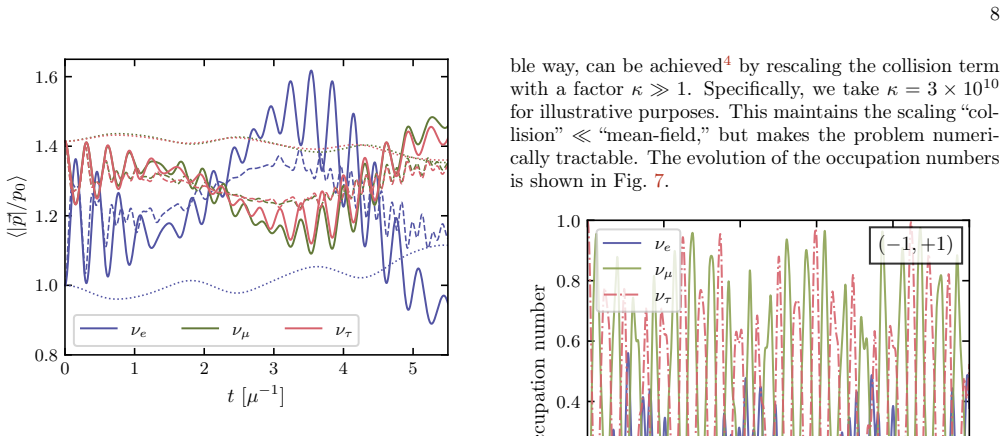
Timescales In the QKE case, the ratio between the scales of the collision and mean-field terms is [see Eqs. (B3) and (22)] GF V 2 V 1/3 GF V = GF V 2/3 ∼2.7×10 −14 .(26) Although this ratio slightly underestimates the strength of the collision term (because the associated phase space, which we do not include, is larger in the numerator than the denominato...
-
[4]
This is visible in our example by looking at the panels representing the momenta(−p0,0)and(+p 0,0)in Fig
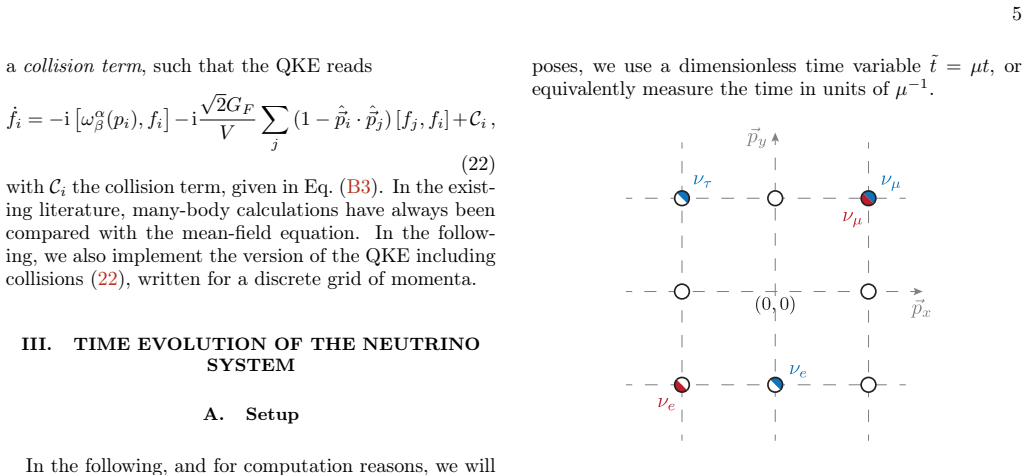
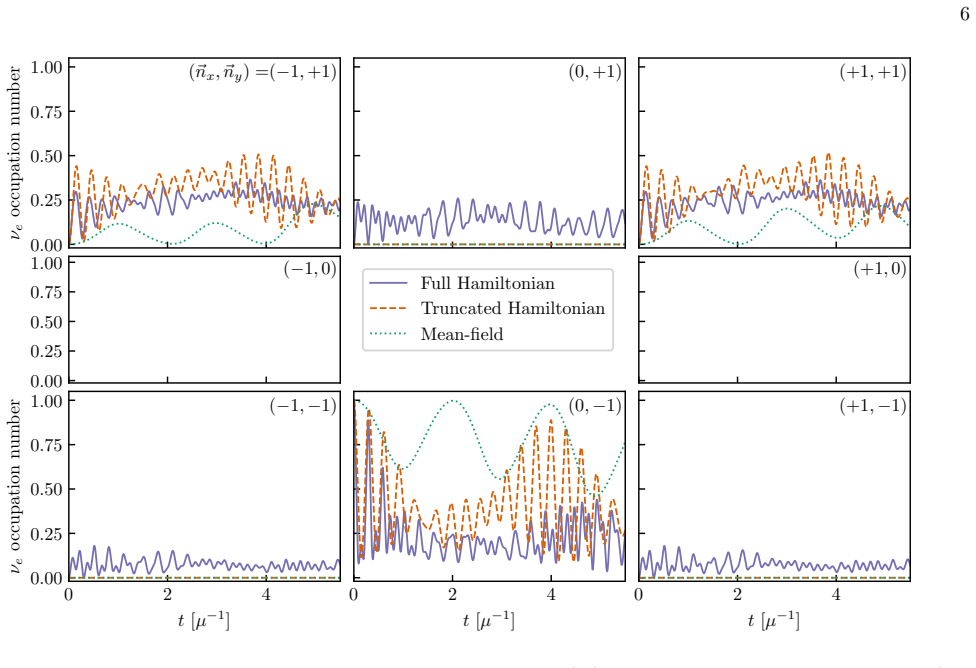
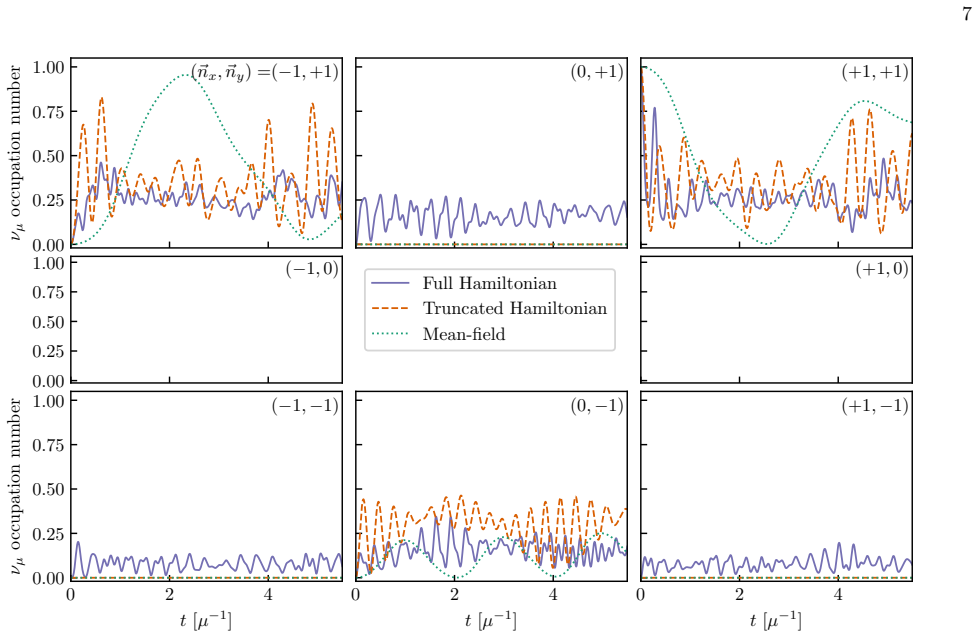
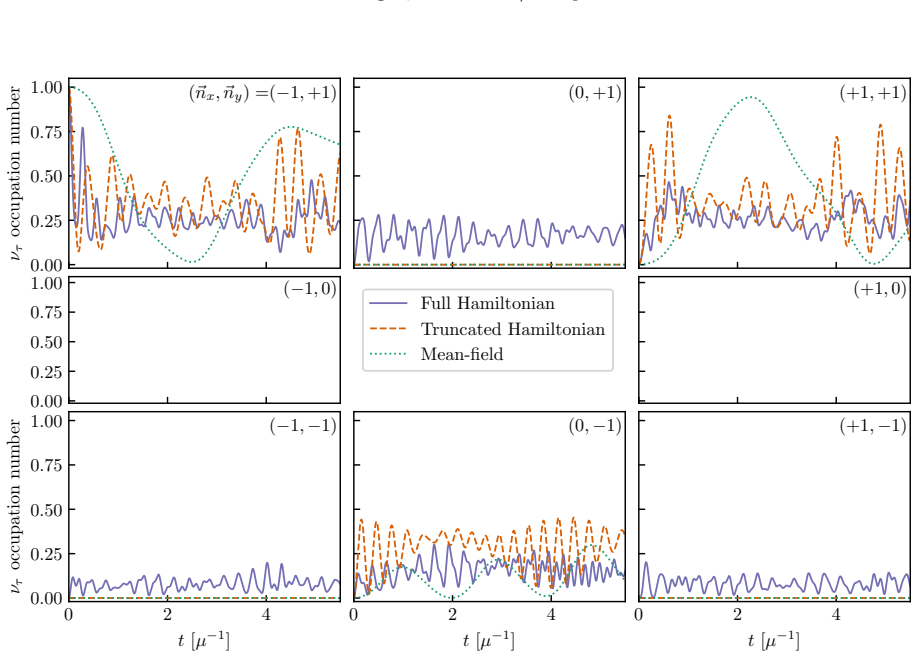
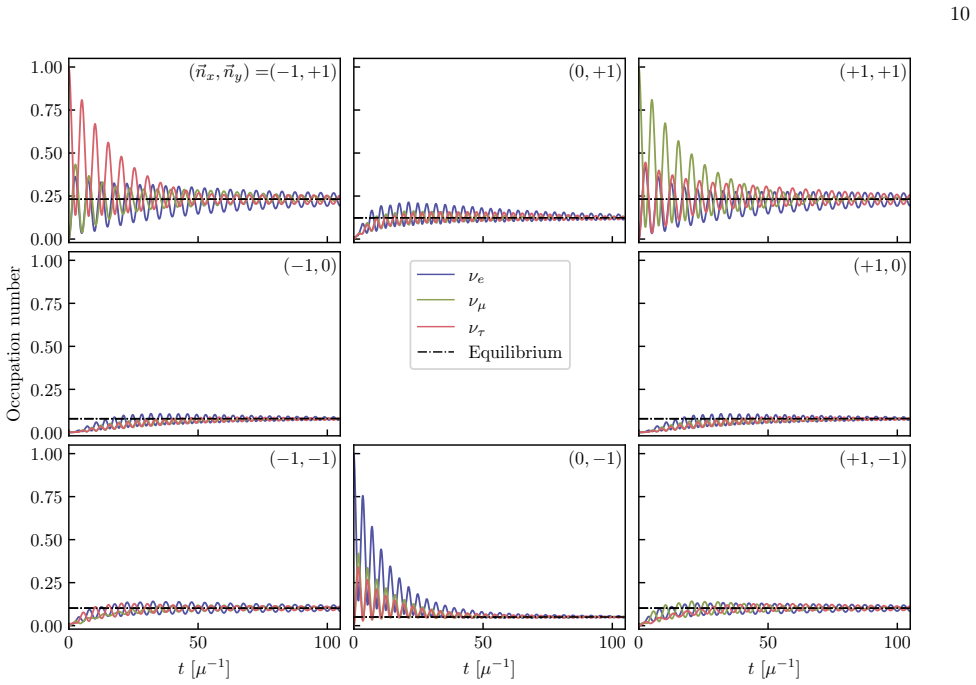
Momentum distribution The set of momentum bins that are occupied by momentum-exchanging processes is different between the quantum kinetic and closed many-body calculations. This is visible in our example by looking at the panels representing the momenta(−p0,0)and(+p 0,0)in Fig. 7, to be compared with the same panels in Figs. 2–4. Given our momentum grid,...
-
[5]
plane waves in a box,
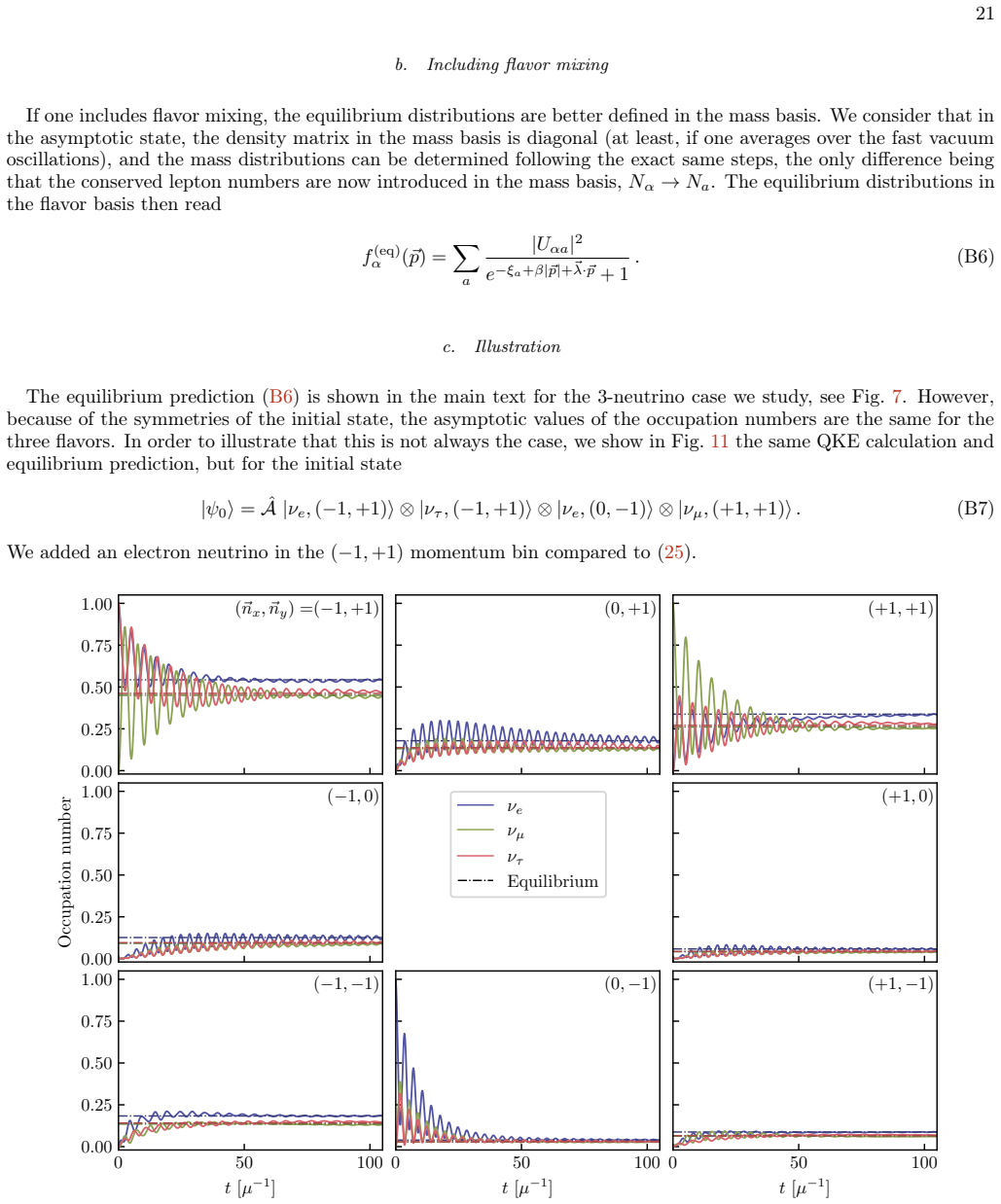
Discussion Since a many-body calculation using the full Hamilto- nian allows for the population of new momenta states, while this is impossible in a mean-field calculation, the comparison of both frameworks will necessarily show sig- nificant differences. By comparing with a QKE calcula- tion for the same setup, we explicitly showed that mo- mentum redist...
-
[6]
UV-cutoff
Splitting one-body/two-body First, we compute an upper bound onC12 by separat- ing the forward/exchange part and the other contribu- tions. Forward/exchange partWe want to compute C(f/e) 12 = h Hvac, H(f/e) νν i .(36) Details are given in Appendix D1, and we obtain the upper bound: C(f/e) 12 ≤8µmax α,i,j |ωαi −ω αj|×N F (NF −1)×N(N−1). (37) We emphasize t...
-
[7]
=V(⃗ pi1 , ⃗ pi2 , ⃗ pi3 , ⃗ pi4)
Two-body operator splitting We have introduced the first order Trotter error asso- ciated with the two-body operator in (35), and it reads explicitly ∥C22∥= 1 2 µ2 X α,β,γ,σ X i1̸=i2,j1̸=j2 X i3,j3 |Vi1...Vj1...| × h ˆa† α,i1ˆaα,i3ˆa† β,i2 ˆaβ,i4 ,ˆa† γ,j1ˆaγ,j3ˆa† σ,j2ˆaσ,j4 i , (40) using the shorthand notationVi1... =V(⃗ pi1 , ⃗ pi2 , ⃗ pi3 , ⃗ pi4). T...
-
[8]
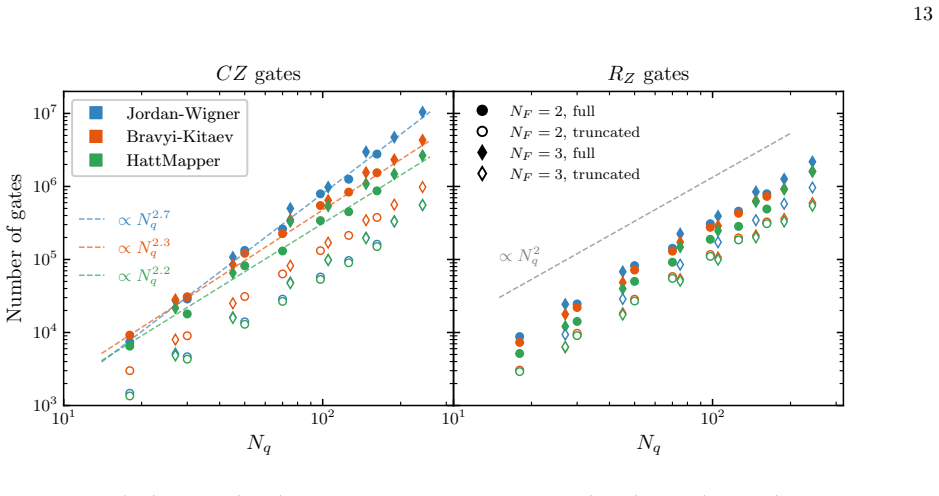
Quantum Resources Provided the Trotter error has been computed, we turn our attention to the quantum computational cost of a single first order Trotter step. At first we need to repre- sent the second quantized Hamiltonian in the qubit ba- sis. To this end, we employ the standard Jordan-Wigner (JW) [79] and Bravyi-Kitaev (BK) [80] transformations, and mor...
-
[9]
Janka, Explosion Mechanisms of Core-Collapse Su- pernovae, Ann
H.-T. Janka, Explosion Mechanisms of Core-Collapse Su- pernovae, Ann. Rev. Nucl. Part. Sci.62, 407 (2012), arXiv:1206.2503 [astro-ph.SR]
Pith/arXiv arXiv 2012
-
[10]
A. Mezzacappa, E. Endeve, O. E. Bronson Messer, and S. W. Bruenn, Physical, numerical, and computational challengesofmodelingneutrinotransportincore-collapse supernovae, Liv. Rev. Comput. Astrophys.6, 4 (2020), arXiv:2010.09013 [astro-ph.HE]
arXiv 2020
-
[11]
A. Burrows and D. Vartanyan, Core-Collapse Su- pernova Explosion Theory, Nature589, 29 (2021), arXiv:2009.14157 [astro-ph.SR]
arXiv 2021
-
[12]
Foucart, Neutrino transport in general relativistic neu- tron star merger simulations, Liv
F. Foucart, Neutrino transport in general relativistic neu- tron star merger simulations, Liv. Rev. Comput. Astro- phys.9, 1 (2023), arXiv:2209.02538 [astro-ph.HE]
arXiv 2023
-
[13]
T. Fischer, G. Guo, K. Langanke, G. Martinez-Pinedo, Y.-Z. Qian, and M.-R. Wu, Neutrinos and nucleosyn- thesis of elements, Prog. Part. Nucl. Phys.137, 104107 (2024), arXiv:2308.03962 [astro-ph.HE]
arXiv 2024
-
[14]
X. Wang and R. Surman, Neutrinos and Heavy Ele- ment Nucleosynthesis, inHandbook of Nuclear Physics, edited by I. Tanihata, H. Toki, and T. Kajino (Springer Nature Singapore, Singapore, 2023) pp. 3735–3753, arXiv:2309.06043 [astro-ph.HE]
arXiv 2023
-
[15]
Sigl and G
G. Sigl and G. Raffelt, General kinetic description of rel- ativistic mixed neutrinos, Nucl. Phys. B406, 423 (1993)
1993
-
[16]
A. Vlasenko, G. M. Fuller, and V. Cirigliano, Neutrino Quantum Kinetics, Phys. Rev. D89, 105004 (2014), arXiv:1309.2628 [hep-ph]
Pith/arXiv arXiv 2014
-
[17]
D. N. Blaschke and V. Cirigliano, Neutrino Quantum Ki- netic Equations: The Collision Term, Phys. Rev. D94, 033009 (2016), arXiv:1605.09383 [hep-ph]
Pith/arXiv arXiv 2016
-
[18]
C. Volpe, D. Väänänen, and C. Espinoza, Extended evo- lution equations for neutrino propagation in astrophys- ical and cosmological environments, Phys. Rev. D87, 113010 (2013), arXiv:1302.2374 [hep-ph]
Pith/arXiv arXiv 2013
-
[19]
Volpe, Neutrino Quantum Kinetic Equations, Int
C. Volpe, Neutrino Quantum Kinetic Equations, Int. J. Mod. Phys. E24, 1541009 (2015), arXiv:1506.06222 [astro-ph.SR]
Pith/arXiv arXiv 2015
-
[20]
J. Froustey, C. Pitrou, and M. C. Volpe, Neutrino decou- pling including flavour oscillations and primordial nucle- osynthesis, JCAP12, 015, arXiv:2008.01074 [hep-ph]
arXiv 2008
-
[21]
H. Duan, G. M. Fuller, and Y.-Z. Qian, Collective Neu- trino Oscillations, Ann. Rev. Nucl. Part. Sci.60, 569 (2010), arXiv:1001.2799 [hep-ph]
Pith/arXiv arXiv 2010
-
[22]
I. Tamborra and S. Shalgar, New Developments in Flavor EvolutionofaDenseNeutrinoGas,Ann.Rev.Nucl.Part. Sci.71, 165 (2021), arXiv:2011.01948 [astro-ph.HE]
arXiv 2021
-
[23]
F. Capozzi and N. Saviano, Neutrino Flavor Conversions in High-Density Astrophysical and Cosmological Envi- ronments, Universe8, 94 (2022), arXiv:2202.02494 [hep- ph]
arXiv 2022
-
[24]
M. C. Volpe, Neutrinos from dense environments: Fla- vor mechanisms, theoretical approaches, observations, and new directions, Rev. Mod. Phys.96, 025004 (2024), arXiv:2301.11814 [hep-ph]
arXiv 2024
- [25]
-
[26]
J. T. Pantaleone, Neutrino oscillations at high densities, Phys. Lett. B287, 128 (1992)
1992
-
[27]
N. F. Bell, A. A. Rawlinson, and R. F. Sawyer, Speedup through Entanglement: Many Body Effects in Neutrino Processes, Phys. Lett. B573, 86 (2003), arXiv:hep- ph/0304082
arXiv 2003
-
[28]
A. Friedland and C. Lunardini, Neutrino flavor conver- sioninaneutrinobackground: Singleparticleversusmul- tiparticle description, Phys. Rev. D68, 013007 (2003), arXiv:hep-ph/0304055
Pith/arXiv arXiv 2003
-
[29]
A. Friedland and C. Lunardini, Do many particle neu- trino interactions cause a novel coherent effect?, JHEP 10, 043, arXiv:hep-ph/0307140
-
[30]
A. Friedland, B. H. J. McKellar, and I. Okuniewicz, Con- struction and analysis of a simplified many-body neu- trino model, Phys. Rev. D73, 093002 (2006), arXiv:hep- ph/0602016
arXiv 2006
-
[31]
A. V. Patwardhan, M. J. Cervia, E. Rrapaj, P. Siwach, and A. B. Balantekin, Many-Body Collective Neutrino Oscillations: Recent Developments, inHandbook of Nu- clear Physics, edited by I. Tanihata, H. Toki, and T. Ka- jino (Springer Nature Singapore, Singapore, 2023) pp. 3755–3770, arXiv:2301.00342 [hep-ph]
arXiv 2023
-
[32]
A. B. Balantekin, M. J. Cervia, A. V. Patwardhan, E. Rrapaj, and P. Siwach, Quantum information and quantum simulation of neutrino physics, Eur. Phys. J. A59, 186 (2023), arXiv:2305.01150 [nucl-th]
arXiv 2023
-
[33]
M. J. Cervia, A. V. Patwardhan, A. B. Balantekin, S. N. Coppersmith, and C. W. Johnson, Entanglement and col- lective flavor oscillations in a dense neutrino gas, Phys. Rev. D100, 083001 (2019), arXiv:1908.03511 [hep-ph]
arXiv 2019
-
[34]
A. V. Patwardhan, M. J. Cervia, and A. B. Balantekin, Spectral splits and entanglement entropy in collective neutrino oscillations, Phys. Rev. D104, 123035 (2021), arXiv:2109.08995 [hep-ph]
arXiv 2021
-
[35]
M. Hite and P. Siwach, Quantum resource redistri- bution drives spectral splits in dense neutrino gases, 16 arXiv:2605.23584 [quant-ph] (2026)
Pith/arXiv arXiv 2026
-
[36]
E. Rrapaj, Exact solution of multiangle quantum many- body collective neutrino-flavor oscillations, Phys. Rev. C 101, 065805 (2020), arXiv:1905.13335 [hep-ph]
arXiv 2020
-
[37]
A. Roggero, E. Rrapaj, and Z. Xiong, Entanglement and correlations in fast collective neutrino flavor oscillations, Phys. Rev. D106, 043022 (2022), arXiv:2203.02783 [astro-ph.HE]
arXiv 2022
- [38]
-
[39]
J. D. Martin, D. Neill, A. Roggero, H. Duan, and J. Carl- son, Equilibration of quantum many-body fast neutrino flavor oscillations, Phys. Rev. D108, 123010 (2023), arXiv:2307.16793 [hep-ph]
arXiv 2023
-
[40]
Y. Qiu, D. Radice, S. Richers, and M. Bhat- tacharyya, Neutrino Flavor Transformation in Neutron Star Mergers, Phys. Rev. Lett.135, 091401 (2025), arXiv:2503.11758 [astro-ph.HE]
arXiv 2025
-
[41]
Y. Qiu, D. Radice, S. Richers, F. M. Guercilena, A. Perego, and M. Bhattacharyya, Impact of neutrino fla- vor conversions on neutron star merger dynamics, ejecta, nucleosynthesis, and multimessenger signals, Phys. Rev. D112, 123039 (2025), arXiv:2510.15028 [astro-ph.HE]
arXiv 2025
-
[42]
A. B. Balantekin, M. J. Cervia, A. V. Patwardhan, R. Surman, and X. Wang, Collective Neutrino Os- cillations and Heavy-element Nucleosynthesis in Su- pernovae: Exploring Potential Effects of Many-body Neutrino Correlations, Astrophys. J.967, 146 (2024), arXiv:2311.02562 [astro-ph.HE]
arXiv 2024
-
[43]
Xiong, Many-body effects of collective neutrino oscillations, Phys
Z. Xiong, Many-body effects of collective neutrino oscillations, Phys. Rev. D105, 103002 (2022), arXiv:2111.00437 [astro-ph.HE]
arXiv 2022
-
[44]
J. D. Martin, A. Roggero, H. Duan, J. Carlson, and V. Cirigliano, Classical and quantum evolution in a sim- ple coherent neutrino problem, Phys. Rev. D105, 083020 (2022), arXiv:2112.12686 [hep-ph]
arXiv 2022
-
[45]
Roggero, Entanglement and many-body effects in col- lective neutrino oscillations, Phys
A. Roggero, Entanglement and many-body effects in col- lective neutrino oscillations, Phys. Rev. D104, 103016 (2021), arXiv:2102.10188 [hep-ph]
arXiv 2021
-
[46]
Roggero, Dynamical phase transitions in models of collective neutrino oscillations, Phys
A. Roggero, Dynamical phase transitions in models of collective neutrino oscillations, Phys. Rev. D104, 123023 (2021), arXiv:2103.11497 [hep-ph]
arXiv 2021
-
[47]
M. J. Cervia, P. Siwach, A. V. Patwardhan, A. B. Bal- antekin, S. N. Coppersmith, and C. W. Johnson, Col- lective neutrino oscillations with tensor networks using a time-dependent variational principle, Phys. Rev. D105, 123025 (2022), arXiv:2202.01865 [hep-ph]
arXiv 2022
-
[48]
Y. Pehlivan, A. B. Balantekin, T. Kajino, and T. Yoshida, Invariants of Collective Neutrino Oscilla- tions, Phys. Rev. D84, 065008 (2011), arXiv:1105.1182 [astro-ph.CO]
Pith/arXiv arXiv 2011
-
[49]
S. Birol, Y. Pehlivan, A. B. Balantekin, and T. Kajino, Neutrino Spectral Split in the Exact Many Body Formal- ism, Phys. Rev. D98, 083002 (2018), arXiv:1805.11767 [astro-ph.HE]
Pith/arXiv arXiv 2018
-
[50]
A. V. Patwardhan, M. J. Cervia, and A. Baha Bal- antekin, Eigenvalues and eigenstates of the many-body collective neutrino oscillation problem, Phys. Rev. D99, 123013 (2019), arXiv:1905.04386 [nucl-th]
arXiv 2019
-
[51]
D. Lacroix, A. B. Balantekin, M. J. Cervia, A. V. Pat- wardhan, and P. Siwach, Role of non-Gaussian quantum fluctuations in neutrino entanglement, Phys. Rev. D106, 123006 (2022), arXiv:2205.09384 [nucl-th]
arXiv 2022
-
[52]
D. Lacroix, A. Bauge, B. Yilmaz, M. Mangin-Brinet, A. Roggero, and A. B. Balantekin, Phase-space methods for neutrino oscillations: Extension to multibeams, Phys. Rev. D110, 103027 (2024), arXiv:2409.20215 [hep-ph]
arXiv 2024
-
[53]
B. Hall, A. Roggero, A. Baroni, and J. Carlson, Sim- ulation of collective neutrino oscillations on a quan- tum computer, Phys. Rev. D104, 063009 (2021), arXiv:2102.12556 [quant-ph]
arXiv 2021
-
[54]
K. Yeter-Aydeniz, S. Bangar, G. Siopsis, and R. C. Pooser, Collective neutrino oscillations on a quan- tum computer, Quant. Inf. Proc.21, 84 (2022), arXiv:2104.03273 [quant-ph]
arXiv 2022
-
[55]
A. K. Jha and A. Chatla, Quantum studies of neutrinos on IBMQ processors, Eur. Phys. J. ST231, 141 (2022)
2022
-
[56]
V. Amitrano, A. Roggero, P. Luchi, F. Turro, L. Vespucci, and F. Pederiva, Trapped-ion quantum sim- ulation of collective neutrino oscillations, Phys. Rev. D 107, 023007 (2023), arXiv:2207.03189 [quant-ph]
arXiv 2023
-
[57]
M. Illa and M. J. Savage, Multi-Neutrino Entanglement and Correlations in Dense Neutrino Systems, Phys. Rev. Lett.130, 221003 (2023), arXiv:2210.08656 [nucl-th]
arXiv 2023
- [58]
- [59]
-
[60]
G. Singh, Arvind, and K. Dorai, Simulating three-flavor neutrino oscillations on a nuclear magnetic resonance quantum processor, Phys. Scripta100, 085106 (2025), arXiv:2412.15617 [quant-ph]
arXiv 2025
-
[61]
L. Spagnoliet al., Collective neutrino oscillations in three flavors on qubit and qutrit processors, Phys. Rev. D111, 103054 (2025), arXiv:2503.00607 [quant-ph]
arXiv 2025
-
[62]
S. Tripathi, S. Joshi, G. Rajpoot, and P. Shukla, Quan- tum simulation of collective neutrino oscillations in dense neutrino environment, Quant. Inf. Proc.25, 163 (2026), arXiv:2508.11610 [quant-ph]
arXiv 2026
-
[63]
K. Bleau, N. Ilic, J. Kopp, U. Rahaman, and X. Y. Yu, Quantum Simulation of Collective Neutrino Oscillations using Dicke States, arXiv:2604.07452 [quant-ph] (2026)
Pith/arXiv arXiv 2026
-
[64]
D. J. Heimsoth, A. B. Balantekin, and P. Si- wach, Three-flavor supernova neutrino simulation us- ing a hybrid quantum-classical algorithm with qutrits, arXiv:2605.01099 [hep-ph] (2026)
Pith/arXiv arXiv 2026
-
[65]
I. Chernyshev, C. E. P. Robin, and M. J. Savage, Quantum magic and computational complexity in the neutrino sector, Phys. Rev. Res.7, 023228 (2025), arXiv:2411.04203 [quant-ph]
arXiv 2025
-
[66]
Johns, Neutrino many-body correlations, Int
L. Johns, Neutrino many-body correlations, Int. J. Mod. Phys. A39, 2450122 (2024), arXiv:2305.04916 [hep-ph]
arXiv 2024
-
[67]
V. Cirigliano, S. Sen, and Y. Yamauchi, Neutrino many- body flavor evolution: The full Hamiltonian, Phys. Rev. D110, 123028 (2024), arXiv:2404.16690 [hep-ph]
arXiv 2024
-
[68]
J. Carlson, A. Roggero, and D. Neill, Neutrino Fla- vor Evolution in High Flux Astrophysical Environments, arXiv:2603.12192 [hep-ph] (2026)
arXiv 2026
-
[69]
M.J.Cervia,Interactionsofneutrinowavepackets,Phys. Rev. D113, 043010 (2026), arXiv:2510.22005 [hep-ph]
arXiv 2026
-
[70]
Y. Xu, J. Froustey, G. M. Fuller, L. Gráf, and A. V. Pat- 17 wardhan, Neutrino helicity oscillations in astrophysical environments: a many-body approach, arXiv:2605.31242 [hep-ph] (2026)
Pith/arXiv arXiv 2026
-
[71]
Y. Liu, K. Yao, J. Hong, J. Froustey, E. Rrapaj, C. Ian- cull, G. Li, and Y. Shi, Hatt: Hamiltonian adaptive ternary tree for optimizing fermion-to-qubit mapping, in 31st HPCA(2025) arXiv:2409.02010 [quant-ph]
arXiv 2025
-
[72]
Navaset al.(Particle Data Group), Review of particle physics, Phys
S. Navaset al.(Particle Data Group), Review of particle physics, Phys. Rev. D110, 030001 (2024)
2024
-
[73]
A. B. Balantekin and Y. Pehlivan, Neutrino-Neutrino In- teractions and Flavor Mixing in Dense Matter, J. Phys. G34, 47 (2007), arXiv:astro-ph/0607527
Pith/arXiv arXiv 2007
-
[74]
Y. Z. Qian and G. M. Fuller, Neutrino-neutrino scat- tering and matter enhanced neutrino flavor transfor- mation in Supernovae, Phys. Rev. D51, 1479 (1995), arXiv:astro-ph/9406073
Pith/arXiv arXiv 1995
-
[75]
Lacroix, S
D. Lacroix, S. Ayik, and P. Chomaz, Nuclear collective vibrationsinextendedmean-fieldtheory,ProgressinPar- ticle and Nuclear Physics52, 497 (2004)
2004
-
[76]
C. Fidler and C. Pitrou, Kinetic theory of fermions in curved spacetime, JCAP06, 013, arXiv:1701.08844 [cond-mat.stat-mech]
-
[77]
S. Richers and M. Sen, Fast Flavor Transformations, inHandbook of Nuclear Physics, edited by I. Tanihata, H. Toki, and T. Kajino (Springer Nature Singapore, Sin- gapore, 2022) pp. 1–17, arXiv:2207.03561 [astro-ph.HE]
arXiv 2022
-
[78]
Virtanenet al., SciPy 1.0: Fundamental Algorithms for Scientific Computing in Python, Nature Methods17, 261 (2020)
P. Virtanenet al., SciPy 1.0: Fundamental Algorithms for Scientific Computing in Python, Nature Methods17, 261 (2020)
2020
-
[79]
A.Javadi-Abhariet al.,QuantumcomputingwithQiskit, arXiv:2405.08810 [quant-ph] (2024)
Pith/arXiv arXiv 2024
-
[80]
D. F. G. Fiorillo, I. Padilla-Gay, and G. G. Raffelt, Col- lisions and collective flavor conversion: Integrating out the fast dynamics, Phys. Rev. D109, 063021 (2024), arXiv:2312.07612 [hep-ph]
arXiv 2024
discussion (0)
Sign in with ORCID, Apple, or X to comment. Anyone can read and Pith papers without signing in.