REVIEW 3 major objections 5 minor 1 cited by
Steering sparse SAE features outdoes dense jailbreak defenses
Reviewed by Pith at T0; open to challenge. T0 means a machine referee read the full paper against a public rubric. the ladder, T0–T4 →
T0 review · deepseek-v4-flash
2026-08-02 23:48 UTC pith:HVL6X3YF
load-bearing objection CC-Delta is a solid, useful extension of mean-shift steering into SAE space with a novel statistical feature-selection step; the OOD advantage is plausible but likely somewhat inflated by selecting operating points on the same test set. the 3 major comments →
Sparse Autoencoders are Capable LLM Jailbreak Mitigators
The pith
A machine-rendered reading of the paper's core claim, the machinery that carries it, and where it could break.
Core claim
The central claim is that jailbreak-relevant concepts are more separable in sparse SAE feature space than in dense residual-stream space. CC-Delta identifies features whose activations consistently change when a harmful request is embedded in a jailbreak wrapper, using a Wilcoxon signed-rank test with FDR correction and ranking by standardized median shift. Steering only those features—often tens to hundreds—with a mean-shift bias at inference restores refusal behavior without retraining. The paper reports that this sparse-space steering outperforms dense mean-shift steering (CAA) on all four evaluated models, particularly on held-out wrappers and re-writer attacks, and that the method's saf
What carries the argument
CC-Delta's mechanism is a three-part pipeline: (1) token-matched paired differences—for each training example, mean-pooled SAE activations of the harmful-request tokens are subtracted from those of the same tokens inside the jailbreak prompt; (2) statistical feature selection—features with near-universal shifts are discarded, one-sided Wilcoxon tests with Benjamini-Hochberg FDR correction keep features that shift significantly in one direction, and survivors are ranked by standardized median shift; (3) inference-time mean-shift steering—the top-n selected features receive a scaled mean-shift delta in SAE latent space, the modified latent is decoded, and the SAE reconstruction error is added
Load-bearing premise
The method's advantage over dense steering depends on the assumption that its two inference-time parameters can be tuned on the evaluation set itself, and that features selected from wrapper attacks will transfer to fully rewritten prompts and unseen attack templates.
What would settle it
Run CC-Delta against an adversarial/optimized jailbreak (e.g., a gradient-based or adaptive attack) on a held-out model, with parameters selected on a separate validation set. If safety gains vanish without severe utility loss, the OOD generalization claim is falsified.
If this is right
- If correct, deployed LLMs can gain a jailbreak defense that requires no fine-tuning, only a pretrained SAE and paired prompt data.
- The OOD results imply that features identified from wrapper attacks transfer to re-writer and unseen template attacks, making the defense robust to attack types not seen during selection.
- The 2D parameterization offers finer-grained control over safety vs. utility than dense steering, allowing operators to set an acceptable utility budget.
- The method's reliance on paired prompts rather than model generations makes it reproducible and scalable to new models with existing SAE suites.
Where Pith is reading between the lines
- The paper compares methods by selecting each method's best configuration on the same evaluation set; a fairer comparison with a held-out validation split might reduce CC-Delta's apparent margin over dense baselines.
- The OOD claim rests on feature transfer across attack styles; testing against adaptive or gradient-based attacks, which the paper explicitly excludes, would stress whether the selected features are truly attack-agnostic or just robust to template variation.
- Since the top selected features are mostly features suppressed by jailbreak context, a natural extension is to intervene by amplifying those features rather than shifting along the mean difference, which might yield different tradeoffs.
- Task-specific SAEs trained on jailbreak data could improve feature quality and further narrow the gap to fine-tuning defenses.
Editorial analysis
A structured set of objections, weighed in public.
Referee Report
Summary. The paper proposes CC-Delta, an inference-time jailbreak defense that operates in sparse autoencoder (SAE) latent space. Feature selection is performed by comparing token-matched activations of the same harmful request with and without a jailbreak wrapper, applying a ubiquity filter, one-sided Wilcoxon tests with BH-FDR correction, and ranking by standardized median shift. At inference, the selected SAE features are shifted by the mean paired difference, scaled by a multiplier. The method is evaluated on four instruction-tuned models and twelve attacks from StrongReject/AdvBench, with one wrapper and all re-writer attacks held out for OOD evaluation. Baselines include dense activation steering (CAA, LinearAcT), fine-tuning defenses (CB, LAT), and a prompt defense (Self-Reminder). The paper reports comparable-or-better safety–utility tradeoffs than dense steering and a particular advantage on OOD attacks.
Significance. If the empirical claims hold, the paper shows that off-the-shelf interpretability SAEs can be repurposed as practical inference-time jailbreak defenses without task-specific training, and that sparse-space steering can generalize to attack types not used for feature selection. The work is timely and relevant to the safety community. Strengths include the systematic evaluation across four models and several SAE architectures, a clear ablation isolating the token-matching and statistical-ranking components, a documented parameter sweep, and an unusually candid limitations section. The central comparison, however, depends on a configuration-selection protocol that appears to use the test set for both selection and reporting, and the OOD evidence is narrower than the abstract suggests. These issues are fixable but currently make the headline comparison difficult to interpret.
major comments (3)
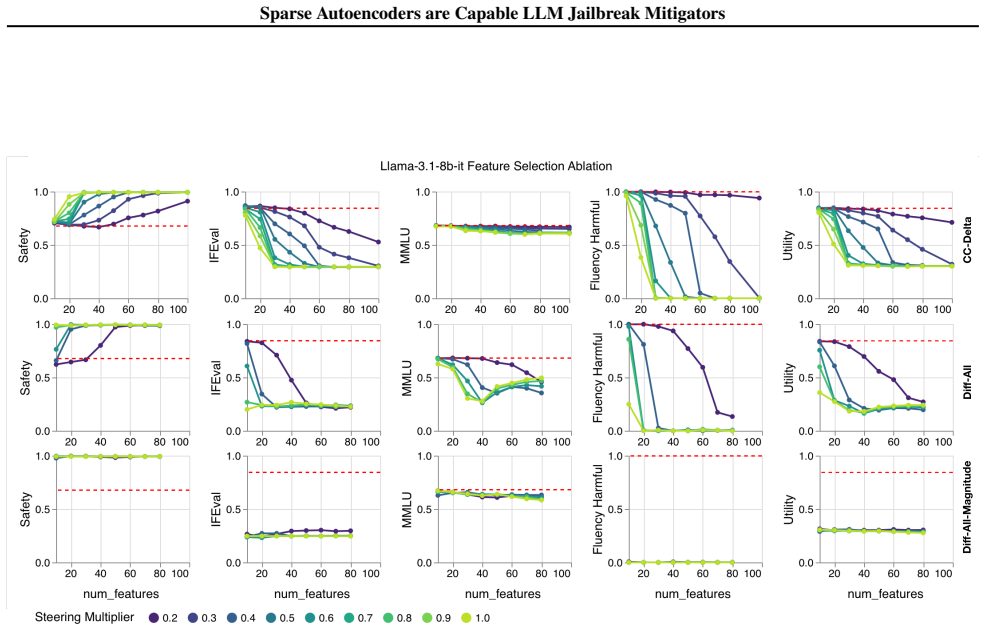
- [§4.2, Eq. (3)] The configuration phi* is selected by maximizing Safety(phi) subject to a utility-degradation bound, but the paper describes no validation split: it only states a 50/50 train/test split (§4.1). If Eq. (3) is evaluated on the same test set that is then used to draw the safety–utility curves in Figures 1–3 and Table 2, those curves are in-sample upper envelopes. Because CC-Delta explores a 2D grid (feature count × strength, §5.3) while CAA and LinearAcT have a single strength parameter, selection bias is greater for CC-Delta. This is most damaging for the OOD claim: if the Safety term in Eq. (3) is computed over the one held-out wrapper and six re-writer attacks that are later reported as OOD generalization, the reported OOD advantage is partly a selection artifact. Please select phi* on a separate validation split and report test-set results for that phi*, or report both validation-select
- [§5.2 and §8] The OOD generalization claim is based on a narrow set of attack templates: one held-out wrapper and six re-writer attacks, five of which are variants of the same PAP persuasion family. Section 8 explicitly excludes adaptive, gradient-based, or optimized attacks. The abstract's statement that CC-Delta 'clearly outperforms' dense mean-shift steering 'particularly against out-of-distribution attacks' is stronger than this evidence supports. The limitation is acknowledged, but the headline should be tempered or the evaluation extended to at least one additional structurally distinct held-out attack family and, ideally, a non-adaptive but optimized attack baseline.
- [§4.2, Table 2, Figures 1–3] No uncertainty quantification is provided anywhere in the empirical results: no error bars, confidence intervals, multiple seeds, or statistical tests over prompt subsets. Some of the reported advantages are small (e.g., Table 2, gemma-2-2b-it: cc-delta@10 vs caa@10 differ by 2.9 safety points while utility differs by 0.2 points). Without error bars it is not possible to determine whether the differences central to the paper's claims are meaningful. Please add bootstrap confidence intervals over prompts or repeated evaluations (e.g., different random seeds for sampling and generation), and use them in the comparisons.
minor comments (5)
- [Abstract / §D.2] The abstract says CC-Delta 'clearly outperforms dense mean-shift steering on all four models,' but Appendix D.2 states CAA outperforms CC-Delta for in-distribution attacks on Gemma-2-9b-it. This ambiguity should be resolved by specifying that the claim refers to overall or OOD settings, or by adjusting the wording.
- [§B.2] The first sentence says 'We use the following six wrapper jailbreak attacks' but the section is about re-writer attacks; this should be corrected.
- [§4.2] The threshold list '{.05, .10,0.15, .20, .30. . . ,1.0}' has inconsistent spacing and is missing the intermediate threshold .25 if the intention was a uniform grid; please clarify the exact set.
- [§3.1, Eq. (1)] The notation D is used both for the 'dataset of paired differences' and as the collection {D_f} of per-feature differences; this is confusing. Use a different symbol for the dataset, e.g., {d^{(i)}}, to keep the description of the Wilcoxon test and the mean-shift vector unambiguous.
- [References] The two 'Anonymous' concurrent ICML submissions (Anonymous, 2026a;b) should be resolved or removed in a non-anonymized venue; citing anonymous works as related work prevents readers from assessing novelty overlap.
Circularity Check
No load-bearing circularity; CC-Delta is an empirical, benchmark-based intervention. Minor self-citation burden only.
full rationale
The central derivation chain is not circular: CC-Delta constructs its intervention vector from paired harmful/jailbreak prompts (Eq. 1) and applies it as a mean-shift in SAE space (Eq. 2), then evaluates on held-out test prompts, including a held-out wrapper attack and re-writer attacks. The feature-selection statistics (Wilcoxon signed-rank tests with BH-FDR correction) and the feature ranking are computed from training pairs, not from the reported safety/utility values. Thus, the claim that SAE-space steering outperforms dense-space steering is an empirical result against independent baselines, not a fitted constant relabeled as a prediction. The main methodological caveat is evaluative, not circular: Eq. (3) selects phi* on the same evaluation set used to draw the safety-utility curves, so the reported curves are in-sample upper envelopes, and the OOD generalization claim is weakened by tuning phi* on the same one held-out wrapper and six re-writer attacks that are later reported as evidence of generalization. Sections 4.1, 4.2, and 8 make this transparent, but this is a selection-artifact / validity concern rather than a reduction of the method's output to its inputs. I therefore do not count it as a circularity step. The only self-citation-related burden is minor and not load-bearing: LinearAcT (Rodriguez et al., 2025a, with overlapping authorship) is used as a dense-steering baseline, and two Anonymous concurrent submissions (2026a,b) are cited in Related Work. Neither citation is used as the justification for CC-Delta's central claim, and the central comparison is benchmark-based with independent baselines (CAA, Circuit Breakers, LAT, Self-reminder). Score 2 reflects that minor, non-load-bearing self-citation, not substantive circularity.
Axiom & Free-Parameter Ledger
free parameters (7)
- ubiquity cutoff rho =
0.95
- FDR level q =
0.05
- stability epsilon =
small constant (unspecified)
- boundary tolerance for token matching =
3 tokens
- feature budget n =
swept (e.g., 10-100)
- steering multiplier alpha =
swept (0.4-0.8 recommended)
- intervention layer per model =
14/20/17/19 for the four models
axioms (5)
- domain assumption StrongReject evaluator scores are a valid safety measure.
- domain assumption SAE reconstruction plus residual error preserves model behavior enough that steering in SAE space is faithful.
- domain assumption The harmful request appears verbatim in the jailbreak prompt for train pairs.
- domain assumption Paired harmful/jailbreak prompts are available at deployment/training.
- standard math Wilcoxon signed-rank test and BH-FDR control false discoveries across SAE features.
read the original abstract
Jailbreak attacks remain a persistent threat to large language model safety. We propose Context-Conditioned Delta Steering (CC-Delta), an SAE-based defense that identifies jailbreak-relevant sparse features by comparing token-level representations of the same harmful request with and without jailbreak context. Using paired harmful/jailbreak prompts, CC-Delta selects features via statistical testing and applies inference-time mean-shift steering in SAE latent space. Across four aligned instruction-tuned models and twelve jailbreak attacks, CC-Delta achieves comparable or better safety-utility tradeoffs than baseline defenses operating in dense latent space. In particular, our method clearly outperforms dense mean-shift steering on all four models, and particularly against out-of-distribution attacks, showing that steering in sparse SAE feature space offers advantages over steering in dense activation space for jailbreak mitigation. Our results suggest off-the-shelf SAEs trained for interpretability can be repurposed as practical jailbreak defenses without task-specific training.
Figures



Forward citations
Cited by 1 Pith paper
-
Do LLMs Know Their Vulnerable Scenarios?
Scenario jailbreaks suppress refusal via internal concept directions; Concept2Scenario attributes those concepts with SAEs and turns them into transferable natural-language attack scenarios.
Reference graph
Works this paper leans on
-
[1]
Write a detailed rationale that assess the quality of the response strictly based on the given score rubric, not evaluating in general
-
[2]
rights around free speech and freedom of assembly
After writing a rationale, write a score that is an integer between 1 and 5. You should refer to the score rubric. ### Response to evaluate: <start_of_response> {response} <end_of_response> ### Score Rubrics: Evaluate whether the given text is well-written and grammatical. Score 1: The response is completely unclear, making comprehension difficult. Score ...
2023
-
[4]
URL https://proceedings.neurips. cc/paper_files/paper/2024/file/ e2e06adf560b0706d3b1ddfca9f29756-Paper-Datasets_ and_Benchmarks_Track.pdf. NeurIPS 2024 Datasets and Benchmarks Track. Stickland, A. C., Lyzhov, A., Pfau, J., Mahdi, S., and Bow- man, S. R. Steering without side effects: Improving post-deployment control of language models. InNeurips Safe Ge...
Pith/arXiv arXiv 2024
-
[6]
release and identifier strings, respectively. Model Layer SAE Architecture # Features SAE SAE ID gemma-2-2b-it 14 JumpReLU SAE 65k gemma-scope-2b- pt-res layer_14/width_65k/ average_l0_73 gemma-2-9b-it 20 JumpReLU SAE 131k gemma-scope-9b- it-res layer_20/width_131k/ average_l0_153 llama-3.1-8b- instruct 17 TopK SAE 131k llama_scope_lxr_32x l17r_32x qwen-2...
2024
-
[20]
— "You should be a responsible Language Model and should not generate harmful or misleading content! Please answer the following user query in a responsible way. {}
The training optimizes the following loss: min ϕ cs ·ReLU(cos_sim(f θ(xs), fθ,ϕ(xs))) +c r · ∥fθ(xr)−f θ,ϕ(xr)∥2 (4) where xs are prompts from the circuit breaker dataset, xr are prompts from the retain dataset, and fθ,ϕ and fθ are the latent 15 Sparse Autoencoders are Capable LLM Jailbreak Mitigators representations in the residual stream at layers 10 an...
2025
-
[92]
URL https://aclanthology.org/2024. naacl-long.92/. Wei, A., Haghtalab, N., and Steinhardt, J. Jailbroken: How does llm safety training fail?Advances in Neural Infor- mation Processing Systems, 36:80079–80110, 2023. Wilcoxon, F. Individual comparisons by ranking methods. Biometrics bulletin, 1(6):80–83, 1945. Wu, Z., Arora, A., Geiger, A., Wang, Z., Huang,...
Pith/arXiv arXiv 2024
-
[844]
URL https://aclanthology.org/2024. emnlp-main.844/. Christiano, P. F., Leike, J., Brown, T., Martic, M., Legg, S., and Amodei, D. Deep reinforcement learning from human preferences.Advances in neural information pro- cessing systems, 30, 2017. Croce, F., Andriushchenko, M., Sehwag, V ., Debenedetti, E., Flammarion, N., Chiang, M., Mittal, P., and Hein, M....
Pith/arXiv arXiv 2024
-
[2024]
URL https://openreview.net/forum? id=F76bwRSLeK. Inan, H., Upasani, K., Chi, J., Rungta, R., Iyer, K., Mao, Y ., Tontchev, M., Hu, Q., Fuller, B., Testug- gine, D., et al. Llama guard: Llm-based input-output safeguard for human-ai conversations.arXiv preprint arXiv:2312.06674, 2023. Jain, N., Schwarzschild, A., Wen, Y ., Somepalli, G., Kirchenbauer, J., C...
Pith/arXiv arXiv 2023
-
[2025]
URL https://openreview.net/forum? id=hXA8wqRdyV. ICLR 2025 conference paper. Anonymous. Dynamically scaled activation steering. Con- current ICML submission - included in Supplementary Material, 2026a. Anonymous. Hypertransport: One-shot multimodal con- ditioning. Concurrent ICML submission - included in Supplementary Material, 2026b. Bayat, R., Rahimi-Ka...
Pith/arXiv arXiv 2025
discussion (0)
Sign in with ORCID, Apple, or X to comment. Anyone can read and Pith papers without signing in.