REVIEW 4 major objections 5 minor 21 references
A Model-Based Approach to Imitation Learning through Multi-Step Predictions
T0 review · 4 major / 5 minor · reviewed 2026-08-16 · deepseek-v4-flash
Pith's one-line read By training a policy together with learned multi-step predictors and a dynamics-consistency term, imitation learning can track an expert over long horizons with less compounding error and noise sensitivity than behavior cloning.
desk verdict A promising model-based IL method with a solid empirical story, but the theoretical guarantees are for an oracle version and the appendix proofs are unfinished. read the letter →
The pith
A machine-rendered reading of the paper's core claim, the machinery that carries it, and where it could break.
The reading
What carries the argument
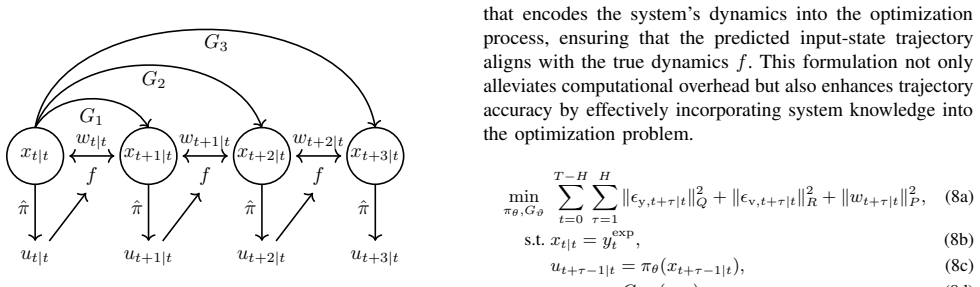
The load-bearing mechanism is the multi-step predictor family $G_{\tau,\vartheta}$. Each predictor maps the encoded current observation $z_t$ to a state prediction $\tau$ steps ahead, $x_{t+\tau|t}=G_{\tau,\vartheta}(z_t)$, so the optimizer never has to unroll the dynamics step by step. A consistency residual $w_{t+\tau|t}=x_{t+\tau|t}-f(x_{t+\tau-1|t},u_{t+\tau-1|t})$ penalizes disagreement between the predicted trajectory and the known dynamics, weighted by $P$, which grounds the learned predictors in the true system. The policy $\pi_\theta$ maps predicted states to controls, and all parameters are trained jointly against the surrogate loss of Eq. (8), which combines state errors, input errors, and the consistency penalty. In the LTI analysis the predictors are fixed at their ground-truth values $G^{\star}_\tau=(A+BK^{\star})^\tau$; the closed-form gain then follows from a least-squares normal equation.
What would settle it
Take the linear time-invariant setup of Theorem 1, estimate the multi-step predictors by least squares on the same noisy rollouts used for $K$, freeze them, and measure $\|\hat{K} - K^{\star}\|$ as $T$ grows. If the error does not decay like $1/\sqrt{T-H+1}$ or is dominated by a term proportional to the predictor-estimation bias, the bound does not extend to the implemented procedure. A cleaner alternative: intentionally bias the predictors, for example by truncating the estimation horizon, and check whether the observed error matches the predictor-bias term.
Extended reading notes
Core claim
The central claim is that imitation learning should be framed as a multi-step prediction problem: instead of matching expert actions one state at a time, learn a policy and a family of $\tau$-step state predictors so that the predicted closed-loop trajectory tracks the expert's observed trajectory over a horizon $H$, with a penalty for inconsistency with the known transition function. In the linear time-invariant case with a linear expert policy, the paper derives a closed-form expression for the estimated feedback gain and proves a finite-sample bound: with high probability, $\|\hat{K}_{\mathrm{PIL}} - K^{\star}\| \leq \kappa_1/\sqrt{T-H+1} + \kappa_2\|\Sigma_\xi\|$, so the policy error decays as the number of demonstrations grows and grows linearly with the state-measurement noise covariance. For the one-step case $H=1$, it further shows that PIL's expected distance to the expert controller is no larger than behavior cloning's when state noise is small relative to input noise. Numerical comparisons on linear systems, an inverted pendulum, and MuJoCo tasks support the claim that PIL outperforms both behavior cloning and rollout-based imitation.
Load-bearing premise
The theoretical guarantees treat the multi-step predictors as the exact expert closed-loop transitions that remain fixed while the policy is fitted, whereas the implemented method learns them from the same noisy data and trains them jointly with the policy.
Editorial extensions
If this is right
- Guaranteed policy error shrinks as $O(1/\sqrt{T-H+1})$ in the number of demonstrations, so collecting more expert trajectories directly improves long-horizon tracking.
- The bound's linear dependence on $\|\Sigma_\xi\|$ means sensor quality, not just expert behavior, is a first-order determinant of imitation quality; noise-robust imitation learning should include state denoising.
- Since PIL does not require differentiating through the dynamics, it stays competitive even when dynamics gradients are unavailable, which the pendulum experiments support.
- In the fixed-predictor linear case the method reduces to a closed-form least-squares problem, making it substantially cheaper than rollout-based trajectory optimization.
- Horizon $H$ is a tunable accuracy-computation tradeoff: longer horizons help up to a point, and the experiments show increasing prediction order reduces maximum trajectory discrepancy.
Reading between the lines
- A direct testable extension would split the data: estimate $G_\tau$ on one clean set, freeze it, then fit $K$; if the bound in Theorem 1 holds only in this regime, the joint-training gap is the real limiting factor.
- The encoder in PIL acts as a learned denoiser, so an editor-level guess is that the same framework extends to partially observed nonlinear systems where the encoder learns a belief state rather than a filtered observation.
- Because the consistency term is a soft constraint, replacing the known model $f$ with a learned dynamics model would turn PIL into a fully model-based imitation learning method that learns both dynamics and policy from demonstrations, a direction the paper lists for future work.
- The $H=1$ comparison suggests that state-transition information is most valuable when action observations are noisier than state observations; an empirical sweep varying $\mathrm{tr}(\Sigma_\xi)/\mathrm{tr}(\Sigma_\eta)$ could test this boundary directly.
Signed reviews
Editorial analysis
A structured set of objections, weighed in public.
Referee Report
Summary. The paper proposes Predictive Imitation Learning (PIL), a model-based imitation learning framework in which a policy and a set of multi-step state predictors are trained jointly by minimizing a surrogate objective that combines state prediction error, control prediction error, and a dynamics-consistency penalty. The authors argue that this formulation is computationally cheaper than rollout-based trajectory matching and more robust to measurement noise and distribution shift than behavior cloning. The manuscript reports experiments on linear systems, an inverted pendulum, and MuJoCo continuous-control tasks, where PIL outperforms BC and a rollout-based baseline. For LTI systems with linear expert policies, the authors provide finite-sample guarantees: Theorem 1 gives a high-probability bound on the learned feedback gain error, and Theorem 2 attempts to show that PIL has a smaller expected error than BC when state noise is not too large.
Significance. If the theoretical guarantees were established for the implemented algorithm, this would be a useful contribution to offline model-based imitation learning: the surrogate objective is plausible, the approach is computationally simpler than trajectory rollouts, and the empirical results are broadly positive. The manuscript also ships a public implementation, which aids reproducibility, and the experiments cover both linear and high-dimensional nonlinear tasks. However, the theoretical core as written only analyzes an oracle version of the method, and the comparison theorem is not a comparison of actual estimation errors; these gaps currently prevent the paper from supporting its central claims as strongly as stated.
major comments (4)
- [Section IV, Appendix A, Lemma 3] Theorem 1 is proven for an oracle version of the algorithm, not for the implemented PIL. In Lemma 3, the gradient derivation replaces Gτ with the exact expert closed-loop transition by using Gτ = (A+BK*)Gτ−1 to eliminate Gτ (Eq. (16)). The implemented method, however, estimates Gτ from the same noisy data, either separately via least squares (Appendix E, Eq. (59)) or jointly with the policy (Eq. (8)). With state noise, the least-squares estimate is not consistent for G*τ; it is attenuated, Ĝτ ≈ G*τ Σx(Σx+Σξ)^{-1}. Consequently, Eq. (14) and the concentration bound in Lemma 4 do not apply to the estimated predictors used in the experiments. The theorem therefore provides a guarantee for a different, oracle-predictor algorithm. The authors should either analyze the estimated-predictor case, including a bound on the bias (G*τ − Ĝτ) in the closed form, or explicitly state and clearly label the oracle assumption in the theorem and its proof.
- [Section IV, Theorem 1 and Appendix B, Lemma 4] The statement of Theorem 1 omits a data-coverage condition that the proof requires. Theorem 1 says 'Under Assumption 1, for any T ≥ O(n log(1/δ))', but Lemma 4 additionally requires T ≳ (ψξ/ϕξ²) n log(...) (Eq. (18)) so that the empirical covariance lower bound (Eq. (30), via Lemma 5) holds. This condition is not implied by Assumption 1 when the state-noise covariance Σξ is large relative to the minimum state covariance ϕx. Without it, the claimed O(1/√T) rate plus the κ2||Σξ|| floor does not follow. Please either add the missing condition to the theorem statement or prove the bound under Assumption 1 alone.
- [Section IV, Theorem 2 and Appendix C] Theorem 2 does not establish the claimed advantage of PIL over BC. The theorem compares expected norms of quantities ωPIL and ωBC without defining them, and the appendix proof only compares constants in upper bounds (Eqs. (49)–(50)) under the matrix condition (51): ∥B⊤Q(I−A)∥√trΣξ ≤ ∥B⊤QB∥√trΣη. That condition is not equivalent to the text's tr(Σξ) ≤ C tr(Ση), since C would need to depend on the system matrices in a specific way. Moreover, a comparison of upper-bound slopes does not imply the actual estimation errors satisfy E∥bKPIL − K*∥ ≤ E∥bKBC − K*∥. The claimed superiority over BC is therefore not substantiated by the theorem.
- [Appendix B] The sample-complexity proof relies on 'Proposition 8.2 of Sasha', 'Proposition 3.1 of Sasha', and 'Equation (46) of Sasha' without any bibliographic identification. These results are load-bearing for the matrix concentration steps used in Eqs. (24), (26), (27), and (39), so the proof cannot be checked as written. Please provide full statements and proofs of the cited propositions or a precise, complete reference.
minor comments (5)
- [Section IV, Theorem 1 and Lemma 4] The theorem and Lemma 4 state an equality, ||bKPIL − K*|| = κ1/√(T−H+1) + κ2||Σξ||, but the proof establishes an upper bound; the statements should use '≤'.
- [Appendix C, Lemma 7] The statement of Lemma 7 is garbled: it reads '∥bK−K*∥ ≤ α+β∥∥' with a missing argument, and the proof is left incomplete with 'such that'. Please complete the lemma statement and proof.
- [Appendix E, Section V.A] In the linear-system experiment, the predictors are first estimated by least squares and then fixed, which is not the joint training described in Section III-D and Eq. (8); the exact protocol should be clarified, as the theoretical section does not cover either variant.
- [References] Reference [20] is titled the same as this paper and has a placeholder arXiv number 'arXiv:XXXXX'; if it is intended to be this manuscript or a companion paper, please cite it properly.
- [Appendix B, Proof Sketch] There is a typo in the proof sketch of Theorem 1: 'its’ norm' should be 'its norm'.
Circularity Check
Theorem 1 is proved for oracle multi-step predictors Gτ=(A+BK⋆)^τ, while PIL estimates Gτ from the same noisy data; the fitted-predictor error is excluded from the claimed bound.
-
fitted input called prediction
[Appendix A, Lemma 3 / Eq. (14); Theorem 1 (Section IV); Appendix E, Eq. (59)]
"We will make heavy use of the τ-step transition matrix x_{t+τ}=G⋆_τ x_t, where the ground truth is given by G⋆_τ=(A+BK)^τ. ... The optimal solution bK is given by bK=K⋆+(R+B⊤PB)−1(Σ_{t,τ}R(η_t−K⋆G_{τ−1}ξ_t)(G_{τ−1}y_t)⊤)(Σ_{t,τ}(G_{τ−1}y_t)(G_{τ−1}y_t)⊤)−1. ... In our method, these predictors are estimated via least squares and used to compute the feedback gain."
Lemma 3's closed form collapses B⊤P G_τ y_t − B⊤P A G_{τ−1}y_t to B⊤P B K⋆ G_{τ−1}y_t; this requires G_τ y_t=(A+BK⋆)G_{τ−1}y_t, i.e., the predictor is the exact expert closed-loop transition. Theorem 1 then treats this expression as the PIL learning error. But PIL estimates G_τ by least squares from the same noisy y_t used to fit K (Appendix E, Eq. (59)); with state noise the least-squares predictor is attenuated, adding a bias term (G⋆_τ−Ĝ_τ)Σ y_t y_t^⊤ to Eq. (14) that is absent from the claimed κ2∥Σξ∥ floor. So the bound characterizes an oracle estimator whose input already contains G⋆_τ; the fitted parameter has been replaced by its true value, which is the fitted-input-called-prediction pattern.
-
other
[Section IV (setup citation) and References [20]]
"For a detailed explanation of the setup, please refer to [20]. ... [20] H. Balim, Y. Hu, Y. Zhang, and N. Li, “A model-based approach to imitation learning through multi-step predictions,” arXiv preprint arXiv:XXXXX, 2025."
The reference invoked for the setup is the present paper itself, with a placeholder arXiv identifier. It supplies no independent or external content, so any reliance on it for the theoretical assumptions is self-referential rather than supported. This is a minor citation defect because the setup is restated in the appendix, but it is a missing reference that should be flagged.
full rationale
The main theoretical claim (Theorem 1) is not self-contained for the implemented method: its proof is built on Lemma 3, which assumes the multi-step predictors are the exact expert closed-loop transitions G⋆_τ=(A+BK⋆)^τ, while the algorithm (and the linear-system experiments, Appendix E, Eq. (59)) fits G_τ from the same noisy measurements used to fit K. The error of that fit is not bounded, so the theorem's κ1/√T + κ2∥Σξ∥ bound characterizes an oracle version of PIL rather than the proposed fitted-predictor procedure. This is a load-bearing gap in the central guarantee, though not a definitional reduction of the paper's overall framework. Theorem 2 is likewise stated for the idealized restriction G1=A+BK, an acknowledged oracle assumption. The self-citation [20] is a placeholder referring to the paper itself and is not independent support. These issues warrant a moderate circularity score, but the empirical comparisons are externally benchmarked and the framework itself is not a mere renaming of a known result.
Assumptions & free parameters
free parameters (3)
- Prediction horizon H =
varied 1..8 in experiments
- Loss weights Q, R, P =
task-specific (e.g., Q=0.25I, R=0.01I, P=I for MuJoCo)
- Exponential decay factor alpha =
0.9
assumptions (4)
- domain assumption The true system dynamics f are known and used in the consistency loss
- domain assumption Assumption 1: the empirical state covariance is bounded below
- domain assumption Gaussian measurement noise in the theoretical analysis
- domain assumption Bounded expert trajectories and stable open-loop dynamics
Cite this review
Pith. "Pith review of A Model-Based Approach to Imitation Learning through Multi-Step Predictions." pith.science (2026). https://pith.science/paper/HXOW4ID7
@misc{pith2026250413413,
  author       = {Pith},
  title        = {Pith review of: A Model-Based Approach to Imitation Learning through Multi-Step Predictions},
  year         = {2026},
  howpublished = {\url{https://pith.science/paper/HXOW4ID7}},
  note         = {Machine review of arXiv:2504.13413}
}
read the original abstract
Imitation learning is a widely used approach for training agents to replicate expert behavior in complex decision-making tasks. However, existing methods often struggle with compounding errors and limited generalization, due to the inherent challenge of error correction and the distribution shift between training and deployment. In this paper, we present a novel model-based imitation learning framework inspired by model predictive control, which addresses these limitations by integrating predictive modeling through multi-step state predictions. Our method outperforms traditional behavior cloning numerical benchmarks, demonstrating superior robustness to distribution shift and measurement noise both in available data and during execution. Furthermore, we provide theoretical guarantees on the sample complexity and error bounds of our method, offering insights into its convergence properties.
Figures


Figures from the paper (1 more)

Reference graph
Works this paper leans on
-
[20]
A model-based approach to imitation learning through multi-step predictions,
H. Balim, Y . Hu, Y . Zhang, and N. Li, “A model-based approach to imitation learning through multi-step predictions,” arXiv preprint arXiv:XXXXX, 2025. APPENDIX A. Setup and Algorithm for Linear Systems In this section, we first restate the problem setup and the proposed algorithms for linear time-invariant (LTI) systems, and then provide closed-form cha...
work page 2025
-
[1]
Agile autonomous driving using end-to-end deep imitation learning,
Y . Pan, C.-A. Cheng, K. Saigol, K. Lee, X. Yan, E. Theodorou, and B. Boots, “Agile autonomous driving using end-to-end deep imitation learning,” arXiv preprint arXiv:1709.07174 , 2017
arXiv 2017
-
[2]
Is imitation learning the route to humanoid robots?
S. Schaal, “Is imitation learning the route to humanoid robots?” Trends in cognitive sciences , vol. 3, no. 6, pp. 233–242, 1999
1999
-
[3]
Survey of imitation learning for robotic manipulation,
B. Fang, S. Jia, D. Guo, M. Xu, S. Wen, and F. Sun, “Survey of imitation learning for robotic manipulation,” International Journal of Intelligent Robotics and Applications , vol. 3, pp. 362–369, 2019
2019
-
[4]
Robot learning towards smart robotic manufacturing: A review,
Z. Liu, Q. Liu, W. Xu, L. Wang, and Z. Zhou, “Robot learning towards smart robotic manufacturing: A review,” Robotics and Computer- Integrated Manufacturing, vol. 77, p. 102360, 2022
work page 2022
-
[5]
An algorithmic perspective on imitation learning,
T. Osa, J. Pajarinen, G. Neumann, J. A. Bagnell, P. Abbeel, J. Peters et al., “An algorithmic perspective on imitation learning,” Foundations and Trends® in Robotics , vol. 7, no. 1-2, pp. 1–179, 2018
2018
-
[6]
Imitation learning: A survey of learning methods,
A. Hussein, M. M. Gaber, E. Elyan, and C. Jayne, “Imitation learning: A survey of learning methods,” ACM Computing Surveys (CSUR) , vol. 50, no. 2, pp. 1–35, 2017
2017
-
[7]
Efficient reductions for imitation learning,
S. Ross and D. Bagnell, “Efficient reductions for imitation learning,” in Proceedings of the thirteenth international conference on artificial intel- ligence and statistics . JMLR Workshop and Conference Proceedings, 2010, pp. 661–668
2010
Show all 21 references
-
[8]
Alvinn: An autonomous land vehicle in a neural network,
D. A. Pomerleau, “Alvinn: An autonomous land vehicle in a neural network,” Adv Neural Inf Process Syst , vol. 1, 1988
1988
-
[9]
A reduction of imitation learning and structured prediction to no-regret online learning,
S. Ross, G. Gordon, and D. Bagnell, “A reduction of imitation learning and structured prediction to no-regret online learning,” in Proceedings of the fourteenth international conference on artificial intelligence and statistics. JMLR Workshop and Conference Proceedings, 2011, ...
2011
-
[10]
Dart: Noise injection for robust imitation learning,
M. Laskey, J. Lee, R. Fox, A. Dragan, and K. Goldberg, “Dart: Noise injection for robust imitation learning,” in Conference on robot learning. PMLR, 2017, pp. 143–156
2017
-
[11]
Generative adversarial imitation learning,
J. Ho and S. Ermon, “Generative adversarial imitation learning,” Adv Neural Inf Process Syst , vol. 29, 2016
2016
-
[12]
Tasil: Taylor series imitation learning,
D. Pfrommer, T. Zhang, S. Tu, and N. Matni, “Tasil: Taylor series imitation learning,” Adv Neural Inf Process Syst , vol. 35, pp. 20 162– 20 174, 2022
2022
-
[13]
Is behavior cloning all you need? understanding horizon in imitation learning,
D. J. Foster, A. Block, and D. Misra, “Is behavior cloning all you need? understanding horizon in imitation learning,” arXiv preprint arXiv:2407.15007, 2024
2024 arXiv
-
[14]
Provable guarantees for generative behavior cloning: Bridging low- level stability and high-level behavior,
A. Block, A. Jadbabaie, D. Pfrommer, M. Simchowitz, and R. Tedrake, “Provable guarantees for generative behavior cloning: Bridging low- level stability and high-level behavior,” Adv Neural Inf Process Syst , vol. 36, 2024
2024
-
[15]
Dida: Denoised imitation learning based on domain adaptation,
K. Huang, H.-H. Sun, S. Wan, M. Shao, S. Feng, L. Gan, and D.-C. Zhan, “Dida: Denoised imitation learning based on domain adaptation,” arXiv preprint arXiv:2404.03382 , 2024
2024 arXiv
-
[16]
Usn: A robust imitation learning method against diverse action noise,
X. Yu, B. Han, and I. W. Tsang, “Usn: A robust imitation learning method against diverse action noise,” Journal of Artificial Intelligence Research, vol. 79, pp. 1237–1280, 2024
2024
-
[17]
Model-based imitation learning by probabilistic trajectory matching,
P. Englert, A. Paraschos, J. Peters, and M. P. Deisenroth, “Model-based imitation learning by probabilistic trajectory matching,” in 2013 IEEE international conference on robotics and automation . IEEE, 2013, pp. 1922–1927
2013
-
[18]
Model-based imitation learning for urban driving,
A. Hu, G. Corrado, N. Griffiths, Z. Murez, C. Gurau, H. Yeo, A. Kendall, R. Cipolla, and J. Shotton, “Model-based imitation learning for urban driving,” Adv Neural Inf Process Syst, vol. 35, pp. 20 703–20 716, 2022
2022
-
[19]
Model predictive control,
B. Kouvaritakis and M. Cannon, “Model predictive control,” Switzer- land: Springer International Publishing , vol. 38, 2016
2016
-
[21]
Notice that the noise ηt−K⋆Gτ−1ξt is independent of the state xt and that the covariance of the noise is Ση +K⋆Gτ−1ΣξG⊤ τ−1K⋆⊤
(23) Here we let Σx =PT−H t=0 xtx⊤ t + (T−H + 1)I. Notice that the noise ηt−K⋆Gτ−1ξt is independent of the state xt and that the covariance of the noise is Ση +K⋆Gτ−1ΣξG⊤ τ−1K⋆⊤. Hence we apply Proposition 8.2 with R2 =ψη +ψ2 Kψξ∥Gτ−1∥2 and get the following with probability a...
Reviewed August 16, 2026 · model on record in the stance chip above.
Discussion (0). Continue with ORCID to comment.