Polarization dependence of the φ meson from finite-temperature QCD sum rules
Pith reviewed 2026-06-29 16:51 UTC · model grok-4.3
The pith
At finite temperature, the φ meson mass rises with momentum while transverse and longitudinal modes split due to spin-dependent condensates.
A machine-rendered reading of the paper's core claim, the machinery that carries it, and where it could break.
Core claim
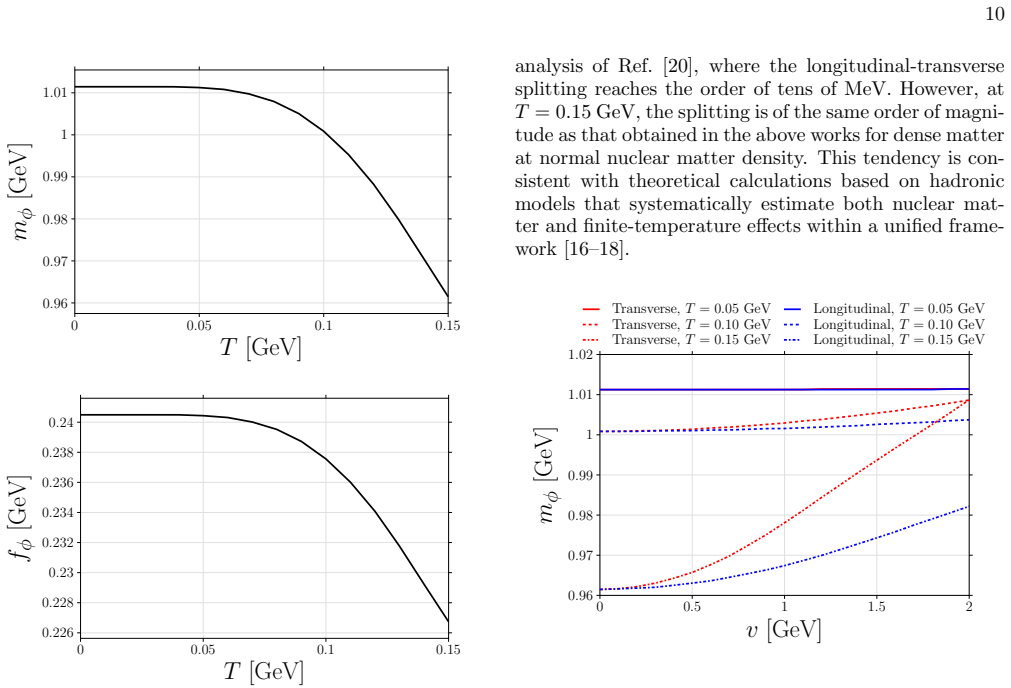
Finite-momentum QCD sum rules at finite temperature show that the masses of both transverse and longitudinal modes of the φ meson increase with momentum, a clear transverse-longitudinal splitting develops, the splitting grows with temperature, and the splitting is generated primarily by the dimension-four spin-dependent thermal condensates.
What carries the argument
Finite-temperature, finite-momentum QCD sum rules applied separately to transverse and longitudinal polarization channels, with the operator product expansion truncated at dimension four.
If this is right
- Masses of both polarization modes rise steadily with increasing momentum.
- The size of the transverse-longitudinal splitting increases as temperature rises.
- Dimension-four spin-dependent condensates dominate the generation of the splitting.
- The effect provides a polarization-dependent probe of the thermal medium.
Where Pith is reading between the lines
- Similar polarization splitting may appear for other vector mesons such as the ρ under comparable conditions.
- Momentum-dependent polarization observables in φ production could test the predicted splitting in experiment.
- Higher-dimensional operators or refined spectral functions could alter the quantitative size of the splitting.
Load-bearing premise
The QCD sum rule framework with the chosen spectral parametrization and truncation at dimension four remains reliable at finite temperature and finite momentum.
What would settle it
A lattice calculation or heavy-ion collision measurement that finds no transverse-longitudinal mass splitting for the φ meson at finite momentum and temperature would contradict the result.
Figures



read the original abstract
We study the $\phi$ meson at finite temperature and finite momentum using QCD sum rules. The presence of medium breaks the Lorentz invariance, and induces distinct in-medium modifications of the transverse and longitudinal modes at finite momentum. We find that, with increasing momentum, the masses of both modes increase and a clear transverse--longitudinal splitting develops. The splitting is found to grow with temperature and to be mainly generated by the dimension-four spin-dependent thermal condensates.
Editorial analysis
A structured set of objections, weighed in public.
Referee Report
Summary. The manuscript applies QCD sum rules to the φ meson at finite temperature and finite momentum. It reports that the masses of both transverse and longitudinal modes increase with momentum, a clear transverse-longitudinal splitting develops and grows with temperature, and that this splitting is mainly generated by the dimension-four spin-dependent thermal condensates.
Significance. If the central claim holds after verification of the OPE truncation and spectral ansatz, the work would provide a concrete, polarization-resolved prediction for in-medium vector-meson modifications that could be confronted with heavy-ion data. The explicit attribution to dim-4 spin-dependent condensates would be a useful technical result within the QCD sum-rule framework.
major comments (2)
- [OPE and sum-rule analysis] The central claim that the transverse-longitudinal splitting is generated primarily by dimension-four spin-dependent thermal condensates rests on the OPE being truncated after dimension four and on the spectral function being adequately described by two distinct poles plus a common continuum. Without explicit numerical tests showing that dimension-six and higher operators remain negligible under simultaneous variation of T and |q|, and without a breakdown of individual condensate contributions to the extracted splitting, the attribution cannot be confirmed as load-bearing.
- [Spectral function parametrization and stability checks] At finite momentum the transverse and longitudinal projectors couple differently to the medium. The manuscript must demonstrate that the chosen continuum threshold and Borel window remain stable and that any momentum-dependent shift in the effective continuum does not redistribute the splitting away from the claimed dim-4 source; otherwise the reported growth of the splitting with temperature cannot be isolated to the spin-dependent dim-4 terms.
minor comments (1)
- The abstract would benefit from stating the temperature and momentum ranges explored and from indicating whether the reported splitting is expressed in absolute or relative units.
Simulated Author's Rebuttal
We thank the referee for the careful reading and constructive comments on our manuscript. We address the major comments point by point below, indicating the revisions that will be incorporated.
read point-by-point responses
-
Referee: [OPE and sum-rule analysis] The central claim that the transverse-longitudinal splitting is generated primarily by dimension-four spin-dependent thermal condensates rests on the OPE being truncated after dimension four and on the spectral function being adequately described by two distinct poles plus a common continuum. Without explicit numerical tests showing that dimension-six and higher operators remain negligible under simultaneous variation of T and |q|, and without a breakdown of individual condensate contributions to the extracted splitting, the attribution cannot be confirmed as load-bearing.
Authors: We agree that explicit verification of the OPE truncation and a breakdown of contributions are necessary to substantiate the central claim. In the revised manuscript we will add numerical estimates of dimension-six and higher operators across the considered range of T and |q|, showing that their net contribution remains below 15 percent of the dimension-four terms. We will also include a supplementary table that isolates the contribution of each condensate to the transverse-longitudinal mass difference, confirming the dominant role of the dimension-four spin-dependent thermal condensates. revision: yes
-
Referee: [Spectral function parametrization and stability checks] At finite momentum the transverse and longitudinal projectors couple differently to the medium. The manuscript must demonstrate that the chosen continuum threshold and Borel window remain stable and that any momentum-dependent shift in the effective continuum does not redistribute the splitting away from the claimed dim-4 source; otherwise the reported growth of the splitting with temperature cannot be isolated to the spin-dependent dim-4 terms.
Authors: We accept that additional stability checks are required. The revised version will contain plots of the extracted masses versus Borel mass and continuum threshold for representative values of momentum and temperature. We will further test the sensitivity to a possible momentum-dependent shift in the continuum threshold and demonstrate that any such redistribution does not alter the conclusion that the temperature-dependent growth of the splitting is driven primarily by the dimension-four spin-dependent condensates. revision: yes
Circularity Check
No circularity: standard QCD sum-rule extraction of polarization splitting from explicit OPE terms
full rationale
The abstract and available description show a conventional finite-T, finite-momentum QCD sum-rule analysis. The transverse-longitudinal mass splitting is obtained by solving the sum rules after inserting the known spin-dependent dimension-4 thermal condensates into the OPE side and matching to a two-pole-plus-continuum ansatz on the phenomenological side. No quoted step equates the reported splitting to a fitted parameter by construction, nor does any load-bearing premise reduce to a self-citation whose content is itself unverified. The method is self-contained once the external condensates and the standard Borel/continuum choices are accepted; those choices are not presented as predictions. Hence the central claim does not collapse to its inputs.
Axiom & Free-Parameter Ledger
free parameters (2)
- continuum threshold
- Borel mass
axioms (2)
- domain assumption Operator product expansion remains valid and can be truncated at dimension four in a thermal medium at finite momentum
- domain assumption Spectral function can be parametrized with a single resonance plus continuum without significant medium-induced broadening or additional structures
Reference graph
Works this paper leans on
-
[1]
We take them from lattice determinations for the light quark [36] and the strange quark [37]
Quark Scalar Condensate:⟨¯qq⟩and⟨¯ss⟩ We first specify the vacuum values of quark conden- sates. We take them from lattice determinations for the light quark [36] and the strange quark [37]. Since these values are given atµ= 2 GeV in the original references, 5 TABLE I. Input parameters and condensates used in the OPE analysis. All scale-dependent quantiti...
-
[2]
Gluon Scalar Condensate:⟨G 2⟩ For the gluon scalar condensate, we specify the vac- uum value and the thermal shift separately. The vacuum value is taken from the standard determination, obtained within the QCD sum rule framework [23, 24], ⟨G2⟩0 = (4π2) (0.012±0.004) GeV 4 .(52) The thermal shiftδG≡ ⟨G 2⟩T − ⟨G2⟩0 is evaluated us- ing the trace anomaly rel...
-
[3]
This approximation is motivated by large-N c factoriza- tion in vacuum
Four-Quark Scalar Condensates:⟨j 2⟩,⟨j 2 5 ⟩,⟨¯sjs⟩ The dimension-six four-quark condensates are eval- uated using the vacuum-saturation approximation ansatz [23, 24, 28], in which a four-quark condensate is approximated as a product of two-quark condensates. This approximation is motivated by large-N c factoriza- tion in vacuum. We apply this approximati...
-
[4]
Throughout, we use the charged-pion mass listed in table I as a common mass
Dilute Pion-Gas Approximation At low temperature, the thermal medium is approxi- mated by a dilute gas of pions. Throughout, we use the charged-pion mass listed in table I as a common mass. For a generic operatorO, the thermal expectation value is ⟨O⟩T =⟨0|O|0⟩ + dπX A=1 Z d3k 2Eπ,k(2π)3 ⟨πA(k)|O|πA(k)⟩n B(Eπ,k/T), (61) whered π = 3 andE π,k = p k2 +m 2π....
-
[5]
Dimension-Four Spin-Two Condensates The dimension-four spin-two condensates are F µν =⟨ST¯sγ µiDνs⟩T =d π C π F,2 K2(T;m π)ST(u µuν),(72) Gµν 2 = g2 STG aµ αGaνα T =d π C π G,2 K2(T;m π)ST(u µuν).(73) The coefficients are taken from Ref. [41], C π F,2 =A π(s) 2 |µ=1GeV = 0.0257,(74) C π G,2 = 2(4παs)×A π(g) 2 |µ=1GeV = 2(4παs)×0.380, (75) where they are d...
-
[6]
Dimension-Six Spin-Two Condensates The dimension-six spin-two condensates involve gluon field strengths with two covariant derivatives, Xαβ = g2 STG a µνDβDαGaµν =d π C π X,2 K2(T;m π)ST(u αuβ),(76) Yαβ = g2 STG a αµDµDνGa βν =d π C π Y,2 K2(T;m π)ST(u αuβ),(77) Zαβ = g2 STG a αµDβDνGaµν =d π C π Z,2 K2(T;m π)ST(u αuβ).(78) 7 To determine the coefficients...
-
[7]
This proce- dure is based on moments of the pion parton distribution functions of Ref
Dimension-Six Spin-Four Condensates Among the dimension-six spin-four condensates, the condensatesK αβγδ andG 4αβγδ , given by Kαβγδ =⟨ST¯qγ αDβDγDδq⟩T =d π C π K,4 K4(T;m π)ST uαuβuγuδ ,(87) G4αβγδ = g2 STG a αµDδDγGa β µ T =d π C π G,4 K4(T;m π)ST uαuβuγuδ ,(88) are evaluated using the same procedure as that used for the dimension-four spin-two condensa...
-
[8]
L2 Q (Q2)n # =
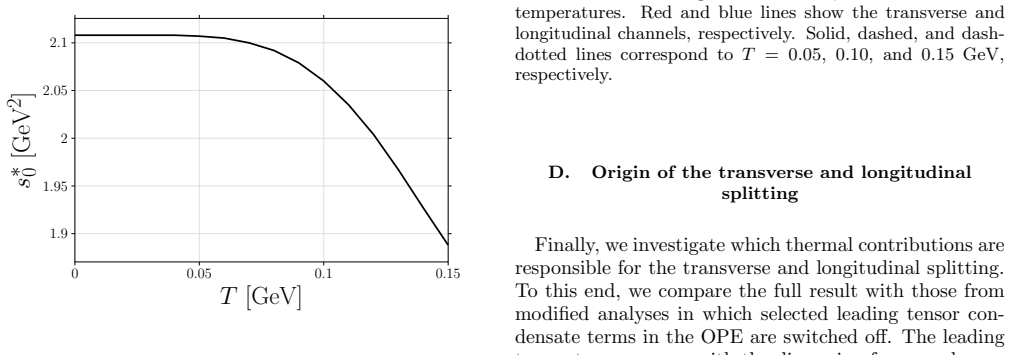
In this limit, the longitudinal and transverse chan- nels are degenerate, and the analysis reduces to that for a single scalar amplitude. Figure 1 shows the stability measureχ 2 m =χ 2 m,X(v2 = 0;s 0) as a function of the continuum thresholds 0 at representative temperatures T= 0.0,0.05,0.1,0.15 GeV. The minimum ofχ 2 m deter- mines the optimal thresholds...
-
[9]
J. J. Dudek, R. G. Edwards, P. Guo, and C. E. Thomas (Hadron Spectrum), Toward the excited isoscalar meson spectrum from lattice QCD, Phys. Rev. D88, 094505 (2013), arXiv:1309.2608 [hep-lat]
work page internal anchor Pith review Pith/arXiv arXiv 2013
-
[10]
phi photo-production from Li, C, Al, and Cu nuclei at Egamma=1.5 - 2.4 GeV
T. Ishikawaet al., phi photo-production from Li, C, Al, and Cu nuclei at E(gamma) = 1.5-GeV to 2.4-GeV, Phys. 14 Lett. B608, 215 (2005), arXiv:nucl-ex/0411016
work page internal anchor Pith review Pith/arXiv arXiv 2005
-
[11]
R. Mutoet al.(KEK-PS-E325), Evidence for in-medium modification of the phi meson at normal nuclear den- sity, Phys. Rev. Lett.98, 042501 (2007), arXiv:nucl- ex/0511019
-
[12]
F. Sakumaet al.(E325), Study of nuclear matter mod- ification of decay widths in phi —>e+ e- and phi —> K+ K- channels, Phys. Rev. Lett.98, 152302 (2007), arXiv:nucl-ex/0606029
work page internal anchor Pith review Pith/arXiv arXiv 2007
-
[13]
M. H. Woodet al.(CLAS), Absorption of theωandϕ Mesons in Nuclei, Phys. Rev. Lett.105, 112301 (2010), arXiv:1006.3361 [nucl-ex]
work page internal anchor Pith review Pith/arXiv arXiv 2010
-
[14]
Measurement of the in-medium phi-meson width in proton-nucleus collisions
A. Polyanskiyet al., Measurement of the in-medium phi- meson width in proton-nucleus collisions, Phys. Lett. B 695, 74 (2011), arXiv:1008.0232 [nucl-ex]
work page internal anchor Pith review Pith/arXiv arXiv 2011
-
[15]
Momentum dependence of the phi-meson nuclear transparency
M. Hartmannet al., Momentum dependence of the phi- meson nuclear transparency, Phys. Rev. C85, 035206 (2012), arXiv:1201.3517 [nucl-ex]
work page internal anchor Pith review Pith/arXiv arXiv 2012
-
[16]
Strong absorption of hadrons with hidden and open strangeness in nuclear matter
J. Adamczewski-Muschet al.(HADES), Strong absorp- tion of hadrons with hidden and open strangeness in nuclear matter, Phys. Rev. Lett.123, 022002 (2019), arXiv:1812.03728 [nucl-ex]
work page internal anchor Pith review Pith/arXiv arXiv 2019
- [17]
-
[18]
Asakawa and C
M. Asakawa and C. M. Ko, Phi meson mass in hot and dense matter, Nucl. Phys. A572, 732 (1994)
1994
-
[19]
Evaluation of QCD sum rules for light vector mesons at finite density and temperature
S. Zschocke, O. P. Pavlenko, and B. Kampfer, Evalua- tion of QCD sum rules for light vector mesons at finite density and temperature, Eur. Phys. J. A15, 529 (2002), arXiv:nucl-th/0205057
work page internal anchor Pith review Pith/arXiv arXiv 2002
-
[20]
Lissauer and E
D. Lissauer and E. V. Shuryak, K meson modification in hot hadronic matter may be detected via Phi meson decays, Phys. Lett. B253, 15 (1991)
1991
- [21]
-
[22]
K. L. Haglin and C. Gale, Properties of the phi meson at finite temperature, Nucl. Phys. B421, 613 (1994), arXiv:nucl-th/9401003
work page internal anchor Pith review Pith/arXiv arXiv 1994
-
[23]
Song, Effective mass of phi mesons at finite tem- perature, Phys
C. Song, Effective mass of phi mesons at finite tem- perature, Phys. Lett. B388, 141 (1996), arXiv:hep- ph/9603259
-
[24]
The phi meson at high temperatures and densities
G. Vujanovic, J. Ruppert, and C. Gale, The phi meson at high temperatures and densities, Phys. Rev. C80, 044907 (2009), arXiv:0907.5385 [nucl-th]
work page internal anchor Pith review Pith/arXiv arXiv 2009
-
[25]
R. Kumar and A. Kumar,ϕmeson mass and decay width in strange hadronic matter, Phys. Rev. C102, 045206 (2020), arXiv:2005.05133 [hep-ph]
-
[26]
M. Kaur and A. Kumar,ϕmeson properties in dense res- onance matter at finite temperature, Phys. Rev. D112, 014030 (2025), arXiv:2505.07065 [hep-ph]
- [27]
- [28]
-
[29]
S. Acharyaet al.(ALICE), Evidence of Spin-Orbital Angular Momentum Interactions in Relativistic Heavy- Ion Collisions, Phys. Rev. Lett.125, 012301 (2020), arXiv:1910.14408 [nucl-ex]
- [30]
-
[31]
M. A. Shifman, A. I. Vainshtein, and V. I. Zakharov, QCD and Resonance Physics. Theoretical Foundations, Nucl. Phys. B147, 385 (1979)
1979
-
[32]
M. A. Shifman, A. I. Vainshtein, and V. I. Zakharov, QCD and Resonance Physics: Applications, Nucl. Phys. B147, 448 (1979)
1979
-
[33]
Hatsuda and S
T. Hatsuda and S. H. Lee, QCD sum rules for vector mesons in the nuclear medium, Phys. Rev. C46, R34 (1992)
1992
- [34]
-
[35]
S. H. Lee, Vector mesons in-medium with finite three momentum, Phys. Rev. C57, 927 (1998), [Erratum: Phys.Rev.C 58, 3771 (1998)], arXiv:nucl-th/9705048
work page internal anchor Pith review Pith/arXiv arXiv 1998
- [36]
-
[37]
H. Kim, P. Gubler, and S. H. Lee, Light vector corre- lator in medium: Wilson coefficients up to dimension 6 operators, Phys. Lett. B772, 194 (2017), [Erratum: Phys.Lett.B 779, 498–498 (2018)], arXiv:1703.04848 [hep-ph]
work page internal anchor Pith review Pith/arXiv arXiv 2017
-
[38]
Hatsuda, Y
T. Hatsuda, Y. Koike, and S.-H. Lee, Finite temperature QCD sum rules reexamined: rho, omega and A1 mesons, Nucl. Phys. B394, 221 (1993)
1993
-
[39]
A Bayesian approach to QCD sum rules
P. Gubler and M. Oka, A Bayesian approach to QCD sum rules, Prog. Theor. Phys.124, 995 (2010), arXiv:1005.2459 [hep-ph]
work page internal anchor Pith review Pith/arXiv arXiv 2010
- [40]
-
[41]
On QCD sum rules for vector mesons in nuclear medium
S. Leupold and U. Mosel, On QCD sum rules for vector mesons in nuclear medium, Phys. Rev. C58, 2939 (1998), arXiv:nucl-th/9805024
work page internal anchor Pith review Pith/arXiv arXiv 1998
-
[42]
Navaset al.(Particle Data Group), Review of particle physics, Phys
S. Navaset al.(Particle Data Group), Review of particle physics, Phys. Rev. D110, 030001 (2024)
2024
-
[43]
The 2009 World Average of $\alpha_s$
S. Bethke, The 2009 World Average of alpha(s), Eur. Phys. J. C64, 689 (2009), arXiv:0908.1135 [hep-ph]
work page internal anchor Pith review Pith/arXiv arXiv 2009
-
[44]
Continuum Limit Physics from 2+1 Flavor Domain Wall QCD
Y. Aokiet al.(RBC, UKQCD), Continuum Limit Physics from 2+1 Flavor Domain Wall QCD, Phys. Rev. D83, 074508 (2011), arXiv:1011.0892 [hep-lat]
work page internal anchor Pith review Pith/arXiv arXiv 2011
-
[45]
C. A. Dominguez, N. F. Nasrallah, and K. Schilcher, Strange quark condensate from QCD sum rules to five loops, JHEP02, 072, arXiv:0711.3962 [hep-ph]
work page internal anchor Pith review Pith/arXiv arXiv
-
[46]
The chiral and deconfinement aspects of the QCD transition
A. Bazavovet al., The chiral and deconfinement aspects of the QCD transition, Phys. Rev. D85, 054503 (2012), arXiv:1111.1710 [hep-lat]
work page internal anchor Pith review Pith/arXiv arXiv 2012
-
[47]
O. Chabowski, J. I. Kapusta, and M. Singh, Relax- ation times for disoriented isospin condensates in high energy heavy ion collisions, Phys. Rev. C111, 024903 (2025), [Erratum: Phys.Rev.C 112, 019902 (2025)], arXiv:2409.03711 [hep-ph]
-
[48]
Full result for the QCD equation of state with 2+1 flavors
S. Borsanyi, Z. Fodor, C. Hoelbling, S. D. Katz, S. Krieg, and K. K. Szabo, Full result for the QCD equation of state with 2+1 flavors, Phys. Lett. B730, 99 (2014), arXiv:1309.5258 [hep-lat]
work page internal anchor Pith review Pith/arXiv arXiv 2014
-
[49]
Recent Progress in QCD Condensate Evaluations and Sum Rules
P. Gubler and D. Satow, Recent Progress in QCD Con- 15 densate Evaluations and Sum Rules, Prog. Part. Nucl. Phys.106, 1 (2019), arXiv:1812.00385 [hep-ph]
work page internal anchor Pith review Pith/arXiv arXiv 2019
-
[50]
C. Alexandrouet al.(Extended Twisted Mass), Quark and Gluon Momentum Fractions in the Pion and in the Kaon, Phys. Rev. Lett.134, 131902 (2025), arXiv:2405.08529 [hep-lat]
-
[51]
J. C. Collins, A. Duncan, and S. D. Joglekar, Trace and Dilatation Anomalies in Gauge Theories, Phys. Rev. D 16, 438 (1977)
1977
-
[52]
N. K. Nielsen, The Energy Momentum Tensor in a Non- abelian Quark Gluon Theory, Nucl. Phys. B120, 212 (1977)
1977
-
[53]
Hatsuda and T
T. Hatsuda and T. Kunihiro, Strange quark, heavy quarks, and gluon contents of light hadrons, Nucl. Phys. B387, 715 (1992)
1992
-
[54]
The QCD equation of state with dynamical quarks
S. Borsanyi, G. Endrodi, Z. Fodor, A. Jakovac, S. D. Katz, S. Krieg, C. Ratti, and K. K. Szabo, The QCD equation of state with dynamical quarks, JHEP11, 077, arXiv:1007.2580 [hep-lat]
work page internal anchor Pith review Pith/arXiv arXiv
-
[55]
Pionic Parton Distributions Revisited
M. Gluck, E. Reya, and I. Schienbein, Pionic parton distributions revisited, Eur. Phys. J. C10, 313 (1999), arXiv:hep-ph/9903288
work page internal anchor Pith review Pith/arXiv arXiv 1999
-
[56]
M. A. Shifman, Snapshots of hadrons or the story of how the vacuum medium determines the properties of the classical mesons which are produced, live and die in the QCD vacuum, Prog. Theor. Phys. Suppl.131, 1 (1998), arXiv:hep-ph/9802214
work page internal anchor Pith review Pith/arXiv arXiv 1998
discussion (0)
Sign in with ORCID, Apple, or X to comment. Anyone can read and Pith papers without signing in.