REVIEW 4 major objections 6 minor 29 references
Optimistic Algorithms for Adaptive Estimation of the Average Treatment Effect
T0 review · 4 major / 6 minor · reviewed 2026-08-08 · deepseek-v4-flash
Pith's one-line read OPTrack, an optimistic adaptive sampling rule, achieves logarithmic Neyman regret against the minimum variance attainable by any estimator and allocation, whereas prior nonasymptotic algorithms only competed with IPW baselines.
desk verdict Genuinely new optimistic allocation for adaptive ATE estimation with a plausible stronger-baseline log regret, but the proof has a real per-arm variance CS gap and a few typos that need fixing. read the letter →
The pith
A machine-rendered reading of the paper's core claim, the machinery that carries it, and where it could break.
The reading
What carries the argument
The central object is the confidence sequence $\mathrm{CS}_t(\pi^\star)$ for the Neyman allocation, built from per-arm confidence sequences for the standard deviations $\sigma(a)$. Lemma B.1 supplies a time-uniform interval around the empirical standard deviation with width of order $\sqrt{(\log\log t + \log(1/\delta))/t}$, and equation (10) feeds the lower and upper endpoints into the Neyman fraction to obtain $\mathrm{CS}_t(\pi^\star)$. OPTrack then sets $\pi_t = \arg\min_{\pi \in \mathrm{CS}_t(\pi^\star)} |1/2 - \pi|$. The optimism principle is what does the work: it forces the played allocation to stay on the Neyman side of $1/2$ once exploration ends, so the per-round Neyman loss is controlled by $|\pi_t - \pi^\star|^2$ plus the reward-estimation error, both of which shrink like $1/(\pi^\star t)$.
What would settle it
Fix a two-arm Bernoulli environment with known $\sigma(0) \neq \sigma(1)$, run OPTrack for horizons $10^3, 10^4, 10^5$, and plot the empirical normalized Neyman regret $T \cdot \mathrm{MSE} - V^\star$. If regret grows linearly in $T$, or its constant grows faster than $\log T$, the Theorem 5.3 bound fails. A sharper check is to test coverage of the variance intervals at stopping times where one arm's count $N_t(a)$ is small; coverage below $1-\delta$ would locate the failure in the transfer from full-sample to random-denominator confidence sequences.
Extended reading notes
Core claim
The paper establishes that optimism can resolve the exploration–exploitation tradeoff in adaptive ATE estimation. The proposed OPTrack algorithm maintains a confidence sequence for the unknown Neyman allocation $\pi^\star = \sigma(1)/(\sigma(0)+\sigma(1))$, and each round plays the allocation in that confidence set that is closest to $1/2$. Because the problem becomes harder as the Neyman allocation moves away from $1/2$, playing the point closest to $1/2$ is acting as if the environment were the easiest feasible one—an instance of the optimism principle. Once $1/2$ leaves the confidence set, optimism keeps the played allocation on the Neyman side of $1/2$, which balances the two arms' sampling counts and yields, with probability at least $1-\delta$, the bound $\widetilde{O}(\Delta(\sigma)^{-2} + (1/\pi^\star)^2 \log T)$ on Neyman regret. The decisive contrast with past work is the baseline: regret is measured against the minimum variance over all estimator–allocation pairs, so the IPW-based ClipSMT and ClipOGD algorithms exhibit linear regret under the same measure.
Load-bearing premise
The regret guarantee rests on the per-arm variance confidence intervals remaining valid simultaneously over all rounds even though the denominator in each arm's sample count is random and data-dependent; the proof supplies a fixed-sample-size lemma and applies it to those random counts.
Editorial extensions
If this is right
- OPTrack attains logarithmic Neyman regret against the minimum-variance efficiency baseline, so its mean squared error converges to the best attainable variance at rate $1/T$ rather than stagnating at a constant gap.
- Because the regret bound depends on $1/\pi^\star$ squared, the algorithm adapts to problem difficulty: a Neyman allocation far from $1/2$ produces a short exploration phase and a small constant, while nearly balanced arms incur a longer exploration phase.
- If Theorem 5.3 is correct, OPTrack strictly dominates the IPW-based algorithms ClipSMT and ClipOGD, which suffer linear regret under the stronger estimator–allocation baseline.
- The A2IPW estimator used by OPTrack is compatible with anytime-valid confidence sequences, so the same allocation rule can feed sequential testing and adaptive inference without restarting exploration.
Reading between the lines
- The optimism principle suggests a template for adaptive estimation beyond ATE: whenever an optimal design is a functional of unknown nuisance parameters, playing the design closest to the 'easiest' feasible instance may convert design regret into logarithmic regret; the paper hints at this for multi-arm and covariate settings but does not prove it.
- A natural testable extension is to probe tightness of the $1/\pi^\star$ squared dependence by varying the ratio $\sigma(0)/\sigma(1)$ in Bernoulli environments and measuring whether the empirical regret constant scales with the predicted factor.
- The random-denominator transfer in the variance confidence sequence could be checked directly: if coverage of the Lemma B.1 intervals fails at stopping times where one arm's count $N_t(a)$ is small, a fully time-uniform per-arm confidence sequence built on stopped martingales would be the safer machinery.
Editorial analysis
A structured set of objections, weighed in public.
Referee Report
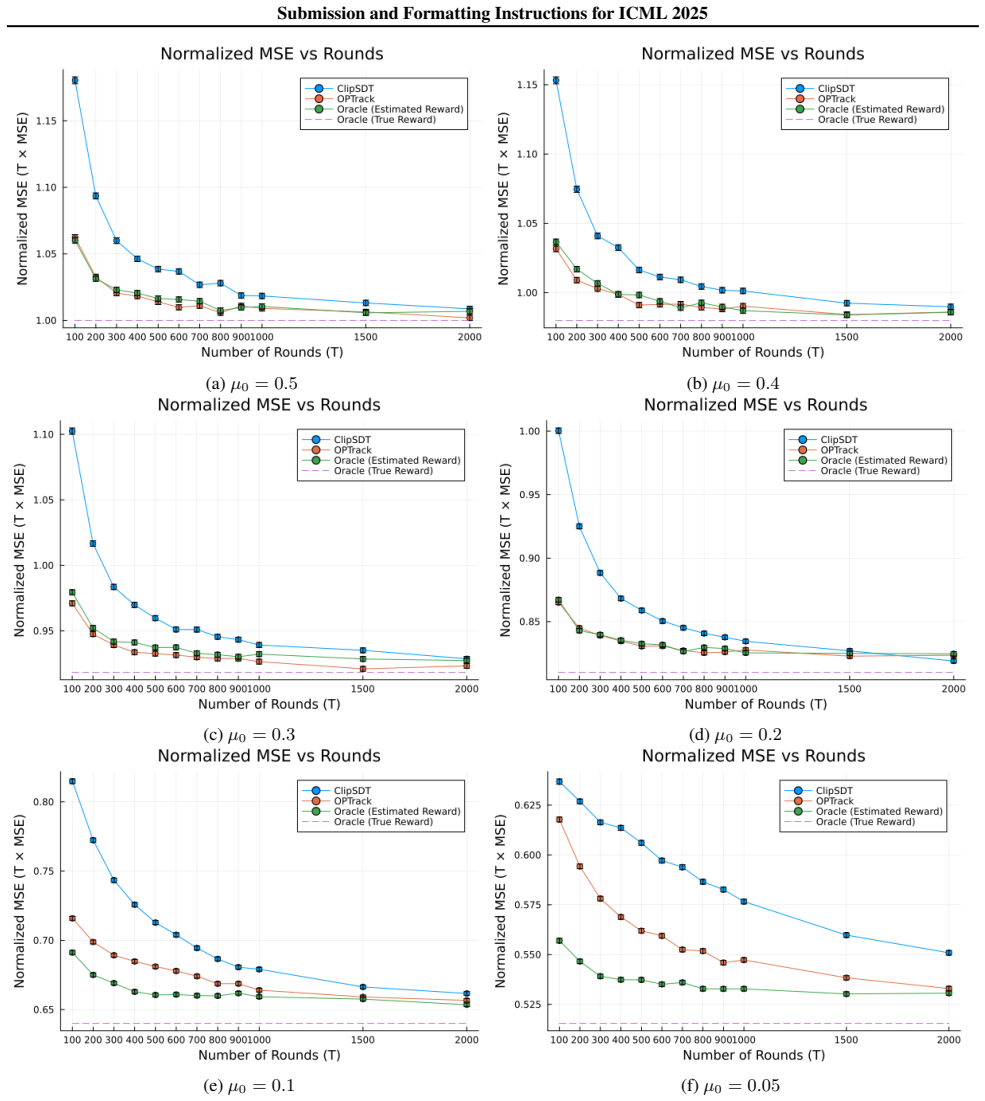
Summary. The paper proposes OPTrack, a fully adaptive algorithm for estimating the average treatment effect with the A2IPW estimator, and analyzes its Neyman regret in a nonasymptotic superpopulation setting (Section 3). The algorithm builds confidence sequences for the per-arm standard deviations, converts them into a confidence sequence CS_t(π*) for the Neyman allocation (Eq. 10), and plays the allocation in CS_t(π*) closest to 1/2 (Algorithm 1), interpreting this as optimism in the face of uncertainty. The main claim (Theorem 5.3) is that with probability at least 1−δ, OPTrack's Neyman regret is Õ(Δ(σ)^{-2} + (1/π*)^2 log T), where the baseline is the minimum variance over all estimator–allocation pairs, a strictly stronger benchmark than the IPW-optimal baselines used by prior nonasymptotic work (Dai et al., 2023; Neopane et al., 2025). The analysis splits time into an exploration phase whose length is bounded in Lemma 5.1 by Õ(Δ(σ)^{-2} log(1/δ)) and a concentration phase in which Lemma 5.2 bounds |π_t − π*| by Õ(√(ℓ(t,δ)/(π* t))). Experiments on six Bernoulli instances over 500,000 simulations report a 10–15% improvement in normalized MSE over ClipSDT at small T and competitiveness with an oracle that knows π*.
Significance. The manuscript targets a real gap: prior finite-sample analyses of adaptive ATE estimation compete against the minimum-variance IPW baseline, whereas the minimum variance over all estimator–allocation pairs is the appropriate semiparametric benchmark. The optimism principle — play the feasible allocation nearest 1/2 — is simple, interpretable, and eliminates the clipping-sequence hyperparameter that burdens ClipSDT, ClipSMT, and ClipOGD, giving a genuinely parameter-free procedure; this is a substantive algorithmic contribution. The experiments are transparent, use a defensible oracle baseline, and show consistent finite-sample gains. However, the main result is not yet verified as written: the regret defined in Eq. (5) is not the quantity bounded in Appendix A.1 (the two differ by a factor of T), the per-arm variance confidence sequence underpinning the good event (16) is not implied by the stated Lemma B.1 for random sample sizes, and several load-bearing bounds are imported without proof from the authors' companion paper. These are repairable correctness gaps rather than refutations of the approach, but they must be closed before the theoretical claims can be accepted.
major comments (4)
- [Section 3, Eqs. (5)–(6), and Appendix A.1] The object bounded in the proof is not the object defined as Neyman regret. With Var(bΔ_T) = (1/T^2) Σ_{t=1}^T E[ℓ(π_t, br_t)] (Lemma C.1), Eq. (5)'s normalized gap is (1/T) Σ_t E[ℓ_t] − V*, where V* = σ²(1)/π* + σ²(0)/(1−π*), while Eq. (6) defines R_T = Σ_t E[ℓ_t] − V*. The proof of Theorem 5.3, Eqs. (19)–(24), bounds Σ_t (E[ℓ_t] − V*), subtracting V* inside each round, so the exploration phase alone contributes 4T and the concentration phase contributes Σ 625ℓ(t,δ)/((π*)² t); these match the stated rate Õ(Δ(σ)^{-2} + (1/π*)² log T) only for the cumulative object Σ_t(E[ℓ_t] − V*). Thus the theorem's bound does not apply to the definition in Eq. (5) (where the same proof would imply only Õ((Δ(σ)^{-2} + (1/π*)² log T)/T)), and Eq. (6) is off by an additive (T−1)V* from the proof's quantity. The definition of R_T and the proof must be reconciled before the logarithmic-regret claim can be evaluated.
- [Appendix B (Lemma B.1) and Eq. (16)] The good event E_σ(δ̃) is asserted as |bσ_t(a) − σ(a)| ≤ 4.2√(ℓ(t,δ)/t) for all arms and all t, but Lemma B.1 provides a confidence sequence only for a variance estimate computed from all t observations of a single [0,1]-bounded sequence. In OPTrack, bσ_t(a) is computed from N_t(a) observations, where N_t(a) is a random sample size, so the natural conclusion of Lemma B.1 applied to the arm-a subsequence is |bσ_t(a) − σ(a)| ≤ 4.2√(ℓ(N_t(a),δ)/N_t(a)) for all t, and no argument converts that random-denominator event into the fixed-denominator bound (16); when N_t(a) is well below t, the displayed bound is stronger than what Lemma B.1 supplies. The crux is load-bearing because the proofs in Appendix A actually use the N_t(a) form — Z_t(a) in Lemma A.1 and Eq. (33) in Lemma 5.1 — while the union bound establishing E(δ̃) uses the t-denominator form. The repair of reindexing arm-specific observation times and stating a time-uniform per-arm CS is standard but is not written down. In addition, Lemma B.1 requires [0,1]-bounded rewards, an assumption absent from Section 3 and from the statement of Theorem 5.3, and the reward event E_r(δ) in Eq. (18) is displayed with √(tℓ(t,δ)) although the proof (Eq. (29)) uses √(ℓ(t,δ)/N_t(a)); both mismatches need to be corrected for the high-probability event to support the main theorem.
- [Section 5 and Appendix A] The proof of Theorem 5.3 imports four load-bearing results from the authors' companion paper Neopane et al. (2025) without stating them: Lemma 4.3 in Eq. (28), Lemma 4.5 in Eq. (31), Lemma B.10 in Eqs. (35)–(36) and in Lemma A.1, and Lemma 2 in the concentration-phase argument described after Theorem 5.3. These bounds carry the constant factors and the π*-dependence that determine the claimed rate, so the theorem cannot be checked from this manuscript alone. Even if the companion paper is correct, this dependence should be made explicit and the relevant lemmas stated (or proved) in an appendix; the current manuscript gives no way for a reader to verify that the cited results apply to the random-allocation, per-arm setting used here.
- [Appendix A.3, Eqs. (48)–(52)] The chain used to lower-bound the denominator in Eq. (47) is invalid as written. Line (48) states Z_{0,t} = 4.2√(ℓ(t,δ)/t), but with Z_{0,t} defined as 4.2√(ℓ(t,δ)/N_t(0)) and N_t(0) ≤ t, the quantity 4.2√(ℓ/t) is a lower bound, not an upper bound, on Z_{0,t}. Line (49), Z_{0,t} ≤ Δ(σ)/8, does not follow from t ≥ T: the exploration-phase exit condition (33) implies only Z_{0,t} + Z_{1,t} < Δ(σ) on the good event, with no split that gives either term a 1/8 margin. Line (50) then replaces Z_{1,t} in the denominator by −Δ(σ)/8 without justification. Since this chain supplies the inequality σ(0) + σ(1) − Z_{0,t} ≥ (σ(0)+σ(1))/2 used to obtain the constant 25 in Lemma 5.2 (Eq. (53)), a central ingredient of the concentration-phase bound of Theorem 5.3 rests on a proof step that does not hold as written; the lemma may be repairable through a different argument, but the current derivation needs to be reworked.
minor comments (6)
- [Section 1, Organization paragraph] The sentences 'The rest of our paper is organized as follows.' and 'The remainder of this paper is structured as follows.' are duplicated back-to-back, and the resulting list omits the Conclusion section that the paper actually contains.
- [Section 5, Notation] The notation 'we let π = min{π, 1 − π}' overloads the allocation π with its distance to the boundary; a distinct symbol (e.g., π̄) would avoid confusion in Lemma 5.1 and Theorem 5.3.
- [Eq. (18)] The displayed event E_r(δ), |br_t(a) − r*(a)| ≤ √(tℓ(t,δ)), is dimensionally inconsistent with its use in Eq. (29), which requires √(ℓ(t,δ)/N_t(a)); as printed the bound is also vacuous for bounded rewards.
- [Algorithm 1 and Eq. (10)] The lower endpoints L_t(σ(a)) from Lemma B.1 can be negative at small t (bσ_t − 1.7√(ℓ/t)); the algorithm should intersect CS_t(π*) with [0,1] or clip the endpoint bounds, otherwise the argmin in step 3 may range outside the unit interval. The timing of the update (CS_t uses data up to t−1) should also be stated explicitly.
- [Sections 2.1 and 6] The claim that ClipSMT and ClipOGD incur linear Neyman regret under the new baseline is asserted but never demonstrated; a one-line comparison of their limiting normalized MSE against V* would substantiate the exclusion from the experiments.
- [Eq. (7)] The term ε²_t(a) inside the definition of ℓ(π, r) carries a time index inappropriate for a generic loss function; the subscript should be dropped or made local to the definition.
Circularity Check
The central log T concentration-phase regret is imported from the authors' own companion paper via Lemma 2, and the proof also leans on companion lemmas 4.3, 4.5, and B.10; however, no fitted input is renamed as a prediction, so the result is not definitionally circular.
-
self citation load bearing
[Section 5, after Theorem 5.3; Appendix A.1, around equation (28)]
"The second term in our bound is the Neyman regret during the concentration phase and follows from the application of Lemma 5.2 in conjunction with Lemma 2 of (Neopane et al., 2025) showing that the Neyman regret scales according to |π⋆ − πt|2 ≈ 1/π⋆·t."
The main logarithmic term of Theorem 5.3 is not derived in this manuscript; it is supplied by Lemma 2 from a companion paper by the same authors. The present paper does not reproduce or verify that lemma, and it is the only support for converting the allocation-gap bound of Lemma 5.2 into a Neyman-regret bound. This makes the central claim load-bearing on a self-citation rather than on a derivation contained in the present manuscript. It is not an equality-by-construction and no fitted parameter is renamed, so it raises the score without making the whole result definitionally circular.
-
self citation load bearing
[Appendix A.2, proof of Lemma 5.1; Appendix A.3, proof of Lemma 5.2]
"Applying Lemma B.10 from (Neopane et al., 2025) shows that whenever t ≥ eO(log(1/δ)), we have that 1.7 sqrt(ℓ(t,δ)/t) < 1/4 so that we need to bound min { t : t > 64/Δ^2(σ) · ℓ(t,δ) }."
The exploration-time bound in Lemma 5.1 and the allocation-convergence rate in Lemma 5.2 both depend on Lemma B.10, and the per-round regret bound in Appendix A.1 also invokes Lemmas 4.3 and 4.5 from the same companion paper, all cited without proof. These self-citations are load-bearing because, without them, the displayed bounds on T and |π_t − π⋆| are not established by the present analysis. The cited statements are separate mathematical lemmas rather than definitions of the target result, so this is dependency through self-citation rather than a purely constructional circle.
full rationale
OPTrack is benchmarked against the external Neyman variance and uses the published A2IPW estimator, so the central comparison is not defined in terms of the algorithm's own outputs. No fitted parameter is renamed as a prediction, and no quantity is defined to be equal to the claimed result by construction. The main circularity concern is the heavy reliance on the authors' companion paper: Theorem 5.3's log T concentration term is attributed to Lemma 2 of Neopane et al. (2025), and the supporting Lemmas 5.1 and 5.2 use Lemma B.10, 4.3, and 4.5 from the same companion work without re-derivation. These are parameter-free mathematical lemmas with stated assumptions, so they are real evidence rather than vacuous self-citation, which prevents a higher score; still, the present paper is not self-contained for its central claim. Separately, there is a correctness gap rather than a circularity: the good event Eσ(δ) in equation (16) uses a confidence width with denominator t, while the algorithm's variance estimate bσ_t(a) has random denominator N_t(a), so the high-probability event as written is not formally justified; this gap is weighed in the verdict but is not an equivalence-by-construction.
Assumptions & free parameters
assumptions (4)
- domain assumption Unconfoundedness and fixed conditional reward means and variances: E[Rt(a)|Ft-1]=r*(a) and V[Rt(a)|Ft-1]=σ^2(a) for all t.
- domain assumption Rewards are bounded in [0,1].
- standard math Time-uniform martingale concentration results of Howard et al. (2021), specifically Theorem 1 for the good event and Lemma B.1.
- ad hoc to paper Lemmas 4.3, 4.5, B.10 and Lemma 2 from Neopane et al. (2025) are correct and applicable.
Cite this review
Pith. "Pith review of Optimistic Algorithms for Adaptive Estimation of the Average Treatment Effect." pith.science (2026). https://pith.science/paper/I2YGI4N2
@misc{pith2026250204673,
  author       = {Pith},
  title        = {Pith review of: Optimistic Algorithms for Adaptive Estimation of the Average Treatment Effect},
  year         = {2026},
  howpublished = {\url{https://pith.science/paper/I2YGI4N2}},
  note         = {Machine review of arXiv:2502.04673}
}
read the original abstract
Estimation and inference for the Average Treatment Effect (ATE) is a cornerstone of causal inference and often serves as the foundation for developing procedures for more complicated settings. Although traditionally analyzed in a batch setting, recent advances in martingale theory have paved the way for adaptive methods that can enhance the power of downstream inference. Despite these advances, progress in understanding and developing adaptive algorithms remains in its early stages. Existing work either focus on asymptotic analyses that overlook exploration-exploitation tradeoffs relevant in finite-sample regimes or rely on simpler but suboptimal estimators. In this work, we address these limitations by studying adaptive sampling procedures that take advantage of the asymptotically optimal Augmented Inverse Probability Weighting (AIPW) estimator. Our analysis uncovers challenges obscured by asymptotic approaches and introduces a novel algorithmic design principle reminiscent of optimism in multiarmed bandits. This principled approach enables our algorithm to achieve significant theoretical and empirical gains compared to prior methods. Our findings mark a step forward in advancing adaptive causal inference methods in theory and practice.
Figures

Reference graph
Works this paper leans on
-
[1]
write newline
" write newline "" before.all 'output.state := FUNCTION n.dashify 't := "" t empty not t #1 #1 substring "-" = t #1 #2 substring "--" = not "--" * t #2 global.max substring 't := t #1 #1 substring "-" = "-" * t #2 global.max substring 't := while if t #1 #1 substring * t #2 global.max substring 't := if while FUNCTION format.date year duplicate empty "emp...
-
[2]
Use of variance estimation in the multi-armed bandit problem
Audibert, J.-Y., Munos, R., and Szepesv \'a ri, C. Use of variance estimation in the multi-armed bandit problem. 2006
work page 2006
-
[3]
Semiparametric efficient inference in adaptive experiments
Cook, T., Mishler, A., and Ramdas, A. Semiparametric efficient inference in adaptive experiments. In Proceedings of the Third Conference on Causal Learning and Reasoning, volume 236 of Proceedings of Machine Learning Research, pp.\ 1033--1064. PMLR, 01--03 Apr 2024
work page 2024
-
[4]
Clip- OGD : An experimental design for adaptive N eyman allocation in sequential experiments
Dai, J., Gradu, P., and Harshaw, C. Clip- OGD : An experimental design for adaptive N eyman allocation in sequential experiments. Advances in Neural Information Processing Systems, 36: 0 32235--32269, 2023
work page 2023
-
[5]
Minimax-optimal off-policy evaluation with linear function approximation
Duan, Y., Jia, Z., and Wang, M. Minimax-optimal off-policy evaluation with linear function approximation. In International Conference on Machine Learning, pp.\ 2701--2709. PMLR, 2020
work page 2020
-
[6]
Doubly robust policy evaluation and learning
Dud \' k, M., Langford, J., and Li, L. Doubly robust policy evaluation and learning. In Proceedings of the 28th International Conference on Machine Learning, pp.\ 1097--1104, 2011
work page 2011
-
[7]
On explore-then-commit strategies
Garivier, A., Lattimore, T., and Kaufmann, E. On explore-then-commit strategies. Advances in Neural Information Processing Systems, 29, 2016
work page 2016
-
[8]
A., Zhan, R., Wager, S., and Athey, S
Hadad, V., Hirshberg, D. A., Zhan, R., Wager, S., and Athey, S. Confidence intervals for policy evaluation in adaptive experiments. Proceedings of the National Academy of Sciences, 118 0 (15): 0 e2014602118, 2021
work page 2021
Show all 29 references
-
[9]
Hahn, J., Hirano, K., and Karlan, D. S. Adaptive experimental design using the propensity score. Journal of Business & Economic Statistics, 29: 0 108 -- 96, 2009
2009
-
[10]
P., Thomas, P
Hanna, J. P., Thomas, P. S., Stone, P., and Niekum, S. Data-efficient policy evaluation through behavior policy search. In International Conference on Machine Learning, 2017
2017
-
[11]
R., Ramdas, A., McAuliffe, J
Howard, S. R., Ramdas, A., McAuliffe, J. D., and Sekhon, J. S. Time-uniform, nonparametric, nonasymptotic confidence sequences. The Annals of Statistics, 2021
2021
-
[12]
Off-policy risk assessment in contextual bandits
Huang, A., Leqi, L., Lipton, Z., and Azizzadenesheli, K. Off-policy risk assessment in contextual bandits. Advances in Neural Information Processing Systems, 34: 0 23714--23726, 2021
2021
-
[13]
Off-policy risk assessment for markov decision processes
Huang, A., Leqi, L., Lipton, Z., and Azizzadenesheli, K. Off-policy risk assessment for markov decision processes. In International Conference on Artificial Intelligence and Statistics, pp.\ 5022--5050. PMLR, 2022
2022
-
[14]
and Li, L
Jiang, N. and Li, L. Doubly robust off-policy value evaluation for reinforcement learning. In International Conference on Machine Learning, pp.\ 652--661. PMLR, 2016
2016
-
[15]
Efficient adaptive experimental design for average treatment effect estimation
Kato, M., Ishihara, T., Honda, J., and Narita, Y. Efficient adaptive experimental design for average treatment effect estimation. arXiv preprint arXiv:2002.05308, 2020
2002 arXiv
-
[16]
J., Denil, M., and de Freitas, N
Konyushova, K., Chen, Y., Paine, T., Gulcehre, C., Paduraru, C., Mankowitz, D. J., Denil, M., and de Freitas, N. Active offline policy selection. Advances in Neural Information Processing Systems, 34: 0 24631--24644, 2021
2021
-
[17]
and Szepesv \'a ri, C
Lattimore, T. and Szepesv \'a ri, C. Bandit algorithms. Cambridge University Press, 2020
2020
-
[18]
Unbiased offline evaluation of contextual-bandit-based news article recommendation algorithms
Li, L., Chu, W., Langford, J., and Wang, X. Unbiased offline evaluation of contextual-bandit-based news article recommendation algorithms. In Proceedings of the fourth ACM international conference on Web search and data mining, pp.\ 297--306, 2011
2011
-
[19]
Toward minimax off-policy value estimation
Li, L., Munos, R., and Szepesv \'a ri, C. Toward minimax off-policy value estimation. In Artificial Intelligence and Statistics, pp.\ 608--616. PMLR, 2015
2015
-
[20]
Optimal treatment allocation for efficient policy evaluation in sequential decision making
Li, T., Shi, C., Wang, J., Zhou, F., et al. Optimal treatment allocation for efficient policy evaluation in sequential decision making. Advances in Neural Information Processing Systems, 36, 2024
2024
-
[21]
Ma, C., Zhu, B., Jiao, J., and Wainwright, M. J. Minimax off-policy evaluation for multi-armed bandits. IEEE Transactions on Information Theory, 68: 0 5314--5339, 2021
2021
-
[22]
Logarithmic N eyman regret for adaptive estimation of the average treatment effect
Neopane, O., Ramdas, A., and Singh, A. Logarithmic N eyman regret for adaptive estimation of the average treatment effect. AISTATS, 2025
2025
-
[23]
On the two different aspects of the representative method: the method of stratified sampling and the method of purposive selection
Neyman, J. On the two different aspects of the representative method: the method of stratified sampling and the method of purposive selection. Journal of the Royal Statistical Society, 97: 0 123--150, 1934
1934
-
[24]
Thompson, W. R. On the likelihood that one unknown probability exceeds another in view of the evidence of two samples. Biometrika, 25 0 (3-4): 0 285--294, 1933
1933
-
[25]
Optimal and adaptive off-policy evaluation in contextual bandits
Wang, Y.-X., Agarwal, A., and Dud k, M. Optimal and adaptive off-policy evaluation in contextual bandits. In International Conference on Machine Learning, pp.\ 3589--3597. PMLR, 2017
2017
-
[26]
and Ramdas, A
Waudby-Smith, I. and Ramdas, A. Estimating means of bounded random variables by betting. Journal of the Royal Statistical Society Series B Methodological, 2023
2023
-
[27]
Anytime-valid off-policy inference for contextual bandits
Waudby-Smith, I., Wu, L., Ramdas, A., Karampatziakis, N., and Mineiro, P. Anytime-valid off-policy inference for contextual bandits. ACM/JMS Journal of Data Science, 2022
2022
-
[28]
Inference for batched bandits
Zhang, K., Janson, L., and Murphy, S. Inference for batched bandits. Advances in Neural Information Processing Systems, 33: 0 9818--9829, 2020
2020
-
[29]
Statistical inference with m-estimators on adaptively collected data
Zhang, K., Janson, L., and Murphy, S. Statistical inference with m-estimators on adaptively collected data. Advances in Neural Information Processing Systems, 34: 0 7460--7471, 2021
2021
Reviewed August 8, 2026 · model on record in the stance chip above.
Discussion (0). Continue with ORCID to comment.