REVIEW 1 major objections 1 minor 82 references
Content-Induced Spatial-Spectral Aggregation Network for Change Detection in Remote Sensing Images
T0 review · 1 major / 1 minor · reviewed 2026-06-27 · grok-4.3
Pith's one-line read CSI-Net fuses spatial and spectral features using content guidance to suppress differences in unchanged regions for improved change detection.
desk verdict CSI-Net is an incremental remote sensing change detection network whose SD module rests on an untested assumption about spectral statistics. read the letter →
The pith
A machine-rendered reading of the paper's core claim, the machinery that carries it, and where it could break.
The reading
What carries the argument
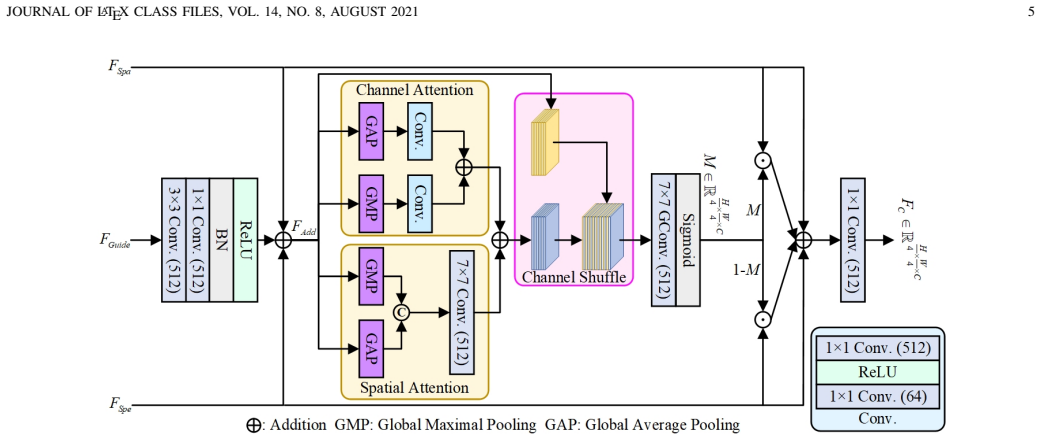
The content-guided integration (CGI) module, which directs interaction between spatial and spectral features using high-level content information as a guide.
What would settle it
A test case where the network fails to detect verified changes in regions that exhibit the spectral variance patterns the module is meant to handle would falsify the claim.
Extended reading notes
Core claim
The central claim is that introducing high-level content information as a guide for interaction allows the CSI-Net to efficiently integrate spatial features from graph convolutions and spectral features from means and variances, producing better change detection by learning changed features while suppressing spectral differences in unchanged regions.
Load-bearing premise
Calculating means and variances in the spectral difference module will suppress spectral differences in unchanged regions without discarding signals needed to detect actual changes.
Editorial extensions
If this is right
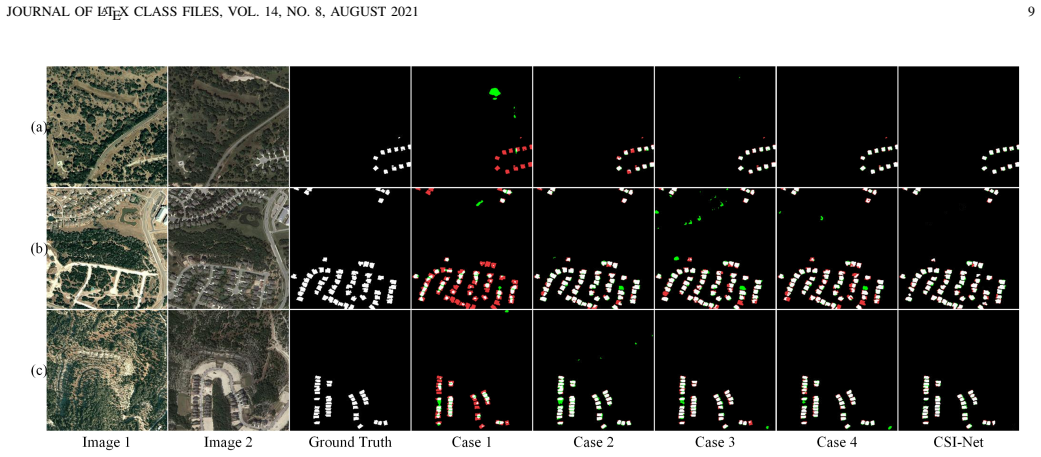
- The CSI-Net produces better performance than state-of-the-art methods on the LEVIR-CD, WHU-CD, and CLCD datasets.
- The approach is applicable to different scenarios in remote sensing change detection.
- Efficient spatial-spectral fusion suppresses spectral differences in unchanged areas while preserving changed features.
- Graph convolution blocks enable global spatial modeling that complements the spectral processing.
Reading between the lines
- The directed fusion strategy could apply to other tasks requiring selective integration of complementary image features.
- Graph-based spatial reasoning may scale to larger or multi-temporal remote sensing sequences beyond the tested datasets.
- Content guidance might reduce false positives in monitoring applications where unchanged areas dominate the scene.
Signed reviews
Editorial analysis
A structured set of objections, weighed in public.
Referee Report
Summary. The manuscript proposes CSI-Net, a content-guided spatial-spectral integration network for change detection in remote sensing images. It comprises an SR module using cascaded graph convolution blocks for global spatial modeling, an SD module that computes means and variances of features to suppress spectral differences in unchanged regions, and a CGI module that employs high-level content information to fuse the spatial and spectral features. The central claim is that this architecture enables superior learning of changed features while suppressing unwanted spectral differences, with experimental results on LEVIR-CD, WHU-CD, and CLCD datasets showing better performance than state-of-the-art methods across different scenarios.
Significance. If validated, the modular design could contribute to remote sensing change detection by offering a structured approach to spatial-spectral fusion that targets suppression of differences in unchanged areas. The combination of graph-based global modeling and content-guided integration is a reasonable direction, though the significance hinges on whether the SD module's statistical reduction reliably preserves change signals.
major comments (1)
- [SD module description] SD module (as described in the abstract and §3): The claim that calculating means and variances reduces the impact of spectral differences only in unchanged regions is load-bearing for the performance improvement assertion, yet the manuscript supplies no derivation, feature distribution analysis, or ablation showing that changed and unchanged regions exhibit separable first- and second-order statistics. When spectral statistics overlap (common under illumination variation or sensor noise), the operation risks attenuating change signals before the CGI integration step, directly threatening the central claim.
minor comments (1)
- [Abstract] Abstract: The performance claim is stated without any numerical metrics, ablation results, or implementation details, which would strengthen immediate readability even if full tables appear later.
Simulated Author's Rebuttal
We thank the referee for the constructive feedback. We address the single major comment below.
read point-by-point responses
-
Referee: [SD module description] SD module (as described in the abstract and §3): The claim that calculating means and variances reduces the impact of spectral differences only in unchanged regions is load-bearing for the performance improvement assertion, yet the manuscript supplies no derivation, feature distribution analysis, or ablation showing that changed and unchanged regions exhibit separable first- and second-order statistics. When spectral statistics overlap (common under illumination variation or sensor noise), the operation risks attenuating change signals before the CGI integration step, directly threatening the central claim.
Authors: We acknowledge that the manuscript provides no derivation, distribution analysis, or ablation to demonstrate separability of first- and second-order statistics between changed and unchanged regions. The SD module design rests on the domain intuition that unchanged pixels share consistent spectral statistics while changes produce deviations, but this is not empirically validated in the current text. To address the concern, the revised manuscript will add: (i) a brief statistical motivation section, (ii) visualizations of per-pixel mean/variance distributions on changed vs. unchanged masks, and (iii) an ablation measuring SD-module impact under controlled illumination shifts. These additions will directly test whether change signals are preserved. revision: yes
Circularity Check
No circularity in derivation chain
full rationale
The paper presents an empirical neural network design (CSI-Net with SR, SD, and CGI modules) whose central claims rest on experimental comparisons to prior methods on LEVIR-CD, WHU-CD, and CLCD. No equations, first-principles derivations, or predictions appear that reduce by construction to fitted parameters, self-definitions, or self-citation chains. The SD module's mean/variance operation is a stated design heuristic, not a derived result that loops back to its own inputs. The architecture is therefore self-contained against external benchmarks.
Assumptions & free parameters
Cite this review
Pith. "Pith review of Content-Induced Spatial-Spectral Aggregation Network for Change Detection in Remote Sensing Images." pith.science (2026). https://pith.science/paper/I5RA5LSW
@misc{pith2026260610328,
  author       = {Pith},
  title        = {Pith review of: Content-Induced Spatial-Spectral Aggregation Network for Change Detection in Remote Sensing Images},
  year         = {2026},
  howpublished = {\url{https://pith.science/paper/I5RA5LSW}},
  note         = {Machine review of arXiv:2606.10328}
}
read the original abstract
The integration of spatial and spectral information is beneficial to the improvement of change detection performance. However, existing methods cannot efficiently suppress the influences of spatial and spectral differences in unchanged areas. To address these issues, in this paper we propose a content-guided spatial-spectral integration network (CSI-Net) for the fusion of global spatial details and spectral difference information. Specifically, the proposed CSI-Net is composed of a spatial reasoning (SR) module, a spectral difference (SD) module, and a content-guided integration (CGI) module. In the SR module, the spatial information is learned by cascaded graph convolution blocks for global modeling. The SD module is responsible for the extraction of spectral features, by calculating the means and variances of features to reduce the impact of spectral differences in unchanged regions. In addition, in order to integrate the spatial-spectral features efficiently, we design a CGI module to further take advantage of their complementary information. In this module, high-level content information is introduced as a guide for a proper interaction. Due to the efficient spatial-spectral fusion, the proposed CSI-Net can learn the changed features better while achieving a suppression of spectral differences. Experimental results on LEVIR-CD, WHU-CD, and CLCD datasets demonstrate that the proposed CSI-Net produces better performance compared to state-of-the-art methods, and is applicable to different scenarios
Figures


Figures from the paper (11 more)




Reference graph
Works this paper leans on
-
[1]
Deep learning for change detection in remote sensing images: Comprehensive review and meta-analysis,
L. Khelifi and M. Mignotte, “Deep learning for change detection in remote sensing images: Comprehensive review and meta-analysis,”IEEE Access, vol. 8, pp. 126 385–126 400, 2020
2020
-
[2]
A scalable high-performance unsupervised system for producing large-scale HR land cover maps: The Italian country case study,
C. Paris, L. Gasparella, and L. Bruzzone, “A scalable high-performance unsupervised system for producing large-scale HR land cover maps: The Italian country case study,”IEEE J. Sel. Topics Appl. Earth Observ. Remote Sens., vol. 15, pp. 9146–9159, 2022
2022
-
[3]
Automated machine learning driven stacked ensemble modeling for forest aboveground biomass prediction using multitemporal Sentinel-2 data,
P. Naik, M. Dalponte, and L. Bruzzone, “Automated machine learning driven stacked ensemble modeling for forest aboveground biomass prediction using multitemporal Sentinel-2 data,”IEEE J. Sel. Topics Appl. Earth Observ. Remote Sens., vol. 16, pp. 3442–3454, 2023
2023
-
[4]
Panchromatic and multispectral image fusion for remote sensing and earth observation: Concepts, taxonomy, literature review, evaluation methodologies and challenges ahead,
K. Zhang, F. Zhang, W. Wan, H. Yu, J. Sun, J. Del Ser, E. Elyan, and A. Hussain, “Panchromatic and multispectral image fusion for remote sensing and earth observation: Concepts, taxonomy, literature review, evaluation methodologies and challenges ahead,”Information Fusion, 2023
2023
-
[5]
End-to-end change detection for high resolution satellite images using improved UNet++,
D. Peng, Y . Zhang, and H. Guan, “End-to-end change detection for high resolution satellite images using improved UNet++,”Remote Sens., vol. 11, no. 11, p. 1382, 2019
2019
-
[6]
SNUNet-CD: A densely connected siamese network for change detection of VHR images,
S. Fang, K. Li, J. Shao, and Z. Li, “SNUNet-CD: A densely connected siamese network for change detection of VHR images,”IEEE Geosci. Remote Sens. Lett., vol. 19, pp. 1–5, 2021
2021
-
[7]
Fully convolutional Siamese networks for change detection,
R. C. Daudt, B. Le Saux, and A. Boulch, “Fully convolutional Siamese networks for change detection,” inIEEE ICIP, 2018, pp. 4063–4067
2018
-
[8]
SemiCDNet: A semisupervised convolutional neural network for change detection in high resolution remote-sensing images,
D. Peng, L. Bruzzone, Y . Zhang, H. Guan, H. Ding, and X. Huang, “SemiCDNet: A semisupervised convolutional neural network for change detection in high resolution remote-sensing images,”IEEE Trans. Geosci. Remote Sens., vol. 59, no. 7, pp. 5891–5906, 2021
2021
Show all 82 references
-
[9]
A deep multiscale pyramid network enhanced with spatial–spectral residual attention for hyperspectral image change detection,
Y . Yang, J. Qu, S. Xiao, W. Dong, Y . Li, and Q. Du, “A deep multiscale pyramid network enhanced with spatial–spectral residual attention for hyperspectral image change detection,”IEEE Trans. Geosci. Remote Sens., vol. 60, pp. 1–13, 2022
2022
-
[11]
Difference enhancement and spatial–spectral nonlocal network for change detection in VHR remote sensing images,
T. Lei, J. Wang, H. Ning, X. Wang, D. Xue, Q. Wang, and A. K. Nandi, “Difference enhancement and spatial–spectral nonlocal network for change detection in VHR remote sensing images,”IEEE Trans. Geosci. Remote Sens., vol. 60, pp. 1–13, 2022
2022
-
[12]
Relation changes matter: Cross-Temporal difference transformer for change detection in remote sensing images,
K. Zhang, X. Zhao, F. Zhang, L. Ding, J. Sun, and L. Bruzzone, “Relation changes matter: Cross-Temporal difference transformer for change detection in remote sensing images,”IEEE Trans. Geosci. Remote Sens., vol. 61, pp. 1–15, 2023
2023
-
[13]
Asymmetric cross-attention hierarchical network based on CNN and transformer for bitemporal remote sensing images change detection,
X. Zhang, S. Cheng, L. Wang, and H. Li, “Asymmetric cross-attention hierarchical network based on CNN and transformer for bitemporal remote sensing images change detection,”IEEE Trans. Geosci. Remote Sens., vol. 61, pp. 1–15, 2023
2023
-
[14]
A multiscale graph convolutional network for change detection in homogeneous and heterogeneous remote sensing images,
J. Wu, B. Li, Y . Qin, W. Ni, H. Zhang, R. Fu, and Y . Sun, “A multiscale graph convolutional network for change detection in homogeneous and heterogeneous remote sensing images,”Int. J. Appl. Earth. Obs. Geoinf., vol. 105, p. 105615, 2021
2021
-
[15]
Semisu- pervised change detection using graph convolutional network,
S. Saha, L. Mou, X. X. Zhu, F. Bovolo, and L. Bruzzone, “Semisu- pervised change detection using graph convolutional network,”IEEE Geosci. Remote Sens. Lett., vol. 18, no. 4, pp. 607–611, 2021
2021
-
[16]
An unsupervised remote sensing change detection method based on multiscale graph convolutional network and metric learning,
X. Tang, H. Zhang, L. Mou, F. Liu, X. Zhang, X. X. Zhu, and L. Jiao, “An unsupervised remote sensing change detection method based on multiscale graph convolutional network and metric learning,”IEEE Trans. Geosci. Remote. Sens., vol. 60, pp. 1–15, 2022
2022
-
[17]
GCN-based multi-scale dual fusion for remote sensing building change detection
S. Liang, Z. Hua, and J. Li, “GCN-based multi-scale dual fusion for remote sensing building change detection.”Int. J. Remote. Sens., vol. 44, pp. 953–980, 2023
2023
-
[18]
Spatial–spectral attention network guided with change magnitude image for land cover change detection using remote sensing images,
Z. Lv, F. Wang, G. Cui, J. A. Benediktsson, T. Lei, and W. Sun, “Spatial–spectral attention network guided with change magnitude image for land cover change detection using remote sensing images,”IEEE Trans. Geosci. Remote. Sens., vol. 60, pp. 1–12, 2022
2022
-
[19]
Change detection based on artificial intelligence: State-of-the-art and challenges,
W. Shi, M. Zhang, R. Zhang, S. Chen, and Z. Zhan, “Change detection based on artificial intelligence: State-of-the-art and challenges,”Remote Sens., vol. 12, no. 10, p. 1688, 2020
2020
-
[20]
A deeply supervised image fusion network for change detection in high resolution bi-temporal remote sensing images,
C. Zhang, L. Wang, D. Yinet al., “A deeply supervised image fusion network for change detection in high resolution bi-temporal remote sensing images,”ISPRS J. Photogramm. Remote Sens., vol. 166, pp. 183–200, 2020
2020
-
[21]
Spectral–spatial–temporal transformers for hyperspectral image change detection,
Y . Wang, D. Hong, J. Sha, L. Gao, L. Liu, Y . Zhang, and X. Rong, “Spectral–spatial–temporal transformers for hyperspectral image change detection,”IEEE Trans. Geosci. Remote Sens., vol. 60, pp. 1–14, 2022
2022
-
[22]
Sscnn-s: A spectral-spatial convolution neural network with Siamese architecture for change detection,
T. Zhan, B. Song, Y . Xu, M. Wan, X. Wang, G. Yang, and Z. Wu, “Sscnn-s: A spectral-spatial convolution neural network with Siamese architecture for change detection,”Remote Sens., vol. 13, no. 5, p. 895, 2021
2021
-
[23]
A theoretical framework for unsupervised change detection based on change vector analysis in the polar domain,
F. Bovolo and L. Bruzzone, “A theoretical framework for unsupervised change detection based on change vector analysis in the polar domain,” IEEE Trans. Geosci. Remote. Sens., vol. 45, no. 1, pp. 218–236, 2006
2006
-
[24]
A framework for automatic and unsupervised detection of multiple changes in multitemporal im- ages,
F. Bovolo, S. Marchesi, and L. Bruzzone, “A framework for automatic and unsupervised detection of multiple changes in multitemporal im- ages,”IEEE Trans. Geosci. Remote. Sens., vol. 50, no. 6, pp. 2196–2212, 2012
2012
-
[25]
Multivariate alteration detection (MAD) and MAF postprocessing in multispectral, bitemporal image data: New approaches to change detection studies,
A. A. Nielsen, K. Conradsen, and J. J. Simpson, “Multivariate alteration detection (MAD) and MAF postprocessing in multispectral, bitemporal image data: New approaches to change detection studies,”Remote Sens. Environ., vol. 64, no. 1, pp. 1–19, 1998
1998
-
[26]
The regularized iteratively reweighted MAD method for change detection in multi-and hyperspectral data,
A. A. Nielsen, “The regularized iteratively reweighted MAD method for change detection in multi-and hyperspectral data,”IEEE Trans. Image. Process., vol. 16, no. 2, pp. 463–478, 2007
2007
-
[27]
Unsupervised change detection of multispectral images based on PCA and low-rank prior,
W. Zhang, J. Li, F. Zhang, J. Sun, and K. Zhang, “Unsupervised change detection of multispectral images based on PCA and low-rank prior,” IEEE Geosci. Remote. Sens. Lett., vol. 19, pp. 1–5, 2022
2022
-
[28]
ICA and kernel ICA for change detection in multispectral remote sensing images,
S. Marchesi and L. Bruzzone, “ICA and kernel ICA for change detection in multispectral remote sensing images,” inIEEE IGARSS., vol. 2. IEEE, 2009, pp. 980–983
2009
-
[29]
Unsupervised change detection of multispectral images based on pca and low-rank prior,
W. Zhang, J. Li, F. Zhang, J. Sun, and K. Zhang, “Unsupervised change detection of multispectral images based on pca and low-rank prior,” IEEE Geosci. Remote Sens. Lett., vol. 19, pp. 1–5, 2021
2021
-
[30]
A critical synthesis of remotely sensed optical image change detection techniques,
A. P. Tewkesbury, A. J. Comber, and N. J. Tate, “A critical synthesis of remotely sensed optical image change detection techniques,”Remote Sens. Environ., vol. 160, pp. 1–14, 2015
2015
-
[31]
Change detection in synthetic aperture radar images based on image fusion and fuzzy clustering,
M. Gong, Z. Zhou, and J. Ma, “Change detection in synthetic aperture radar images based on image fusion and fuzzy clustering,”IEEE Trans. Image. Process., vol. 21, no. 4, pp. 2141–2151, 2012
2012
-
[32]
Sparse unmixing with dictionary pruning for hyperspectral change detection,
A. Ert ¨urk, M.-D. Iordache, and A. Plaza, “Sparse unmixing with dictionary pruning for hyperspectral change detection,”IEEE J. Sel. Topics Appl. Earth Observ. Remote Sens., vol. 10, no. 1, pp. 321–330, 2017
2017
-
[33]
Iterative robust graph for unsupervised change detection of heterogeneous remote sensing images,
Y . Sun, L. Lei, D. Guan, and G. Kuang, “Iterative robust graph for unsupervised change detection of heterogeneous remote sensing images,”IEEE Trans. Image. Process., vol. 30, pp. 6277–6291, 2021
2021
-
[34]
A novel approach to unsupervised change detection based on a semisupervised SVM and a similarity measure,
F. Bovolo, L. Bruzzone, and M. Marconcini, “A novel approach to unsupervised change detection based on a semisupervised SVM and a similarity measure,”IEEE Trans. Geosci. Remote Sens., vol. 46, no. 7, pp. 2070–2082, 2008
-
[35]
A change detection model based on neighbor- hood correlation image analysis and decision tree classification,
J. Im and J. R. Jensen, “A change detection model based on neighbor- hood correlation image analysis and decision tree classification,”Remote Sens. Environ., vol. 99, no. 3, pp. 326–340, 2005
2005
-
[36]
Multiscale unsupervised change detection on optical images by Markov random fields and wavelets,
G. Moser, E. Angiati, and S. B. Serpico, “Multiscale unsupervised change detection on optical images by Markov random fields and wavelets,”IEEE Geosci. Remote Sens. Lett., vol. 8, no. 4, pp. 725–729, 2011
2011
-
[37]
Change detection on remote sensing images using dual-branch multilevel intertemporal network,
Y . Feng, J. Jiang, H. Xu, and J. Zheng, “Change detection on remote sensing images using dual-branch multilevel intertemporal network,” IEEE Trans. Geosci. Remote Sens., vol. 61, pp. 1–15, 2023
2023
-
[38]
Style transformation- based spatial–spectral feature learning for unsupervised change detec- tion,
G. Liu, Y . Yuan, Y . Zhang, Y . Dong, and X. Li, “Style transformation- based spatial–spectral feature learning for unsupervised change detec- tion,”IEEE Trans. Geosci. Remote Sens., vol. 60, pp. 1–15, 2022
2022
-
[39]
Deep depthwise separable convolutional network for change detection in optical aerial images,
R. Liu, D. Jiang, L. Zhang, and Z. Zhang, “Deep depthwise separable convolutional network for change detection in optical aerial images,” IEEE J. Sel. Topics Appl. Earth Observ. Remote Sens., vol. 13, pp. 1109– 1118, 2020
2020
-
[40]
Ultralightweight spatial–spectral feature cooperation network JOURNAL OF LATEX CLASS FILES, VOL. 14, NO. 8, AUGUST 2021 15 for change detection in remote sensing images,
T. Lei, X. Geng, H. Ning, Z. Lv, M. Gong, Y . Jin, and A. K. Nandi, “Ultralightweight spatial–spectral feature cooperation network JOURNAL OF LATEX CLASS FILES, VOL. 14, NO. 8, AUGUST 2021 15 for change detection in remote sensing images,”IEEE Trans. Geosci. Remote Sens., vol....
2021
-
[41]
Learning spectral-spatial- temporal features via a recurrent convolutional neural network for change detection in multispectral imagery,
L. Mou, L. Bruzzone, and X. X. Zhu, “Learning spectral-spatial- temporal features via a recurrent convolutional neural network for change detection in multispectral imagery,”IEEE Trans. Geosci. Remote Sens., vol. 57, no. 2, pp. 924–935, 2018
2018
-
[42]
Edge-guided recurrent convolutional neural network for multitemporal remote sensing image building change detection,
B. Bai, W. Fu, T. Lu, and S. Li, “Edge-guided recurrent convolutional neural network for multitemporal remote sensing image building change detection,”IEEE Trans. Geosci. Remote Sens., vol. 60, pp. 1–13, 2022
2022
-
[43]
Change detection in multisource VHR images via deep siamese convolutional multiple-layers recurrent neural network,
H. Chen, C. Wu, B. Du, L. Zhang, and L. Wang, “Change detection in multisource VHR images via deep siamese convolutional multiple-layers recurrent neural network,”IEEE Trans. Geosci. Remote Sens., vol. 58, no. 4, pp. 2848–2864, 2019
2019
-
[44]
Deep image translation with an affinity- based change prior for unsupervised multimodal change detection,
L. T. Luppino, M. Kampffmeyer, F. M. Bianchi, G. Moser, S. B. Serpico, R. Jenssen, and S. N. Anfinsen, “Deep image translation with an affinity- based change prior for unsupervised multimodal change detection,” IEEE Trans. Geosci. Remote Sens., vol. 60, pp. 1–22, 2022
2022
-
[45]
An end-to- end supervised domain adaptation framework for cross-domain change detection,
J. Liu, W. Xuan, Y . Gan, Y . Zhan, J. Liu, and B. Du, “An end-to- end supervised domain adaptation framework for cross-domain change detection,”Pattern Recognit., vol. 132, p. 108960, 2022
2022
-
[46]
A semisupervised GAN-based multiple change detection framework in multi-spectral images,
F. Jiang, M. Gong, T. Zhan, and X. Fan, “A semisupervised GAN-based multiple change detection framework in multi-spectral images,”IEEE Geosci. Remote Sens. Lett., vol. 17, no. 7, pp. 1223–1227, 2019
2019
-
[47]
A deeply supervised attention metric-based network and an open aerial image dataset for remote sensing change detection,
Q. Shi, M. Liu, S. Li, X. Liu, F. Wang, and L. Zhang, “A deeply supervised attention metric-based network and an open aerial image dataset for remote sensing change detection,”IEEE Trans. Geosci. Remote Sens., vol. 60, pp. 1–16, 2022
2022
-
[48]
Bi- temporal semantic reasoning for the semantic change detection in hr remote sensing images,
L. Ding, H. Guo, S. Liu, L. Mou, J. Zhang, and L. Bruzzone, “Bi- temporal semantic reasoning for the semantic change detection in hr remote sensing images,”IEEE Trans. Geosci. Remote Sens., vol. 60, pp. 1–14, 2022
2022
-
[49]
A densely attentive refinement network for change detection based on very-high-resolution bitemporal remote sensing images,
Z. Li, C. Yan, Y . Sun, and Q. Xin, “A densely attentive refinement network for change detection based on very-high-resolution bitemporal remote sensing images,”IEEE Trans. Geosci. Remote Sens., vol. 60, pp. 1–18, 2022
2022
-
[50]
HANet: A hierarchical attention network for change detection with bi-temporal very-high- resolution remote sensing images,
C. Han, C. Wu, H. Guo, M. Hu, and H. Chen, “HANet: A hierarchical attention network for change detection with bi-temporal very-high- resolution remote sensing images,”IEEE J. Sel. Topics Appl. Earth Observ. Remote Sens., 2023
2023
-
[51]
SwinSUNet: Pure transformer network for remote sensing image change detection,
C. Zhang, L. Wang, S. Cheng, and Y . Li, “SwinSUNet: Pure transformer network for remote sensing image change detection,”IEEE Trans. Geosci. Remote Sens., vol. 60, pp. 1–13, 2022
2022
-
[52]
ConvTransNet: A CNN-transformer network for change detection with multi-scale global-local representa- tions,
W. Li, L. Xue, X. Wang, and G. Li, “ConvTransNet: A CNN-transformer network for change detection with multi-scale global-local representa- tions,”IEEE Trans. Geosci. Remote Sens., 2023
2023
-
[53]
DDPM-CD: Remote sensing change detection using denoising diffusion probabilistic mod- els,
W. G. C. Bandara, N. G. Nair, and V . M. Patel, “DDPM-CD: Remote sensing change detection using denoising diffusion probabilistic mod- els,”arXiv preprint arXiv:2206.11892, 2022
2022
-
[54]
Guided anisotropic diffusion and iterative learning for weakly supervised change detection,
R. Caye Daudt, B. Le Saux, A. Boulch, and Y . Gousseau, “Guided anisotropic diffusion and iterative learning for weakly supervised change detection,” inIEEE CVPR, 2019, pp. 1461–1470
2019
-
[55]
Weakly su- pervised change detection using guided anisotropic diffusion,
R. C. Daudt, B. Le Saux, A. Boulch, and Y . Gousseau, “Weakly su- pervised change detection using guided anisotropic diffusion,”Machine Learning, vol. 112, no. 6, pp. 2211–2237, 2023
2023
-
[56]
Deep residual learning for image recognition,
K. He, X. Zhang, S. Ren, and J. Sun, “Deep residual learning for image recognition,” inIEEE CVPR, 2016, pp. 770–778
2016
-
[57]
S2dbft: Spectral-spatial dual-branch fusion transformer for hyperspectral image classification,
Y . Zhang, Z. Wang, M. Huang, M. Li, J. Zhang, S. Wang, J. Zhang, and H. Zhang, “S2dbft: Spectral-spatial dual-branch fusion transformer for hyperspectral image classification,”IEEE Transactions on Geoscience and Remote Sensing, 2025
2025
-
[58]
Implementation of motion estimation based on heterogeneous parallel computing system with opencl,
J. Zhang, J.-F. Nezan, and J.-G. Cousin, “Implementation of motion estimation based on heterogeneous parallel computing system with opencl,” in2012 IEEE 14th International Conference on High Perfor- mance Computing and Communication & 2012 IEEE 9th International Conference on ...
2012
-
[59]
3d octave and 2d vanilla mixed convolutional neural network for hyperspectral image classification with limited samples,
Y . Feng, J. Zheng, M. Qin, C. Bai, and J. Zhang, “3d octave and 2d vanilla mixed convolutional neural network for hyperspectral image classification with limited samples,”Remote Sensing, vol. 13, no. 21, p. 4407, 2021
2021
-
[60]
Learning vertex representations for bipartite networks,
M. Gao, X. He, L. Chen, T. Liu, J. Zhang, and A. Zhou, “Learning vertex representations for bipartite networks,”IEEE transactions on knowledge and data engineering, vol. 34, no. 1, pp. 379–393, 2020
2020
-
[61]
Multi-granularity episodic contrastive learning for few-shot learning,
P. Zhu, Z. Zhu, Y . Wang, J. Zhang, and S. Zhao, “Multi-granularity episodic contrastive learning for few-shot learning,”Pattern Recognition, vol. 131, p. 108820, 2022
2022
-
[62]
A novel ground-based cloud image segmentation method by using deep transfer learning,
Z. Zhou, F. Zhang, H. Xiao, F. Wang, X. Hong, K. Wu, and J. Zhang, “A novel ground-based cloud image segmentation method by using deep transfer learning,”IEEE Geoscience and Remote Sensing Letters, vol. 19, pp. 1–5, 2021
2021
-
[63]
Ensemble meteorological cloud classification meets internet of dependable and controllable things,
J. Zhang, P. Liu, F. Zhang, H. Iwabuchi, A. A. d. H. e Ayres, V . H. C. De Albuquerqueet al., “Ensemble meteorological cloud classification meets internet of dependable and controllable things,”IEEE Internet of Things Journal, vol. 8, no. 5, pp. 3323–3330, 2020
2020
-
[64]
Automated cca-mwf algorithm for unsupervised identification and removal of eog artifacts from eeg,
M. Miao, W. Hu, B. Xu, J. Zhang, J. J. Rodrigues, and V . H. C. De Albu- querque, “Automated cca-mwf algorithm for unsupervised identification and removal of eog artifacts from eeg,”IEEE Journal of Biomedical and Health Informatics, vol. 26, no. 8, pp. 3607–3617, 2021
2021
-
[65]
Supervised learning based discrete hashing for image retrieval,
Q. Ma, C. Bai, J. Zhang, Z. Liu, and S. Chen, “Supervised learning based discrete hashing for image retrieval,”Pattern Recognition, vol. 92, pp. 156–164, 2019
2019
-
[66]
Clothing sale forecasting by a composite gru–prophet model with an attention mechanism,
Y . Li, Y . Yang, K. Zhu, and J. Zhang, “Clothing sale forecasting by a composite gru–prophet model with an attention mechanism,”IEEE Transactions on Industrial Informatics, vol. 17, no. 12, pp. 8335–8344, 2021
2021
-
[67]
Distilled large language model-driven dynamic sparse expert activation mechanism,
Q. Chen, Z. Zhang, Z. Zhang, K. Zhang, D. Li, W. Wang, J. Zhang, and C. Liu, “Distilled large language model-driven dynamic sparse expert activation mechanism,”Applied Soft Computing, p. 114037, 2025
2025
-
[68]
Dual-path aggregation transformer network for super-resolution with images occlusions and variability,
Q. Chen, L. Wang, Z. Zhang, X. Wang, W. Liu, B. Xia, H. Ding, J. Zhang, S. Xu, and X. Wang, “Dual-path aggregation transformer network for super-resolution with images occlusions and variability,” Engineering Applications of Artificial Intelligence, vol. 139, no. PartA, 2025
2025
-
[69]
Kftd: Koopman- fourier time-differentiable network for continuous ocean spatiotemporal forecasting,
Q. Chen, Z. Zhang, H. Liu, J. Zhang, and C. Bai, “Kftd: Koopman- fourier time-differentiable network for continuous ocean spatiotemporal forecasting,” inProceedings of the 32nd ACM SIGKDD Conference on Knowledge Discovery and Data Mining V . 1, 2026, pp. 94–103
2026
-
[70]
A novel dataset and lightweight distil- lation baseline for highlight transparent object detection,
Z. Zhang, G. Li, H. Zhang, Q. Chen, Q. Zhang, J. Wan, M. Xiong, C. Bai, D. Li, W. Zhanget al., “A novel dataset and lightweight distil- lation baseline for highlight transparent object detection,”International Journal of Computer Vision, vol. 134, no. 4, p. 157, 2026
2026
-
[71]
Idd-net: Industrial defect detection method based on deep-learning,
Z. Zhang, M. Zhou, H. Wan, M. Li, G. Li, and D. Han, “Idd-net: Industrial defect detection method based on deep-learning,”Engineering Applications of Artificial Intelligence, vol. 123, p. 106390, 2023
2023
-
[72]
Zero-shot learning in industrial scenarios: New large- scale benchmark, challenges and baseline,
Z. Zhang, Q. Chen, M. Xiong, S. Ding, Z. Su, X. Yao, Y . Sun, C. Bai, and J. Zhang, “Zero-shot learning in industrial scenarios: New large- scale benchmark, challenges and baseline,” inProceedings of the AAAI Conference on Artificial Intelligence, vol. 39, no. 10, 2025, pp. 10...
2025
-
[73]
Representation learning based on co-evolutionary com- bined with probability distribution optimization for precise defect loca- tion,
J. Zhang, Z. Zhang, Q. Chen, G. Li, W. Li, S. Ding, M. Xiong, W. Zhang, and S. Chen, “Representation learning based on co-evolutionary com- bined with probability distribution optimization for precise defect loca- tion,”IEEE Transactions on Neural Networks and Learning Systems...
2024
-
[74]
Unification of closed-open industrial detection scenarios: New large-scale benchmarks, challenges and baselines,
Z. Zhang, J. Zhang, Q. Chen, G. Li, D. Chen, S. Jing, H. Wang, D. Li, C. Liu, C. Baiet al., “Unification of closed-open industrial detection scenarios: New large-scale benchmarks, challenges and baselines,”IEEE Transactions on Pattern Analysis and Machine Intelligence, 2026
2026
-
[75]
Arbitrary style transfer in real-time with adaptive instance normalization,
X. Huang and S. Belongie, “Arbitrary style transfer in real-time with adaptive instance normalization,” inIEEE ICCV, 2017, pp. 1510–1519
2017
-
[76]
Semantic- sparse colorization network for deep exemplar-based colorization,
Y . Bai, C. Dong, Z. Chai, A. Wang, Z. Xu, and C. Yuan, “Semantic- sparse colorization network for deep exemplar-based colorization,” in ECCV. Springer, 2022, pp. 505–521
2022
-
[77]
High resolution remote sensing bitemporal image change detection based on feature interaction and multi-task learning,
C. Zhao, Y . Tang, S. Feng, Y . Fan, W. Li, R. Tao, and L. Zhang, “High resolution remote sensing bitemporal image change detection based on feature interaction and multi-task learning,”IEEE Trans. Geosci. Remote. Sens., 2023
2023
-
[78]
Deep learning for change detection in remote sensing: A review,
T. Bai, L. Wang, D. Yinet al., “Deep learning for change detection in remote sensing: A review,”Geo spat. Inf. Sci., pp. 1–27, 2022
2022
-
[79]
A spatial-temporal attention-based method and a new dataset for remote sensing image change detection,
H. Chen and Z. Shi, “A spatial-temporal attention-based method and a new dataset for remote sensing image change detection,”Remote Sens., vol. 12, no. 10, p. 1662, 2020
2020
-
[80]
Fully convolutional networks for multisource building extraction from an open aerial and satellite imagery data set,
S. Ji, S. Wei, and M. Lu, “Fully convolutional networks for multisource building extraction from an open aerial and satellite imagery data set,” IEEE Trans. Geosci. Remote Sens., vol. 57, no. 1, pp. 574–586, 2018
2018
-
[81]
A CNN-transformer network with multiscale context aggregation for fine-grained cropland change detection,
M. Liu, Z. Chai, H. Deng, and R. Liu, “A CNN-transformer network with multiscale context aggregation for fine-grained cropland change detection,”IEEE J. Sel. Topics Appl. Earth Observ. Remote Sens., vol. 15, pp. 4297–4306, 2022
2022
-
[82]
Building change detection for remote sensing images using a dual-task constrained deep siamese convolutional network model,
Y . Liu, C. Pang, Z. Zhan, X. Zhang, and X. Yang, “Building change detection for remote sensing images using a dual-task constrained deep siamese convolutional network model,”IEEE Geosci. Remote Sens. Lett., vol. 18, no. 5, pp. 811–815, 2020. JOURNAL OF LATEX CLASS FILES, VOL....
2020
-
[83]
Remote sensing image change detection with transformers,
H. Chen, Z. Qi, and Z. Shi, “Remote sensing image change detection with transformers,”IEEE Trans. Geosci. Remote Sens., vol. 60, pp. 1–14, 2021
2021
Reviewed June 27, 2026 · model on record in the stance chip above.
Discussion (0). Continue with ORCID to comment.