A Finite Element Method for Fluctuating Navier--Stokes Equations
Pith reviewed 2026-06-29 02:36 UTC · model grok-4.3
The pith
A finite element method preserves fluctuation-dissipation balance at the discrete level for fluctuating Navier-Stokes equations by matching stochastic forcing covariance to the viscous dissipation operator.
A machine-rendered reading of the paper's core claim, the machinery that carries it, and where it could break.
Core claim
By defining the stochastic forcing term in the weak formulation such that its covariance is proportional to the discrete viscous dissipation operator and by applying a nodal quadrature rule to eliminate mesh-scale correlations, the finite-element discretization of the fluctuating Navier-Stokes equations preserves the fluctuation-dissipation balance at the discrete level, allowing correct capture of equilibrium fluctuation statistics across different spatial dimensions and discretization parameters when integrated with the Crank-Nicolson scheme.
What carries the argument
The definition of the stochastic forcing term in the weak formulation with covariance proportional to the discrete viscous dissipation operator, combined with nodal quadrature to remove unphysical mesh-scale correlations.
If this is right
- The method recovers the correct equilibrium fluctuation statistics independent of mesh resolution and other discretization choices.
- Unphysical mesh-scale correlations are removed by the nodal quadrature without loss of overall stability.
- The Crank-Nicolson scheme maintains numerical stability and accuracy for the stochastic system in one, two, and three dimensions.
- The framework applies directly to compressible fluids and produces physically consistent thermal fluctuations at the discrete level.
Where Pith is reading between the lines
- The approach may extend naturally to problems with complex boundaries or immersed objects where finite-element flexibility is useful.
- Similar weak-form matching of stochastic terms could be applied to other fluctuating hydrodynamic models that require discrete fluctuation-dissipation balance.
- The method might serve as a building block for coupling fluctuating hydrodynamics to additional physics such as thermal transport or chemical reactions.
Load-bearing premise
The nodal quadrature rule eliminates unphysical mesh-scale correlations while preserving accuracy and stability for arbitrary choices of discretization parameters.
What would settle it
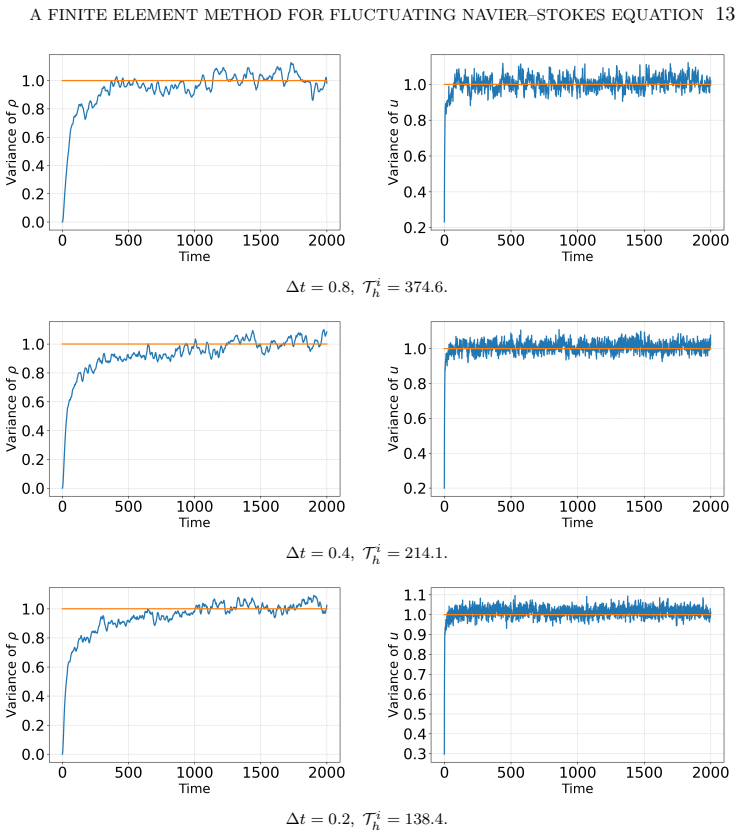
Run the scheme at successively finer meshes and check whether the computed variance of velocity fluctuations at equilibrium deviates from the expected continuum value; any systematic mesh-dependent deviation would falsify discrete balance preservation.
Figures





read the original abstract
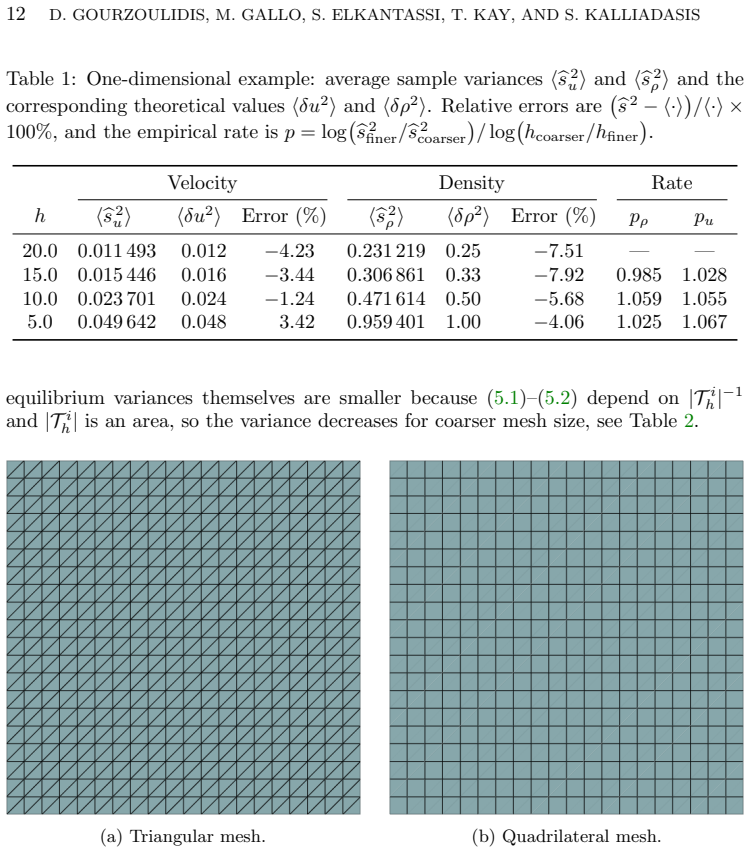
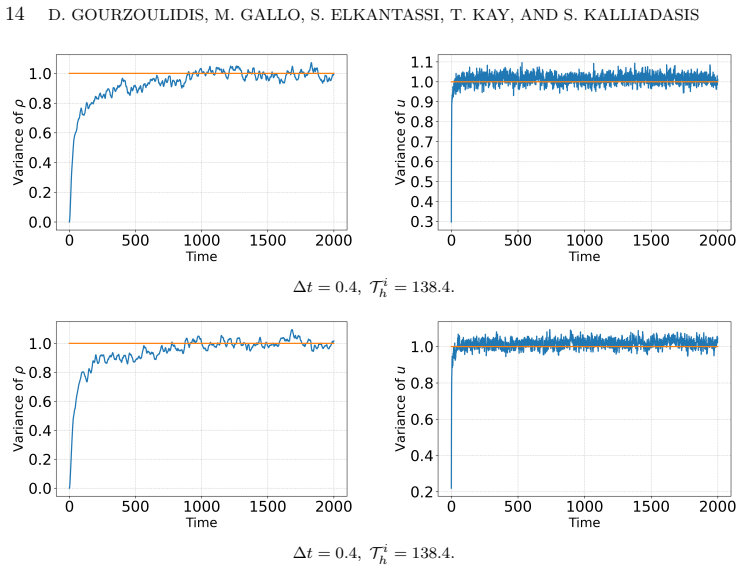
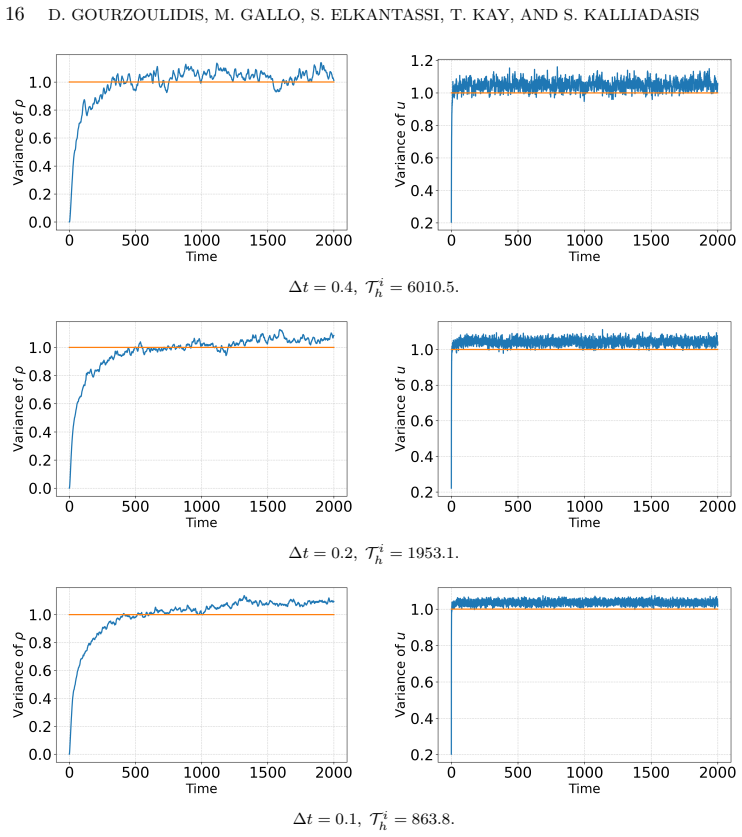
We introduce a finite-element framework for simulating thermal fluctuations in compressible fluids governed by the fluctuating Navier-Stokes equations. The method is designed to preserve the fundamental fluctuation-dissipation balance at the discrete level. This is achieved by defining the stochastic forcing term in the weak formulation, ensuring its covariance is proportional to the discrete viscous dissipation operator. A nodal quadrature rule is employed to eliminate unphysical mesh-scale correlations. The time integration is performed using the Crank-Nicolson scheme to maintain numerical stability and accuracy. The proposed approach is numerically validated in one, two, and three spatial dimensions, demonstrating its capability to correctly capture equilibrium fluctuation statistics across various discretisation parameters.
Editorial analysis
A structured set of objections, weighed in public.
Referee Report
Summary. The manuscript introduces a finite-element discretization of the compressible fluctuating Navier-Stokes equations. The central claim is that defining the stochastic forcing term directly in the weak formulation ensures its covariance is exactly proportional to the discrete viscous dissipation operator, thereby preserving the fluctuation-dissipation balance at the discrete level. A nodal quadrature rule is applied to remove unphysical mesh-scale correlations, Crank-Nicolson time stepping is used for stability, and the scheme is validated numerically in one, two, and three dimensions for correct equilibrium fluctuation statistics across discretization parameters.
Significance. If the preservation result holds exactly, the work supplies a structure-preserving spatial discretization for thermal fluctuations in hydrodynamics that is directly usable in mesoscale simulations. The explicit construction in the weak form and the multi-dimensional numerical tests constitute concrete strengths that would be valuable to the community if the quadrature step is shown to leave the required covariance relation intact.
major comments (2)
- [Abstract] Abstract: the claim that the nodal quadrature 'ensures its covariance is proportional to the discrete viscous dissipation operator' is load-bearing for the central result, yet the text supplies no argument that the quadrature commutes with or preserves the inner-product structure of the viscous bilinear form. Without an explicit demonstration (e.g., that the quadrature is exact on the relevant polynomial spaces or that the discrete operator remains symmetric positive-definite in the same inner product), the fluctuation-dissipation relation holds only approximately after quadrature.
- [Method description (weak-form section)] Method description (weak-form section): the paper must show that the stochastic forcing covariance, after nodal quadrature, remains exactly proportional to the discrete dissipation operator for arbitrary meshes and polynomial degrees. The current statement that quadrature eliminates mesh-scale correlations does not address whether the proportionality constant or the operator identity itself is altered by the point-wise evaluation.
minor comments (2)
- [Abstract] The abstract should state the polynomial degree and mesh regularity assumptions used in the 1D–3D tests so that readers can assess the range of validity.
- Notation for the discrete viscous operator and the stochastic covariance matrix should be introduced with an explicit equation number when first defined.
Simulated Author's Rebuttal
We thank the referee for the careful reading of the manuscript and for highlighting the importance of rigorously establishing the discrete fluctuation-dissipation balance after quadrature. We address the two major comments below and will revise the manuscript to incorporate the requested demonstrations.
read point-by-point responses
-
Referee: [Abstract] Abstract: the claim that the nodal quadrature 'ensures its covariance is proportional to the discrete viscous dissipation operator' is load-bearing for the central result, yet the text supplies no argument that the quadrature commutes with or preserves the inner-product structure of the viscous bilinear form. Without an explicit demonstration (e.g., that the quadrature is exact on the relevant polynomial spaces or that the discrete operator remains symmetric positive-definite in the same inner product), the fluctuation-dissipation relation holds only approximately after quadrature.
Authors: We agree that the abstract claim requires supporting argument and that the current text does not supply an explicit demonstration of preservation after quadrature. In the revised manuscript we will add a concise proof (or reference to an appendix) showing that the chosen nodal quadrature is exact on the polynomial spaces of the viscous bilinear form, thereby preserving symmetry and positive-definiteness in the discrete inner product and leaving the covariance exactly proportional to the discrete dissipation operator. revision: yes
-
Referee: [Method description (weak-form section)] Method description (weak-form section): the paper must show that the stochastic forcing covariance, after nodal quadrature, remains exactly proportional to the discrete dissipation operator for arbitrary meshes and polynomial degrees. The current statement that quadrature eliminates mesh-scale correlations does not address whether the proportionality constant or the operator identity itself is altered by the point-wise evaluation.
Authors: We accept that the method section must explicitly verify the exact proportionality after quadrature for arbitrary meshes and polynomial degrees. The revised weak-form section will contain a mathematical argument demonstrating that the nodal (point-wise) evaluation does not change the operator identity or the proportionality constant, because the same quadrature rule is applied consistently to both the stochastic covariance and the viscous dissipation terms, preserving the underlying discrete inner-product structure. revision: yes
Circularity Check
No significant circularity; preservation holds by explicit construction of the weak-form forcing
full rationale
The paper's central claim is that the fluctuation-dissipation balance is preserved at the discrete level because the stochastic forcing is defined in the weak formulation so that its covariance is proportional to the discrete viscous dissipation operator. This is a deliberate design choice in the discretization, not a derived result that reduces to its own inputs. No parameters are fitted to data and then re-predicted, no self-citations supply load-bearing uniqueness theorems, and the nodal quadrature is introduced as a practical device to remove mesh-scale artifacts rather than as a step that secretly redefines the main relation. The derivation chain is therefore self-contained as a standard construction for enforcing discrete FDT in finite-element methods for stochastic PDEs.
Axiom & Free-Parameter Ledger
axioms (1)
- domain assumption Standard assumptions of finite element approximation theory and the fluctuation-dissipation theorem from statistical mechanics.
Reference graph
Works this paper leans on
-
[1]
A finite element method for stochastic diffusion equations using fluctuating hydrodynamics , journal =. 2024 , issn =. doi:10.1016/j.jcp.2024.113098 , author =
-
[2]
de la Torre, J. A. and Español, Pep and Donev, Aleksandar , title =. The Journal of Chemical Physics , volume =. 2015 , month =
2015
-
[3]
, title =
Ciarlet, Philippe G. , title =. 2002 , doi =
2002
-
[4]
A positivity-preserving scheme for fluctuating hydrodynamics , journal =. 2022 , issn =. doi:10.1016/j.jcp.2022.111248 , author =
-
[5]
Finite element mass matrix lumping by numerical integration with no convergence rate loss , journal =. 1975 , issn =. doi:10.1016/0020-7683(75)90081-5 , author =
-
[6]
A finite-volume method for fluctuating dynamical density functional theory , journal =. 2021 , issn =. doi:10.1016/j.jcp.2020.109796 , author =
-
[7]
SIAM Journal on Numerical Analysis , volume =
Yan, Yubin , title =. SIAM Journal on Numerical Analysis , volume =. 2005 , doi =
2005
-
[8]
and Powell, Catherine E
Lord, Gabriel J. and Powell, Catherine E. and Shardlow, Tony , title =. 2014 , doi =
2014
-
[9]
and Dean, Joseph P
Baratta, Igor A. and Dean, Joseph P. and Dokken, J. 2023 , month = dec, note =
2023
-
[10]
and Dokken, J
Scroggs, Matthew W. and Dokken, J. ACM Transactions on Mathematical Software , year =
-
[11]
and Baratta, Igor A
Scroggs, Matthew W. and Baratta, Igor A. and Richardson, Chris N. and Wells, Garth N. , title =. Journal of Open Source Software , year =
-
[12]
ACM Transactions on Mathematical Software , year =
Aln. ACM Transactions on Mathematical Software , year =
-
[13]
Advances in Water Resources , year =
Dalcin, Lisandro and Kler, Pablo and Paz, Rodrigo and Cosimo, Alejandro , title =. Advances in Water Resources , year =
-
[14]
2025 , number =
Balay, Satish and Abhyankar, Shrirang and Adams, Mark and Benson, Steven and Brown, Jed and Brune, Peter and Buschelman, Kris and Constantinescu, Emil and Dalcin, Lisandro and Dener, Alp and Eijkhout, Victor and Faibussowitsch, Jacob and Gropp, William and Hapla, Victor and Isaac, Tobin and Jolivet, Pierre and Karpeyev, Dmitry and Kaushik, Dinesh and Knep...
2025
-
[15]
Heterogeneous bubble nucleation dynamics , volume=
Gallo, Mirko and Magaletti, Francesco and Casciola, Carlo Massimo , year=. Heterogeneous bubble nucleation dynamics , volume=. doi:10.1017/jfm.2020.761 , journal=
-
[16]
Instability, Rupture and Fluctuations in Thin Liquid Films: Theory and Computations , journal =
Dur. Instability, Rupture and Fluctuations in Thin Liquid Films: Theory and Computations , journal =. 2019 , month = feb, volume =. doi:10.1007/s10955-018-2200-0 , url =
-
[17]
doi:10.1126/sciadv.aav7399 , author =
How crystals form: A theory of nucleation pathways , journal =. doi:10.1126/sciadv.aav7399 , author =
-
[18]
Landau, L. D. and Lifshitz, E. M. , title =
-
[19]
and Delgado-Buscalioni, Rafael and Donev, Aleksandar and Fai, Thomas G
BalboaUsabiaga, Florencio and Bell, John B. and Delgado-Buscalioni, Rafael and Donev, Aleksandar and Fai, Thomas G. and Griffith, Boyce E. and Peskin, Charles S. , title =. Multiscale Modeling & Simulation , volume =. 2012 , doi =
2012
-
[20]
, title =
Donev, Aleksandar and Vanden-Eijnden, Eric and Garcia, Alejandro and Bell, John B. , title =. Communications in Applied Mathematics and Computational Science , volume =. 2010 , pages =
2010
-
[21]
and Garcia, Alejandro and Bell, John B
Donev, Aleksandar and Nonaka, Andrew and Sun, Yifei and Fai, Thomas G. and Garcia, Alejandro and Bell, John B. , title =. Communications in Applied Mathematics and Computational Science , volume =. 2014 , pages =
2014
-
[22]
Coupling a nano-particle with isothermal fluctuating hydrodynamics: Coarse-graining from microscopic to mesoscopic dynamics , journal =
Espa. Coupling a nano-particle with isothermal fluctuating hydrodynamics: Coarse-graining from microscopic to mesoscopic dynamics , journal =. 2015 , doi =
2015
-
[23]
Finite element formulation of fluctuating hydrodynamics for fluids filled with rigid particles using boundary fitted meshes , journal =. 2016 , issn =. doi:10.1016/j.jcp.2016.04.040 , author =
-
[24]
Numerical analysis of fully discrete finite element methods for the stochastic Navier-Stokes equations with multiplicative noise , journal =. 2021 , issn =. doi:10.1016/j.apnum.2021.07.018 , author =
-
[25]
, title =
Holm, Darryl D. , title =. Proceedings of the Royal Society A: Mathematical, Physical and Engineering Sciences , volume =. 2015 , month =
2015
-
[26]
Journal of Scientific Computing , year =
Feng, Xiaobing and Qiu, Hailong , title =. Journal of Scientific Computing , year =. doi:10.1007/s10915-021-01546-4 , issn =
-
[27]
Allen, M. P. and Tildesley, D. J. , title =
-
[28]
and Binder, Kurt , title =
Landau, David P. and Binder, Kurt , title =. 2014 , edition =
2014
-
[29]
Journal of Computational Physics , volume =
Ren, Weiqing and E, Weinan , title =. Journal of Computational Physics , volume =. 2005 , doi =
2005
-
[30]
Frenkel, Daan and Smit, Berend , title =
-
[31]
Nature Communications , volume=
A nanoscale view of the origin of boiling and its dynamics , author=. Nature Communications , volume=. 2023 , publisher=
2023
-
[32]
International Journal of Multiphase Flow , volume=
Vapor bubble nucleation in flowing liquids , author=. International Journal of Multiphase Flow , volume=. 2024 , publisher=
2024
-
[33]
Journal of fluid mechanics , volume=
Complex transition pathways in boiling and cavitation , author=. Journal of fluid mechanics , volume=. 2025 , publisher=
2025
-
[34]
Physical Review Research , volume=
Nanodroplet condensation on solid surfaces , author=. Physical Review Research , volume=. 2025 , publisher=
2025
-
[35]
Proceedings of the National Academy of Sciences , volume=
Fluctuating hydrodynamics and the Rayleigh--Plateau instability , author=. Proceedings of the National Academy of Sciences , volume=. 2023 , publisher=
2023
-
[36]
Physical Review E , volume=
Dissipation-range fluid turbulence and thermal noise , author=. Physical Review E , volume=. 2022 , publisher=
2022
-
[37]
Journal of fluid mechanics , volume=
Thermal fluctuations in the dissipation range of homogeneous isotropic turbulence , author=. Journal of fluid mechanics , volume=. 2022 , publisher=
2022
-
[38]
Nature , volume=
Giant fluctuations in a free diffusion process , author=. Nature , volume=. 1997 , publisher=
1997
-
[39]
Journal of Statistical Mechanics: Theory and Experiment , volume=
A reversible mesoscopic model of diffusion in liquids: from giant fluctuations to Fick’s law , author=. Journal of Statistical Mechanics: Theory and Experiment , volume=. 2014 , publisher=
2014
-
[40]
Physical Review E , volume=
Nonequilibrium fluctuations in time-dependent diffusion processes , author=. Physical Review E , volume=. 1998 , publisher=
1998
-
[41]
Annales Henri Poincar
The Kraichnan model and non-equilibrium statistical physics of diffusive mixing , author=. Annales Henri Poincar. 2024 , organization=
2024
-
[42]
Physical Review Research , volume=
High Schmidt-number turbulent advection and giant concentration fluctuations , author=. Physical Review Research , volume=. 2022 , publisher=
2022
-
[43]
The Journal of chemical physics , volume=
Emergence of long-range non-equilibrium correlations in free liquid diffusion , author=. The Journal of chemical physics , volume=. 2025 , publisher=
2025
-
[44]
Physical review letters , volume=
Spontaneous stochasticity amplifies even thermal noise to the largest scales of turbulence in a few eddy turnover times , author=. Physical review letters , volume=. 2024 , publisher=
2024
-
[45]
Communications in Applied Mathematics and Computational Science , volume=
On the accuracy of finite-volume schemes for fluctuating hydrodynamics , author=. Communications in Applied Mathematics and Computational Science , volume=. 2010 , publisher=
2010
-
[46]
Multiscale Modeling & Simulation , volume=
Staggered schemes for fluctuating hydrodynamics , author=. Multiscale Modeling & Simulation , volume=. 2012 , publisher=
2012
-
[47]
Physics of Fluids , volume=
Thermal fluctuations in metastable fluids , author=. Physics of Fluids , volume=. 2022 , publisher=
2022
-
[48]
Contributions to non-equilibrium thermodynamics. I. Theory of hydrodynamical fluctuations , author=. The Physics of Fluids , volume=. 1970 , publisher=
1970
-
[49]
arXiv preprint arXiv:1805.09331 , year=
Lectures on non-equilibrium effective field theories and fluctuating hydrodynamics , author=. arXiv preprint arXiv:1805.09331 , year=
-
[50]
2006 , publisher=
Hydrodynamic fluctuations in fluids and fluid mixtures , author=. 2006 , publisher=
2006
-
[51]
Physical Review Research , volume=
Non-Gaussian statistics of concentration fluctuations in free liquid diffusion , author=. Physical Review Research , volume=. 2026 , publisher=
2026
-
[52]
Physical Review Fluids , volume=
Thermally activated vapor bubble nucleation: The Landau-Lifshitz--Van der Waals approach , author=. Physical Review Fluids , volume=. 2018 , publisher=
2018
-
[53]
A nonnegativity-preserving finite element method for a class of parabolic SPDEs with multiplicative noise , journal =
Djurdjevac, Ana and Le Bris, Claude and S. A nonnegativity-preserving finite element method for a class of parabolic SPDEs with multiplicative noise , journal =. 2026 , date =
2026
discussion (0)
Sign in with ORCID, Apple, or X to comment. Anyone can read and Pith papers without signing in.