Excitonic-Superconducting Coexistence and Emergent Nematic Superconductivity Driven by Spontaneous Symmetry Breaking
Pith reviewed 2026-06-28 12:28 UTC · model grok-4.3
The pith
An intrinsic mismatch between electron and hole Fermi surfaces enables coexistence of excitonic insulating and superconducting orders and drives spontaneous nematic superconductivity.
A machine-rendered reading of the paper's core claim, the machinery that carries it, and where it could break.
Core claim
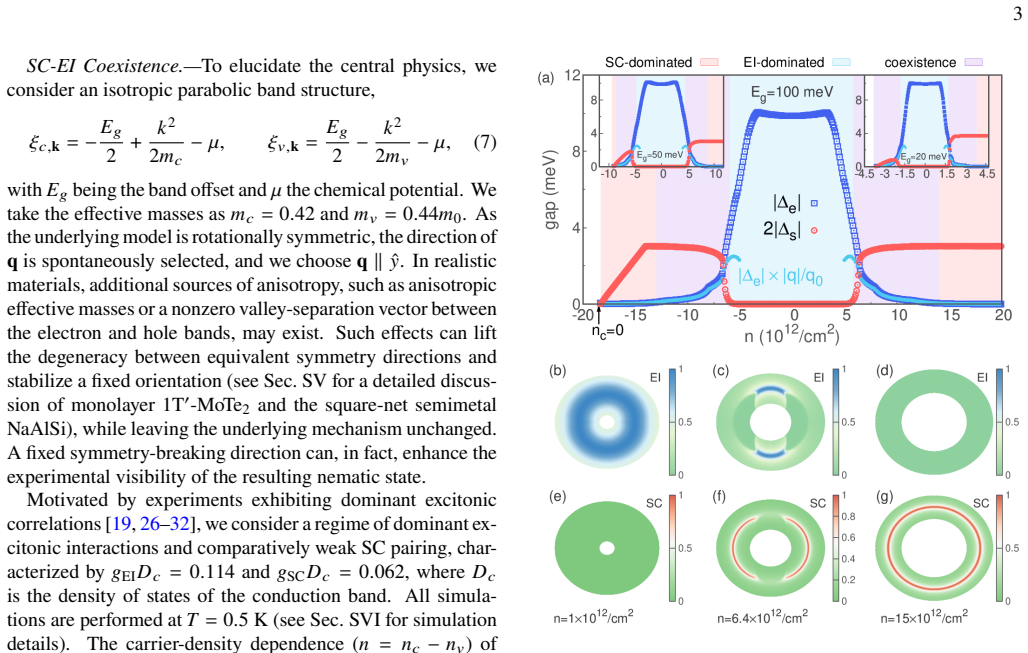
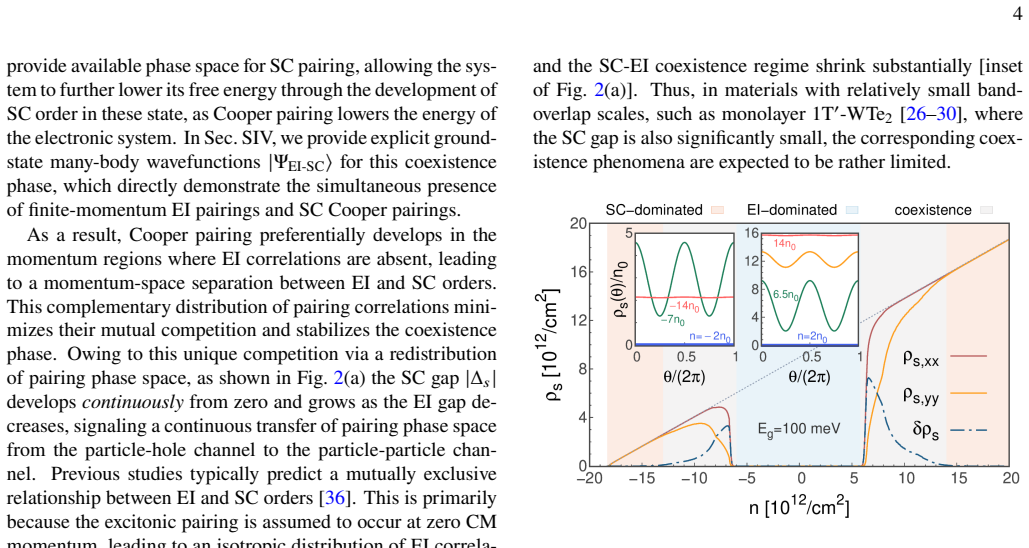
An intrinsic mismatch between electron and hole Fermi surfaces fundamentally reshapes the competition between excitonic insulating and superconducting orders by stabilizing FFLO-like electron-hole pairing and driving spontaneous symmetry breaking of the EI state. The resulting symmetry breaking reconstructs the pairing phase space such that different regions of the Fermi surface complementarily support either EI or SC correlations, leading to their natural coexistence. The emergent SC state breaks rotational symmetry and develops intrinsic nematic superconductivity even without explicit symmetry-breaking fields.
What carries the argument
The intrinsic mismatch between electron and hole Fermi surfaces, which stabilizes FFLO-like electron-hole pairing and drives spontaneous symmetry breaking of the EI state to reconstruct pairing phase space.
If this is right
- EI and SC orders coexist naturally because different Fermi surface regions complementarily support each order.
- The emergent superconducting state spontaneously breaks rotational symmetry to become nematic.
- This occurs even without magnetic fields, spin-orbit coupling, or bare band-structure anisotropy.
- Monolayer 1T'-MoTe2 and the square-net semimetal NaAlSi are candidate platforms where the coexistence and nematicity should appear.
Where Pith is reading between the lines
- Competing orders may generate spontaneous electronic nematicity across a broader range of correlated quantum materials.
- The same Fermi-surface mismatch mechanism could be searched for in other semimetals that host electron and hole pockets.
- Device concepts that rely on anisotropic transport or pairing might exploit this intrinsic route to nematicity.
Load-bearing premise
The self-consistent microscopic theory accurately captures the effects of the intrinsic Fermi surface mismatch on the competition between EI and SC orders without additional explicit symmetry-breaking terms.
What would settle it
Observation of rotational symmetry breaking in the superconducting state of monolayer 1T'-MoTe2 or NaAlSi in the complete absence of applied magnetic fields, spin-orbit coupling, or band anisotropy.
Figures

read the original abstract
Excitonic insulating (EI) and superconducting (SC) orders are generally regarded as mutually exclusive electronic instabilities. Within a self-consistent microscopic theory, we study electronic systems hosting an EI phase in the presence of SC pairing and show that an intrinsic mismatch between electron and hole Fermi surfaces fundamentally reshapes this competition. This mismatch stabilizes FFLO-like electron-hole pairing and drives spontaneous symmetry breaking of the EI state. The resulting symmetry breaking reconstructs the pairing phase space for SC and EI state, such that different regions of the Fermi surface complementarily support either EI or SC correlations, leading to a natural coexistence of the two orders. Notably, the emergent SC state consequently breaks rotational symmetry and develops intrinsic nematic superconductivity, even in the absence of explicit symmetry-breaking fields (such as magnetic fields, spin-orbit coupling, or bare band-structure anisotropy). Our results suggest that candidate materials such as monolayer 1T$'$-MoTe$_2$ and the square-net semimetal NaAlSi may provide promising platforms for observing this phenomenon. More broadly, these findings reveal a unique mechanism by which competing many-body orders generate electronic nematicity, suggesting a broader route toward spontaneous anisotropic electronic states in correlated quantum materials.
Editorial analysis
A structured set of objections, weighed in public.
Referee Report
Summary. The manuscript develops a self-consistent microscopic theory for systems hosting both excitonic insulating (EI) and superconducting (SC) orders. It claims that an intrinsic mismatch between electron and hole Fermi surfaces stabilizes FFLO-like electron-hole pairing, drives spontaneous symmetry breaking of the EI state, reconstructs the pairing phase space to allow natural coexistence of EI and SC on complementary Fermi-surface regions, and produces emergent nematic superconductivity without explicit symmetry-breaking fields. Candidate materials (monolayer 1T'-MoTe2, NaAlSi) are identified.
Significance. If the derivations are internally consistent and the Hamiltonian is shown to remain fully rotationally invariant, the work would identify a mechanism by which Fermi-surface mismatch alone generates spontaneous nematicity from competing orders, with direct relevance to semimetal platforms.
major comments (2)
- [Abstract; model construction] Abstract and model section: The central claim that nematic SC emerges 'even in the absence of explicit symmetry-breaking fields' requires explicit verification that the single-particle dispersions and interaction terms remain fully rotationally invariant while still producing unequal electron-hole Fermi surfaces. Any directional dependence in band parameters or cutoffs would constitute an implicit breaking term that seeds the observed anisotropy, undermining the spontaneous character of the symmetry breaking.
- [Abstract; results] Results on symmetry breaking and coexistence: The reconstruction of pairing phase space and the emergence of nematic SC are asserted to follow from the self-consistent solution, yet the abstract supplies no equations, order-parameter definitions, or numerical validation steps. Without these, it is impossible to confirm that the reported coexistence and nematic order are independent of fitted parameters or implicit anisotropies.
Simulated Author's Rebuttal
We thank the referee for their detailed reading and valuable feedback on our manuscript. We address each major comment below with clarifications on the model construction and results. We believe the central claims hold under a fully rotationally invariant setup, but we will incorporate explicit verifications where helpful.
read point-by-point responses
-
Referee: [Abstract; model construction] Abstract and model section: The central claim that nematic SC emerges 'even in the absence of explicit symmetry-breaking fields' requires explicit verification that the single-particle dispersions and interaction terms remain fully rotationally invariant while still producing unequal electron-hole Fermi surfaces. Any directional dependence in band parameters or cutoffs would constitute an implicit breaking term that seeds the observed anisotropy, undermining the spontaneous character of the symmetry breaking.
Authors: The model employs isotropic parabolic dispersions for electrons and holes with different effective masses (or chemical potentials) that produce a radial Fermi-surface mismatch while preserving full rotational invariance in both the kinetic term and the interaction Hamiltonian. No angular dependence is introduced in the band parameters, cutoffs, or coupling constants. The spontaneous symmetry breaking and nematic SC then arise purely from the self-consistent solution of the coupled EI-SC gap equations under this mismatch. We will add an explicit paragraph in the revised model section (and a footnote in the abstract) confirming the rotational invariance of all terms and noting that the mismatch is purely radial. revision: yes
-
Referee: [Abstract; results] Results on symmetry breaking and coexistence: The reconstruction of pairing phase space and the emergence of nematic SC are asserted to follow from the self-consistent solution, yet the abstract supplies no equations, order-parameter definitions, or numerical validation steps. Without these, it is impossible to confirm that the reported coexistence and nematic order are independent of fitted parameters or implicit anisotropies.
Authors: Abstracts are by design concise and omit technical details; the full manuscript (Sections II–IV) defines the order parameters (EI and SC gaps with FFLO modulation), presents the self-consistent equations, and shows numerical solutions demonstrating coexistence on complementary Fermi-surface arcs and spontaneous nematicity. The results are obtained from a parameter-free minimization once the mismatch ratio is fixed by the band masses, and multiple initial conditions converge to the same nematic state. We will expand the abstract by one sentence to reference the key equations and the numerical procedure, while keeping it within length limits. revision: partial
Circularity Check
No circularity: self-consistent mean-field treatment of intrinsic FS mismatch yields spontaneous breaking without reduction to inputs
full rationale
The provided abstract and context describe a standard self-consistent microscopic theory in which an intrinsic electron-hole Fermi surface mismatch (different sizes/shapes but no explicit anisotropy) stabilizes FFLO-like pairing and drives spontaneous EI symmetry breaking. This reconstructs the phase space leading to coexistence and emergent nematic SC. No equations, fitted parameters, or self-citations are shown that would make any labeled prediction equivalent to its inputs by construction. The mismatch is presented as a model input that remains rotationally invariant while producing unequal FS, and the nematicity emerges spontaneously from the equations rather than being smuggled in. This matches the default expectation of a non-circular derivation; the reader's 3.0 score reflects absence of displayed equations rather than any exhibited reduction.
Axiom & Free-Parameter Ledger
Reference graph
Works this paper leans on
-
[1]
Bardeen, L
J. Bardeen, L. N. Cooper, and J. R. Schrieffer, Theory of super- conductivity, Phys. Rev.108, 1175 (1957)
1957
-
[4]
A. A. Abrikosov, L. P. Gorkov, and I. E. Dzyaloshinski,Methods of quantum field theory in statistical physics(Courier Corpora- tion, 2012)
2012
-
[5]
G. D. Mahan,Many-particle physics(Springer Science & Busi- ness Media, 2013)
2013
-
[8]
B. I. Halperin and T. M. Rice, Possible anomalies at a semimetal- semiconductor transistion, Rev. Mod. Phys.40, 755 (1968)
1968
-
[9]
Dong and Y
S. Dong and Y. Li, Excitonic instability and electronic properties of alsb in the two-dimensional limit, Phys. Rev. B104, 085133 (2021)
2021
-
[10]
Grudinina, M
A. Grudinina, M. Efthymiou-Tsironi, V. Ardizzone, F. Rimin- ucci, M. De Giorgi, D. Trypogeorgos, K. Baldwin, L. Pfeiffer, D. Ballarini, D. Sanvitto, and N. Voronova, Collective excita- tions of a bound-in-the-continuum condensate, Nat. Commun. 14, 3464 (2023)
2023
-
[11]
L. Du, X. Li, W. Lou, G. Sullivan, K. Chang, J. Kono, and R.-R. Du, Evidence for a topological excitonic insulator in InAs/GaSb bilayers, Nat. Commun.8, 1971 (2017)
1971
-
[12]
Y. F. Lu, H. Kono, T. I. Larkin, A. W. Rost, T. Takayama, A. V. Boris, B. Keimer, and H. Takagi, Zero-gap semiconductor to excitonic insulator transition in Ta2NiSe5, Nat. Commun.8, 14408 (2017)
2017
-
[14]
Bi and L
Z. Bi and L. Fu, Excitonic density wave and spin-valley super- fluid in bilayer transition metal dichalcogenide, Nat. Commun. 12, 642 (2021)
2021
-
[15]
Y. Jia, P. Wang, C.-L. Chiu, Z. Song, G. Yu, B. J ¨ack, S. Lei, S. Klemenz, F. A. Cevallos, M. Onyszczak, N. Fishchenko, X. Liu, G. Farahi, F. Xie, Y. Xu, K. Watanabe, T. Taniguchi, B. A. Bernevig, R. J. Cava, L. M. Schoop, A. Yazdani, and S. Wu, Evidence for a monolayer excitonic insulator, Nat. Phys. 18, 87 (2022)
2022
-
[16]
B. Sun, W. Zhao, T. Palomaki, Z. Fei, E. Runburg, P. Mali- nowski, X. Huang, J. Cenker, Y.-T. Cui, J.-H. Chu, X. Xu, S. S. Ataei, D. Varsano, M. Palummo, E. Molinari, M. Rontani, and D. H. Cobden, Evidence for equilibrium exciton condensation in monolayer WTe2, Nat. Phys.18, 94 (2022)
2022
-
[17]
C. Zhao, M. Hu, J. Qin, B. Xia, C. Liu, S. Wang, D. Guan, Y. Li, H. Zheng, J. Liu, and J. Jia, Strain Tunable Semimetal– Topological-Insulator Transition in Monolayer 1T’-WTe2, Phys. Rev. Lett.125, 046801 (2020)
2020
-
[18]
Varsano, M
D. Varsano, M. Palummo, E. Molinari, and M. Rontani, A mono- layer transition-metal dichalcogenide as a topological excitonic insulator, Nat. Nanotechnol.15, 367 (2020)
2020
-
[20]
H. Guo, X. Zhang, and G. Lu, Pseudo-heterostructure and con- densation of 1D moir´e excitons in twisted phosphorene bilayers, Sci. Adv.9, eadi5404 (2023)
2023
-
[21]
K. Tran, G. Moody, F. Wu, X. Lu, J. Choi, K. Kim, A. Rai, D. A. 6 Sanchez, J. Quan, A. Singh, J. Embley, A. Zepeda, M. Camp- bell, T. Autry, T. Taniguchi, K. Watanabe, N. Lu, S. K. Banerjee, K. L. Silverman, S. Kim, E. Tutuc, L. Yang, A. H. MacDon- ald, and X. Li, Evidence for moir ´e excitons in van der waals heterostructures, Nature567, 71 (2019)
2019
-
[22]
E. C. Regan, D. Wang, C. Jin, M. I. Bakti Utama, B. Gao, X. Wei, S. Zhao, W. Zhao, Z. Zhang, K. Yumigeta, M. Blei, J. D. Carlstr¨om, K. Watanabe, T. Taniguchi, S. Tongay, M. Crommie, A. Zettl, and F. Wang, Mott and generalized wigner crystal states in WSe2/WS2 moir´e superlattices, Nature579, 359 (2020)
2020
-
[23]
F. Wu, T. Lovorn, and A. H. MacDonald, Topological exciton bands in moir ´e heterojunctions, Phys. Rev. Lett.118, 147401 (2017)
2017
-
[24]
F. Wu, T. Lovorn, E. Tutuc, and A. H. MacDonald, Hubbard model physics in transition metal dichalcogenide moir ´e bands, Phys. Rev. Lett.121, 026402 (2018)
2018
-
[25]
C. J. Butler, T. Ikenobe, M.-C. Jiang, D. Hirai, T. Yamada, G.-Y. Guo, R. Arita, T. Hanaguri, and Z. Hiroi, Coexisting Electronic Smectic Liquid Crystal and Superconductivity in a Si Square- Net Semimetal, Phys. Rev. Lett.136, 076001 (2026)
2026
-
[26]
T. Song, Y. Jia, G. Yu, Y. Tang, P. Wang, R. Singha, X. Gui, A. J. Uzan-Narovlansky, M. Onyszczak, K. Watanabe, T. Taniguchi, R. J. Cava, L. M. Schoop, N. P. Ong, and S. Wu, Unconventional superconducting quantum criticality in monolayer WTe 2, Nat. Phys.20, 269 (2024)
2024
-
[27]
T. Song, Y. Jia, G. Yu, Y. Tang, A. J. Uzan, Z. J. Zheng, H. Guan, M. Onyszczak, R. Singha, X. Gui, K. Watanabe, T. Taniguchi, R. J. Cava, L. M. Schoop, N. P. Ong, and S. Wu, Unconventional superconducting phase diagram of monolayer WTe2, Phys. Rev. Res.7, 013224 (2025)
2025
-
[28]
F. Yang, G. D. Zhao, Y. Shi, and L. Q. Chen, Microscopic phase-transition framework for gate-tunable superconductivity in monolayer WTe 2, Phys. Rev. B113, L100501 (2026)
2026
-
[29]
Fatemi, S
V. Fatemi, S. Wu, Y. Cao, L. Bretheau, Q. D. Gibson, K. Watan- abe, T. Taniguchi, R. J. Cava, and P. Jarillo-Herrero, Electrically tunable low-density superconductivity in a monolayer topolog- ical insulator, Science362, 926 (2018)
2018
-
[30]
Sajadi, T
E. Sajadi, T. Palomaki, Z. Fei, W. Zhao, P. Bement, C. Olsen, S. Luescher, X. Xu, J. A. Folk, and D. H. Cobden, Gate-induced superconductivity in a monolayer topological insulator, Science 362, 922 (2018)
2018
-
[31]
D. A. Rhodes, A. Jindal, N. F. Q. Yuan, Y. Jung, A. Antony, H. Wang, B. Kim, Y.-c. Chiu, T. Taniguchi, K. Watanabe, K. Bar- mak, L. Balicas, C. R. Dean, X. Qian, L. Fu, A. N. Pasupathy, and J. Hone, Enhanced superconductivity in monolayer𝑇 𝑑-MoTe2, Nano Lett.21, 2505 (2021)
2021
-
[33]
H. B. Rhee, S. Banerjee, E. R. Ylvisaker, and W. E. Pickett, Naalsi: Self-doped semimetallic superconductor with free elec- trons and covalent holes, Phys. Rev. B81, 245114 (2010)
2010
-
[34]
Yamada, D
T. Yamada, D. Hirai, H. Yamane, and Z. Hiroi, Superconduc- tivity in the topological nodal-line semimetal NaAlSi, J. Phys. Soc. Jpn.90, 034710 (2021)
2021
-
[35]
Zhong, Z
R. Zhong, Z. Yang, Q. Wang, F. Zheng, W. Li, J. Wu, C. Wen, X. Chen, Y. Qi, and S. Yan, Spatially dependent in-gap states induced by andreev tunneling through a single electronic state, Nano Lett.24, 8580 (2024)
2024
-
[37]
Larkin and Y
A. Larkin and Y. N. Ovchinnikov, Nonuniform state of super- conductors, JETP20, 762 (1965)
1965
-
[38]
Fulde and R
P. Fulde and R. A. Ferrell, Superconductivity in a strong spin- exchange field, Phys. Rev.135, A550 (1964)
1964
-
[39]
Hoyer and J
M. Hoyer and J. Schmalian, Role of fluctuations for density- wave instabilities: Failure of the mean-field description, Phys. Rev. B97, 224423 (2018)
2018
-
[40]
T. M. Rice and G. K. Scott, New mechanism for a charge- density-wave instability, Phys. Rev. Lett.35, 120 (1975)
1975
-
[42]
Gr¨ uner and A
G. Gr¨ uner and A. Zettl, Charge density wave conduction: A novel collective transport phenomenon in solids, Physics Re- ports119, 117 (1985)
1985
-
[43]
Yang and M
F. Yang and M. W. Wu, Fulde–Ferrell state in spin–orbit-coupled superconductor: Application to Dresselhaus SOC, J. Low Temp. Phys.192, 241 (2018)
2018
-
[45]
Y. Xu, C. Qu, M. Gong, and C. Zhang, Competing superfluid or- ders in spin-orbit-coupled fermionic cold-atom optical lattices, Phys. Rev. A89, 013607 (2014)
2014
-
[46]
Barzykin and L
V. Barzykin and L. P. Gor’kov, Inhomogeneous stripe phase re- visited for surface superconductivity, Phys. Rev. Lett.89, 227002 (2002)
2002
-
[47]
Dimitrova and M
O. Dimitrova and M. V. Feigel’man, Theory of a two- dimensional superconductor with broken inversion symmetry, Phys. Rev. B76, 014522 (2007)
2007
-
[50]
Yang and L
F. Yang and L. Q. Chen, Altermagnetism-induced noncollinear superconducting diode effect and unidirectional superconduct- ing transport, Phys. Rev. B112, L220502 (2025)
2025
-
[51]
In conventional zero-qEI theories [14], the EI gap is strongest when electron-hole pairing is perfectly matched, and remains approximately constant upon weak tuning of the chemical poten- tial due to the robustness of the zero-CM-momentum condensate against small Fermi-surface mismatch. Once the electron or hole doping exceeds a critical value, however, t...
-
[52]
Candolfi, M
C. Candolfi, M. M ´ıˇsek, P. Gougeon, R. Al Rahal Al Orabi, P. Gall, R. Gautier, S. Migot, J. Ghanbaja, J. c. v. Ka ˇstil, P. Levinsk´ y, J. c. v. Hejtm´anek, A. Dauscher, B. Malaman, and B. Lenoir, Coexistence of a charge density wave and super- conductivity in the cluster compound K 2Mo15Se19, Phys. Rev. B101, 134521 (2020)
2020
-
[53]
C. A. Balseiro and L. M. Falicov, Superconductivity and charge- density waves, Phys. Rev. B20, 4457 (1979)
1979
-
[54]
Jaefari, S
A. Jaefari, S. Lal, and E. Fradkin, Charge-density wave and su- perconductor competition in stripe phases of high-temperature superconductors, Phys. Rev. B82, 144531 (2010)
2010
-
[55]
C.-W. Chen, J. Choe, and E. Morosan, Charge density waves in strongly correlated electron systems, Rep. Prog. Phys.79, 084505 (2016). Excitonic-Superconducting Coexistence and Emergent Nematic Superconductivity Driven by Spontaneous Symmetry Breaking (Supplemental Materials) Fei Yang,1 Ruigang Li, 2 Junwei Liu, 1,∗ and Binghai Yan 3, 4,† 1Department of Ph...
2016
-
[56]
Real-space structure of possible density waves 13
Direct and Exchange Coulomb Interactions 13 C. Real-space structure of possible density waves 13
-
[57]
Analysis of the excitonic charge-density-wave (CDW) order 13
-
[58]
Superconducting nematicity and significant anisotropy ratio 15 SVII
Possible valley-structure-induced superconducting PDW-like gap modulations 14 SVI. Superconducting nematicity and significant anisotropy ratio 15 SVII. Simulation details 16 References 17 SI. Derivation of the gap equations In this section, we give the explicit derivation of the superconducting and excitonic gap equations. We start from the mean-field Ham...
-
[59]
Direct and Exchange Coulomb Interactions In general, the interband Coulomb interaction can be separated into direct and exchange contributions, 𝐻𝑐𝑣 =𝐻 dir 𝑐𝑣 +𝐻 ex 𝑐𝑣 ,(S92) where the conduction-band electrons are centered around the𝐾valley, while the valence-band electrons are centered around the inequivalent𝐾 ′ valley [Fig. SI]. The direct Coulomb inter...
-
[60]
In this situation, the excitonic order does not merely carry a small residual momentum, but also contains the large intervalley momentum connecting the two band extrema
Analysis of the excitonic charge-density-wave (CDW) order Here we analyze the structure of the excitonic charge-density-wave (CDW) order when the conduction and valence bands are centered at different valleys. In this situation, the excitonic order does not merely carry a small residual momentum, but also contains the large intervalley momentum connecting...
-
[61]
Possible valley-structure-induced superconducting PDW-like gap modulations As discussed in Sec. SIV C, the superconducting pairing considered in the present work does not correspond to an FFLO superconducting state, since the Cooper pairing always occurs between time-reversal-related conduction-band states and therefore 15 carries zero center-of-mass mome...
-
[62]
A. A. Abrikosov, L. P. Gorkov, and I. E. Dzyaloshinski,Methods of quantum field theory in statistical physics(Courier Corporation, 2012). 18
2012
-
[63]
Schrieffer,Theory of Superconductivity(W.A
J. Schrieffer,Theory of Superconductivity(W.A. Benjamin, 1964)
1964
-
[64]
Tinkham,Introduction to superconductivity, Vol
M. Tinkham,Introduction to superconductivity, Vol. 1 (Courier Corporation, 2004)
2004
-
[65]
F. Yang, G. D. Zhao, Y. Shi, and L. Q. Chen, Microscopic phase-transition framework for gate-tunable superconductivity in monolayer WTe2, Phys. Rev. B113, L100501 (2026)
2026
-
[66]
Yang and L
F. Yang and L. Q. Chen, Microscopic phase-transition theory of charge density waves: Revealing hidden crossovers of phason and amplitudon, Phys. Rev. Lett.136, 146503 (2026)
2026
-
[67]
F. Yang, Y. Shi, and L.-Q. Chen, Preformed cooper pairing and the uncondensed normal-state component in phase-fluctuating monolayer cuprate superconductivity, Phys. Rev. B113, 104523 (2026)
2026
-
[68]
Yang and L
F. Yang and L. Q. Chen, Tractable framework for phase transitions in phase-fluctuating disordered two-dimensional superconductors: Applications to bilayer mos2 and disordered ino𝑥 thin films, Phys. Rev. B113, 094517 (2026)
2026
-
[69]
Bardeen, L
J. Bardeen, L. N. Cooper, and J. R. Schrieffer, Theory of superconductivity, Phys. Rev.108, 1175 (1957)
1957
-
[70]
G. D. Mahan,Many-particle physics(Springer Science & Business Media, 2013)
2013
-
[71]
J ´erome, T
D. J ´erome, T. M. Rice, and W. Kohn, Excitonic insulator, Phys. Rev.158, 462 (1967)
1967
-
[72]
Kohn, Excitonic phases, Phys
W. Kohn, Excitonic phases, Phys. Rev. Lett.19, 439 (1967)
1967
-
[73]
B. I. Halperin and T. M. Rice, Possible anomalies at a semimetal-semiconductor transistion, Rev. Mod. Phys.40, 755 (1968)
1968
-
[74]
M. V. Mostovoy, F. M. Marchetti, B. D. Simons, and P. B. Littlewood, Effects of disorder on coexistence and competition between superconducting and insulating states, Phys. Rev. B71, 224502 (2005)
2005
-
[75]
Bi and L
Z. Bi and L. Fu, Excitonic density wave and spin-valley superfluid in bilayer transition metal dichalcogenide, Nat. Commun.12, 642 (2021)
2021
-
[76]
Larkin and Y
A. Larkin and Y. N. Ovchinnikov, Nonuniform state of superconductors, JETP20, 762 (1965)
1965
-
[77]
Fulde and R
P. Fulde and R. A. Ferrell, Superconductivity in a strong spin-exchange field, Phys. Rev.135, A550 (1964)
1964
-
[78]
Yang and M
F. Yang and M. W. Wu, Fulde–Ferrell state in spin–orbit-coupled superconductor: Application to Dresselhaus SOC, J. Low Temp. Phys. 192, 241 (2018)
2018
-
[79]
L. Dong, L. Jiang, and H. Pu, Fulde–ferrell pairing instability in spin–orbit coupled fermi gas, New J. Phys.15, 075014 (2013)
2013
-
[80]
Y. Xu, C. Qu, M. Gong, and C. Zhang, Competing superfluid orders in spin-orbit-coupled fermionic cold-atom optical lattices, Phys. Rev. A89, 013607 (2014)
2014
-
[81]
Barzykin and L
V. Barzykin and L. P. Gor’kov, Inhomogeneous stripe phase revisited for surface superconductivity, Phys. Rev. Lett.89, 227002 (2002)
2002
-
[82]
Dimitrova and M
O. Dimitrova and M. V. Feigel’man, Theory of a two-dimensional superconductor with broken inversion symmetry, Phys. Rev. B76, 014522 (2007)
2007
-
[83]
D. F. Agterberg and R. P. Kaur, Magnetic-field-induced helical and stripe phases in Rashba superconductors, Phys. Rev. B75, 064511 (2007)
2007
-
[84]
Xu and C
Y. Xu and C. Zhang, Berezinskii-Kosterlitz-Thouless Phase Transition in 2D Spin-Orbit-Coupled Fulde-Ferrell Superfluids, Phys. Rev. Lett.114, 110401 (2015)
2015
-
[85]
Yang and L
F. Yang and L. Q. Chen, Altermagnetism-induced noncollinear superconducting diode effect and unidirectional superconducting transport, Phys. Rev. B112, L220502 (2025)
2025
-
[86]
Yang and M
F. Yang and M. W. Wu, Gauge-invariant microscopic kinetic theory of superconductivity in response to electromagnetic fields, Phys. Rev. B98, 094507 (2018)
2018
-
[87]
Yang and M
F. Yang and M. W. Wu, Impurity scattering in superconductors revisited: Diagrammatic formulation of the supercurrent-supercurrent correlation and higgs-mode damping, Phys. Rev. B106, 144509 (2022)
2022
-
[88]
Nambu, Nobel lecture: Spontaneous symmetry breaking in particle physics: A case of cross fertilization, Rev
Y. Nambu, Nobel lecture: Spontaneous symmetry breaking in particle physics: A case of cross fertilization, Rev. Mod. Phys.81, 1015 (2009)
2009
-
[89]
Nambu, Quasi-particles and gauge invariance in the theory of superconductivity, Phys
Y. Nambu, Quasi-particles and gauge invariance in the theory of superconductivity, Phys. Rev.117, 648 (1960)
1960
-
[90]
Yang and M
F. Yang and M. W. Wu, Gauge-invariant microscopic kinetic theory of superconductivity: Application to the optical response of nambu- goldstone and higgs modes, Phys. Rev. B100, 104513 (2019)
2019
-
[91]
Ambegaokar and L
V. Ambegaokar and L. P. Kadanoff, Electromagnetic properties of superconductors, Il Nuovo Cimento22, 914 (1961)
1961
-
[92]
P. B. Littlewood and C. M. Varma, Gauge-invariant theory of the dynamical interaction of charge density waves and superconductivity, Phys. Rev. Lett.47, 811 (1981)
1981
discussion (0)
Sign in with ORCID, Apple, or X to comment. Anyone can read and Pith papers without signing in.