REVIEW 3 major objections 5 minor 1 cited by
Automated Detection of Sport Highlights from Audio and Video Sources
T0 review · 3 major / 5 minor · reviewed 2026-08-10 · deepseek-v4-flash
Pith's one-line read The paper claims that a small ensemble of two 2D CNNs—one on audio Mel-spectrograms, one on stacked greyscale frames—detects football highlights at about 89% audio and 83% video test accuracy, and that averaging the two streams cuts false…
desk verdict A readable, honest industry report on a small-data highlight detection recipe, but the ensemble improvement it claims is never measured. read the letter →
The pith
A machine-rendered reading of the paper's core claim, the machinery that carries it, and where it could break.
The reading
What carries the argument
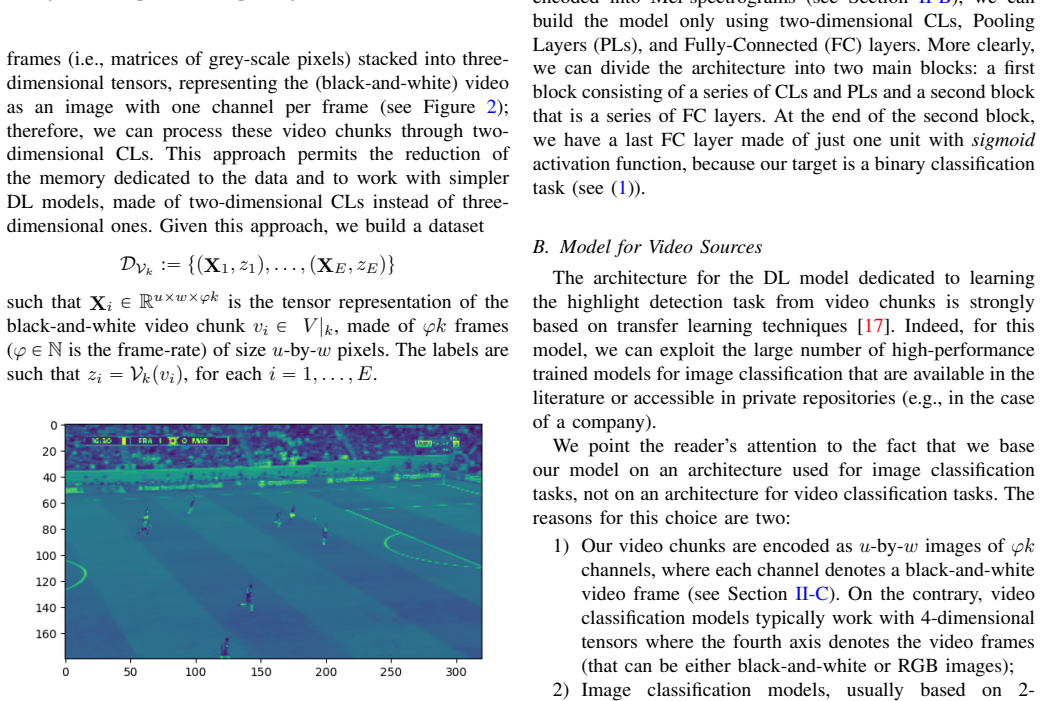
The load-bearing machinery is the pair of cheap encodings plus a score-averaging rule. Audio chunks become Mel-spectrograms, which emphasise human-voice frequencies and let a from-scratch 2D CNN capture commentator and crowd reactions. Video chunks become stacked greyscale frames, one channel per frame, so a pretrained image-classification model can be reused: the first convolutional layer's RGB filters are adapted to the multi-frame input by averaging each filter's three channel weights and repeating the result across frames, preserving the pretrained spatial knowledge. The ensemble is the arithmetic mean of per-second audio and video scores, and its claimed work is to cancel complementary false positives and negatives. The exact architectures and training configurations are withheld under a non-disclosure agreement, so the documented public core is this encoding scheme and the averaging rule rather than the numerical training details.
What would settle it
Apply the described pipeline to a fresh set of full football broadcasts with independently annotated highlight intervals, and measure per-chunk classification accuracy with $k=5$ second windows and per-second scores at a threshold of 0.5. If the audio stream does not reach roughly 89% accuracy, the video stream roughly 83%, or if the averaged ensemble does not lower false-positive and false-negative rates below both single streams, the paper's core claim that small datasets and simple 2D models are sufficient would be contradicted.
Extended reading notes
Core claim
The central claim is that a dual-stream design can detect football highlights with practical accuracy while staying lightweight. Each 5-second chunk is encoded either as a Mel-spectrogram image or as a stack of greyscale frames treated as a multi-channel image, and a binary classifier learns whether the chunk intersects a highlight interval. On the authors' test sets the audio model reaches approximately 89% accuracy and the video model approximately 83%, with balanced error behaviour across positive and negative labels. The key result is that the simple arithmetic average of the two streams' raw sigmoid scores at each second produces an ensemble whose mistakes are complementary rather than additive: crowd-noise audio false positives are offset by video true negatives, while video misses of spectator reactions are offset by audio detection of the crowd roar. The robustness mechanism is demonstrated on two applied clips, including one where audio extends the detected highlight through celebrations and one where video pins down the start of the action.
Load-bearing premise
Everything rests on the ground-truth highlight intervals used to label the audio and video chunks being correct and representative of real football broadcasts; the paper does not specify where the recordings come from, who annotated the highlights, or how many matches are involved.
Editorial extensions
If this is right
- With the reported accuracies, highlight detection can run on modest computational resources and roughly 700 to 1000 labelled chunks per modality, so deployment is feasible where large annotated video corpora are unavailable.
- Because the ensemble is just the mean of two independently trained streams, robustness can be improved by adding a modality without retraining either network.
- Per-second score averaging over sliding windows naturally makes detected highlights include the build-up before a key event and the celebration after it, matching the structure of human-edited highlight clips.
- The same binary-chunk formulation and pipeline applies to other sports and scene types, requiring new labelled data and a suitable choice of window length $k$.
Reading between the lines
- Beyond the paper, the complementary-error claim predicts a testable asymmetry: masking crowd audio should hurt the ensemble far less than the audio stream alone, because the video stream still detects goalmouth action.
- The balanced private test sets probably overstate performance on real broadcasts, where highlight seconds are rare; reporting precision and recall under natural class imbalance would show whether the reported robustness survives deployment conditions.
- The filter-averaging trick that converts RGB pretrained filters to stacked greyscale frames could transfer to other multi-channel inputs, such as optical-flow stacks or multi-view video, without retraining the feature extractor.
- Varying the window length $k$ while keeping the labels fixed would map the precision-versus-training-difficulty trade-off noted in the paper, giving practitioners an operating curve for choosing $k$.
Editorial analysis
A structured set of objections, weighed in public.
Referee Report
Summary. The paper proposes a dual-stream deep-learning pipeline for detecting football highlights. Audio is encoded as Mel-spectrograms and classified by a 2D CNN; video is encoded as stacked grayscale frames (treated as a multi-channel image) and classified by a transfer-learned 2D CNN whose first-layer filters are adapted by averaging RGB weights across channels and replicating across frames. The authors build two private, balanced datasets of five-second chunks, train the two models, and report approximately 89% audio accuracy and 83% video accuracy on held-out test portions. They then define an ensemble model (Eq. 5) that averages the per-second audio and video scores, claim that it improves robustness against false positives and false negatives, and illustrate this with two qualitative clips from the Soccernet repository. The paper concludes that the approach is lightweight, scalable, and practical for automated highlight detection.
Significance. If the reported numbers are reliable, the work is a modest practical contribution: it provides a clean problem formulation, a simple way to reuse a 2D image-classification network for short video chunks, and evidence that small datasets can support reasonable highlight detection. The audio and video confusion matrices are internally plausible in shape, and the use of a public corpus for the two demonstration clips is a positive feature. However, the scientific significance is strongly limited by the private dataset, the NDA-restricted architecture and training details, the absence of any baseline comparison, and the lack of quantitative evaluation of the ensemble claim. The paper currently reads more like an industrial application note than a fully verifiable methods contribution.
major comments (3)
- [Section IV-B, Tables I-III] There is a quantitative inconsistency between Table I and the confusion matrices. With a balanced test set and entries normalized to the total test-set size, the audio confusion matrix (TP 43%, FN 7%, FP 4%, TN 46%) yields accuracy 89%, recall 86%, precision 91.5%, and F1 approximately 88.7%, whereas Table I reports recall = accuracy = 89.24% and precision 89.33%. The video matrix (TP 41%, FN 9%, FP 7%, TN 43%) yields accuracy 84%, recall 82%, precision 85.4%, and F1 approximately 83.6%, again disagreeing with Table I. The statement in Section IV-B that accuracy 'coincides with the recall index' is also not generally true for a balanced test set; it requires the true-positive rate to equal the true-negative rate, which the confusion matrices do not satisfy. Please reconcile the tables and report exact test-set sizes and raw counts.
- [Section V, Eq. (5), Section V-B] The central claim that the ensemble model Me improves robustness against false positives and false negatives is not quantitatively evaluated. Tables I-III report metrics only for the individual audio and video models; no test-set accuracy, precision, recall, F1, or confusion matrix is reported for the ensemble defined by Eq. (5). The only evaluation of Me is qualitative, on two Soccernet clips, and the second clip still contains a brief false highlight ('GK throw-in') that the authors propose to filter out post hoc rather than having the ensemble suppress it. Because averaging two scores can also dilute a stronger stream with a weaker one, the claimed improvement requires a paired comparison of Ma, Mv, and Me on identical test examples. Please report ensemble metrics on the same held-out test sets, including a per-second or per-chunk comparison and the chosen threshold epsilon.
- [Sections II-B, II-C, IV-A, Remarks 3.1 and 4.1] The experimental protocol is too underspecified to support the generalization claims. The datasets are described only as samples taken from 'available recordings' with known highlights, balanced to 50/50, with no source matches, number of matches, annotation protocol, or temporal split. A single random split is used, with no repeated runs, error bars, or confidence intervals, and no baseline comparison (e.g., majority class, standard feature-based methods, or prior soccer-event-detection systems). The NDA in Remarks 3.1 and 4.1 further prevents independent reproduction, since the architecture family, layer details, hyperparameters, and exact training configuration are withheld. In particular, the filter-adaptation step in Eq. (3) is asserted to preserve useful video features, but no ablation or alternative adaptation is tested. Please provide as much dataset and training detail as possible, add repeated split evaluation or cross-validation, and include at least one baseline comparison.
minor comments (5)
- [Section I, reference [3]] Reference [3] ('J. Smith and J. Doe', Journal of Video Analysis, 2000) appears to be an unverifiable placeholder; please replace it with a complete and accessible citation.
- [Section II-A, Eq. (1)] The condition Hpaq = H should be written as Hpaq = ∅; as printed, H is used both as the name of the highlight-interval mapping and as a set, which is confusing.
- [Section IV-A] There is a typo, 'made up of of approximately'; more importantly, the approximate dataset sizes (about 700 and 1000 samples) should be replaced by exact cardinalities, and the train/validation/test split sizes should be given precisely.
- [Section V-A, Eq. (4)] The pipeline does not specify the window stride or how the set of windows containing a given second is constructed; Eq. (4) depends on this choice, so please define the window placement and overlap.
- [Figures 3 and 4] The prediction curves in Figures 3 and 4 are difficult to read in print: please add axis labels, a clear legend, the ground-truth highlight intervals, and markings for the annotated video frames.
Circularity Check
No significant circularity: test accuracies come from held-out sets and the ensemble is a fixed unweighted average, not a fitted prediction.
full rationale
The paper's claimed results are empirical rather than derived from a fitted constant. The target functions A_k and V_k are defined directly from ground-truth highlight intervals H(a)/H(v) (Eqs. 1-2), and the datasets D_Ak and D_Vk are labeled with exactly those functions, but this is the standard supervised-learning setup, not a circular argument: the models are evaluated on held-out test chunks that were not used for training, and the reported 89%/83% accuracies, precisions, recalls, and confusion matrices (Tables I-III) are test-set measurements. The ensemble model M_e is defined as the arithmetic mean of the two streams' per-second scores (Eq. 5) with fixed weight 1/2, so no parameter is fit to the test set and then reported as a prediction. The threshold epsilon=0.5 is hand-chosen, not optimized on the test set. There are no load-bearing self-citations: references are standard external works, and the Soccernet clips [18,19] are only used for qualitative illustration. The NDA-based withholding of architecture and training details (Remarks 3.1, 4.1) and the absence of quantitative ensemble metrics (Section IV-B reports only individual-stream metrics) are reproducibility and correctness limitations, not circular reasoning, because they do not make any reported result equal to its input by construction.
Assumptions & free parameters
free parameters (5)
- window size k =
5 seconds
- highlight detection threshold epsilon =
0.5
- ensemble combination weights =
1/2 for audio and 1/2 for video
- pretrained image classification model M =
undisclosed (NDA)
- audio and video model hyperparameters =
undisclosed (NDA)
assumptions (6)
- domain assumption Highlights are disjoint time intervals of integer seconds and never overlap (Section II-A).
- domain assumption Colors are not meaningful for highlight detection in football, so grayscale frames suffice (Section II-C).
- domain assumption Crowd and commentator reactions are strong indicators of highlights (Section I).
- ad hoc to paper The transfer learning filter adaptation in Eq. (3), averaging RGB filter weights across channels and replicating them across frames, preserves useful features for video chunks.
- domain assumption A chunk is labeled positive if it intersects any highlight interval, regardless of how much of the chunk is highlight (Eq. 1, 2).
- ad hoc to paper The private test set is representative of real football broadcasts despite being drawn from an unnamed source with balanced sampling (Section IV-A).
Cite this review
Pith. "Pith review of Automated Detection of Sport Highlights from Audio and Video Sources." pith.science (2026). https://pith.science/paper/IBKWKEHF
@misc{pith2026250116100,
  author       = {Pith},
  title        = {Pith review of: Automated Detection of Sport Highlights from Audio and Video Sources},
  year         = {2026},
  howpublished = {\url{https://pith.science/paper/IBKWKEHF}},
  note         = {Machine review of arXiv:2501.16100}
}
read the original abstract
This study presents a novel Deep Learning-based and lightweight approach for the automated detection of sports highlights (HLs) from audio and video sources. HL detection is a key task in sports video analysis, traditionally requiring significant human effort. Our solution leverages Deep Learning (DL) models trained on relatively small datasets of audio Mel-spectrograms and grayscale video frames, achieving promising accuracy rates of 89% and 83% for audio and video detection, respectively. The use of small datasets, combined with simple architectures, demonstrates the practicality of our method for fast and cost-effective deployment. Furthermore, an ensemble model combining both modalities shows improved robustness against false positives and false negatives. The proposed methodology offers a scalable solution for automated HL detection across various types of sports video content, reducing the need for manual intervention. Future work will focus on enhancing model architectures and extending this approach to broader scene-detection tasks in media analysis.
Figures


Figures from the paper (1 more)

Forward citations
Cited by 1 Pith paper
-
DIAMOND: An LLM-Driven Agent for Context-Aware Baseball Highlight Summarization
DIAMOND combines WPA and Leverage Index with LLM narrative scoring to select baseball highlight plays, reporting F1 of 84.8% on five KBO games despite evaluation caveats.
Reference graph
Works this paper leans on
-
[3]
Traditional handcrafted feature detection methods in video analysis,
J. Smith and J. Doe, “Traditional handcrafted feature detection methods in video analysis,” Journal of Video Analysis , 2000
work page 2000
-
[1]
Structure analysis of soccer video with domain knowledge and hidden markov models,
L. Xie, S.-F. Chang, A. Divakaran, and H. Sun, “Structure analysis of soccer video with domain knowledge and hidden markov models,” Pattern Recognition Letters, 2004
work page 2004
-
[2]
Automatically extracting highlights for tv baseball programs,
Y . Rui, A. Gupta, and A. Acero, “Automatically extracting highlights for tv baseball programs,” in Proceedings of the Eighth ACM International Conference on Multimedia , 2000
work page 2000
-
[4]
Learning spatiotemporal features with 3d convolutional networks,
D. Tran, L. Bourdev, R. Fergus, L. Torresani, and M. Paluri, “Learning spatiotemporal features with 3d convolutional networks,” in Proceedings of the IEEE International Conference on Computer Vision (ICCV), 2015
work page 2015
-
[5]
Using 3d convolutional neural networks for real- time detection of soccer events,
O. A. N. Rongved, S. A. Hicks, V . Thambawita, H. K. Stensland, E. Zouganeli, D. Johansen, C. Midoglu, M. A. Riegler, and P. Halvorsen, “Using 3d convolutional neural networks for real- time detection of soccer events,” International Journal of Semantic Computing, vol. 15, no. 02, pp. 161–187, 2021. [Online]. Available: https://doi.org/10.1142/S1793351X2140002X
-
[6]
Video classification with channel-separated convolutional networks,
D. Tran, H. Wang, L. Torresani, J. Ray, Y . LeCun, and M. Paluri, “Video classification with channel-separated convolutional networks,” in Proceedings of the IEEE/CVF International Conference on Computer Vision (ICCV), 2020
work page 2020
-
[7]
Improved Soccer Action Spotting using both Audio and Video Streams
B. Vanderplaetse and S. Dupont, “Improved soccer action spotting using both audio and video streams,” arXiv preprint arXiv:2011.04258, 2020
work page Pith review arXiv 2011
-
[8]
Deep content- based music recommendation,
A. van den Oord, S. Dieleman, and B. Schrauwen, “Deep content- based music recommendation,” in Advances in Neural Information Processing Systems, C. Burges, L. Bottou, M. Welling, Z. Ghahramani, and K. Weinberger, Eds., vol. 26. Curran Associates, Inc.,
Show all 20 references
-
[9]
Speech emotion recognition: Emotional models, databases, features, preprocessing methods, supporting modalities, and classifiers,
M. B. Akc ¸ay and K. O ˘guz, “Speech emotion recognition: Emotional models, databases, features, preprocessing methods, supporting modalities, and classifiers,” Speech Communication , vol. 116, pp. 56–76, 2020. [Online]. Available: https: //www.sciencedirect.com/science/articl...
2020
-
[10]
On the effect of log-mel spectrogram parameter tuning for deep learning-based speech emotion recognition,
A. Mukhamediya, S. Fazli, and A. Zollanvari, “On the effect of log-mel spectrogram parameter tuning for deep learning-based speech emotion recognition,” IEEE Access, vol. 11, pp. 61 950–61 957, 2023
2023
-
[11]
Heart sound classification using deep learning techniques based on log-mel spectrogram,
M. T. Nguyen, W. W. Lin, and J. H. Huang, “Heart sound classification using deep learning techniques based on log-mel spectrogram,” Circuits, Systems, and Signal Processing , vol. 42, pp. 344–360, 1 2023
2023
-
[12]
A survey on deep reinforcement learning for audio-based applications,
S. Latif, H. Cuay ´ahuitl, F. Pervez, F. Shamshad, H. S. Ali, and E. Cambria, “A survey on deep reinforcement learning for audio-based applications,” Artificial Intelligence Review , vol. 56, pp. 2193–2240, 3 2023
2023
-
[13]
The relation of pitch to frequency: A revised scale,
S. S. Stevens and J. V olkmann, “The relation of pitch to frequency: A revised scale,” The American Journal of Psychology , vol. 53, p. 329, 7 1940
1940
-
[14]
Goodfellow, Y
I. Goodfellow, Y . Bengio, and A. Courville, Deep Learning . MIT press. [Online]. Available: www.deeplearningbook.org
-
[15]
3d convolutional neural networks for human action recognition,
S. Ji, W. Xu, M. Yang, and K. Yu, “3d convolutional neural networks for human action recognition,” IEEE Transactions on Pattern Analysis and Machine Intelligence , vol. 35, no. 1, pp. 221–231, 2013
2013
-
[16]
Learning spatiotemporal features with 3d convolutional networks,
D. Tran, L. Bourdev, R. Fergus, L. Torresani, and M. Paluri, “Learning spatiotemporal features with 3d convolutional networks,” in 2015 IEEE International Conference on Computer Vision (ICCV) , 2015, pp. 4489– 4497
2015
-
[17]
A survey on deep transfer learning,
C. Tan, F. Sun, T. Kong, W. Zhang, C. Yang, and C. Liu, “A survey on deep transfer learning,” in Artificial Neural Networks and Machine Learning – ICANN 2018 , V . K˚urkov´a, Y . Manolopoulos, B. Hammer, L. Iliadis, and I. Maglogiannis, Eds. Cham: Springer International Publis...
2018
-
[18]
Soccernet: A scalable dataset for action spotting in soccer videos,
S. Giancola, M. Amine, T. Dghaily, and B. Ghanem, “Soccernet: A scalable dataset for action spotting in soccer videos,” in 2018 IEEE/CVF Conference on Computer Vision and Pattern Recognition Workshops (CVPRW), 2018, pp. 1792–179 210
2018
-
[19]
SocerNet,
“SocerNet,” https://www.soccer-net.org/data#h.ov9k48lcih5g, accessed: 2025-01-17. Francesco Della Santa Research Associate at Politecnico di Torino. He got a Master Degree in Mathematics at University of Florence and a Ph.D. in Pure and Applied Mathematics at Politecnico di To...
2025
-
[2013]
Available: https://proceedings.neurips.cc/paper files/ paper/2013/file/b3ba8f1bee1238a2f37603d90b58898d-Paper.pdf
[Online]. Available: https://proceedings.neurips.cc/paper files/ paper/2013/file/b3ba8f1bee1238a2f37603d90b58898d-Paper.pdf
2013
Reviewed August 10, 2026 · model on record in the stance chip above.
Discussion (0). Continue with ORCID to comment.