REVIEW 3 major objections 6 minor 75 references
I Know Which LLM Wrote Your Code Last Summer: LLM generated Code Stylometry for Authorship Attribution
T0 review · 3 major / 6 minor · reviewed 2026-08-06 · deepseek-v4-flash
Pith's one-line read C code carries a strong enough stylistic fingerprint to identify which LLM generated it.
desk verdict Valuable new benchmark for LLM code attribution, but template overlap between train and test likely inflates the headline accuracies. read the letter →
The pith
A machine-rendered reading of the paper's core claim, the machinery that carries it, and where it could break.
The reading
What carries the argument
The central object is CodeT5-Authorship: the pretrained CodeT5+ encoder with the decoder removed, whose first-token output embedding is passed through a linear, GELU, dropout, and linear classification head to produce a probability distribution over possible authors. It carries the argument by showing that an encoder-only model working on 512-token snippets captures style cues better than larger decoder-only models or long-context encoders. The other load-bearing component is LLM-AuthorBench, a corpus of 32,000 gcc-compilable C programs generated from 300 parameterized templates instantiated into about 4,000 unique tasks, with only exact duplicates removed and Type 1 and Type 2 near-duplicates retained to preserve stylistic variation.
What would settle it
Train the same classifier on LLM-AuthorBench under a template-disjoint split, holding out entire templates rather than individual programs, and compare accuracy; a substantial drop below the reported 97.56% and 95.40% figures would show the current numbers are inflated by near-duplicate tasks. A second test is to generate several hundred C programs from completely new prompts outside the 300 templates and measure attribution accuracy on that unseen material.
Extended reading notes
Core claim
CodeT5-Authorship, a 24-layer encoder-only Transformer built by removing the decoder from CodeT5+ (770M) and adding a two-layer GELU-activated classification head over the first-token embedding, can attribute C programs to their generating LLM with 97.56% accuracy in binary classification (GPT-4.1 versus GPT-4o) and 95.40% accuracy in five-way classification among Gemini 2.5 Flash, Claude 3.5 Haiku, GPT-4.1, Llama 3.3, and DeepSeek-V3. It outperforms seven traditional ML classifiers and eight fine-tuned Transformers, including BERT, RoBERTa, CodeBERT, ModernBERT, DistilBERT, DeBERTa-V3, Longformer, and LoRA-fine-tuned Qwen2-1.5B. The experiments find that comment style is the single richest cue, that removing comments hurts accuracy more in the multi-class setting, and that extending context beyond 512 tokens brings only marginal gains. The paper's conclusion is that reliable authorship attribution of LLM-generated C code is feasible with moderately sized Transformer encoders.
Load-bearing premise
The load-bearing premise is that the train/test separation, made over individual programs, measures model-specific style rather than template-specific familiarity, because each of the 300 task templates is reused about 13 times per model and only exact duplicates are removed.
Editorial extensions
If this is right
- Generated C code is traceable to one of several known candidate LLMs at over 95% accuracy, so provenance checking can work as a post-hoc forensic step rather than requiring watermarks.
- Comment handling matters: removing comments drops multi-class accuracy by 7.2 percentage points, so attribution systems should treat comment phrasing as a first-class signal.
- A moderate 512-token encoder outperforms larger decoder-only and long-context models, suggesting the decisive style cues are local and that architecture matters more than context length.
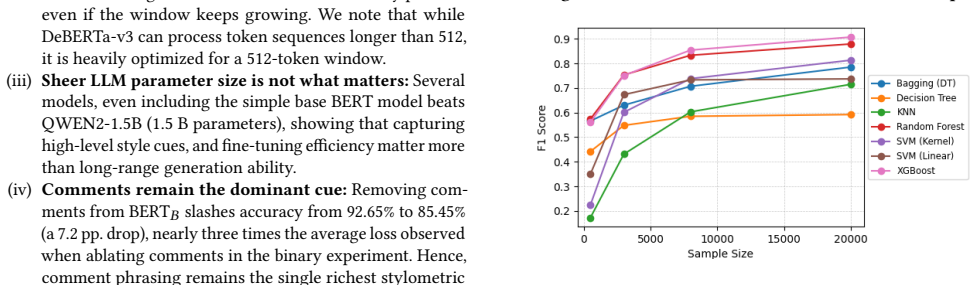
- A tuned XGBoost on hand-crafted features reaches 90.8% accuracy in under a minute, giving a low-cost attribution option for smaller candidate sets.
- DeepSeek-V3 is the most confusable author in the five-way test, so model families with converging output styles may need additional discriminative signals.
Reading between the lines
- Beyond the paper: a template-disjoint evaluation, holding out entire task templates rather than individual programs, would test whether the reported numbers reflect author style or reuse of near-duplicate tasks across the train and test splits.
- Beyond the paper: because comments are the dominant cue, paraphrasing or stripping comments is a plausible low-effort evasion, and a direct attack test would quantify how much real-world security the method provides.
- Beyond the paper: if the same encoder approach transfers to Python, Java, or Rust, the benchmark could be extended to cross-language attribution, but comment and formatting conventions differ enough that transfer is not guaranteed.
- Beyond the paper: an encoder-based attribution model could serve as an independent check on generative-watermark claims, since it relies on natural style drift rather than an embedded marker.
Editorial analysis
A structured set of objections, weighed in public.
Referee Report
Summary. The paper introduces LLM-AuthorBench, a benchmark of 32,000 C programs generated by eight LLMs from 300 parameterized templates, and CodeT5-Authorship, an encoder-only variant of CodeT5+ with a two-layer classification head. The authors evaluate CodeT5-Authorship against seven classical ML classifiers and eight transformer baselines. They report 97.56% accuracy for binary attribution between GPT-4.1 and GPT-4o, and 95.40% accuracy for five-way attribution among Gemini 2.5 Flash, Claude 3.5 Haiku, GPT-4.1, Llama 3.3, and DeepSeek-V3. The paper addresses two research questions: whether attribution generalizes to arbitrary programming tasks (RQ1) and which model families work best (RQ2). The central claim is that reliable authorship attribution of LLM-generated C code is feasible with moderately sized Transformer encoders.
Significance. If the results withstand closer evaluation, the paper would be a valuable contribution: it provides a public benchmark for LLM code attribution, a strong encoder-only architecture, and a systematic comparison of many baselines. The open release of the dataset and training code is a strength. However, the current evaluation design has a serious template-leakage problem: the train/test split is over programs, not templates, so near-duplicates of the same task appear in both training and validation. This threatens the generalizability claim in RQ1. The paper's small out-of-distribution probe is insufficient to rule out this alternative explanation. The contribution is therefore promising but not yet fully supported.
major comments (3)
- [Section 3.1.1 and Section 3.1] The train/test split is performed over individual programs, not templates. Since the 4,000 tasks are generated from only 300 templates (each template appears ≈13.3 times per model) and only Type 0 (byte-identical) duplicates are removed, Type 1/2 near-duplicates of the same template can appear in both training and validation. A transformer encoder can then memorize template–author associations (e.g., 'bubble-sort tasks from GPT-4o tend to have comments phrased like this') instead of learning model-specific style. This directly threatens RQ1, which asks whether attribution works for arbitrary programming tasks. Please re-evaluate with a template-disjoint split (e.g., assign entire templates to train/test) or provide strong evidence that accuracy degrades only mildly under such a split. The current cross-check in Section 4.3 is too small to rule out this leakage.
- [Section 4.3] The out-of-distribution cross-check uses only a few new prompts and only two models, and it reports confidence values (99% and 100%) rather than accuracy over a meaningful sample. Confidence is not a substitute for classification accuracy. To support the claim of generalization to arbitrary tasks, evaluate on a larger set of held-out prompts (e.g., 50–100 new templates per model) and report accuracy, precision, and recall, and specify the number of prompts used.
- [Section 4.1 and Section 4.2, Tables 5 and 6] All reported accuracies come from a single run per configuration, with no error bars or multiple seeds. Since the top models are separated by small margins (e.g., 97.56% vs. 97.00% vs. 96.88% in Table 5), it is unclear whether these differences are statistically significant. Please report results over multiple random seeds (at least 3) with mean and standard deviation, or otherwise justify why single runs suffice.
minor comments (6)
- [Section 6, Conclusion] The sentence 'In the harder multi-class scenario it again edges out (96%), the best long-context baseline (Longformer, 95%)' should read 95.4% per Table 6, not 96%.
- [Section 4.2, first paragraph] The phrase 'To gasp how significant' should be 'To gauge how significant'.
- [Section 4.1, item (v)] The word 'additinal' should be 'additional'.
- [Section 3.1] The phrase 'only unique C programs are included' is contradicted by Section 3.1.1, which explicitly retains Type 1/2 clones; please rephrase to avoid confusion.
- [Tables 5 and 6] The 'Time' column does not specify units; add 'minutes' to the header or legend.
- [Section 4.1] The claim that structural metrics from Table 4 shift decision boundaries by at most 0.4 pp is stated without supporting details; consider providing a supplementary table or a more concrete description of the ablation.
Circularity Check
No significant circularity: the reported accuracies are empirical measurements on held-out programs, and the template-overlap issue is a benchmark-validity concern rather than a self-referential derivation.
full rationale
The paper's derivation chain is a standard supervised-learning pipeline: construct LLM-AuthorBench from 300 parameterized templates, prompt eight LLMs to produce 32,000 labeled C programs, split 80/20 by program, fine-tune CodeT5-Authorship and baselines on the training split, and report accuracies on the validation split. The reported 97.56% binary and 95.40% multi-class accuracies are empirical measurements on held-out programs whose labels are the known generating LLM; they are not quantities obtained by plugging fitted parameters back into the loss or by identifying the output with the input by construction. No step in the derivation equates a prediction with a fitted value or with the training labels. The main weakness is Section 3.1.1's template reuse: each of the 300 templates is used on average 13.3 times per model, only fully identical (Type 0) programs are removed, and the split is over programs rather than templates, so Type 1/2 near-duplicates can appear in both train and validation. This means validation accuracy may partly reflect template-specific artifacts rather than model style, which is a threat to the RQ1 generalization to 'arbitrary programming tasks.' However, that is an external-validity/data-leakage limitation, not a circular step: validation labels are independent of the training fit, and the paper does not define the attribution target in terms of the model's own outputs. The only self-citation ([58], a prior empirical study by overlapping authors on vulnerability rates in AI-generated C code) is used as background motivation and is not load-bearing for the attribution result. Thus, under the circularity definition used here, there is no significant circularity; the template-overlap concern belongs in a correctness/robustness review rather than a circularity score.
Assumptions & free parameters
free parameters (5)
- Dropout rate in classification head =
0.20
- Activation function =
GELU
- Pooling strategy =
first token embedding
- Context window =
512 tokens
- Template count N =
300
assumptions (4)
- domain assumption gcc -c compilation is a valid filter for well-formed C programs
- domain assumption Programs from the same OpenRouter API endpoint represent the named LLM
- domain assumption NiCad Type 1 and Type 2 clones are distinct enough for stylometry
- domain assumption Random program-level split yields independent training and test sets
Cite this review
Pith. "Pith review of I Know Which LLM Wrote Your Code Last Summer: LLM generated Code Stylometry for Authorship Attribution." pith.science (2026). https://pith.science/paper/IHDXDADT
@misc{pith2026250617323,
  author       = {Pith},
  title        = {Pith review of: I Know Which LLM Wrote Your Code Last Summer: LLM generated Code Stylometry for Authorship Attribution},
  year         = {2026},
  howpublished = {\url{https://pith.science/paper/IHDXDADT}},
  note         = {Machine review of arXiv:2506.17323}
}
read the original abstract
Detecting AI-generated code, deepfakes, and other synthetic content is an emerging research challenge. As code generated by Large Language Models (LLMs) becomes more common, identifying the specific model behind each sample is increasingly important. This paper presents the first systematic study of LLM authorship attribution for C programs. We released CodeT5-Authorship, a novel model that uses only the encoder layers from the original CodeT5 encoder-decoder architecture, discarding the decoder to focus on classification. Our model's encoder output (first token) is passed through a two-layer classification head with GELU activation and dropout, producing a probability distribution over possible authors. To evaluate our approach, we introduce LLM-AuthorBench, a benchmark of 32,000 compilable C programs generated by eight state-of-the-art LLMs across diverse tasks. We compare our model to seven traditional ML classifiers and eight fine-tuned transformer models, including BERT, RoBERTa, CodeBERT, ModernBERT, DistilBERT, DeBERTa-V3, Longformer, and LoRA-fine-tuned Qwen2-1.5B. In binary classification, our model achieves 97.56% accuracy in distinguishing C programs generated by closely related models such as GPT-4.1 and GPT-4o, and 95.40% accuracy for multi-class attribution among five leading LLMs (Gemini 2.5 Flash, Claude 3.5 Haiku, GPT-4.1, Llama 3.3, and DeepSeek-V3). To support open science, we release the CodeT5-Authorship architecture, the LLM-AuthorBench benchmark, and all relevant Google Colab scripts on GitHub: https://github.com/LLMauthorbench/.
Figures


Figures from the paper (3 more)


Reference graph
Works this paper leans on
-
[1]
Mohammed Abuhamad, Tamer AbuHmed, Aziz Mohaisen, and DaeHun Nyang
-
[2]
Mohammed Abuhamad, Tamer Abuhmed, David Mohaisen, and Daehun Nyang
-
[3]
Mohammed Abuhamad, Ji-su Rhim, Tamer AbuHmed, Sana Ullah, Sanggil Kang, and DaeHun Nyang. 2019. Code authorship identification using convolutional neural networks. Future Generation Computer Systems 95 (June 2019), 104–115. doi:10.1016/j.future.2018.12.038
-
[4]
Uri Alon, Meital Zilberstein, Omer Levy, and Eran Yahav. 2018. code2vec: Learning Distributed Representations of Code. doi:10.48550/arXiv.1803.09473 arXiv:1803.09473 [cs]
-
[5]
Bander Alsulami, Edwin Dauber, Richard Harang, Spiros Mancoridis, and Rachel Greenstadt. 2017. Source Code Authorship Attribution Using Long Short-Term Memory Based Networks. In Computer Security – ESORICS 2017 , Simon N. Foley, Dieter Gollmann, and Einar Snekkenes (Eds.). Springer International Publishing, Cham, 65–82. doi:10.1007/978-3-319-66402-6_6
-
[6]
Jinze Bai, Shuai Bai, Yunfei Chu, Zeyu Cui, Kai Dang, Xiaodong Deng, Yang Fan, Wenbin Ge, Yu Han, Fei Huang, Binyuan Hui, Luo Ji, Mei Li, Junyang Lin, Runji Lin, Dayiheng Liu, Gao Liu, Chengqiang Lu, Keming Lu, Jianxin Ma, Rui Men, Xingzhang Ren, Xuancheng Ren, Chuanqi Tan, Sinan Tan, Jianhong Tu, Peng Wang, Shijie Wang, Wei Wang, Shengguang Wu, Benfeng X...
-
[7]
Dimitris Bamidis, Ilias Kalouptsoglou, Apostolos Ampatzoglou, and Alexandros Chatzigeorgiou. 2024. Software Skills Identification: A Multi-Class Classification on Source Code Using Machine Learning. Global Clinical Engineering Journal 6, SI6 (Dec. 2024), 74–77. doi:10.31354/globalce.v6iSI6.278
- [8]
Show all 75 references
- [9]
-
[10]
Benedikt Boenninghoff, Steffen Hessler, Dorothea Kolossa, and Robert M. Nickel
-
[11]
Tom Brown, Benjamin Mann, Nick Ryder, Melanie Subbiah, Jared D Ka- plan, Prafulla Dhariwal, Arvind Neelakantan, Pranav Shyam, Girish Sastry, Amanda Askell, Sandhini Agarwal, Ariel Herbert-Voss, Gretchen Krueger, Tom Henighan, Rewon Child, Aditya Ramesh, Daniel Ziegler, Jeffrey...
2020
-
[12]
Aylin Caliskan, Fabian Yamaguchi, Edwin Dauber, Richard Harang, Konrad Rieck, Rachel Greenstadt, and Arvind Narayanan. 2018. When Coding Style Survives Compilation: De-anonymizing Programmers from Executable Binaries. In Proceedings 2018 Network and Distributed System Security...
2018
-
[13]
Aylin Caliskan-Islam, Richard Harang, Andrew Liu, Arvind Narayanan, Clare Voss, Fabian Yamaguchi, and Rachel Greenstadt. 2015. De-anonymizing Pro- grammers via Code Stylometry. 255–270. https://www.usenix.org/conference/ usenixsecurity15/technical-sessions/presentation/caliskan-islam
2015
- [14]
-
[15]
Cordy and Chanchal Kumar Roy
James R. Cordy and Chanchal Kumar Roy. 2011. The NiCad Clone Detector.2011 IEEE 19th International Conference on Program Comprehension (2011), 219–220. https://api.semanticscholar.org/CorpusID:2991109
2011
-
[16]
Tugce Coskun, Rusen Halepmollasi, Khadija Hanifi, Ramin Fadaei Fouladi, Pinar Comak De Cnudde, and Ayse Tosun. 2022. Profiling developers to pre- dict vulnerable code changes. In Proceedings of the 18th International Confer- ence on Predictive Models and Data Analytics in Soft...
2022
-
[17]
Desmarais, and Foutse Khomh
Arghavan Moradi Dakhel, Michel C. Desmarais, and Foutse Khomh. 2023. Dev2vec: Representing Domain Expertise of Developers in an Embedding Space. Information and Software Technology 159 (July 2023), 107218. doi:10.1016/j.infsof. 2023.107218 arXiv:2207.05132 [cs]
2023
-
[18]
Sumanth Dathathri, Abigail See, Sumedh Ghaisas, Po-Sen Huang, Rob McAdam, Johannes Welbl, Vandana Bachani, Alex Kaskasoli, Robert Stanforth, Tatiana Matejovicova, Jamie Hayes, Nidhi Vyas, Majd Al Merey, Jonah Brown-Cohen, Rudy Bunel, Borja Balle, Taylan Cemgil, Zahra Ahmed, Ki...
-
[19]
Jacob Devlin, Ming-Wei Chang, Kenton Lee, and Kristina Toutanova. 2019. BERT: Pre-training of Deep Bidirectional Transformers for Language Understanding. In Proceedings of the 2019 Conference of the North American Chapter of the Association for Computational Linguistics: Human...
2019
-
[20]
Ahmet Emir Dirik. 2013. Source Attribution Based on Physical Defects in Light Path. In Digital Image Forensics: There is More to a Picture than Meets the Eye , Husrev Taha Sencar and Nasir Memon (Eds.). Springer, New York, NY, 219–236. doi:10.1007/978-1-4614-0757-7_7
2013 doi
- [21]
-
[22]
Alberto Ferrante, Eric Medvet, Francesco Mercaldo, Jelena Milosevic, and Cor- rado Aaron Visaggio. 2016. Spotting the Malicious Moment: Characterizing Mal- ware Behavior Using Dynamic Features. In 2016 11th International Conference on A vailability, Reliability and Security (A...
2016 doi
-
[23]
Georgia Frantzeskou, Efstathios Stamatatos, Stefanos Gritzalis, and Sokratis Katsikas. 2006. Effective identification of source code authors using byte-level information. In Proceedings of the 28th international conference on Software engi- neering (ICSE ’06) . Association for...
2006
-
[24]
Georgia Frantzeskou, Efstathios Stamatatos, Stefanos Gritzalis, and Sokratis Katsikas. 2006. Source Code Author Identification Based on N-gram Author Profiles. In Artificial Intelligence Applications and Innovations, Ilias Maglogiannis, Kostas Karpouzis, and Max Bramer (Eds.)....
2006 doi
-
[25]
Jason Gray, Daniele Sgandurra, Lorenzo Cavallaro, and Jorge Blasco Alis. 2024. Identifying Authorship in Malicious Binaries: Features, Challenges & Datasets. ACM Comput. Surv. 56, 8, Article 212 (April 2024), 36 pages. doi:10.1145/3653973
2024 doi
- [26]
-
[27]
Dixiao Guo, Anmin Zhou, Liang Liu, Shan Liao, and Lei Zhang. 2022. A Method of Source Code Authorship Attribution Based on Graph Neural Network. In Proceedings of 2021 Chinese Intelligent Automation Conference , Zhidong Deng (Ed.). Springer, Singapore, 645–657. doi:10.1007/978...
2022 doi
-
[28]
Hanxi Guo, Siyuan Cheng, Kaiyuan Zhang, Guangyu Shen, and Xiangyu Zhang
-
[29]
Surbhi Gupta, Neeraj Mohan, and Munish Kumar. 2021. A Study on Source Device Attribution Using Still Images. Archives of Computational Methods in Engineering 28, 4 (June 2021), 2209–2223. doi:10.1007/s11831-020-09452-y
2021 doi
-
[30]
Andrea Gurioli, Maurizio Gabbrielli, and Stefano Zacchiroli. 2025. Is This You, LLM? Recognizing AI-written Programs with Multilingual Code Stylome- try . In 2025 IEEE International Conference on Software Analysis, Evolution and Reengineering (SANER). IEEE Computer Society, Lo...
2025
- [31]
-
[32]
Xie He, Arash Habibi Lashkari, Nikhill Vombatkere, and Dilli Prasad Sharma. 2024. Authorship Attribution Methods, Challenges, and Future Research Directions: A Comprehensive Survey. Information 15, 3 (March 2024), 131. doi:10.3390/ info15030131 Number: 3 Publisher: Multidiscip...
2024
-
[33]
Jeremy Howard and Sebastian Ruder. 2018. Universal Language Model Fine- tuning for Text Classification. In Proceedings of the 56th Annual Meeting of the Association for Computational Linguistics (Volume 1: Long Papers), Iryna Gurevych and Yusuke Miyao (Eds.). Association for C...
2018 doi
-
[34]
Vaibhavi Kalgutkar, Ratinder Kaur, Hugo Gonzalez, Natalia Stakhanova, and Alina Matyukhina. 2019. Code Authorship Attribution: Methods and Challenges. ACM Comput. Surv. 52, 1 (Feb. 2019), 3:1–3:36. doi:10.1145/3292577
2019 doi
-
[35]
Avila, Jacob Brunelle, and Baba Mamadou Camara
Raphaël Khoury, Anderson R. Avila, Jacob Brunelle, and Baba Mamadou Camara
-
[36]
Jungin Kim, Shinwoo Park, and Yo-Sub Han. 2025. Marking Code Without Breaking It: Code Watermarking for Detecting LLM-Generated Code. doi:10. 48550/arXiv.2502.18851 arXiv:2502.18851 [cs]
2025 doi
- [37]
- [38]
-
[39]
Paula Lissón and Nicolas Ballier. 2018. Investigating Lexical Progression through Lexical Diversity Metrics in a Corpus of French L3.Discours. Revue de linguistique, psycholinguistique et informatique. A journal of linguistics, psycholinguistics and computational linguistics 2...
2018 doi
-
[40]
Jiawei Liu, Chunqiu Steven Xia, Yuyao Wang, and Lingming Zhang
- [41]
-
[42]
T.J. McCabe. 1976. A Complexity Measure. IEEE Transactions on Software Engineering SE-2, 4 (1976), 308–320. doi:10.1109/TSE.1976.233837
1976
- [43]
-
[44]
Nguyen, Juri Di Rocco, Claudio Di Sipio, Riccardo Rubei, Davide Di Ruscio, and Massimiliano Di Penta
Phuong T. Nguyen, Juri Di Rocco, Claudio Di Sipio, Riccardo Rubei, Davide Di Ruscio, and Massimiliano Di Penta. 2024. GPTSniffer: A CodeBERT-based classifier to detect source code written by ChatGPT. Journal of Systems and Software 214 (Aug. 2024), 112059. doi:10.1016/j.jss.20...
2024
- [45]
-
[46]
Wei Hung Pan, Ming Jie Chok, Jonathan Leong Shan Wong, Yung Xin Shin, Yeong Shian Poon, Zhou Yang, Chun Yong Chong, David Lo, and Mei Kuan Lim
-
[47]
Ad- vances in Neural Information Processing Systems 36 (Dec
Is Your Code Generated by ChatGPT Really Correct? Rigor- ous Evaluation of Large Language Models for Code Generation. Ad- vances in Neural Information Processing Systems 36 (Dec. 2023), 21558– 21572. https://proceedings.neurips.cc/paper_files/paper/2023/hash/ 43e9d647ccd3e4b7b...
2023
-
[48]
Erwin Quiring, Alwin Maier, and Konrad Rieck. 2019. Misleading Authorship Attribution of Source Code using Adversarial Learning. 479–496. https://www. usenix.org/conference/usenixsecurity19/presentation/quiring
2019
-
[49]
Nathan Rosenblum, Xiaojin Zhu, and Barton P. Miller. 2011. Who Wrote This Code? Identifying the Authors of Program Binaries. In Computer Security – ESORICS 2011, Vijay Atluri and Claudia Diaz (Eds.). Springer, Berlin, Heidelberg, 172–189. doi:10.1007/978-3-642-23822-2_10
2011 doi
- [50]
-
[51]
Yanir Seroussi, Ingrid Zukerman, and Fabian Bohnert. 2014. Authorship Attribu- tion with Topic Models. Computational Linguistics 40, 2 (June 2014), 269–310. doi:10.1162/COLI_a_00173 Place: Cambridge, MA Publisher: MIT Press
2014 doi
-
[52]
Kanishka Silva, Ingo Frommholz, Burcu Can, Fred Blain, Raheem Sarwar, and Laura Ugolini. 2024. Forged-GAN-BERT: Authorship Attribution for LLM- Generated Forged Novels. In Proceedings of the 18th Conference of the European Chapter of the Association for Computational Linguisti...
2024
-
[53]
Qige Song, Yongzheng Zhang, Linshu Ouyang, and Yige Chen. 2022. BinMLM: Binary Authorship Verification with Flow-aware Mixture-of-Shared Language Model . In 2022 IEEE International Conference on Software Analysis, Evolution and Reengineering (SANER) . IEEE Computer Society, Lo...
2022
- [54]
-
[55]
Shinwoo Park, Hyundong Jin, Jeong-won Cha, and Yo-Sub Han. 2025. Detection of LLM-Paraphrased Code and Identification of the Responsible LLM Using Coding Style Features. doi:10.48550/arXiv.2502.17749 arXiv:2502.17749 [cs] version: 2
2025 doi
- [56]
-
[57]
N. N. Thathsarani. 2024. A Comprehensive Software Complexity Metric Based on Cyclomatic Complexity. In 2024 4th International Conference of Science and Information Technology in Smart Administration (ICSINTESA). 90–95. doi:10.1109/ ICSINTESA62455.2024.10748227
2024
-
[58]
Cordeiro
Norbert Tihanyi, Tamas Bisztray, Mohamed Amine Ferrag, Ridhi Jain, and Lu- cas C. Cordeiro. 2024. How secure is AI-generated code: a large-scale comparison of large language models. Empirical Software Engineering 30, 2 (Dec. 2024), 47. doi:10.1007/s10664-024-10590-1
2024 doi
-
[59]
Farhan Ullah, Muhammad Rashid Naeem, Hamad Naeem, Xiaochun Cheng, and Mamoun Alazab. 2022. CroLSSim: Cross-language software similarity detector using hybrid approach of LSA-based AST-MDrep features and CNN-LSTM model. International Journal of Intelligent Systems 37, 9 (2022),...
2022 doi
-
[60]
Ashish Vaswani, Noam Shazeer, Niki Parmar, Jakob Uszkoreit, Llion Jones, Aidan N Gomez, Ł ukasz Kaiser, and Illia Polosukhin. 2017. Attention is All you Need. In Advances in Neural Information Processing Systems , Vol. 30. Curran Associates, Inc. https://papers.nips.cc/paper_f...
2017
-
[61]
Ningfei Wang, Shouling Ji, and Ting Wang. 2018. Integration of Static and Dynamic Code Stylometry Analysis for Programmer De-anonymization. In Proceedings of the 11th ACM Workshop on Artificial Intelligence and Security (AISec ’18). Association for Computing Machinery, New Yor...
2018
- [62]
- [63]
-
[64]
Jason Wei, Xuezhi Wang, Dale Schuurmans, Maarten Bosma, Brian Ichter, Fei Xia, Ed Chi, Quoc Le, and Denny Zhou. 2022. Chain-of-Thought Prompting Elicits Reasoning in Large Language Models. https://arxiv.org/abs/2201.11903v6
2022 arXiv
- [65]
-
[66]
Sarim Zafar, Muhammad Usman Sarwar, Saeed Salem, and Muhammad Zubair Malik. 2020. Language and Obfuscation Oblivious Source Code Authorship Attribution. IEEE Access 8 (2020), 197581–197596. doi:10.1109/ACCESS.2020. 3034932
2020 doi
-
[67]
David Álvarez Fidalgo and Francisco Ortin. 2025. CLAVE: A deep learning model for source code authorship verification with contrastive learning and transformer encoders. Inf. Process. Manage. 62, 3 (April 2025). doi:10.1016/j.ipm.2024.104005 Received *; revised *; accepted *
2025
- [70]
-
[71]
Benjamin Warner, Antoine Chaffin, Benjamin Clavié, Orion Weller, Oskar Hall- ström, Said Taghadouini, Alexis Gallagher, Raja Biswas, Faisal Ladhak, Tom Aarsen, Nathan Cooper, Griffin Adams, Jeremy Howard, and Iacopo Poli. 2024. Smarter, Better, Faster, Longer: A Modern Bidirec...
2024 arXiv
-
[2018]
In Proceedings of the 2018 ACM SIGSAC Conference on Computer and Communications Security (CCS ’18)
Large-Scale and Language-Oblivious Code Authorship Identification. In Proceedings of the 2018 ACM SIGSAC Conference on Computer and Communications Security (CCS ’18) . Association for Computing Machinery, New York, NY, USA, 101–114. doi:10.1145/3243734.3243738
2018
-
[2019]
IEEE Computer Society, 36–45
Explainable Authorship Verification in Social Media via Attention-based Similarity Learning. IEEE Computer Society, 36–45. doi:10.1109/BigData47090. 2019.9005650
2019
-
[2021]
ACM Trans
Large-scale and Robust Code Authorship Identification with Deep Feature Learning. ACM Trans. Priv. Secur. 24, 4 (July 2021), 23:1–23:35. doi:10.1145/ 3461666
2021
-
[2023]
In 2023 IEEE International Conference on Systems, Man, and Cybernetics (SMC)
How Secure is Code Generated by ChatGPT?. In 2023 IEEE International Conference on Systems, Man, and Cybernetics (SMC) . 2445–2451. doi:10.1109/ SMC53992.2023.10394237 ISSN: 2577-1655
2023
-
[2024]
Nature 634, 8035 (Oct
Scalable watermarking for identifying large language model outputs. Nature 634, 8035 (Oct. 2024), 818–823. doi:10.1038/s41586-024-08025-4 Publisher: Nature Publishing Group
2024 doi
- [2025]
Reviewed August 6, 2026 · model on record in the stance chip above.
Discussion (0). Sign in to comment.