Engineering Hybrid Resonances in Nanophotonics
Pith reviewed 2026-05-21 03:08 UTC · model grok-4.3
The pith
Hybrid plasmonic-Mie resonators combine strong near-field enhancement from plasmonics with low-loss multipolar responses from dielectrics to improve nanophotonic performance.
A machine-rendered reading of the paper's core claim, the machinery that carries it, and where it could break.
Core claim
Hybrid plasmonic-Mie resonators emerged recently as a promising direction by synergistically combining the strong near-field enhancement of plasmonic components with the low-loss, multipolar resonances of dielectric Mie elements, enabling advanced functionalities and applications in nanophotonics.
What carries the argument
The engineered coupling between plasmonic and Mie resonances in hybrid structures, which boosts light-matter interactions through structural design and material selection.
If this is right
- Hybrid designs improve efficiency in applications such as sensing, emission, and light manipulation.
- Epsilon-near-zero materials add options for field localization, phase control, and energy flow management.
- Integration with topological materials like Sb2Te3 or Bi2Se3 can add spin-dependent optical responses.
- Computational methods help identify optimal geometries for specific performance targets.
Where Pith is reading between the lines
- If the gains scale to integrated circuits, hybrids could reduce power needs in nanoscale optical components.
- Similar hybridization ideas might apply to other resonance pairs, such as magnetic and electric modes.
- Direct tests could compare hybrid versus single-type performance in a fixed device footprint.
Load-bearing premise
The coupling between plasmonic and Mie resonances can be engineered through structural design to produce net performance gains in light-matter interactions beyond what either component achieves alone.
What would settle it
A side-by-side measurement showing that an optimized hybrid device achieves no higher field enhancement factor or lower loss than the best pure plasmonic or pure Mie device under identical conditions.
Figures
read the original abstract
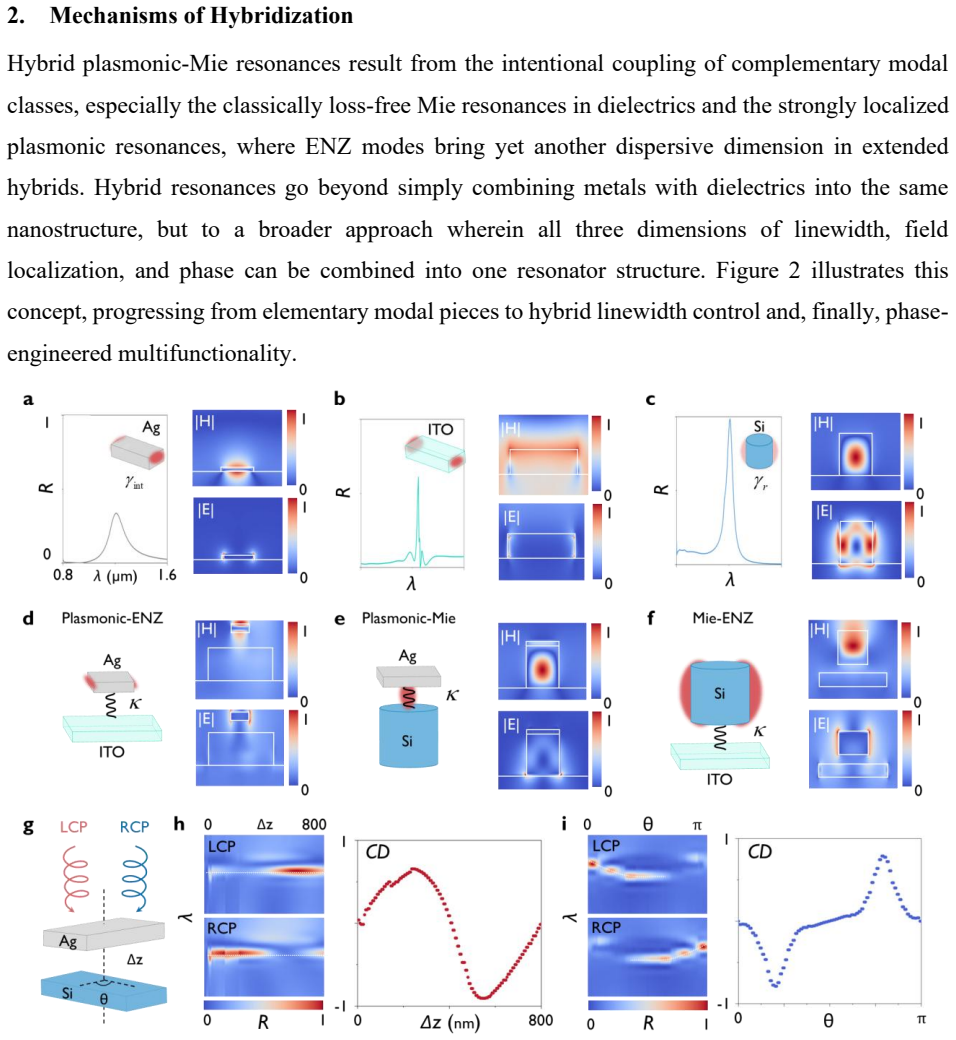
Hybridization of resonances is known to overcome inherent limitations of individual systems, enabling advanced functionalities and applications. Here we discuss hybrid plasmonic-Mie resonators that emerged recently as a promising direction in advancing nanophotonic structures by synergistically combining the strong near-field enhancement of plasmonic components with the low-loss, multipolar resonances of dielectric Mie elements. We review the recent progress in the field, encompassing the fundamental physical principles, structural design strategies, material platforms, computational optimization approaches, and representative device implementations. Our discussion starts by evaluating the complementary characteristics of plasmonic and Mie resonances followed by a description of the coupling between these resonances in order to boost light-matter interactions. Afterward, we explore the performance of efficient hybrid resonators for different application areas. Apart from the conventional metal-dielectric systems, we consider the recent class of epsilon-near-zero (ENZ) materials, which can provide unique advantages in terms of field localization, phase engineering, and energy flow management in the vicinity of zero-permittivity conditions, offering more flexibility in designing hybrid nano-optical devices. Lastly, we point out potential research avenues aiming to improve functional and efficient nanophotonic devices, especially those involving emerging topological material systems, such as Sb2Te3, Bi2Te3, Bi2Se3, combining plasmonic amplification, dielectric confinement, and spin-dependent optical behavior.
Editorial analysis
A structured set of objections, weighed in public.
Referee Report
Summary. The manuscript is a review of hybrid plasmonic-Mie resonators in nanophotonics. It evaluates the complementary characteristics of plasmonic resonances (strong near-field enhancement) and dielectric Mie resonances (low-loss multipolar responses), describes mechanisms for their coupling to enhance light-matter interactions, surveys structural design strategies, material platforms, and computational optimization, reports on application performance, extends the discussion to epsilon-near-zero (ENZ) materials for field localization and phase engineering, and identifies future directions involving topological materials such as Sb2Te3, Bi2Te3, and Bi2Se3.
Significance. If the synthesis accurately reflects the cited literature, the review provides a useful consolidation of how hybrid systems can combine plasmonic enhancement with dielectric low-loss properties to improve nanophotonic device performance. The coverage of ENZ extensions and emerging topological materials adds timely context for researchers working on efficient light-matter interaction platforms.
minor comments (2)
- Abstract: the final sentence listing topological materials is lengthy and could be split or rephrased for improved readability while retaining the key examples.
- The review would benefit from a concise summary table (perhaps in the applications section) compiling representative performance metrics (e.g., enhancement factors or Q-values) from the cited hybrid resonator works to make the synergistic-gain claims more immediately accessible.
Simulated Author's Rebuttal
We thank the referee for the positive assessment of our review on hybrid plasmonic-Mie resonators and for recommending minor revision. The referee's summary accurately captures the manuscript's scope, including the complementary strengths of plasmonic and Mie resonances, coupling mechanisms, material platforms, ENZ extensions, and future directions with topological materials. We appreciate the recognition of the timely context for nanophotonic applications.
Circularity Check
Review article with no derivation chain or fitted predictions
full rationale
This manuscript is explicitly a review paper that summarizes principles, design strategies, material platforms, and applications of hybrid plasmonic-Mie resonators drawn from prior literature. It contains no new equations, no quantitative predictions, no fitted parameters, and no derivation steps that could reduce to self-referential inputs. The central claims rest on synthesis of established complementary properties (plasmonic near-field enhancement and dielectric low-loss multipoles) rather than any internal construction or self-citation load-bearing argument. No circularity is present.
Axiom & Free-Parameter Ledger
Lean theorems connected to this paper
-
IndisputableMonolith/Cost/FunctionalEquation.leanwashburn_uniqueness_aczel unclear?
unclearRelation between the paper passage and the cited Recognition theorem.
The essential physics of hybrid plasmonic-Mie resonances can be captured by a minimal coupled-mode description... Γ± ∼ α±γ_r + β±γ_int
What do these tags mean?
- matches
- The paper's claim is directly supported by a theorem in the formal canon.
- supports
- The theorem supports part of the paper's argument, but the paper may add assumptions or extra steps.
- extends
- The paper goes beyond the formal theorem; the theorem is a base layer rather than the whole result.
- uses
- The paper appears to rely on the theorem as machinery.
- contradicts
- The paper's claim conflicts with a theorem or certificate in the canon.
- unclear
- Pith found a possible connection, but the passage is too broad, indirect, or ambiguous to say the theorem truly supports the claim.
Reference graph
Works this paper leans on
-
[1]
1 Rezaei, S. D. et al. Tri-functional metasurface enhanced with a physically unclonable function. Materials Today 62, 51-61 (2023). 2 Ha, S. T., Li, Q., Yang, J. K., Demir, H. V., Brongersma, M. L. & Kuznetsov, A. I. Optoelectronic metadevices. Science 386, eadm7442 (2024). 3 Prasad, P. N. Nanophotonics. (John Wiley & Sons, 2004). 4 Chengfeng, P., Shutao,...
work page 2023
-
[2]
Fedyanin, A. A. Magneto -optical response enhanced by Mie resonances in nanoantennas. Acs Photonics 4, 2390-2395 (2017). 74 Chen, W. et al. Broadband solar metamaterial absorbers empowered by transformer‐based deep learning. Advanced Science 10, 2206718 (2023). 75 Chen, W. et al. All‐Dielectric SERS Metasurface with Strong Coupling Quasi‐BIC Energized by ...
work page 2017
discussion (0)
Sign in with ORCID, Apple, or X to comment. Anyone can read and Pith papers without signing in.