REVIEW 3 major objections 4 minor 57 references
Differential 6-DOF Pose Estimation with Provable First-Order Immunity to Camera Calibration Errors
T0 review · 3 major / 4 minor · reviewed 2026-08-06 · deepseek-v4-flash
Pith's one-line read The paper establishes that 6-DOF platform motion can be recovered directly from inter-frame image displacements, with translational camera-to-platform calibration errors canceling exactly and rotational errors reduced to a bounded…
desk verdict A genuinely new differential 3D-2D formulation with an elegant exact translation-immunity proof, but the reference-pose initialization error is not analyzed and could limit the claims for truly moving platforms. read the letter →
The pith
A machine-rendered reading of the paper's core claim, the machinery that carries it, and where it could break.
The reading
What carries the argument
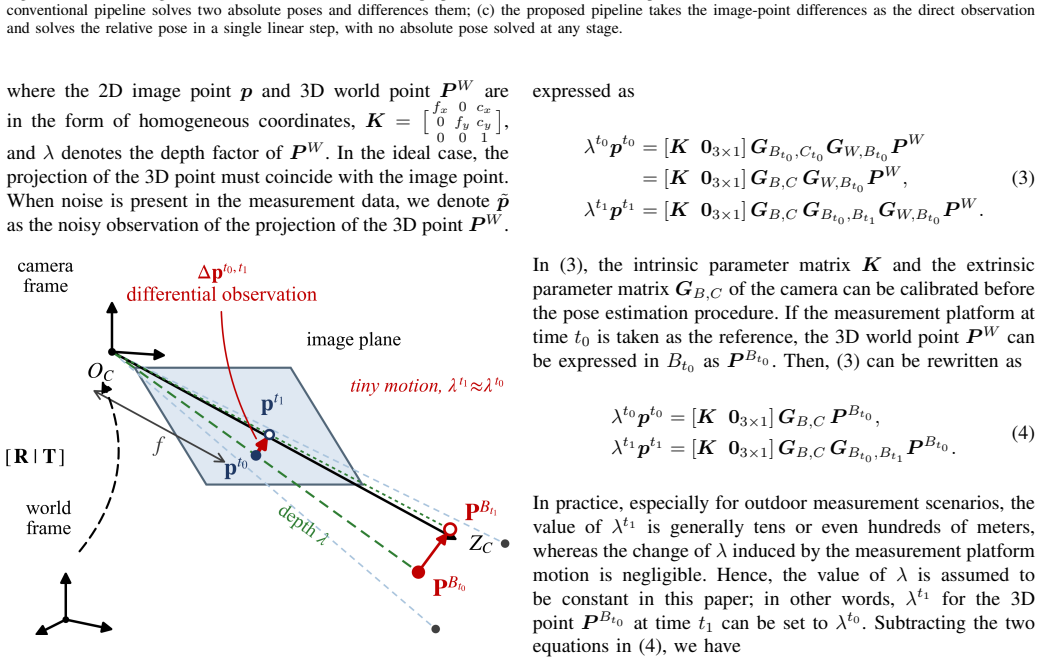
The central object is the differential projection constraint of Eqs. (8)–(10), Δp_{t0,t1} = (1/λ_{t0}) K R_{B,C} [I3 − [P_B]×] η, where Δp is the inter-frame image displacement, K the intrinsic matrix, R_{B,C} the rotational part of the camera-to-platform extrinsics, P_B the control-point coordinates in the platform frame at the reference epoch, and η ∈ se(3) the six motion parameters. The matrix M = (1/λ) K R_{B,C} [I3 − [P_B]×] is what carries the argument: because it contains only R_{B,C} and not the extrinsic translation T_{B,C}, translational calibration errors drop out of the model, and the product structure of the perturbation term shows why rotational errors are bounded by calibration error times motion magnitude. The depth-invariance approximation λ_{t1} ≈ λ_{t0} is the second load-bearing mechanism; the paper proves the discarded residual is exactly (Δλ/λ)(p1 − c), a radial 'zoom' about the principal point, and derives the measurable-axial-displacement bound |T_Z| ≤ λσ/ρ_max.
What would settle it
Take a calibrated rig with known ground-truth extrinsic translation, apply a deliberately wrong translational extrinsic (say 50 mm) while keeping the reference platform pose at t0 exactly correct, and measure the monocular solver's translation RMSE over the ±30 arcmin, 0.5-pixel regime; the paper predicts flat RMSE, so any systematic growth with the added translation error would falsify Conclusion 1. A second, stronger check is to initialize the reference pose at t0 from a PnP solve on the first frame and repeat; if translation RMSE then scales with the extrinsic translation error, the immunity is limited to the idealized reference-frame setup.
Extended reading notes
Core claim
By writing the platform motion between t0 and t1 as exp(η) ≈ E + Σ η_j G_j on se(3) and assuming the depth of each control point is nearly invariant over the interval, the paper derives the linear constraint Δp = Mη, with M = (1/λ) K R_{B,C} [I3 − [P_B]×]. The design matrix depends on the camera intrinsics, the rotational part of the camera-to-platform extrinsics, and the control-point coordinates in the platform frame at t0, but not on the translational part of the extrinsics. Substituting a perturbed extrinsic G_error = exp(μ) ≈ E + Σ μ_j G_j into this constraint shows that the μ_0, μ_1, μ_2 (translation) terms vanish identically, while only μ_3, μ_4, μ_5 (rotation) terms survive as a bilinear perturbation ΔG2 = Σ μ_j G_j G_{B,C} Σ η_j G_j, whose norm is bounded by the calibration error times the motion magnitude. The paper calls this first-order immunity and proves, for a multi-camera rig, that each camera block inherits the translation immunity and that complementary viewing directions attenuate rotational-error effects through the weighted average in the normal equations.
Load-bearing premise
The load-bearing premise is that the platform's own pose at the reference time t0, together with the control-point coordinates and depths in that frame, is known without error; if the reference frame is initialized from a noisy absolute pose estimate, the claimed exact translation immunity need not hold.
Editorial extensions
If this is right
- If the central claim holds, 6-DOF micro-motion accuracy is set by image noise and rotational calibration quality, not by how precisely the camera's mounting position on the platform is known.
- The same linear system works for monocular and arbitrary rigid multi-camera configurations, so a rig with complementary viewing directions can dilute rotational calibration error roughly as the square root of the number of cameras.
- The bias-eliminated estimator makes long-term or network-averaged results trustworthy: ordinary least squares leaves a systematic bias that does not vanish with more points, while the corrected estimator is consistent and asymptotically normal.
- The observability theorem gives a practical rule: at least three non-collinear control points are needed, and collinear points annihilate a screw motion, so the design matrix rank drops to five.
- The approximation bounds define when the linear solver is valid: axial translation should stay within roughly λσ/ρ_max and rotation within about √(2σ/f), matching the reported ±30 arcmin working range.
Reading between the lines
- Beyond the paper: the exact translation immunity is proved for the differential model after the reference frame at t0 is fixed, but it does not automatically extend to an end-to-end system in which that reference pose is itself estimated from the first image; a PnP-initialized pipeline could reintroduce translation errors through the reference frame.
- Beyond the paper: because the design matrix depends only on the rotational part of the extrinsics, the method could in principle be paired with a rotation-only calibration procedure, relaxing total-station or hand-eye calibration requirements in field deployment.
- Beyond the paper: the depth-invariance residual is a pure radial zoom about the principal point, which suggests a testable extension in which a first pass estimates motion and a second pass corrects for the zoom using the estimated depth change, extending the axial working range.
- Beyond the paper: a natural next experiment is to feed the solver with learned feature correspondences and measure whether the translation immunity holds under realistic matching noise, since the theoretical cancellation is independent of how correspondences are obtained.
Editorial analysis
A structured set of objections, weighed in public.
Referee Report
Summary. The paper proposes a differential 6-DOF platform-motion estimation method that recovers inter-frame motion directly from image-point displacements and known 3D control points, bypassing per-frame absolute pose estimation. Starting from the perspective projection equations, the authors subtract two epochs, invoke a depth-invariance approximation, and use a first-order SE(3) motion model to obtain a linear system (Eqs. (5)-(10)). They claim exact cancellation of translational camera-to-platform extrinsic calibration errors, a bounded effect of rotational extrinsic errors, generic observability conditions, a Cramér–Rao lower bound, and a bias-eliminated consistent estimator. Synthetic experiments for monocular and binocular configurations and a summary of real-world tests are provided, with the proposed linear solver showing sub-millisecond runtime and the best or joint-best accuracy among the compared PnP and generalized-PnP baselines.
Significance. If the claims hold, this is a valuable contribution to high-precision micro-motion estimation: the differential formulation turns a nonlinear 6-DOF relative-pose problem into a linear solve, provides an exact algebraic cancellation of a common calibration-error component, and includes a closed-form bias correction with an asymptotic consistency proof. The paper supplies machine-checkable derivations for the core identities (e.g., the depth-invariance residual in Proposition 1 is an exact identity), an observability analysis, a CRLB, and reproducible simulated comparisons. The novelty of directly using inter-frame displacements to avoid absolute pose estimation is real, and the immunity result, even if only within the linearized model, is a useful theoretical characterization.
major comments (3)
- [Section III-C, Eqs. (4)-(9)] The derivation implicitly assumes that the world-to-platform transformation at the reference epoch, G_W,Bt0, is known exactly, because it rewrites P_W as P_Bt0 without explaining how this pose is obtained. For a moving platform this pose must be estimated (typically by PnP at t0), and errors in it perturb the control-point coordinates P_Bt0 and depths λ_i that enter the design matrix M in Eq. (9). Conclusion 1 covers only errors in the camera-to-platform extrinsic G_B,C, not errors in P_Bt0. The synthetic experiments in Section IV-A use noise-free control-point coordinates in the platform frame, so this error source is never exercised. Please state the assumption explicitly, derive the first-order effect of reference-pose errors on the estimated η, and add a numerical experiment (e.g., a 1-arcmin reference rotation or 30-mm reference translation error). As written, the claim that the method 'avoids independent absolute-pose estimation' and the reported accuracy cannot be extended to mobile platforms without this analysis.
- [Section III-E, Eqs. (18)-(20), Theorem 1] The bias-eliminated estimator is derived under the assumption that the only regressor noise is image localization noise at t0 (e0,i in Eq. (18)). Deterministic errors in P_Bt0 from the reference-pose or surveyed-coordinate estimates create an additional component in ΔM_i proportional to the Jacobian of M_i with respect to P_Bt0, and the correction terms in (19)-(20) no longer remove the bias. Remark 1 mentions surveyed-coordinate errors but provides no closed-form correction and no experiment for the common-mode reference-pose case that is the actual initialization scenario for a moving platform. Since the abstract and Section III-E claim a 'provably consistent' estimator, the proof and validation need to cover this case, or the claim must be scoped to settings where the reference pose is known exactly.
- [Section III-D, Conclusion 2] The statement that rotational extrinsic errors produce a 'bounded perturbation' is not quantified anywhere in the main text; no explicit bound is given, and the proof is deferred to the supplemental material. Given the title's emphasis on 'provable first-order immunity,' the main text should at least state the functional form of the bound, e.g., ||δη|| ≤ C(μ_R) · ||η|| with C expressed in terms of the calibration error and the singular values of the stacked design matrix M. Without this, a central advertised property cannot be evaluated from the paper alone.
minor comments (4)
- [Figure 15] The text immediately after Fig. 15 contains garbled character sequences (e.g., '/uni00000014/uni00000013/uni00000014' and similar) that appear to be an encoding artifact; please remove or regenerate these lines before publication.
- [Table II] Several entries in Table II are em-dashes (e.g., the median translation for LHM, EPnP+GN, DLS, and ASPnP); please clarify whether these values were not computed or were excluded for a specific reason, and report the numbers if available.
- [Section III-F, Eq. (22)] The CRLB in Eq. (22) is stated for Gaussian noise with a noise-free design matrix M, but in practice M is constructed from noisy measurements; the paper should clarify that this is an oracle bound and that the bias-eliminated estimator's asymptotic efficiency is with respect to this oracle.
- [Section IV-C] The real-world validation is reported only as a summary with details deferred to the supplemental material; please ensure that the final submission includes the complete lab and bridge experiments, or explicitly state that the supplemental results are part of the accepted manuscript.
Circularity Check
No significant circularity: the central immunity, bias, observability, and CRLB results are derived from first principles; the paper's self-citations are not load-bearing.
full rationale
The derivation chain is self-contained. Equations (4)-(10) follow algebraically from the perspective projection equations, the depth-invariance assumption, and the first-order SE(3) representation; no step introduces the target result as an input. Conclusion 1's exact immunity to translational extrinsic errors is an algebraic cancellation: because the vector (G_Bt0,Bt1 - E)P has zero fourth coordinate, the translational generators G0-G2 annihilate the homogeneous component, so the translational part of G_error drops out exactly (Eqs. (13)-(14) and Conclusion 1). This is a proven identity, not a fitted or assumed equivalence. Conclusions 2-4, Theorem 2 (observability), Theorem 3 (CRLB), Proposition 1 (validity boundaries), and the bias-eliminated estimator (Eqs. (18)-(21)) are all derived from stated noise and geometry assumptions rather than from data fitting or from the authors' prior work. The synthetic experiments reuse the same model, but that is a closed-loop implementation check, not a logical circularity. Self-citations ([8]-[10], [21], [47]) appear in related work and as baselines and do not carry the load of the main claims. The main unaddressed risk is the reference-pose initialization: P_Bt0 must be error-free for the stated immunity, and Section III-C does not analyze errors in P_Bt0; Remark 1 only gestures at surveyed-coordinate corrections without a closed form or experiment. That is a completeness and accuracy limitation, not a circularity. No prediction in this paper reduces by construction to its inputs.
Assumptions & free parameters
free parameters (2)
- Noise level sigma^2 for bias correction =
Estimated from residuals (Eq. 21); true value used in simulations
- Divergence filter threshold =
1 degree rotation error
assumptions (6)
- domain assumption The inter-frame motion is small enough that exp(eta) is approximated by E + sum eta_j G_j to first order
- domain assumption The depth of each control point is approximately unchanged between frames, lambda_t1 approximately equals lambda_t0
- domain assumption Camera intrinsics K are known exactly
- domain assumption Extrinsic calibration error is small and modeled as left multiplication, G_error = exp(mu) approximately E + sum mu_j G_j
- ad hoc to paper The reference platform pose at time t0 (world-to-platform transformation) is known, so control-point coordinates P_Bt0 and depths lambda_i are available
- standard math Noise terms are i.i.d., zero-mean with finite fourth moments, and the normal matrix Q = lim (1/n) sum M_i^T M_i is positive definite
Cite this review
Pith. "Pith review of Differential 6-DOF Pose Estimation with Provable First-Order Immunity to Camera Calibration Errors." pith.science (2026). https://pith.science/paper/IMTWMAAV
@misc{pith2026260804673,
  author       = {Pith},
  title        = {Pith review of: Differential 6-DOF Pose Estimation with Provable First-Order Immunity to Camera Calibration Errors},
  year         = {2026},
  howpublished = {\url{https://pith.science/paper/IMTWMAAV}},
  note         = {Machine review of arXiv:2608.04673}
}
read the original abstract
Accurate six-degree-of-freedom (6-DOF) motion estimation is essential for robotic manipulation, autonomous systems, and structural displacement monitoring. Conventional 3D-2D methods estimate absolute camera poses independently at each time and recover platform motion through camera-to-platform extrinsics, making them sensitive to extrinsic calibration errors, especially for micromotion. We present a differential pose estimation method that directly recovers platform motion from inter-frame image displacements and known 3D control points. By differencing perspective projection equations, using a depth-invariance approximation, and modeling motion on SE(3), the method avoids independent absolute-pose estimation and supports both monocular and multi-camera systems. We prove that translational extrinsic errors cancel exactly, while rotational errors induce a bounded perturbation determined by calibration error, motion magnitude, and observation geometry. We also derive generic observability conditions, a Cramer-Rao lower bound, and a bias-eliminated consistent estimator, and characterize the validity limits of the approximations. Extensive synthetic and real-world experiments establish a new state of the art for 6-DOF platform micromotion estimation, outperforming representative PnP and generalized-PnP methods in accuracy, calibration robustness, and computational efficiency. With five control points and 0.5-pixel image noise, the monocular solver obtains a combined pitch-yaw rotation RMSE of 10.09 arcsec, a translation RMSE of 3.70 mm, and a runtime of 0.34 ms. The binocular solver achieves a rotation RMSE of 10.58 arcsec, a translation RMSE of 3.91 mm, and a runtime of 0.27 ms. Code will be released upon publication at https://github.com/zyoungszu/pami2026.
Figures


Figures from the paper (12 more)


Reference graph
Works this paper leans on
-
[1]
Hi-slam2: Geometry-aware gaussian slam for fast monocular scene reconstruction,
W. Zhang, Q. Cheng, D. Skuddis, N. Zeller, D. Cremers, and N. Haala, “Hi-slam2: Geometry-aware gaussian slam for fast monocular scene reconstruction,”IEEE Transactions on Robotics, vol. 41, pp. 6478–6493, 2025
2025
-
[2]
Dvn-slam: Dynamic visual neural slam based on local-global encoding,
W. Wu, G. Wang, T. Deng, S. Ægidiu, S. Shanks, V . Modugno, D. Kanoulas, and H. Wang, “Dvn-slam: Dynamic visual neural slam based on local-global encoding,” in2025 IEEE International Conference on Robotics and Automation (ICRA). IEEE, 2025, pp. 14 564–14 571
work page 2025
-
[3]
Y . Ge, L. Zhang, Y . Wu, and D. Hu, “Pipo-slam: Lightweight visual- inertial slam with preintegration merging theory and pose-only de- scriptions of multiple view geometry,”IEEE Transactions on Robotics, vol. 40, pp. 2046–2059, 2024
work page 2024
-
[4]
Orb-slam3: An accurate open-source library for visual, visual–inertial, and multimap slam,
C. Campos, R. Elvira, J. J. G. Rodr ´ıguez, J. M. M. Montiel, and J. D. Tard ´os, “Orb-slam3: An accurate open-source library for visual, visual–inertial, and multimap slam,”IEEE Transactions on Robotics, vol. 37, no. 6, pp. 1874–1890, 2021
2021
-
[5]
X. Han, S. Wang, X. Huang, and Z. Kan, “Posefusion: Multi-scale keypoint correspondence for monocular camera-to-robot pose estimation in robotic manipulation,” in2024 IEEE International Conference on Robotics and Automation (ICRA). IEEE, 2024, pp. 795–801
work page 2024
-
[6]
Ctrnet- x: Camera-to-robot pose estimation in real-world conditions using a single camera,
J. Lu, Z. Liang, T. Xie, F. Richter, S. Lin, S. Liu, and M. C. Yip, “Ctrnet- x: Camera-to-robot pose estimation in real-world conditions using a single camera,” in2025 IEEE International Conference on Robotics and Automation (ICRA). IEEE, 2025, pp. 1914–1920
work page 2025
-
[7]
Mobile aloha: Learning bimanual mobile manipulation using low-cost whole-body teleoperation,
Z. Fu, T. Z. Zhao, and C. Finn, “Mobile aloha: Learning bimanual mobile manipulation using low-cost whole-body teleoperation,” in8th Annual Conference on Robot Learning, 2024
2024
-
[8]
B. Hu, W. Chen, Y . Zhang, Y . Yin, Q. Yu, X. Liu, and X. Ding, “Vision-based multi-point real-time monitoring of dynamic displacement of large-span cable-stayed bridges,”Mechanical systems and signal processing, vol. 204, p. 110790, 2023
work page 2023
Show all 57 references
-
[9]
Displace- ment measurement of large structures using nonoverlapping field of view multi-camera systems under six degrees of freedom ego-motion,
Q. Yu, Y . Yin, Y . Zhang, W. Chen, B. Hu, and X. Liu, “Displace- ment measurement of large structures using nonoverlapping field of view multi-camera systems under six degrees of freedom ego-motion,” Computer-Aided Civil and Infrastructure Engineering, vol. 38, no. 11, pp. 14...
2023
-
[10]
A vision monitoring system for multipoint deflection of large-span bridge based on camera networking,
Y . Yin, Q. Yu, B. Hu, Y . Zhang, W. Chen, X. Liu, and X. Ding, “A vision monitoring system for multipoint deflection of large-span bridge based on camera networking,”Computer-Aided Civil and Infrastructure Engineering, vol. 38, no. 13, pp. 1879–1891, 2023
2023
-
[11]
An efficient solution to the five-point relative pose prob- lem,
D. Nist ´er, “An efficient solution to the five-point relative pose prob- lem,”IEEE Transactions on Pattern Analysis and Machine Intelligence, vol. 26, no. 6, pp. 756–770, 2004
2004
-
[12]
From correspondences to pose: Non- minimal certifiably optimal relative pose without disambiguation,
J. Tirado-Gar ´ın and J. Civera, “From correspondences to pose: Non- minimal certifiably optimal relative pose without disambiguation,” in Proceedings of the IEEE/CVF Conference on Computer Vision and Pattern Recognition, 2024, pp. 403–412
2024
-
[13]
Epnp: An accurate o(n) solution to the pnp problem,
V . Lepetit, F. Moreno-Noguer, and P. Fua, “Epnp: An accurate o(n) solution to the pnp problem,”International Journal of Computer Vision, vol. 81, no. 2, pp. 155–166, 2009
2009
-
[14]
A novel parametrization of the perspective-three-point problem for a direct computation of absolute camera position and orientation,
L. Kneip, D. Scaramuzza, and R. Siegwart, “A novel parametrization of the perspective-three-point problem for a direct computation of absolute camera position and orientation,” inProceedings of the IEEE/CVF Conference on Computer Vision and Pattern Recognition. IEEE, 2011, pp....
2011
-
[15]
Generalized maximum likelihood estimation for perspective-n-point problem,
T. Zhan, C. Xu, C. Zhang, and K. Zhu, “Generalized maximum likelihood estimation for perspective-n-point problem,”IEEE Robotics and Automation Letters, vol. 10, no. 2, pp. 1752–1759, 2025
2025
-
[16]
Complete solution classification for the perspective-three-point problem,
X.-S. Gao, X.-R. Hou, J. Tang, and H.-F. Cheng, “Complete solution classification for the perspective-three-point problem,”IEEE Transac- tions on Pattern Analysis and Machine Intelligence, vol. 25, no. 8, pp. 930–943, 2003
2003
-
[17]
An efficient algebraic solution to the perspective-three-point problem,
T. Ke and S. I. Roumeliotis, “An efficient algebraic solution to the perspective-three-point problem,” inProceedings of the IEEE Confer- ence on Computer Vision and Pattern Recognition, 2017, pp. 7225–7233
2017
-
[18]
A simple direct solution to the perspective-three-point problem,
G. Nakano, “A simple direct solution to the perspective-three-point problem,” inBMVC, 2019, p. 26
2019
-
[19]
Lambda twist: An accurate fast robust perspective three point (p3p) solver,
M. Persson and K. Nordberg, “Lambda twist: An accurate fast robust perspective three point (p3p) solver,” inProceedings of the European Conference on Computer Vision (ECCV), 2018, pp. 318–332. PREPRINT SUBMITTED TO IEEE TRANSACTIONS ON PATTERN ANALYSIS AND MACHINE INTELLIGENCE 16
2018
-
[20]
Revisiting the p3p problem,
Y . Ding, J. Yang, V . Larsson, C. Olsson, and K. ˚Astr¨om, “Revisiting the p3p problem,” inProceedings of the IEEE/CVF Conference on Computer Vision and Pattern Recognition, 2023, pp. 4872–4880
2023
-
[21]
Finding degenerate conics by in-plane rotations: A direct perspective- three-point solver,
Y . Zhang, B. Wang, Y . Zhang, Z. Lin, W. Chen, X. Liu, and Q. Yu, “Finding degenerate conics by in-plane rotations: A direct perspective- three-point solver,”Robotics and Autonomous Systems, vol. 185, p. 104897, 2025
2025
-
[22]
Fast and globally convergent pose estimation from video images,
C.-P. Lu, G. D. Hager, and E. Mjolsness, “Fast and globally convergent pose estimation from video images,”IEEE Transactions on Pattern Analysis and Machine Intelligence, vol. 22, no. 6, pp. 610–622, 2000
2000
-
[23]
A robust o(n) solution to the perspective- n-point problem,
S. Li, C. Xu, and M. Xie, “A robust o(n) solution to the perspective- n-point problem,”IEEE Transactions on Pattern Analysis and Machine Intelligence, vol. 34, no. 7, pp. 1444–1450, 2012
2012
-
[24]
A simple, robust and fast method for the perspective-n-point problem,
P. Wang, G. Xu, Y . Cheng, and Q. Yu, “A simple, robust and fast method for the perspective-n-point problem,”Pattern Recognition Letters, vol. 108, pp. 31–37, 2018
2018
-
[25]
A direct least-squares (dls) method for pnp,
J. A. Hesch and S. I. Roumeliotis, “A direct least-squares (dls) method for pnp,” inProceedings of the IEEE International Conference on Computer Vision. IEEE, 2011, pp. 383–390
2011
-
[26]
Revisiting the pnp problem: A fast, general and optimal solution,
Y . Zheng, Y . Kuang, S. Sugimoto, K. Astrom, and M. Okutomi, “Revisiting the pnp problem: A fast, general and optimal solution,” in Proceedings of the IEEE International Conference on Computer Vision, 2013, pp. 2344–2351
2013
-
[27]
An efficient and accurate algorithm for the perspecitve-n-point problem,
L. Zhou and M. Kaess, “An efficient and accurate algorithm for the perspecitve-n-point problem,” inIEEE/RSJ International Conference on Intelligent Robots and Systems (IROS). IEEE, 2019, pp. 6245–6252
2019
-
[28]
A consistently fast and globally optimal solution to the perspective-n-point problem,
G. Terzakis and M. Lourakis, “A consistently fast and globally optimal solution to the perspective-n-point problem,” inEuropean Conference on Computer Vision. Springer, 2020, pp. 478–494
2020
-
[29]
A globally optimal method for the pnp problem with mrp rotation parameterization,
M. Lourakis and G. Terzakis, “A globally optimal method for the pnp problem with mrp rotation parameterization,” in25th International Conference on Pattern Recognition (ICPR). IEEE, 2021, pp. 3058– 3063
2021
-
[30]
Very fast solution to the pnp problem with algebraic outlier rejection,
L. Ferraz, X. Binefa, and F. Moreno-Noguer, “Very fast solution to the pnp problem with algebraic outlier rejection,” inProceedings of the IEEE Conference on Computer Vision and Pattern Recognition, 2014, pp. 501–508
2014
-
[31]
Solving the pnp problem with anisotropic orthogonal procrustes analysis,
V . Garro, F. Crosilla, and A. Fusiello, “Solving the pnp problem with anisotropic orthogonal procrustes analysis,” in2012 Second Interna- tional Conference on 3D Imaging, Modeling, Processing, Visualization & Transmission. IEEE, 2012, pp. 262–269
2012
-
[32]
A novel iterative solution to the perspective-n-point problem via cost function approximation,
L. Zhou, Z. Wei, and X. Wang, “A novel iterative solution to the perspective-n-point problem via cost function approximation,”IEEE Transactions on Robotics, 2025
2025
-
[33]
Cpnp: Consistent pose estimator for perspective-n-point problem with bias elimination,
G. Zeng, S. Chen, B. Mu, G. Shi, and J. Wu, “Cpnp: Consistent pose estimator for perspective-n-point problem with bias elimination,” in2023 IEEE International Conference on Robotics and Automation (ICRA), 2023, pp. 1940–1946
2023
-
[34]
Efficient solution to pnp problem based on vision geometry,
Q. Sun, T. Zhang, G. Zhang, K. Wang, D. Zhu, J. Li, and X. Zhang, “Efficient solution to pnp problem based on vision geometry,”IEEE Robotics and Automation Letters, vol. 9, no. 4, pp. 3100–3107, 2023
2023
-
[35]
Quadratic pose estimation problems: Globally optimal so- lutions, solvability/observability analysis, and uncertainty description,
J. Wu, Y . Zheng, Z. Gao, Y . Jiang, X. Hu, Y . Zhu, J. Jiao, and M. Liu, “Quadratic pose estimation problems: Globally optimal so- lutions, solvability/observability analysis, and uncertainty description,” IEEE Transactions on Robotics, vol. 38, no. 5, pp. 3314–3335, 2022
2022
-
[36]
Optimal dlt-based solutions for the perspective-n-point,
S. Henry and J. A. Christian, “Optimal dlt-based solutions for the perspective-n-point,”arXiv preprint arXiv:2410.14164, 2024
2024 arXiv
-
[37]
Bias- eliminated pnp for stereo visual odometry: provably consistent and large- scale localization,
G. Zeng, Y . Shen, Z. Hong, Y . Hong, V . Ila, G. Shi, and J. Wu, “Bias- eliminated pnp for stereo visual odometry: provably consistent and large- scale localization,”IEEE Robotics and Automation Letters, 2025
2025
-
[38]
On pose recovery for generalized visual sensors,
C.-S. Chen and W.-Y . Chang, “On pose recovery for generalized visual sensors,”IEEE Transactions on Pattern Analysis and Machine Intelligence, vol. 26, no. 7, pp. 848–861, 2004
2004
-
[39]
A minimal solution to the generalised 3-point pose problem,
D. Nist ´er and H. Stew ´enius, “A minimal solution to the generalised 3-point pose problem,”Journal of Mathematical Imaging and Vision, vol. 27, no. 1, pp. 67–79, 2007
2007
-
[40]
Minimal solutions for the multi- camera pose estimation problem,
B. Liu, F. Fraundorfer, and G. H. Lee, “Minimal solutions for the multi- camera pose estimation problem,”The International Journal of Robotics Research, vol. 34, no. 7, pp. 837–848, 2015
2015
-
[41]
A simple and robust solution to the minimal general pose estimation,
P. Miraldo and H. Araujo, “A simple and robust solution to the minimal general pose estimation,” inIEEE International Conference on Robotics and Automation (ICRA). IEEE, 2014, pp. 2119–2125
2014
-
[42]
Efficient intersection of three quadrics and applications in computer vision,
Z. Kukelova, J. Heller, and A. Fitzgibbon, “Efficient intersection of three quadrics and applications in computer vision,” inProceedings of the IEEE Conference on Computer Vision and Pattern Recognition, 2016, pp. 1799–1808
2016
-
[43]
Using multi-camera systems in robotics: Efficient solutions to the npnp problem,
L. Kneip, P. Furgale, and R. Siegwart, “Using multi-camera systems in robotics: Efficient solutions to the npnp problem,” in2013 IEEE International Conference on Robotics and Automation. IEEE, 2013, pp. 3770–3776
2013
-
[44]
Globally optimal o(n) solution to the pnp problem for general camera models,
G. Schweighofer and A. Pinz, “Globally optimal o(n) solution to the pnp problem for general camera models,” inBMVC, 2008, pp. 1–10
2008
-
[45]
Upnp: An optimal o(n) solution to the absolute pose problem with universal applicability,
L. Kneip, H. Li, and Y . Seo, “Upnp: An optimal o(n) solution to the absolute pose problem with universal applicability,” inEuropean conference on computer vision. Springer, 2014, pp. 127–142
2014
-
[46]
A universal, closed-form approach for absolute pose problems,
F. Wientapper, M. Schmitt, M. Fraissinet-Tachet, and A. Kuijper, “A universal, closed-form approach for absolute pose problems,”Computer Vision and Image Understanding, vol. 173, pp. 57–75, 2018
2018
-
[47]
Ea-gpnp: Efficient and accurate generalized- perspective-n-point solution via optimized null space analysis,
Y . Zhang, B. Wang, K. Li, W. Chen, X. Wang, Y . Zhang, Y . Zhang, Y . Guo, and Q. Yu, “Ea-gpnp: Efficient and accurate generalized- perspective-n-point solution via optimized null space analysis,”IEEE Transactions on Robotics, 2026
2026
-
[48]
Poseamm: A unified framework for solving pose problems using an alternating minimization method,
J. Campos, J. R. Cardoso, and P. Miraldo, “Poseamm: A unified framework for solving pose problems using an alternating minimization method,” inInternational Conference on Robotics and Automation (ICRA). IEEE, 2019, pp. 3493–3499
2019
-
[49]
Superpoint: Self- supervised interest point detection and description,
D. DeTone, T. Malisiewicz, and A. Rabinovich, “Superpoint: Self- supervised interest point detection and description,” inProceedings of the IEEE conference on computer vision and pattern recognition workshops, 2018, pp. 224–236
2018
-
[50]
Superglue: Learning feature matching with graph neural networks,
P.-E. Sarlin, D. DeTone, T. Malisiewicz, and A. Rabinovich, “Superglue: Learning feature matching with graph neural networks,” inProceedings of the IEEE/CVF conference on computer vision and pattern recognition, 2020, pp. 4938–4947
2020
-
[51]
Posenet: A convolutional network for real-time 6-dof camera relocalization,
A. Kendall, M. Grimes, and R. Cipolla, “Posenet: A convolutional network for real-time 6-dof camera relocalization,” inProceedings of the IEEE international conference on computer vision, 2015, pp. 2938– 2946
2015
-
[52]
An analysis of the total least squares problem,
G. H. Golub and C. F. Van Loan, “An analysis of the total least squares problem,”SIAM Journal on Numerical Analysis, vol. 17, no. 6, pp. 883– 893, 1980
1980
-
[53]
W. A. Fuller,Measurement Error Models. John Wiley & Sons, 2009
2009
-
[54]
A. W. Van der Vaart,Asymptotic Statistics. Cambridge University Press, 2000, vol. 3
2000
-
[55]
Statistical signal processing: Estimation theory,
S. M. Kay, “Statistical signal processing: Estimation theory,”Prentice Hall, vol. 1, pp. Chapter–3, 1993
1993
-
[56]
Aspnp: An accurate and scalable solution to the perspective-n-point problem,
Y . Zheng, S. Sugimoto, and M. Okutomi, “Aspnp: An accurate and scalable solution to the perspective-n-point problem,”IEICE TRANS- ACTIONS on Information and Systems, vol. 96, no. 7, pp. 1525–1535, 2013
2013
-
[57]
gdls: A scalable solution to the generalized pose and scale problem,
C. Sweeney, V . Fragoso, T. H ¨ollerer, and M. Turk, “gdls: A scalable solution to the generalized pose and scale problem,” inEuropean Conference on Computer Vision. Springer, 2014, pp. 16–31
2014
Reviewed August 6, 2026 · model on record in the stance chip above.
Discussion (0). Continue with ORCID to comment.