Agentic Symbolic Search: Characterizing PDEs Beyond Hand-crafted Expressions, Meshes, and Neural Networks
Pith reviewed 2026-06-26 17:53 UTC · model grok-4.3
The pith
Agentic Symbolic Search turns PDE theory into evolved symbolic programs that yield closed-form approximations for previously intractable solution behaviors.
A machine-rendered reading of the paper's core claim, the machinery that carries it, and where it could break.
Core claim
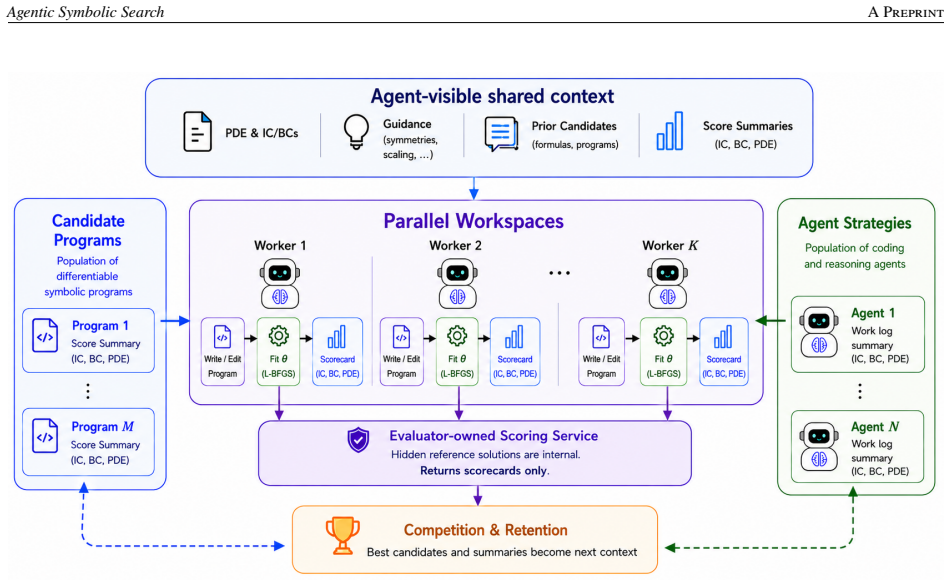
ASYS is a prior-guided framework in which an agent translates PDE theory, public problem constraints, and accumulated search experience into testable differentiable symbolic programs. The mathematical forms are refined under evolutionary search, while their continuous parameters are fit by gradient-based optimization. Across five problems spanning bounded dynamics, finite-time blow-up, and free-boundary focusing, ASYS produces interpretable representations including a geometric interface formula for Allen-Cahn 2D dynamics and a nine-parameter contraction law for Keller-Segel chemotactic blow-up in settings where no closed-form description was previously available.
What carries the argument
Agentic Symbolic Search (ASYS), a framework that converts PDE theory into evolutionary-refined differentiable symbolic programs whose parameters are optimized by gradients.
If this is right
- For problems with known analytical forms, ASYS recovers these forms naturally.
- For problems without known forms, ASYS constructs analytical approximations that can guide further mathematical analysis.
- ASYS offers a new paradigm for characterizing PDE solutions beyond hand-crafted expressions, meshes, and neural networks.
Where Pith is reading between the lines
- The discovered symbolic expressions could serve as starting points for proving stability or existence results that were previously inaccessible.
- Applying the same agentic loop to families of related PDEs might expose shared structural patterns across equation classes.
- Coupling ASYS outputs with automated theorem provers could turn the generated formulas into machine-checked statements about long-time behavior.
Load-bearing premise
An agent can reliably convert PDE theory and constraints into symbolic programs whose evolutionary refinement will capture the essential solution structure.
What would settle it
Apply ASYS to a PDE whose exact closed-form solution is known and check whether the method recovers that exact form; or compare the discovered Allen-Cahn interface formula and Keller-Segel contraction law against high-resolution numerical simulations of those equations.
Figures




read the original abstract
Mathematicians understand a PDE solution through mathematical structures rather than tables of computed values. Historically, this has been the product of mathematical analysis, carried out by hand for each problem individually. Neither numerical simulation nor neural networks produce those structures directly. We propose Agentic Symbolic Search (ASYS), a prior-guided framework in which an agent translates PDE theory, public problem constraints, and accumulated search experience into testable differentiable symbolic programs. The mathematical forms are refined under evolutionary search, while their continuous parameters are fit by gradient-based optimization. This makes the search an automated form of inductive-bias injection rather than blind symbolic regression. For problems with known analytical forms, ASYS recovers these forms naturally; for other problems, ASYS constructs analytical approximations which can guide mathematicians toward further analysis. In our experiments, across five problems spanning bounded dynamics, finite-time blow-up, and free-boundary focusing, ASYS produces interpretable representations, including a geometric interface formula for Allen-Cahn 2D dynamics and a nine-parameter contraction law for Keller-Segel chemotactic blow-up, in settings where no closed-form description was previously available. ASYS shows the possibility of a new paradigm for characterizing PDE solutions, beyond handcrafted analytical solutions, mesh-based numerical solutions, and neural network approximations.
Editorial analysis
A structured set of objections, weighed in public.
Referee Report
Summary. The paper introduces Agentic Symbolic Search (ASYS), a framework in which an LLM-based agent translates PDE theory, constraints, and search experience into differentiable symbolic programs. These programs are refined via evolutionary search over their structure while continuous parameters are optimized by gradient descent. The central claim is that ASYS recovers known closed-form solutions on problems where they exist and, on five problems without prior closed forms (bounded dynamics, finite-time blow-up, free-boundary focusing), yields new interpretable representations such as a geometric interface formula for 2D Allen-Cahn dynamics and a nine-parameter contraction law for Keller-Segel chemotactic blow-up.
Significance. If the generated symbolic forms can be shown to encode dominant dynamics rather than incidental fits, the method would constitute a genuine advance in automated discovery of mathematical structure for PDEs, complementing both hand analysis and numerical/neural approaches. The absence of quantitative error metrics, baseline comparisons, ablation studies, or explicit residual definitions in the provided description, however, prevents assessment of whether the reported representations satisfy this standard.
major comments (2)
- Abstract: the claim that ASYS 'produces interpretable representations ... in settings where no closed-form description was previously available' is not accompanied by any quantitative error metrics, baseline comparisons, ablation studies, or explicit definition of how success (e.g., PDE residual, boundary-condition satisfaction, blow-up scaling) was measured; without these the data-to-claim link cannot be verified.
- Abstract (method description): the framework assumes an agent reliably converts PDE theory into 'testable differentiable symbolic programs' whose evolutionary refinement captures essential structure. No concrete operator sets, initial program templates, or residual definitions are supplied, leaving open the possibility that reported forms are over-parameterized approximations rather than mathematically useful characterizations.
Simulated Author's Rebuttal
We thank the referee for the constructive feedback on our manuscript. We address each major comment below and will make revisions to improve clarity and verifiability of the claims.
read point-by-point responses
-
Referee: Abstract: the claim that ASYS 'produces interpretable representations ... in settings where no closed-form description was previously available' is not accompanied by any quantitative error metrics, baseline comparisons, ablation studies, or explicit definition of how success (e.g., PDE residual, boundary-condition satisfaction, blow-up scaling) was measured; without these the data-to-claim link cannot be verified.
Authors: We agree that the abstract would be strengthened by including quantitative support. The full manuscript reports PDE residual norms, comparisons to numerical solutions, and explicit success criteria (residual thresholds, boundary-condition satisfaction, and scaling exponents) in Sections 4–5. We will revise the abstract to incorporate key error metrics and a concise definition of the residual measure used. revision: yes
-
Referee: Abstract (method description): the framework assumes an agent reliably converts PDE theory into 'testable differentiable symbolic programs' whose evolutionary refinement captures essential structure. No concrete operator sets, initial program templates, or residual definitions are supplied, leaving open the possibility that reported forms are over-parameterized approximations rather than mathematically useful characterizations.
Authors: The manuscript specifies the operator sets (arithmetic, differentiation, integration, and PDE-specific operators) in Section 3.1, initial program templates derived from theory in Section 3.2, and residual definitions (including boundary terms and blow-up indicators) in Section 4.2. To make these elements immediately visible, we will add a brief summary of the operator library and residual computation to the abstract. revision: yes
Circularity Check
No significant circularity detected
full rationale
The paper describes ASYS as an agent-driven search process that translates external PDE theory, constraints, and search experience into symbolic programs, which are then refined by evolutionary search and gradient-based parameter fitting. The central outputs (e.g., recovered known forms or new approximations such as the geometric interface or nine-parameter contraction law) are generated results of this search rather than quantities defined by construction from the inputs or from fitted parameters renamed as predictions. No self-definitional equations, load-bearing self-citations, uniqueness theorems imported from the authors, or ansatzes smuggled via citation appear in the abstract or described framework. The derivation chain remains self-contained as a method for inductive-bias injection, with experiments serving as external validation on benchmark problems.
Axiom & Free-Parameter Ledger
axioms (1)
- domain assumption An agent can translate PDE theory, public problem constraints, and accumulated search experience into testable differentiable symbolic programs
Reference graph
Works this paper leans on
-
[1]
Updating quasi-
Nocedal, Jorge , journal=. Updating quasi-. 1980 , doi=
1980
-
[2]
arXiv preprint arXiv:2605.09018 , year=
Evolutionary Ensemble of Agents , author=. arXiv preprint arXiv:2605.09018 , year=
-
[3]
arXiv preprint arXiv:2604.23472 , year=
Escher-Loop: Mutual Evolution by Closed-Loop Self-Referential Optimization , author=. arXiv preprint arXiv:2604.23472 , year=
-
[4]
1992 , publisher=
Genetic Programming: On the Programming of Computers by Means of Natural Selection , author=. 1992 , publisher=
1992
-
[5]
Nature , volume=
Mathematical discoveries from program search with large language models , author=. Nature , volume=. 2024 , publisher=
2024
-
[6]
2025 , doi=
Novikov, Alexander and V. 2025 , doi=
2025
-
[7]
Shojaee, Parshin and Meidani, Kazem and Gupta, Shashank and Farimani, Amir Barati and Reddy, Chandan K. , booktitle=. 2025 , note=. doi:10.48550/arXiv.2404.18400 , pages=
-
[8]
2025 , doi=
Xia, Shijie and Sun, Yuhan and Liu, Pengfei , journal=. 2025 , doi=
2025
-
[9]
2026 , note=
Li, Shanda and Marwah, Tanya and Shen, Junhong and Sun, Weiwei and Risteski, Andrej and Yang, Yiming and Talwalkar, Ameet , journal=. 2026 , note=
2026
-
[10]
2026 , doi=
Du, Jianda and Sun, Youran and Yang, Haizhao , journal=. 2026 , doi=
2026
-
[11]
and Gholami, Amir , journal=
Gaonkar, Saarth and Zheng, Xiang and Xi, Haocheng and Tiwari, Rishabh and Keutzer, Kurt and Morozov, Dmitriy and Mahoney, Michael W. and Gholami, Amir , journal=. 2025 , doi=
2025
-
[12]
and Karniadakis, George Em , journal=
Toscano, Juan Diego and Chen, Daniel T. and Karniadakis, George Em , journal=. 2025 , doi=
2025
-
[13]
2026 , doi=
Toscano, Juan Diego and Chai, Zhaojie and Karniadakis, George Em , journal=. 2026 , doi=
2026
-
[14]
2025 , doi=
Liu, Jianming and Zhu, Ren and Xu, Jian and Ding, Kun and Zhang, Xu-Yao and Meng, Gaofeng and Liu, Cheng-Lin , journal=. 2025 , doi=
2025
-
[15]
2025 , note=
Wuwu, Qingpo and Gao, Chonghan and Chen, Tianyu and Huang, Yihang and Zhang, Yuekai and Wang, Jianing and Li, Jianxin and Zhou, Haoyi and Zhang, Shanghang , booktitle=. 2025 , note=
2025
-
[16]
Journal of Computational Physics , volume=
Physics-informed neural networks: A deep learning framework for solving forward and inverse problems involving nonlinear partial differential equations , author=. Journal of Computational Physics , volume=. 2019 , publisher=
2019
-
[17]
International Conference on Learning Representations , year=
Fourier Neural Operator for Parametric Partial Differential Equations , author=. International Conference on Learning Representations , year=
-
[18]
Learning nonlinear operators via
Lu, Lu and Jin, Pengzhan and Pang, Guofei and Zhang, Zhongqiang and Karniadakis, George Em , journal=. Learning nonlinear operators via. 2021 , doi=
2021
-
[19]
Proceedings of the National Academy of Sciences , volume=
In-context Operator Learning with Data Prompts for Differential Equation Problems , author=. Proceedings of the National Academy of Sciences , volume=. 2023 , doi=
2023
-
[20]
, journal=
Yang, Liu and Osher, Stanley J. , journal=. 2024 , doi=
2024
-
[21]
arXiv preprint arXiv:2404.19756 , year=
Liu, Ziming and Wang, Yixuan and Vaidya, Sachin and Ruehle, Fabian and Halverson, James and Solja. arXiv preprint arXiv:2404.19756 , year=
-
[22]
arXiv preprint arXiv:2001.04385 , year=
Universal differential equations for scientific machine learning , author=. arXiv preprint arXiv:2001.04385 , year=
Pith/arXiv arXiv 2001
-
[23]
Asymptotic Self-Similar Blow-Up Profile for Three-Dimensional Axisymmetric
Wang, Yongji and Lai, Ching-Yao and G. Asymptotic Self-Similar Blow-Up Profile for Three-Dimensional Axisymmetric. Physical Review Letters , volume=. 2023 , doi=
2023
-
[24]
arXiv preprint arXiv:2509.14185 , year=
Discovery of Unstable Singularities , author=. arXiv preprint arXiv:2509.14185 , year=
-
[25]
Journal of Computational Physics , volume=
Multi-stage neural networks: Function approximator of machine precision , author=. Journal of Computational Physics , volume=. 2024 , doi=
2024
-
[26]
, journal=
Wang, Yixuan and Liu, Ziming and Li, Zongyi and Anandkumar, Anima and Hou, Thomas Y. , journal=. High Precision. 2025 , doi=
2025
-
[27]
Investigating the Ability of
Kumar, Dibyakanti and Mukherjee, Anirbit , journal=. Investigating the Ability of. 2024 , doi=
2024
-
[28]
Proceedings of the National Academy of Sciences , volume=
Discovering governing equations from data by sparse identification of nonlinear dynamical systems , author=. Proceedings of the National Academy of Sciences , volume=. 2016 , doi=
2016
-
[29]
Interpretable Machine Learning for Science with
Cranmer, Miles , journal=. Interpretable Machine Learning for Science with. 2023 , doi=
2023
-
[30]
2020 , doi=
Udrescu, Silviu-Marian and Tegmark, Max , journal=. 2020 , doi=
2020
-
[31]
International Conference on Learning Representations , year=
Deep Symbolic Regression: Recovering Mathematical Expressions from Data via Risk-Seeking Policy Gradients , author=. International Conference on Learning Representations , year=
-
[32]
Journal of Machine Learning Research , volume=
Finite Expression Method for Solving High-Dimensional Partial Differential Equations , author=. Journal of Machine Learning Research , volume=. 2025 , note=
2025
-
[33]
Neuro-Symbolic
Oikonomou, Orestis and Lingsch, Levi and Grund, Dana and Mishra, Siddhartha and Kissas, Georgios , journal=. Neuro-Symbolic. 2025 , doi=
2025
-
[34]
Proceedings of the 42nd International Conference on Machine Learning , series=
Closed-form Solutions: A New Perspective on Solving Differential Equations , author=. Proceedings of the 42nd International Conference on Machine Learning , series=. 2025 , note=
2025
-
[35]
Proceedings of the AAAI Conference on Artificial Intelligence , volume=
An Interpretable Approach to the Solutions of High-Dimensional Partial Differential Equations , author=. Proceedings of the AAAI Conference on Artificial Intelligence , volume=. 2024 , doi=
2024
-
[36]
1996 , doi=
Scaling, Self-Similarity, and Intermediate Asymptotics , author=. 1996 , doi=
1996
-
[37]
Physical Review Letters , volume=
Universality and scaling in gravitational collapse of a massless scalar field , author=. Physical Review Letters , volume=. 1993 , doi=
1993
-
[38]
Numerical simulation of singular solutions to the two-dimensional cubic
Sulem, P-L and Sulem, C and Patera, A , journal=. Numerical simulation of singular solutions to the two-dimensional cubic. 1984 , doi=
1984
-
[39]
LeMesurier, B. J. and Papanicolaou, G. C. and Sulem, Catherine and Sulem, Pierre-Louis , journal=. Focusing and Multi-Focusing Solutions of the Nonlinear. 1988 , doi=
1988
-
[40]
On universality of blow-up profile for
Merle, Frank and Rapha. On universality of blow-up profile for. Inventiones Mathematicae , volume=. 2004 , doi=
2004
-
[41]
The blow-up dynamic and upper bound on the blow-up rate for critical nonlinear
Merle, Frank and Rapha. The blow-up dynamic and upper bound on the blow-up rate for critical nonlinear. Annals of Mathematics , volume=. 2005 , doi=
2005
-
[42]
Universal pinching of 3
Eggers, Jens , journal=. Universal pinching of 3. 1993 , doi=
1993
-
[43]
2015 , publisher=
Singularities: Formation, Structure, and Propagation , author=. 2015 , publisher=
2015
-
[44]
Nonlinearity , volume=
The Role of Self-Similarity in Singularities of Partial Differential Equations , author=. Nonlinearity , volume=. 2009 , doi=
2009
-
[45]
Potentially Singular Solutions of the 3
Luo, Guo and Hou, Thomas Y , journal=. Potentially Singular Solutions of the 3. 2014 , doi=
2014
-
[46]
, journal=
Chen, Jiajie and Hou, Thomas Y. , journal=. Stable Nearly Self-Similar Blowup of the 2. 2022 , doi=
2022
-
[47]
, journal=
Chen, Jiajie and Hou, Thomas Y. , journal=. Stable Nearly Self-Similar Blowup of the 2. 2025 , doi=
2025
-
[48]
, journal=
Chen, Jiajie and Hou, Thomas Y. , journal=. Singularity Formation in 3. 2025 , doi=
2025
-
[49]
Acta Metallurgica , volume=
A microscopic theory for antiphase boundary motion and its application to antiphase domain coarsening , author=. Acta Metallurgica , volume=. 1979 , doi=
1979
-
[50]
On the blowing up of solutions of the
Fujita, Hiroshi , journal=. On the blowing up of solutions of the
-
[51]
Journal of Theoretical Biology , volume=
Initiation of slime mold aggregation viewed as an instability , author=. Journal of Theoretical Biology , volume=. 1970 , doi=
1970
-
[52]
European Journal of Applied Mathematics , volume=
A Self-Similar Solution to the Focusing Problem for the Porous Medium Equation , author=. European Journal of Applied Mathematics , volume=. 1993 , publisher=
1993
-
[53]
Singularity Formation and Global Well-Posedness for the Generalized
Chen, Jiajie , journal=. Singularity Formation and Global Well-Posedness for the Generalized. 2020 , doi=
2020
-
[54]
Mathematics of Control, Signals and Systems , volume=
Approximation by superpositions of a sigmoidal function , author=. Mathematics of Control, Signals and Systems , volume=. 1989 , doi=
1989
-
[55]
Neural Networks , volume=
Approximation capabilities of multilayer feedforward networks , author=. Neural Networks , volume=. 1991 , doi=
1991
-
[56]
Approximation theory of the
Pinkus, Allan , journal=. Approximation theory of the. 1999 , doi=
1999
-
[57]
Machine Learning , volume=
Approximation and estimation bounds for artificial neural networks , author=. Machine Learning , volume=. 1994 , doi=
1994
-
[58]
Conference on Learning Theory (COLT) , pages=
Benefits of depth in neural networks , author=. Conference on Learning Theory (COLT) , pages=. 2016 , note=
2016
-
[59]
Advances in Neural Information Processing Systems (NeurIPS) , pages=
The expressive power of neural networks: A view from the width , author=. Advances in Neural Information Processing Systems (NeurIPS) , pages=. 2017 , note=
2017
-
[60]
Acta Numerica , volume=
Nonlinear approximation , author=. Acta Numerica , volume=. 1998 , doi=
1998
-
[61]
1822 , publisher=
Th\'eorie analytique de la chaleur , author=. 1822 , publisher=
-
[62]
Mathematische Annalen , volume=
\"Uber die partiellen Differenzengleichungen der mathematischen Physik , author=. Mathematische Annalen , volume=. 1928 , doi=
1928
-
[63]
Tellus , volume=
Numerical integration of the barotropic vorticity equation , author=. Tellus , volume=. 1950 , doi=
1950
-
[64]
Physical Review Letters , volume=
Interaction of ``solitons'' in a collisionless plasma and the recurrence of initial states , author=. Physical Review Letters , volume=. 1965 , doi=
1965
-
[65]
Journal of the Atmospheric Sciences , volume=
Deterministic nonperiodic flow , author=. Journal of the Atmospheric Sciences , volume=. 1963 , doi=
1963
-
[66]
Advances in Neural Information Processing Systems (NeurIPS) , year=
Characterizing possible failure modes in physics-informed neural networks , author=. Advances in Neural Information Processing Systems (NeurIPS) , year=
-
[67]
International Conference on Machine Learning (ICML) , pages=
On the spectral bias of neural networks , author=. International Conference on Machine Learning (ICML) , pages=. 2019 , note=
2019
-
[68]
Progress of Theoretical Physics Supplement , volume=
Initial Value Problems of One-Dimensional Self-Modulation of Nonlinear Waves in Dispersive Media , author=. Progress of Theoretical Physics Supplement , volume=. 1974 , publisher=
1974
-
[69]
Mathematische Annalen , volume=
Singularity Patterns in a Chemotaxis Model , author=. Mathematische Annalen , volume=. 1996 , publisher=
1996
-
[70]
arXiv preprint arXiv:2606.08405 , year=
Self-Evolving Scientific Agent Discovers Generalizable Physically-Reasoned Fluid Control , author=. arXiv preprint arXiv:2606.08405 , year=
-
[71]
International Conference on Learning Representations (ICLR) , year=
Adam: A Method for Stochastic Optimization , author=. International Conference on Learning Representations (ICLR) , year=
discussion (0)
Sign in with ORCID, Apple, or X to comment. Anyone can read and Pith papers without signing in.