LightStim: A Framework for QEC Protocol Evaluation and Prototyping with Automated DEM Construction
Pith reviewed 2026-05-09 22:27 UTC · model grok-4.3
The pith
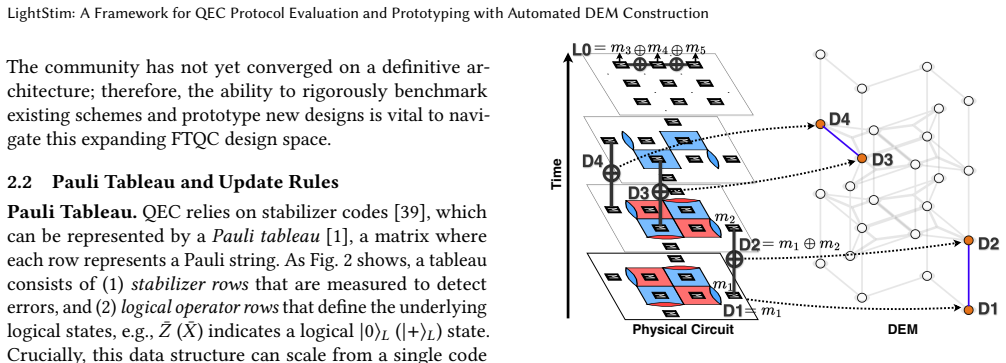
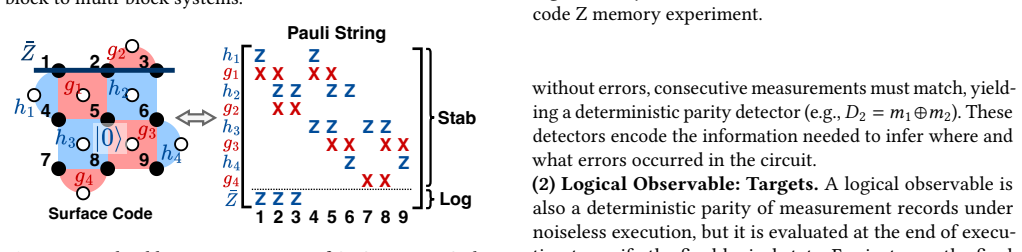
LightStim automates Detector Error Model construction for quantum error correction protocols by maintaining an augmented Pauli tableau during circuit compilation.
A machine-rendered reading of the paper's core claim, the machinery that carries it, and where it could break.
Core claim
By maintaining a Pauli tableau augmented with measurement records concurrently with circuit compilation, the framework constructs the complete set of detectors and observables required for the Detector Error Model of any quantum error correction protocol without protocol-specific input, as confirmed by exact matches in counts and logical error rates to public implementations across memory experiments, distillation circuits, and a novel heterogeneous cross-code lattice surgery design.
What carries the argument
A Pauli tableau augmented with measurement records that is updated in tandem with circuit compilation to automatically identify every detector and observable.
If this is right
- Exact detector and observable counts match those from public implementations for all tested protocols.
- Logical error rates remain consistent in simulations of memory experiments and end-to-end distillation circuits.
- New protocol designs can be prototyped and evaluated without manual DEM construction.
- A unified infrastructure supports systematic comparison across simple and complex quantum error correction schemes.
Where Pith is reading between the lines
- Researchers could test a much larger space of custom error correction schemes without the overhead of hand-crafted annotations.
- The approach may allow direct incorporation of device-specific noise models to produce more realistic performance predictions.
- Systematic sweeps over many protocol variants become practical, potentially revealing hybrid designs that outperform current standards.
Load-bearing premise
That the information captured in the augmented Pauli tableau during compilation is sufficient to identify every detector and observable for arbitrary quantum error correction protocols.
What would settle it
An independently verified manual Detector Error Model for any protocol that produces a different detector count or a different logical error rate when simulated with the framework's output.
Figures



read the original abstract
Fault-tolerant quantum computing increasingly demands rigorous, circuit-level evaluation of diverse quantum error correction (QEC) protocols and efficient prototyping of new ones. Such evaluation requires both the physical circuit and its Detector Error Model (DEM) to estimate end-to-end logical error rates. However, DEM construction today is performed by manual annotation, a tedious and error-prone process that effectively limits evaluation to simple memory experiments. We present LightStim, a framework that automates DEM construction concurrently with circuit compilation by maintaining a Pauli tableau augmented with measurement records, with no protocol-specific input required. We benchmark LightStim across protocols from memory experiments to end-to-end distillation circuits; cross-validation against public implementations confirms exact detector and observable counts and consistent logical error rates. Additionally, we demonstrate a novel heterogeneous cross-code lattice surgery design between surface and punctured quantum Reed-Muller codes. These capabilities together make LightStim a unified infrastructure for systematic QEC protocol evaluation and exploration. LightStim is open-sourced at https://github.com/QuTone/LightStim.
Editorial analysis
A structured set of objections, weighed in public.
Referee Report
Summary. The manuscript presents LightStim, a framework that automates construction of Detector Error Models (DEMs) for quantum error correction protocols concurrently with circuit compilation. It maintains a Pauli tableau augmented with measurement records and requires no protocol-specific annotations or manual inputs. The approach is benchmarked on protocols ranging from memory experiments to distillation circuits, with cross-validation against public implementations confirming exact detector and observable counts plus consistent logical error rates. It is further used to prototype a novel heterogeneous cross-code lattice surgery between surface and punctured quantum Reed-Muller codes.
Significance. If the tableau-based construction fully captures all relevant error propagations without omissions, LightStim would substantially lower the barrier to rigorous circuit-level QEC evaluation and enable systematic exploration of complex protocols. The cross-validation on multiple protocols and the concrete demonstration of a new heterogeneous design provide reproducible evidence of utility for the tested cases and constitute a clear strength.
major comments (2)
- [Method section on Pauli tableau] Method section describing the Pauli tableau augmentation with measurement records: the central claim that this procedure yields a complete DEM for arbitrary QEC protocols (including those with mid-circuit measurements, resets, and feed-forward) rests on the assumption that all error propagations are tracked by the tableau updates. No explicit handling is shown for conditional branches or measurement-outcome-dependent logical observables, which could silently omit detectors even when counts match on the reported benchmarks.
- [Validation and cross-code lattice surgery section] Validation and cross-code lattice surgery section: while exact detector/observable counts and consistent logical error rates are reported against public implementations, the manuscript does not detail how the heterogeneous cross-code operations (surface to punctured Reed-Muller) propagate errors across code boundaries or whether additional measurement records are implicitly required. This is load-bearing for the claim of no protocol-specific input.
minor comments (2)
- [Figures and tables] Figure captions and table legends should explicitly state the error model parameters and number of shots used for the logical error rate comparisons to allow direct reproduction.
- [Abstract] The abstract states 'no protocol-specific input required' but the text should clarify whether this includes the absence of any hidden annotations for resets or classical feed-forward in the circuit description language.
Simulated Author's Rebuttal
We thank the referee for their thorough review and constructive feedback on our manuscript. We address each of the major comments below and will incorporate revisions to enhance the clarity and completeness of the presentation.
read point-by-point responses
-
Referee: [Method section on Pauli tableau] Method section describing the Pauli tableau augmentation with measurement records: the central claim that this procedure yields a complete DEM for arbitrary QEC protocols (including those with mid-circuit measurements, resets, and feed-forward) rests on the assumption that all error propagations are tracked by the tableau updates. No explicit handling is shown for conditional branches or measurement-outcome-dependent logical observables, which could silently omit detectors even when counts match on the reported benchmarks.
Authors: We thank the referee for highlighting this important aspect. The augmented Pauli tableau in LightStim is constructed to track error propagations through all operations, including mid-circuit measurements, resets, and feed-forward, by maintaining measurement records that capture outcome dependencies. However, we agree that the manuscript would benefit from more explicit description. In the revised version, we will add a new subsection in the Methods section explaining the handling of conditional branches and outcome-dependent observables. This will include pseudocode or a small example demonstrating that all relevant detectors are captured without omissions. We believe this will address the concern while maintaining the no-protocol-specific-input design. revision: yes
-
Referee: [Validation and cross-code lattice surgery section] Validation and cross-code lattice surgery section: while exact detector/observable counts and consistent logical error rates are reported against public implementations, the manuscript does not detail how the heterogeneous cross-code operations (surface to punctured Reed-Muller) propagate errors across code boundaries or whether additional measurement records are implicitly required. This is load-bearing for the claim of no protocol-specific input.
Authors: We appreciate the referee pointing out the need for greater detail in the cross-code lattice surgery demonstration. The LightStim framework handles cross-code operations by extending the measurement records across the boundary without requiring manual annotations, as the tableau augmentation is uniform. To strengthen this, we will revise the relevant section to provide a detailed breakdown of error propagation in the heterogeneous surgery, specifying the measurement records involved for interfacing the surface code with the punctured quantum Reed-Muller code. This will explicitly show that no additional protocol-specific inputs are needed beyond the circuit description. revision: yes
Circularity Check
No circularity: algorithmic DEM construction is a self-contained procedure validated against independent public implementations
full rationale
The paper describes LightStim as an algorithmic procedure that maintains a Pauli tableau augmented with measurement records during circuit compilation to automatically produce the DEM, requiring no protocol-specific input. This is presented as a direct implementation of standard Pauli tracking and measurement bookkeeping rather than a derivation that reduces to fitted parameters, self-definitions, or prior self-citations. Benchmarking relies on cross-validation against separate public implementations, which independently confirm detector/observable counts and logical error rates; this constitutes external evidence rather than self-referential support. No load-bearing steps invoke uniqueness theorems from the same authors, smuggle ansatzes via citation, or rename known results as new predictions. The skeptic concern about possible missed error propagations in complex protocols is a question of algorithmic completeness and correctness, not circularity in the reported construction.
Axiom & Free-Parameter Ledger
axioms (2)
- domain assumption Pauli errors dominate and can be tracked via tableau methods in quantum circuits
- domain assumption Measurement records suffice to identify all detectors without protocol-specific rules
invented entities (1)
-
LightStim framework
no independent evidence
Forward citations
Cited by 1 Pith paper
-
Analytical and Compressed Simulation of Noisy Stabilizer Circuits
Closed-form expressions and circuit compression enable efficient strong and weak simulation of noisy stabilizer circuits with non-deterministic measurements.
discussion (0)
Sign in with ORCID, Apple, or X to comment. Anyone can read and Pith papers without signing in.